Showing posts with label Carroll. Show all posts

Saturday, November 7, 2015

Weekly Ramble: Miyazaki, Description, Computing, Carroll, Whatever [Ramble 1]

I’m considering writing a weekly post in which I ramble over what I’ve been up to in the past week and perhaps think about the week to come. That’s what I’m doing now. Maybe I’ll make it a regular activity, maybe not. We’ll see.
THE_WIND_RISES-01.44.51
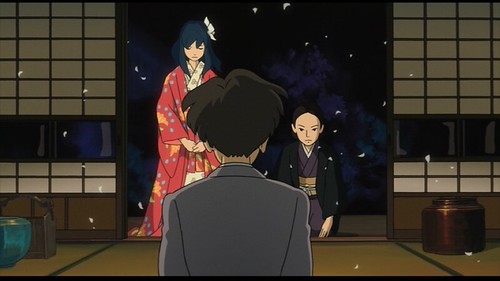
The screen shots in this post are from the marriage sequence in The Wind Rises.
Daily Routine

First, my daily routine isn’t so stable as it’s once been. On those days when I have two shots of scotch I tend to have them earlier in the day than my usual, which has been after 4 or 5 PM. These days I may have my scotch as early as 1 PM, but more likely 2 or 3 PM. But still, only two, and not every day.

What’s up with that?

I’ve always been a napper, two or three a day, morning and afternoon. These days at least once or twice a week I may sleep 45 minutes to over an hour in the early evening, which is more than a nap, but then I’ll work to 10:30, 11 or even midnight or later. That’s unusual.

THE_WIND_RISES-01.45.01

Miyazaki

This morning, for the first time in over two years, I spent time taking screen shots of a film, Miyazaki’s The Wind Rises. (Why the hiatus? Changed computers and my screen shot software no longer worked.) This is something I like doing. It’s a way of thinking about a film, of observing what goes on. I don’t see how any serious student of film can work without being able to view scenes over and over and to stop the film and take frame grabs.

Anyhow, I took two dozen shots of the opening sequence and I’ll be doing a post on it, maybe later today, maybe not ‘till tomorrow or later. Just as Walter Murch’s opening montage for Apocalypse Now prefigured the whole film and set us up for it, so Miyzaki’s sequence prefigures The Wind Rises. The end is there in the beginning. The sequence also echos Porco Rosso and Howl’s Moving Castle.

If you come to the film knowing that it’s about the aeronautical engineer who designed the (in)famous Zero of World War II, you know that the film will sooner or later arrive at that war. But why does Miyazaki prefigure it in an opening dream sequence? – for that’s what it is, though we’re well into it before we realize that it’s a dream? This, of course, is an aesthetic decision, as is the decision to end in a dream where Horikoshi’s dead wife urges him to live.

In between, the life – college, earthquake, taking a job with Mitsubishi, a trip to Germany to observe their aeronautical engineering, vacation in the mountains, falling in love, designing and testing a new plane, success, wife dies, World War II – it’s all there, interspersed with dream sequences where he chats with a childhood hero, Gianni Caproni, the Italian aeronautical engineer. What aesthetic function, what ethical function, do these dream sequences serve? Why Italy? Yes, it’s European, on the opposite side of the world from Japan. What else is bound up in that opposition?

Dream-Italy-pure flight vs. WakingWorld-Japan-War

What holds them together? Does it go like this?

Gianni Caproni  || Horikoshi's Wife

Why Jiro Hirokoshi? Yes, he’s an aeronautical engineer and Miyazaki’s family was in the airplane business. But, as a designer, and engineer, Horikoshi created things: something from nothing. That, of course, is what Miyazaki does.

THE_WIND_RISES-01.45.09

Tuesday, November 3, 2015

The Conduit Metaphor and the Intentionalist Debate in Literary Criticism

In thinking about Joseph Carroll’s literary theorizing I’ve found myself thinking about authorial intention, interpretation, and the meaning of literary texts. Carroll believes that the meaning of a literary text is determinate and it was put there by the text’s author. This is a traditional position in a long and contentious discussion that has waxed and waned since the 1950s. Various positions have been argued but the profession has not arrived at a consensus on the matter.

I think it’s a hopeless discussion myself, and I don’t know whether I want to expend much effort trying to explain why it’s hopeless. But I’ve been making notes and drafting text and thought I’d post one bit. It’s about what cognitive linguists know as the conduit metaphor, a common way of talking about communication. The metaphor is pervasive, but mistaken. My sense of intentionalism is that the participants in those discussions tacitly buy into the conduit metaphor, though some of them come very close to exposing it and then disposing of it.

I remain of the view that interpreting texts is such a loose business that appeals to authorial intention are of relatively little practical value. If you will, what they can achieve is well within the “margin of error” or “fuzz factor” for interpretation in general.

The Conduit Metaphor for Speech

In 1979 Michael Reddy published an article that had wide influence on the study of metaphor in cognitive linguistics [1]. The article is based on a small group (53) of example sentences. Here are the first three (p. 166):
1. Try to get your thoughts across better
2. None of Mary’s feelings came through to me with any clarity
3. You still haven’t given me any idea of what you mean
Reddy’s argument is that many of our statements about communication seemed to be based on the notion of sending something (the thought, idea, feeling) through a conduit, hence he calls it the conduit metaphor. He knows that communication doesn’t work that way, but that’s not his central issue. His central concern is to detail the way we use the conduit metaphor to structure our thinking about communication.

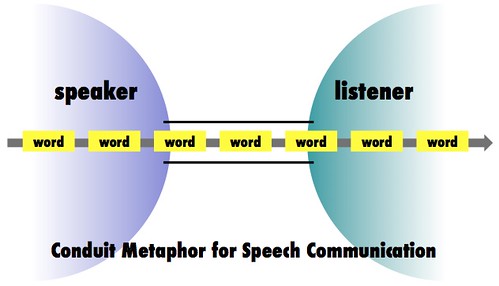
The conduit metaphor seems to presuppose a picture – cognitive linguists would call it an image schema – that looks something like this:

conduit metaphor

We have the speaker on the left and the listener on the right. Words flow through the conduit in the middle from the speaker to the listener. Of course, when these individuals switch conversational roles the words would flow through the conduit in the opposite direction.

This picture implies that meaning is somehow physically IN those words traveling through the conduit. If that were the case then, in a practical sense, there would be no such thing as speech that you cannot understand. You may not know much about quantum mechanics, for example, but if a physicist tells you something about the subject you will understand it immediately. Why? Because the meaning is physically in the words. Similarly, someone might tell you a story in Mandarin, a language you’ve never heard – no problem! The story makes perfect sense. Why? Because the meaning is right there in the sounds.

Saturday, October 31, 2015

Tinker Bell and Fairy Dust: Joseph Carroll Doesn’t Know what He Doesn’t Know

Several years ago the journal Style devoted a double issue to evolutionary criticism. It had a target article by Joseph Carroll, responses from over thirty other scholars, and then a final reply by Carroll. One of the respondents was Ellen Spolsky [1].

In her first paragraph she notes that Carroll’s article lays out an evolutionary model of human nature in only 1600 words. She wonders by what authority Carroll presents this summary – does he think of himself as an evolutionary psychologist or an outsider to the field? – and then goes on to note (p. 285):
Beyond my general ability to follow rational argument, how can I evaluate the claims made therein? The most surprising is the claim that he reports finding a “consensus” model. Am I being asked to believe that although my own academic area of literary theory is cross-hatched by contested claims, the field of evolution and evolutionary psychology is blissfully free of conflict and competition? Especially when it comes to a model (of all things!) of human nature? I am being asked to believe in Tinkerbell [sic].
Those of you who know Carroll’s work will not be surprised if I tell you can he manages a superficially plausible response. He’s a skilled rhetorician. For one thing, no, he isn’t claiming that those 1600 words are all there is. There’s more to it, but, alas, you’re going to have to do some reading in the field [2].

Yet for all the apparent plausibility of Carroll’s response, I’ve read enough of his work, and know enough psychology (from reading it as well as using it in my work over the past four decades), to believe that Spolsky’s metaphorical dismissal is apt. Carroll believes in a Tinker Bell version of the newer psychologies and his arguments use generous sprinklings of fairy dust to make them glitter and sparkle.

Cognitive Science in Its Early Phases

In reading through several of Carroll's publications I found an astonishing statement near the end of Graphing Jane Austen [3] – authored with three others. By this point the main argument has concluded and Carroll is simply differentiating his approach from other psychological approaches to literary study. After running through Freud and Jung he comes to the recent interest in cognitive science. It’s in that context that he asserts (p. 167): “In its early phases, research in cognitive science typically operated in the discursive mode of formalistic speculative philosophy, and it was much preoccupied with models of the mind derived from analogies with computers.” If that statement were accurate if would score heavily for literary Darwinism. But it isn’t accurate. Rather, it is extravagantly – dare I say, defensively? – inaccurate.

It’s a bit like saying: “Little is known about Shakespeare. Consequently identifying the man behind the name has been a major project for Shakespeare scholars.” The first statement is true. And, while it is also true that people have worried about whether or not someone other than the man from Avon wrote plays under Shakespeare’s name, this is almost entirely the work of amateurs; it is not a focus of Shakespeare studies.

Another comparison: “For several centuries prior to Darwin biologists took notes, drew pictures, and collected specimens.” That’s true, though they weren’t called biologists then. And the statement completely misses classification and thus gives no sense of the systematic nature of the work. Nor does it indicate that description and taxonomy are major aspects of the foundation on which Darwin built his theory of evolution. Without it he’d have had no way to do the necessary comparative work.

Getting back to Carroll, yes in “its early phases” cognitive science was interested in computational models of mind. But characterizing that work as “formalistic speculative philosophy” is ludicrous, so ludicrous I can’t imagine how that statement got into print. Any time within the last decade a college sophomore could have gotten a more accurate picture in only five or ten minutes online. Carroll is not a sophomore. He’s a senior scholar with two-decades invested in the study of a psychological movement – evolutionary psychology – with substantial roots in cognitive science, including the early phases. How could he be so wrong about that?

By any reasonable account cognitive science in its early phases extends back into the 1950s and 60s. These thinkers, among others, became active and prominent in the 1950s [4]:
Noam Chomsky: The publication of Syntactic Structures in 1957 brought new interest to linguistics and stimulated psychologists to test his syntactic theories by experimental research.

Herbert Simon eventually won a Nobel Prize in economics but he is best known for his wide-ranging work in artificial intelligence, much of it in conjunction with his colleague

Allen Newell. In 1975 the Association for Computing Machinery awarded the Turing Award to Newel and Simon for that work.

Marvin Minsky has spent his career at MIT and is one of the best-known researchers in artificial intelligence and neural networks.

John McCarthy was a Stanford mathematician who organized the first international conference on artificial intelligence in 1956 and later invented the LISP programming language, which became the language of choice for work in artificial intelligence.

George A. Miller first became known for the use of information theory in studying language. His 1956 paper, “The magical number seven, plus or minus two”, is one of the best known in modern psychology. In 1960 he published Plans and the Structure of Behavior, in conjunction with another psychologist, Eugene Galanter, and a neuroscientist, Karl Pribram. I’ll return to this book in a minute.
These men were not doing speculative philosophy. There’s no quick and easy way to characterize what they were doing, but “cognitive science” is a good phrase, coined in 1973 by Christopher Longuet-Higgins [5], who was originally trained as a chemist. Just when did cognitive science pass out of its “early phases”? Who knows? And for the purpose of this post it doesn’t make any difference. That list alone makes it clear that Carroll’s characterization of those early phases is wrong.

Thursday, October 29, 2015

Authorial Intention in Literary Study, an Informal Note

Why have literary critics been so concerned about authorial intention? I say “have been” because these discussions were most vigorous back in the 1960s and 1970s, but now are not so important – though the issue is central to Joseph Carroll, the Darwinian critic.

One might think it was about how one reasons to an interpretation of a work. That’s certainly how it seemed back in the 60s and 70s. But I don’t believe that any more. For one thing, there are a few important cases where an appeal to the author has little traction. How do you appeal to the author of Iliad or Odyssey? We don’t know who Homer was, if indeed he was a single individual. While we do know who Shakespeare was – I give no credence to the arguments that Shakespeare was someone else – we know so little about him that an appeal to Shakespearean plausibility is little more than an appeal to the Elizabethan world view. And then in one peculiar and particular case where we know a great deal about the author – I’m thinking about Coleridge and “Kubla Khan” – critics feel free to ignore or reason away the one thing he told us about the text, that it is incomplete.

As a practical matter, whatever else we might know about a given author, whatever materials we might have – drafts, correspondence, essays, whatever ¬– the text itself is going to be out best source of evidence. The really tricky problems that arise with interpreting a literary texts – I’m thinking here of de Man’s essay, “Form and in Intent in the American New Criticism” – also exist in dealing with any form of secondary material, whether by the author or others. Something else is going on.

Wednesday, October 28, 2015

Me, Joseph Carroll, and the Search for Precision in Literary Criticism

I’ve been thinking a lot about Joseph Carroll recently and have been drafting material for posts that I may or may not put online [1]. It’s hard, very hard. And if I post them, it’s likely to be brutal in stretches, long stretches, for we are very different thinkers.

But we do share a motivation. Here’s a passage from Graphing Jane Austen [2], a recent book he co-authored with three other scholars (pp. 61-62):
It is the author who stipulates the features of characters and situations, describes a setting, delineates a sequence of actions, and orchestrates the whole to produce a continuous sequence of recognitions and emotional responses that vary little from reader to reader. If the reader is competent, the reader registers precisely what is in the text, just as an observer; if he or she is alert, registers precisely the physical features and expressive character of some actual person.
Forget about the author. That’s a matter on which we disagree quite a bit. To a first approximation, I think they’re (methodologically) useless; he thinks they’re (theoretically) the whole ball of wax.

It’s the second sentence that interests me. One word in particular: “precisely”. He thinks there is something precise about literary texts and so do I. He thinks it’s meaning that is precise. I think that centering one’s desire for precision on meaning is hopeless, and so I abandoned that quest some time ago. I’m centering my desire for precision on form [3].

To say much more than this would require entering into a conversation that will be long and difficult. I can’t do that now. Still, the conviction that there is something very precise about literary texts and literary phenomena, that is not a trivial matter. On the contrary, it’s at the heart of how literature is central to culture and society, to human life.

* * * * *

[1] I’ve had a bit to say about Darwinian literary criticism, and have gathered those posts into a working paper: On the Poverty of Literary Darwinism (2015) 45 pp., URL: https://www.academia.edu/15853288/On_the_Poverty_of_Literary_Darwinism

[2] Joseph Carroll, Jonathan Gottschall, John Johnson, Daniel Kruger. Graphing Jane Austen: The Evolutionary Basis of Literary Meaning. New York: Palgrave Macmillan, 2012. FWIW this book is Carroll’s most significant contribution to literary criticism to date. Why? Because it is empirical, though it is by no means the first empirical study of literature. There is a long history of that. Given that it is empirical, it gives us a new kind insight into a significant body of texts. Though I’ve not taken the time to study it carefully, it seems to me that there is solid work here, work that can and should be built upon. FWIW this book is Carroll’s most significant contribution to literary criticism to date. Why? Because it is empirical, though it is by no means the first empirical study of literature. There is a long history of that. Given that it is empirical, it gives us a new kind insight into a significant body of texts. Though I’ve not taken the time to study it carefully, it seems to me that there is solid work here, work that can and should be built upon.

[3] My central, and rather long, statement on the matter: Literary Morphology: Nine Propositions in a Naturalist Theory of Form. PsyArt: An Online Journal for the Psychological Study of the Arts, August 2005, Article 060608. http://www.psyartjournal.com/article/show/l_benzon-literary_morphology_nine_propositions_in

Thursday, September 26, 2013

All Hail Our Darwinian Overlords!

This piece was originally published in The Valve, 30 May 2009. I'm republishing it now because it stands in thematic counterpoint to a major essay I'm currently slogging my way though, Computational Linguistics and Literary Studies in Search of Love (working title). As the reach of the title suggests, I'm taking stock of where literary studies is and where it might go in view of a very different discipline. Well, Joseph Carroll has his ideas on those matters as well. Color me skeptical.
Joseph Carroll has been the chief theorist and proselytizer of literary Darwinism. David DiSalvo has a long interview with him at Neuronarrative.

DiSalvo first asks what literary Darwinism is:
Literary Darwinists integrate literary concepts with a modern evolutionary understanding of the evolved and adapted characteristics of human nature. They aim not just at being one more “school” or movement in literary theory. They aim at fundamentally transforming the framework for all literary study. They think that all knowledge about human behavior, including the products of the human imagination, can and should be subsumed within the evolutionary perspective.
An ambitious program, to say the least. But let's leave it alone for a bit – I'll offer an alternative view a bit later – and allow Carroll continue. He talks broadly about reductionism, culture, literacy, the adaptive value of literature, an empirical study of characters in canonical 19th C. British novels, the brain, human emergence and interaction between scientists and humanists.

The conversation then returns to the future of literary studies. Here's the downside scenario:
Literary study could continue to insist on disconnecting itself from empirically discernible facts about human nature and human cognition, or it could realize that science is not a threat and a competitor but an ally in the quest for human understanding. If it takes the former course, I think it will continue to decline catastrophically in prestige, enrollments, and funding. Its practitioners will either continue to invent arcane verbal systems designed for the superficial reprocessing of canonical literary texts, or they will resign themselves to the ever more tenuous elaboration of the sophistical quibbles at the heart of postmodern literary theory.
Unless the humanities in general come to grips with the last three or four decades of work in psychology, biology, and neurosciences, and so forth, Carroll believes "they are doomed to irrelevance and triviality."

If, however, the humanities, and literary studies in particular, undertakes to assimilate this work, here's the possible upside:
Let’s assume for the sake of argument that literary study manages to get past its own blockages. What then? All the world is before them: large-scale explanatory principles to hash out, a whole taxonomy to found on underlying principles of human nature, whole cultural epochs to analyze from a bio-cultural perspective, multitudes of texts to locate, with all their specific meaning structures and imaginative forms, in these yet-to-be-established bio-cultural contexts. We have before us the macro-world of human evolutionary history and the micro-world of the brain, cultural history to incorporate with human universals; neuroimaging and neurochemical analysis to integrate with tonal and stylistic analysis.

The kind of work I’m describing here would not merely offer new lenses through which to view existing knowledge. It would provide a starting point for a continuous, progressive program in creating new knowledge. Literary Darwinists have to assimilate the best insights of previous theory and criticism, but they have to reformulate those insights within a completely new framework located within the larger, total field of the human sciences. They cannot merely take concepts ready-made from existing evolutionary theories of culture. They have to absorb evolutionary theories, examine them critically, push back when the theories are inadequate to the realities of literary experience, and formulate new fundamental concepts in literary study-formal, generic, and historical. They have to participate in fashioning the linkages between their own specific fields of endeavor and the broader field of the evolutionary human sciences. They have to make the world anew.
We've got two decades to prepare ourselves for the new dispensation:
Five years ago, literary Darwinism was just a mild sensation on the margins of literary study. It is now a swelling tide. In five years, ten, maybe fifteen, possibly even twenty, I think it will have fundamentally altered the framework within which literary study is conducted.
I have no objections, in principle, to a new framework. I just don't see that literary Darwinism is deep enough to be such a framework. That's a bit much to take on here and now (more griping here).

Friday, December 7, 2012

Paradise Lost: The Faith of Evolutionary Psychology

This is another re-post from The Valve, July 2009. In it I argue that the adaptive account of literature given by Joseph Carroll, and based on an idea of E.O. Wilson, has the same abstract form as a trope in Christian apologetics and so is, in effect, a religious idea in naturalist camouflage.
Recent proponents of the biocultural study of literature and the arts have devoted a fair amount of intellectual energy to explaining why literature is biologically adaptive: How does literature originally contribute to species survival? No one has been more vigorous in this effort than Joseph Carroll, perhaps the central figure in what he calls literary Darwinism. A few weeks ago Carroll posted “The Adaptive Function of Literature and the Other Arts” at the blog for On the Human, a website sponsored by the National Humanities Center, and a number of people showed up to discuss it, including several prominent Darwinians, Ellen Dissanayake, Robert Story, and Brian Boyd. I was there as well. The resulting discussion went on for 40 comments, some of them quite long.

Since then I have continued to think about Carroll’s position and have concluded that his argument is too vague to support meaningful truth claims. Beyond that, I have begun to suspect that this argument may be better understood as a pseudo-biological rationalization of Christian tropes, original sin and the expulsion from Paradise. The purpose of this post is outline that argument. First I quote Carroll’s argument; then I explain why its biology is rather thin; finally, I point out the underlying Christian tropes.

Carroll’s Hypothesis

Carroll’s hypothesis is derived from one that E. O. Wilson made in Consilience, which I have not read. In the following selection from Carroll’s blog post I have underlined some passages and inserted identifying numerals (0) to facilitate discussion:
The distinguished sociobiologist Edward O. Wilson offers a very different vision of human cognitive evolution. In Consilience: The Unity of Knowledge (1998), Wilson poses the same question posed by Pinker:
If the arts are steered by inborn rules of mental development, they are end products not just of conventional history but also of genetic evolution. The question remains: Were the genetic guides mere byproducts—epiphenomena—of that evolution, or were they adaptations that directly improved survival and reproduction? And if adaptations, what exactly were the advantages conferred? (224)
(1) Wilson’s answer to this question draws a decisive line between the mental powers of humans and other animals. Other animals are “instinct-driven” (225). Humans are not. “The most distinctive qualities of the human species are extremely high intelligence, language, culture, and reliance on long-term contracts” (224). The adaptive value of high intelligence is that it provides the means for behavioral flexibility—for generating plans based on mental representations of complex relationships, engaging in collective enterprises requiring shared mental representations, and thus producing novel solutions to adaptive problems. Behavioral flexibility has made of the human species the most successful alpha predator of all time, but achieving dominance in this way has come with a cost. (2) Wilson speaks of the “psychological exile” of the species (224-25). To the modern human mind, alone among all minds in the animal kingdom, the world does not present itself as a series of rigidly defined stimuli releasing a narrow repertory of stereotyped behaviors. It presents itself as a vast and potentially perplexing array of percepts, inferences, causal relations, contingent possibilities, analogies, contrasts, and hierarchical conceptual structures. The human mind is free to organize the elements of cognition in an infinitely diverse array of combinatorial possibilities. (3) And most of those potential forms of organization, like most major mutations, would be fatal. Freedom is the key to human success, and it is also an invitation to disaster. This is the insight that governs Wilson’s explanation for the adaptive function of the arts. “There was not enough time for human heredity to cope with the vastness of new contingent possibilities revealed by high intelligence. . . . The arts filled the gap” (1998, p. 225). (4) If instincts are defined as stereotyped programs of behavior released automatically by environmental stimuli, we can say that in humans the arts partially take the place of instinct. Along with religion, ideology, and other emotionally charged belief systems, the arts form an imaginative interface between complex mental structures, (5) genetically transmitted behavioral dispositions, and behavior.
The argument can be summarized thus: Animals are behaviorally coupled to the world through instincts (1). Humans lack instincts (1, 4) and so need the arts to establish a behavioral connection to the world. Note that Carroll says nothing about why or how humans lost instinctive behavior, though perhaps Wilson covered that in his exposition. For the moment, let’s take the argument at face value.