Showing posts with label Dumbo. Show all posts

Wednesday, June 2, 2021

The Underground Railroad [Media Notes 58] + bonus guide to posts about racial violence on New Savanna

I’ve watched the first episode, “Chapter 1: Georgia”, of The Underground Railroad on Amazon Prime. I’ll not be watching more. Let me explain. After that I’ll give you links to some relevant posts here at New Savanna.

Violence, cruelty, and murder

The first episode has two scenes of particular violence, one early, one late. In the early scene a boy and a young woman are tied to a post and are whipped. It’s late evening, so the light is poor. We’re at a distance so we don’t see faces. We just see clothed bodies slumped down while tied.

The late scene is much worse. It’s daylight. And...come to think of it, I’m not going to describe what happened. It’s not necessary. You can imagine easily enough. An escaped slave has been captured and he is tortured and killed on the lawn of the planation while the good white folks watch, chatter, and even dance. The owner gives a disquisition on how such discipline is necessary to give guidance to these sub-humans (something like that).

What’s really important, however, is the way these scene is presented to us. Before we get to it we’re out in the cotton fields. The overseer (named, as I recall, Prideful) tells the workers to drop their bags in the field where they are and come with him. He leads them to the plantation lawn and lines them up so they can see the scene I just described to you. They see it; we see them seeing it; and then we see it. While the murder/torture takes place the camera moves back and forth between torture/murder and the slaves watching.

I don’t know whether the other nine episodes have more of this. If so, I don’t want to see it. Even if not, though surely there will be more terrible violence. I’m not interested.

I’m familiar with relevant history. I’ve seen that well-known photo of the man whose back is a mass of scar tissue. I’ve read accounts, particularly of lynchings. I’ve blogged about them – see below. I’ve seen photos of lynchings, many in the form of postcards. This kind of material is not new to me.

What I suspect and fear is that scene is a metaphor for the whole series. African Americans and Woke Whites are cast in the role of those slaves, watching, while the series itself does duty as that scene of torture/murder. If you’re an African American and so minded, you get to feel justified in a sense of grievance and victimization. If you’re white and woke, why, you can score a month, maybe two, of Sundays worth of penance by watching the whole series.

No thank you.

* * * * *

Some posts to read:

Blacks, Blues, and Soul Sickness: Lynching and Racism in the USofA

This post begins by describing the lynching of Henry Smith in 1893 in Paris, Texas. There was enough advance notice that the railroads ran special excursion trains to bring people to the event. An estimated 10,000 men, women, and children gathered to witness Smith’s torture and killing.

Later on I reference John Dollard’s 1937 study, Caste and Class in a Southern Town, which “redirected the study of southern race relations in general and lynching in particular” by asking a simple question: Why do people need racism? As Dollard observed, social life is often frustrating, generating aggressive impulses which cannot be always be satisfied. In Dollard’s view this leads to

a generalized or “free-floating” aggression . . . [that] can be thought of as a tendency to kick, hit, scorn or derogate someone or something if one could only find out what. A second necessity is that of a permissive social pattern. This must exist in order to lift the in-group taboos on hostility. The permissive pattern isolates a group within the society which may be disliked. Usually it is a defenseless group. . . The third essential in race prejudice is that the object must be uniformly identifiable. [pp. 445-446]

In other words, white racists are using blacks as scapegoats for the accumulated frustrations they experience in daily life. Aggressive impulses are being displaced from their real objects, which are appropriate targets, to substitute objects, toward whom one can act aggressively. 

I conclude by citing a study showing that one “could predict the number of Southern lynchings occurring during any given year between 1882 and 1930 simply by knowing the price of cotton. When cotton went down, the frequency of lynchings went up.”

Lynching in America: Not Just Sneakin' Around at Night

From the post:

In a detailed study of lynchings occurring between 1880 and 1930 (Lynching in the New South, 1993) in Georgia, representing the deep South, and Virginia, representing the borderline South, W. Fitzhugh Brundage shows that lynchings were committed by several types of group, the terrorist mob, the private mob, the posse, and the mass mob. Terrorist mobs were relatively small, generally less than fifty people, and consisted of members of groups organized to maintain white supremacy through intimidation and violence; the Ku Klux Klan is the best-known of these groups. Private mobs were also relatively small, but were convened only to avenge or punish specific alleged offenses, and then dispersed. Posses were quasi-legal bodies constituted to capture criminals. However, they frequently overstepped their charge and lynched the criminal.

Mass mobs, such as the one that executed Henry Smith, were responsible for the largest number of lynchings, 34% in Georgia and 40% in Virginia. These were also the most spectacular lynchings and involved hundreds or even thousands of people from all strata of Southern society, from top to bottom. These were the most highly ritualized lynchings, a matter emphasized by both Brundage and Williamson, who talk as though these mobs did their work according to written standards and practices.

The final two paragraphs:

However savage the violence in a mass mob lynching, the ritualized nature of that violence means that the lynchings were not simply wild outpourings of anger and hatred. Rather, they represent culturally sanctioned and rehearsed expressions of attitudes. This ritualized violence is one way that people were able to affirm their communal life.

Many lynchings were occasioned, if not by rape, then by allegations of rape, but not the majority of lynchings. According to Brundage, murder was the offense alleged in 46 % of Georgia lynchings and 44% of Virginia lynchings while sexual offenses were alleged in 28% of Georgia lynchings and 46% of Virginia lynchings. The remaining lynchings, 25% in Georgia and 10% in Virginia, were for a variety of offenses, such as theft, arson, or insulting a white person in any of the numerous ways whites perceived insults from blacks. In contradiction of these facts, the general perception of lynchings in the South was that they were occasioned by rape. Sex is what was on people’s minds.

Empaths & Gangstas: On the psycho-sociology of race in America [Media notes, Star Trek S3 E12]

In this post I use a Star Trek episode, “The Empath,” as an analogy to the psycho-social role African America has played in the socio-psychodynamics of the nation as a whole. African Americans are cast – they surely didn’t not volunteer for the part – in the role of the empath in this episode. The key passage (the rest is a direct quotation from the post): Let me suggest that this process of absorption and dissipation is an instance of something I think of as the empath dynamic, so-called after that Star Trek episode:

From the Wikipedia:

On stardate 5121.5, the starship USS Enterprise arrives at Minara II to pick up research personnel. The mission is crucial since the Minaran star is close to going supernova. Captain Kirk, Dr. McCoy, and Mr. Spock beam to the planet to locate the research team while the Enterprise waits in orbit. The landing team finds the research camp abandoned and the scientists missing.

Meanwhile in orbit, the Enterprise is bombarded by intense solar radiation which is causing instrumentation failure, and threatening the lives of the crew. Mr. Scott orders the ship to break orbit while the landing party continues the search for the missing scientists on the planet.

As the search continues, the landing party finds themselves teleported to an underground chamber, and there they find a young woman lying on a raised platform. The woman awakens but she appears to be mute and all attempts to verbally communicate with her are in vain. Dr. McCoy names the mystery woman "Gem".

Soon, two silver-robed aliens appear, and identify themselves as Vians. Kirk approaches the beings but they repel the team with a force field. Kirk is injured and knocked to the floor. The silent Gem then rushes to Kirk's side and uses a mental power to absorb Kirk's injuries, taking them on herself and then dissipating them, healing him instantly and revealing that she is a powerful empath.

The various processes by which the African American community receives a hit of anxiety/aggression from the European American community without returning anxiety/aggression in equal measure are the processes which allow the empath mechanism to work. Many of these processes are self-destructive – the most obvious are crime and substance abuse (as a parallel, think about the British getting the Chinese addicted to opium).

Animals in Cartoons: Tripping the Elephants Electric

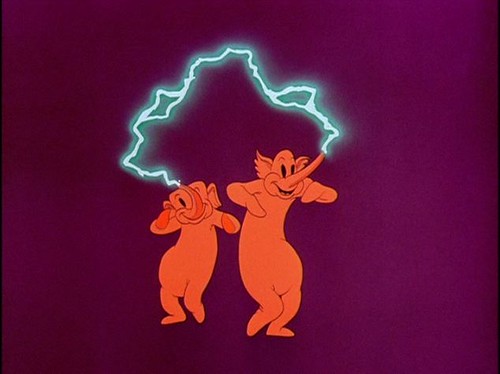
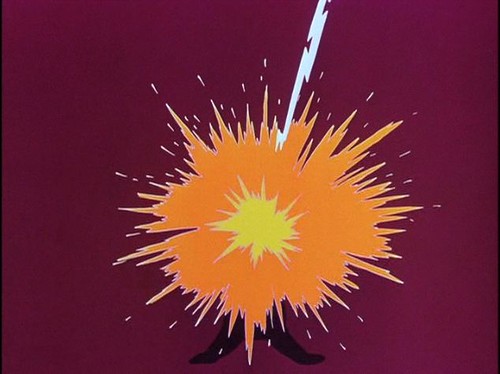
This is about the “electric” elephants in the “Pink Elephants on Parade” sequence in Disney’s Dumbo. I have two addenda about the execution of elephants in early 20th century America. The first is about the public electrocution of an elephant on Coney Island. Could the electrical charges in those elephants in the 1941 Disney film be a cultural echo of that very public execution? The second addendum links to an account of an elephant that was publicly hanged in Tennessee in 1916. Folklore had it that “two Negro keepers” were hanged along with the elephant.
Monday, June 25, 2018

Electric Elephants @3QD, Disney’s Dumbo

Dumbo LECTRIC 11

Disney’s been doing live-action remakes of many of its animated features. It released its second remake of The Jungle Book in 2016 and will be releasing a remake of Dumbo next year.


I’ve put up a post at 3 Quarks Daily where I examine the symbolic penumbra elephants have taken on in that film: Disney’s Dumbo, Tripping The Elephants Electric.

Dumbo LECTRIC 21 ZAP

You might be interesting in my working paper, Walt Disney’s Dumbo, a Myth of Modernity.

Sunday, May 27, 2018

Secrets of Pink Elephants Revealed

This is the second most-popular post on the blog. That, I assume, is because it's about an amazing and enigmatic bit of animation. Some day I'll return to it and take a deeper look. For now, I'm reposting it at the top of the blog. Enjoy.
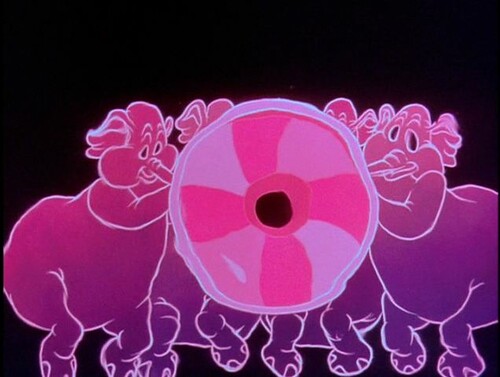
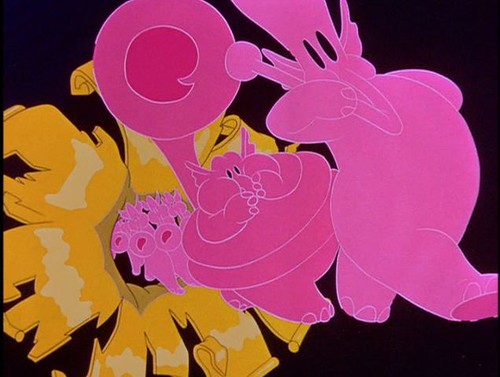
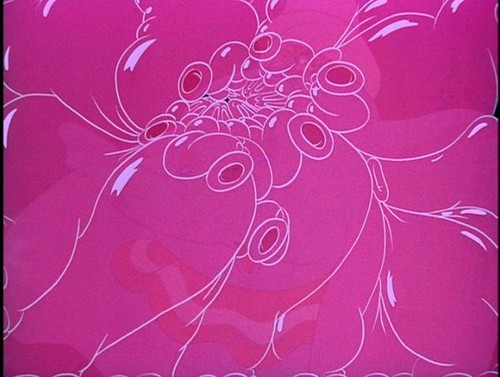
“Pink Elephants on Parade,” from Walt Disney’s Dumbo, is one of the best known, and strangest, animated sequences that Disney, or any studio, has ever done (see clip below). It’s strange on two counts. In the first place, it doesn’t seem to advance the Dumbo story in any way. As the sequence begins Dumbo and Timothy Mouse are pleasantly drunk; when it ends they’re sleeping high in a tree. The sequence tells us nothing about how they got from one state to the other, nor does it tell us anything that’s otherwise going on in the movie. The movie is about elephants, the sequence is about elephants, pink ones; and that elephant connection seems to be all that links the sequence to the larger plot.

Putting that aside, is there any order within the sequence itself or is it just a collection of strange gags? This is the question that interests me. And my answer is that, yes, there is some order there. There is a progression.

1. Elephants from Elephants

Let’s start at the beginning. Dumbo and Timothy have drunk water that was accidentally laced with booze. They get drunk and Dumbo starts blowing rather surprising bubbles through his trunk. Timothy asks him to blow a large bubble, which he does. That bubble assumes elephant form, turns pink, and proceeds to blow a second pink elephant from its trunk. The second blows a third, and now we see four pink elephants. Their trunks become trumpet-like, playing a fanfare which we hear on the sound-track. They merge their trunks

pink elephants 3 four in one

and the merged bell expands, bursts, and becomes a portal for a parade of marching elephants.

pink elephants 4 parade from one

Each elephant in the parade is playing a musical instrument, which is a deformed part of its body.

There are three things to note so far. 1) The parade of elephants has now become effectively detached from Dumbo. He blew the first bubble, but it became an elephant on its own. The rest followed from that. 2) The purely instrumental music we’re hearing is, in effect, being created by the elephants themselves. 3) At various points in this opening segment we see reactions from both Dumbo and Timothy; they’re on-screen characters.

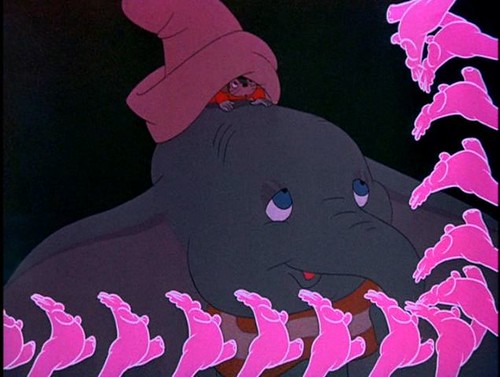
We get a series of gags emphasizing that the elephants are making the music, and then we see a parade of small elephants march around (notice Dumbo and Timothy watching them):

pink elephants 8 round it

There is no structure in the film-space itself on which those elephants are marching. They’re walking on the border of the frame. This is the sort of self-conscious gag that’s as old as animation itself – such trickery was fundamental to Winsor McCay’s work, but also to Disney’s Alice shorts. Those elephants will parade around the entire perimeter of the frame and then they’ll start expanding until they burst.

pink elephants 9 filled


2. An Elephant State of Mind

With that we move to new phase. We no longer see Dumbo or Timothy on screen; they’re out for the rest of the sequence. The elephants are no longer depicted as being the source of the music. They’re just elephants. And the music gets a vocal that comments on the rather creepy things happening on screen.

Saturday, March 7, 2015

"Seeing the elephant"

Ringling Brothers has decided to retire their elephant acts, ending a 200 year long tradition in American entertainment. Traditionally, elephants have been creatures of wonder, writes Janet M. Davis in the NYTimes:
Audiences spoke solemnly of “seeing the elephant” as an awe-inspiring encounter with a wondrous being. Others, who missed her appearances, pined for an opportunity to “see the elephant.” Soldiers during the Mexican-American War and Civil War even spoke of “seeing the elephant” as a metaphor for the incomprehensible experience of battle.

The sensational popularity of the Crowninshield Elephant led the way for others. The first elephant appeared in an American circus at the turn of the 19th century, and by the 1870s, impresarios defined their shows’ worth by the number of elephants they had. In response to decades of evangelical censure for displaying scantily clad human performers, circus owners pointed to their popular elephants as proof of their broader mission to educate and entertain.
See my many posts on Disney's Dumbo.

Monday, November 11, 2013

Freud Does Disney

Pastoral spiral3

I've now created a working paper out of two long posts offering psychoanalytic insights into Fantasia and Dumbo. The SSRN link is here. Abstract and introduction are below.
Abstract: Dumbo tells a coming of age story about a young elephant who must gain psychological independence from his mother; Fantasia consists of eight episodes on various subjects, but they are strung together with the image of the conductor, Leopold Stokowski, and his (famous) hands. Two of the episodes (Nutcracker Suite and Night on Bald Mountain) dramatize the use of hands in controlling the actions of others. I elaborate on these issues using the psychoanalytic work of Erik Erikson, Ernst Kris, John Bowlby, and Norman Holland and introduce material on the neuropsychology of motor control.
Unity of Being in Disney?

I wrote the two essays in this working paper while heading toward a post on “Unity of Being in Fantasia and Dumbo.” But I’ve not gotten there yet, not do I intend to jam that paper into these introductory remarks. But I’ll WILL try to explain why I wanted to write that paper and why I had to write these two pieces on the way there.

The phrase is obviously philosophical, and I am using it as such, but I have no particular doctrine attached to it. The Wikipedia tells me it is of Sufi originWahdat al-Wujud – but I claim no specific Sufi influence beyond having read, and taken seriously, a bunch of Idries Shah’s Nasrudin stories back in the 1960s and 1970s. I have adopted the phrase because I find its connotations and implications useful. If my use in fact is consistent with Sufi tradition, give credit there. If my use differs considerably, I mean no disrespect.

I adopted the term while I was working out a philosophical scheme inspired by Bruno Latour, Paul Feyerabend, and Graham Harman, among others. I needed a way to distinguish between two kinds of literary criticism. The kind I’m most interested in for myself I’ve come to call naturalist criticism. The aim of naturalist criticism is objective knowledge of literature, and film as well, and of any other aesthetic object.

What do I call the other kind of criticism and what’s it about? Well, Rohan Maitzen, a colleague of mine from The Valve, brought Wayne Booth’s The Company We Keep: An Ethics of Fiction to my attention and he gave me a term for the other kind of criticism, ethical criticism. Unity of being is what ethical criticism is about. If beauty is what art is about, then the aim of works of art is to bring about unity of being in people who apprehend those works.

Wednesday, September 4, 2013

Elephant Regression: On the Couch with Dumbo

DUMBO white goo

That post-in-progress on Unity of Being in Fantasia and Dumbo? the one that prompted me to mount an informal defense of psychoanalytic thought? – you guessed it, it’s still kicking me in the ass. So I’m going to do a Tristram Shandy and progress by digressing. I’m going to address one of the issues I posed in the antepenultimate paragraph of that post:
When Dumbo is kicked from the burning tower in his second appearance in the circus, he lands in a tub filled with white liquid, not water, but a white liquid. Is that supposed to suggest milk? If so, why?
And, just so you know that I’m going somewhere, I’m going to go from that puzzle to what is, after all, the single biggest puzzle in this film: Why a parade of pink elephants?

Before tackling either of those, however, I want to pose a question: What’s the problem? Why think about them – the tub filled with milk, the pink elephants – at all? The obvious answer is: Because they don’t make any sense.

Caveat: this is a long one. You might want to pull up a stool, rest your feet, and get a plate of chips or veggie pieces. This is going to take awhile.

Deliberate Nonsense

Take the pink elephants sequence. It is the best-known sequence in the film. It takes up four and a half minutes of screen time at the beginning of the film’s last quarter, but it doesn’t advance the plot in any direct and obvious way. It tells us nothing about Dumbo, his mother, or the circus. Nothing.

Of course, Dumbo’s physical situation at the end of that sequence is very different from his physical situation at the beginning of that sequence. When the sequence began he was in the middle of the circus grounds getting drunk. When the sequence ends he’s up in a tree out in the country somewhere, with the circus nowhere in sight. And that presents a physical problem that is also dramatic: how is he ever going to get back to the circus? But it’s difficult to see what the sequence itself has to do with however Dumbo got up in that tree. They could have put just about any old thing in there to "cover over" Dumbo's drunken flight.

The sequence looks like it’s just a placeholder. And yet that can’t possibly be so. Animation is a very expensive way to make films. Walt’s bean-counting brother, Roy, wouldn’t have let him waste four-and-a-half minutes of animation resources on a mere placeholder.

No, that sequence is in the film because it is dramatically necessary – something I argue in American Mythology in Disney’s Dumbo.

By this time Walt Disney had been in the animation business for over a decade and a half and had enjoyed over a decade of tremendous success. His story-men, animators, in-betweeners, background artists, inkers, painters, and cameramen were the best in the business. These people knew what they were doing, though their deepest knowledge was, no doubt, more intuitive than explicit. If they put the pink elephants sequence in the film, they did so because it HAD to be there.

For what it’s worth, I’ve come to adopt a rule of thumb that goes something like this:
When competent and experienced artists do something that doesn’t make any sense, pay attention. Precisely because they’re competent and experienced artists they know that whatever-it-is doesn’t make any sense but they do it anyway because that bit of nonsense somehow solves a problem that must be solved.
And so it is, in a more modest way, with that white liquid Dumbo dives into. What Dumbo is doing is a familiar gag in cartoons. A character in a circus is high up on a pole and dives, or is pushed, into a small tub of, we presume, water, and does so without injury. It’s always water that the character dives into, at least we assume it’s water. Why? Because it’s transparent, like water. And water is common and ubiquitous, frequently in tubs, and so forth and so on. Water is our default assumption in such cases.

Thus, when Dumbo goes through the net and the liquid flies out as he enters it, the white color comes as a surprise. And the camera holds and zooms in on Dumbo for about ten seconds, forcing that whiteness upon us. We have no choice but to notice it and wonder about it. At the end of that shot there’s a quick cut and we’re watching and listening to the clowns congratulate themselves after that smashing performance. THEY wow’ed ‘em, and poor Dumbo was their foil. We’re into the next sequence in the film.

Before looking at the film in some detail, however, I’d like to build some conceptual equipment.

Thursday, June 6, 2013

Animals R Us & We R Them

"...there are more captive tigers living in the state of Texas alone than wild specimens running free anywhere else on the planet."


Social Science Information has a special issue, June 2013; 52 (2), on the shared lives of humans and animals. Here's the full abstract of one of the articles:
In the (bleary) eye of the tiger: An anthropological journey into jungle backyards 
David Jaclin 
Université de Montréal and Muséum National d’Histoire Naturelle, Paris
David Jaclin, Department of Communication, University of Montreal, CP 6128, succursale Centre-ville, Montreal, QC H3C 3J7, Canada. Email: davidjaclin@gmail.com 
Abstract: North America shelters a growing population of so-called ‘exotic animals’. If the phenomenon is not recent, it now fuels a considerable black market. Jungle backyards compose a non-negligible (yet often neglected) part of some modern ecological landscapes. This article explores problematical situations emerging from these shared humanimal lives. It presents the first results of a multi-species ethnography and examines the prevalence of what I call beastness – an antique commerce amid humans and animals that reveals not only utilitarian purposes, but also relational entanglements. Such a commerce feeds a sizeable economy and exerts major selective pressures (both biological and cultural) on organisms and their environment. For instance, there are more captive tigers living in the state of Texas alone than wild specimens running free anywhere else on the planet. From a strictly statistical point of view, the average tiger is no longer the tiger we imagine. Not wild anymore but neither quite domesticated, some animals – pioneers, in a sense – shuffle traditional taxonomical and ontological conceptions. Through biographical material, I reflect on adaptive responses as well as on zoological potentialities developed by this always-evolving bestiary. Providing serious case studies to further debates dealing with bio–eco–conservation, I discuss the influence of informational and communicational processes crystallized by some of our contemporary crossed becomings.
* * * * *

This general topic is relevant to a number of posts I've done on animation, including many of my Dumbo posts. More specifically:


Saturday, April 20, 2013

Gene Siskel on Dumbo

From his Playboy interview in tandem with Roger Ebert:
The movie with the strongest emotional pull of my youth—and it has to do with my psychological history—was Dumbo. The separation from the mother was terrifying to me. And also Dumbo’s flying. It was like my whole ego was riding right on his trunk when he had to fly and believe in that mouse. I felt that I had big ears and I think most people feel that they have big ears stashed somewhere in their life.
BTW, the whole interview is worth a quick read.


Monday, April 8, 2013

Animated Acting: Sporn on Tytla

Vladimir Tytla was one of the great Disney animators. He was just before the era of the so-called "nine old men," but is arguably better than any of them. Michael Sporn has a post where he examines two scenes Tytla did, one in Dumbo and the other in Night of Bald Mountain (from Fantasia), with frame grabs and drawings. In general Sporn observes:
animation, there was animation technique and styles. These rarely had anything to do with acting. However, there were a number of animators at the Disney studio who wanted to put the focus on their acting and actually studied Stanislavsky and Boleslavsky so that their characters would give a great performance. Tytla was certainly a leader among the animators to do this.
Of the Dumbo performance, which Sporn believes to be one of the greatest ever, he says: "Dumbo was gentle, all truth. The honest performance meant keeping everything  above board and on the table. That is undoubtedly the performance Tytla drew."

And of the devil in Night on Bald Mountain:
The devil’s motion throughout this piece is very slow, tightly drawn images of the devil lyrically moving through the musical phases. It’s pure dance. Any distortion is done via the tight editing that Tytla has constructed. Very close images of the hands with the flame shaped dancers moving about in tight close up as Chernobog’s large face with searing eyes closely watching the fallen creatures dancing in his hands. It’s distortion enough. 
Tytla has constructed the most romantic sequence imaginable, and the emotion of the dance acts as the climax for all of Fantasia, and it succeeds in spades. All hoisted by the animation, itself. No loud crushing peak, just a dance done in a tightly choreographed number completely controlled by Tytla. It’s the ultimate tour de force of animation, and we’ll never see the likes of it again.
My own verdict on this scene: "There’s a heft and grandeur in Chernobog that is worthy of Milton’s Satan in Paradise Lost. Without Tytla’s powerful acting, his powerful realization of Chernobog, Night on Bald Mountain would only be a magnificent swirling freak show. Tytla gave it the weight of Greek tragedy."

Read Sporn's post and examine the frame grabs and the drawings. Then look back through the other three posts in this series.

Friday, October 19, 2012

Five Animated Features: A Book?

Edited from a note to Tim Perper.

Once I'd finished my Dumbo project I decided that “Hey, I've got a book here, Fantasia and Dumbo.” The book wouldn't be a general market coffee table book, of course, but a serious analytic study of those two films for a sophisticated (and heavily academic) audience. I've already got THAT one well-mapped out so I know more or less where this thing would be going.

But I'm considering extending my coverage beyond those two films to include several others:
Porco Rosso
Ghost in the Shell 2: Innocence
Ratatouille
That gives me five feature-length films. I'd want to devote considerable time to each film, so I'd have to cut back on the Disney material. Which is OK, because I've got all this stuff online for anyone who's interested. The addition of the three other films broadens the scope of the book, which should broaden its appeal.

And it also helps one of my methodological points, which is comparative analysis. As you know, I'm big on description. And, as you also know, description is not at all a straight-forward business. Not at all. It's tricky stuff. Because these things we're describing are complex. Just WHAT do you describe, and why, and when do you stop?

Well, one way to focus the descriptive effort is to look at several examples—you know, “comparison and contrast” from composition 101. You focus on what's similar across your examples and what's different. Depending on what you're looking at, you've still got a tricky job, but at least this gives you some direction.

The addition of the other three films opens up the analytic/descriptive space considerably. Obviously I'm not aiming for a comprehensive study of feature-length animation. I just want to explore some things, both thematic and methodological, and, above all, make the point that: This is serious art worth careful and serious consideration.

Wednesday, October 3, 2012

Ratatouille 3: Mommy ex Machina

And another thing.

In watching Ratatouille this time around, after I’d just been through a major examination of Dumbo, I was struck by how Bird staged Ego’s reaction to the ratatouille served up at the climax of the film. He  has Ego regress to his childhood.

Why?

Well, the film itself gives us a reason for that; his beloved mother had fed him ratatouille when he was but a boy.

But why’d Bird do that? All he needed to do in order to get his happy ending was to have Ego like the dish. Why the regression?

I’m suggesting that there’s a dramatic reason for the regression, but one that doesn’t follow directly from the story. Bird wants to invoke sentimentality about idyllic childhood moments. Whether he really needs to do so is another matter. That he does so is obvious. Note that the moment is elaborately staged, an indication that Bird REALLY REALLY meant it.

Here we see Ego putting a bite into his mouth:

Ratatouille 9 in mouth

Food in mouth, got it.

Of course, food goes in the mouth. Everyone knows that. But the close-up forces us to attend to that ordinary event, to note it and think about it. And, we all know that in psychoanalytic thinking orality is associated with mother, through her breast, the infant’s source of food. And that’s where Bird is taking us—well, to mommy, though not to her breast (this is, after all, a family film)—and with spectacular visual effects.

Sunday, September 30, 2012

A Remark about Talk in Dumbo

The elephants talk among themselves as do the crows. Further, the crows talk with Dumbo and with Timothy Mouse, who also talks with Dumbo and with the other Elephants.

Timothy also talks to one human, and is the only animal to do so. But he does so in a very special situation. He talks to the ringmaster while he’s asleep. But he doesn't converse with him.

Is that a way of indentifying animals with the human “subconscious mind”—the term Timothy uses when addressing the sleeping ringmaster?

Ratatouille, a Quick Note on Man, Vermin and Food

This recent blogging about animals and animation has made me think of Pixar’s Ratatouille, which mostly takes place in a city, Paris, and sometimes in the sewers. It is not, of course, a feature from the Golden Age. Rather, it is quite recent, 2007, and in CGI. Alas, I don’t have time to give it a full treatment. This brief note will have to do for now.

Let’s start with a passage from Lois Rostow Kuznets, When Toys Come Alive: Narratives of Animation, Metamorphosis, and Development (1994). We’re late in the book, with a discussion of the relations of man and beast in Western thought (p. 140):
The gap between man and beast has not gone unquestioned. In The Happy Beast in French Thought of the Seventeenth Century (1933), George Boas describes a challenge to this way of thinking [man over beast] in the form of primitivism. According to Boas, the French primitivists were men who not only “looked to their pre-civilized fellows as exemplars of human conduct,” but who sometimes “turned their admiring glances below man and found the true models in the animals” (1). He calls this philosophy “theriophily,” and notes that in this line of thinking “natural” is always superior to civilized (which becomes regarded as overcivilized and effete).
So, in Ratatouille our protagonist is not only an animal, but a rat, named Remy. Rats are vermin. They’re not pets, like cats, dogs, or parakeets; nor work animals, like horses or some breeds of dogs; nor are they game animals, like squirrel or deer; nor fur animals, like beaver, raccoon, or mink. They eat anything, including trash—THAT, I suspect, is why they’re classed as vermin (here we should dip into the anthropological literature on taboo, but I’ve not the time). We hunt them to rid ourselves of them, but we don’t eat their flesh nor wear their pelts.

Remy, however, is no ordinary rat. He’s a gourmet, and he’s learned to cook by stealing glances at a TV cooking show hosted by the great Gusteau, whose motto “Anyone can cook” gets stretched to include at least one rat, Remy. So, a creature culturally classified as a trash-eater is cast as a superior chef.

Wednesday, September 12, 2012

Disney's Dumbo: A Myth of Modernity

It was back in the early Spring of 2007 that I sent Mike Barrier a longish email on Dumbo. I sent it as ordinary correspondence and did expect him to publish it. But he did. Which was fine by me.

But I had no intention to do any more work on Dumbo.

Then, for whatever reason, I posted Secrets of Pink Elephants Revealed in the Fall of 2010. Again, I had no particular reason in mind and certainly had no intention of doing extensive work on the film. That post become the second most popular one on New Savanna, and still is.

Tripping the Elephants Electric was my third major piece on Dumbo. I posted it on June 29 of this year, 2012, and fully intended to do some more work on the film. But not as much as I ended up doing.

And I will do more work on it. Just how much more, and when, I don’t know. For now, though, it is best to lay things to rest, more or less. I need to let things settle down before I read through the whole slew of posts and try to make sense of it all.

For that WILL be required. I like what I’ve done. I don’t feel that I’m on top of things just yet. It’s more like I’m just getting around to figuring out what questions need to be asked. I need to think more about animals and about this “myth logic” that I keep invoking. And I probably need to gin up some more sophisticated intellectual equipment, more than can be conveniently deployed on New Savanna, even in a series of long-form posts.

As an example of the sort of thing I’ll be pondering, consider the bath scene. Vladimir Tytla, the lead animator for Dumbo, based his work in that scene on observations of his own infant son interacting with his mother as she bathed him. We SEE an elephant on the screen, but we see the gestures and motions of a human infant and mother at play. Similarly, in the middle of The Nutcracker Suite in Fantasia we see goldfish dancing languorously and sensuously. Don Lusk based those movements on footage that director Sam Armstrong shot of Princess Omar, who is supposed to have danced before crowned heads.

We see animals on the screen, but we feel their movements as human movements—or do we? Not quite, not exactly, I think. We abstract or extract the motions from the image and match the movements we see with our own inner movements. Somehow in this process the movements themselves float free of us and them and become just movements and gestures, pure expression. Essences even.

That’s what I want to understand. One of the things anyhow.

It’s a simple thing, really. But we don’t have the language we need to understand that simplicity. That’s what I’m after. That language.

This marvelous film has brought me closer to it.

* * * * *

You can download a PDF of the Dumbo posts here (SSRN) or here (Academia.edu). I have revised them slightly in the process of gathering them together, but I haven't made any substantive changes.

Wednesday, September 5, 2012

Dumbo as Myth 3: Modern Times

It’s been a long way through, this analysis of Dumbo. Now’s the time to put it together. First I use a psychoanalytic framework to look at how the film ends, with the Dumbombers and, before them, those strange pink elephants. Then I take a detour through evolutionary psychology and arrive at the nature/culture problem which the film transforms into the relationship between the infant-mother relationship (nature) and circus work (culture).

From there we have to go outside Circus World entirely, into Pink Elephant Land, and into the countryside where we meet the crows. It is only by going outside the circus that Disney solves a problem that arose within the circus: What do you do with an unnatural elephant? But then all of culture is unnatural as well. Solving Dumbo’s problem is thus a proxy for solving all those many problems.

That solution, though, is a fragile thing, as I suggest at the very end.

A Little Crude Psychoanalysis

Not psychoanalytic thinking in any deep and rigorous way, but some ideas inspired by psychoanalytic thought.

First, that the human life-world begins in the relationship between mother and child. For the infant the world consists of mother and the rest. Second, that one’s mind and personality are organized as “layers” where the deepest layers emerge earliest and subsequent layers are built upon the earlier one. This is also, of course, a Piagetian idea, though he was interested in cognition and reasoning, not feeling and desire.

Dumbo, of course, centers on the relationship between Dumbo and his mother. They’re physically separated as a consequence of her attempting to protect him from taunts by a human boy. We don’t actually see and thus experience their relationship being restored until the very end of the film. I emphasize what we see because we can easily infer, after the film is over, that their relationship was probably restored sometime shortly after Dumbo’s triumphant flying act. But we don’t SEE that in the movie. What we see is a quick cut from the triumphal act to a bunch of newspaper and magazine covers depicting events that must have taken weeks if not longer. I mean, seriously, how long would it take to design a new bomber, test it, get it into production, and get it into use? That’s a couple of years.

Now, I’m not saying this either to argue that a lot of time has in fact passed between triumph and the scene we’re actually shown or to suggest that Disney is playing fast and loose with the facts. Of course he is. That’s ground zero for this kind of movie-making. This is myth and such matters are irrelevant (my inner Groucho Marx just said you mean ‘irrelephant’ don’t you?). All that matters is what happens on the screen and what happens is this:

Wednesday, August 29, 2012

Dumbo Interlude: The Bear That Wasn’t

As I was working on Dumbo it became clear that I needed to know more about the emergence of “funny animals” cartoons. While Akira Lippit’s insights from the end of Electric Animal (which showed up in the post Animals in Cartoons: Tripping the Elephants Electric) were on the mark I wanted more, that is, more specifically about animation history.

I think I found, if not IT (such ITs are never really found, are they?), at least something that promises to be very useful. It’s The Animated Bestiary: Animals, Cartoons, and Culture (2009), by Paul Wells. The title’s promising and so is the book. I’ve read through a very interesting introduction and hit pay dirt in the first paragraph of the first chapter, “The Bear Who Wasn’t: Bestial Ambivalence.”

Here’s that paragraph:
In Chuck Jones’s adaptation of Frank Tashlin’s children’s book The Bear That Wasn’t . . . a bear emerges out of hibernation into a Metropolis-style factory, where he is viewed as “a silly man, who needs a shave, and wears a fur coat.” Though he maintains he is a bear, his protestations are ignored and he is put to oppressive, repetitive work in the factory, until he too denies his own identity. Finally, reminded of his intrinsic place in the natural order by the passing of a flock of migrating geese and the onset of autumn, he escapes the human world and goes back to hibernation. Tashlin’s pessimistic tale was written in 1946, and in its depiction of an inhumane hierarchy of foremen, managers, vice-presidents, and presidents, and even downbeat zoo animals, it shows a hopeless view of humankind as it seeks to rebuild the postwar world.
Now, we don’t have a factory in Dumbo, but as I pointed out in Dumbo as Myth 2.2: Machines and Fordism, the factory method of repetitive production is alluded to at the beginning of the Pink Elephants episode where elephant after elephant after elephant parades by, as though they came off an assembly line; and, of course, that episode ends with elephants transforming themselves into machines (cars, trains, and motorboats). Similar, Fordism lurked in Fantasia behind those repetitive brooms in The Sorcerer’s Apprentice.

Monday, August 13, 2012

Dumbo as Myth 2.4: Talking Animals

Unlike Snow White and the Seven Dwarfs, which has no talking animals, Dumbo has many of them, and talking humans as well. In this post I want to look at who talks, and in the case of Dumbo and his mother, who doesn’t, and examine how that talk, or silence, functions in the film.

The first talker we encounter in Dumbo is the stork who delivers him. Then we hear the elephant matrons, and one line from Mrs. Jumbo, when she utters her son’s name, which is the only line she speaks in the film. Later, after the tent’s been put up in the middle of a stormy night, after the opening day parade, and after Dumbo’s had a bath, we hear the first human talking, a barker drawing the crowed to the side shows and the menagerie (plus crowd chatter). The next human to talk is the brat who taunts Dumbo (more chatter).

I’m going to start with those talking humans, move on to the others, and then move on to the animals, talkers and non-talkers, move to the peculiar case of Timothy Mouse, and conclude with a comparison to Pinocchio.

Humans Talking

So, Dumbo has concluded his bath, he ventures toward the crowd as he hears the barker and gets noticed by a big-eared boy, who taunts him, remaking how odd he looks—with lots of crowd chatter in the background. This leads to the first crisis in the movie, when Mrs. Jumbo spanks the boy and then goes berserk. That brings the ringmaster running: “What’s going on?...Surround her. ” Thus yet another human speaks, one who’s the boss of the circus and thus the authority in the story.

We hear from him several more times. We hear him when he introduces his spectacular new act, an introduction which prompts cynical remarks from the elephants actually performing the act. But we also hear him at night, in his tent.

The first time is when he’s talking to his assistant about a new act and later that night when he’s gotten the brilliant idea suggested to him by Timothy Mouse. In that conversation with his assistant we don’t see either of them directly. Rather we see them in silhouette against the tent wall. THAT’s what I want to talk about. We see the same motif while eavesdropping on the clown conversation, which is the other major bit of human-talk in the film.

Sunday, August 12, 2012

Bleg: The Subconscious Mind

In Dumbo Timothy Mouse implants an idea into the ringmaster’s mind by talking to him in his sleep:

DUMBO  ghost

He explicitly says: “I am the voice of your subconscious mind. Your inspiration.”

What would this have meant to Disney’s audience in the early 1940s? Of course, his audience was large and, presumably, diverse and relatively few of them would have had a college education. Judging from a graph in Caplow, Hicks, and Wattenberg, The First Measured Century (p. 53) fewer than 10% of adults had a college degree and only about 25% had graduated high school.

I, of course, though “Freud and psychoanalysis” when I heard that term, especially in that context. But the Freudian term is “unconscious” rather than “subconscious”, and, as the Wikipedia entry for “subconscious” points out, Freud explicitly rejected the term. Rather, “subconscious” is a lay term that sometimes erroneously substitutes for “unconscious” and sometimes means, well, the subconscious mind.

Which came in vogue early in the last century. I queried Google’s Ngram Viewer on “subconscious” and “unconscious” and discovered a thing or two. First, “unconscious” appears far more often than “subconscious”, with peaks just after 1920 and in the mid-1950s. Given that the Ngram Viewer is running against a database of books rather than of print in general that seems to make sense. But it would be interesting to run the query against popular periodicals and popular books. Second, “subconscious” peaks just after 1920, but then falls, never to rise again (this is clearer in this query on “subconscious” only).

A bit more sleuthing turned up this ad from Popular Science in March of 1923 touting Self Mastery Through Conscious Autosuggestion by one Emile Coué, who
stands out today as the man who has discovered just what to do to put in operation the great forces in our subconscious mind to help us achieve whatever we desire.
I’ve not read the book and what little I’ve read about it suggests that it’s not going to say anything about mental mice giving you inspiration while asleep. But it does have the feel of the kind of pop psych that was likely rather well known. Further, Coué’s ideas were picked up by Norman Vincent Peale and Robert Schuller, which seems to be the right popular ball park.

So I’m guessing that Coué and similar writers are more responsible for the early 1920s peak of “subconscious” than Freud is and that this strain of thinking is more likely to have been known to Disney’s 1940s audience than psychoanalysis is.

Comments?

Tuesday, August 7, 2012

Dumbo as Myth 2.3: A Bit of Circus History

Disney, of course, did not create this little circus out of whole cloth. He drew and depended on a history, not only of the circus itself, but of circus movies. While the word “circus” dates back to ancient Rome, the modern circus originated in 18th Century England while the traveling circus dates to the second quarter of the 19th Century in America.

Joshua Brown was the first to adopt the canvas tent as a performance venue in 1825. At roughly the same time Hachaliah Bailey organized a traveling menagerie around an African elephant and others soon entered the menagerie business, with some adding circus performances as well. “With that,” writes Dominique Jando,”the unique character of the American circus emerged: It was a traveling tent show coupled with a menagerie and fun by businessmen, a very different model from that of European circuses, which for the most part remained under the control of performing families.”

By mid-century some 30 circuses toured the country and became quite popular, perhaps the most popular form of mass entertainment in the country. [I say “perhaps” because I’m getting this information from articles about circuses; I’ve read articles about minstrelsy that claim it as the most popular form of entertainment. As far as I can tell, nothing of importance hangs on the truth of these claims. Both were popular forms of entertainment.] William C. Coup, P.T. Barnum’s manager, conceived the circus train in the early 1870s and thus completed the configuration we see in Dumbo.