Since I've recently been discussing the fate of classical music (see this post, and this one too) I've decided to jump this post from March of 2012 to the top of the queue. Why? Because one thing that happened to classical music is that its techniques and devices have been put to use in crafting music for the soundtracks of films, including cartoons. In the case of What's Opera, Doc extracts from Wagner operas were used.
* * * * *
What's Opera Doc from 2K HistoryClips on Vimeo.
It is a truth universally acknowledged that What’s Opera, Doc? is one of the finest cartoons ever made. It satirizes opera, Wagner in particular; it parodies Disney’s Fantasia, and, for that matter, it parodies the routines of its stars, Bugs Bunny and Elmer Fudd. The production was, by Warner Brother’s standards, lavish, and the layouts, by Maurice Noble, are inspired.
All of that’s obvious. What’s not so obvious is that the film plays on the nature of reality in a way that’s reminiscent of Dance of the Hours from Disney's Fantasia. As I’ve argued in Animal Passion? Hyacinth Hippo and Ben Ali Gator, that episode depicts the inability of animal dancers to stay in role with the result that, when Ben Ali Gator courts Hyacinth Hippo we don’t know whether they’re acting roles or whether their passion is, well, real. Something like that is going on in What’s Opera, Doc? Elmer Fudd is in role as, well, Siegfried I guess, from beginning to end, but Bugs is not.
Note: I’m not going to comment on the design. But you should pay attention to it. Note the colors, the camera angles, and the use of lines. It’s really exquisite.
Kill the Wabbit
Let’s start at the beginning. As the title card and credits roll we hear an orchestra warming up. We thus know that, yep, as the title says, this is going to be opera. The opening music is wild and stormy and we see a stormy sky, and then a large hulking shadow appears projected against a cliff. More sky and lightening, and then we see that the large shadow is projected by a rather small fellow:

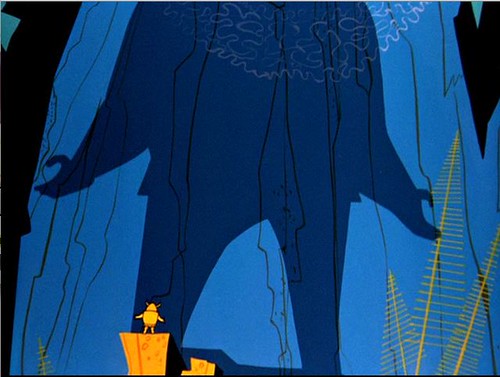
It this point a simple, and rather old, point has been made: things aren’t always what they seem to be. The camera zooms in and it’s Elmer Fudd, in heroic costume as a Nordic warrior, informing us that he’s “hunting wabbits.”
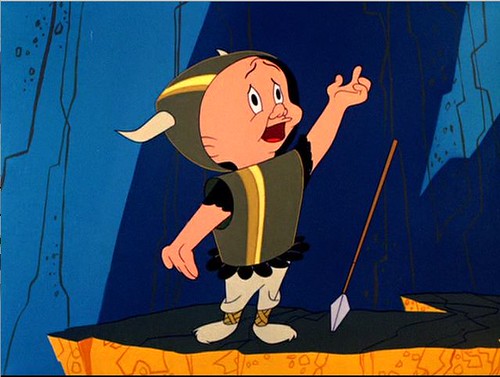
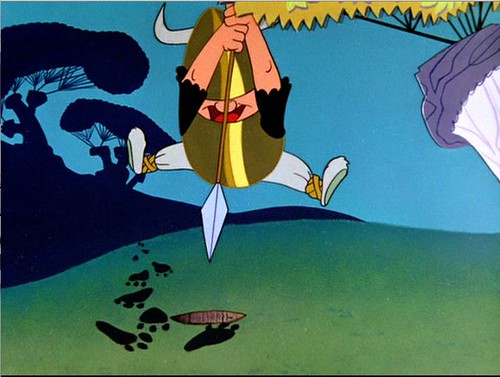
As Elmer sings “Kill the wabbit” while poking his spear into a rabbit hole, Bugs hears him and is rather distressed. Bugs approaches and delivers his classic line, “What’s up, Doc?” Bugs, however, is not in costume and so not, presumably, in role. He’s just Bugs.


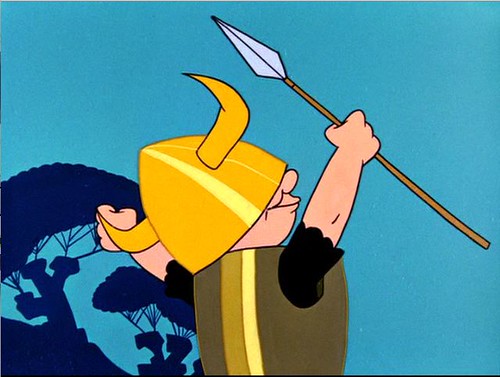
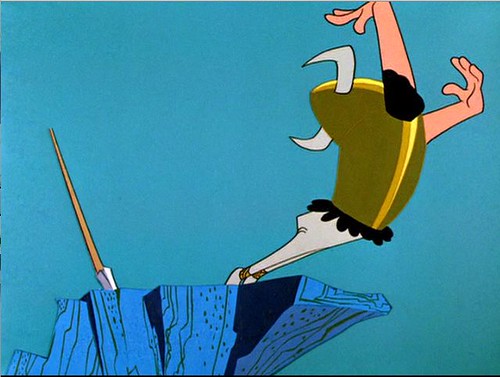
For whatever reason, Elmer is completely oblivious to the identity of this character, which has us, the audience, wondering what indeed is up? When Bugs asks the mighty Nordic warrior just how he expects to kill the rabbit, Elmer replies that he’ll use his spear and magic helmet. The spear, of course, is just a standard weapon, the Nordic warrior equivalent of Elmer’s more usual shotgun. But a magic helmet, that’s something else entirely and gives the Nordic warrior powers that Elmer never had. Note how the helmet glows when Elmer mentions it:
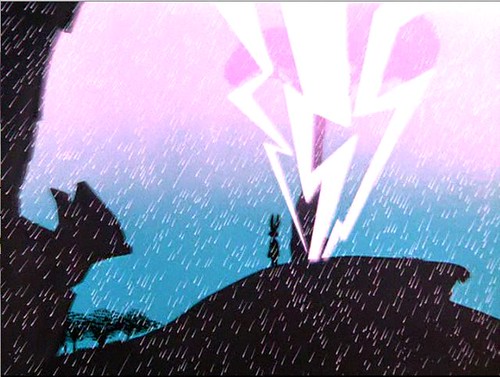
Perhaps sensing a challenge, Elmer offers to demonstrate the helmet’s powers and climbs to the top of a tall promontory and summons up foul weather in a scene reminiscent of the dream sequence from The Sorcerer’s Apprentice. Lightening strikes a tree next to Bugs, who’s OK. But he starts running.
It’s then, when they’re far apart, then Elmer realizes that that creature, that’s the wabbit!