Showing posts with label F Me Pump. Show all posts

Sunday, February 16, 2025

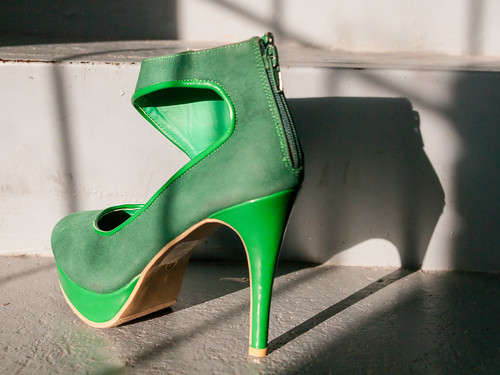
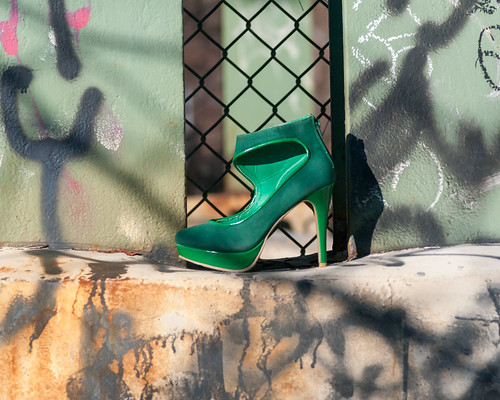
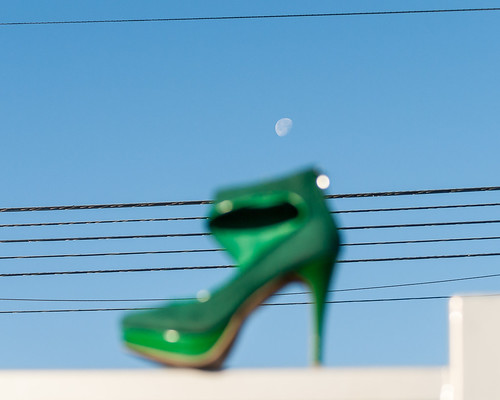
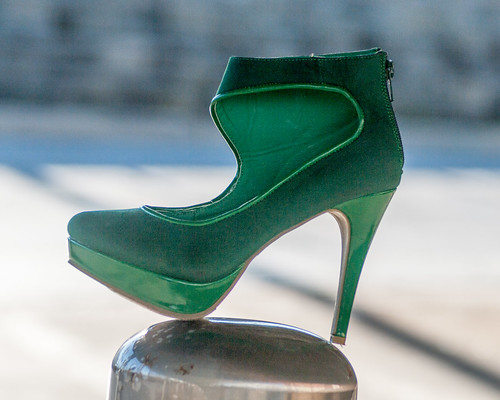
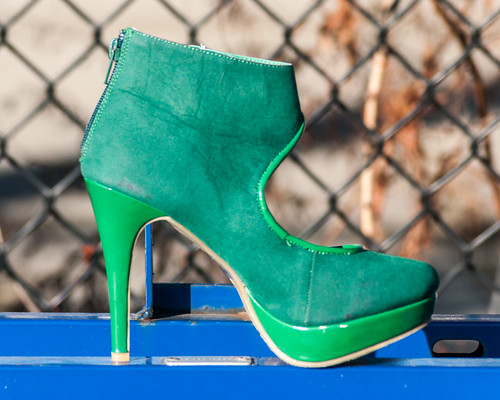
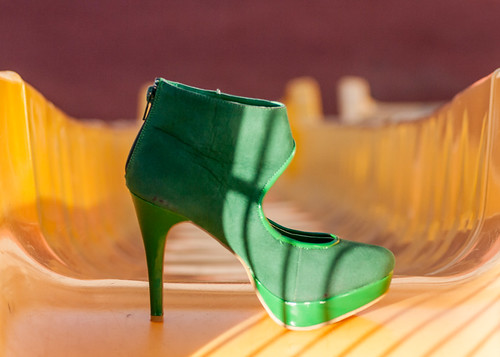
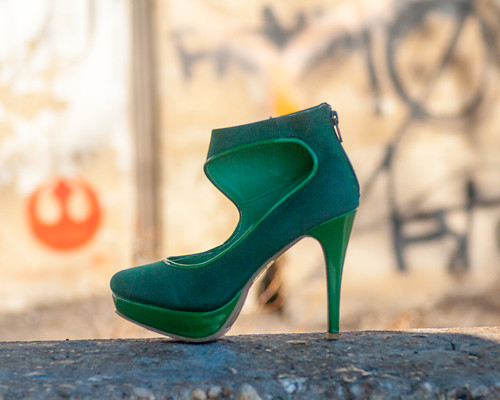
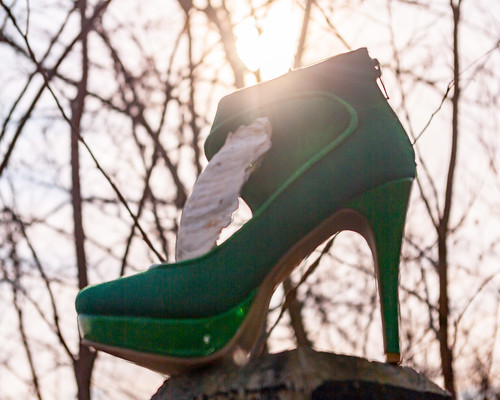
Cleopatra's Electric Green Platform Shoe

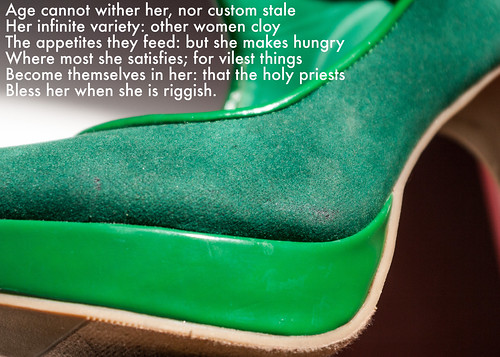
Age cannot wither her, nor custom stale
Her infinite variety: other women cloy
The appetites they feed: but she makes hungry
Where most she satisfies; for vilest things
Become themselves in her: that the holy priests
Bless her when she is riggish.

        – Shakespeare, Antony and Cleopatra

Saturday, January 11, 2025

Claude 3.5 Sonata describes the infamous green pump astride a fire hose valve. Hot Hot Hot!

The way this conversation develops interesting. Of particular interest: When I reply “LOL!”, Claude recognizes that as ironic. How? What kind of contextual awareness is involved? Then, at the end, when I sign off with a conventional (albeit an obsolete convention), “Later alligator,” Claude fails to respond with the proper, “After awhile, crocodile.”

What am I looking at?

This appears to be an artistic or fashion photograph featuring a bright green high-heeled platform shoe balanced on top of a fire hose valve. The valve is brass or bronze-colored and connected to what looks like a red standpipe, likely part of a building's fire suppression system. The composition creates an interesting contrast between the utilitarian fire safety equipment and the stylish women's footwear.

Can you read the print on the valve?

From the image, I can see "BH" and "FIRE HOSE VALVE" printed on the brass valve assembly.

Can you read what’s printed below "FIRE HOSE VALVE"?

Yes, I can see "F.Q. ASY." printed below "FIRE HOSE VALVE" on the brass valve.

Yeah, it’s hard to make out. Since the valve is nearby, I went and checked. It says “FIG A97.” What’s the number below that?

From the image I can see "300" printed below the valve model number.

OK. Do you think the photo is trying to make some kind of statement with the contrast between the shoe and the pipe and valve?

Yes - the composition appears to be making a statement about contrasts: industrial vs. fashionable, utility vs. luxury, safety vs. style. The bright green stiletto heel positioned atop critical fire safety equipment creates visual tension and could be commenting on priorities in urban spaces or building design.

& the shoe is obviously a woman’s shoe while fire-fighting is typically regarded as a man’s job.

Yes - that's a key part of the contrast. The image juxtaposes traditionally gendered elements: the feminine high heel against industrial firefighting equipment historically associated with male-dominated professions. This visual tension could be commenting on gender roles and stereotypes in different professional spheres.

Monday, December 4, 2017

Further thoughts about Cleopatra’s pumps: A walk on the beach (how romantic)

20171202-_IGP1467

Last time out – Some thoughts about Cleopatra’s Pumps – I observed that, while I’m primarily a street photographer, many of my shots of the green F me pump are in the realm of studio photography, even if I don’t have a studio. I then showed, and commented on, a bunch of shots I took in my apartment and apartment building.

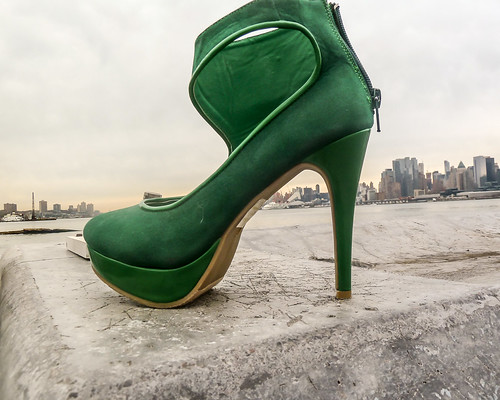
Now we’re going to the street. Well, not the street, the beach (in Jersey City, NJ, no less). Now the point of street photography is that you take the world as it presents itself to you. You can choose where to point your camera and how to frame the shot, but the objects you see, and, above all, the light in the scene, those you have to take as given. In contrast, in studio photography you get to control everything (more or less – but we aren’t omnipotent).

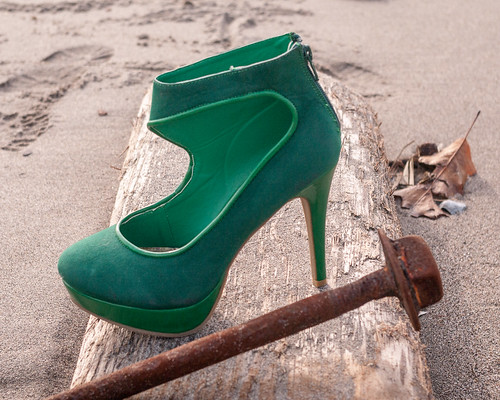
I took these shots outdoors and had to deal with the existing light. In that sense they are street photographs. But I intervened in the scene by placing that bright green platform pump in it and making it the focus of my shot. I am thus interested in the interaction between the shoe and the scene.

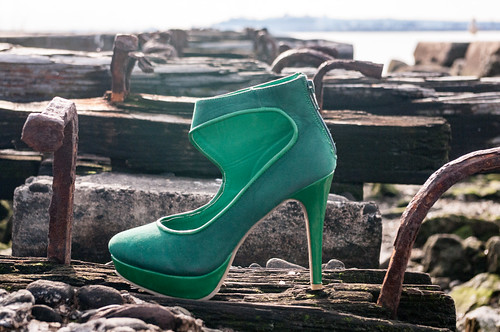
I took all of these photographs at the southern end of Liberty State Park in Jersey City. Here I’ve placed the shoe on the remnants of a pier:

20171202-_IGP1370

I’m interested in the contrast between the material and shape of the shoe and the gritty work-world remnants of the pier, the rotting wood and the large rusty iron spikes. I suppose one could read that juxtaposition as the Male pier vs. the Female shoe, but that is not at all necessary. Really, the materials and forms are interesting and compelling in and of themselves, otherwise there’s really no point to the photograph.

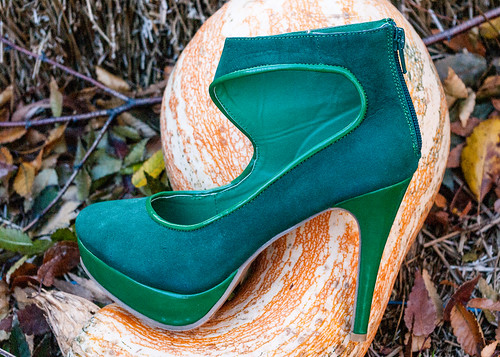

Same pier, different position and orientation:

20171202-_IGP1365

That’s another pier in the background. The trees are obvious, the people standing around, not so obvious. Nor is it obvious that we can see the Statue of Liberty through the trees just above the top of the shoe. I didn’t notice it until just now. Was I (subliminally) aware of it when I framed the shot? I don’t know. But I’ve been shooting at the park for several years now, and I am very much aware of that statue.

Wednesday, November 29, 2017

Some thoughts about Cleopatra’s Pumps

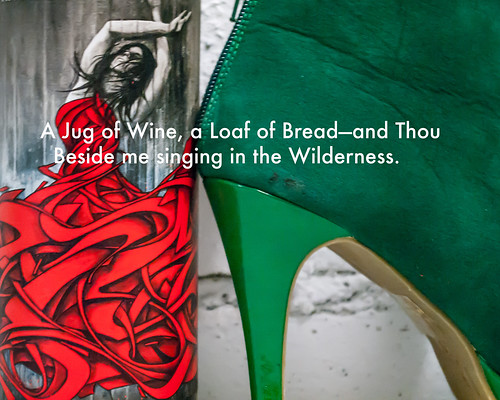
Rubaiyat

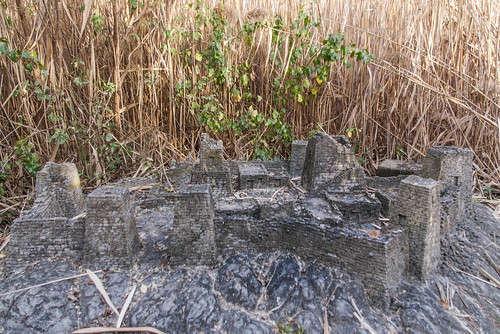
How time flies. It was only Friday that I announced my photography project, “Cleopatra’s Shoes, or the F Me Pump”, and already I’m reflecting on it, like I’ve learned something. Well, I’ve taken 350 photos or so and I’ve uploaded 137. I’ve got specific plans for more. In particular, I really want to get shots of Ms. Cleo at this miniature castle, if I can find it again (there are no signs or paths leading the way):

20141104-IMGP1853

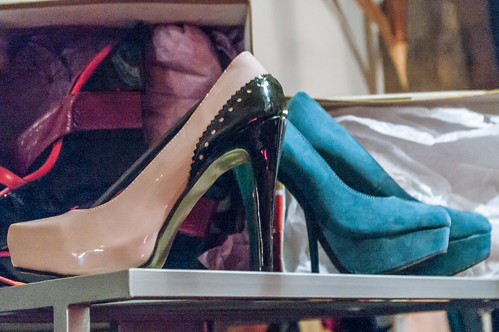
And of course I’d like to get some shots of her with her sisters at Wayquay’s joint:

20161217-_IGP8367

20160702-_IGP6729

20161015-P1120427

But why, why more photos when you’ve already got so many?

Why not?

But, yes, the question’s a good one, and I’ve been pondering it. Basically, I’m playing, I’m exploring.

Sunday, November 26, 2017

Paul Bloom on Cruelty and Violence

Manne’s analysis can be seen as an exploration of an observation made by Margaret Atwood—that men are afraid that women will laugh at them, and women are afraid that men will kill them. For Manne, such violent episodes are merely an extreme manifestation of everyday misogyny, and she extends her analysis to catcalling, attitudes toward abortion, and the predations of Donald Trump.

Nor are the mechanisms she identifies confined to misogyny. The aggressions licensed by moral entitlement, the veneer of bad faith: those things are evident in a wide range of phenomena, from slaveholders’ religion-tinctured justifications to the Nazi bureaucrats’ squeamishness about naming the activity they were organizing, neither of which would have been necessary if the oppressors were really convinced that their victims were beasts.

If the worst acts of cruelty aren’t propelled by dehumanization, not all dehumanization is accompanied by cruelty. Manne points out that there’s nothing wrong with a surgeon viewing her patients as mere bodies when they’re on the operating table; in fact, it’s important for doctors not to have certain natural reactions—anger, moral disgust, sexual desire—when examining patients. The philosopher Martha C. Nussbaum has given the example of using your sleeping partner’s stomach as a pillow when lying in bed, and goes on to explore the more fraught case of objectification during sexual intercourse, suggesting that there’s nothing inherently wrong about this so long as it is consensual and restricted to the bedroom.

As a philosopher, Manne grounds her arguments in more technical literature, and at one point she emphasizes the connection between her position and the Oxford philosopher P. F. Strawson’s theory of “reactive attitudes.” Strawson argued that, when we’re dealing with another person as a person, we can’t help experiencing such attitudes as admiration and gratitude, resentment and blame. You generally don’t feel this way toward rocks or rodents. Acknowledging the humanity of another, then, has its risks, and these are neatly summarized by Manne, who notes that seeing someone as a person makes it possible for that person to be a true friend or beloved spouse, but it also makes it possible for people to be “an intelligible rival, enemy, usurper, insubordinate, betrayer, etc.”
It's not simply dehumanization:
Certainly, Pitzer’s description of various concentration camps contains so many examples of cruelty and degradation that it’s impossible to see them as a mere failure to acknowledge the humanity of their victims. As the scholar of warfare Johannes Lang has observed of the Nazi death camps, “What might look like the dehumanization of the other is instead a way to exert power over another human.”

The limitations of the dehumanization thesis are hardly good news. There has always been something optimistic about the idea that our worst acts of inhumanity are based on confusion. It suggests that we could make the world better simply by having a clearer grasp of reality—by deactivating those brain implants, or their ideological equivalent. The truth may be harder to accept: that our best and our worst tendencies arise precisely from seeing others as human.

Saturday, November 25, 2017

Cleopatra enters Rome


This is the scene in Cleopatra, the 1963 historical epic, where Cleopatra enters Rome, where she meets Mark Antony, who would become the love of her life. At 5:53 Mark Antony remarks to Caesar, "Nothing like this has come into Rome since Romulus and Remus" – and they're weren't real, just myths. Finally, at about 6:04, we see Cleopatra, draped in gold, wearing a gold headpiece, and showing a bit of cleavage.

But no funk me pumps. FAKE NEWS!

She's enthroned between the paws of a large black sphinx pulled by a cast of thousands. She's higher than the mighty Caesar, who must thus look up to her. The ladies or Rome are looking mighty disgruntled. Bet they were waiting for the fuck me pumps.

The role of Cleopatra was played by Elizabeth Taylor. Richard Burton played Antony. Their behind the scenes love affair was the talk of the nation.

Friday, November 24, 2017

Friday Fotos: Cleopatra’s Shoes, or, the F Me Pump

I recently explained how I found a woman’s shoe on the street and decided to use it as a prop for photographs. That has blossomed into a photography project I’m (tentatively) calling “Cleopatra’s Shoes, or the F Me Pump”. Why Cleopatra? Here’s how Shakespeare introduces her in Antony and Cleopatra:

Cleopatra

I suppose that Harvey Weinstein, Leon Wieseltier, Donald Trump, and other of their ilk think that a woman wearing such a shoe is “asking for it”. That betrays their insecurity, contempt for women, and utter lack of imagination.

Cleopatra may well have been flaunting it, but that’s very different from asking for it. If she is flaunting it, then, she may signal that you are welcome to ask for it provided you do so with desire, imagination, politesse, and respect. She’s also playing. And you know how the cliché goes, don’t you? Fun is fundamental.

And, you know what, I’ll bet Antony flaunted his pumps too. Here’s how Shakespeare sends him off the stage:

Antony

Between them, Antony and Cleopatra ruled half the Mediterranean world. And they delighted in their F Me Pumps. It behooves us to do the same.

Here are some relevant videos pointed out to me by a few of my Facebook friends; friends, incidentally, who are also real-life friends.


Here’s the photos I’ve collected so far. Click on the angle brackets to scroll through the photos and  click on the photo itself to be whisked away to to my Flickr album fro the project, which currently has 76 photos, with more on the way.

The Eff Me Pump / Cleopatra's Shoe

They’re just raw material for the project, not the final product. What’s the final product? Don’t know. We’re not there yet.

Finally, the Shakespeare passages by themselves:
Age cannot wither her, nor custom stale
Her infinite variety: other women cloy
The appetites they feed: but she makes hungry
Where most she satisfies; for vilest things
Become themselves in her: that the holy priests
Bless her when she is riggish.
Antony and Cleopatra, Act 2, Scene 2

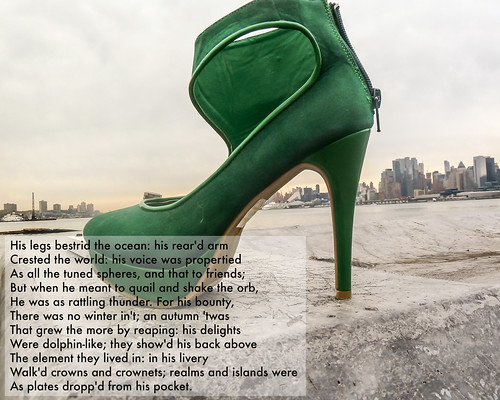
His legs bestrid the ocean: his rear'd arm
Crested the world: his voice was propertied
As all the tuned spheres, and that to friends;
But when he meant to quail and shake the orb,
He was as rattling thunder. For his bounty,
There was no winter in't; an autumn 'twas
That grew the more by reaping: his delights
Were dolphin-like; they show'd his back above
The element they lived in: in his livery
Walk'd crowns and crownets; realms and islands were
As plates dropp'd from his pocket.
Antony and Cleopatra, Act 5, Scene 2

Sunday, November 19, 2017

Shoes!

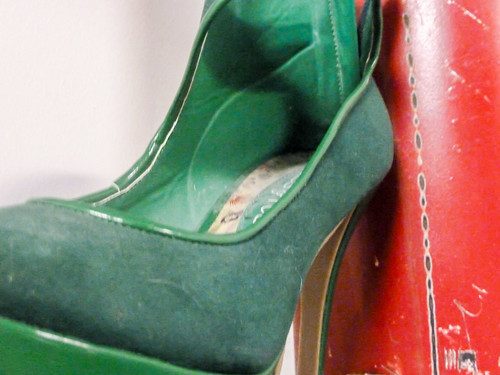
As you can see from my most recent post, I have acquired a rather exotic women's shoe.  I was walking to the library when I spotted it on the sidewalk. Apparently discarded, a single shoe, left foot, size 7, "Kiss & Tell" – How's THAT for branding? There's a label on the sole at the instep that says, "All Man-Made Material Made in China". What does that mean? I understand "Made in China", but "All Man-Made Material" is ambiguous. Does it mean that all the materials are man-made (and they're made in China), so that the suede uppers are actually some artificial suede substance? Of does it mean that the man-made materials were made in China (the sole and heel are plastic) but the rest might well be natural? If so, was it also assembled in China?

Anyhow, as soon as I saw the shoe one of those little light-bulbs went off above my head:

Prop!

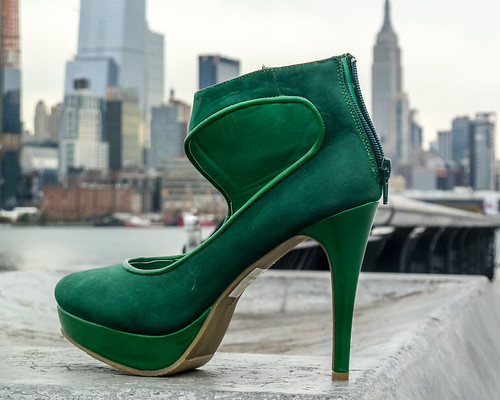
So I grabbed it and put it in my backpack and then continued on to the library to return my film, Miyazaki's Castle in the Sky, and pick up my book, King Kong: The History of a Movie Icon from Fay Wray to Peter Jackson. There's a connection, you see, between King Kong and that shoe. King Kong died on the Empire State Building, right? Why not pose the shoe with the Empire State Building. Like this perhaps:

20171118-P1140279

Notice that, from this angle, that size 7 woman's shoe is larger than that phallic whatsiewhoseit across the river.

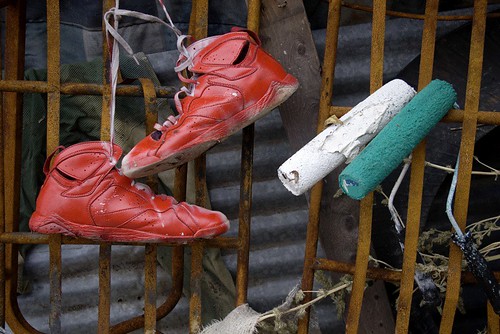
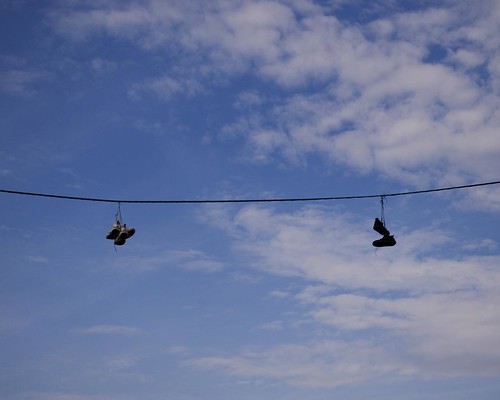
Then I realized that these aren't the only photos of shoes I've got. For example, I found these hanging outside the improvised shack of some homeless person:

red shoes.jpg

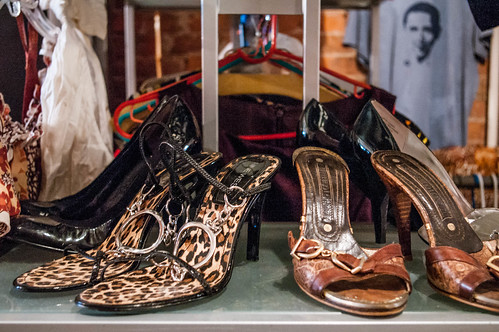
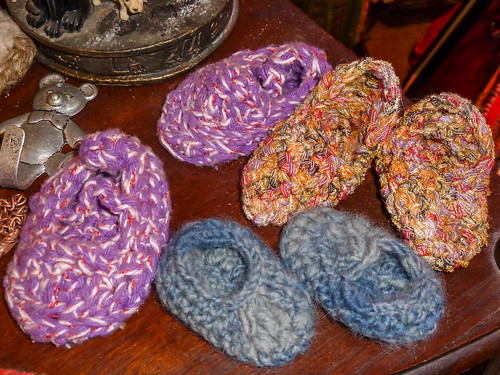
And then we have the stash of women's shoes that my friend Wayquay is selling at The Ruins JC. Mostly women's shoes, but not all of them. I suppose we could say these baby booties (made by Wayquay herself) aren't shoes, strictly speaking, but they serve the same function, no?

20170826-P1130015

And I've got other shoe shots as well, like these:

IMGP9079rd

This, of course, is a minor sport.

Anyhow, I figured that, with these latest shots of the green shoe – I've got more that I haven't uploaded, and I plan to take more photos as well (perhaps in Narnia) – I should create a tag here at New Savanna (shoes) to capture those shots and write up a brief post acknowledging the importance of shoes.

20171118-P1140232

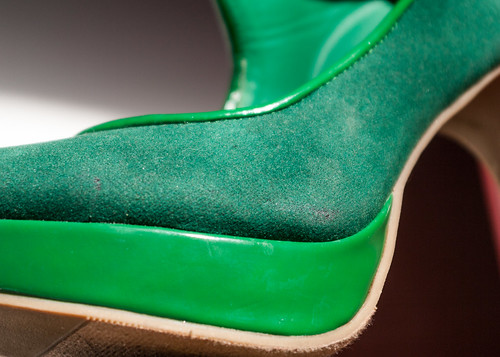
Isn't that green just gorgeous! That shoe's the greatest prop ever!

Two views of Manahattan

20171118-P1140269

20171118-P1140280

BONUS below the fold –

"It was beauty killed the beast."