Thursday, July 9, 2026
Friday, August 15, 2025
The Sound of The Ancestors: An Authentic West African Drum Solo
YouTube:
Akinmola Boluwatife Samuel is a dynamic musician, vocalist, and drummer who blends traditional African rhythms with contemporary expression. With a B.A. in music from Lagos State University, where he was awarded Drummer of the Year in recognition of his exceptional talent. Boluwatife leads the _African Folk Band_, infusing Apala tradition jazz, and call and response vocal form into his music. As a husband and father, family inspires his artistry, fueling his commitment to storytelling through rhythm and melody. His work celebrates Africa's rich musical heritage, captivating audiences worldwide.
Listen carefully to how he has tuned the deums.
Tuesday, August 5, 2025
Five countries generate half of Africa's GDP
GDP growth projection for 2025:
— Stats Globe (@statsglobe) August 2, 2025
πͺπΉ Ethiopia: 6.5%
π°πͺ Kenya: 5%
πͺπ¬ Egypt: 4.1%
π²π¦ Morocco: 3.6%
π³π¬ Nigeria: 3.2%
π©πΏ Algeria: 3%
π¦π΄ Angola: 2.8%
πΏπ¦ South Africa: 1.5%
According to IMF.
Friday, July 11, 2025
Nollywood: The World's Third Largest Film Industry
"Nollywood - Nigeria's Mirror" takes us to Lagos, the third largest film industry in the world. Scholars Jonathan Haynes and Onookome Okome serve as guides as we negotiate the intricacies and eccentricities of Nollyood's past and digital future. Nollywood films dramatize key tensions in contemporary Nigerian life, such as the relationship between tradition and cosmopolitanism. Distributed through pirate DVD networks across Africa, the Caribbean and the Diaspora at large, Nollywood films are a global phenomenon - and we'll find out why. We'll also be joined by Christopher Kirkley of the Sahel Sounds blog, who transports us to northern Nigeria and into the electronic sound world of Hausa film music.
An earlier post about Nollywood: Nollywood Millionaire.
Thursday, November 28, 2024
"Take Five," five ways
"Take Five" is a jazz standard composed by Paul Desmond. It was first recorded in 1959 and is the third track on Time Out by the Dave Brubeck Quartet. Frequently covered by a variety of artists, the track is the biggest-selling jazz song of all time and a Grammy Hall of Fame inductee.
Dave Brubeck was inspired to create an album based on odd time signatures during his state-sponsored 1958 Eurasia trip. The track was written after the Quartet's drummer, Joe Morello, requested a song in quintuple (5/4) meter. Desmond composed the melodies on Morello's rhythms while Brubeck arranged the song. The track's name is derived from its meter, and the injunction, "Take five", meaning "take a break for five minutes". The track is written in E♭ minor and is in ternary (ABA) form.
Released as a promotional single in September 1959, "Take Five" became a sleeper hit in 1961, and then went on to become the biggest-selling jazz single of all time. The track still receives significant radio airplay.
Yesterday I cruised YouTube for recordings. I listed to over a dozen. Most of them had the same time feel as Brubeck's original recorder. The instrumentation would be different and the tempo might be faster of slower, but the basic time feel was the same, a jazz swing. But I found four versions that were distinctly different, though I assume there are others out there. I've presented them below, after Brubeck's original recording.
Jazz Swing: Dave Brubeck Quartet (1959, the original recording)
Salsa: Tito Puente (1985)
I heard Tito Puente live at the Troy Savings Bank Music Hall in the early 1980s. They were hot! hot!! hot!!! People were dancing in aisles. Not bad for a place originally built to present the European classics. Pictures of some of them – Bach, Haydn, Mozart, and the rest – lined the walls. I wonder what they were thinking about Puente. I'd like to think they were savvy enough to smile. [Note: They take it in four, but four with a clave.]
Ska: New York Ska-Jazz Ensemble (2009)
I know next to nothing about ska, but this is a good performance. I like it. [Also in four.]
Pakistani: Sachal Studios (2011)
This is interesting. It's a large group, lot's of fiddles. The arrangement borrows heavily from Brubeck's original. The major difference is in the percussion, which is a tabla player, a very good one, and that gives the whole thing a different underlying rhythmic pulse.
Africans: Chyke Martins and Udoh Band (2024)
I love this, so smooth and slinky. Listen to Martins throw in a bit of "Summertime" at 4:30.
Saturday, March 2, 2024
The invention of the West
Steven Poole reviews, Josephine Quinn, How the World Made the West (2024), in The Guardian. The opening paragraph:
Like the railway and the telegraph, western civilisation was invented in the 19th century. It had located its noble roots in classical Athens and Rome, and from then, so the story went, white Europeans embarked on a smooth progression of gradual sophistication and enlightenment that culminated, not coincidentally, in the glories of the British empire.
That’s not quite how it all got started, argues ancient history professor Josephine Quinn in this fascinating account of the cultural and martial doings around the Mediterranean in the two millennia BC, and thence up to the middle ages. For her, “civilisational thinking” itself is the enemy, not only in historiography but in modern geopolitics. [...]
But “western civilisation” would not exist without its Islamic, African, Indian and Chinese influences.
I agree. A bit later:
With such relentless trade and travel comes, naturally, cultural commingling. “Overseas exchange meant that Cretans could pick and choose from different cultural options, and they did,” Quinn remarks. Cultural appropriation was not yet an affront; indeed, it could be a strength, as we learn later from Polybius’s remark about the upstart Romans: “They are unusually willing to substitute their own customs for better practice from elsewhere.”
The book is rich in marvellous detail, and succeeds in making the pre-classical world come to life. There is something of the modern wheedling teenager in the complaining minor royal who ends a letter to the king of Egypt with the line “Send me much gold”.
Still later, after this and that:
Meanwhile, it didn’t take until the 19th century for the idea of “the west” to arrive, as Quinn notes. The “earliest known version of a binary polarity setting Europe against Asia”, she observes, is found already in Herodotus’s tales of the Persian wars; and Frankish Christians began thinking of themselves as “European” in the wake of the Arab conquest.
Doubtless, though, those fusty 19th-century gentlemen historians were blinkered, in the same way that we shall appear blinkered to historians a century hence. Quinn makes this point beautifully when discussing the “stories of warrior women in the Steppe” in the first millennium BC, which were long dismissed as fantasy by scholars. “There was no room in civilisational thinking for cultures run aggressively and successfully by women,” she observes. “In recent decades, however, more than one hundred women’s graves containing axes, swords and occasionally armour have come to light in Russia and Ukraine.”
I've been making a similar argument for a long time. Although it has long been convention to trace "the West" back to ancient Greece and to Israel, and those genealogical connections are real, the idea that there this cultural entity, "the West," extends back into ancient times is more on the order of a founding myth than a summary history. It should be obvious on the face of it that if any contemporary citizen of a Western country were transported back in time to the ancient world, anywhere, they'd find themselves in a very strange culture that they do not at all recognize. For that matter, the England of Shakespeare and Queen Elizabeth I would be barely recognizable as English by contemporary speakers of the language. The language would be difficult to understand and to speak, and the customs strange.
In "The Evolution of Cognition" David Hays and I point out that contemporary Western culture would have been impossible without arithmetic imported from the Arab world. In "Culture, Plurality, and Identity in the 21st Century" I point out that the idea of a Western cultural identity is relatively recent and was preceded and facilitated by the idea of Christendom that emerged in Europe in the 16th century.
Friday, December 1, 2023
Three Against Two the Tumbuka Way
I'm bumping this to the top on the principle that I need to do more posts about music. This doesn't actually add a post to the blog, but it brings one out of the past and into the present.
Saturday, November 4, 2023
A.I. in Africa (Rokhaya Diagne)
Dionne Searcey, As a Teen, She Loved Video Games. Now She’s Using A.I. to Try to Quash Malaria. NYTimes, Nov. 3, 2023. From the article:
While some of her cohorts are most passionate about sensor fusion or robotics, Ms. Diagne is into artificial intelligence and machine deep-learning. She helped create an award-winning networking app to meet others with similar interests — like Tinder but for tech nerds. And she founded a start-up called Afyasense (she borrowed “afya,” or health, from Swahili, an East African language) for her disease-detection projects using A.I.
“She is someone with whom talking is a pleasure due to the quality of the questions she asks and also the answers she gives,” said IsmaΓ―la Seck, a leader in Senegal’s growing A.I. community.
Like many other young people in Africa’s tech boom, Ms. Diagne is at the center of overlapping phenomena on the continent — a growing, educated middle class raising even more educated children who, with each tap on a keyboard, have adopted a sense that the continent’s biggest problems can be solved.
Ms. Diagne wants to use A.I. to improve health outcomes in the region, a choice she made after a range of childhood illnesses landed her in Dakar hospitals, which struggled to provide consistent, quality care.
“I know the mistakes that are unfortunately made,” she said.
Ms. Diagne’s drive has earned her recognition. Her malaria project recently won an award at an A.I. conference in Ghana and a national award in Senegal for social entrepreneurship, as well as $8,000 in funding.
There's more at the link.
Sunday, September 4, 2022
Into the Future: From Tyler Cowen through Kim Stanley Robinson to Kisangani 2150
Tyler Cowen. Average Is Over: Powering America Beyond the Age of the Great Stagnation. Dutton (2013).
Freestyle chess and beyond
A series of Freestyle tournaments was held staring in 2005. In the first tournament, grandmasters played, but the winning trophy was taken by ZackS. In a final round, ZackS defeated Russian grandmaster Vladimir Dobrov and his very well rated (2,600+) colleague, who of course worked together with the programs. Who was ZackZ? Two guys from New Hampshire, Steven Cramton and Zackary Stephen, then rated at the relatively low levels of 1,685 and 1,395, respectively. Those ratings would not make them formidable local club players, much less regional champions. But they were the best when it came to aggregating the inputs from different computers. In addition to some formidable hardware, they used the chess software engines Fritz, Shredder, Junior, and Chess Tiger.
The top games of Freestyle chess probably are the greatest heights chess has reached, though who actually is to judge? The human-machine pair is better than any human – or any machine – can readily evaluate. No search engine will recognize the paired efforts as being the best available, because the paired strategies are deeper than what the machine alone can properly evaluate.
A new kind of science?
For at least three reasons, a lot of science will become harder to understand:
- In some (not all) scientific areas, problems are becoming more complex and unsusceptible to simple, intuitive, big breakthroughs.
- The individual scientific contribution is becoming more specialized, a trend that has been running for centuries and is unlikely to stop.
- One day soon, intelligent machines will become formidable researchers in their own right.
Most current scientific research looks like “human directing computer to aid human doing research,” but we will move closer to “human feeding computer to do its own research” and “human interpreting the research of the computer.” The computer will become more central to the actual work, even to the design of the research program, and the human will become the handmaiden rather than the driver of progress.
An intelligent machine might come up with a new theory of cosmology, and perhaps no human will be able to understand or articulate that theory. Maybe it will refer to non-visualizable dimensions of space or nonintuitive understandings of time. The machine will tell us that the theory makes good predictions, and if nothing else we will be able to use one genius machine to check the predictions of the theory from another genius machine. Still, we, as humans, won’t have a good grasp on what the theory means and even the best scientists will grasp only part of what the genius machine has done.
We’re on the very of having computer systems that understand the entirety of human “natural language,” a problem that was considered a very tough one only a few years ago. Just talk to Siri on your iPhone and she is likely to understand your voice, give you the right answer, and help you make an appointment.
Friday, August 26, 2022
Sex among the Aka, hunter-gatherers of the Central African Republic [sex is work of the night]
2. The Aka report having sex about 3 times a night, with some days of rest between (all data are self-reported). Here, these frequencies are converted to weekly for comparison with neighboring Ngandu farmers and the US: pic.twitter.com/EVIprY0hkv
— Ed Hagen (@ed_hagen) August 26, 2022
3. The Aka and Ngandu both report that having sex is mainly to have children, which warms my sociobiological heart: pic.twitter.com/hwTAnO0jdZ
— Ed Hagen (@ed_hagen) August 26, 2022
There are seven more tweets in the stream.
Monday, April 18, 2022
Tell me about the blues: Did they originate in New Orleans?
In a recent post Ted Gioia considers the possibility that the blues originated in New Orleans. After considerable discussion:
All this is significant and enlightening, but insufficient to prove that New Orleans was the birthplace of the blues. But it does suggest that blues was a significant ingredient in its commercial music scene at a fairly early stage. My considered judgment is that New Orleans was the source of “blues-inflected jazz”—but that’s a very different claim than citing it as the home of all blues. And as all the available evidence shows, early jazz borrowed ingredients from every imaginable source—military music, spirituals, opera arias, etc. The fact that an idiom showed up in a New Orleans jazz performance is no proof that it was invented in New Orleans.
After further discussion of just how the blues wound up in New Orleans and how innovation spreads he says:
My assessment of the totality of this evidence suggests that the blues has very old roots, originating with performers who found new ways of playing African-inflected music in the New World—but typically in rural areas where they could remain immune to many of the influences linked to commercial trends in American music. The blues style eventually became urbanized in the closing years of the 19th century, and New Orleans was probably the first city where this style of music rose to prominence. It almost certainly arrived there as part of the larger migration from country to city—just as it later participated in the ensuing emigration of African-Americans from South to North. The idea that this path of dissemination went the other way around—with city musicians from New Orleans relocating to remote sharecropper plantations—is much harder to accept. That simply wasn’t the way people moved in those years.
* * * * *
This is the fourth post in my series, “Tell me about the blues.” The series is tagged with the label, tell me blues.
Tuesday, January 18, 2022
Three Against Two: Splitting the Mind [augmented with new material]
Interesting new paper about the perennial question of lateralization and timing, from Chris Kell's lab in Frankfurt https://t.co/AeoVe5x9Zo Differential contributions of the two human cerebral hemispheres to action timing— David Poeppel (@davidpoeppel) November 21, 2019
Abstract from the article: Anja Pflug, Florian Gompf, et al., Differential contributions of the two human cerebral hemispheres to action timing, eLife 2019;8:e48404 DOI: 10.7554/eLife.48404:
Abstract: Rhythmic actions benefit from synchronization with external events. Auditory-paced finger tapping studies indicate the two cerebral hemispheres preferentially control different rhythms. It is unclear whether left-lateralized processing of faster rhythms and right-lateralized processing of slower rhythms bases upon hemispheric timing differences that arise in the motor or sensory system or whether asymmetry results from lateralized sensorimotor interactions. We measured fMRI and MEG during symmetric finger tapping, in which fast tapping was defined as auditory-motor synchronization at 2.5 Hz. Slow tapping corresponded to tapping to every fourth auditory beat (0.625 Hz). We demonstrate that the left auditory cortex preferentially represents the relative fast rhythm in an amplitude modulation of low beta oscillations while the right auditory cortex additionally represents the internally generated slower rhythm. We show coupling of auditory-motor beta oscillations supports building a metric structure. Our findings reveal a strong contribution of sensory cortices to hemispheric specialization in action control.
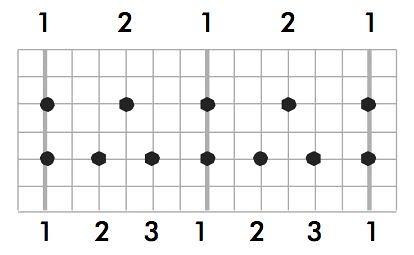
Three against two is one of the most important rhythm ‘cells’ in all of music. What do I mean, three against two? You play three evenly spaced beats in one ‘stream’ in the same period of time you play two evenly spaced beats in another ‘stream.’ It sounds simple enough but, the problem is that three and two do not have a common divisor, making the ‘evenly spaced’ part of the formula a bit tricky. The two patterns coincide on the first beat, but the second and third beats of the three-beat stream happen at different times from the second beat of the two-beat stream. And if you think that’s a lot of verbiage for something that ought to be simple, when then you’re beginning to get the idea.
![]() |
| Three Against Two |
In a slow tempo it may serve you to think of the second eighth-note of the triplet as being subdivided into two sixteenths. After both hands have played the first note of their respective groups simultaneously, the place of the aforsaid sixteenth note is to be filled by the second note of the couplet.
Monday, August 23, 2021
Work isn't all it's cracked up to be [more naps!]
Cassady Rosenblum, Work is a False Idol, NYTimes, Aug. 22, 2021.
The lying flat movement, or tangping as it’s known in Mandarin, is just one expression of this global unraveling. Another is the current worker shortage in the United States. As of June, there were more than 10 million job openings in the United States, according to the most recent figures from the Labor Department — the highest number since the government began tracking the data two decades ago. While conservatives blame juiced-up pandemic unemployment benefits, liberals counter that people do want to work, just not for the paltry wages they were making before the pandemic.
Both might be true. But if low wages were all that’s at play, we would expect to see reluctant workers at the bottom of the socioeconomic ladder, and content workers at the top. Instead, there are murmurs of dissent at every rung, including from the inner sanctums of Goldman Sachs, where salaries for investment bankers start at $150,000. According to a leaked internal survey, entry-level analysts at the investment bank report they’re facing “inhumane” conditions, working an average of 98 hours a week, forgoing showers and sleep. “I’ve been through foster care,” said one respondent. “This is arguably worse.”
In the United States, Black activists, writers and thinkers are among the clearest voices articulating this spiritual malaise and its solutions, perhaps because they’ve borne the brunt of capitalism more than other groups of Americans. Tricia Hersey, a performance artist and the founder of the Nap Ministry, an Atlanta-based organization, is one of them. Ms. Hersey says she discovered the power of naps during a draining year of graduate school at Emory University, an experience that inspired her to bring the gospel of sleep to fellow African Americans whose enslaved and persecuted ancestors were never able to properly rest.
Note:
But it’s worth noting that Mr. Luo acknowledged the necessity of making a living, and @hollabekgrl didn’t say she never wanted to work at a job or hone a craft; she said she doesn’t want a “career,” a corporate-flavored word that conjures images of PowerPoints and power suits. While jobs are sustenance, careers are altars upon which all else is sacrificed.
Monday, May 17, 2021
The role of clothing in cultural evolution [agriculture, Rank 2]
Sam Dresser, The clothing revolution, Aeon.
My recent work shows that clothing wasn’t just the unique adaptation of a more-or-less hairless mammal to the changing natural environments. The development of clothing led to innovations with many repercussions for humanity, beyond survival in cold climates. A need for portable insulation from the cold in the Palaeolithic promoted major technological transitions. These include stone toolkits for working animal hides and, subsequently, bone tools such as pointed awls and needles to make tailored garments. Later, during the coldest stage of the last ice age, Homo sapiens in middle latitudes devised multi-layered outfits with an inner layer of underwear. Equipped with effective protection from wind chill, our species could penetrate into the frigid Arctic Circle, further north than cold-adapted Neanderthals had managed to venture. From the northeastern corner of Siberia, modern humans strolled across an exposed land bridge to enter Alaska by 15,000 years ago, if not earlier, to likely become the first hominins to set foot in the Americas. At the Broken Mammoth site in Alaska, archaeologists have unearthed the fragile technology that made the journey possible: a 13,000-year-old eyed needle.
Until recently, the scientific study of clothing was largely the work of physiologists who have explored its thermal properties, which are now well understood. The physiology of clothing allows us to say precisely how much clothing people must wear to survive at sub-freezing temperatures and at differing wind-chill levels. Early hominins in Africa had begun to harness fire between 1 and 2 million years ago, perhaps for cooking more than warmth. Fire was utilised as hominins spread into Europe and northern China, where Homo erectus retreated into caves to escape wind chill. However, even if earlier hominins were more hairy than modern humans, whenever they found themselves in cold conditions beyond certain well-defined survival thresholds, they needed to carry portable insulation while out in the open. For modern humans, exposure times for frostbite can be less than an hour, and life-threatening hypothermia can develop overnight, even in cities. From a thermal perspective, two aspects of clothing are important. First is the number of layers, with each extra layer increasing the total insulation value. The second aspect is whether garments are fitted, or tailored, to enclose the body, especially the limbs. Fitted garments offer superior protection from wind chill, a major risk factor for frostbite and hypothermia.
Alas, clothing doesn't survive well over time and so the archaelogical record is poor.
All the evidence we have for ice-age clothing is indirect but, nonetheless, the available evidence shows that people had tailored clothes in the last ice age. The world’s oldest eyed needles are found in southern Russia 40,000 years ago, and one needle in Denisova Cave is said to be 50,000 years old. In the vicinity of Moscow at a site called Sunghir, 30,000-year-old human burials have thousands of beads neatly arranged on the skeletons.
But...
Scientific efforts to shed light on the prehistory of clothes have received an unexpected boost from another line of research, the study of clothing lice, or body lice. These blood-sucking insects make their home mainly on clothes and they evolved from head lice when people began to use clothes on a regular basis. Research teams in Germany and the United States analysed the genomes of head and clothing lice to estimate when the clothing parasites split from the head ones. One advantage of the lice research is that the results are independent from other sources of evidence about the origin of clothes, such as archaeology and palaeoclimatology. The German team, led by Mark Stoneking at the Max Planck Institute for Evolutionary Anthropology, came up with a date of 70,000 years ago, revised to 100,000 years ago, early in the last ice age. The US team led by David Reed at the University of Florida reported a similar date of around 80,000 years ago, and maybe as early as 170,000 years ago during the previous ice age. These findings from the lice research suggest that our habit of wearing clothes was established quite late in hominin evolution.
I love it! Piecing things together through an understanding of causal linkage. Sherlock would love it, too.
And then we've got complex clothing:
My work draws on the known thermal physiology of clothes to distinguish two basic forms of clothing: simple and complex. Simple clothing is loose, not fitted, and consists of just a single layer. Examples of simple garments include capes or cloaks draped over the shoulders, and loincloths. Simple clothes can provide a certain amount of insulation in cold weather, although these loose garments can offer only limited protection from wind chill. Simple clothes made from thick furs were probably sufficient when hominins began to occupy northern Europe during colder glacial stages from half a million years ago. Complex clothes are closely fitted around the body and can have cylinders attached to enclose the limbs properly; additionally, they can have up to four or five layers. Complex clothes were a more recent development, and represent a quantum leap in clothing technology, allowing humans to defeat wind chill and survive in the coldest places on Earth. [...]
Complex clothes required scrapers but also hide-cutting tools, called blades, to cut the hides into regular shapes and make the cylinders for sleeves and leggings. The separate shapes had to be sewn together carefully, hence we start to find more dedicated hide-piercing tools, called awls, later refined into the iconic ice-age clothing tool, the eyed needle.
Technologies come and go:
Another clue pointing to the role of climate change is how these technologies sometimes disappeared during warm climate phases. We see this happen in southern Africa, for example, where stone blades and bone awls appear during a cold climate phase around 75,000 years ago. With a return to milder environmental conditions 60,000 years ago, hide-cutting blade tools and hide-piercing bone awls disappear from the archaeological record, only to reappear later towards the coldest phase 22,000 years ago, the Last Glacial Maximum (LGM). Apparently, Stone Age people wore clothes in cold weather, and went naked when clothes were not needed. Clothes became a social necessity for people more recently, perhaps after many generations of wearing clothes on a regular basis, mainly in the colder middle latitudes of the northern hemisphere from the LGM onwards. Once clothes replaced body painting for personal decoration and display, the need to wear clothes was uncoupled from climate.
Australia:
The pattern of clothing in Aboriginal Australia can challenge a number of cherished theories about the origin of clothing. For one, routine Aboriginal nakedness implies that humans didn’t invent clothes due to some inherent sense of modesty. Neither, as hunter-gatherers, did we need clothes for the sake of appearance. Along with African peoples such as the San who used antelope cloaks for warmth, habitually naked foragers relied on traditional techniques such as body painting, tattooing and scarification to dress themselves, and they got dressed up more elaborately for ceremonies and other special occasions, without clothes.
Australian evidence, or absence of evidence, is likewise pertinent to the origins of agriculture. It’s no coincidence that neither textile clothing nor agriculture featured in the traditional Aboriginal lifestyles.
Clothing and the Anthropocene:
When the Pleistocene ended 12,000 years ago, there was a new development with clothes. Global temperatures increased dramatically and, along with the melting of continental ice sheets and the rise in sea levels, environments became wetter and more humid. Adapting to these moist conditions, people shifted to making their clothes with fabrics woven from natural fibres such as wool and cotton. Compared with leathers and furs, fabrics are better at managing moisture. The woven structure is permeable to air and moisture and, in warm climates, wind penetration can help to cool the body. Moisture from higher sweating rates could evaporate more easily from the skin and also from the fabric, adding to the cooling effect. The warm and wet period after the last ice age, called the Holocene, coincides with a momentous transition, the beginning of the Neolithic era when people started to engage in agriculture.
The agricultural transition was a turning point in humanity’s relationship to the natural world, altering the environment profoundly and enabling the rise of cities and civilisations. My surprising suggestion is that there was a connection between the textile revolution and the agricultural revolution. By implication, this technological change in clothes led to the Anthropocene, a phase of humanly induced global warming that started with agriculture and was accelerated by the Industrial Revolution.
Paradigm shift?
The prevailing narrative in anthropology privileges food in the transition to agriculture, and the whole concept of hunting and gathering refers essentially, if not exclusively, to the food economy.
Nevertheless, anthropologists including Robert Kelly at the University of Wyoming have been saying for some time, and for a number of reasons, that the hunter-gatherer category has reached the end of its useful life. Yet we’re still encumbered with outdated food-focused terms such as foragers and hunter-gatherers to denote pre-agricultural lifestyles. By definition, the shift from foraging to farming must have begun in the food economy. Not necessarily so, in my view.
Aside from a paradigm shift, the textile hypothesis invites a critical re-evaluation of the evidence we have about early agriculture. Archaeological evidence for textile fibres in early agricultural contexts has been present all along but overlooked, and this evidence for fibres does provide food for thought. [...]
The popular notion of agriculture as a superior food strategy reflects anachronistic perceptions of foraging as a harsh, precarious lifestyle. In contrast, archaeologists have now recognised the serious risks of famine and malnutrition in the early farming communities, and confirmed the relative ease of traditional foraging lifestyles, even in marginal environments such as Australian deserts. Anthropologists realise that foraging for food has many advantages, including the flexibility and security that derives from exploiting a wide resource base. These benefits highlight another enigma, namely, that many Neolithic societies continued to rely on foraging for much of their food supply, sometimes for thousands of years after they adopted agricultural practices. Similarly, evidence from northern Europe suggests that forager communities were inclined to resist the spread of agriculture.
It just keeps going and going.
Directly and indirectly, textiles tipped the balance in favour of agriculture. Food production did become a dominant feature, with more plant and animal species domesticated to feed humans. Even then, as the archaeologist Brian Hayden points out, agricultural foodstuffs often served as surplus products for feasting on special occasions, not everyday food staples. As the main reason for agriculture in the first instance, food alone is insufficient and problematic. An alternative textile scenario might sound implausible, requiring a revolution in how we look at the agricultural revolution. Yet this scenario does echo the analogous role of textiles in the Industrial Revolution, a pivotal point in history when factory-style production of cotton textiles was an impetus for industrialisation. Ironically, if both agriculture and industrialisation were intertwined with clothes, this would mean a human adaptation to cold weather could ultimately make the whole world warmer.
Hey, GPT-3, analyze this!
Sunday, January 24, 2021
Reading The Human Swarm 8: What about the USA? [and in view of 1/6]
This is the 8th post in my extended consideration of Mark Moffett's The Human Swarm (2019). In it I consider the current polarized political situation in the USA. The events in Washington, D.C., of 1/6 make Moffett's thoughts on group identity and coherence more urgent.
I totally agree. I can't make common cause with liars, cheats, people who glorify superstition and bigotry, and whose idea of morality is micromanaging other people's genitals. I have no intention in living in a country with a larcenous mad dictator. There can be no unity.— Lyn Gerry (@LynGerry1) December 14, 2019
Let’s call the nation’s founding set of circumstances the Originating Dispensation (OD). The OD consists, on the one hand, of a set of documents, the Declaration of Independence and the Constitution chief among them, but they’re surrounded by various supporting documents, for example, the Federalist Papers. On the other hand, the OD also consists of a multiplicity of facts on the ground, chief among which are the specific groups of people who participated in the process. While the founding documents may have aspired to universal principles, the facts on the ground privileged males of means among all others, males over females, and whites over everyone else.
The OD was mightily stressed by the Civil War, but managed to pull things together and lasted for another century, reaching its high point in the 1950s. By that time a bunch of amendments had been made to the constitution, among others: slavery was eliminated and discriminated outlawed, incomes were taxed, and women were granted the right to vote. Through it all white men, mostly Protestant, ran the country, more or less. They formed the dominant culture. Then things began to unravel in the 60s, the Civil Rights Movement, anti-war movement, feminism, hippies and so forth.
The OD is still unraveling and I don't see how it can be put back together. Humpty Dumpty has fallen. Everyone genuflects to the Constitution, but the will to make it hold seems terribly weak.
During the fifties the country was still coasting on the national unity that had formed during World War II, the most extensive war that world had seen, one fought across all the continents of the Old World. That solidarity was, in effect, the founding crucible of the Civil Rights Movement, as though the nation was at last strong enough and secure enough to grant, in fact, the rights which had been extended to African American in law almost a century ago.
Societies contain ethnicities and races that stick together despite the members’ prejudices about each other. The usual view, voiced by William Sumner more than a century ago, is that friction with outsiders draws a society together. Clearly that’s not always true. The external forces that promote civil peace primarily galvanize the dominant people while often straining their ties to a society’s other ethnicities when those groups are regarded as part of the problem. This tension among the members can cause a kind of social autoimmune disease, turning a society against itself.
Addendum 12.16.19: From Today's NYTimes, Max Fisher, In Era of Hardening Identities, Trump Order on Jews Kindles Questions Old and New:
President Trump’s executive order targeting anti-Semitic and anti-Israel speech on campuses might be framed as a narrow legal matter, but it has touched on a defining issue of our time: Who belongs, and who decides?
The order is ambiguous as to whether it sees Jews as a distinct nationality or a minority race, but either interpretation aligns with Mr. Trump’s preoccupation with defining, and policing, the boundaries of identity.
And the order’s creation of special status for Jews, but not other religious minorities, follows Mr. Trump’s habit of welcoming some demographic groups into the rights and protections of American identity and excluding others. Tellingly, the singling out of Jews for special protection in the order left some feeling still more exposed.
Such preoccupations with identity have animated not just the Trump administration but much of the global populist backlash. Leaders and movements across the democratic world are increasingly focused on enforcing narrow national identities of the sort that defined the late 19th and early 20th centuries. [...]
What is National Identity?
The concept, scarcely 200 years old, holds that humanity is divided among fixed communities, each defined by a common language, ethnicity and homeland. Those communities are nations; membership is one’s national identity. The core tenet of nationalism so pervades today’s world that it feels almost self-evident: Any nation of people should have a country, and any country should consist of a nation.
The concept of an overarching identity tied to one’s country was invented not by ancient poets or warriors but by 19th-century European governments. As monarchies teetered and the church declined, governments saw engineering common languages and ethnic heritages as a way to justify their rule over polyglot empires, as well as an opportunity to marshal their populations for collective pursuits like industry or war. [...]
The world, unable to unwind a global order built on national identity, sought to manage its worst tendencies by promoting cultural pluralism, international integration and protections for minorities and migrants. These values did not so much replace national identity as sit uneasily alongside it, eventually leading to a backlash.
Friday, August 28, 2020
A Myth of Africa: Ritual Structure in Dusk of Dawn
The headnote aside, these notes date back to the 1990s. For those interested in formal matters, this is about ritual patterning in a piece of autobiographical non-fiction. [I'd originally posted this in 2010. I'm bumping it to the top of the queue because it's about time.]Serendipity, fate, kismet, synchronicity, or just plain coincidence. Call it what you will.
In “Two Essays Concerning the Symbolic Representation of Time” Edmund Leach has described the ritual structure of Durkheim's “states of the moral person” (Leach 1965a). They are: 1) secular life, 2) separation from the secular world and transition to 3) the marginal state where the ‘moral person’ is in a world discontinuous from the ordinary world, often being regarded as being dead, and from which a return to the secular is made by a process of 4) aggregation or desacralization, often symbolized by rebirth. Arnold van Gennep talks of separation, transition, and incorporation in The Rites of Passage (Van Gennep 1960). The ritual sequence involves two realms of being, the secular and the sacred, and is designed to order the transition of initiates between these two realms. The ontological problem is isomorphic to that of hypnosis. Secular life corresponds to ordinary waking consciousness; separation corresponds to induction; margin or transition corresponds to trance; and aggregation or incorporation to release – which leaves the person back at the initial state, ordinary consciousness, or secular life. Hypnosis and ritual both involve ontological transition.
SECULAR
1. The Plot
2. A New England Boy and Reconstruction
3. Education in the Last Decades of the Nineteenth Century
4. Science and Empire
SACRED
5. The Concept of Race
6. The White World
7. The Colored World Within
SECULAR
8. Propaganda and World War
9. Revolution
Sunday, July 28, 2019
Kisangani 2150, some materials for plotting routes to the future
So having written Stubborn Attachments, I now wish to live the book, so to speak. I am donating the royalties from the book to a man I met in Ethiopia on a factfinding trip earlier this year, I shall call him Yonas [not his real name].
He is a man of modest means, but he aspires to open his own travel business. He has a young and growing family, and also a mother to support. He is also hoping to buy a larger house to accommodate his growing family. In his life, he faces stresses – financial and otherwise — that I have never had to confront. When I visited his home, his wife had just had a new baby girl, but Yonas’s income depends on the vicissitudes of tourist demand, and by American standards it is in any case low.
I met Yonas when he served as my travel guide around Lalibela. I spent a full day with him, touring the underground, rock-hewn stone churches of that city. He struck me as reliable, conscientious, well-informed, and I was impressed by the quality of his English, which he had acquired on his own. He also took me by his village to meet his family, and they performed a coffee ceremony for me, cooking freshly ground coffee beans (it was delicious, something I had never imagined). Based on my impressions from that day, I believe an investment in Yonas will help his entire family and perhaps his broader community as well. Since then, he and I have kept in touch by email.
As another way of “living the content” of my book, I will be sending the funds via Stripe, Stripe Press being the publisher of this book. Stripe, a payments company, really has made it easy to send money across borders, thereby helping to knit the whole world together. I hope someday Yonas is able to apply for incorporation through Atlas, a Stripe service that helps entrepreneurs incorporate in Delaware, with his travel business, or with whatever else he may do.
Tuesday, October 23, 2018
What’s the key difference between the MacArthur Fellow’s Program and the (new) Emergent Ventures program? [TALENT SEARCH]
The dialog begins
Well, for one thing, the MacFellows program has a lot of money and has been around while EV is just new and not so heavily funded.
Looking for holes
Yes yes.