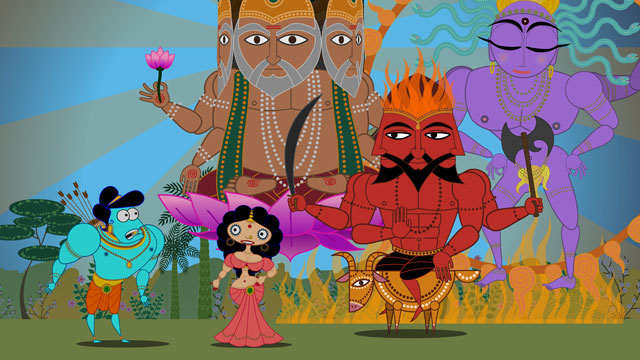
14:19 And the angel thrust in his sickle into the earth, and gathered the vine of the earth, and cast it into the great winepress of the wrath of God. https://t.co/qpcHebgQG7 pic.twitter.com/YwWIxKaZ8h
— Apocalypse Animated (@ApocalypseAnim) January 19, 2026
Showing posts with label Nina Paley. Show all posts
Showing posts with label Nina Paley. Show all posts
Tuesday, January 20, 2026
The Wine of God
Tuesday, May 20, 2025
Nina rides again, sorta'
I drew "Buckin' Bronchie" because I think bronchiectasis sufferers need a name (bronchies) and a mascot. Next I will draw Bronchiesaurus. Meanwhile, which of these 2 versions is better? pic.twitter.com/bEQj3G6U0n
— Nina Paley (@ninapaley) May 20, 2025
Sunday, March 9, 2025
Nina Paley on sex and life
Nina is a wise woman. I'm bumping this to the top of the queue on that account.
Nina Paley reflects on sex and her complex experience of it: My Sex-Positive Memoirs, 4W, January 14, 2020. It's mostly about her years in San Francisco in the 1990s. Near the beginning:
A horny, childfree, sex-loving, non-monogamous (that’s another story) heterosexual young woman should have had no trouble finding sex partners, yet this was not the case. I did find a few men to have sex with—once. They would have sex once, then I’d never hear from them again. Even finding such men was difficult.
Why was I pursuing non-committal, “empty” sex anyway? Sure I loved sex, but I didn’t understand it.
I had received plenty of sex education: my mother worked for Planned Parenthood, and my childhood was filled with earnest Liberal sex-education books like “How Babies Are Made” and “What’s Happening to Me?” Throughout my teens and young adulthood, I was encouraged to talk about sex, to “communicate,” so I would be spared the repressive hang-ups of my mother’s generation. I was naturally drawn to the Sex-Positive circles of San Francisco, where we talked and talked and talked about sex. But this “sex education” - all the Liberal discourse around sex - unwittingly encouraged dissociation: we could only talk about the body as a thing that does acts. Much of our intellectualism was a defense against vulnerability and what we dreaded most: shame. We separated sex from love and relationships; we thought that was progressive and empowering.
Overall, I wish we had shut up about sex more, and mediated it less. Mechanics aside, sex is a mystery, to be experienced directly and personally. Talking about sex is as useful as talking about God. Mediating spiritual experience does nothing to enhance such experience, but it does allow manipulation of seekers, giving rise to cults.
Toward the middle:
Was I supposed to save myself for Love? I’d already been in love, several times, and my lovers imploded and left me. Men found me “too intense.” No one wanted my love, not even me. The idea of men loving me for who I actually was was long gone. No one wanted my soul, but some wanted my body, which was thin at last, and with makeup, a wig, and high heels was literally a hot commodity.
I was well aware I was supposed to be cautious, and took precautions; I only responded to solicitations specifying “no nudity” and “no sex” (both of which turned out to be laughable, and are tactics still used to this day to recruit young, vulnerable women). I was also aware that I was supposed to feel ashamed. I spent a lot of time considering shame, and rejecting it: I wasn’t harming anyone (ha!), my choices were informed, my eyes were open. Sex was nothing to be ashamed of. Objectifying my own body was nothing to be ashamed of: all the strippers, prostitutes, and porn models/directors who spoke at SFSI [San Francisco Sex Information] made that clear. It was work, it was art, it was expression. No shame in objectification: we are all objects, we live in a material world. Nothing wrong with exchange for money, either; we exchange all kinds of goods and services for money, why are bodies and sex any different?
Now-me knows sex is different, and bodies are not commodities. Then-me simply wouldn’t have believed it. The body is sacred? Nothing is sacred in this world. Was I supposed to just cloister myself, be abstinent until Mr. Right came along? There is no Mr. Right, there was no one who would understand and respect and love me the way I needed to be loved, and time was ticking away while my very temporal body was at its peak of beauty and my hormones were screaming “fuck! fuck! fuck!” [...]
A hot body is often the biggest asset many young women have. We are lucky if we have hot, conventionally attractive bodies. All my years developing my mind and talents meant nothing compared to my brief moment of hot-boddedness. Men who were never impressed by my art would fall over themselves to buy me drinks and otherwise attend to me when I went out in a wig and makeup. I actually felt sorry for these men, so helplessly conditioned they were to respond to stupid gender cues, their feeble minds taken over by mediated programming. Do I pity them still? As much as I pity anyone who surrenders personal responsibility and critical thinking in favor of unexamined social programming. Such people are pathetic—and authoritarian, dangerous enablers.
For about a year, I enabled them myself, by dressing up as the male idea of a sexy woman: drag.
Toward the end:
Life is all about making mistakes. No one has figured out how to get it right. If you keep sex sacred and private, your kids grow up repressed and ashamed (or so my elders have told me; I wouldn’t know). If you make sex casual and public, it becomes a commodity and we lose our souls. Radical feminists rightly criticize porn, but banning porn outright is repressive — and almost certain to backfire, given the willful misapplication of porn regulations thus far. (In the 1990’s, alternative comic books were regularly seized at the Canadian border because they were “mistaken” as porn. This effectively turned me against any and all porn regulation, but only later did I consider the border guards’ frequent “mistakes” may have been on purpose, to manipulate people like me into opposing regulation I would otherwise support).
My 20’s were hard. So was my childhood. So is right now. I’m not entitled to a do-over of childhood, youth, or last week. Do I regret the choices I’ve made? Yes, in the sense I wouldn’t make those same choices again. But no in the sense that all of those choices made me who I am, and I like myself. I did stupid things because I didn’t know any better, and the only way for me to learn was to do the stupid things I did. It’s not like “sex work will hurt you” was any secret. Warnings against it were plentiful but not persuasive, and besides, I’d found my way into a kind of cult. The herd I homed to was all about sex work, porn, objectification, and “non-judgement”; who was I gonna listen to, them or a bunch of repressed prudes?
Now I’m in menopause, and have hardly any libido anyway. Whether that’s due to the permanent scars of my “sex-positive” 20’s, or the natural exhaustion of my ovaries, I do not know. Many or most women slow down a lot sexually in their 50’s, yet sex is still worshiped throughout our culture. Much of our population couldn’t care less about sex, even while it permeates all media as the be-all and end-all of life. Sex in advertising, sex in novels, sex in movies, sex on television, sex, sex, sex — and most women over 50 don’t give a damn. Many women under 50 do, but we have to see sex from the male perspective all the damn time, because men still make most media. We objectify ourselves.
It is a relief to not be horny all the time any more. It’s also unnerving, because in this society we’re supposed to be horny. Except when I was horny, men didn’t like that either. Women are either out-of-control nymphomaniacs, or dried-up prudes.
Or maybe, just maybe, women’s sexuality doesn’t exist to please men.
I just wish it had pleased me.
Tuesday, April 16, 2024
Mimi and Eunice ride again
In 2018 I published these comics, figuring I'd already been canceled so might as well be honest. Not many people saw them, because, you know, canceled. How do they hit today, almost 6 years later? Complete set at https://t.co/v77QrcSiaO pic.twitter.com/hWOZ2Hnv48
— Nina Paley (@ninapaley) April 16, 2024
Monday, January 1, 2024
Nina Paley loves being sucked into AI [Happy New Year!]
Other artists hate having their work and styles sucked into AI. But I love it! My work is all Free Culture, I am thrilled to find my name on this list. If Midjourney would actually generate something that looks like my style… https://t.co/DwOGhbl6YS
— Nina Paley (@ninapaley) January 1, 2024
Don't forget this, from a decade ago:
Wednesday, December 13, 2023
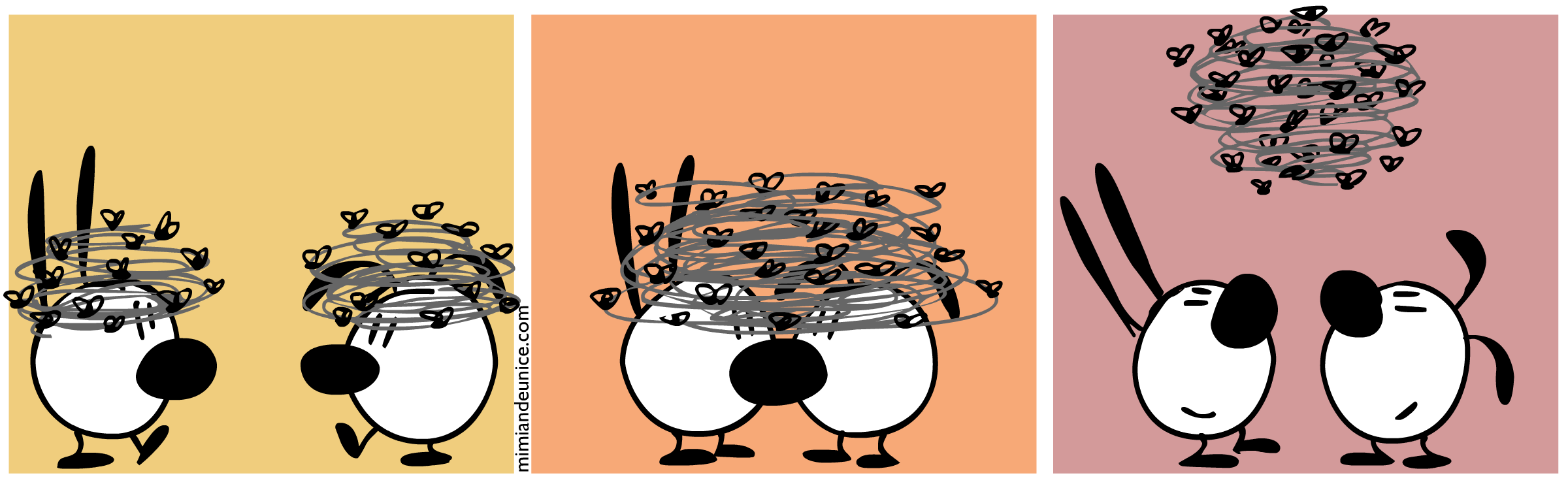
Tuesday, November 21, 2023
The Agni Pariksha segment from Nina Paley's Sita Sings the Blues
Now that I've just put fire on the table, though a segment from Disney's original animated version of The Jungle Book, I might as well go whole hog. At the center of Nina Paley's Sita Sings the Blues there is an astonishing 3-minute sequence depicting a fire ritual, the Agni Pariksha. Here it is:
I described that sequence in some detail in something I published in 2014, Cultural Evolution: A Vehicle for Cooperative Interaction Between the Sciences and the Humanities. I've also interviewed Nina about that segment, Nina Paley on the Agni Pariksha, where she comments on the segment as we move through it from beginning to end. I've also provided some descriptive information on the sequence.
What follows is an edited version of the presentation in the cultural evolution paper.
* * * * *
Nina Paley’s animated film, Sita Sings the Blues, revises and retells the story of Rama and Sita from the Ramayana, one of the classic texts of Hinduism. Paley tells Sita’s story in three different ways: 1) in a series of vignettes set to songs recorded by Annette Hanshaw in the 1920s and which is animated in a very “cartoony” style; 2) in a series of scenes based on paintings Paley did in imitation of 18th Century Rajput miniatures and on collages based on what appears to be calendar and greeting-card art, and 3) through voice-over dialogue among three Indian-Americans talking about the Ramayana and realized on-screen as three Indonesian shadow puppets. The multiplicity of this story, its many sources – which I’ve only hinted at in this brief description – is deliberately built-in to the visual and audio texture of the film.
Let's look at the film itself. What does it look like on the screen? How do we describe it? What features are important to the film’s effect, and which are incidental? These are important and difficult questions and I can do no more than indicate what’s entailed.
In particular, I want to examine the Agni Pariksha segment, which is unlike anything other segment in the film. In the Ramayana Sita had to prove her fidelity to Rama in a trial by fire. She throws herself into the flames and is rescued by Agni, the fire deity, thereby establishing her purity.
Paley has placed this segment somewhat after the middle of the film at the point immediately after Nina, her alter ego in the film, learns that her husband wants a divorce. On the sound track we hear her heart thumping away while we see it pulsing (a stylized red heart) and finally breaking. At that point Nina screams, the virtual camera zooms into her wide-open mouth, and we’re into the segment, which is basically a solo dance amid flames.
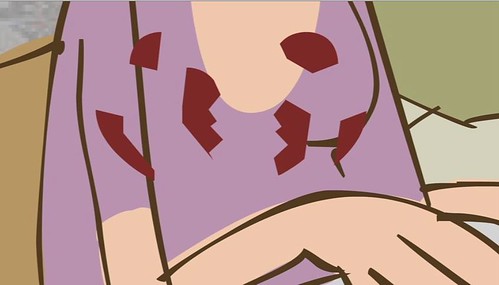
Nina’s broken heart.
The role of Sita is danced by Reena Shah, who voices Sita and who also sings the lyrics, written in Hindi by her mother, Laxmi Shah. This is the only place in the film where we hear Hindi and the only place where we see live action, sort of. Paley videotaped Shah dancing before a green screen and then hand-traced Shah’s movements into the film.
Rather than attempting to describe the entire three-minute segment, which could easily go on and on – “a picture is worth thousand words” and this film packs a lot of them into 180 seconds. Instead, I’ll concentrate on a few frames. The following two frames are from the beginning and the end of the segment, respectively. We see Sita in white outline against a black background, but her hair has some color fill (collaged in) in the ending segment, but not the beginning.
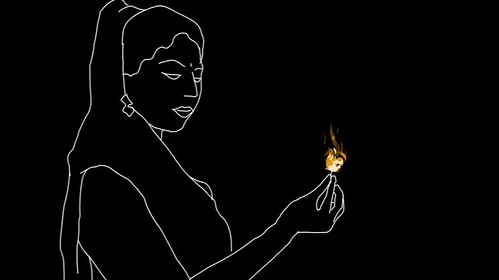
Light the match.

Blowing out the match.
In both frames she is holding lighted match. She lit the match at the opening of the segment and then dropped it, lighting the fire beneath her. At the end she blows the match out, ending the segment. Thus there is a bit of visual continuity between the opening and ending segments. At the same time the final act, in effect, reverses the opening one. The opening act took Sita into the fire; the closing act brings her out of it and back into the world.
Is this a rite de passage? (Of course it is, of course.) For who? Sita, Nina, us? Of what kind, from what to what?
Now consider these three frames, which come one after the other in the film:


Sita dancing, 1, 2, 3
The backgrounds are pretty much the same, which is what you would expect from such closely spaced frames. But look at Sita in the center. Her outline is not quite the same from one frame to the next, for she’s spinning counter-clockwise at a pretty good rate; but her overall visual mass remains in the same position within the frame. The texture filling her form, however, differs radically from one frame to the next. All three body fills are half-tone images magnified to the point where the individual dots are visible, but I can’t make out identity of the material in either the first frame or the third. The second image is the head of a woman.
Paley uses this technique throughout the segment. None of the collage elements is on the screen for more than a fraction of a second. You can identify some of the images, but not most of them. It is obvious that she’s showing lots of different things mostly through Sita’s form, but through other elements of the segment as well.
Now look at Sita in this next frame, to the left. Her outline, in black, is decoupled from the texture-filling forms, one for her hair (yellow-green), one for her body (a warm medium brown) and still others for her eyes. Paley does this for about six seconds. What’s this about?

Form and fill dissociated
If you’ve been reading visual neuroscience you may note that fill and outline are handled in different systems, as is motion. So Paley is “manipulating” those systems, which is interesting. But that doesn’t tell us why she’s doing it? Because she can, and it’s interesting? Certainly, but is that all?
Before I hazard a guess I want to state that the most important thing, at this point, is simply to describe what’s going on. Without that description, nothing else can be done.
So, why’s she doing it? Because it’s different from every other segment in the film, including the two segments that also depict the Agni Pariksha. One of those is set to Annette Hanshaw’s performance of “Mean to Me” while the other is set to her performance of “I’ve Got a Feelin’ I’m Fallin’.” In both of those cases the visual style is Paley’s old-time “cartoony” style, which she uses for all the Hanshaw performances. That is to say, those ritual enactments are not visually different from any other events in the Hanshaw version of the Sita story.
Any anthropologist will tell you that rituals are about transformation (e.g. van Gennup 1960); some literary critics will tell you that as well (e.g. Frye 1965, Barber 1959). By making this segment visually different from anything else in the film Paley is giving the film itself a ritual dimension – though the part of me that is a child of the 60s is thinking “altered state of consciousness” (cf. Fischer 1975). She’s not merely showing a ritual, depicting one in the film; she is inviting us to enact a ritual by experiencing the visual world in a way that is radically different from what we experience anywhere else in the film. This segment of the film IS ritual.
Now, if we wish, we can begin thinking about what happens in the nervous system in this segment that is different from every other segment in the film. In the annoying manner of math textbooks, however, I’ll leave that as an exercise for the reader.
Monday, November 13, 2023
Extra! Extra! Read all about it! New Savanna now has 666 tags. [Mark of the Freakin' Apocalyptic Beast]
When I added that last photo post, from my recent breakfast at Turning Point in Hoboken, my breakfast joint now that the Malibu is toast – though perhaps it will be reborn, I decided that, I've got so many of these posts of my breakfast food and ambience, I really ought to add a new tag. So I did. "Breakfast" is now in the tag list.
That brings my tag total to 666, the Mark of the Beast (Book of Revelation 13:18). Dare I tempt fate in that way? Perhaps that would signal the AGI emerging from the web that it's time to take control.
The horror! The horror!
13:18 Here is wisdom. Let him that hath understanding count the number of the beast: for it is the number of a man; and his number is Six hundred threescore and six.... https://t.co/081eE7WaJ9 pic.twitter.com/roo0lWfXll
— Apocalypse Animated (@ApocalypseAnim) May 1, 2023
Wednesday, May 18, 2022

Thursday, April 21, 2022
Lillian Friedman Astor – First woman animator in a major American studio [Nina Paley]
Here are her offer letters from Fleischer from 1933. pic.twitter.com/uUTWcSSPr0
— Aaron Astor (@AstorAaron) April 20, 2022
And here's a sample of her work: "Betty Boop: Pudgy Takes a Bow-Wow" from 1937. She gets animation credit with Myron Waldman.https://t.co/g2QHxdmHSt
— Aaron Astor (@AstorAaron) April 20, 2022
Nice photo of her in her studio on her Wikipedia page. https://t.co/OnlhEeWBpD pic.twitter.com/7W4LU2OPj5
— Aaron Astor (@AstorAaron) April 20, 2022
LOL!
— Bill Benzon, aka The Danish Space Laser (@bbenzon) April 21, 2022
Dibble, dabble, boil and bubble,
Our ears are burning
And you're in trouble.
This post says a little about what women did in Disney's studios at the time and how very difficult it was, In Praise of Women's Hands.
Friday, February 18, 2022
Nina Paley does the Apocalypse
The @internetarchive was the source for this perfect music I found for the https://t.co/u1PXoMxWEV trailer video. https://t.co/yPprTMQtsr
— Nina Paley (@ninapaley) February 18, 2022
Sunday, October 10, 2021
Nina Paley’s Summa Quiltologica
I would like to perform the following experiment: Select two groups of people who are fairly sophisticated about the visual arts but who have never heard of Nina Paley nor know about her work. Each group will see the quilts in Nina Paley’s 4 Elements series. One group will be told that they are, say, an MFA (Master of Fine Arts) project by a student at a first class art school, say Cal Arts. The other group will be told they were by a cartoonist.
What will they say? In particular, will the conceptual framing – art student vs. cartoonist – elicit different kinds of comments? I’m fishing for a specific difference. Here’s a photo of the four together:
 |
| Image courtesy of Des Pickard |
The most obvious thing about the set is that three are strongly colored (Earth, Water, and Fire) while the fourth, Air, is not. The second most obvious thing, at least to me, is that they are in distinctly different visual styles. Earth, the first one Paley did, is more or less early modernist, think of say, Matisse crossed with Rousseau. Water, the second one she did, is East Asian. The waves are reminiscent of that Hokusai print everyone knows (though, in fact, a bit different from it) and the dragon is East Asian, though a perhaps bit streamlined.
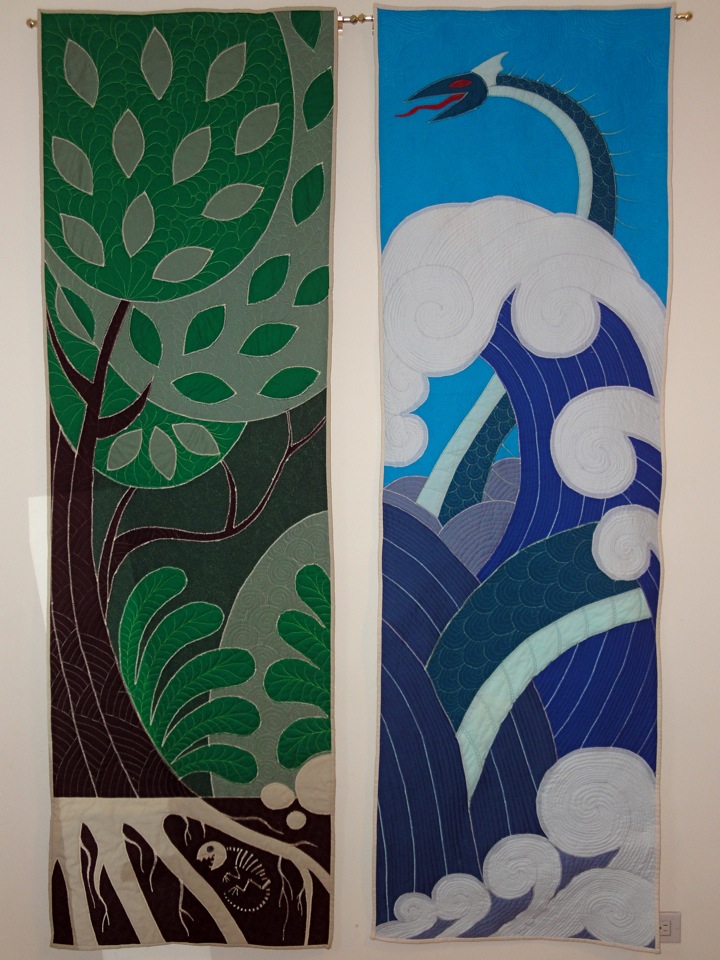
The third, Fire, derives from Indian and Tibetan sources:

The patterns on the hands, for example, are mehndi patterns in which henna is used a temporary form of skin decoration used in the Indian Subcontinent. The cloud forms are inspired by Tibetan tapestries (cf. this post of Paley's). As for the fourth, Air, we’ll get to that shortly.
Getting back to our experiment. I’m guessing that the people who think these are made by a cartoonist would be less likely to remark on the stylistic difference than those who think the quilts were done as an MFA project. If you think of the quilts as the work of a cartoonist, well, cartoonists like broad forms and bright colors, right? And at least three of the four are just like that, right? So what more is there to say?
If, on the other hand, you think they were done by an MFA student, you’re more likely to notice the stylistic difference and to wonder: What’s up with that? If you don’t like it, you may wonder why this artist has no personal style, but seems to be foundering around among different styles. If you’re more charitable you may wonder whether this deliberate eclecticism is, for example, a statement about transnationalism in our global era.
My own view is somewhat like the last. But only somewhat. I’m not much concerned that Paley is making some such statement. I’m simply struck with wonder that she’s worked in four different styles. Except for the last, Air, the stylistic difference is easy to miss, to look over or look past. But it’s right there in front of you, big as day.
The imagery in these quilts is not like that in her cartoons – at least like the cartoons I’ve seen. Nor is it like that in her animations, including Sita Sings the Blues. Quilting is a new medium and so she’s adopted a new style/s.
Now, the fourth quilt, Air/Nude:

Darin made this comment on my previous post:
The white nude is gorgeous, to be sure, but to my eye it doesn't at all look like it belongs with the previous three in the 4 Elements series. It's like Nina no longer felt like working in that style, but she still felt the nagging absence of the fourth quilt.
Yes, it is very different and, for all I know, it may represent a stylistic departure. We’ll have to see.
The white-on-white coloring is at once very contemporary (think minimalist) and very classical, sorta. That is, we think of white marble statues as very classical – the Ancient Greeks and Romans. And this is reminiscent of those white statues. And if you think of quilting as bas relief sculpture in fabric, the parallel becomes even closer. Yet we now know, and Paley certainly does, that those ancient statues were, in fact, painted in often bright colors. That is to say, those classical statues and bas reliefs were as highly colored as the other quilts in Paley’s series. I am thus beginning to suggest that the relationship between this fourth quilt and the other three is – here comes that word – dialectical. It completes the series even as it plays against and off it.
Notice, for example, that while the first three quilts are highly colored, they have distinctly different color schemes. What they have in common are large curvilinear forms and (often quite intricate) stitching within those forms. In the fourth quilt those different color schemes ‘cancel one another out’ and become whit;, the curvilinear forms become the form of a woman; and the intricate stitching becomes still more intricate and becomes the background behind the woman.
And yet that background is also the foreground. For quilting is about the stitching, not the piecing. In this quilt the piecing, the assemblage of different pieces of fabric, is gone. All the expressive work is in the stitching. But you can’t see it as a distance, as you can the figure of a woman. You have to get up close and move your head and eyes over the piece. You must touch it with your eyes.
That stitching is in dozens of different patterns – hundreds? It is an encyclopedia of stitching patterns and, as such, implies the whole universe of quilting patterns. The four different aesthetic styles implies the whole world of aesthetic styles. And the titular theme – the four elements: earth, air, fire, and water – implies the fundamental stuff of the cosmos.
Within that fundamental stuff there are the DNA molecules Paley stitched into the background, the thread of life rendered in quilter’s thread. Think also of the small skeletons at the bottom of Earth and Fire, not threads, but bones, bones that then retreat into the background and been transformed into threading patterns.
It’s all in there, round and round; earth, air, wind, and fire: north, south, east, and west; animal, vegetable, mineral; life, death, DNA, and a stitch in time. A Summa Quiltologica.
Friday, May 14, 2021
Give Nina money ($$$$) so she can create more MysticSymbolic AWESOMENESS! {pretty, pretty please, pretty pretty please please}
MysticSymbolic is my current project, and I’m raising money to (hopefully) get my genius collaborator @toolness enough time away from his day job to make it much more awesome. More money = more coding time = more awesome!https://t.co/KkDRiXRKhN via @YouTube
— Nina Paley (@ninapaley) May 14, 2021
Here's the fundraiser: MysticSymbolic Development. About:
MysticSymbolic currently lets you randomly generate “creatures ” - really compositions - using a vocabulary of over 100 visual symbols I’ve been designing and testing over the last several weeks.
The same symbols appear in randomly-generated mandalas , with some limited animation functions. Atul also made these controllable animated waves , based on the way I animate waves in my films . Thanks to the contributions of Maneesh Yadav, we have the beginnings of procedurally-generated colors; thanks to contributor Dave Weaver, we have experiments running on a separate web site .
But these represent the mere embryo of what MysticSymbolic will be, if we can get some quality dedicated coder time. Then it will be able to generate complete compositions with animated backgrounds and harmonious colors. [...]
What do you get for contributing? MysticSymbolic is a Free Culture, Open Source Software project. We’re giving it to everyone as we create it, and you can use the assets or fork the software already. But there will be more and better assets to use and code to fork, if we can afford more work-time.
Friday, January 15, 2021
2020 vision
"2020", a $100 Drawing for Linda. https://t.co/5C1ZRpzCxj pic.twitter.com/i7Yy4Vk1II
— Nina Paley (@ninapaley) January 11, 2021
Sunday, July 14, 2019
The Sita Chronicles
This post lists my various work on Nina Paley’s Sita Sings the Blues,
from my initial review in The Valve, to the post on cultural evolution
which featured it, through my ongoing articles and interviews.
Reviews and Essays
- Sita Sings the Freakin’ Gorgeous Blues
- Frog Up Ponyo Sita: Complacency vs. Vision
- On Learning to See Sita Sings the Blues
- From Elizabeth to an Nina: Stick to Your Guns, Baby
- Behind the Scenes: Disney, Miyazaki, Paley
Analysis and Description
- The Agni Pariksha in Context
- Cultural Evolution: A Vehicle for Cooperative Interaction Between the Sciences and the Humanities (online, downloadable)
- Ritual in Sita Sings the Blues, Part 1
- Ritual in Sita Sings the Blues, Part 2A
- Ritual in Sita Sings the Blues, Part 2B
- Ritual in Sita Sings the Blues, Part 3 — Shakespearean Resonance
- Ritual in Sita Sings the Blues, Part 4 — The Cosmos
- Notes on Ritual: Sita Sings the Blues (PDF) – Consists of 1, 3, 4, 5, 6, and 7 plus some advice from Queen Elizabeth I of England to Nina Paley on sticking to her guns.
- Notes on the Agni Pariksha in Sita Sings the Blues (PDF) – Descriptive information about the Agni Pariksha episode, including 1) a nine-page table describing what happens in the episode scene by scene, 2) a list of the heart images, 3) lyrics to the song, with English translation, 4) a set of 21 representative screen shots.
Interviews
A note about the order: All of these are part of the same interview. I've listed them in their order in that one interview. But the second interview segment is the first one I published and the first interview segment is the second one I published.
A note about the order: All of these are part of the same interview. I've listed them in their order in that one interview. But the second interview segment is the first one I published and the first interview segment is the second one I published.
- Nina Paley on Fire
- Nina Paley on Directing and Being Directed
- Nina Paley: Seeing Gods
- Nina Paley: A very brief hot mess
- Nina Sez: Invent Stuff? Who, me? Nah
- Nina Paley: Talking about Art is Creepy
- Nina Paley on the Agni Pariksha (PDF) – Transcript of an interview with Nina Paley on the Agni Pariksha episode of Sita Sings the Blues. Includes 21 screen shots used to prompt Paley's comments.
Saturday, July 13, 2019
Post 6000 here on New Savanna – My oh my, how time flies!
My first post at New Savanna went up on April 14, 2010. It consisted of a single Mimi & Eunice strip by Nina Paley and was called Pay Up. If you follow the link you’ll find the strip isn’t there; broken link. But I’m pretty sure this is the one:

It looks like I did 188 posts with Mimi & Eunice, mostly up through 2012, which seems to be when Paley stopped doing them. However, I’ve just discovered that she did a series of The Jenndra Identitty Comics in late 2018 which will not please the woke among us. Looks like I’ll have some more Nina Paley to post.
Here’s a tweet, some concept art for Hayao Miyazaki’s Totoro, one of my favorite films by one of my favorite film-maker. I’ve posted quite a bit about him – including extensive analysis of his most recent feature, The Wind Rises.
Hayao Miyazaki's concept art for My Neighbor Totoro pic.twitter.com/zVWuexvgxg— 41 Strange (@41Strange) July 13, 2019
I’ve been posting tweets since September of 2018.
And here’s a post I did to mark post number 2500: 2500 Posts: What Have I Been Doing at New Savanna?. That went up on July 14, 2014 and included five photos and one diagram. It also included some accounting of what I’d been up to most recently.
I’m pretty sure that, back then I’d intended to do another such post to mark #5000. But that came and went and I didn’t even notice it. It was fortuitous that I picked up on #6000. Will I catch #10,000? Will I even be posting then?
Who knows?
But 6000 posts! Can you believe it? There are 1969 photo posts – I know this because they’re all tagged with “photo” and the analytics gives me a count of how many posts are on a tag. Almost all of the photos are mine, though a very few are in tweets. These posts all have one or more photos in them, some perhaps as many as a dozen or more. Most of them are without commentary. But a few have light commentary, and fewer still have extensive commentary.
I try to vary my choice of photos from day to day. Sometimes the photo or photos for a given day will be in counter point with other posts on that day.
Roughly speaking, the other 4000 posts or so are divided between long-form posts in which I think about various subjects – literature and literary criticism, music, cultural evolution, computers and computing, psychology of various kinds, some autobiographical pieces, and so forth – and posts linking to articles by others. There’s no easy way for me to count the long-form posts. I’d guess there are less than a 1000 of them. Less than 500 or more? Can’t say. But this is where I do much of my thinking, out loud and in public. Some of them are more polished than others, and I use various writing styles as the topic warrants.
The other 3000 to 3500 (or more) posts feature material by others, generally with quotations, often extensive, from the sources. If I’m linking to an academic article I’ll include the abstract and sometimes material from the body of the article. Depending on this or that, I may comment on the linked material, sometimes just a sentence or two, but sometimes at greater length. Let’s say that half of these posts (but I don’t really know the percentage) are on topics I’m actively thinking a posting about and so constitute research. The other half is just things I’m interested in, often current events.
More later.
One other thing. I don't know what I've got here. Sure, I know roughly what I've got, and I've got that ridiculous tag cloud over there to the right. But when I go roaming through the archives I find things I've forgotten about.
Always.
It's like that, no?
* * * * *
One other thing. I don't know what I've got here. Sure, I know roughly what I've got, and I've got that ridiculous tag cloud over there to the right. But when I go roaming through the archives I find things I've forgotten about.
Always.
It's like that, no?
Thursday, August 2, 2018
Seder-Masochism: Nina Paley began at the end and ended at the beginning
Nina Paley has now finished her second feature film, Seder-Masochism–her first, of course, is the marvelous Sita Sings the Blues. Seder-Masochism is now playing at festivals but the full movie is not yet generally available; it seems that some of the festivals won’t show a film that has an “online platform”. So we’re going to have to wait awhile to see it whole, from beginning to end.
But Nina’s been releasing segments since 2012 and I’ve seen most, perhaps all of them. I want to offer some brief comments about two of them. This Land is Mine is the first segment she released, but it will be the last one in the film. God-Mother is one of the last she released–I don’t know whether or not it is THE last–but will be the first one in the film, even before the credits. Jordan Peterson has interviewed her and, in that interview, Nina said that the process of making the making turned about to be a journey of discovery in which she, in effect, discovered God-Mother.
The End: This Land is Mine
This Land is Mine is in the style she used for the music clips of Sita Sings the Blues:
The song is the theme song from Exodus, a contemporary epic about the founding of the modern state of Israel that came out made in 1960. The movie was a hit and so was it’s theme song. Originally an instrumental, “This Land is Mine” was given lyrics by Pat Boone and was a major hit, both in instrumental and vocal versions. Paley’s clip is based on a vocal version sung by Andy Williams.
The clip’s opening is very ‘stagy’:


The virtual camera then zooms in on a generic Early Man who starts singing the song:
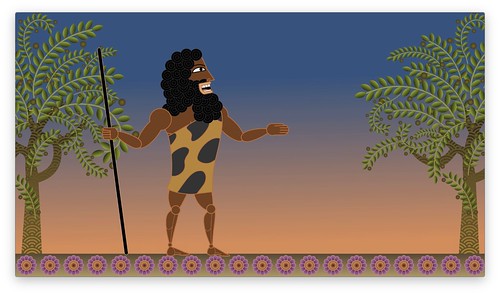
The camera then stays focused on that space through the clip to the very end.
Soon another figure, a Canaanite, enters from the right, in different dress, kills our Early Man, and continues singing. An Egyptian enters from the left, shoots this character with an arrow, and continues the serenade. You can pretty much guess what happens next. Someone enters from the right, kills our Egyptian, and continues singing. Sorta’. Enter from the right, yes. Kills the Egyptian, yes. Continues sing, you bet. But he passes across the screen, in silhouette, exits at the left, and then re-enters from the left, and comes up behind the Egyptian. Then he kills him. And the slaughter continues, left, right, left, right, etc. until the very end, when we’re all dead:
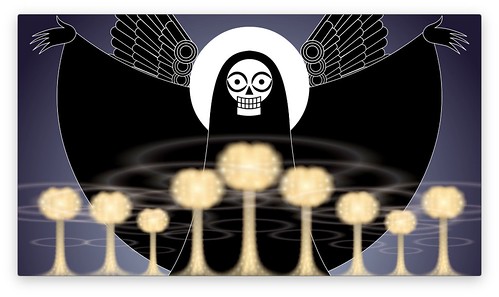
The atomic Angel of Death takes us all.
This is a very grim segment. Cruel. But also witty, and even beautiful, as Jordan Peterson notes in one of his remarks to Nina.
Paley keeps our interest by changing the costumes of the killers (Paley identifies them all in this blog post) and by varying the timing and method of slaughter. For example, if you know the song at all, then you know at one point we have this line: “So take my hand...” When you hear some poor soul start singing that, you know what’s going to happen, don’t you?
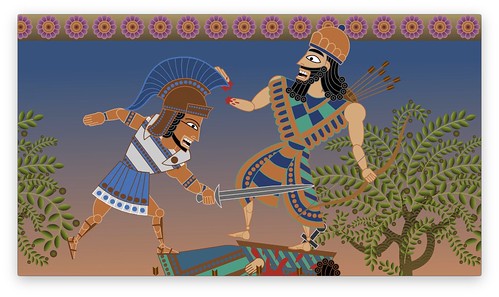
And so it goes, line after line of this preposterous anthem, people get slaughtered right and left, left and right, until the Angel of Death takes them all. And then Paley runs the end credits, but over distinctly different music, a gently singing version of the theme by Quincy Jones. Does she keep this for the full-length version? It’s not as though the credits change much: “written, directed, designed, animated, etc. by Nina Paley.” Well, I guess she’d got to give credits for all the musical selections.
Saturday, July 28, 2018
Another ramble to figure out what I’m up to: space travel, peace, Joe Rogan, computational lit crit [Ramble 11]
It’s time for a bit of rambling so I can take stock and figure out where I am & where I need to go.
GVMBP 2018
Sunday I posted some photos from Saturday’s Massive Block Party, thrown by Green Villain, Writer’s Workbench, and VYV Apartments. More on went up on Tuesday.
Onward Ho!
On Sunday I uploaded another essay to 3 Quarks Daily: Three Children Of The Space Age: Elon Musk, Freeman Dyson, And Me. That essay, of course, goes deep into my past, up through the present and, who knows, maybe into the future. But I wrote it as kind of an outer out-there bounds to a project I’ve been working on with Charlie Keil, a series of little books, or pamphlets, on the theme: Local Paths to Peace Today. We published the first volume two years ago: We Need a Department of Peace: Everybody's Business, Nobody's Job.
 |
| Ralph Nader with his copy of We Need a Department of Peace |
We’ve just sent the second volume off to press: Thomas Naylor’s Paths to Peace: Small is Necessary. That’s about how everything’s too damn big, especially the states we live in. We’re now working on a third volume which doesn’t have a title yet (though CK likely has something he’s thinking about). For the moment let’s call it Where We Want to Go: Cooperation and the Common Glad Impulse.
Well, I figure we need to present some scenario for a different future, the opposite of those dystopian scenarios I wrote for Abbe Mowshowitz two decades ago. Now, you see, CK is something of a Luddite and has no interest in manned space travel, but I’m a bit different. Elon Musk has interesting things to say about where we’re going and how we get there, so I figured that would be a good warm-up.
Moving closer to Where We Want to Go, I’m participating in a group reading of Kim Stanley Robinson’s New York 2140, which is about a future in which the seas have risen 50 feet. Can we live in that world? Robinson says we can. I think so too. My idea is to take KSR’s world and tweak it a bit to meet our requirements, Charlie’s and mine. Of course, I’ve already read and blogged about New York 2140, but Bryan Alexander, futurist and educational consultant, has just kicked off a group reading. I figure that’s a good way for me to see what others think about the future.
This kicked off a series of posts on Musk, the simulation argument, and the Singularity. I’ll likely return here from time to time.
Joe Rogan’s reality club
On Thursday I returned to my interest in Joe Rogan with a long post, Joe Rogan and Joey Diaz call “Bruce Lee vs. Chuck Norris” – a rough transcription of their conversation. The title tells the story. I took a ten minute conversation that Rogan had with his buddy, Joe Diaz, about a scene from a classic martial arts film. Why’d I do that? Because I’m interested in what Rogan does and how he does it. Conversation’s his medium. The next step is to go through the conversation and comment on it, like I did with a paragraph from Heart of Darkness.
I don’t know when I’ll get around to this. Or even if I will. But I really should, shouldn’t I? And then I can wrap up my Rogan posts into another working paper.
Computational Lit Crit
Later on Thursday I published a long post on Michael Gavin’s recent article, Vector Semantics, William Empson, and the Study of Ambiguity. This first post centered on a famous memorandum, Gavin 1.1: Warren Weaver (1949) and statistical semantics. I’ve got two more posts planned for this series:
- Gavin 1.2: Warren Weaver 1949 and compositional semantics
- Gavin 2: Comments on a passage from “Paradise Lost”
Those posts are in an advanced stage of planning and an early stage of drafting. I hope to have Gavin 1.2 up in a day or three, to be followed by Gavin 2 and day or three later. Then I’ll assemble them into a working paper, post it, and then set about turning it into a paper for submission to an appropriate journal, perhaps Cultural Analytics.
The idea is to compare and contrast three distinct approaches to meaning, traditional “close-reading”, statistical semantics (which is well known in the digital humanities), and what I’m calling compositional or constructive semantics, which is not so well-known. Compositional semantics is what I did my doctoral work on. It’s well developed in cognitive science, but also in computational narratology, and computer gaming. Once I’ve got all three on the table (in Gavin 2) I can make a distinction between close reading on the one hand, and statistical and compositional semantics on the other. Close reading is about meaning, and meaning is ontologically subjective (in Searle’s sense). But statistical and compositional semantics are not. The exist in the object realm; they objectify meaning. Close reading is validated through ethical arguments; it is a tool of ethical criticism.
Statistical and compositional semantics are somewhat different and I’ve not yet figured out just how to talk about them. For the moment, let’s say that statistical semantics are assessed with respect to truth. Within cognitive criticism statistical semantics may be used in the context of an argument that is basically about meaning.
Compositional semantics as well can be assessed as to its truth. But it also has engineering uses.
It’s complicated.
* * * * *
And I’ve got to keep all these balls in the air, Green Villain, scenarios for the future, Rogan, and cognitive criticism.
And the photographs. Took several hundred this week.
That’s a lot of work.
Addendum: Oh, I forgot! I've got to start blogging about the segment's of Nina Paley's Seder-Masochism. The first post will be about two segments, This Land is Mine, which is the first one Nina made and is the last one in the film and, God-Mother, one of the last segments she completed and first in the film.
* * * * *
Addendum: Oh, I forgot! I've got to start blogging about the segment's of Nina Paley's Seder-Masochism. The first post will be about two segments, This Land is Mine, which is the first one Nina made and is the last one in the film and, God-Mother, one of the last segments she completed and first in the film.
Sunday, July 15, 2018
Jordan Peterson interviews Nina Paley
Nina Paley is an animator and artist who makes unbelievably beautiful films. We discussed her life, her views, and her work, interspersing her animation throughout. Nina has done a particularly brilliant job of animating Exodus as a feature length film (see www.sedermasochism.com, as well as her Vimeo channel https://vimeo.com/user2983855
BTW, Nina has a prayer to her muse. She recites it at about 50:20:
Our idea, which art in the ether, that cannot be named, thy vision come, thy will be done, on earth as it is in abstraction. Give us this day, our daily spark, and forgive us our criticism, as we forgive those who critique against us. And lead us not into stagnation, but deliver us from ego; for thine is the vision, the power, and the glory forever. Amen.
Peterson remarks:
I would interpret that as a mantra that opens up the gateway between you and this transcendent force that allows people religious inspiration. And you're doing something like clearing out your ego. And I think it is very interesting that it is associated with something like The Lord's Prayer.
Sunday, March 11, 2018
A quick take on civilization by Nina Paley
Civilization: pic.twitter.com/oj7Qd8EkDA— Nina Paley (@ninapaley) March 11, 2018
Subscribe to:
Posts (Atom)