Showing posts sorted by relevance for query "the profession". Sort by date Show all posts

Saturday, August 7, 2021

The road to Xanadu led to Mars: Why structuralism sent me there but the profession went elsewhere

I've issued a new working paper. Title above, download, abstract, contexts, and introduction below:

Download at:

Academica.edu: https://www.academia.edu/50780325/The_road_to_Xanadu_led_to_Mars_Why_structuralism_sent_me_there_but_the_profession_went_elsewhere
SSRN: http://ssrn.com/abstract=3901083
ResearchGate: https://www.researchgate.net/publication/353755798_The_road_to_Xanadu_led_to_Mars_Why_structuralism_sent_me_there_but_the_profession_went_elsewhere

Abstract: Academic literary criticism has become centered on the interpretation of meaning in literary texts. As a consequence, the profession has no consensus account of what texts are or what form is. By following tentative interest in structuralism, semiotics, and linguistics to the analysis of “Kubla Khan” I moved deep into the cognitive sciences with an analysis of Shakespeare’s Sonnet 129. That effectively removed me from the profession, which continued to pursue a wide variety of interpretive approaches. A 21st century discipline would retain interpretation as ethical criticism while incorporating other approaches as description, naturalistic, and computational criticism.
DOI: 10.13140/RG.2.2.17288.75521

Contents

If this is a paradigm shift, how can it be understood? 2
The problematics of text, form, and diagrams 5
Dictionaries, encyclopedias, and the word illusion 10
The word illusion in literary criticism 12
The failure of structuralism and linguistics: Why did academic literary criticism turn its back on intellectual opportunity in the mid-1970s? [and why did I ignore the profession?] 17
Jakobson’s poetic function and textual closure 30
Literary studies for the Twenty-First Century 34
Appendix 1: A short chronology of career events 39
Appendix 2: Cognitive science and literary theory, 1948-1999 40

If this is a paradigm shift, how can it be understood?

I have characterized my career in the following fanciful way:

In the early 1970s I discovered that “Kubla Khan” had a rich, marvelous, and fantastically symmetrical structure. I'd found myself intellectually. I knew what I was doing. I had a specific intellectual mission: to find the mechanisms behind “Kubla Khan.” As defined, that mission failed, and still has not been achieved some 40 odd years later. It's like this: If you set out to hitch rides from New York City to, say, Los Angeles, and don't make it, well then your hitch-hike adventure is a failure. But if you end up on Mars instead, just what kind of failure is that? Yeah, you’re lost. Really lost. But you’re lost on Mars! How cool is that!

Of course, it might not actually be Mars. It might just be an abandoned set on a studio back lot.

I have all but concluded that I have indeed landed on Mars, rather then being lost in an abandoned movie studio. But I would like to know how it happened: There we were back in the 1960s and 1970s, all set to explore the lands that structuralism laid before us, and I end up in a strange and different place while the others more or less abandoned structuralism and ended up where they had started, but facing the other way, any other way, and spinning elegantly in circles.

I two reasons for having chosen this rather fanciful way of characterizing my career. Fanciful though it is, it does give a reasonable sense of how I see things. And the fancy blunts the embarrassing fact that I have to talk about myself so much. I can’t help it. I don’t approach the study of literature the way other literary critics do. I want to know why. The only way to figure that out is to look at what I do and what they do.

The times they are a changing

If I talk of a paradigm shift, I do so because “paradigm” seems to be the word we use to characterize the difference between how I think about literary texts and phenomena and how most members of the profession do. The difference between us is paradigmatic.

Of course, as Thomas Kuhn used the word in The Structure of Scientific Revolutions, paradigms are communal conceptual objects. An intellectual discipline or some substantial group of thinkers within the discipline has a paradigm, a way of construing the world so as to interrogate the world and establish answers. In this case the discipline in question is academic literary criticism. And literary criticism perhaps best thought of as a family of closely related paradigms, if indeed the term is at all appropriate, as Kuhn was talking about science, not intellectual life in the large, though others have generalized from his use of the term. But that’s a quibble.

Given that use, it’s rather, grand, shall we say, for me to talk about my paradigm. One adherent does not a paradigm make. As I said, this is a bit embarrassing. But I do approach the study of literature a bit differently than other critics. I want to understand how and why that difference came about.

Back in the early 1970s, when I was still a graduate student, I was more or less aligned with many of my fellow critics in the pursuit of textual meaning. In the processing of thinking about why interpretations for a given text seemed to proliferate rather than converge the profession entered a period of methodological reflection that included an interest in structuralism, semiotics, and linguistics. I followed that interest and went beyond it, deep into the cognitive sciences. For the most part, however, those others who had been interested in structuralism had abandoned it by the early 1980s in favor of post-structuralism, deconstruction, or something else. To be sure some critics pursued narratology, which has affinities with structuralism, but those are a small minority within the profession.

How did that happen? Why? I suppose I could assert that I am brilliant and creative while the profession is populated by hide-bound clerks. But, aside from the fact that that is not true, it wouldn’t explain anything. What did I see that others did not, or, if you will, why did I pursue it further than others did? Correlatively what interested them that was not so compelling to me? Those questions require fairly specific answers, answers that allow everyone to come out of this story with a some measure of dignity.

On the one hand there is the fact that I have written papers that are quite unlike others offered within the discipline; I mention some of them in the text and in the footnotes of the section, “The failure of structuralism and linguistics.” All of the ones I mention in that section, save working papers on ring-composition (and on Heart of Darkness) have been published in the formal literature. Publication does not mean acceptance as gospel truth, it means only that the work is judged worthy of consideration by other professionals. But I have yet to convince other professionals to take up some of the methods I use in those papers. More importantly, as far as I know, others have not arrived independently at them. Why not?

What’s in the rest of this document?

I make my major argument in the longest section of this working paper: “The failure of structuralism and linguistics: Why did academic literary criticism turn its back on intellectual opportunity in the mid-1970s? [and why did I ignore the profession?].” Since all of the sections in this paper were originally written as independent blog posts, you may choose to read that without reading any of the others.

But I have included them for various reasons. Actually, come to think of it, I have included them for one reason: They are about the problematic nature of the concepts of both text and form within what I am calling standard literary criticism. Neither concept is problematic for me. But then I don’t use them to mean quite the same thing.

Let’s take them up in order:

The problematics of text, form, and diagrams: I look at an apology that Mark Rose offered for including simple diagrams in a discussion of Shakespeare plays. I take the fact of that apology as evidence of the profession’s (informal) norms about proper intellectual method. But why would such simple diagrams raise suspicions?

Dictionaries, encyclopedias, and the word illusion: This one and the next one are about something I have come to call the word illusion, a term I use to refer to the fact that what we see on the page (or hear in the air) is only a word form, not the word-in-full, complete with meaning and syntactic affordances. That turns out to be the key concept in this paper. I this post I talk about the role dictionaries and encyclopedias play in fostering and supporting the word illusion.

The word illusion in literary criticism: The word illusions opens the way to problematic conceptions of both the text and literary form. Though such conceptions are central to the discipline, it has no consensus accounts of either.

The failure of structuralism and linguistics: Why did academic literary criticism turn its back on intellectual opportunity in the mid-1970s? [and why did I ignore the profession?]: I suspect that text and form only became problematic after the structuralist collapse, that is, after literary criticism had to rationalize its willingness to countenance the world illusion, as I call it. All the elaborate theoretical language serves the purpose of saying that we are not fooled by words. The professions made tentative gestures toward structuralism, semiotics, and linguistics in the late 1960s and early 1970s. This is an account of why, in following those gestures I abandoned standard interpretive methodologies in favor of the nascent cognitive sciences while the profession felt it was necessary to truncate those gestures in favor of the interpretive approaches that came to be known as Theory.

Jakobson’s poetic function and textual closure: I re-interpret Jakobson’s poetic function in terms of computation as the governing process in reading a text.

Literary studies for the Twenty-First Century: Would consist of five interlinked fields of activity: infrastructure (preparation of texts, corpora, etc.), ethical criticism, description, naturalist criticism, and computational criticism.

Appendix 1: A short chronology of career events: From 1972 (my master’s thesis at Hopkins) through the present; this chronology can be used as a means of linking events described in “The failure of structuralism and linguistics” with events in a related working paper, Crisis Among HUMANITIES DISCIPLINES in the Twenty-First Century.

Appendix 2: Cognitive science and literary theory, 1948-1999: A parallel list of significant texts in the two intellectual domains.

Saturday, September 28, 2019

To J. Hillis Miller, 2019: On the State of Literary Criticism

A new working paper, title above, abstract, table of contents, and introduction below. Download at:

Academia.edu: https://www.academia.edu/40466672/To_J._Hillis_Miller_2019_On_the_State_of_Literary_Criticism

* * * * *

Abstract: J. Hillis Miller is one of the premier literary critics in the American academy over the last half-century. He is a first-generation deconstructive critic. I studied with him in the 1960s at Johns Hopkins and then went a different way, toward cognitive science. This working paper consists three documents: 1) A letter to the editor (of PMLA) responding to Miller’s 1986 President’s address, 2) a long open letter from 2015 in which I discuss structuralism, cognitive science, and computational criticism, and 3) a chronology sketching out parallel developments in literary theory and cognitive science from the 1950s through the end of the century.

Contents

J. Hillis Miller, at Johns Hopkins and beyond 3
Response to the President’s Address, 1986: On the Demise of Deconstruction 4
Paths Not Taken: An Open Letter to J. Hillis Miller 5
A Fork in the Road 5
Heart of Darkness 6
Apocalypse Now 8
Myth and Form 9
Literary Culture and History 10
The Land Before Us 14
Appendix: A Parallel Chronology of Literary Theory and Cognitive Science 15

J. Hillis Miller, at Johns Hopkins and beyond

In my first semester at Johns Hopkins I took a course on the modern British novel. It was taught by J. Hillis Miller. I can’t say that I remember much about him, after all, 1966 was awhile ago. I do remember that the course was taught in one of those amphitheater style lecture halls, a rather old one. And I remember three of the texts we read: E. M. Forster, A Passage to India (a revelation), Henry James, The Ambassadors (a snore), Joseph Conrad, The Secret Agent (???) – there must have been a half dozen more, but I don’t recall what they were.

I remember a bit more about the graduate seminar I audited in the fall of 1969. By that time, of course, I’d become acclimated to literary criticism at Hopkins, having taken courses with D. C. Allen, Don Howard, and Earl Wasserman in English and a handful of courses with Dick Macksey in the Humanities Center. This was three years after the infamous 1966 structuralism conference and things were hoppin’. The course was the Victorian novel. I specifically remember reading Trollop (The Last Chronicle of Barset) and Dickens (Bleak House). I also remember the graduate students asking him about going to the MLA convention. Miller offered some dismissive remarks about the intellectual proceedings but suggested the “meatmeet market” aspect had some value (for them). Given that Hopkins was in the vanguard of work in critical theory Miller’s attitude was natural.

A decade-and-a-half later, 1986, Miller was giving the annual Presidential Address at the MLA convention: “The Triumph of Theory, the Resistance to Reading, and the Question of the Material Base.” Over the course of a decade and a half Miller had gone from the outskirts of the profession to the apex, from being an outsider storming the ramparts to commanding the heights and noting that the revolution, alas, seems to have disintegrated.

His theme was the eclipse of deconstruction in favor of a turn toward “toward history, culture, society, politics, institutions, class and gender conditions, the social context.” I don’t recall whether or not I attended the MLA convention that year – I would have been job hunting – but I didn’t hear the address. I did read it, though, when it was published in PMLA.

By that time I was effectively out of the profession. I had been unable to make it through/over structuralism to deconstruction. Back in the early 1970s that was of little significance. Structuralism didn’t know that it was dead and Prof. Miller was happy to write a letter of recommendation for me based on my master’s thesis, which was a structuralist analysis of “Kubla Khan”. That letter, and a couple of others (certainly one from Dick Macksey), took me to the English Department at SUNY Buffalo. There I went over the river and through the woods to the Linguistics Department where I went from structuralism to computational linguistics under the tutelage of David Hays.

That was, and is, an intellectually plausible move. But professionally, my goose was cooked, though it took a few years for me to figure that out. The intellectual openness that had characterized the 1960s and 1970s was gone and the profession was shrink-wrapping itself around “history, culture, society, politics, institutions, class and gender conditions, the social context,” to repeat Miller’s phrase.

I was a bit surprised hear him assert that deconstruction was waning; (faux?) deconstruction seemed to be all over the place. If it was on the way out, though, that was fine by me. I wrote a letter to PMLA in which I offered a generational-succession account of deconstruction’s demise. That letter is reproduced below.

The idea is simple. Critics of Miller’s generation had to work to earn their rebellion from mid-century critical routines. Subsequent generations simply learned rebellion from that initial generation, though they may have donned different hats or masks to assert their difference/différance. But the thrill was gone, hence deconstruction’s demise.

And so it goes. Miller went his way and I went mine. He’s retired and I’m still scrounging about in the hinterlands and conducting the occasional guerilla raid on the folk in that gritty city on the hill.

Back in 2015 I decided to address at open letter to Miller. I’d done this several times before (and since). While some people have replied to such open letters (Steven Pinker, Willard McCarty) and that is certainly welcome, it isn’t necessary. That isn’t why I undertake the exercise, which is fundamentally a rhetorical device for thinking things through in a fairly specific way.

The open litter affords me a particular audience. It’s much easier to address an audience with known interests than to address the General and Undefined Other. While I don’t know Miller’s criticism in any detail, I have read several recent pieces and a couple of interviews where he talks about the profession in general historical terms. I have a sense of the intellectual milieu. That, plus resonance from ancient days at Hopkins, was enough for me. Addressing this letter to Miller was a way for me to think about my work in relation to (what I perceived to be some of) his interests/that milieu.

I open the letter, Paths Not Taken – which I’ve reproduced below, by recalling my structuralist account of “Kubla Khan”, and obseving that the profession had gone one way, while I had gone another. Then I reprise my recent work on Heart of Darkness, a text Miller knows well (and had written about more than once), which was in some way reminiscent of my work on “Kubla Khan” over 40 years ago. From there I move to Apocalypse Now, which, after all, had been based on Heart of Darkness. That’s not the only reason I chose that work. Miller has several times mentioned that he thinks the profession has to address itself to other media, that the literary no longer has the status it had in the mid twentieth century. Thus it made sense for me to write about a film, one with literary resonance. From there I wander back into classic structuralist territory, Lévi-Strauss and Mary Douglass, and come out of into computational criticism. I look at Matt Jockers’s Macroanalysis, charts and all (after all, did not Lévi-Strauss use charts?) and manage to close on Edward Said (believe it or not).

Toto Prof. Miller, we’re not in Kansas Baltimore/New Haven/Irvine anymore.

But that’s where there document ends, figuratively speaking.

As I noted up top I took many courses with Dick Macksey when I was at Hopkins. For each author we studied he’d hand out a chronology of important events. I conclude this working paper with a brief chronology showing the parallel course of the cognitive sciences and literary theory. The chronology begins in the 1950s – Chomsky, Frye, and Sputnik in 1957 – and ends at the turn of the millennium. Miller’s Presidential address to the MLA runs parallel with a panel discussion, “The Dark Ages of AI”, held at the 1984 meeting of the American Association for Artificial Intelligence.

Tuesday, January 10, 2017

Rejected @NLH! Part 0: Some reflections on being turned down cold at a top journal

Generally the introduction is the last thing I write in a working paper. That’s because either, 1) I’ve assembled a working paper out of posts that were originally written as one-offs, or 2) in the case where I know that I’m posting to a working paper, I still don’t quite know the compass of that working paper. This time I’m trying something different.

I propose to write a working paper with this overall title:
Rejected at New Literary History, a Working Paper
I’ve already been blogging on that subject and I’ve made extensive notes and something of an outline for a working paper. So, I’ve decided to start with an introduction. I may well have to revise it when I gather the posts together. That’s OK.

* * * * *

Early last fall I submitted a paper for publication in New Literary History: Sharing Experience: Computation, Form, and Meaning in the Work of Literature [1]. Not only did I have high hopes. I had high expectations. I really thought this would be accepted. And yet, when I got news of rejection, I was not surprised. Disappointed, certainly. Surprised, not really.

Now that just doesn’t make sense. If I really thought it would be accepted, then rejection should have surprised me, no? But it didn’t.

What’s going on? The human mind, that’s what. A strange beast. And yet it is precisely because I thought hard about the article and had specific ideas about why I would be attractive to New Literary History, ideas I’ll discuss in a later piece, that it becomes both imperative and possible for me to learn from the rejection. I’ve got to revise those ideas somehow.

Thus I’ve been spending a fair amount of time trying to figure out not only why the paper was rejected but why and how I misjudged things. Sure, I received comments from a reviewer and they were quite dismissive. But those comments were not very helpful.

Why not? And yet the fact that they weren’t helpful, that fact is itself helpful, for it tells me that we live in different conceptual worlds, that reviewer and me. After all these worlds, different conceptual worlds.

What went wrong?

Let us consider some possibilities:
  1. It is possible that I simply don’t have anything worthwhile to say about literature. If that is the case, then there’s really nothing I can do that would have resulted in an article acceptable to NLH or to any other literary journal.
  2. I don’t really believe this, that I have nothing worthwhile to contribute. And given that I have already published in other literary journals, I don’t think it’s the case that I have nothing to contribute to literary studies.
  3. It is however possible that I have nothing to contribute to NLH.
  4. It is also possible that I do have something to say to the NLH readership, but I didn’t manage to convey that in my article. Perhaps a somewhat different article is needed.
Given that I reject #1, how do I decide among #2, #3, and #4?

The reviewer’s comments, which I will get to in a later post, lead me to #3, though quite possibly the reviewer believes #1. The reviewer’s comments center on computing, which is, after all, how I framed my article. There is nothing, alas, in the reviewer’s comments suggesting that they think about computing in a sophisticated way. If they are sophisticated, then those comments are damning indeed.

But those comments could easily come from someone with little sophistication and, moreover, someone for whom computers and computing are little more than ideological talismans of the anti-human. If this is the case, well, what then?

Monday, September 4, 2017

Once more, with feeling: Computation, criticism, and a way forward

And I mean computation, not as a tool to crunch data or process words, but as a way of thinking about literary structure and process. How do I sell that to the profession when it would seem that I long ago abandoned the approach to computation and the literary mind that convinced me of computation’s importance in the first place?

We’ve been through this before. It’s complicated.

That abandonment is what it seems. As a consequence of my immersion in cognitive science I have a much different sense of intellectual possibilities and responsibilities. And I bring a much different set of intuitions to bear in my literary researches.

The intuitions, those are key. If I could, by a snap of my fingers, grant one thing to the profession, it would be those intuitions. It does not, alas, work like that. How does one develop those kinds of intuitions? Do you have to do it like I did, by internalizing a sophisticated computational model of the mind? Or can you back into it another way?

That other way would of course be through the description of literary form. But those critics don’t even seem to have a hint of curiosity about form, a little grain of irritation to be nurtured into pearls of description, not wisdom. No, not wisdom.

* * * * *

Let me present an example of the kind of blindness that seems pervasive in academic literary criticism. Back in the spring of 2001 James Paxson published an article, “Revisiting the deconstruction of narratology: master tropes of narrative embedding and symmetry” [1] in which he discussed ring composition. As you know, ring composition is a hobby horse of mine. I like it because, well, fundamentally, it intrigues me. I’m curious. It’s something definitely to look for and describe in a text.

Paxson dismisses ring composition, not without reason, of course, but the reasons he gives are not good ones. They betoken a professional arrogance that lingers on. I say “professional” because I have no reason to think that Paxson himself was an arrogant man. He was pleasant enough in our brief email correspondence, which was about ring-composition. No the arrogance is in the profession, in its stance toward the intellectual world.

Here's what Paxson says:
Ring composition is the symmetry or concentricity believed to characterize the aggregate of images, episodes, or utterances comprising certain culturally special narratives. [brief description of ring-composition deleted] And although the “elements” might seem arbitrarily produced, analysis of ring composition...always works to resolve the narrative into a decisive tectonic calculus, a notation that might neatly be expressed something like ABCCBA. More customarily, the ring analyst will indicate each reversed element using the prime exponent, ...C’B’A’. (Compare the fact that the use of calculi, as the formulations of Mieke Bal and Jeffrey Williams indicate, still undergird the persistent scientism of narratological research in focalization.) But more telling is the primacy of that tectonic center in the ring text, a center often marked by an X in the notation, ABC...X... C 'B 'A'. Ring analysts look for such linear symmetries in brief, isolated passages that comprise epics, lais, romances, or novels, and they insist on coherent linear symmetry in entire narratives, prose or lyrical, however lengthy. Ring composition therefore speaks to the desire to find bilateral or biaxial symmetry, a symmetry that might seem at times, certainly to skeptical theorists, less than perfect, often too fanciful. But to the narratological ring analyst, intrinsically bilateral symmetry cannot be denied. Her enthusiasm might obscure less than perfect bilateral symmetry, revealing at times merely punctuated anaphora or redundancy. But the ringer’s tectonic enthusiasm, the rage for order, characterizes virtually all of these symmetry-seeking exercises in critical formalism.
Notice that dismissive term, “ringer”, which Paxson repeats later on.

Tuesday, February 28, 2017

Rejected! @ New Literary History, with observations about the discipline

20161231-_IGP8810

I've now taken my posts on being turned down at NLH and uploaded them as a working paper:


Abstract, table of contents, and introduction below.

* * * * *

Abstract: The author submitted an article entitled “Sharing Experience: Computation, Form, and Meaning in the Work of Literature” to a top tier journal, New Literary History (NLH). The article was rejected. This working paper reads that rejection as a rejection of computational thinking that is ideological in nature rather than being grounded in any sophisticated understanding of computation. Back in the 1970s there was a brief window of intellectual opportunity when literary critics where open to the emerging cognitive sciences, but that had closed by the end of the decade. The discipline now recognizes that it needs new ideas but 1) has yet to figure out how to re-connect with the possibilities that were bypassed three decades ago, and 2) doesn’t know what it doesn’t know.

C O N T E N T S

Introduction: Some reflections on being turned down cold at a top journal 2
Outside looking in on the critics’ table 7
What I got out of writing the article 12
Party like it’s 1975! 19
Déjà vu all over again at New Literary History 35
What’s up doc? The Romantic hayride is over 42
Appendix 1: The profession of literary criticism as I have observed it over 50 years 51
Appendix 2: Topic Models: Strange Objects, New Worlds 55

Introduction: Some reflections on being turned down cold at a top journal

Early last fall I submitted a paper for publication in New Literary History: “Sharing Experience: Computation, Form, and Meaning in the Work of Literature” (PDF). Not only did I have high hopes. I actually had high expectations, which of course is quite different. I really thought this piece would be accepted. And yet when I got news of rejection, I was not surprised. Disappointed, certainly. Surprised, not really.

Now that just doesn’t make sense. If I really thought it would be accepted, then rejection should have surprised me, no? But it didn’t.

What’s going on? The human mind, that’s what. A strange beast. And yet it is precisely because I thought hard about the article and had specific ideas about why I would be attractive to New Literary History, ideas I’ll discuss in a later on, that it becomes both imperative and possible for me to learn from the rejection. I’ve got to revise those ideas somehow.

Thus I’ve been spending a fair amount of time trying to figure out not only why the paper was rejected but why and how I misjudged things. Sure, I received comments from a reviewer. They were quite dismissive. As far as I can tell, if I wanted to wrtie something that would please that reviewer, I would have to abandon just about everything in the essay. Not very helpful.

Why not? And yet the fact that they weren’t helpful, that fact is itself helpful, for it tells me that we live in different conceptual worlds, that reviewer and me.

But Why Go Public with These Thoughts?

One does not generally make a public statement about having an article rejected at a journal. That’s private business. And it’s only quite recently that making a public statement would even have been possible. Without the internet there’d be no way to do it.

Still, what’s the point? I suppose there’s an element of vanity involved, as though my rejection would interest others. But it’s not about me; it really isn’t. It’s about the ideas. For the last four decades I have been pursuing ideas that are significantly different from those that have developed within the profession. I’ve published many of these ideas in various places. In fact, some of the ideas in the manuscript NLH rejected were first published in MLN (Modern Language Notes) four decades ago. But for the most part, these ideas are at best marginal. I was hoping that by publishing them in NLH, they would get broader exposure.

Why?

It is widely recognized that the discipline of literary criticism is in trouble; NLH certainly recognizes it. New ideas are needed. And that’s what I’ve got, new ideas, albeit some of them are several decades old.

This is about the what we might call the “possibility space” of literary studies. The discipline has explored a certain range of intellectual spaces over the past century or so. What new possibilities are open for exploration? I’ve explored spaces that few others have explored and I laid out some of that work in the article I submitted. In effect, I sent a test “probe” into “the discipline” and it said “NO”.

What has that “no” told me about the discipline? That’s not an easy question to answer and any answer I come up with will necessarily be highly uncertain. That’s just how these things are.

Monday, December 26, 2016

Time is Tricky: Looking Back at Looking Forward in Literary Criticism

Some crude thoughts in the course of mulling over my rejection at NLH. I’ve said most of this before, though not quite in this form.

Time is tricky. When I shuffled off to Buffalo in 1973 I thought I was going to get the training and credential, Ph.D. in English, that would allow me to enter the profession. I realize in retrospect, though, that by that time I had already left the profession intellectually. No one realized that at the time, not me, but not the people I studied with in the English Department at Buffalo. Yes, it was obvious that my interests were quite outside the mainstream. The department at Buffalo was deliberately conceived as an experimental one and encouraged work that was outside the mainstream. But my work, it was outside the ‘envelope’ at Buffalo.

It’s clear that my work with David Hays in linguistics was the center of my studies at Buffalo. Of course the English Department knew of this and approved. It was while at Buffalo that I published my cognitive networks article in MLN. That article was full of technical diagrams and well-night unintelligible to humanists. My 1978 dissertation, “Cognitive Science and Literary Theory”, was similar. The department awarded me a degree for it, but I doubt that anyone understood it.

When, then, grant me a degree? For one thing, their colleague in linguistics, David Hays, signed off on it. For another they had faith in me. Perhaps they were open and optimistic about the future of the profession; that’s what the department was for, no?

I have trouble imagining any English department today awarding a degree for the dissertation that I wrote back then. Back then no one was working on cognitive science and literature. Now it is a recognized, if minor, specialty. But that 1978 dissertation is very different from current work in literary cognition. Contemporary literary cognitivists haven’t looked at computation, and the don’t do the kind of thinking that requires diagrams (or formal expressions). The technical content of that old dissertation would make it a tough slog for contemporary literary cognitivists.

Back then – the 1970s – the profession was open and looking ahead. That’s not true today, at least not in the same spirit. A lot of people know that things have to change. But I don’t see a lot of people looking for new things. People are just drifting. But, and here’s the tricky part, it is clear in retrospect that it was during those same optimistic 1970s that the profession opted for the course that now seems cramped and closed. Though I don’t think this is quite the right formulation, the profession rejected any mode of thought that required non-discursive thinking. That means the “technical structuralism” that bothered Geoffrey Hartman.

But it also means – and this linkage is new to this story – the kind of formal analysis that Mark Rose employed in Shakespearean Design (1972). For that required him to use diagrams, simple diagrams that are nothing like the complicated cognitive diagrams that I use, and he was apologetic about that. As far as I can tell (I hope I'm wrong) that study has been without substantial intellectual issue until James E. Ryan's, Shakespeare’s Symmetries: The Mirrored Structure of Action in the Plays (McFarland 2016).

Digital criticism is the major exception. As far as I can tell this is the only arena in literary studies where non-discursive modes of thinking are important. Who knows where that will lead. Maybe it will lead literary criticism to open up. But it might also lead to a split where the digital critics form their own departments – they already have their own conferences and journals (like other specialties). We’ll see.

Wednesday, June 23, 2021

The failure of structuralism and linguistics: Why did academic literary criticism turn its back on intellectual opportunity in the mid-1970s? [and why did I ignore the profession?]

6.25.21: Revised and updated with new material.

I’ve been through this before, I know, but I keep coming back to it. Maybe this time I can get it right, or at least inch beyond were I got the last time. However, I’m not going to take the time to link to specific posts or working papers that are relevant. I’m just going to talk this one straight through.

However, I did update a post where I’ve been keeping track of my thinking on this issue. Here it is:

The profession of literary criticism as I have observed it over the course of 50 years [& related matters], https://new-savanna.blogspot.com/2017/01/the-profession-of-literary-criticism-as.html

I will say this, after having drafted this essay, I think I’ve got it right, more or less. This satisfies my curiosity about this matter, though no doubt there are details to be nailed down, etc.

Two Perspectives

We have two perspectives, two aspects to examine: 1) the profession in general, and 2) my history in particular. Let us assume that by my senior year in college, 1968-69 at Johns Hopkins, I had internalized some version of a standard academic approach to literary criticism. The object of criticism was to interpret the text. There was some question as to whether or not interpretations were unique, whether or not they could be objective, at least in principle. This was quite problematic and extensively debated. But there was no doubt that interpretation was the name of the game.

That’s the period when structuralism, not post-structuralism or deconstruction, was getting attention, what with its codes, little diagrams, and formulae. Perhaps, some thought, structuralism will clear up some of the debates about the nature of the text, meaning, and interpretation and, at the same time, open avenues of collaboration with neighboring disciplines. I grabbed ahold of that and had worked my way to computational semantics by early 1974. But the profession tossed structuralism over in favor of Derrida and friends. Why the divergence? And why did it take me so long – roughly two decades, into the mid-1990s – to realize that it had been form that had my attention all along that, in effect?

Lévi-Strauss and the logic of myths

I suppose it was in my sophomore year that I first encountered the work of Claude Lévi-Strauss. It would have been in a class I took with Richard Macksey. He’d assigned the following text as optional reading:

Claude Lévi-Strauss, The Structural Study of Myth, The Journal of American Folklore, Vol. 68 No. 270, Oct-Dec 1955, pp. 428-444.

I read it and was fascinated. I did a paper on Oedipus at Colonus – so it must have been his Idea of the Theatre course – in which I drew a table modeled more or less after something I’d seen in that article. It’s important that I’d internalized the article to the point where I did draw a table.

I forget what kind of table it was. I may still have the paper – I’ve kept some of my undergraduate work (just as Jerry Seinfeld has all his notes back to the first bit he ever performed) – but it would be in storage along with the rest of my library. It might have looked something like this, from the article:

That’s about the logic underlying the Oedipus stories. I sometimes talk of ‘myth logic.’

Then there’s this intriguing diagram:

It looks a bit like a slice through some kind of machine, a myth machine, no? Notice that we’ve got “life” at the upper left and “death” at the lower right. In between we’ve got some linkage between “animal food” and “life destroyed.” What’s going on?

Lévi-Strauss was working out a theory/model whatchamacallit that myths work by resolving binary oppositions. The big one, of course, is life-death. You then substitute mediating terms for each side of the opposition until you reach a point where you’ve got a common term, or something like that. That’s what that horizontal slot is about.

He argued that in myth after myth after myth for several years, until he adopted a somewhat different and more elaborate whatchamacallit in Mythologies, the first volume of which was The Raw and the Cooked, which are mediating terms for nature and culture, respectively.

That’s what caught the attention of the folks who organized and attended the (in)famous structuralism conference at Hopkins in the fall of 1966. Though I was on campus at the time, I didn’t attend any of the sessions, nor would it have done me any good as they we all in French, one of many languages of which I know little to nothing. But I was in Dick Macksey’s orbit, and that was enough. I read that essay, wrote that paper, and was hooked on Lévi-Strauss for the next few years.

But why?

The word illusion and the problem of meaning

When I talk of the word illusion I’m alluding to the fact that when we see words on the page – or for that matter, hear them, but mostly we see them on the page in our work – we think we’re seeing the whole word in the way that we see the whole cat when we look at it. In the case of the cat, of course, we may be looking at it from, say, its left side, but it has a right side that is invisible to us, not to mention the belly and back, as well as its interior organs. But that’s not quite what I have in mind.

We see a word on the page and we know how to spell it, how to pronounce it, how to conjugate it (if it is a verb) and so on. And we know its meaning, or perhaps meanings. We feel that we grasp of that when we see it there on the page. The word.

But the word, the whole word in full, isn’t on the page at all. All that’s on the page is the word form. We hold all the rest of that in our heads. That all the rest of it is somehow inherent in those marks on the page, that’s a perceptual-cognitive illusion. The word illusion. If meaning inhered in the marks, then you could look at a text in a foreign language and grasp the meaning immediately, from the marks. Obviously language doesn’t work like that.

Well, linguists have quite a bit to say about word forms, and about phonology, morphology, and syntax. And the structuralist movement latched on to this domain primarily through the structuralist linguistics Ferdinand de Saussure. He talked of the sign as consisting of a signifier (the word form) and signified (meaning), where the signified was explicitly understood as being different from the referent, the thing (out there) in the world to which the word referred.

It’s easy enough to say all that, and even to believe it. But how do we work with, think about, those signifiers? We can’t get at them directly. They’re not physically present in the speech stream or inscribed on the page with written symbols. They’re in the mind, or brain, but we can’t observe them directly.

We have to get at them indirectly. Obviously they form some kind of system. Perhaps it’s a differential system, like the phonemes, which have binary features. We can work with phonemes directly. Perhaps we can detect the workings of a differential system of meanings in texts. That’s what Lévi-Strauss was doing in his work on myth. He was examining myths, how they unfold through some system of categories, how those categories reflect off one another, and deducing the likely terms in the underlying system of meaning. Those diagrams, those little formulas, they’re all representations of a system of signifiers in the mind, your mind, my mind, every mind. Those representations make the hidden and invisible world of signifiers real and tractable.

That’s what made structuralism so appealing to a generation of scholars who, having entered into the business of interpreting texts, were beginning to fear it to be a somewhat dodgy business.

Well, members of the profession gave it a try from the mid-1960s and into the 1970s. Robert Scholes produced a little book on structuralism. Jonathan Culler produced a somewhat bigger book, Structuralist Poetics, and lectured it across the country in ‘75 or ‘76. But, in a review of Mythologiques in Diacritics at that time, Eugenio Donato said we can set aside the analyst of ethnographic materials; it’s Lévi-Strauss the enigmatic philosopher who interests us, the Lévi-Strauss who believes his analysis of a myth is but another variant of the myth, and so forth. [I had little interest Lévi-Strauss the philosopher.] In the title essay of The Fate of Reading (1975), Geoffrey Hartman pronounced an interdiction on semiotics, linguistics and “technical structuralism” in literary criticism. And behind it all was Derrida’s deconstruction of Lévi-Strauss in “Structure, Sign, and Play in the Discourse of the Human Sciences,” the paper he delivered at the 1966 structuralism symposium at Hopkins.

Derrida had won. Structuralism and linguistics lost. But I went with losers. I went beyond them. It was clear to me from my careful study of The Raw and the Cooked, that if there was that much structure there, there must be more. I was going to look for it.

Trees in “Kubla Khan”

But it wasn’t at all obvious in 1968-69 that structuralism and linguistics had lost. What’s when I took a two-semester course in Romantic Literature, taught by Earl Wasserman. He praised my Wordsworth paper as exhibiting a “mature approach” to whatever poem I’d analyzed, I forget which. I’d also done a paper on “Kubla Khan,” and that poem would come to dominate the earliest phase of my career. I was told that that paper prompted Wasserman to ask a question in my name (they did that back in those days, do they still do it?) at some presentation where I wasn’t present. I believe that I’d proposed that the poem achieves completeness by asserting its own completeness and he asked about that.

Monday, December 17, 2012

Literary History, the Future: Kemp Malone, Corpus Linguistics, Digital Archaeology, and Cultural Evolution

In scientific prognostication we have a condition analogous to a fact of archery—the farther back you draw your longbow, the farther ahead you can shoot.
– Buckminster Fuller

The following remarks are rather speculative in nature, as many of my remarks tend to be. I’m sketching large conclusions on the basis of only a few anecdotes. But those conclusions aren’t really conclusions at all, not in the sense that they are based on arguments presented prior to them. I’ve been thinking about cultural evolution for years, and about the need to apply sophisticated statistical techniques to large bodies of text—really, all the texts we can get, in all languages—by way of investigating cultural evolution.

So it is no surprise that this post arrives at cultural evolution and concludes with remarks on how the human sciences will have to change their institutional ways to support that kind of research. Conceptually, I was there years ago. But now we have a younger generation of scholars who are going down this path, and it is by no means obvious that the profession is ready to support them. Sure, funding is there for “digital humanities,” so deans and department chairs can get funding and score points for successful hires. But you can’t build a new and profound intellectual enterprise on financially-driven institutional gamesmanship alone.

You need a vision, and though I’d like to be proved wrong, I don’t see that vision, certainly not on the web. That’s why I’m writing this post. Consider it a sequel to an article I published back in 1976 with my teacher and mentor, David Hays: Computational Linguistics and the Humanist. This post presupposes the conceptual framework of that article, but does not restate nor endorse its specific visionary recommendations (given in the form of a hypothetical computer program, called Prospero, for simulating the “reading” of texts).

The world has changed since then and in ways neither Hays nor I anticipated. This post reflects those changes and takes as its starting point a recent web discussion about recovering the history of literary studies by using the largely statistical techniques of corpus linguistics in a kind of digital archaeology. But like Tristram Shandy, I approach that starting point indirectly, by way of a digression.

Who’s Kemp Malone?

Back in the ancient days when I was still an undergraduate, and we tied an onion in our belts as was the style at the time, I was at an English Department function at Johns Hopkins when someone pointed to an old man and said, in hushed tones, “that’s Kemp Malone.” Who is Kemp Malone, I thought? From his Wikipedia bio:
Born in an academic family, Kemp Malone graduated from Emory College as it then was in 1907, with the ambition of mastering all the languages that impinged upon the development of Middle English. He spent several years in Germany, Denmark and Iceland. When World War I broke out he served two years in the United States Army and was discharged with the rank of Captain.

Malone served as President of the Modern Language Association, and other philological associations ... and was etymology editor of the American College Dictionary, 1947.
Who’d have thought the Modern Language Association was a philological association?

Friday, August 14, 2015

On the Matter of Form: Three Language Games (attn Sandra MacPherson)

Last evening I decided to avail myself of online resources available to me through my alma mater, Johns hopkins. I took a look through the recent journal literature and found a very interesting essay:
Sandra Macpherson, A Little Formalism, ELH, Volume 82, Number 2, Summer 2015, pp. 385-405.
She says she's looking for "for a genuinely formalist critical practice, a little formalism that would turn one away from history without shame or apology" (p. 385).

She's singing my song. I think. Can't really tell, though, since she's operating within the conceptual parameters of contemporary literary theory and, as you know, I jumped from that ship years ago. And I jumped in part because it didn't foster a critical practice that attended to literary form in a robust way.

What does she mean by form? She means "nothing more—and nothing less—than the shape matter (whether a poem or a tree) takes" (p. 390). I can live with that, but I'm not sure just what she thinks literary matter is and how it can be formed. While I'll say a vew things about her essay in another post, I thought I'd dig out an old post from The Valve, Back to Basics: Three Experiments in Language, as I wrote it to explore, in a preliminary way, literary matter. I posted it on March 27, 2010 and it engendered a lively discussion, which I recommend to you. This version is changed slightly from the original.

* * * * *

Game 1: A “found” poem

Every so often you come upon an exercise that goes like this: Someone selects some arbitrary hunk of prose, breaks it into lines of some appropriate length, and presents in on the page as a “found poem.” If the person doing this is a literary critic, the object might be to worry the distinction between literary and non-literary language. That doesn’t much interest me, not here and now. What does interest me is simply that a chunk of language that wasn’t created as a “poem” can be made to read something like a “poem” by such a simple and arbitrary procedure.

Let’s look at a simple example. You should read the following passage aloud with a slight pause at the end of each line (you know, like a poem), or at least imagine it in your mind’s ear. It’s from a recent diary by David Patrick Columbia:
Afterwards at dinner
at Swifty’s
(which was jumping
last night) Margo and I talked
about Norris and her new book.
I mentioned the
item this week on Page
Six about the woman
who has written
her memoir about her long
affair with Norman
Mailer. This was very upsetting
news for Norris when it broke
last year. What’s more
the woman was
making it known that she
was selling
her “papers” to Harvard
Somehow those line breaks, some of them at arbitrary positions with respect to the passage’s phrase structure, give the passage a different feel. You know, like poetry. Your mind wanders just a bit in those short intervals, seeking what’s otherwise not there. Among other things that aren’t ordinarily there are the unconscious mechanisms of language itself. In those intervals we can sense, if not quite see, them.

Just what are those mechanisms? And how do they work? That, of course is a matter of intense investigation. More than we can possibly attend to here and now.

Saturday, March 14, 2026

The profession of literary criticism as I have observed it over the course of 50 years [& related matters]

Last entry added 3.14.26 
Partial update (two entries, the last two) 12.11.23
Updated 6.21.21.
Updated 12.9.19.
Updated 6.23.17.

In the course of thinking about my recent rejection at New Literary History I found myself, once again, rethinking the evolution of the profession as I’ve seen it from the 1960s to the present. In fact, that rejection has led me, once again, to rethink that history and to change some of my ideas, particularly about the significance of the 1970s.

This post is a guide to my historically-oriented thinking about academic literary criticism. Much, but not all, of the historical material is autobiographical in nature. For, above all, taken collectively, these posts represent my effort to understand my relationship to the academic study of literary criticism.

I list the articles more or less in the order of writing. In some cases an article has been rewritten and revised several years after I first wrote it. The link I give is to the most recent version.

Touchstones • Strange Encounters • Strange Poems • the beginning of an intellectual life (1975-2015)

This is about my years at Johns Hopkins, both undergraduate (1965-1969) and graduate (1969-72). That’s when, I see in retrospect, I left the profession intellectually, with a “structuralism and beyond” MA thesis on “Kubla Khan,” even before I’d joined it institutionally, by getting my PhD. I originally wrote this while I was working on my PhD in English at SUNY Buffalo. Art Efron published a journal, Paunch, and I wrote it for that. The current version includes interpolated comments from 2014 and 2015.

The Demise of Deconstruction: On J. Hillis Miller’s MLA Presidential Address 1986. PMLA. Vol. 103, No. 1, Jan. 1988, p. 57.

A letter I published in PMLA in which I replied to J. Hillis Miller on the eclipse of deconstruction. I suggested 1) that deconstruction had a different valence for those who merely learned it in graduate school than for those who had struggled to create it, and 2) that it was in eclipse because it did the same thing to every text.

“NATURALIST” criticism, NOT “cognitive” NOT “Darwinian” – A Quasi-Manifesto
March 31, 2010 (originally at The Valve)
https://new-savanna.blogspot.com/2011/06/naturalist-criticism-not-cognitive-not.html

I declare my commitment to ‘naturalist’ literary criticism, thereby denying ‘cognitive criticism,’ with which I had associated myself for years, and ‘Darwinian criticism,’ with which I had never associated myself. Takes the form of a loose dialog.

For the Historical Record: Cog Sci and Lit Theory, A Chronology
(2006-2016)

At the beginning of every course (at Johns Hopkins) Dick Macksey would hand out a chronology, a way, I suppose, of saying “history is important” without lecturing on the topic. It was with that in mind that I originally posted this rough and ready chronology in a comment to a discussion at The Valve. The occasion was an online symposium that interrogated Theory by discussing the anthology, Theory’s Empire (Columbia UP 2005). I then emended it a bit and made it a freestanding post. As the title suggests, it juxtaposes developments in cognitive science and literary theory from the 1950s through the end of the millennium.

[BTW The entire Theory’s Empire symposium is worth looking at, including the comments on the posts: http://www.thevalve.org/go/valve/archive_asc/C41]

Seven Sacred Words: An Open Letter to Steven Pinker
(2007-2011)

An Open Letter to Steven Pinker: The Importance of Stories and the Nature of Literary Criticism (2015)

Steven Pinker has been a severe critic of the humanities for ignoring recent work in the social and behavioral sciences. He has also argued that the arts serve no biological purpose, that they are “cheesecake for the mind.” When I read his The Stuff of Thought (2007) I realized his later chapters contained the basis for an account of the arts. I sketched that out, added a brief account of why deconstruction had been popular, and published it as an open letter, along with his reply. It appeared first at The Valve (2007) and then at New Savanna (2011). In 2015 I posted it to a “session” at Academia.edu. I took some of my comments in that discussion along with some other materials and published the lot at Academic.edu as a working paper. In a final section I propose a four-fold division of literary criticism: 1) description, 2) naturalist criticism, 3) ethical criticism, and 4) digital criticism.

Lévi-Strauss and Myth: Some Informal Notes
(2007-2011)

Beyond Lévi-Strauss on Myth: Objectification, Computation, and Cognition
(2007-2015)

These are two versions of roughly the same material. Each was assembled from four blog posts. The first and fourth sections are the same in both working paper, but two and three differ. The more recent version also contains a short appendix comparing Lévi-Strauss and Latour. I published the first series at The Valve shortly after Lévi-Strauss had died. They are an attempt to explain what Lévi-Strauss was up to in his work on myth, why he failed, and why that work remains important. The fourth section (common to both versions), Into Lévi-Strauss and Out Through “Kubla Khan”, is an account of how and why I went from Lévi-Strauss’s structuralism to cognitive science. Warning: it contains diagrams. I suppose I could create a deluxe edition which contains all the posts.

The Only Game in Town: Digital Criticism Comes of Age
(May 5, 2014)

Here I argue that digital criticism’s deepest contribution to literary criticism is that it requires fundamentally different modes of thinking. It is not purely discursive. It is statistical and visual. Moreover the visualizations are central to the thought process. This may also be the first time I’ve explicitly identified the mid-1970s as an important turning point in the recent history of literary criticism.

Paths Not Taken and the Land Before Us: An Open Letter to J. Hillis Miller
(January 30, 2015)

I had studied with Miller at Johns Hopkins (but have had no contact with him since). While I certainly say a bit about what I’ve been doing since I left Hopkins, including ring-composition, I also introduce him to Matt Jockers’ Macroanalysis and Goldstone and Underwood, “The Quiet Transformations of Literary Studies: What Thirteen Thousand Scholars Could Tell Us”. New Literary History 45, no. 3, Summer 2014. I mention Kemp Malone, a Hopkins person, as he came up in blog discussion of the paper.

On the Poverty of Literary Cognitivism 2: What I Learned When I Walked off the Cliff of Cognitivism
(August 24, 2015)

I attempt to explain what, in the end, I got out of my immersion in cognitive networks since I haven’t used them in my post-graduate work in literature. What I got most immediately was a powerful way of thinking about language in general where there is a sharp distinction between the object of thought, captured in diagrams, and a given text: The text is one thing, the model is another. There is no confusing the two. Moretti has made similar remarks about the diagrams he uses in ‘distant reading.’

Thursday, October 22, 2015

Prospects: The Limits of Discursive Thinking and the Future of Literary Criticism

Another working paper. The usual deal, links, abstract, contents, and introduction.
Book Revue 1 Shakesworks

Abstract: After considering future prospects for literary criticism in terms of conceptual possibilities, and preferred intellectual style, this picture emerges: 1. Ethical criticism is the only criticism we can do that is entirely prose-centric. 2. Naturalist criticism requires considerable intellectual investment outside of literary study and is quite limited if one insists on prose-centric thinking. 3. Description has relatively few extra-literary prerequisites, but requires tables or diagrams. It is not consonant with a prose-centric orientation. 4. Computational criticism is giving us new phenomena to examine, but it is not prose-centric. From this we may conclude that discursivity, prose-centric thinking, is the primary obstacle preventing further development of literary criticism. It stands in the way of computational criticism and description, neither of which is fundamentally discursive, and constrains the development of naturalist criticism.

CONTENTS

Introduction: Beyond Discursive Thought
Meaning, Theory, and the Disciplines of Criticism
Some Notes on Ethical Criticism, with Commentary on J. Hillis Miller and Charlie Altieri
Ethical Criticism: Blakey Vermeule on Theory, Cornel West in the Academy, Now What?
Literary Form, the Mind, and Computation: A Brief Note (Boiling It Down)
Description as a Mode of Literary Criticism
The Only Game in Town: Digital Criticism Comes of Age
The Disciplines of Psychology, the Study of Literature, and an Ecology of Cultural Beings
Latour, Language, and Translation
Appendix 1: An Annotated Guide to my Writing about the Profession
Appendix 2: Critical Disciplines, the Short Version
Appendix 3: Critical Method: the Four-Fold Way, from Then to Now

Introduction: Beyond Discursive Thought

Abstractly considered, the future of academic literary criticism has three aspects: 1) intellectual capabilities and methods, 2) institutional arrangements, and 3) the preferences of those seeking to do literary research and publication. Most of my thinking and writing about the matter has focused on the first issue, though I’ve made some scattered remarks here and there on the second. But I’ve mostly neglected the third – well, not quite. It’s complicated.

I’ve written a bit about ethical criticism, a term I’ve taken from Wayne Booth, and that is certainly partially motivated by that third issue. Why do people become professional literary scholars? Because they want to do ethical criticism. They may not call it that, but that’s what most people in the profession do under the guise of interpretation, Certainly that is what critique is about.

Style Matters

But the issue has another aspect, and that has to do with how people think. When, some 40 years ago, I turned toward the cognitive sciences and away from structuralism and post-structuralism, deconstruction, and the rest, the turn was driven as much by intellectual style as by epistemological conviction. No, I didn’t have much affection for the predicate calculus, which I learned in a course in symbolic logic (it fulfilled my math requirement), but I did like the intellectual style I found in linguistics books, the sense of rigor and explicit order. I also liked the diagrams. A lot.

There were large sections in my dissertation — Cognitive Science and Literary Theory [1] — where the major burden of the argument was carried by the diagrams. I’d work out the diagrams first and then write prose commentary on them. That modus operandi pleases me a great deal. In the preface to Beethoven’s Anvil (the book had some diagrams, but not many) I refer to my thinking in that book as speculative engineering. I like that term: speculative engineering [2].

There are other intellectual styles, obviously. Some very different from my diagrammatic and speculative engineering style. New historicism, for example, is, or can be, a very writerly style. One gathers stories, vignettes, and passages from various writers, literary and not, and arranges them more according to rhythm, surprise, and repose than for logical progression and finality — though such matters come into play as well. It is a style that can be a bit like literature itself, at least prose fiction, though one can sneak in some lyrical passages here and there, and maybe even a bit of insistent rhythm.

I’ve been told, and have no reason to doubt, that new historicism is the closest thing academic literary criticism currently has to a dominant methodological practice. I can’t help but thinking that this preference is as much about intellectual style as about epistemological conviction. Yes, the varieties of Theory are also prose-centric, but they are more insistently argumentative, if not polemical, and so don’t offer the (often unrealized?) possibilities for lyrical expression that flow from new historicism.

Consequently, I’ve got two suspicions about intellectual style:
• In anyone’s intellectual ecology, style preferences are deeper and have more inertia than explicit epistemological beliefs.
• Some of the pigheadedness that often crops up in discussions about humanities vs. science is grounded in stylistic preference that gets rationalized as epistemological necessity.
I think/suspect/fear that is the case with a lot of literary critics. And that affects the first issue, intellectual capabilities and methods. For many of the most exciting intellectual opportunities require that one think in modes other than discursive prose.

* * * * *

What I would like to do in the rest of this introduction, then, is consider the future possibilities of literary criticism in light of two considerations: intellectual possibilities, and conceptual style. First I offer a sketch of how prose-centricity has affected the evolution of literary criticism over the past half-century or so and then I look at a four-fold division of intellectual possibilities in light of that evolution.

Friday, September 20, 2013

J. Hillis Miller on the Profession of Literary Criticism

J. Hillis Miller is now one of the Grand Old Men of literary criticsm. When I first saw him, lecturing on, among other texts, The Secret Agent and A Passage to India, in perhaps my very first college literature course, he wasn't old, but he seemed grand enough to me, not quite the proverbial country bumpkin, but close enough. That was a year before the French landed in Baltimore for the structuralist symposium and rummage sale of '66. None of us knew what the future would foist upon us.

We still don't. While I'm not about to predict the future, not in this post, I look back in the spirit of Buckminster Fuller, who once observed: "In scientific prognostication we have a condition analogous to a fact of archery – the further back you are able to draw your longbow, the further ahead you can shoot" (Critical Path, 1981, p. 229).

First I want to present, with commentary, some remarks Miller published in the ADE Bulletin in 2003. Then I want to present some passages, with little commentary, from an interview Miller gave more recently.

Hillis Miller, the Long View

I first published these remarks in The Valve in October, 2008.

I’ve been browsing the archives of the ADE Bulletin, which is full of articles on the nature and state of the profession, more articles than I care to read. I recommend “Days of Future Past," by Michael Bérubé (2002) and “The Situation of the Humanities; or, How English Departments (and Their Chairs) Can Survive into the Twenty-First Century," by Annette Kolodny (2005). But I’d like to quote some passages from J. Hillis Miller, “My Fifty Years in the Profession" (2003).

Why Miller? Well, he is a prominent and honored member of the profession. That is one thing.

There is a more personal reason: his lectures captivated me when I was an undergraduate at Johns Hopkins. He was a model of wit and erudition, the very essence of a humanities professor. But also, when he talks about Hopkins, I know what he’s talking about because I was there.

And that sense of connection is important to me as I ponder these issues, the nature of and future of the discipline. The questions are important, but also abstract and remote. As accustomed as I am to abstraction, it also makes me antsy. This business of evaluative criticism, for example. The people who urge it are very earnest; but their talk seems very abstract, quote remote from the fact of doing such criticism time and again. Right now, the evaluative practice that is most meaningful to me concerns my photographs: which ones are worth processing and posting online, and just how do I tweak this or that one? I have some notion of how to talk about such things - after all, I really do make such decisions and I do have terms in which I think about them. Compared the demands of that simple task a list of evaluative criteria strikes me as almost hopelessly remote.

Enough about my photos and judgments. Back to Hillis Miller. My other reason for singling out his essay is that he’s reflecting about his 50 years in the profession. And that’s what interests me.

Monday, October 9, 2017

How I discovered the structure of “Kubla Khan” & came to realize the importance of description

I say discover because I regard the poem’s structure as something existing objectively in the world, prior to and independent of my work, or anyone else’s for that matter. However, I regard that discovery as tentative because it really hasn’t been confirmed. The profession – academic literary criticism – isn’t like that.

But I’m getting ahead of myself with this talk of a discovery that hasn’t been confirmed. Let’s set that aside for the moment. We’ll return to the issue at the end – though that’ll take awhile (you might want to get a cup of coffee, or some scotch, whatever’s appropriate).

This is about description, and how I came to realize the importance of description. That happened through my work on “Kubla Khan” – other texts as well, but that was the Rubicon. I’m going through this once again now because the profession seems to be in the process of discovering, or rediscovering description – e.g. the special issue of Representations (Summer 2016) devoted to it – and is still quite tentative about it. By my reading – and here I’m being polemical – they don’t know what they’re up to.

But then I didn’t know what I was doing either, not back then. That’s why I’m writing this, to emphasize how very difficult it can be to understand what you’re doing. It was only two decades or more after the fact that I came to understand what I had done in the early 1970s.

A structuralist analysis of “Kubla Khan”

In my senior year at Johns Hopkins I enrolled in a two-semester course on Romantic Literature, taught by (the legendary) Earl Wasserman. Keats, Shelley, and Sir Walter Scott in the Fall (1968); Wordsworth, Coleridge, and Jane Austen in the Spring (1969). That’s when I became hooked on “Kubla Khan”, the spring of 1969. I had this idea that the poem attained completeness by asserting its own incompleteness, a formulation that Wasserman loved, and that would have been well suited to the emerging deconstructive dispensation, though I didn’t frame it that way.

I stayed at Hopkins for a master’s degree in Humanities and wrote my thesis on “Kubla Khan”. I had become interested in structuralism and wanted to do a structuralist analysis – I refuse to call it a reading – of the poem, which was dripping with the binary oppositions so central to structuralist thought. Oh, I had other thinkers I wanted to bring to the poem, but I centered on Lévi-Strauss.

Therein lies the problem. It stalked and ambushed me and laid me low. When he began his work on myth Lévi-Strauss pursued the idea that a myth began with a binary opposition – life vs. death, nature vs. culture, that sort of thing – expressed in extreme form and proceeded by substituting successively less extreme forms of the opposition until, with one final substitution, it all but eliminated the opposition. Thus he had an intriguing scheme that explained why myths took the form they did. That’s what attracted me, the possibility of an actual explanation.

But he’d abandoned that scheme when he began Mythologiques. Oh well, never mind. Anyhow, I wasn’t dealing with a myth or group of myths, I was dealing with a poem. One poem: “Kubla Khan”.

Finding binary oppositions was easy – Kubla vs. the wailing woman, the wailing woman vs. the Abyssinia maid, Kubla vs. the maid, the dome vs. the caves, wailing vs. song, maid vs. auditors, Kubla vs. poet. They were all over the place, those oppositions. But I couldn’t see any order to them.

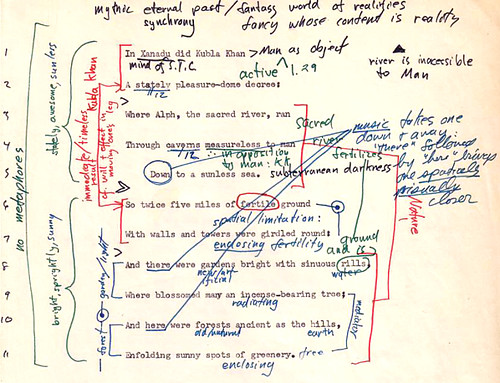
Here’s a fragment from one of my worksheets:

KK-working-text-old-2cr72.jpg

I’d typed the poem out in triple-space and then marked it up. I must have done this half-a-dozen times. Sometimes double spaced, sometimes triple. And I used different colors of felt-tip pens to indicate different aspects of structure.

It just went on and on. And then I gave up.

Of course there was more on my mind than those oppositions. For one thing I had been reading everything I could find on “Kubla Khan” in the Hopkins library. Along with bits and pieces of that scholarship I was also weaving my other core thinkers into the mix, Wittgenstein, Piaget, Merleau-Ponty, and Nietzsche. But it wasn’t working. In the spring of 1970 I stopped typing on page 142. Some time after that, I don’t recall when, I had the idea of treating line-end punctuation as a means of dividing the text into hierarchically ordered units in the same way that parentheses, brackets and braces are used in grouping elements of mathematical expressions. Once I had done that I could see that the punctuation structure of the poem matched the units I that had slowly emerged in my examination of binary oppositions.