Thursday, May 8, 2014

Bootstrapping Recursion into the Mind without the Genes

Recursion is one of the most important mechanisms that has been introduced into linguistics in the past six decades or so. It is also one of the most problematic and controversial. These days significant controversy centers on question of the emergence of recursion in the evolution of language. These informal remarks bear on that issue.

Recursion is generally regarded as an aspect of language syntax. My teacher, the late David Hays, had a somewhat different view. He regarded recursion as mechanism of the mind as a whole and so did not specifically focus on recursion in syntax. By the time I began studying with him his interest had shifted to semantics.

He had the idea that abstract concepts could be defined over stories. Thus: charity is when someone does something nice for someone without thought of a reward. We can represent that with the following diagram:
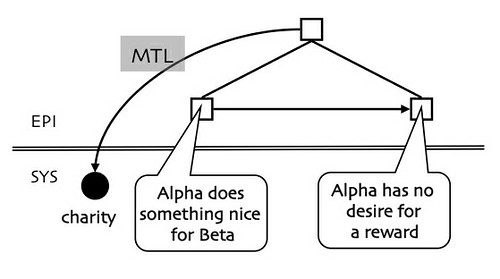
MTL def

The charity node to the left is being defined by the structure of episodes at the right (the speech balloons are just dummies for a network structure). The head of the episodic structure is linked to the charity node with a metalingual arc (MTL), named after Jakobson’s metalingual function, which is language about language. So, one bit of language is defined by s complex pattern of language. Charity, of course, can appear in episodes defining other abstract stories, and so on, thus making the semantic system recursive.

Now let’s develop things a bit more carefully, but still informally. Nor do we need to get so far as the metalingual definition of abstract concepts. But we do need the metalingual mechanism.


Tuesday, May 6, 2014

Is There Anything Beyond Quantum Computing?

Is There Anything Beyond Quantum Computing? (3QD):
Basically, we want to know which problems computers can solve not only in principle, but in practice, in an amount of time that won’t quickly blow up in our faces and become longer than the age of the universe. We don’t care about the exact speed, e.g., whether a computer can do a trillion steps or “merely” a billion steps per second. What we care about is the scaling behavior: How does the number of steps grow as the number to be factored, the molecule to be simulated, or whatever gets bigger and bigger?
I like this: scaling behavior.

For the DH folks interested in the nature of computing, THIS is the sort of thing that computer scientists worry about, but is of little direct relevance to practical programming. 

A more mundane example: chess. From an abstract computational point of view chess is no more difficult than tic-tac-toe. Tic-tac-toe is a finite game. Not only does each game have a finite number of steps, but the number of possible games is finite as well. Chess is the same, provided that a convention is adopted to end some games in a draw (e.g. if no piece is exchanged in 50 moves, end the game).  With that provision, each chess game has a finite number of steps and the number of games is finite.

Think about it.

However, The number of possible chess games is very very large while the number of possible tic-tac-toe games is pretty small. That makes programming a computer to play tic-tac-toe very different from programming one to play chess.

American Heartache in Jersey City

IMGP6444

The thing about graffiti is, it’s a fugitive art. Walls come and go – in the case of freight trains, literally – pieces get buffed, tagged over, and so forth. Nothing stays.

A couple of years ago I spotted a small dilapidated industrial building near the remains of the old Morris Canal in Jersey City along the upper New York Bay. Part of the roof was gone, windows broken out, some walls a-tumble. And graffiti, inside and out. I called it the Urban Design Center and proceeded to photograph it, catching it in various weather, times of day and, of course, changes in décor.

IMGP6460

I’ve been out of the city for a while, but went back last Saturday. And I checked in on the old Urban Design Center. Looks like it’s now being torn down, what’s left of it. More of the structure is gone and there was a steam shovel parked next to it. The graffiti was out of control – tags on throwies on pieces on tags and just random paint – the kind of stuff I like, call it graffiti chaos. There was a piece of plywood with “Rest in Peace R.I.P” painted on it in haste, with “R.I.P” repeated several times.

Monday, May 5, 2014

Digital Criticism Comes of Age, a Post at 3QD

I’ve got a new post at 3 Quarks Daily: The Only Game in Town: Digital Criticism Comes of Age.

I open with Moretti – natch – then to Willard McCarty’s 2013 Busa Award Lecture, where he talks of embracing the computer as Other. I end with Said on his belief in an autonomous aesthetic realm, despite the difficulties of conceptualizing how it could possibly work. The thrust of the article, though, is whether or not we can actually get this venture moving, really moving. What are the chances of really embracing the Other?

Though I made my peace with the computer years ago, and so am biased, I don’t know the answer to that question. But I’ve made some progress in figuring out what that question entails and that form the bulk of my essay.

The issue is one that’s been with academic literary study since the early 20th Century. In the 1920s the matter was stated most succinctly by Archibald MacLeish, that poems should not mean but be. In that late 1950s we find ourselves in the “Polemical Introduction” to Northrup Frye’s well-known Anatomy of Criticism (pp. 27-28):
The reading of literature should, like prayer in the Gospels, step out of the talking world of criticism into the private and secret presence of literature. Otherwise the reading will not be a genuine literary experience, but a mere reflection of critical conventions, memories, and prejudices. The presence of incommunicable experienced in center of criticism will always keep criticism as art, as long as the critic recognized that criticism comes out of it but cannot be built on it.
The issue came home to me in a rejection letter for my first essay on “Kubla Khan” – which ended up going into Language and Style in 1985 – where the reviewer complained that the essay “ought to argue with itself, to put into question some of the patterns it establishes-or better, perhaps to let the poem talk back.”

What does he mean, “let the poem talk back”? I know very well that the statement isn’t meant to be taken literally. But what’s the non-literal version of the statement? Under what circumstances could a poem do something like talk back?

Under face-to-face performance circumstances. To be sure, the poem doesn’t talk, but the poet does. The poet recites the poem, the teller spins the tale, the audience reacts with silence, groans, laughter, remarks, and the poet replies. There the poet/story-teller and audience share the same physical and discursive space and so CAN interact in real time. But criticism really isn’t like that, no matter how much this or that critic wishes otherwise.

Madam Wayquay's House of Crochet

IMGP6534

IMGP6533

IMGP6535

Sunday, May 4, 2014

Working Paper on Computational Historicism

I've now taken my recent series of four posts on computational historicism and edited them into a single working paper. This required some reorganizing. I took that Stephen Greenblatt material that had opened the second post and moved it to the beginning of the working paper. The paper is thus framed by Stephen Greenblatt on the directionality of literary history (not his phrase) at the beginning and Edward Said on the autonomous aesthetic realm at the end. I've also expanded and tweaked some of the other discussions. I've also added two appendices.

You can download the paper HERE (SSRN) and HERE (Academia.edu).  Abstract and contents below.


Toward a Computational Historicism: From Literary Networks to the Autonomous Aesthetic

Abstract: Stephen Greenblatt has identified pairs of moments in literary history such that the former moment must necessarily have preceded the later: literary history has a direction. This can be explained by asserting that the later texts required computational procedures capable of operating on the objects created by the earlier procedures, in the manner of Piaget’s reflective abstraction. Beyond Greenblatt’s examples two such pairs are examined, Amleth and Hamlet, The Winter’s Tale and Wuthering Heights. Also considered: Heuser and Le-Khac on 19th Century British novels. Three network-based network models are considered, at macro (topic modeling), meso (Moretti’s character networks), and micro scales (cognitive networks) of time.

Contents
Part 1: Greenblatt’s Difference: Time and History
Part 2: Conceptual Topology and Discourse
Part 3: Spatializing Time: Sonnet 129
Part 4: Abstraction at the Time Scale of History
Part 5: Into the Autonomous Aesthetic
Appendix 1: Hamlet as Ring, The Winter’s Tale also
Appendix 2: Nine Propositions in Computational Criticism

A monumental study of the globalising age that was the 19th century


‘The Transformation of the World’, by Jürgen Osterhammel. Review by David Cannadine. High quality global journalism requires investment. Please share this article with others using the link below, do not cut & paste the article. 
Since this book runs to almost 1,000 pages of text, and includes more than 3,000 endnotes and a bibliography listing well over 3,000 items, it is impossible to do it full and adequate justice, even in a lengthy review such as this. Part monster-piece, part masterpiece, its limitations are inescapably those of the global history genre: from one perspective, the book is too long and too detailed; from another its coverage is very uneven, and subjects such as gender and culture receive inadequate attention; there is no treatment of the first world war, although the author insists that his 19th century did not end until the 1920s; readers expecting a clear chronology will be sorely disappointed; and there is a sense in which the whole never quite becomes greater than the sum of its parts. 
Yet the book’s merits also compel acclaim and admiration: it is a work of prodigious scholarship and astonishing authorial stamina; within the confines of the subject, it raises the study of global history to a new level of academic sophistication and geographical comprehensiveness; it abounds with memorable phrases and aphorisms, which betoken a lively and playful mind; and it offers wise and original insights about the many ways in which the 19th century made the world that we still, today, inhabit.

Maplewood, NJ: Sky and Tree, Orientation, Bridge and Tree

IMGP5832

IMGP5831

IMGP5805

A Dream of Simulation and the Reality of Description, an Open Letter to Willard McCarty

Hi Willard,

I know you’re interested in the idea of computer simulations of human mental processes, so I thought you’d be interested in how I got from my vision of such simulation – the Prospero project from the 1976 essay in Computers and the Humanities – to my current hobbyhorse, description. Description, after all, is rather pedestrian and would seem like something of a comedown from the high techno-romance of simulating the mind.

It isn’t. In fact, it’s a consequence of that romance, a step along the way. A trail that has proven to be much longer than I’d anticipated back then.

But how could I have known? Sometimes when you venture into the unknown you end up finding something familiar. But you may also end up having your mind altered and your imagination changed.


When I went of to SUNY Buffalo back in 1973 I didn’t intend to work on Shakespeare’s Sonnet 129. I was gunning for Coleridge’s “Kubla Khan” and did the Shakespeare sonnet as a preliminary exercise. But I never really got around to “Kubla Khan.”

By the time I’d gotten to Buffalo I’d found my way to some of the early work on semantic networks, but didn’t know I’d find someone at Buffalo who could educate me in that art. A fellow graduate student in English, Ralph Reese, had been studying with David Hays (in the Linguistics Department) and he introduced me. It took me a couple of months to become fluent in Hays’s formalism, out of which I wrote a long term paper on some passages from Patterson, Book V.

By that time Hays had become interested in grounding his semantic theory in something, and that something was a feedback model of the mind developed by William Powers, whose book, Behavior: The Control of Perception (1973) had been well-reviewed in Science. So we – Hays and his research group – set out to figure out how to do that, theoretically, though not in simulation. The result was a model where cognition was grounded in perception and action. Though we didn’t use the term, it was a model of embodied cognition.

Saturday, May 3, 2014

The photographer among the lilies of the kitchen

Sheldon Klein on Computing Lévi-Strauss, a blast from the past

The work of Claude Lévi-Strauss was terribly important to humanistic thinking in the last half of the 20th Century. As Alan Liu has pointed out in a recent essay, “The Meaning of the Digital Humanities” (PMLA 128, 2013, 409-423) Lévi-Strauss’s structuralist anthropology was “a midpoint on the long modern path toward understanding the world as system” (p. 418).

Back in the 1970s a computer scientist and computational linguist at the University of Wisconsin, Sheldon Klein, developed a model that would generate myths. I’ve appended the title and abstract of a report of that work, with a link to the report. This is typical of the work done on story-telling in the 1970s. More recently David Ferrucci, who led IBM’s Watson project, did a story-telling project with Selmer Bringsjord: Artificial Intelligence and Literary Creativity: Inside the Mind of Brutus, A Storytelling Machine (1999).

• • • • • •

Sheldon Klein et al. Modeling Propp and Levi-Strauss in a Meta-Symbolic Simulation System. Computer Science Department, University of Wisconsin, Technical Report No. 226, October 1974.

Abstract: Tests of the system include an automated generative model for a portion of Levi-Strauss' The Raw and the Cooked, and an automated generative model for Propp's Morphology of the Folktale. Output presented includes fifty Russian folktales, generated at an average rate of 128 words per second (Univac 1110/1108), including computation of plot, generation of deep structure and generation of surface text. The meta-symbolic simulation system includes a powerful behavioral simulation programming language that models, generates and manipulates events in the notation of a semantic network that changes through time, and a generalized, semantics-to-surface structure generation mechanism that can describe changes in the semantic universe in the syntax of any natural language for which a grammar is supplied. The total system has the power of at least the 2nd order predicate calculus, and will facilitate the formulation of highly abstract meta-models of discourse, including logical quantification of such models. Other features include the ability to treat objects, characters and complex actions as manifestations of the same abstract semantic unit. Extensions of the research to riddle, dream and myth generation and analysis are discussed, as well as the possibility of modeling more of the work of Levi-Strauss.

Here’s another version of that work, in French:

Klein, S., Aeschliman, Applebaum, Balsisger, Curtis, Foster, Kalish, Kamin, Lee & Price 1976. Simulation d'hypothèses émisés par Propp et Lévi-Strauss en utilisant un système de simulation meta-symbolique. Informatique et Sciences Humaines, No. 28, pp. 63-133, Mars. [A revised and expanded French translation of 'Modelling Propp and Lévi-Strauss in a Meta-symbolic Simulation System.' in Patterns in Oral Literature, edited by H. Jason & D. Segal, World Anthropology Series, The Hague: Mouton, 1977, with a new Lévi-Strauss model, a revised Propp model, and a different set of computer generated folktales.]

Friday, May 2, 2014

Town, Country, Blossoms, Sky

IMGP6239

IMGP6228

IMGP6241

Method in DH: Signal and Concept, Operationalization

Signal and concept: distinction employed by Ryan Hauser and Long Le-Khac: A Quantitative Literary History of 2,958 Nineteenth-Century British Novels: The Semantic Cohort Method. Stanford Literary Lab, Pamphlet 4, May 2012.

Operationalization: concept discussed in Franco Moretti, “Operationalizing”: or, the Function of Measurement in Modern Literary Theory, Stanford Literary Lab, Pamphlet 6, December 2013.

Think like a social scientist: Arthur Stinchcombe, Constructing Social Theories, New York: Harcourt, Brace, and World, 1968.

• • • • • •

Toward the end of their pamphlet Hauser and Le-Khac observe (pp. 46-47):
How do we get from numbers to meaning? The objects being tracked, the evidence collected, the ways they’re analyzed—all of these are quantitative. How to move from this kind of evidence and object to qualitative arguments and insights about humanistic subjects— culture, literature, art, etc.—is not clear. In our research we’ve found it useful to think about this problem through two central terms: signal and concept. We define a signal as the behavior of the feature actually being tracked and analyzed. The signal could be any number of things that are readily tracked computationally: the term frequencies of the 50 most frequent words in a corpus, the average lengths of words in a text, the density of a network of dialogue exchanges, etc. A concept, on the other hand, is the phenomenon that we take a signal to stand for, or the phenomenon we take the signal to reveal. It’s always the concept that really matters to us. When we make arguments, we make arguments about concepts not signals.
I’ve already noted that I believe the equation of computing with quantitative is misleading (From Quantification to Patterns in Digital Criticism). That’s one thing.

The solution Heuser and Le-Khac propose is to distinguish between signals, which they can measure, and concepts, which are the phenomena being indicated by the signals. The distinction is useful and it’s also pretty much standard in social science, though not necessarily in those terms. While the mechanisms responsible for the operation of, for example, an automobile, can be observed directly, those operating in human society or the human mind are generally inaccessible to direct observation.

In order to investigate those mechanisms one must propose a theory or a model and then operationalize that theory. What does that mean? Moretti (p. 1):
Forget programs and visions; the operational approach refers specifically to concepts, and in a very specific way: it describes the process whereby concepts are transformed into a series of operations—which, in their turn, allow to measure all sorts of objects. Operationalizing means building a bridge from concepts to measurement, and then to the world. In our case: from the concepts of literary theory, through some form of quantification, to literary texts.
Just so.

Thursday, May 1, 2014

Some Varieties of Visual Thinking

Square Spiral 2

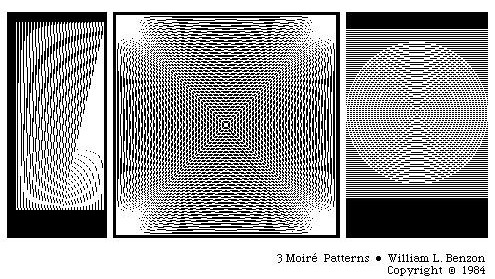
Moire Trio

Strange Eye

Visual Thinking for the Machinic Theorist

Visualization has proved to be essential to many projects in digital humanities. The visualizations aren’t mere illustrations of verbal concepts, helpful but not essential. They are the stuff of thought itself.

Sydney Lamb, one of the first generation of researchers in computational linguistics, has remarked that “... it is precisely because we are talking about ordinary language that we need to adopt a notation as different from ordinary language as possible, to keep us from getting lost in confusion between the object of description and the means of description” (Pathways of the Brain: The Neurocognitive Basis of Language, John Benjamins 1999, p. 274).

Working independently, and on Shakespeare plays, not language itself, Franco Moretti expresses a similar idea (Network Theory, Plot Analysis, Stanford Literary Lab, Pamphlet No. 2, May 2011, p. 4):
Third consequence of this approach: once you make a network of a play, you stop working on the play proper, and work on a model instead: you reduce the text to characters and interactions, abstract them from everything else, and this process of reduction and abstraction makes the model obviously much less than the original object – just think of this: I am discussing Hamlet, and saying nothing about Shakespeare’s words – but also, in another sense, much more than it, because a model allows you to see the underlying structures of a complex object.
These passages speak to cognitive mechanisms. Whether or not any given line of reasoning and experiment is valid, that’s a question for episdemology proper. Visualization is a matter of cognitive strategy; it’s about thinkability.

Some years ago I wrote an article on visual thinking for an encyclopedia:
William Benzon. Visual Thinking. Allen Kent and James G. Williams, Eds. Encyclopedia of Computer Science and Technology. Volume 23, Supplement 8. New York; Basel: Marcel Dekker, Inc. (1990) 411-427. Available on line: https://www.academia.edu/13450375/Visual_Thinking  
I’ve reproduced the three sections of the article in the rest of this post.

• • • • • •

Visual Thinking: A Speculative Proposal

Given that visual thinking has a motor component, I offer the following speculative proposal: visual thinking involves the internalization of visuo-manipulative activity and of movement through the environment. We move through the physical environment, sometimes in a familiar place, sometimes in a strange place; we handle objects, sometimes to accomplish a specific task, sometimes simply to inspect the object. Visual thinking involves imagined locomotion in imagined settings, imagined manipulation of imagined objects. The settings and objects may be real, but not present, or they may exist only in imagination. In defining visual thinking in this way I am aligning myself with an approach to thinking which derives from Lev Semenovich Vygotsky's seminal analysis of the relationship between thought and language.