Tuesday, December 5, 2017

Dizzy Gillespie, “21st-century Gabriel”

Writing in The American Scholar David Grogan has given us what is perhaps the best short introduction to the life and achievement of John Birks "Dizzy" Gillespie. Some excepts follow:
October 21, 2017, marked the 100th anniversary of the birth of John Birks “Dizzy” Gillespie. Dizzy was a consummate showman: a trumpet virtuoso with blowfish cheeks and horn bent heavenward who in his prime played faster and higher than anyone before or since. In the popular imagination, he was typecast as the steadfast sidekick to saxophonist Charlie “Bird” Parker, whose meteoric ascent into the jazz firmament and descent into heroin addiction fit the romantic archetype of an artistic genius doomed to die young. The late jazz critic Leonard Feather’s characterization of Dizzy as a “21st-century Gabriel” was more astute. Dizzy sounded a clarion call for the bebop revolution with his dazzling pyrotechnics on trumpet and harmonic innovations as a composer and arranger; expanded the ranks of the jazz vanguard by translating what Bird, Thelonious Monk, and other visionaries were doing into a language aspiring musical insurgents could understand; and then unleashed a host of ancestral spirits from the African diaspora by adding Afro-Cuban and Afro-Brazilian polyrhythms to the mix. He exuded a spirit of joy both on and off stage that reflected his faith in the disarming power of music and laughter to promote racial harmony and world peace, and he was unabashedly “dizzy,” a scatterbrained genius, full of boundless kinetic energy, who left a trail of madcap mayhem behind him.
Prophet:
“In traditional African societies, they say there are times when the creator sends down musical prophets to lift up our spirits,” says pianist Randy Weston. “Dizzy was one of those prophets.” In the late 1940s, Weston was helping his father run a soul food restaurant in their Brooklyn brownstone and met Dizzy around the corner at drummer Max Roach’s house, a favorite hangout for beboppers. What left the most indelible impression on Weston was seeing Dizzy onstage with his Afro-Cuban orchestra, which featured the conga player Chano Pozo. “During the slave era,” Weston says, “the African drum was outlawed in America because our ancestors still remembered how you talk with the drum. They couald take a drum and send a message 20 miles away. When Dizzy had this jet-black Cuban propel his entire orchestra with one drum—bom de bop shoo bop shoo bam—that was a revolution.” Pozo’s style of percussion on “Manteca” and “Cubano Be/Cubano Bop” echoed the rhythms of Dizzy’s Yoruba ancestors. “The pulse of Mother Africa, which connects us as a global people, was at the heart of all his music,” says Weston.
The contradictions of genius:
“People didn’t recognize the full scope of Dizzy’s musical genius,” Schifrin says. “They thought he played too many notes. But like Mozart, he played exactly the notes he needed. He was a master of both harmony and melody. And no matter how fast he played, not one note was out of place.”

“He had an IQ of a million, but he couldn’t walk across a room without dropping something,” says Charles “Whale” Lake, who was Dizzy’s road manager for nearly a quarter century. “Every time we got into a limo to leave a hotel, I’d say, ‘Wait a second, John, I think I forgot something.’ Then I’d go back up to his room and find a trail of clothes, books, money, rolls of film, his passport. He was very unkempt.”
Clap your hands:
One evening, in his basement rec room, Dizzy gave me an impromptu lesson in rhythm. “White people clap their hands one two one two, but this goes one and two and one and two and,” he said. Then he began demonstrating a polyrhythmic pattern with his hands and feet while chanting, “Way down south in the land of cotton, old times there are not forgotten.” He chuckled as I struggled to match the dancelike movements of his limbs and keep a steady pulse by stomping on the downbeat with the heel of my right foot. “Whooee, our music is spiritually inspired,” he said.
Diz and Bird:
In 1947, Bird surprised Dizzy when he showed up at his first major concert at Car-negie Hall. “He walked out on stage with a rose,” Dizzy said. “It probably cost him his last 75 cents.” Even though the two teamed up for several historic concerts and recordings in the years that followed, Bird’s erratic behavior gradually tore them apart. Dizzy was forever haunted by his last encounter with Bird, a week before his death in March 1955. “I ran into him at a club called the Embers, on 52nd Street in New York, and he looked so sad. He said, ‘Save me.’ I said, ‘Man, nobody can save you. You have to save yourself.’ When I heard he died, it broke me up. I thought I would never get over it.”
His wife, Lorraine:
Dizzy credited one person with making sure he didn’t get sucked into a vortex of self-destruction like Bird. “My wife, Lorraine, is my Rock of Gibraltar,” he said. When they met in 1937, paying gigs were scarce for Dizzy and she was a petite young widow earning subsistence wages as a member of a traveling troupe of chorus girls. Dizzy was attracted by her lissome beauty and wicked sense of humor, as well as her moral rectitude. “While the rest of the chorus girls were up in the wings looking for musicians who would take them to after-hours joints, she’d be down in the dressing room, knitting or crocheting or reading.” At first she ignored the mash notes Dizzy sent her. But their romance blossomed after she saw him begging outside the Apollo Theater in Harlem for 15 cents to buy a bowl a soup. Lorraine curbed Dizzy’s reckless spending, helped him negotiate with shady booking agents, and brought a sense of emotional stability to his life.
His woman on the side and the mother of his only child:
Bryson’s affair with Dizzy continued for several years while she struggled to raise Jeanie on a paltry income from a variety of temporary jobs. “The money I got from Dizzy was irregular, and only when I saw him in person,” she says. Everything changed after she pressed for steady child support and Lorraine found out about Jeanie. “All hell broke loose. Lorraine had to deal with three really hurtful things. One: I was 20 years younger than her. Two: I was white. But the real kicker: I had the baby. Dizzy later told me, ‘She never lets me forget it. She just sits in the house and doesn’t say anything.’ ” Dizzy formally agreed to make monthly child support payments of $125. Bryson’s relationship with Dizzy unraveled after that. “I never had any illusions that he and I were going to ride off into the sunset together,” she says. “But I was madly in love with this man, madly in love. And he loved Jeanie.”
There's more – the article goes on through his conversion to Baha'i to his death, but these excerpts will have to do. It's an excellent article.

I met Gillespie twice, once in Baltimore after a concert he gave at Morgan State in the early 1970s, and once in Buffalo at a club in the mid-1970s, where I was introduced to him by Frank Foster, who was teaching at SUNY Buffalo at the time. I opened for him once, in Albany in 1984.


Tim Burke on contemporary politics in the USofA

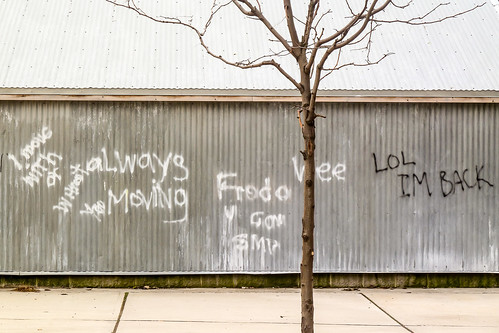
Hand style found in Hoboken

20171203-P1140527

20171205-P1140607

20171205-P1140608

20171205-P1140610

20171205-P1140609

Story-telling among hunter-gatherers supports cooperation

Cooperation and the evolution of hunter-gatherer storytelling

Daniel Smith, Philip Schlaepfer, Katie Major, Mark Dyble, Abigail E. Page, James Thompson, Nikhil Chaudhary, Gul Deniz Salali, Ruth Mace, Leonora Astete, Marilyn Ngales, Lucio Vinicius & Andrea Bamberg Migliano

Nature Communications 8, Article number: 1853 (2017)
doi:10.1038/s41467-017-02036-8

Abstract

Storytelling is a human universal. From gathering around the camp-fire telling tales of ancestors to watching the latest television box-set, humans are inveterate producers and consumers of stories. Despite its ubiquity, little attention has been given to understanding the function and evolution of storytelling. Here we explore the impact of storytelling on hunter-gatherer cooperative behaviour and the individual-level fitness benefits to being a skilled storyteller. Stories told by the Agta, a Filipino hunter-gatherer population, convey messages relevant to coordinating behaviour in a foraging ecology, such as cooperation, sex equality and egalitarianism. These themes are present in narratives from other foraging societies. We also show that the presence of good storytellers is associated with increased cooperation. In return, skilled storytellers are preferred social partners and have greater reproductive success, providing a pathway by which group-beneficial behaviours, such as storytelling, can evolve via individual-level selection. We conclude that one of the adaptive functions of storytelling among hunter gatherers may be to organise cooperation.

Inner speech, just like outer, except it's internal, and silent to the outer world (Vygotsky)

Neurophysiological evidence of efference copies to inner speech

Thomas J Whitford, Is a corresponding authorBradley N Jack, Daniel Pearson, Oren Griffiths, David Luque, Anthony WF Harris, Kevin M Spencer, Mike E Le Pelley
Cite as: eLife 2017;6:e28197 doi: 10.7554/eLife.28197

Abstract

Efference copies refer to internal duplicates of movement-producing neural signals. Their primary function is to predict, and often suppress, the sensory consequences of willed movements. Efference copies have been almost exclusively investigated in the context of overt movements. The current electrophysiological study employed a novel design to show that inner speech – the silent production of words in one’s mind – is also associated with an efference copy. Participants produced an inner phoneme at a precisely specified time, at which an audible phoneme was concurrently presented. The production of the inner phoneme resulted in electrophysiological suppression, but only if the content of the inner phoneme matched the content of the audible phoneme. These results demonstrate that inner speech – a purely mental action – is associated with an efference copy with detailed auditory properties. These findings suggest that inner speech may ultimately reflect a special type of overt speech.

* * * * *
From SCIENMAG (Science Magazine):
Previous research suggests that when we prepare to speak out loud, our brain creates a copy of the instructions that are sent to our lips, mouth and vocal cords. This copy is known as an efference-copy.

It is sent to the region of the brain that processes sound to predict what sound it is about to hear. This allows the brain to discriminate between the predictable sounds that we have produced ourselves, and the less predictable sounds that are produced by other people.

"The efference-copy dampens the brain's response to self-generated vocalisations, giving less mental resources to these sounds, because they are so predictable," says Associate Professor Whitford.

"This is why we can't tickle ourselves. When I rub the sole of my foot, my brain predicts the sensation I will feel and doesn't respond strongly to it. But if someone else rubs my sole unexpectedly, the exact same sensation will be unpredicted. The brain's response will be much larger and creates a ticklish feeling."
This study showed that inner speech produces a similar efference-copy.
The researchers found that, just as for vocalized speech, simply imagining making a sound reduced the brain activity that occurred when people simultaneously heard that sound. People's thoughts were enough to change the way their brain perceived sounds. In effect, when people imagined sounds, those sounds seemed quieter.

"By providing a way to directly and precisely measure the effect of inner speech on the brain, this research opens the door to understanding how inner speech might be different in people with psychotic illnesses such as schizophrenia," says Associate Professor Whitford.

Not with a bang, but with a rainbow of ducks and a departing hyperobject

20171202-P1140439-2 Eq Fd P

20171202-P1140439-2 Eq Fd B

20171202-P1140439-2 Eq Fd G

20171202-P1140439-2 Eq Fd Y

20171202-P1140439-2 Eq Fd O

20171202-P1140439-2 Eq Fd HuSt LnFd

 • • • • • • 


20171202-P1140353

The long reach of Disney: Today's Tweets

I saw this:

And replied with this:

"Here endeth the lesson."– Sean Connery and Jim Malone in The Untouchables (1987).

Monday, December 4, 2017

Further thoughts about Cleopatra’s pumps: A walk on the beach (how romantic)

20171202-_IGP1467

Last time out – Some thoughts about Cleopatra’s Pumps – I observed that, while I’m primarily a street photographer, many of my shots of the green F me pump are in the realm of studio photography, even if I don’t have a studio. I then showed, and commented on, a bunch of shots I took in my apartment and apartment building.

Now we’re going to the street. Well, not the street, the beach (in Jersey City, NJ, no less). Now the point of street photography is that you take the world as it presents itself to you. You can choose where to point your camera and how to frame the shot, but the objects you see, and, above all, the light in the scene, those you have to take as given. In contrast, in studio photography you get to control everything (more or less – but we aren’t omnipotent).

I took these shots outdoors and had to deal with the existing light. In that sense they are street photographs. But I intervened in the scene by placing that bright green platform pump in it and making it the focus of my shot. I am thus interested in the interaction between the shoe and the scene.

I took all of these photographs at the southern end of Liberty State Park in Jersey City. Here I’ve placed the shoe on the remnants of a pier:

20171202-_IGP1370

I’m interested in the contrast between the material and shape of the shoe and the gritty work-world remnants of the pier, the rotting wood and the large rusty iron spikes. I suppose one could read that juxtaposition as the Male pier vs. the Female shoe, but that is not at all necessary. Really, the materials and forms are interesting and compelling in and of themselves, otherwise there’s really no point to the photograph.

Same pier, different position and orientation:

20171202-_IGP1365

That’s another pier in the background. The trees are obvious, the people standing around, not so obvious. Nor is it obvious that we can see the Statue of Liberty through the trees just above the top of the shoe. I didn’t notice it until just now. Was I (subliminally) aware of it when I framed the shot? I don’t know. But I’ve been shooting at the park for several years now, and I am very much aware of that statue.

The critique of critique


Contents
  1. Introduction to Focus: Postcritique – pp. 3-4 – Matthew Mullins
  2. Postcritical Reading – pp. 4-5 – Rita Felski
  3. Fashion Conscious Phenomenon – pp. 5-6 – Bruce Robbins
  4. Critique, Theology and the Future of Cultural Criticism – pp. 7-8 – John-Mark Hart
  5. A Reader’s Love – pp. 8-9 – Julie Orlemanski
  6. Postcritique and Social Justice – pp. 9-10,– Elizabeth S. Anker
  7. Race and Interpretive Possibility – pp. 11-12 – Kinohi Nishikawa
  8. Reading is Seeing – pp. 12-13 – Sarah Tindal Kareem
  9. The Irony of Critique – pp. 14-15 – Daniel Rosenberg Nutters
  10. Critique Has Its Uses – pp. 15-18 – Lee Konstantinou
I find the title of #4 particularly provocative. Why? Because I think critique itself has pretensions toward a transcendental point of view on the world and so tends toward something like theology. Here's the first paragraph:
Over the last several decades, there have been two distinct turns towards theology within secular cultural theory. The first of these—which was mostly associated with postructuralist thinkers like Jacques Derrida, Michel Foucault, Gilles Deleuze, and Jacques Lacan—began in the latter decades of the twentieth century and, with a few notable exceptions, took a combative stance towards Christianity. The project of these theorists was generally to interrogate the church and its theology, and to deconstruct the Christian residue within Western culture. The second turn towards theology, which is emerging from the Marxist tradition, began around the dawn of the twenty-first century (with important precursors) and shows signs of being more constructive. Thinkers in this vein—such as Alain Badiou, Terry Eagleton, and Slavoj Žižek—have tended to engage living theologians in direct dialogue and to argue (despite their persistent atheism) that Christian theology possesses resources which secular theory lacks, both for criticizing oppressive structures of power and for conceptually grounding the work of resisting oppression in pursuit of a better world. Moreover, this second turn towards theology is mirrored by a turn of contemporary Christian thinkers like John Milbank, Miroslav Volf, Emmanuel Katongole, and James K. A. Smith towards direct engagement with leading secular theorists. It is my contention that this emerging dialogue between theology and theory has unrealized potential for literary criticism, including the potential to redeem “critique” as it is widely practiced by literary scholars today.
#7 as well, as race in America is a long-term interest of mine, especially through music. Some early passages:
In 2011 Kenneth W. Warren sparked controversy by positing that the demise of state-sponsored segregation had sundered the unity of the African American literary project, effectively bringing it to an end. [...]

Since 2011, a handful of critics, including Walter Benn Michaels, Stephen M. Best, and Douglas A. Jones, have published work that generally accords with Warren’s claim. Their line of critique is to reject the idea that past common experience—not only segregation but, more profoundly, slavery—should be a continuous, if not perpetual, organizing principle of black literary and cultural production. Citing Toni Morrison’s Beloved (1987) as a touchstone, these critics diagnose a troubling yet pervasive nostalgia for conditions that once compelled racial unity as a matter of social oppression. In their view, such nostalgia bespeaks a regrettable state of false consciousness, whereby one’s imaginary relation to group identity can only be achieved by living in the past.

Unsurprisingly, the other side of the debate has endorsed practically the opposite philosophy of history. With far more critics represented on this side, what might be called the field’s commonsense position is to insist on the enduring legacy of slavery and Jim Crow in contemporary America. Less an explicit model of periodization than an assertion that race matters in comparable ways across the centuries, this line of critique more or less echoes Beloved’s narrative strategy: namely, identify those connections to the past that bind present-day subjects to the departed and thereby affirm the coherence of the black experience. History, in this account, is what hurt and what continues to hurt.
I can't help but think of Ta-Nehisi Coates here, with his insistence that to be "white" is to be racist and hence that racism inheres in America.

"The Irony of Critique", like several of these pieces, is a consideration of a book:
Jeffrey R. Di Leo’s collection Criticism After Critique: Aesthetics, Literature, and the Political emerges at a moment when academic critique—a politically animated critical skepticism that draws upon the insights offered by deconstruction, psychoanalysis, Marxism, and various forms of historicism—seems to have become stale, ineffective, and formulaic. Now that scholarship has debunked assumptions about the transcendental value of art, unmasked myth, illusion, and ideological aberrations, opened up an insular canon, exhumed repressed voices and forgotten histories, and demonstrated the complicity of the liberal-humanist tradition with the worst of Western Civilization, what next? The digital humanities, new formalism, surface and distant reading, new materialisms, and the self-proclaimed return to aesthetics represent some of the new critical fashions competing to carry the baton for literary studies into the twenty-first century. They promise relevance, innovation, a renewed political urgency, the ability to overcome common impediments such as the critic’s fallible subjectivity, and different ways of “reading” that can yield new forms of historical and sociological knowledge. With a range of new methodologies from which to choose, what is left of what Di Leo calls “the modus operandi of the humanities,” namely, critique?
On the whole, this looks like a useful set of short – dare I use that word? – interventions.


Sunday, December 3, 2017

Some writing on Hoboken walls

20171203-P1140524

20171203-P1140529

On “the psychological reality of syntax”

When people talk about “the psychological reality of syntax”, there are (at least) two importantly different types of psychological state that they might have in mind. One of them is what I call mental phrase markers (MPMs)—representations of the syntactic structure of incoming linguistic stimuli, constructed in the course of on-line comprehension, and also whatever states play an analogous role in language production. MPMs are relatively transient states; their “lifespan” is typically measured in milliseconds. The other type of state is what I’ll call mental syntactic principles (MSPs)—representations of the general rules, principles, or constraints that jointly constitute a grammar for a language. MSPs are standing structures, architectural features of the human parsing mechanism. When the language faculty is inactive, i.e., when no comprehension or production processes are taking place, these structures are, so to speak, dormant. In the jargon of contemporary metaphysics, we can say that they are dispositional, rather than occurrent.

In principle, MPMs can be psychologically real while MSPs are not. Alternatively, as I shall argue, both can be useful psychological constructs, but MPMs are best seen as explicit (subpersonal) representations, whereas there is little or no evidence that MSPs are psychologically real in that sense.
On the psychological reality of MPMS:
1. Neurolinguistics: EEG studies using the violation paradigm have found that early left anterior negativity is elicited by, and only by, syntactically ill-formed phrases. [...] These and other studies show that the human sentence-processing mechanism constructs distinctly syntactic representations.

2. Structural priming: In producing language, people tend to employ the syntactic structures that they recently produced or comprehended. [...]ermine their content to a degree of precision that ERP studies cannot yet achieve.

3. “Garden-path” processing: Linguistic input is rife with ambiguity. The language processing system is remarkably effective in selecting the correct resolution of such ambiguities. When it fails to do so, the anomaly shows up in behavior—e.g., extended fixations on a crucial part of a sentence, in eye-tracking studies (Rayner, Carlson, and Frazier, 1983), or a modulation of reaction times in cross-modal priming studies (Nicol and Swinney, 1989). Three principles of ambiguity resolution, Minimal Attachment, Late Closure, and the Minimal Chain Principle, form the foundation of many psychologically plausible parsing models (Frazier, 1979; DeVincenzi, 1991). [...]

A fourth argument for the psychological reality of MPMs is indirect: I claim that no known model of language processing can explain the available data concerning human parsing preferences without positing MPMs.
Now things get tricky:
Having argued for the psychological reality of MPMs, I claim that their construction and manipulation can only be accomplished by a mechanism that either explicitly represents a grammar or embodies it. A system that “embodies” a grammar does not store a set of rules and principles in an explicit data structure (Stabler, 1983) and does not “access” or “read” them during real-time operations. Rather, the rules of the grammar are “hardwired” into the causal structure of the system, in such a way as to guide the construction of MPMs. In order to be an instance of embodiment, in the sense that I intend here, this hardwiring must also meet a condition that is stronger than the mere ability to process inputs of a certain type—i.e., stronger than mere “conformity” to a rule. For every rule or principle of the grammar, the hardwired system must have a unique causal mechanism that mediates the computation of all the syntactic representations that are in the domain and range of that rule or principle (Davies, 1995). A language-processing system can conform to a particular grammar without embodying it in this sense. Embodiment is weaker than representation, but stronger than conformity, in ways that are open to empirical test.

The embodiment/representation distinction is important, but making progress on the psychological reality issue requires being as clear as possible about the relationships between it and five other distinctions: conscious/nonconscious, personal/subpersonal, implicit/explicit, declarative/procedural, and occurrent/dispositional.
And with that, I leave you to puzzle through this most interesting post. I would underscore the importance of Pereplyotchik's distinction between representation and embodiement and his later assertion, "At present, I argue, there are no decisive reasons for thinking that grammars are declaratively represented as data structures in the mind/brain, rather than embodied as hardwired procedural dispositions." Whew!

Robert Wright and Judith Shulevitz discuss male sexual predation


Robert Wright (Bloggingheads.tv, The Evolution of God, Nonzero, Why Buddhism Is True) and Judith Shulevitz (The New York Times, The Sabbath World)

  • Bob and Judith try to rank the sexual predators in terms of badness, from Harvey Weinstein on down 00:00
  • Male power in all its variety 06:23
  • Are we entering a neo-Victorian era? 21:00
  • Why understanding isn’t forgiveness 26:50
  • Stepping down in disgrace as a career move 36:15
  • After the purge, will women finally feel at home in the workplace? 47:26
  • Bob and Judith share their own experiences with workplace sexual harassment 1:00:26

Saturday, December 2, 2017

From today's shoot: On the beach

20171202-P1140467

20171202-P1140451

20171202-_IGP1397

Stochasticity in cultural evolution: a revolution yet to happen

Billiard, S. & Alvergne, A. History and Philosophy of the Life Sciences (2018) 40: 9. https://doi.org/10.1007/s40656-017-0173-y

Abstract

Over the last 40 years or so, there has been an explosion of cultural evolution research in anthropology and archaeology. In each discipline, cultural evolutionists investigate how interactions between individuals translate into group level patterns, with the aim of explaining the diachronic dynamics and diversity of cultural traits. However, while much attention has been given to deterministic processes (e.g. cultural transmission biases), we contend that current evolutionary accounts of cultural change are limited because they do not adopt a systematic stochastic approach (i.e. accounting for the role of chance). First, we show that, in contrast with the intense debates in ecology and population genetics, the importance of stochasticity in evolutionary processes has generated little discussion in the sciences of cultural evolution to date. Second, we speculate on the reasons, both ideological and methodological, why that should be so. Third, we highlight the inadequacy of genetically-inspired stochastic models in the context of cultural evolution modelling, and ask which fundamental stochastic processes might be more relevant to take up. We conclude that the field of cultural evolution would benefit from a stochastic revolution. For that to occur, stochastic models ought to be developed specifically for cultural data and not through a copy-pasting of neutral models from population genetics or ecology.

1 Introduction

Evolutionary theory has been applied to the study of culture in various ways for more than 100 years. In the field of cultural evolution, most, if not all, of the approaches developed until the 1970s were narrative-based and interpretive, that is, there were no quantitative predictions for how cultural traits (e.g. behaviours, ideas, artefacts) should vary and be distributed in a population. Contemporary cultural evolution research differs markedly from these previous traditional approaches in that it is built upon a quantitative and mathematical framework. Building on precursors like Gulick (1905) and Binford (1963), a quantitative framework was developed in 1981 by two evolutionary scientists, Cavalli-Sforza and Feldman (1981). They borrowed mathematical tools from population genetics to predict how the social transmission of information between individuals influences the dynamics of culture at the population level. Cavalli-Sforza and Feldman (1981) contributed two main concepts: (1) cultural selection, analogous to natural selection, which describes the differential reproductive success of cultural traits, considered as deterministic, and (2) cultural drift, analogous to genetic drift, which accounts for the role of chance in cultural change.

Following Cavalli-Sforza and Feldman’s seminal work, there has been an explosion of cultural evolution studies in anthropology and archaeology (reviewed in Mesoudi 2011; Lewens 2015), mostly focusing on social transmission mechanisms, for instance the importance of vertical social transmission (i.e. from parents to offspring) as compared with horizontal social transmission (i.e. from peers). Subsequently, the anthropologists Boyd and Richerson (1985) and their students extended Cavalli-Sforza and Feldman’s framework to include various modes of cultural selection, which they coined biased cultural transmission, e.g. prestige-bias and conformist-bias but also payoff-biased social transmission (Henrich and McElreath 2003). Overall, the concept of cultural selection, though arguably more complex than the concept of natural selection, fell on fertile soil in the human sciences as testified to by the intense debates between the schools of cultural (Acerbi and Mesoudi 2015) and cognitive anthropology (Claidière et al. 2014) over what cultural selection actually entails (see also Lewens 2015 for a dispassionate review).

Comparatively to the success encountered by the concept of cultural selection, the concept of cultural drift has been much less popular than that of cultural selection, and it remains little explored. There has undoubtedly been a productive utilisation of neutral models in archaeology and anthropology (neutral models are a special category of stochastic models where population change is not pushed towards a particular direction, “Appendix 1”). To date, however, there have been little controversies over the role of selection versus drift for understanding the evolution of culture and patterns of cultural diversity. This is in sharp contrast with the biological sciences, within which the relative importance of selection and drift for explaining both species diversity and evolutionary change has been intensely debated for years. In population genetics and ecology, it led to a stochastic revolution whereby the cause of change by default is not assumed to be selection anymore but rather stochastic processes, in particular genetic drift and demographic stochasticity (Kimura 1983; Hubbell 2001). Broadly speaking, selection models must now provide more explanatory power than neutral models (models without selection) for the data at hand to be accounted for by selection.

In the field of cultural evolution, such a stochastic revolution has yet to happen. Questioning the role of stochasticity for explaining patterns of cultural diversity is necessary, however, for several reasons. First, there is strong empirical evidence that there is a large population-level variance or noise around the mean value of cultural traits, which is neglected by classic deterministic approaches. Given social systems are subject to stochastic effects, properly defining and modelling random fluctuations around the population mean of cultural traits is key for determining the extent to which cultural diversity is underpinned by adaptive processes. Second, since agents of cultural evolution are discrete (individuals) and populations are finite, stochasticity is necessary to explain some features of the diachronic dynamics of cultural traits. For instance, fluctuations and the extinction of a trait cannot be modelled with classical approaches based on differential equations. Third, stochasticity is a fundamental concept in psychology and neurobiology for making sense of how individuals make decisions (Forstmann et al. 2016). Fourth, in contrast with evolutionary biology and ecology (where the Wright-Fisher’s and Moran’s models are classically used), there is no consensus over which stochastic process is the referent one for cultural evolution models. Finally, since random genetic drift and natural selection are equally important in the neo-Darwinian theory of evolution, the role of stochasticity in driving cultural change and diversity must be considered to adequately evaluate the relevance of the analogy between biological and cultural evolution.

In this paper, our overarching goal is to evaluate the need for a stochastic revolution in the field of cultural evolution by contrasting the uses and utility of stochastic models in the biological sciences (i.e. population genetics and ecology) and in some of the human sciences engaging with cultural evolution research (i.e. archaeology and anthropology). First, we discuss the role given to stochasticity in the cultural evolution literature. Second, we question why there has only been a few controversies over the role of stochasticity in cultural evolution as compared with the intense debates that neutral theory generated in ecology and population genetics. Finally, we dispute the analogy between cultural and genetic drift and its relevance for the study of cultural evolution. We conclude that a stochastic revolution is much needed in contemporary cultural evolution studies, albeit not in a copy-paste fashion from the biological sciences, but after the sources of stochasticity unique to human culture have been identified. Such a paradigm change from a deterministic to a stochastic view of the world has proven to be fruitful in several scientific disciplines including physics, chemistry, biology and psychology (Gigerenzer et al. 1989; Hacking 1990). We contend that it would also be productive for advancing the field of cultural evolution because making chance a central concept will allow a better description of the processes underpinning cultural evolution and an increased control of uncertainty when interpreting observations.

[...]

Friday, December 1, 2017

The Author as Manly-Man: Mark Twain revealed