Showing posts sorted by relevance for query duchamp. Sort by date Show all posts

Monday, August 19, 2013

Through Duchamp and Beyond: Graffiti in the Promised Land?

IMGP3087

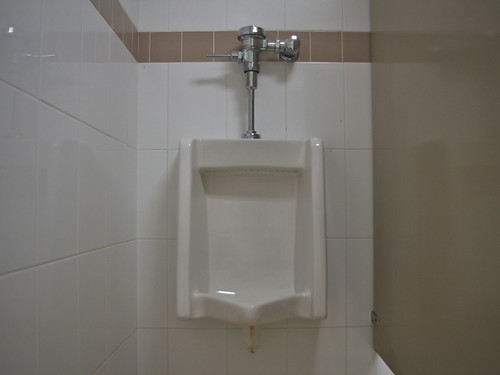
Artists have been at odds with the gallery and museum scenes since Impressionism emerged in the late 19th Century. But the aesthetic potshot heard round the world was undoubtedly Duchamp’s infamous urinal. He took a porcelain urinal, turned it on its side, called it Fountain, and submitted it for display in the 1917 show of the Society of Independent Artists in New York City. The society refused to display it.

Was it art or not? If so, why? Those questions are with us to this day.

IMGP3069

If one is going to declare that Fountain is art, one must give reasons, no? Traditionally those reasons have to do with the intrinsic properties of the art object, that it is beautiful, that it somehow captures the essence of something important and ennobling. But how can that be true of an ordinary urinal? If a urinal can be considered beautiful, and thus worthy of being displayed in an art gallery or museum, then doesn’t that open the way to declaring just about anything to be a work of art?

Wednesday, July 2, 2014

Duchamp's fountain is leaking all over the web


Back in 1917 Marcel Duchamp scandalized the art world by entering an ordinary urinal into an art exhibit under the title of "Fountain." It's not simply that it's a utilitarian object; a flowerpot, for example, would not have been quite so scandalous, though no more a work of art than a urinal. What stung is the urinal's function. Is that what art's for, a conduit channelling psychic waste into the universal underground?

IMGP7252

But who'd have known that, a century later, urinals would have become a standard photographic subject? No doubt some of the photographers know of Duchamp, and some do not. Does an enterprising photographer need that kind of authorization to flick one of these things?

IMGP7257

Tuesday, June 14, 2011

Graffiti Hit the Reset Button on Culture

When I was an undergraduate I discovered that, more often than not, my best thoughts were afterthoughts. I’d work hard on a paper, get it where I wanted it, turn it in. Sometime in the next day or so I’d figure out what I should’ve said. By then, of course, it was too late.

Well, it’s happened again. I worked hard on a proposal for funding a book about graffiti. I reviewed my notes, a bunch of posts I’d published, wrote up the short narrative and the long narrative, the table of contents, and got it all submitted. A day early too.

Now, a week later, I figure out what I should have said in the proposal. It’s one of those Gestalt switch deals, you know, the duck/rabbit. I submitted the duck, and only now have I seen the rabbit. Or, if not the rabbit, the potential for a rabbit. [I'm still stewing on it.]

IMGP0238rd

What I submitted was conceptualized was graffiti PLUS the culture in which it swims. What I should have submitted was the culture that’s been organizing itself THROUGH the graffiti. Big difference. What I submitted hangs everything off the graffiti, which is what every discussion of graffiti does. Hell, it’s what every discussion of art, even art-in-context, does. What matters is the culture that organizes itself around and through the art. What matters is the culture and social practice that organizes itself through the graffiti.

You see, when you hang everything off the graffiti itself the first question that hits you is: Is it freakin’ art? That’s an important question. But when you put it first, then everything else depends on the answer. If it IS art, then it’s important in one way. If it ISN’T, then it’s important in a different way, or not at all.

But, really, does the question matter? Is it the right one?

Monday, September 14, 2015

Graffiti Aesthetics • Some Notes

Another working paper, title above, link, abstract, and introduction below. 

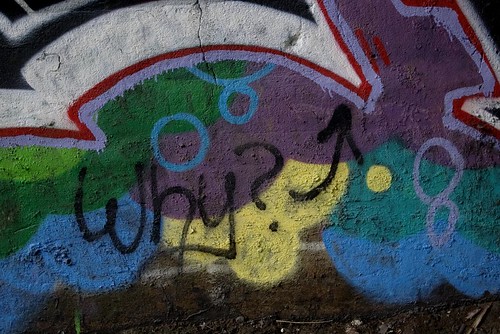
This image asks a question (notice where the arrow points):

IMGP3226rd

I answer it at the very end of the post.

* * * * *


Abstract: Graffiti may or may not be art, and that may or may not matter. To those ends I discuss a half dozen or so pieces in different styles, show that, whatever his particular style, Ceaze’s letterforms do not overlap, identify X-form and ‘crazy organic’ as styles, and distinguish between ‘old school’ and wild style. Moreover, because of its insistence on the name as the basic matrix of a piece, graffiti may represent a break from the past comparable to the adoption of 3D perspective in the early modern era and the creation of abstraction at the beginning of the modern. Finally, graffiti exists on at least a half dozen different quality levels.

CONTENTS

Introduction: Graffiti Writing Art 2
Graffiti Aesthetics: Five Easy Pieces 4
Graffiti Aesthetics 2: Learning to See 9
Old School and Wild Style 9
Another Example 11
Triple-Logic 12
Styles of Derivation 13
Graffiti Aesthetics 3: Stylistic Identity 17
Graffiti Aesthetics 4: The Space of Writing 23
Graffiti, Is it Art? 27

Introduction: Graffiti Writing Art

Is it art? – that’s what they always ask. Is it art? As often as not the implied answer is, No, it’s vandalism, as though it couldn’t be both. Even if that’s not the implied answer there’s a sense that art is a well-defined thing and that one can answer the question by applying some well-known definition of that well-defined thing to the phenomenon of graffiti and voilà! out pops the answer, yes or no.

More sophisticated people know that Is it art? has been a preoccupation at least since Duchamp hung a urinal on a wall, in the wrong orientation, and dubbed it “Fountain”. Even with that under their belt, these more sophisticated people may be stumped by the question, and then launch into a long-winded exposition of the history of the 20th century plastic arts that manages to go nowhere. And so the question is left hanging, like Duchamps’ urinal.

Let it hang. The people who first created graffiti – by which I mean certain styles that originated in Philadelphia and New York City in the late 1960s and early 1970s – knew little about capital “A” Art and weren’t going there. For their descendants Art is somewhere between the enemy, irrelevant, and moderately interesting, depending on time of day, phase of the Moon, blood temperature, heads or tails, and a dozen other variables which may or may not sum to 42.

What I know is that when I walked along that corridor of columns (in Jersey City, NJ, near the Holland Tunnel, yet so far away), four abreast, extravagant colors and patterns eight feet high and twenty feet wide at the base of each, I thought I’d entered some wacked out Egyptian temple that had been decorated by priests who had been higher than the Saturn V that took Neil Armstrong to the Moon. I was overwhelmed. I didn’t know what I was seeing.

Is it art? Who gives a crap?

That was nine years ago. That’s when I decided to photograph graffiti. That’s when I decided to get a better camera so I could take better photos. And that’s when I decided to write about graffiti for The Valve, a group blog of mostly literary folks that I was writing for.

I posted the first four of these pieces to The Valve in August of 2007, almost a year after I’d begun photographing graffiti. I posted the last of them to New Savanna (The Valve has been defunct for a couple years now) in July of this year.

Friday, August 19, 2011

Reading Latour 2: The Social

The Question of Graffiti

Public discourse on graffiti tends to be dominated by one question: Is it art or vandalism? My first impulse, as you might imagine, is to note that we don’t have an either/or dichotomy here, that graffiti can easily both. I suspect that reaction is both too sophisticated and not sophisticated enough.

What I’m thinking, of course, is whether or not an image is art is logically independent of where it is and whether or not it is legally there. The people who pose the question obviously don’t think that way, otherwise they wouldn’t post just THAT question. Still, if you asked them, What is art? what would they say? I don’t know, but I can imagine that someone during the conversation at least some of them would say: I know it when I see it. And some might say: You know, it’s in museums and galleries and sells for lots of money.

That first non-answer is what happens when you try to define art by its content and someone pushes you to the wall on it. When I say that the nature of art is independent of its legal status, that sort of thing is surely what I have in mind. And if you pressed me on it, well, seriously, if you REALLY DID press men on it, I wouldn’t say “I know it when I see it.” But I’d admit there is a problem. What about Duchamp’s urinal? What makes that urinal art, but not all the other urinals in the world?

Which brings me to that second answer: It hangs in galleries, etc. That, of course, is an institutional definition. And it’s a very sophisticated sense of what art is, more sophisticated than most people are on such matters. My imaginary interlocutor is not, in fact, offering such a definition. Rather, in desperation, they’re using museums and galleries as shorthand ways of pointing out thousands of examples of capital “A” Art. And so they point to the institutions that, in the institutional definition, constitute art.

And so we’re back at that question: Is it art or vandalism? If that question is taken as one, not about the images themselves, but about the authorizing institutions, then, YES, it is dichotomous. And the dichotomy is between institutionally authorized and, not merely unauthorized, but entirely outside legitimate society. What I think is that, as ordinarily asked and understood, the question is unclear, indefinite, ambiguous. It is not clearly and explicitly about institutions, but it implies them; nor is it NOT about imagistic content, for the question does implies it.

Social Calculations

The question is a messy one. As is the matter of ‘the social.’ And that brings us back to Latour. As I mentioned in my previous Latour post, he sets up his argument by countering his position against what he takes to be The Standard view. Here’s how he starts that (p. 3):
The first solution has been to post the existence of a specific sort of phenomenon variously called ‘society’, ‘social order’, ‘social practice’, ‘social dimension’, or ‘social structure’. For the last century during which social theories have been elaborated, it has been important to distinguish this domain of reality from other domains such as economics, geography, biology, psychology, law, science, and politics. A given trait was said to be ‘social’ or to ‘pertain to society’ when it could be defined as possessing specific properties, some negative—it must not be ‘purely’ biological, linguistic, economical, natural—and some positive—it must achieve, reinforce, express, maintain, reproduce, or subvert the social order.

Friday, September 5, 2014

Jeff Koons is a capitalist tool!

Distasteful as it may be to bestow such an accolade on someone who traffics so brazenly in the shallow, the banal, the meretricious, and the cheap, he really is the most important artist of our time. Koons is the avatar of a new kind of art and a new kind of art world, both of which he helped to create.

After the unremitting barrage of hype and market talk, the Whitney show makes it possible to take a dispassionate measure of Koons’s achievement. The result is sobering. The work looks oddly out of place at the Whitney, as if it had somehow washed up there accidentally. And right out of the gate it becomes clear that Koons doesn’t have enough ideas to sustain a retrospective on this scale. On the second floor, where the show begins, the elevator deposits you into a gallery filled with eight of the works from his “The New” series (each body of work comes with its own title) that put him on the map in the early 1980s. These are pairs of vacuum cleaners stacked in Lucite cases and illuminated with fluorescent lights—commercially manufactured household appliances displayed as if they were holy relics. In keeping with the avant-garde ethos of the time, Koons here is critiquing society’s habit of turning anything and everything into a salable commodity. Showing two would have made the point; six is padding. This sets the pattern for the entire exhibition.
Sounds about right. Koons is the maven of the marketplace:
In my view, too little attention has been paid to Koons’s five-year career selling mutual funds and commodities on Wall Street in the 1980s. It is the key to understanding his art. So much of what Koons has done and the way he has done it bears the stamp of an astute entrepreneur rather than an artist. The rollout of each neatly packaged and titled series resembles the test marketing of the latest product line more than the unveiling of “new work”—an artist’s latest démarche. This is particularly noticeable in Koons’s early pieces, produced from the late 1970s to the early 1980s. It is too tidy, missing the mix of unevenness, eclecticism, and general messiness that is the hallmark of a conventional apprenticeship phase. Then there is Koons’s persona. He’s no brooding Romantic loner. Rather, Koons is the affable pitchman, nattily dressed in a suit and tie, ready with a smile and some soothing patter with which to reassure or elucidate the confused spectator. He’s even willing to abase himself just a little in the interests of self-promotion, as he did this summer in a Vanity Fair photo shoot showing him pumping iron in the buff. 
Indeed, there’s a sense in which Koons isn’t really at home in the role of artist. He possesses no real imaginative gifts and doesn’t seem to understand what artists do. Real artists take raw material and transform it. Even a Duchamp readymade is transformed, through its altered context rather than changes to its physical form. By contrast, Koons’s “transformations” are mostly sideways moves—increases of scale, replication in another material, the addition of little embellishments like flowers or colored spheres that he calls “gaze balls.” The original object remains largely as it was.
H/t 3QD. Cf. Business Art, Reconsidered, at a blade of grass.

Thursday, July 26, 2012

Bryant Watch: McArt

Levi Bryant was discussing cave art in the comments to one of his recent machinological manifestos (a mech manifesto or McManifesto?) and elicited a critical comment from a friend of his. He decided the matter required more elaboration than is typical of a comment. So he fired up the boiler, set the gears in motion, and cranked out another post. Here’s a couple early lines:
While I readily acknowledge that the cave painters were the cause of the paintings, I strongly disagree that the painters are a part of the being of the painting. Just as ones parents are the cause of one’s being while nonetheless the child is an autonomous being, the painting is an autonomous beings that have its own power that exceed any particular cultural or historical context.
Both sentences merit close attention. Let’s start with the first.

Just what does he mean by the being of a painting? There is no doubt that the pigments of a painting, whether on a wall in a cave or on a canvas in a museum, exist independently of the artist or artists and independently of any observers. That is a truism, and an utterly uninteresting one at that.

In his original post, Machinic Art: The Matter of Contradiciton, Bryant had asserted: “The art work does not represent a percept, affect, or sensation, it creates a percept, affect, or sensation that has now become an autonomous material being in its own right, liberated from dependence on the sense organs.” This is just confused.

Monday, May 30, 2011

Placeholder: Flowers, Photos, Art

I keep thinking I need to take another whack at “What is art?” in the context of my photos. Most recently, the iris photos. But, as I think about it, the essay grows and grows in my mind until it oversteps the bounds of a blog post. So, instead, I offer this place holder.

The burden, the theme, is, of course, what’s the difference between art photos and the rest, which might be calendar shots or national geographic shots (considered as a generic type of photo) or greeting card shots or family album shots or just photos? What’s the difference, the distinction, the activator? The affordances?

Of course, it took awhile for photos to be accepted as art. Even longer for color photos. That’s a side issue, I think. Maybe not.

In the background there is Duchamp’s urinal. It’s not the object, it’s the setting, the mindset. But would the joke slash provocation have worked with a man’s suit or a flower pot or a sewing machine? Then came Warhol, with the Brillo boxes, soup cans, electric chair, Marilyns, and, yes, flowers. More provocation, less joke, less provocative, however, as the career wore on.

Still: all the photos.

Monday, October 14, 2013

When Did the Art World Jump the Shark?

Of course there's more than one art world. But one of them is dominated by wealthy collectors and institutions who compete for status by buying and selling rare objects at very high prices. Some of these rare objects are by old and not-so-old masters and some are brand spanking new, created to feed the monster.

This art world is not, of course, easily distinguishable from the other art worlds, the one's concerned with valid human expression. After all, some of that older work WAS legitimately created in and of its time. It's only in retrospect that is power and beauty has become subordinated to money-fever.

In the last decade or so the corrupt art world has found its way to the oil money of the Middle East. The New York Times has an article on the current scene in Doha, Qutar:
Christie’s, which holds auctions in Dubai and exhibitions in Doha, reported last year that sales in the Middle East were approaching 10 percent of its annual turnover.

“Our numbers are probably similar,” said Alexander Rotter, who runs Sotheby’s contemporary art department in New York and was in Doha last week, too. Sotheby’s opened its office here in 2008 and had its first Doha auction the next year. In April it had its first auction of contemporary art here with works by artists from the United States as well as the Middle East and Asia. “There is a new breed of collector here that didn’t exist 10 years ago,” said Mr. Rotter, who organized the sale and was its auctioneer. “And they are in it to win it.”
And also:
Asking for public opinion is a novelty in this absolute monarchy. But the Qatar Museums Authority seems to be drumming up feedback even more aggressively than most American museums do.
This most recent effusion of buzz surrounds the work of Damien Hirst, who. according to the late Robert Huges, is all hype: "Isn't is a miracle what so much money and so little ability can produce."


I've had quite a bit to say about art here on New Savanna, especially about graffiti. Some posts:

Thursday, September 12, 2013

Graffiti: Drop Back and Punt

That’s not the phrase I want – “drop back and punt” – but it’s the best I can do at the moment. The phrase I want is French (a language I do not know). I found it in, I believe, Arthur Koestler’s The Ghost in the Machine, which had a mighty influence on me in my late teens and early 20s. What the phrase meant was, well, drop back and punt, but in a somewhat more elevated and sophisticated context.

The phrase characterized a phenomenon found in evolutionary biology. A population is caught in a dead end; its niche is contracting and the species is so well adapted to that niche that it cannot survive elsewhere. How can the population survive? One thing that happens is that subsequent generations become dedifferentiated, simpler if you will (“dropping back...”), which allows them to move to a new niche (“... and punting”), and there the population can develop new specializations appropriate to that niche. Koestler saw certain forms of (cultural) creativity as functioning like that. (Bleg: Does anyone know the French term that Koestler used?)

That’s what graff culture is up to, which puts us in territory I explored in a recent post, Through Duchamp and Beyond: Graffiti in the Promised Land?, and a somewhat older one, Graffiti Hit the Reset Button on Culture. As we know, graffiti started totally outside the art world. It was made by people who simply wanted to put a claim on the world, to be recognized. They weren’t interested in making art; that came later, and fitfully.

As Susan Farrell, founder of Art Crimes, put it to me in email, graffiti is a combination of art and extreme sport. Take this example by Distort:

IMGP3487

While it has a certain style, it is not Art in any conventional sense. What’s remarkable is that it’s at the top of an abandoned five or six story building.

Thursday, October 9, 2014

Think Graffiti: The Academy of the Wall

20141005-IMGP1064
Eric Felisbret. Graffiti New York. Harry Abrams 2009.

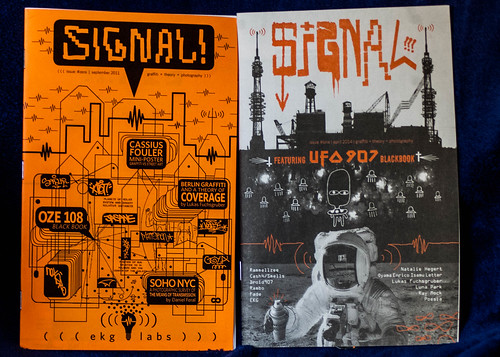
Signal: graffiti + theory + photography. Issue #zero. September 2011.

Signal: graffiti + theory + photography. Issue #one. April 2014.
So you want to read about graffiti – and by “graffiti” you mean the form of visual expression that arose in New York City and Philadelphia in the late 1960s and early 1970 and wrote across walls world-wide by 1990. What to read? Where do you start?

The first question is a tough one, to which I’ll return in a sec. The second one is easy: Start with Mailer and Naar, The Faith of Graffiti. It was the first book about graffiti and still, as far as I know, the best. Why the best, given that the art has changed considerably since Naar’s classic photographs?

First, those photographs ARE classic. Few graffiti photos since come up to Naar’s standard, and that’s important. For photos belong inside graffiti culture and are not merely a record of and commentary on it. Second, Mailer’s text took graffiti seriously and put it in its proper context, which is that of world-wide art since the beginning of time.

After that, though, what next? Lots of possibilities, but Eric Felisbret, Graffiti New York, is one possibility, and a good one. As the title suggests, it’s an informal history of graffiti in New York City from the beginning up until not too long ago. By “informal” I mean that the book is written for a general audience and is not a formal academic history with all the conceptual apparatus that implies. Which is fine. But someday formal academic histories of graffiti are going to have to be written.

As such, it presupposes little or no prior knowledge of graffiti, which is true for most of the coffee table graff books around. And, like most such books, it is skewed toward pieces, aka masterpieces, the large elaborate murals that, at their best, just look so damn! goooood.

But they aren’t all of graff, not even half, and Felisbret knows that. Graffiti New York comes with the standard features of such books, an explanation of graffiti’s major forms – tags, throwies, and pieces, a glossary (a good one, too), and quotations from the writers themselves. Since it’s about the New York scene the book has sections devoted to the five boroughs and a chapter on the gallery scene.

But perhaps its best feature is the chapter on the community, graffiti as a form of social organization. You can pick this up from the other books, but Graffiti New York gives it focal attention: the writers, crews, hubs, women, and even the cops, all are covered. This is where graffiti lives, and how it lives in the community. If you want to understand how graffiti grows and flows, and why it’s important, you need to understand the community.

Still and all, Graffiti New York fits the standard mold, and that’s a scheme that treats graffiti as, well, you know, as art, capital “A” Art. On the one hand that’s a good thing, a progressive move. It’s a move Mailer took in his text, The Faith of Graffiti, but Mailer was writing in the previous century, indeed, the previous millennium. It’s time to move on.