Saturday, February 25, 2017

Numerosity areas in the brain

A network of topographic numerosity maps in human association cortex,
Ben M. Harvey & Serge O. Dumoulin
Nature Human Behaviour 1, Article number: 0036 (2017)
doi:10.1038/s41562-016-0036

Abstract

Sensory and motor cortices each contain multiple topographic maps with the structure of sensory organs (such as the retina or cochlea) mapped onto the cortical surface. These sensory maps are hierarchically organized. For example, visual field maps contain neurons that represent increasingly large parts of visual space with increasingly complex responses. Some visual neurons respond to stimuli with a particular numerosity — the number of objects in a set. We recently discovered a parietal topographic numerosity map in which neural numerosity preferences progress gradually across the cortical surface, analogous to sensory maps. Following this analogy, we hypothesized that there may be multiple numerosity maps. Numerosity perception is implicated in many cognitive functions, including foraging, multiple object tracking, dividing attention, decision-making and mathematics. Here we use ultra-high-field (7 Tesla, 7T) functional magnetic resonance imaging (fMRI) and neural-model-based analyses to reveal numerosity-selective neural populations organized into six widely separated topographic maps in each hemisphere. Although we describe subtle differences between these maps, their properties are very similar, unlike in sensory map hierarchies. These maps are found in areas implicated in object recognition, motion perception, attention control, decision-making and mathematics. Multiple numerosity maps may allow interactions with these cognitive systems, suggesting a broad role for quantity processing in supporting many perceptual and cognitive functions.

Networks and cumulative culture among hunter-gatherers

Characterization of hunter-gatherer networks and implications for cumulative culture,
A. B. Migliano, A. E. Page, J. Gómez-Gardeñes, G. D. Salali, S. Viguier, M. Dyble, J. Thompson, Nikhill Chaudhary, D. Smith, J. Strods, R. Mace, M. G. Thomas, V. Latora & L. Vinicius
Nature Human Behaviour 1, Article number: 0043 (2017)
doi:10.1038/s41562-016-0043

Abstract
Social networks in modern societies are highly structured, usually involving frequent contact with a small number of unrelated ‘friends’. However, contact network structures in traditional small-scale societies, especially hunter-gatherers, are poorly characterized. We developed a portable wireless sensing technology (motes) to study within-camp proximity networks among Agta and BaYaka hunter-gatherers in fine detail. We show that hunter-gatherer social networks exhibit signs of increased efficiency for potential information exchange. Increased network efficiency is achieved through investment in a few strong links among non-kin ‘friends’ connecting unrelated families. We show that interactions with non-kin appear in childhood, creating opportunities for collaboration and cultural exchange beyond family at early ages. We also show that strong friendships are more important than family ties in predicting levels of shared knowledge among individuals. We hypothesize that efficient transmission of cumulative culture may have shaped human social networks and contributed to our tendency to extend networks beyond kin and form strong non-kin ties.

We studied in-camp proximity networks (within and between households) as a proxy for social interactions in two hunter-gatherer populations from Africa and southeast Asia. We developed a portable wireless sensing technology (motes; Fig. 1) to record all dyadic interactions within a radius of approximately 3 metres at 2-minute intervals for 15 hours a day (05:00–20:00) over a week, in six Agta camps in the Philippines (200 individuals, 7,210 recorded dyadic interactions) and three BaYaka camps in Congo-Brazzaville (132 individuals, 3,397 dyadic interactions; see Supplementary Table 1 with descriptive statistics for all camp networks). We built high-resolution proximity networks mapping the totality of close-range interactions within each camp. In hunter-gatherers (who lack technology-aided communication), close proximity is an indicator of joint activities such as foraging, parental care and information exchange.

Spot the windows

20141130-_IGP0784

Thursday, February 23, 2017

Bourdain talks at Google, New York

Looks like I've got a Jones for Anthony Bourdain. I've been watching mostly Parts Unknown, but also A Cook's Tour, and I've even gone scouting for stuff about him on Google Scholar. And, yes, there is an academic literature on cooking shows and travel shows and he's discussed in it. But that's not what this is about. I just wanted to share this interview with Bourdain and three of the production team, Tom Vitale (Producer/Director), Zach Zambonie (Director of Photography), and Todd Liebler (Director of Photography). As you might imagine, there's lots of Bourdain interviews out there, and I've seen a few. I'm posting this one because it's not just Bad-Boy Tony.


BTW, if Bad-Boy Tony were to be reincarnated, he'd like to come back as a kick-ass funk bass player, like Bootsy Collins.

Tuesday, February 21, 2017

Ezra Klein interviews Elizabeth Drew about Trump

This is a superb interview. Well worth listening two, all 73 minutes of it.


Elizabeth Drew is the author of Washington Journal, one of my favorite books about Watergate. Drew covered the story as a reporter for the New Yorker, and the book emerges from the real-time, journalistic diary she kept amidst the chaos. As such, it does something no other Watergate book does: tells the story not as a tidy tale with a clear beginning and inevitable end, but as an experience thick with confusion, rumors, alarm, and half-truths.

Of late, I've heard a lot of people comparing the early days of Donald Trump's administration — with the strange scandals around Russia, the fast resignation of Trump's national Security Advisor, and the mounting pressure for investigation — with Watergate. And so I asked Drew, who is now a writer at the New York Review of Books, to provide some perspective on whether that comparison makes sense, and how to think about the Trump scandals that are unfolding, slowly and haltingly, right now.

Books:
-Philip Roth’s The Plot Against America
-Andrew Schlesinger’s The Age of Jackson
Drew emphasizes that, whatever Trump is, it's something we've not seen before, so comparisons with Watergate are of relatively little value. Her sense is that it, whatever it is, can't be sustained for four years. But she's unwilling to speculate about what will bring it to a stop. We've got to let it unfold. Not that we should be passive, but simply that we cannot prejudge how to act and react. It's a new phenomenon.

Shakespeare and his collaborators?

In 1989, a young professor named Gary Taylor published “Reinventing Shakespeare,” in which he argued that Shakespeare’s unrivalled literary status derives less from the sheer greatness of his plays than from the cultural institutions that have mythologized the Bard, elevating him above equally talented Renaissance playwrights. “Shakespeare was a star, but never the only one in our galaxy,” Taylor wrote. [...]
Late last year, Taylor shocked readers once again. The New Oxford Shakespeare, for which Taylor serves as lead general editor, is the first edition of the plays to credit Christopher Marlowe as a co-author of Shakespeare’s “Henry VI,” Parts 1, 2, and 3. It lists co-authors for fourteen other plays as well, ushering a host of playwrights—Thomas Nashe, George Peele, Thomas Heywood, Ben Jonson, George Wilkins, Thomas Middleton, and John Fletcher, along with Marlowe—into the big tent of the complete works. This past fall, headlines around the world trumpeted the Marlowe-Shakespeare connection, and spotlighted the editors’ methodology: computer-aided analysis of linguistic patterns across databases of early modern plays. “Shakespeare has now fully entered the era of Big Data,” Taylor announced in a press release.

It’s no longer controversial to give other authors a share in Shakespeare’s plays—not because he was a front for an aristocrat, as conspiracy theorists since the Victorian era have proposed, but because scholars have come to recognize that writing a play in the sixteenth century was a bit like writing a screenplay today, with many hands revising a company’s product. The New Oxford Shakespeare claims that its algorithms can tease out the work of individual hands—a possibility, although there are reasons to challenge its computational methods. But there is a deeper argument made by the edition that is both less definitive and more interesting. It’s not just that Shakespeare collaborated with other playwrights, and it’s not just that Shakespeare was one of a number of great Renaissance writers whose fame he outstripped in the ensuing centuries. It’s that the canonization of Shakespeare has made his way of telling stories—especially his monarch-centered view of history—seem like the norm to us, when there are other ways of telling stories, and other ways of staging history, that other playwrights did better.

* * * * *

Out of curiosity, I took a look at The New Oxford Shakespeare. They're offering, not one, but two versions of the complete Shakespeare. One version, Modern Critical Edition, seems to be a standard critical edition consisting of eclectic texts with supporting apparatus. The other version, Critical Reference Edition, is for hard-core Shakespeare scholars:
  • A two-volume Complete Works that assembles primary resources in one place
  • Presented with original spelling, punctuation, capitalization, abbreviations, typographical contrasts, ambiguities, and inconsistencies
  • Footnotes identify and discuss any editorial corrections in the early documents
  • Marginal notes record press variants and key variants in different documents
  • Songs are presented with the original musical notation, when available
  • Cast lists identify the length and type of each role, discuss potential doubling possibilities, and note essential props
Whoa!!!

Sunday, February 19, 2017

Artifice

IMGP3333

IMGP3342

IMGP3356

An Open Letter to Dan Everett about Literary Criticism

If you’ve heard of Dan Everett at all, most likely you’ve heard about his work among the Pirahã and his battle with Noam Chomsky and the generative grammarians. He went into the Amazon to live among the Pirahã in the mid-1970s with the intention of learning their language, translating the Bible into it, and converting them to Christianity. Things didn’t work out that way. Yes, he learned their language, and managed to translate a bit of the Bible into Pirahã. But, no, he didn’t convert them. They converted him, as it were, so he is now an atheist.

Not only did Everett learn Pirahã, but he compiled a grammar and reached the conclusion – a bit reluctantly at first – that it lacks recursion. Recursion is the property that Chomsky believes is irreducibly intrinsic to human language. And so Everett found himself in pitched battle with Chomsky, the man whose work revolutionized linguistics in the mid-1950s. If that interests you, well you can run a search on something like “Everett Chomsky recursion” (don’t type the quotes into the search box) and get more hits than you can shake a stick at.

I’ve never met Dan face-to-face, but I know him on Facebook where I’m one of 10 to 20 folks who chat with him on intellectual matters. Not so long ago I reviewed his most recent book, Dark Matter of the Mind, over at 3 Quarks Daily. I thus know him, after a fashion.

And so I thought I’d address an open letter to him on my current hobbyhorse: What’s up with literary criticism?

* * * * *

Dear Dan,

I’ve been trying to make sense of literary criticism for a long time. In particular, I’ve been trying to figure out why literary critics give so little descriptive attention to the formal properties of literary texts. I don’t expect you to answer the question for me but, who knows, as an outsider to the discipline and with an interest in language and culture, perhaps you might have an idea or two.

I figured I’d start by quoting a fellow linguist, one moreover with an affection for Brazil, Haj Ross. Then I look at Shakespeare as a window into the practice of literary criticism. I introduce the emic/etic distinction in that discussion. After that we’ll take a look at Joseph Conrad’s Heart of Darkness in the course of which I introduce the question, What would I teach in a first level undergraduate class? I find that to be a very useful way of thinking about the discipline; I figure that might also appeal to you as a Dean and Acting Provost. I conclude by returning to the abstractosphere by distinguishing between naturalist and ethical criticism. Alas, it’s a long way through, so you might want to pour yourself a scotch.

Haj’s Problem: Interpretation and Poetics

Let’s start with the opening paragraphs from a letter that Haj Ross has posted to Academia.edu. Of course you know who Haj is, but I think it’s useful to note that, back in the 1960s when he was getting a degree in linguistics under Chomsky at MIT, he was also studying poetics under Roman Jakobson at Harvard, and that, over the years, he has produced a significant body of descriptive work on poetry that, for the most part, exists ‘between the cracks’ in the world of academic publication. The letter is dated November 30, 1989 and it was written when Haj was in Brazil at Departamento de Lingüística, Universidade Federal de Minas Gerais, Belo Horizonte [1]. He’s not sure whom he wrote it to, but thinks it was one Bill Darden. He posted it with the title “Kinds of meanings for poetic architectures” and with a one-line abstract: “How number can become the fabric on which the light of the poem can be projected”. Here’s the opening two paragraphs:
You correctly point out that I don’t have any theory of how all these structures that I find connect to what/how the poem means. You say that one should start with a discussion of meaning first.

That kind of discussion, which I have not heard much of, but already enough for me, I think, seems to be what people in literature departments are quite content to engage in for hours. What I want to know, however, is: what do we do when disputes arise as to what two people think something means? This is not a straw question - I have heard Freudians ram Freudian interpretations down poems’ throats, and I think also Marxists, etc., and somehow, just as most discussions among Western philosophers leave me between cold and impatient, so do these literary ones. So, for that matter, do purely theoretical, exampleless linguistic discussions. Armies may march on their stomachs; I march on examples. So I would much rather hear how the [p]’s in a poem are arrayed than about how the latent Oedipal etc., etc. In the former case, I know where to begin to make comments, in the latter, ich verstumme.
You’ll have to read the whole letter to find out what he meant by that one-line abstract, but I assure you that it’s both naïve and deep at one and the same time, mentioning, among other things, the “joy of babbling” and the role of the tamboura in Indian classical music. At the moment I’m interested in just those two opening paragraphs.

While I got my degree in literary criticism and understand the drive/will to meaning, I also understand Haj’s attraction to verifiable pattern/structures and his willingness to pursue that even though he cannot connect it to meaning. Yes, meaning is the primary objective of academic literary criticism and, yes, justifying proposed meanings is (deeply) problematic. I also know that the academic discipline of literary criticism was NOT founded on the activity of interpreting texts. It was founded in the late 19th century on philology, literary history, and editing – that is, editing the canonical literary works for study by students and scholars. Roughly speaking, the interest in interpretation dates back to the second quarter of the 20th century, but it didn’t become firmly institutionalized until the third quarter of the century. You can see that institutionalization in this Ngram search on the phrase “close reading”, which is a term of art for interpretive analysis:
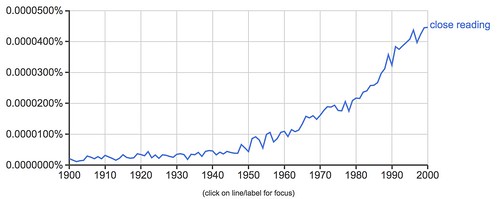
close reading
Figure 1: "Close reading"

And that’s when things became interesting. As more and more critics came to focus on interpretation, the profession became acutely aware of a problem: different critics produced different interpretations, which is the correct interpretation? Some critics even began to wonder whether or not there was such a thing as the correct interpretation. We are now well within the scope of the problem that bothered Haj: How do you justify one interpretation over another?

That’s the issue that was in play when I entered Johns Hopkins as a freshman in 1965. Though I had declared an interest in psychology, once I’d been accepted I gravitated toward literature. Which means that, even as I was working as hard as I could to figure out how to interpret a literary text, I was also party to conversations about the problematic nature of interpretation. As I have written elsewhere about those years at Hopkins [2] there’s no need to recount them here. The important point is simply that literary critics were acutely aware of the problematic nature of interpretation and devoted considerable effort to resolving the problem.

In the course of that problematic thrashing about, literary critics turned to philosophy, mostly Continental (though not entirely), and linguistics, mostly structuralist linguistics. In 1975 Jonathan Culler published Structuralist Poetics, which garnered him speaking invitations all over America and made his career. For Culler, and for American academia, structuralism was mostly French: Saussure, Jakobson (not French, obviously), Greimas, Barthes, and Lévi-Strauss, among others. But Culler also wrote of literary competence, clearly modeled on Chomsky’s notion of linguistic competence, and even deep structure. At this point literary critics, not just Culler, were interested in linguistics.

Here’s a paragraph from Culler’s preface (xiv-xv):
The type of literary study which structuralism helps one to envisage would not be primarily interpretive; it would not offer a method which, when applied to literary works, produced new and hitherto unexpected meanings. Rather than a criticism which discovers or assigns meanings, it would be a poetics which strives to define the conditions of meaning. Granting new attention to the activity of reading, it would attempt to specify how we go about making sense of texts, what are the interpretive operations on which literature itself, as an institution, is based. Just as the speaker of a language has assimilated a complex grammar which enables him to read a series of sounds or letters as a sentence with a meaning, so the reader of literature has acquired, through his encounters with literary works, implicit mastery of various semiotic conventions which enable him to read series of sentences as poems or novels endowed with shape and meaning. The study of literature, as opposed to the perusal and discussion of individual works, would become an attempt to understand the conventions which make literature possible. The major purpose of this book is to show how such a poetics emerges from structuralism, to indicate what it has already achieved, and to sketch what it might become.
However much critics may have been interested in this book, that interest did not produce a flourishing poetics. Even Culler himself abandoned poetics after this book. Interpretation had become firmly established as the profession’s focus.

As for the problem of justifying one interpretation over another, deconstructive critics argued that the meaning of texts was indeterminate and so, ultimately, there is no justification. Reader response critics produced a similar result by different means. The issue was debated into the 1990s and then more or less put on the shelf without having been resolved.

I have no quarrel with that. I think the basic problem is that literary texts of whatever kind – lyric or narrative poetry, drama, prose fiction – are different in kind from the discursive texts written to explicate them. There is no well-formed way of translating meaning from a literary to a discursive text. When you further consider that different critics may have different values, the problem becomes more intractable. Interpretation cannot, in principle, be strongly determined.

What, you might ask, what about the meaning that exists in a reader’s mind prior to any attempt at interpretation? Good question. But how do we get at THAT? It simply is not available for inspection.

What happens, though, when you give up the search for meaning? Or, if not give up, you at least bracket it and subordinate it to an interest in pattern and structure as intrinsic properties of texts? Is a poetics possible? Let’s set that aside for awhile and take a detour though the profession’s treatment of The Bard, William Shakespeare, son of a glover and London actor.


Saturday, February 18, 2017

The Greatest Man in Siam


This is one of my favorite cartoons. I've blogged about it quite a bit, and have packaged those posts into a working paper. About 3/4 of the way though there is a dance sequence that is one of the most joyous bits of film I've ever seen. The animation is superb, and so is the music. Given the date, 1944, the music is big band music, and this band plays like it's playing for live dancers. And the trumpet soloist, he plays like it's the third set of a good night.

And yes, sure, the cartoon is Orientalist, sexist, patriarchal, racist and a few other things as well. After you've gotten over that, look at the eyes and ask yourself, Why does the trumpet player get the girl? The cartoon's premise is that men are competing for the king's daughter. Why do the first three lose and thaelast one win? As I said, look at the eyes. What's that about? What values?

A bird and the city

20161022-_IGP7518

The rise of interpretive literary criticism

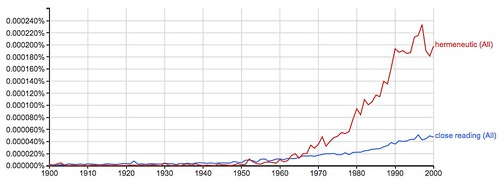
In various posts I've pointed out that interpretation didn't become central to academic literary study until after World War II. We can see that in the following Google Ngram chart on the phrase "close reading", which is the term of art for interpretation:

close reading

This comparison with "hermeneutic" is instructive:
close reading hemeneutic

They rise at roughly the same time, but the more technical "hermeneutic" quickly out paces "close reading". Why? Is this evidence for "physics envy" leading to the intellectually useless proliferation of technical jargon? Well, if you believe that literary criticism has no need of a theoretical infrastructure, then, sure, why not?

But I don't believe that. I may not like the theoretical instruction literary criticism has created for itself, but that doesn't mean I think it is best done without such an infrastructure. And the steep rise of "hermeneutic" seems to reflect the general rise of a theoretical infrastucture. Without any particular evidence at hand, the term strikes me as being more useful in general theoretical discussion. Close reading is something a critic does; hermeneutics is something critics talk about.

Friday, February 17, 2017

Donald Trump: Pop Star as President

If Elvis Presley had been elected President of the United States, what kind of president would he have been? We now know: Trumpian. If Michael Jackson had been elected President of the United States, what kind of president would he have been? We now know: Trumpian. As far as I know these two musicians never had political aspirations – though a pill-addicted Presley once tried to cajole Richard Nixon into appointing him as anti-drug ambassador to the nation’s youth – but, like Trump, they lived in the public eye and they lived within an entourage of associates and ‘minders’ who kept the world at bay.

Secure in this circle, the star could do whatever he wanted, as long as the money kept coming in. For Presley and Jackson the money was driven by record sales and ticket sales. THAT was the connection with the world at large. They gift the world with music and the world gifts them with money. As long as those things are roughly in balance, the beat went on, more or less. Sure, there’s also the personal quirks, indulgences, and localized craziness that fueled the gossip rags of all media. But as long as the money train stayed on the rails the rest was just noise. The entourage could handle it. Until the drugs got out of control and the entourage was useless.

Pre-Presidential Trump is a more complicated case. Initially, and with the help of Daddy’s money and contacts – little Donald was born to an entourage – he made his money in real estate development. He did deals, face-to-face. Then, over time, he transitioned to a franchise operation and a TV star. Showbiz! But, as with Elvis and Michael, as long as the money came in, nothing else mattered. A little scandal here and there – and as far as we know, The Donald has never been into anything comparable to Elvis’s pill habit or Michael’s cosmetic adventurism and child fetishism – but it’s just noise.

Now that he’s President, things have changed. Drastically. Money is no longer his connection to the world. To be sure, he’s still holding on to his vast business empire – Yuge, I tell you, Yuge! The best! – though he’s distanced himself from it by the length of a pinky. But, and here’s the crucial point, that business empire is no longer his lever on reality. That’s not how he judges his personal efficacy any more. Let me repeat that, with emphasis: That’s NOT how he judges his PERSONAL sense of efficacy.

Now that he’s president his personal sense of efficacy is linked to his acts as president. And that’s not working out so well. He’s finding out that, at every level and in every way, the world is not willing to jump at his command. In particular, the media isn’t presenting a picture of his actions and efficacy that is consonant with his intentions. All of a sudden we have a comedian (John Oliver) placing educational ads on his favorite TV shows – fake commercials full of true facts! Trump’s image in the media was one thing when his world centered on his ability to generate a money stream; in that context it played a secondary and subsidiary role – all PR is good PR. Now that that income stream has been shifted into a secondary role, all he’s got left is the media flow.

He signs executive orders and he expects the media to show him how dynamic, forceful, and all-around-wonderful he is. And, remember, this is now the main event. When the media doesn’t comply. What does he do? He goes on TV and delivers a 77 minute rant against media.

How long can he keep this up?

Wednesday, February 15, 2017

Fathers and sons

This is a fascinating little video. It's an interview with Paul Cohen, who played lead trumpet for Count Basie for years and years. The two men were very close; Cohen thought of Basie as a father. But there came a time when Basie "rejected" Cohen and Cohen left the band. Cohen's playing on "Poor Butterfly", which plays in the background during the interview, is gorgeous.

Tuesday, February 14, 2017

Distort in context

This photo just got a 'favorite' at Flickr:

20161015-P1120471

I'm pretty sure the 'fav' had more to do with Distort than with the photograph itself. I'm fine with that.