Monday, March 13, 2017

Journey to 3Tops: Indiana SLuGS and the Land that Time Forgot

Here's a piece from several years ago. Now that I'm involved in The Bergen Arches Project I've decided to bump it to the top of the queue. The graffiti 'landscape" has changed since then, and I've made some notations about that. "WAAGNFNP" is, of course, the We Are All Nuclear Fireball Now Party, which I've written about a bit earlier, and 3Tops is the Party's enforcer.
About two weeks ago (I'm writing this on 23 July 2007) I was checking my Flickr account to see if anyone had commented on any of my photos. I hit pay dirt. One PLASMA SLuGS (red ribbon for WAR} had made the following comment on one of my graffiti photographs: “please if u dont mind tell me where n how to get here.” Bingo!

As some of you party loyalists may know, I've been photographing local graffiti since last fall. The visage of our fine and noble 3Tops is, in fact, one of the pieces I'd found, not to mention other WAAGNFNP notables, such as Toothy. Graffiti, however, is generally illegal, and the people who do it don't leave contact information on the walls. Thus, while I now have hundreds, thousands even, of photographs of graffiti within a mile or so of my apartment, I don't know who painted them. And, since I have no roots in the area, I've got no social network through which I can track them down.

That's one of the reason I'd started posting my photos to Flickr. I figured that some of the writers (a term of art) would see them and perhaps, one day, one of them would contact me about them. SLuGS is the first.

Of course, I told him where the picture was taken - in Jersey City, about a mile in from the Holland Tunnel near the old Long Dock Tunnel. I also offered to take him on a tour of the local graffiti. He took me up on my offer and showed up that Sunday afternoon with a woman he introduced as his wife, a backpack full of spray paint, and a Canon single-lens reflex camera. I revved up Google Earth and showed them where we were, where the graffiti is, and off we went, with the intention of going into the Erie Cut.

On the way there SLuGS did a little painting, with both his wife and I snapping pictures:

laylabill07.jpg
Still there, though faded a bit.
That's the SLuG, his identifying mark that he uses instead of the name that most writers use. It's painted on the base of one of the columns supporting I78 as it comes down off the Jersey Heights (or the Jersey Palisades) and feeds into the Holland Tunnel. He's done thousands of these here and there, mostly I'd guess in the New York City area, but other places as well. He's been to Amsterdam and he's made cooperative arrangements to get the PLASMA SLuG up all over.


Saturday, March 11, 2017

The role of Navajo women in the early semiconductor industry

I learned that from 1965-1975 the Fairchild Corporation’s Semiconductor Division operated a large integrated circuit manufacturing plant in Shiprock, New Mexico, on a Navajo reservation. During this time the corporation was the largest private employer of Indian workers in the U.S. The circuits that the almost entirely female Navajo workers produced were used in devices such as calculators, missile guidance systems, and other early computing devices. [...] How and why did the most advanced semiconductor manufacturer in the world build a state of the art electronics assembly plant on a Navajo reservation in 1965? The short answer is: cheap, plentiful, skillful workers, and tax benefits. A 1969 Fairchild News Release explains that the plant was “the culmination of joint efforts of the Navajo People, the U.S. Bureau of Indian Affairs (B.I.A), and Fairchild.” Navajo leadership helped to push this project forward; Raymond Nakai, chairman of the Navajo Nation from 1963 to 1971, and the self-styled first “modern” Navajo leader, was instrumental in bringing Fairchild to Shiprock. He spoke fervently about the necessity of transforming the Navajo as a “modern” Indian tribe, and what better way to do so than to put its members to work making chips, potent signs of futurity that were no bigger than a person’s fingernail? [...]

The idea that Navajo weavers are ideally suited, indeed hard-wired, to craft circuit designs onto either yarn or metal appeals to a romantic notion of what Indians are and the role that they play in U.S. histories of technology.

This experiment in bringing the high tech electronics industry to the Navajo Reservation at Shiprock ended abruptly. In 1975, protesters associated with the American Indian Movement occupied and shut down the plant, demanding better conditions for workers. Indeed, the industry had experienced a slow down and some workers had been laid off. Though this was part of a national trend and not unique to the Shiprock plant, given the national social context of protest against racism and civil rights violations, it is not surprising that this occupation followed on the heels of AIM’s stand-off at Wounded Knee and the occupation of Alcatraz in California. The protesters viewed the plant as a continuation of the exploitation of native people, and they were correct that the Shiprock area had suffered from economic hardship for many years, hardship that was directly related to the long-standing disempowerment and impoverishment of the Navajo. It was difficult for them to perceive these layoffs as anything but more of the same. The protesters left after a week, but by then Fairchild had already decided to close the plant permanently, focusing instead on its operations in Asia.

Monday, March 6, 2017

Trump: The Man, the Oath, the Presidency

In the course of a discussion over at Marginal Revolution, prior_test2 linked to a most interesting post at Lawfare by Benjamin Wittes and Quinta Jurecic entitled “What Happens When We Don’t Believe the President’s Oath?” As title suggests, it centers on the President’s Oath of Office, which is quite brief: “I do solemnly swear . . . that I will faithfully execute the office of President of the United States, and will to the best of my ability, preserve, protect and defend the Constitution of the United States.” Their point is that it is this oath that links the private individual, Donald J. Trump, to the public office, President of the United States, and thereby both binds him to that office and separates his private interests and concerns from that office.

Alas:
There’s only one problem with Trump’s eligibility for the office he now holds: The idea of Trump’s swearing this or any other oath “solemnly” is, not to put too fine a point on it, laughable—as more fundamentally is any promise on his part to “faithfully” execute this or any other commitment that involves the centrality of anyone or anything other than himself.

Indeed, a person who pauses to think about the matter has good reason to doubt the sincerity of Trump’s oath of office, or even his capacity to swear an oath sincerely at all. We submit that huge numbers of people—including important actors in our constitutional system—have not even paused to consider it; they are instinctively leery of Trump’s oath and are now behaving accordingly.
And so:
...the presidential oath is actually the glue that holds together many of our system’s functional assumptions about the presidency and the institutional reactions to it among actors from judges to bureaucrats to the press. When large enough numbers of people within these systems doubt a president’s oath, those assumptions cease operating. They do so without anyone’s ever announcing, let alone ruling from the bench, that the President didn’t satisfy the Presidential Oath Clause and thus is not really president. They just stop working—or they work a lot less well.
By way of clarification:
There’s a big, if somewhat ineffable, difference between opposing a president and not believing his oath of office. All presidents face opposition, some of it passionate, extreme, and delegitimizing. All presidents face questions about their motives and integrity. Hating the President is a very old tradition, and many presidents face at least some suggestion that their oaths do not count. Obama, after all, was a foreign-born Muslim to his most extreme detractors.

Yet, for a variety of reasons we discuss below, there is something different about the questions about Trump’s oath, and it is how widespread and mainstream the anxiety is. It’s also, and we want to be frank about this, how reasonable the anxiety is when applied to a man whose word one cannot take at face value on the prepolitical trust the oath represents. That person does not get certain presumptions our system normally attaches to presidential conduct.
And so we have:
On the contrary, the belief that there is something different about this president is extraordinarily common among sober commentators of both the left and right—and, even more notably, among many of those with significant experience in government in both career and political roles.

So why the doubts? For one thing, Trump’s highly erratic statements and behavior include any number of incidents that seem to reflect a lack of understanding of his office or its weight. It’s not just the tweets. This is a person, after all, who suggested before the election that he might not even serve as president if he prevailed; who then said that he would accept the results of the election “if I win”; who made up a whole lot of voter fraud; who promised to prosecute his opponent; who, in his first public address following the inauguration, stood in front of the CIA’s Memorial Wall and bragged falsely about the number of people who attended his inaugural ceremony; who has made use of the immense power of the bully pulpit to publicly complain about the “unfair” decision by a private retail company to drop his daughter’s fashion line; who approached the process of selecting a Secretary of State, National Security Advisor, and nominee to the Supreme Court in a manner more fit for reality television than the office of the presidency; who refused to accept responsibility for the death of a Navy SEAL in a botched counterterrorism raid conducted on his orders, claiming instead that “this was something they [the generals] wanted to do,” before standing in front of Congress and apparently ad-libbing that the SEAL was looking down with happiness from Heaven because Trump received extended applause during his address; and whose most memorable quotation coming out of the presidential campaign was the inimitable, “Grab ‘em by the pussy”—a phrase he then dismissed as “locker room talk.”

Moral seriousness and respect for his office just isn’t his thing.

This is also a person whose campaign was rife with promises to commit crimes and to abuse the powers of the very office for which he then took the oath.

The combination of the sprawling nature of his business and the intentional obscurity of his finances is also a factor.

Two worlds in the sky

20161210-P1120768

Theft! A History of Music

From Duke University's Center for the Study of the Public Domain:
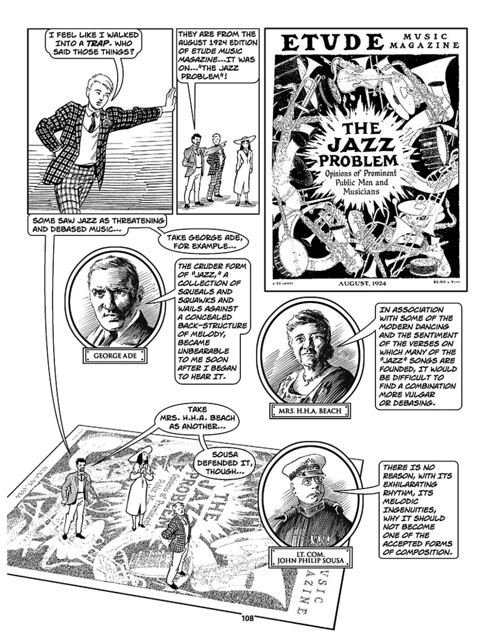
We are proud to announce the publication of Theft! A History of Music, a graphic novel laying out a 2000 year long history of musical borrowing from Plato to rap. The comic, by James Boyle, Jennifer Jenkins and the late Keith Aoki, is available as a handsome 8.5 x 11″ paperback, and for free download under a Creative Commons license.
About the Book 
This comic lays out 2000 years of musical history. A neglected part of musical history. Again and again there have been attempts to police music; to restrict borrowing and cultural cross-fertilization. But music builds on itself. To those who think that mash-ups and sampling started with YouTube or the DJ’s turntables, it might be shocking to find that musicians have been borrowing—extensively borrowing—from each other since music began. Then why try to stop that process? The reasons varied. Philosophy, religion, politics, race—again and again, race—and law. And because music affects us so deeply, those struggles were passionate ones. They still are. 
The history in this book runs from Plato to Blurred Lines and beyond. You will read about the Holy Roman Empire’s attempts to standardize religious music with the first great musical technology (notation) and the inevitable backfire of that attempt. You will read about troubadours and church composers, swapping tunes (and remarkably profane lyrics), changing both religion and music in the process. You will see diatribes against jazz for corrupting musical culture, against rock and roll for breaching the color-line. You will learn about the lawsuits that, surprisingly, shaped rap. You will read the story of some of music’s iconoclasts—from Handel and Beethoven to Robert Johnson, Chuck Berry, Little Richard, Ray Charles, the British Invasion and Public Enemy. 
To understand this history fully, one has to roam wider still—into musical technologies from notation to the sample deck, aesthetics, the incentive systems that got musicians paid, and law’s 250 year struggle to assimilate music, without destroying it in the process. Would jazz, soul or rock and roll be legal if they were reinvented today? We are not sure. Which as you will read, is profoundly worrying because today, more than ever, we need the arts. 
All of this makes up our story. It is assuredly not the only history of music.  But it is definitely a part—a fascinating part—of that history. We hope you like it. 
You can read the book online, download a free PDF, or buy a paperback.

Here's a sample page:
Theft_Jazz

Saturday, March 4, 2017

Once again, language universals

Cathleen O'Grady on Ars Technia:
Language takes an astonishing variety of forms across the world—to such a huge extent that a long-standing debate rages around the question of whether all languages have even a single property in common. Well, there’s a new candidate for the elusive title of “language universal” according to a paper in this week’s issue of PNAS. All languages, the authors say, self-organise in such a way that related concepts stay as close together as possible within a sentence, making it easier to piece together the overall meaning. [...]

A lot has been written about a tendency in languages to place words with a close syntactic relationship as closely together as possible. Richard Futrell, Kyle Mahowald, and Edward Gibson at MIT were interested in whether all languages might use this as a technique to make sentences easier to understand.

The idea is that when sentences bundle related concepts in proximity, it puts less of a strain on working memory. For example, adjectives (like “old”) belong with the nouns that they modify (like “lady”), so it’s easier to understand the whole concept of “old lady” if the words appear close together in a sentence.

The original research:

Large-scale evidence of dependency length minimization in 37 languages
Richard Futrell, Kyle Mahowald, and Edward Gibson

PNAS August 18, 2015 vol. 112 no. 33 10336-10341
doi: 10.1073/pnas.1502134112

Significance

We provide the first large-scale, quantitative, cross-linguistic evidence for a universal syntactic property of languages: that dependency lengths are shorter than chance. Our work supports long-standing ideas that speakers prefer word orders with short dependency lengths and that languages do not enforce word orders with long dependency lengths. Dependency length minimization is well motivated because it allows for more efficient parsing and generation of natural language. Over the last 20 y, the hypothesis of a pressure to minimize dependency length has been invoked to explain many of the most striking recurring properties of languages. Our broad-coverage findings support those explanations.

Abstract

Explaining the variation between human languages and the constraints on that variation is a core goal of linguistics. In the last 20 y, it has been claimed that many striking universals of cross-linguistic variation follow from a hypothetical principle that dependency length—the distance between syntactically related words in a sentence—is minimized. Various models of human sentence production and comprehension predict that long dependencies are difficult or inefficient to process; minimizing dependency length thus enables effective communication without incurring processing difficulty. However, despite widespread application of this idea in theoretical, empirical, and practical work, there is not yet large-scale evidence that dependency length is actually minimized in real utterances across many languages; previous work has focused either on a small number of languages or on limited kinds of data about each language. Here, using parsed corpora of 37 diverse languages, we show that overall dependency lengths for all languages are shorter than conservative random baselines. The results strongly suggest that dependency length minimization is a universal quantitative property of human languages and support explanations of linguistic variation in terms of general properties of human information processing.

Friday, March 3, 2017

Short interview with Mario Batali and Anthony Bourdain on writing


Lights! Where's the cameras and the action?

20160827-_IGP7083

What about all those AI assistants kids interact with these days?

“How they react and treat this nonhuman entity is, to me, the biggest question,” said Sandra Calvert, a Georgetown University psychologist and director of the Children’s Digital Media Center. “And how does that subsequently affect family dynamics and social interactions with other people?”

With an estimated 25 million voice assistants expected to sell this year at $40 to $180 — up from 1.7 million in 2015 — there are even ramifications for the diaper crowd.

Toy giant Mattel recently announced the birth of Aristotle, a home baby monitor launching this summer that “comforts, teaches and entertains” using AI from Microsoft. As children get older, they can ask or answer questions. The company says, “Aristotle was specifically designed to grow up with a child.”

Boosters of the technology say kids typically learn to acquire information using the prevailing technology of the moment — from the library card catalogue, to Google, to brief conversations with friendly, all-knowing voices. But what if these gadgets lead children, whose faces are already glued to screens, further away from situations where they learn important interpersonal skills?
For example:
“We like to ask her a lot of really random things,” said Emerson Labovich, a fifth-grader in Bethesda, Md., who pesters Alexa with her older brother Asher. [...]

Yarmosh’s 2-year-old son has been so enthralled by Alexa that he tries to speak with coasters and other cylindrical objects that look like Amazon’s device. Meanwhile, Yarmosh’s now 5-year-old son, in comparing his two assistants, came to believe Google knew him better.
Etiquette?
In a blog post last year, a California venture capitalist wrote that his 4-year-old daughter thought Alexa was the best speller in the house. “But I fear it’s also turning our daughter into a raging a------,” Hunter Walk wrote. “Because Alexa tolerates poor manners.”

To ask her a question, all you need to do is say her name, followed by the query. No “please.” And no “thank you” before asking a follow-up.

“Cognitively I’m not sure a kid gets why you can boss Alexa around but not a person,” Walk wrote. “At the very least, it creates patterns and reinforcement that so long as your diction is good, you can get what you want without niceties.”

Thursday, March 2, 2017

Serpentine: Early morning by the tracks in Jersey City

20080703-IMGP9197

The physicality of computing

Intuitions are very important; they are the foundations of our thinking. But explaining or even merely “grasping” our intuitions is difficult. This is a story about my intuitions about computing. Lightly edited from a recent email:

My programming skills are minimal; and I’ve never done more the small example programs and that was long ago. These days I hand-code my posts, but that’s not programming.

But I’ve spent a lot of time thinking about computing. Back in the 1970s I studied computational semantics under David Hays, who was one of the first generation workers in machine translation. One of the things he impressed on me was the computation, real computation, is a physical process and thus subject to physical constraints. Too much talk about computation and information and the like treats them as immaterial substances, Cartesian res cogitans. Back in those days I bought a textbook on microprocessor design and read through several chapters. Of course what I got out of the exercise was not very deep, but it wasn’t trivial either.

Eventually I bought my first microcomputer, a North Star Horizon (this was before the days of the IBM PC). And I got a content-addressed memory board manufactured by a small (and now defunct) company started by Sidney Lamb (another first-generation MT researcher). One day the display on my computer went kerflooey (not exactly a technical term). Well, I knew that video-display boards had a synch-generator chip and it seemed to me that the problems I was having might have been caused by trouble with that chip. So I examined the circuit diagram for the video board and located the synch-generator. And then opened the box, removed the board, located the synch-generator, and reseated it. When I replaced the board and turned on the machine, the display was working fine. It’d guessed right.

That was years ago but I still remember it. Why? Because that gave me a tangible sense of the physicality of this information processing stuff. And I think all features of the story are important:
1) reading a text on microprocessor design,
2) somewhere reading about synch-generators,
3) having a problem with my machine and guessing about it’s nature,
4) consulting a circuit diagram of one board in my machine,
5) removing the board,
6) locating the chip on it,
7) reseating the chip,
8) reassembling the machine, and
9) testing it.
It’s all part of the same story. And that’s a story that informs my sense of the physicality of computing. I had to think about what I was doing at every step along the way.

That’s very different from simply believing that whatever happens in your computer is physical because, well, what else could it be? But I don’t know just how I’d characterize the knowledge I got from that experience. It’s not abstract. I hesitate to say that it’s deep or profound. But it’s very very real.

Tuesday, February 28, 2017

Rejected! @ New Literary History, with observations about the discipline

20161231-_IGP8810

I've now taken my posts on being turned down at NLH and uploaded them as a working paper:


Abstract, table of contents, and introduction below.

* * * * *

Abstract: The author submitted an article entitled “Sharing Experience: Computation, Form, and Meaning in the Work of Literature” to a top tier journal, New Literary History (NLH). The article was rejected. This working paper reads that rejection as a rejection of computational thinking that is ideological in nature rather than being grounded in any sophisticated understanding of computation. Back in the 1970s there was a brief window of intellectual opportunity when literary critics where open to the emerging cognitive sciences, but that had closed by the end of the decade. The discipline now recognizes that it needs new ideas but 1) has yet to figure out how to re-connect with the possibilities that were bypassed three decades ago, and 2) doesn’t know what it doesn’t know.

C O N T E N T S

Introduction: Some reflections on being turned down cold at a top journal 2
Outside looking in on the critics’ table 7
What I got out of writing the article 12
Party like it’s 1975! 19
Déjà vu all over again at New Literary History 35
What’s up doc? The Romantic hayride is over 42
Appendix 1: The profession of literary criticism as I have observed it over 50 years 51
Appendix 2: Topic Models: Strange Objects, New Worlds 55

Introduction: Some reflections on being turned down cold at a top journal

Early last fall I submitted a paper for publication in New Literary History: “Sharing Experience: Computation, Form, and Meaning in the Work of Literature” (PDF). Not only did I have high hopes. I actually had high expectations, which of course is quite different. I really thought this piece would be accepted. And yet when I got news of rejection, I was not surprised. Disappointed, certainly. Surprised, not really.

Now that just doesn’t make sense. If I really thought it would be accepted, then rejection should have surprised me, no? But it didn’t.

What’s going on? The human mind, that’s what. A strange beast. And yet it is precisely because I thought hard about the article and had specific ideas about why I would be attractive to New Literary History, ideas I’ll discuss in a later on, that it becomes both imperative and possible for me to learn from the rejection. I’ve got to revise those ideas somehow.

Thus I’ve been spending a fair amount of time trying to figure out not only why the paper was rejected but why and how I misjudged things. Sure, I received comments from a reviewer. They were quite dismissive. As far as I can tell, if I wanted to wrtie something that would please that reviewer, I would have to abandon just about everything in the essay. Not very helpful.

Why not? And yet the fact that they weren’t helpful, that fact is itself helpful, for it tells me that we live in different conceptual worlds, that reviewer and me.

But Why Go Public with These Thoughts?

One does not generally make a public statement about having an article rejected at a journal. That’s private business. And it’s only quite recently that making a public statement would even have been possible. Without the internet there’d be no way to do it.

Still, what’s the point? I suppose there’s an element of vanity involved, as though my rejection would interest others. But it’s not about me; it really isn’t. It’s about the ideas. For the last four decades I have been pursuing ideas that are significantly different from those that have developed within the profession. I’ve published many of these ideas in various places. In fact, some of the ideas in the manuscript NLH rejected were first published in MLN (Modern Language Notes) four decades ago. But for the most part, these ideas are at best marginal. I was hoping that by publishing them in NLH, they would get broader exposure.

Why?

It is widely recognized that the discipline of literary criticism is in trouble; NLH certainly recognizes it. New ideas are needed. And that’s what I’ve got, new ideas, albeit some of them are several decades old.

This is about the what we might call the “possibility space” of literary studies. The discipline has explored a certain range of intellectual spaces over the past century or so. What new possibilities are open for exploration? I’ve explored spaces that few others have explored and I laid out some of that work in the article I submitted. In effect, I sent a test “probe” into “the discipline” and it said “NO”.

What has that “no” told me about the discipline? That’s not an easy question to answer and any answer I come up with will necessarily be highly uncertain. That’s just how these things are.

Monday, February 27, 2017

Will the real Rachel Dolezal stand up?

Do you remember Rachel Dolezal, the white woman and black activist who was outed two years ago for passing as black? The Guardian has a fascinating article about her. Her life has been all but destroyed: "Today Dolezal is jobless, and feeding her family with food stamps. A friend helped her pay this month’s rent; next month she expects to be homeless. She has applied for more than 100 jobs, but no one will hire her, not even to stack supermarket shelves." She got a scholarship to study art at Howard University, but she lost that after a year. She was pregnant, her marriage was in trouble and this and that.
At Howard she had been introduced to the idea that racial identity was “an invention of human beings”; an arbitrary classification devised by colonial whites to justify their power and privilege. “It’s socially constructed as a world view, and people operate within it, but that also means that it can be reconstructed or deconstructed. And this was a great awakening for me, because it meant I wasn’t forced to own whiteness. It wasn’t like the honest thing to do is say, ‘I’m white’, because race is a social construct. And this gave me this great sense of internal freedom: I wasn’t actually all fucked up. I was actually on to something this whole time.”

Newly divorced, she reached a decision. “For the first time in my life, I really decided consciously to be free from the repression, and free from feeling like I had to do things in a way that was acceptable to other people. I had the courage to be exactly who I was.” From that day on, Dolezal would be unambiguously and publicly black, and remains so to this day.

It was surprisingly easy. She sunbathed, styled her hair into braids or dreadlocks or weaves, and applied bronzer when her tan faded. She stopped going to church, began dating men and women, ticked the box marked ‘black’ on medical and employment forms (she still does today), and when anyone asked about her ethnicity, she would say she was “mixed”. If asked which parent was black, she would say her mother was white. She made extra income by braiding hair.

Wasn’t she lying? “The times that I tried to explain more, I wasn’t understood more. Nobody wanted to hear, ‘I’m pan-African, pro-black, bisexual, an artist, mother and educator.’ People would just be like, ‘Huh? What? What are you talking about?’ So I felt like by not talking about my biological ancestry, I gave people the opportunity to relate to me as an individual, not part of a group.”
The whole thing is worth at least a quick read.

Truth be told, while I think what Dolezal did was wack, I understand and sympathize with it.