Saturday, May 30, 2020

Why are farmers destroying crops and dumping milk when supermarket shelves are empty?

Michael Pollan, The Sickness in Our Food Supply, The New York Review of Books, June 11, 2020.
The juxtaposition of images in the news of farmers destroying crops and dumping milk with empty supermarket shelves or hungry Americans lining up for hours at food banks tells a story of economic efficiency gone mad. Today the US actually has two separate food chains, each supplying roughly half of the market. The retail food chain links one set of farmers to grocery stores, and a second chain links a different set of farmers to institutional purchasers of food, such as restaurants, schools, and corporate offices. With the shutting down of much of the economy, as Americans stay home, this second food chain has essentially collapsed. But because of the way the industry has developed over the past several decades, it’s virtually impossible to reroute food normally sold in bulk to institutions to the retail outlets now clamoring for it. There’s still plenty of food coming from American farms, but no easy way to get it where it’s needed.

How did we end up here? The story begins early in the Reagan administration, when the Justice Department rewrote the rules of antitrust enforcement: if a proposed merger promised to lead to greater marketplace “efficiency”—the watchword—and wouldn’t harm the consumer, i.e., didn’t raise prices, it would be approved. ... The new policy, which subsequent administrations have left in place, propelled a wave of mergers and acquisitions in the food industry. As the industry has grown steadily more concentrated since the 1980s, it has also grown much more specialized, with a tiny number of large corporations dominating each link in the supply chain. One chicken farmer interviewed recently in Washington Monthly, who sells millions of eggs into the liquified egg market, destined for omelets in school cafeterias, lacks the grading equipment and packaging (not to mention the contacts or contracts) to sell his eggs in the retail marketplace. That chicken farmer had no choice but to euthanize thousands of hens at a time when eggs are in short supply in many supermarkets.

On April 26, John Tyson, the chairman of Tyson Foods, the second-largest meatpacker in America, took out ads in The New York Times and other newspapers to declare that the food chain was “breaking,” raising the specter of imminent meat shortages as outbreaks of Covid-19 hit the industry. Slaughterhouses have become hot zones for contagion, with thousands of workers now out sick and dozens of them dying. This should come as no surprise: social distancing is virtually impossible in a modern meat plant, making it an ideal environment for a virus to spread. In recent years, meatpackers have successfully lobbied regulators to increase line speeds, with the result that workers must stand shoulder to shoulder cutting and deboning animals so quickly that they can’t pause long enough to cover a cough, much less go to the bathroom, without carcasses passing them by. Some chicken plant workers, given no regular bathroom breaks, now wear diapers. A worker can ask for a break, but the plants are so loud he or she can’t be heard without speaking directly into the ear of a supervisor. Until recently slaughterhouse workers had little or no access to personal protective equipment; many of them were also encouraged to keep working even after exposure to the virus. Add to this the fact that many meat-plant workers are immigrants who live in crowded conditions with little or no access to health care, and you have a population at dangerously high risk of infection.
Later:
Under normal circumstances, the modern hog or chicken is a marvel of brutal efficiency, bred to produce protein at warp speed when given the right food and pharmaceuticals. So are the factories in which they are killed and cut into parts. These innovations have made meat, which for most of human history has been a luxury, a cheap commodity available to just about all Americans; we now eat, on average, more than nine ounces of meat per person per day, many of us at every meal.7 Covid-19 has brutally exposed the risks that accompany such a system. There will always be a tradeoff between efficiency and resilience (not to mention ethics); the food industry opted for the former, and we are now paying the price.
Local systems fare better:
The food chain is buckling. But it’s worth pointing out that there are parts of it that are adapting and doing relatively well. Local food systems have proved surprisingly resilient. Small, diversified farmers who supply restaurants have had an easier time finding new markets; the popularity of community-supported agriculture (CSA) is taking off, as people who are cooking at home sign up for weekly boxes of produce from regional growers. ... In many places, farmer’s markets have quickly adjusted to pandemic conditions, instituting social-distancing rules and touchless payment systems. The advantages of local food systems have never been more obvious, and their rapid growth during the past two decades has at least partly insulated many communities from the shocks to the broader food economy.

The pandemic is, willy-nilly, making the case for deindustrializing and decentralizing the American food system, breaking up the meat oligopoly, ensuring that food workers have sick pay and access to health care, and pursuing policies that would sacrifice some degree of efficiency in favor of much greater resilience. Somewhat less obviously, the pandemic is making the case not only for a different food system but for a radically different diet as well.

It’s long been understood that an industrial food system built upon a foundation of commodity crops like corn and soybeans leads to a diet dominated by meat and highly processed food. Most of what we grow in this country is not food exactly, but rather feed for animals and the building blocks from which fast food, snacks, soda, and all the other wonders of food processing, such as high-fructose corn syrup, are manufactured. While some sectors of agriculture are struggling during the pandemic, we can expect the corn and soybean crop to escape more or less unscathed. That’s because it takes remarkably little labor—typically a single farmer on a tractor, working alone—to plant and harvest thousands of acres of these crops. So processed foods should be the last kind to disappear from supermarket shelves.

Friday, May 29, 2020

"The Real Folk Blues" benefit for COVID-19


Funimation

Anime gives back! In collaboration with Sunrise and Mason Lieberman, we are thrilled to share this star-studded tribute to the gorgeous music of Yoko Kanno and Cowboy Bebop to benefit COVID-19 relief.

Featuring over forty special guests including Yoko Kanno herself, The Seatbelts, original cast members and a veritable who's-who of the modern game and anime industries, ALL PROCEEDS from this track will be donated to the CDC Foundation and Doctors without Borders (MSF) in support of the fight against COVID-19.

Get the vinyl: https://funi.to/2Yke6SN

Music Direction/Arrangement - Mason Lieberman (Senior Game Audio Coordinator @ Tencent. Composer/Recording Artist on projects like RWBY, Beyblade Burst, Rising of the Shield Hero, League of Legends, Super Smash Bros, and more)
Click through to YouTube for the full credits.

Classification of songs in Disney feature animated films


A bunch of tweets later...

Cumulative cultural learning among children

Reindl, E., Gwilliams, A.L., Dean, L.G. et al. Skills and motivations underlying children’s cumulative cultural learning: case not closed. Palgrave Commun 6, 106 (2020). https://doi.org/10.1057/s41599-020-0483-7
Abstract

The breakthrough study of Dean et al. (Science 335:1114–1118, 2012) claimed that imitation, teaching, and prosociality were crucial for cumulative cultural learning. None of their child participants solved the final stage of their puzzlebox without social support, but it was not directly tested whether the solution was beyond the reach of individual children. We provide this missing asocial control condition, showing that children can reach the final stage of the puzzlebox without social support. We interpret these findings in the light of current understanding of cumulative culture: there are currently conflicting definitions of cumulative culture, which we argue can lead to drastically different interpretations of (these) experimental results. We conclude that the Dean et al. (Science 335:1114–1118, 2012) puzzlebox fulfils a process-focused definition, but does not fulfil the (frequently used) product-focused definition. Accordingly, the precise role of social support for the apparent taxonomic distribution of cumulative culture and its ontogeny warrants further testing.

Introduction

A potentially defining feature of humans is the ability to produce cumulative culture (CC), a key factor differentiating us from non-humans (Richerson and Boyd, 2005; Tennie et al., 2009; Tomasello et al., 1993; Whiten, 2017, but see Claidière et al., 2014; Jesmer et al., 2018; Sasaki and Biro, 2017; Schofield et al., 2017), and a phenomenon resulting from a nexus of capacities that are believed to be more developed in humans compared to other species, such as language, prosociality or perspective-taking (Tomasello, 2019). Currently, there is no widely agreed-upon definition of CC, a situation which—as we show below—has major implications for both the design and interpretation of experimental findings. Yet, with an increasing number of experimental studies on the social and cognitive processes underlying CC in humans and non-human animals (Caldwell and Millen, 2008; Caldwell et al., 2012; Claidière et al., 2014; Dean et al., 2012; Derex et al., 2013, 2019; Derex and Boyd, 2015; Fay et al., 2019; Jesmer et al., 2018; Mcguigan et al., 2017; Reindl et al., 2017; Sasaki and Biro, 2017; Schofield et al., 2017; Wasielewski, 2014; Zwirner and Thornton, 2015), researchers have highlighted the need for conceptual refinements and clarifications (Caldwell et al., 2016; Charbonneau, 2018; Mesoudi and Thornton, 2018; Miton and Charbonneau, 2018; Reindl et al., 2017; Schofield et al., 2017). One factor that has contributed to misunderstandings and disagreements regarding what constitutes CC, and to what extent it can be found in non-human animals, is the fact that the term “cumulative culture” is used to refer to both cultural products (i.e., behaviour or products of behaviour) and processes (i.e., cumulative cultural learning, cumulative cultural evolution; Tennie et al., 2018; see Mesoudi and Thornton, 2018, for an overview of current definitions of CC)Footnote 1.

For some researchers, CC describes a process of a gradual increase in the efficiency and/or complexity of a cultural trait through repeated innovation and transmission events (often over generations; Dean et al., 2014; Mcguigan et al., 2017; Mesoudi and Thornton, 2018; Schofield et al., 2017). Within this framework, the actual level of efficiency/complexity of the final product resulting from such a process is not relevant for determining whether the process is deemed cumulative. Therefore, we will refer to this definition as process-focused (Fig. 1a). For example, Schofield et al. (2017) suggested that food-washing behaviours in Japanese macaques has increased in efficiency over a period of 60 years and might thus represent a case of cumulative cultural evolution in non-human primates. The question of whether the most efficient observed technique of food-washing—digging a separate pool of water for rinsing potatoes—could have been invented from scratch without dependency on the older, less efficient techniques—was therefore not decisive for the authors’ conclusion for CC. Another example is the increase in flight distance of paper planes that has been observed in transmission chain experiments with human adults (Caldwell and Millen, 2008, 2009): while the authors acknowledge that the flight distances achieved at the end of the transmission chains could also have been reached by a few individuals without the opportunity of social learning within the experiment, they argue that the observed increase in flight distance, via cycles of learning and innovation, validate the experiment as a laboratory model of cumulative cultural evolution. Such process-focused definitions of CC correspond to the recently defined “core criteria” of CC by Mesoudi and Thornton (2018).

In contrast, other researchers, in addition to describing CC as a process of gradual increase in the efficiency/complexity of a cultural trait, require the efficiency/complexity of the trait (i.e., the product of this gradual increase) to go beyond the limits of what any individual of the species could re-innovate from scratch (i.e., on their own; Aplin, 2019; Boyd and Richerson, 1995; Boyd et al., 2011; Charbonneau, 2015; Henrich and Tennie, 2017; Miton and Charbonneau, 2018; Reindl et al., 2017; Richerson and Boyd, 2005; Tennie et al., 2018, 2009; Tomasello et al., 1993; Vale et al., 2017; Fig. 1b). We refer to this definition as product-focused. While for product-focused researchers the criterion of the trait being highly likely to be impossible to innovate by a single individual is a necessary part of the definition of CC, process-focused researchers would see this as an additional feature that only some cumulative cultural products possess (Mesoudi and Thornton, 2018). Note that while we claim that scholars generally fall into one of these categories of defining CC (and some may use both, see e.g., Fay et al., 2019, 2018), we do not suggest that either of these definitions is currently commonly accepted or that one is followed by the majority of researchers in the field.


The line drawings (culminating in “stars”) represent cultural traits increasing in efficiency/complexity. a The process-focused definition describes CC as a gradual increase in the efficiency/complexity of a cultural trait; the product of such a process is called a cumulative cultural product, regardless of whether the product can be re-innovated by a single “naive” individual (illustrated by the dashed line). Examples for process-focused CC are the increased flight distance of paper planes over transmission chains of human adults (Caldwell and Millen, 2009) or the improved food-washing behaviours in Japanese macaques (Schofield et al., 2017, both examples lie possibly below the dashed line, i.e., both can potentially be re-innovated by naive individuals) or a bow and arrow (above the dashed line, probably too complex to be re-innovated from scratch by a single human). The area below the dashed line is equivalent to Mesoudi and Thornton’s (2018) core criteria CC, the area above is equivalent to their extended criteria. Core criteria CC is characterised by increases in the learnability of a trait or changes towards a fixed, local optimum (e.g., artificial languages becoming more easily learned (Kirby et al., 2008), pigeon flying routes increasingly approaching optimum (Sasaki and Biro, 2017)), while extended criteria CC is open-ended (e.g., many technological products such as ever-improving computers). b In the product-focused definition a process/product is labelled as cumulative only when the product of the process is beyond what any “naive” individual could reinnovate from scratch (i.e., it needs to lies above the dashed line; e.g., bow and arrow). Here, cultural traits that may be individually innovated (such as the paper planes or the food-washing behaviours) are not CC (labelled by some instead as latent solutions (Tennie et al., 2009)). For product-focused researchers, CC is inherently open-ended (Tennie et al., 2018, like Mesoudi and Thornton’s (2018) extended criteria of CC). Here, increases in the learnability of a trait or changes towards local optima of the trait resulting in products that remain within what naive individuals can re-innovate do not constitute CC, but have been called step-wise traditions (Tennie et al., 2009). Note that the term CC only applies to the level of a species or population, but not to the level of an individual. The labels that relate to the level of the individual are those introduced by Lev Vygotsky: the “Zone of Actual Development” (describing what an individual is already capable of doing by themselves) and the “Zone of Proximal Development” (describing what an individual can acquire through social learning). For further discussion on how the Vygotsky’s concepts relate to CC, see Reindl et al., 2018).

Looking up [Iris]

Thursday, May 28, 2020

Is the law blind, or biased? Special prosecutors edition: the cases of Clinton and Trump.


Starting at roughly 32:50 we have a fascinating discussion involving matters of law, character, personal judgement, and politics. The arena is that of Presidential misconduct in the cases of Clinton and Trump.

Paul Rosenzweig is a never-Trump conservative who had been on the team that Ken Starr assembled to prosecute President Clinton. He thought that prosecution was justified. But Rosenzweig is shocked and baffled to see Starr defend President Trump, especially in view of his belief that the substantive matters at issue in the Trump case are much worse than those in the Clinton case. Why, he asks, should a lawyer's (e.g. Starr) judgment about legal issues change when then culprit is a Republican (Trump) rather than a Democrat (Clinton)?

NOTE: You may have to click through to YouTube.

Wednesday, May 27, 2020

At the head of the COVID-19 class: 4 nations, 4 narcissists

A Child of the Space Age

Bumping this to the top in honor of the SpaceX launch that was cancelled today. It might happen Saturday or Sunday.


2001-6-cosmic-child

One evening in the fall of 1957 my father took me outside. He pointed up to the sky and said “That’s Sputnik.” I’m not sure I saw the (moving) speck of light he was pointing to but I believed him. Yes, there was Sputnik up there in the sky. A man-made object going around the earth.

A first.

I was almost ten years old at the time and that's the first time my mind connected with world history. That’s the oldest event I can remember that is important to me as an individual and  also important in the history of the world. No doubt I had some awareness of other world-scale events as a young child, but I don’t remember them. This one I do.

From Here to the Moon

Some time in the mid-1990s I was working a trade show in Orlando, Florida. things were slow at the booth so I decided to ditch the last day and head over to Kennedy Space Center. I’d grown up watching satellite launches on TV and was curious about the place they had been staged from.

So I drove east through central Florida, which was much like a desert except that it had lots of plants. I arrived at Kennedy Space Center around noon. I parked the van wherever, walked past a parade of rockets on display, and purchased a ticket for one of the standard tours. The NASA guides took us through some launch pads, around and even up into a couple gantry towers, and we saw a couple control rooms–one, as I recall, mocked up as though a mission were in progress. And then we saw it, a Saturn V suspended from the ceiling of a long, low building. The physical scale was humbling, but it was more than that. Big is big – that Saturn was the length of a football field – but this earth and these buildings birthed journeys that took us to the Moon. There is sacred energy in this soil and these structures where humankind ventured beyond ourselves, not merely into space, but into an almost living presence above and beyond.

That’s what floored me. This ground, this very ground where I was standing, was once tangibly connected to the moon 238,900 miles (384,400 km) away. Men had suited up in a building on this site, gotten into a small capsule atop a large rocket, and four days later got out and walked on the all of a sudden here and now beneath our feet, the moon. And then – How they ever did it I'll never know because when you've been there how do you ever but you have no choice, do you? You want to live, to see your wife and children again – they got back into their landing craft, took off from the moon, and returned to earth in another four days. Eight days from the earth to the moon and back.

Incredible.

And it really happened. In my life time, four decades ago. But there’s no guarantee that it will happen again in my remaining years, much less that we’ll travel to Mars or mine the asteroids.

Dreams and Reality

I don’t know when I first started thinking about space travel. Walt Disney featured it on his evening TV show, which started in 1954; there were science fiction movies, both in the theaters and on TV, and there were comic books. But I have few specific memories of those things.

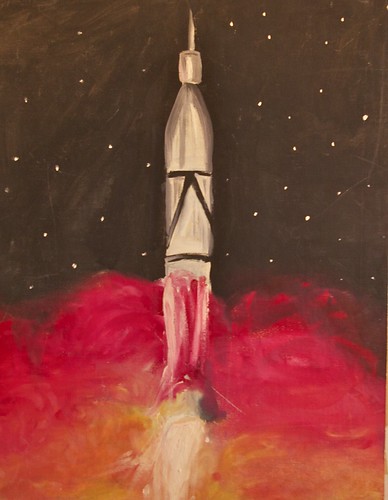
The earliest thing I can put my finger on is this painting I did as a child:

IMGP4383

There’s no date on it, but I’d guess I did it when I was eight or nine. I was somewhat older when I did this painting, though it too is undated:

IMGP4384

The technique says I was older, as does the medium. This one is in oil paints while the other is in tempera. I used tempera for the first year or two when I took art lessons; then my teacher, Glenn Brougher, moved me to oils.

I’d guess that I painted the second one from a photograph. It depicts a Jupiter-C launch vehicle (compare with the photograph here; notice the painted markings).

Tuesday, May 26, 2020

Hoboken Irises @3QD – with thoughts on iris dwellers and iris galaxies


I’ve got a new piece at 3 Quarks Daily. It’s built around eleven photographs of irises: A Fantasia on Irises.

Artists too have been attracted to irises. Here’s three:

Ogata Korin, Irisis, c. 1705.

Vincent Van Gogh, Irises, 1889.

Georgia O’Keefe, White Iris, 1930.

There's a correlation between SARS-CoV-2 in sewage and new COVID-19 cases

Cumulative cultural evolution


Highlights

Our species’ ecological success is supported by our ability to selectively learn beneficial social information, resulting in the accumulation of innovations over time. Population size affects the social information available to subsequent generations of learners and constrains cumulative culture.

Population structure constrains the flow of social information and can promote the accumulation of innovations by bringing culturally distinct groups into contact. Effective population structure results from a combination of structural barriers (e.g., lack of contact between individuals) and behavioral barriers (e.g., unwillingness to share social information).

Compared with non-human primates, humans live in large networks of unrelated individuals that might be conducive to the accumulation of cultural innovations. This social structure might partly result from selection pressures linked to our extensive reliance on culturally accumulated knowledge.

Abstract

Our species has the peculiar ability to accumulate cultural innovations over multiple generations, a phenomenon termed ‘cumulative cultural evolution’ (CCE). Recent years have seen a proliferation of empirical and theoretical work exploring the interplay between demography and CCE. This has generated intense discussion about whether demographic models can help explain historical patterns of cultural changes. Here, we synthesize empirical and theoretical studies from multiple fields to highlight how both population size and structure can shape the pool of cultural information that individuals can build upon to innovate, present the potential pathways through which humans’ unique social structure might promote CCE, and discuss whether humans’ social networks might partly result from selection pressures linked to our extensive reliance on culturally accumulated knowledge.

Saturday, May 23, 2020

Rhythms of Speech and Rhythms of Brains


The brain has rhythms - and so do music and speech. Recent research reveals that the temporal structure of speech and music and the temporal organization of various brain structures align in systematic ways. The role that brain rhythms play in perception and cognition continues to be elucidated through studies of various types. I will describe some intuitively simple and fun but surprising results that illuminate the temporal structure of linguistic experience. From recognizing speech to building abstract grammatical structures, how the brain constructs and represents time reveals unexpected puzzles about language.⠀
⠀
David Poeppel is the Director of the Department of Neuroscience at the Max-Planck-Institute (MPIEA) in Frankfurt, Germany and a Professor of Psychology and Neural Science at NYU. He also directs the Center for Language, Music, and Emotion (CLaME) at NYU and Max Planck.

Friday, May 22, 2020

Logistics R Us, but....we're no match for the current corona virus

David Segal, What Happened to the Great American Logistics Machine? NYTimes, May 22, 2020:
It was reassuring to watch leaders of Walmart, CVS, Target and others gather in the Rose Garden with President Trump in mid-March to announce that the companies would chip in to rapidly expand Covid-19 testing, working in tandem with the administration. Today, Target has exactly one testing site, in the parking lot of its store in Chula Vista, Calif. After a stumbling start, Walmart announced that it had beaten its goal of opening 100 sites by May 31. CVS had opened 50 sites as of mid-May, and promised to have 1,000 open by the end of the month.

Every bit helps, but 1,101 sites won’t get us to the goal of five million tests a day that Mr. Trump referred to in late April.

You’d never know it from the halting pace of this rollout, but the United States is a pioneer in public-private partnerships. Spectacularly ambitious ones, in fact. Like the moon landing. The National Aeronautics and Space Administration hired 20,000 companies across all 50 states to produce and assemble the roughly six million parts needed for each of the Apollo missions. They included Playtex, best known as the maker of the Cross Your Heart bra, which was hired to build the spacesuits worn by the astronauts. (We know about comfortable, flexible garments, Playtex said in its pitch.)

“In some ways, NASA had to invent large-project management for the modern era,” Charles Fishman wrote in “One Giant Leap: The Impossible Mission That Flew Us to the Moon,” “while supervising the invention and perfection of the technology to do something that had never been done before.”

Back in the present, and back on earth, the coronavirus is offering a real-time demonstration of how to hopscotch the globe, with ease and speed. Exactly how it gets around is, to some degree, a mystery we are still solving. (Cats can give it to cats, a study published this month concluded.) But starting from an unknown patient zero, it has infected nearly five million people around the world in a matter of months, enlisting victims in its supply chain and deploying them as vehicles to get around.

Iris petals [red background]

Wednesday, May 20, 2020

Paul Romer on what's wrong with economics [with coda on what he learned about post-scarcity society at Burning Man]

From a recent conversation with Tyler Cowen (Paul Romer on a Culture of Science and Working Hard):
ROMER:...but I think the lesson from the financial crisis, which we’re learning again now, is one about the fragility of extensive interconnection. We’ve paid attention to optimize efficiency with massive reliance on specialization and these complicated supply chains.

But the growth, the proliferation of connection means that our system is more fragile than we realize. A shock comes, and things happen that we didn’t anticipate. But again, that’s part of learning about a very new type of economy which is changing in real time.

The ones that struck me as being particularly worrisome were, first, I think the negative effect that economists have had in terms of protecting competition. Through the law and economics movement, we ratified this notion that big is okay as long as you can make some case that it’s efficient.

The upshot is, is that I think because of technical economics and the arguments of economists, antitrust is much more tolerant now of dominant firms, and if we believe that competition’s good in a whole bunch of ways, this could actually be very, very harmful. So that’s one.

COWEN: Doesn’t Amazon look pretty good right now in the midst of the pandemic? Do you wish we had split it up into different parts?

ROMER: My sense is that we’d be better off if we had five Amazons instead of one.* And I don’t see why we couldn’t have five Amazons if we, as voters, say, “This is the kind of society we want to live in. Let’s just aim for that.” And same thing — the more worrisome positions are those of the tech firms that are so deeply connected now to many aspects of our lives and where there’s really very little competition and a lot of opacity about what these firms actually do.

COWEN: Let me try to defend the economics profession a bit more. If we look at climate policy, a lot of economists have recommended a carbon tax — not quite a consensus, but a very common view. Now, of course we haven’t done it, but it seems to me the profession, in some manner, is essentially correct there. So you would side with the profession on that?

ROMER: Yeah. Again, in some sense, the main point of the article that I’m making is that economists need to accept that our role is that of the technical adviser. We can say, “If you apply a carbon tax, carbon emissions will go down. Here’s what other effects we think they’ll have. But it’s up to you, the voters, to decide whether you want to follow that policy or not.”

So, if the voters don’t follow us, I think, to a first approximation, that’s not really our responsibility. And what I’m critical of is this tendency for economists to assume the responsibility of philosopher king and say to voters, “Well, we know better what a society should be like, what society should do. Listen to us. We’ll tell you the way things should be. We’ll tell you what you should do.”

And, in truth, I think we get into that mode a lot more than we realize. Certainly, some members of the profession get into that mode. And I think they’ve done, really, quite a bit of harm when they did that.
What Romer learned at Burning Man:
Another thing that really stood out, which is not exactly a surprise, but maybe it was the surprise in that group — if you ask, what do people do if you put them in a setting where there’s supposed to be no compensation, no quid pro quo, and you just give them a chance to be there for a week. What do they do?

They work. What people do at Burning Man is they go there and they work. They’ll do a different job, like they’ll work as part of the volunteer police force, or they’ll help maintain sanitation. They’ll work to set up something which offers a service to other people. But there’s enormous satisfaction that we draw from accomplishment and the provision of the output that we produce, making it available to others.

If somebody asked me, “What’s a post-scarcity society going to look like?” Somebody actually said this to me there. He was like, “What does post-scarcity society look like?” People work hard because they like it. They work on things that they care about and they think others will care about, and that’s an encouraging insight, I think, about people.
*See another post I did today:  Are we grappling with problems beyond our conceptual means? [counterfeit capitalism][#Progress_Studies, NOT].