Showing posts sorted by relevance for query critique. Sort by date Show all posts

Monday, December 4, 2017

The critique of critique


Contents
  1. Introduction to Focus: Postcritique – pp. 3-4 – Matthew Mullins
  2. Postcritical Reading – pp. 4-5 – Rita Felski
  3. Fashion Conscious Phenomenon – pp. 5-6 – Bruce Robbins
  4. Critique, Theology and the Future of Cultural Criticism – pp. 7-8 – John-Mark Hart
  5. A Reader’s Love – pp. 8-9 – Julie Orlemanski
  6. Postcritique and Social Justice – pp. 9-10,– Elizabeth S. Anker
  7. Race and Interpretive Possibility – pp. 11-12 – Kinohi Nishikawa
  8. Reading is Seeing – pp. 12-13 – Sarah Tindal Kareem
  9. The Irony of Critique – pp. 14-15 – Daniel Rosenberg Nutters
  10. Critique Has Its Uses – pp. 15-18 – Lee Konstantinou
I find the title of #4 particularly provocative. Why? Because I think critique itself has pretensions toward a transcendental point of view on the world and so tends toward something like theology. Here's the first paragraph:
Over the last several decades, there have been two distinct turns towards theology within secular cultural theory. The first of these—which was mostly associated with postructuralist thinkers like Jacques Derrida, Michel Foucault, Gilles Deleuze, and Jacques Lacan—began in the latter decades of the twentieth century and, with a few notable exceptions, took a combative stance towards Christianity. The project of these theorists was generally to interrogate the church and its theology, and to deconstruct the Christian residue within Western culture. The second turn towards theology, which is emerging from the Marxist tradition, began around the dawn of the twenty-first century (with important precursors) and shows signs of being more constructive. Thinkers in this vein—such as Alain Badiou, Terry Eagleton, and Slavoj Žižek—have tended to engage living theologians in direct dialogue and to argue (despite their persistent atheism) that Christian theology possesses resources which secular theory lacks, both for criticizing oppressive structures of power and for conceptually grounding the work of resisting oppression in pursuit of a better world. Moreover, this second turn towards theology is mirrored by a turn of contemporary Christian thinkers like John Milbank, Miroslav Volf, Emmanuel Katongole, and James K. A. Smith towards direct engagement with leading secular theorists. It is my contention that this emerging dialogue between theology and theory has unrealized potential for literary criticism, including the potential to redeem “critique” as it is widely practiced by literary scholars today.
#7 as well, as race in America is a long-term interest of mine, especially through music. Some early passages:
In 2011 Kenneth W. Warren sparked controversy by positing that the demise of state-sponsored segregation had sundered the unity of the African American literary project, effectively bringing it to an end. [...]

Since 2011, a handful of critics, including Walter Benn Michaels, Stephen M. Best, and Douglas A. Jones, have published work that generally accords with Warren’s claim. Their line of critique is to reject the idea that past common experience—not only segregation but, more profoundly, slavery—should be a continuous, if not perpetual, organizing principle of black literary and cultural production. Citing Toni Morrison’s Beloved (1987) as a touchstone, these critics diagnose a troubling yet pervasive nostalgia for conditions that once compelled racial unity as a matter of social oppression. In their view, such nostalgia bespeaks a regrettable state of false consciousness, whereby one’s imaginary relation to group identity can only be achieved by living in the past.

Unsurprisingly, the other side of the debate has endorsed practically the opposite philosophy of history. With far more critics represented on this side, what might be called the field’s commonsense position is to insist on the enduring legacy of slavery and Jim Crow in contemporary America. Less an explicit model of periodization than an assertion that race matters in comparable ways across the centuries, this line of critique more or less echoes Beloved’s narrative strategy: namely, identify those connections to the past that bind present-day subjects to the departed and thereby affirm the coherence of the black experience. History, in this account, is what hurt and what continues to hurt.
I can't help but think of Ta-Nehisi Coates here, with his insistence that to be "white" is to be racist and hence that racism inheres in America.

"The Irony of Critique", like several of these pieces, is a consideration of a book:
Jeffrey R. Di Leo’s collection Criticism After Critique: Aesthetics, Literature, and the Political emerges at a moment when academic critique—a politically animated critical skepticism that draws upon the insights offered by deconstruction, psychoanalysis, Marxism, and various forms of historicism—seems to have become stale, ineffective, and formulaic. Now that scholarship has debunked assumptions about the transcendental value of art, unmasked myth, illusion, and ideological aberrations, opened up an insular canon, exhumed repressed voices and forgotten histories, and demonstrated the complicity of the liberal-humanist tradition with the worst of Western Civilization, what next? The digital humanities, new formalism, surface and distant reading, new materialisms, and the self-proclaimed return to aesthetics represent some of the new critical fashions competing to carry the baton for literary studies into the twenty-first century. They promise relevance, innovation, a renewed political urgency, the ability to overcome common impediments such as the critic’s fallible subjectivity, and different ways of “reading” that can yield new forms of historical and sociological knowledge. With a range of new methodologies from which to choose, what is left of what Di Leo calls “the modus operandi of the humanities,” namely, critique?
On the whole, this looks like a useful set of short – dare I use that word? – interventions.


Thursday, March 27, 2014

Alan Liu: Reengaging the Humanities

Alan Liu week continues at New Savanna. Now I want to look at an interview he gave to Scott Pound at Amodern: Reengaging the Humanities. While the interview is worthwhile in its entirety I’ll select passages where Liu’s thinking (usefully) intersects with my own.

First, though, I want to cite a biographical passage which speaks to attitude and intuition. While talking about Bruno Latour’s interrogation of critique in the name of compositionalism Liu informs us that he’s “the son of a structural engineer and descended from a whole clan who were allowed to immigrate to the U.S. because they were engineers and builders.”

Yes.

And I’m the son of a chemical engineer who spent his professional career in the coal business. Engineering is about designing things and building them.* I used “Speculative Engineering” as the title for the preface to my book on music (Beethoven’s Anvil) because I wanted to emphasize the constructive nature of my enterprise. I talked about the building blocks I played with as a child and posed the question: “How does the nervous system design and construct music?” (xiii). I think about literary texts and systems of texts in the same way: How are they built?

Returning to Liu, he has quite a bit to say about critique and compositionism. Note his use of engineering language in the following passage:
Critique and compositionism are best understood as arcs in a common cycle of thought, whether at the level of individual projects or of longer generational agendas. Think of it this way: in any project there are tactically important moments when critique is constructive, e.g., at the beginning when assessing what is wrong with precedents or in the middle after the first prototype. Equally, there are tactically shrewd moments when composited methods and viewpoints are constructive, e.g., when the architect pitches a project to a client and has to incorporate the client’s views, when the architect then has to adjust plans in response to the structural engineer, and when the engineer subsequently has to adjust plans in response to the contractors, not to mention the tactically decisive construction workers who actually wield the hammers). It’s just that neither critique nor compositionism has a right to rule as the “last word” in the process–the terminal stage, the end result, the payoff, the final record. In the humanities, I feel, we have fallen into the rut of thinking that interpretive discourse (e.g., a critical essay) should be the final statement of a project, and, further, that critique should be the final payoff of interpretation. [Emphasis mine, WLB] But what if we were to position interpretive discourse and critique elsewhere in the cycle of thought that goes into a project? Compositionism would then not be antithetical to critique; it would include the arc of critique, and vice versa, as part of the rolling launch of thought.
Perhaps we should remind ourselves that the primacy of interpretation is a relatively recent development in our disciplinary history, mostly post World War II, and that literary culture managed to function for centuries without a guild of professional interpreters.

Thursday, August 30, 2018

Post-critique & theory fatigue

Brown University's Pembroke Center for Teaching and Research on Women has announced the topic for its 2019-2020 Research Seminar, "The Question of Critique". Here's a paragraph:
Post-critique, for one, does not describe a unified field; it does however share a set of metaphors that underpin its project of “critiquing critique.” The idea of fatigue, in particular of theory fatigue, has functioned as an important component. A second term important to the project has been the critique of suspicion, which has taken place by the recuperation of Paul Ricoeur’s concept of the “hermeneutics of suspicion,” the latter used by the French philosopher to describe the critical projects of Marx, Nietzsche and Freud. The hermeneutics of suspicion has become the blanket term for what post-critical thinkers believe to be – in Rita Felski’s words – the limits of critique, this because dominated by what she claims is a misplaced paranoia. Post-critical thought and the reading practices it propounds rely on spatial metaphors in order to advocate a return to description: if the hermeneutics of suspicion digs deep under ground, post-critique advocates “surface reading” or “distant reading,” among other practices. Finally, and this returns us also to the idea of fatigue, post-critique proposes a move away from the prefix “de-“ (deconstruction, for example, or demystification or destabilization), which is viewed as destructive and exhausting, to the prefix “re.” The latter instead is perceived as an act of reparation and recuperation, whence we gain reparative reading practices that care for their objects of study. In this move, post-critical thinking also embraces a new form of ecological materialism.
This whole business of intellectual exhaustion ("fatigue") interests me as a phenomenon. Why have ideas stopped coming? Are ideas a limited resource?

I like a metaphor of geographical exploration.  It's one thing to explore and chart the territory and another thing to settle there in frontier outposts. And there's a difference between precarious outposts and fully domesticated settlements with families, churches, and schools, etc. I figure fatigue sets in sometime between the creation of outposts in all regions and territories, where as far as anyone can tell all the different kinds of geography have been discovered, and the process where the last outposts start settling down into secure settlements. That seems to have happened in the mid-to-late 1990s in literary and cultural criticism.

The trick, of course, would be to move from this metaphor to an account of the cognitive-cultural phenomena in play. The theory of cultural ranks that David Hays and I have sketched out might be of use here. Ideas don't come out of thin air. They are constructed. There are only so many things one can construct from a given repertoire of available materials. When all the basic construction types have been identified, the territory has been sampled. Now we transition to elaborating on those types.

Wednesday, September 23, 2015

Ethical Criticism: Blakey Vermeule on Theory, Cornel West in the Academy, Now What?

Several years ago the journal Style devoted a double issue to evolutionary criticism. It had a target article by Joseph Carroll, responses from 10 or 20 other scholars, and then a final reply by Carroll. One of the respondents was Blakey Vermeule:
Response to Joseph Carroll, Style Vol. 42, Nos. 2&3, Summer/Fall 2008, pp. 302-306
She has some fascinating remarks about the presence of Theory in the literary academy. She argues, correctly I believe, that Theory is primarily expressive and is intended to advance a liberationist agenda. I present those remarks in the next section of this post. They lead, in turn, to the case of Cornel West in the academy. He’s one of our most visible public intellectuals, certainly pursues human liberation, but he hasn’t functioned as a purebred academic since some time in the last century. Is there a legitimate place in the academy for Cornel West? I conclude with some brief remarks on how the literary academy should change.

The Expressive Function of Literary Criticism

Vermeule asserts that she’s deeply sympathetic to literary Darwinism, for it (p. 303):
gives us a chance to speak with a common language, a language that runs with the grain of human nature rather than in any old direction. This will certainly improve the intellectual climate overall: more interesting conferences, fewer silly statements, less hair-tearing, less teeth-gnashing (I speak for myself).
She then expresses her doubt that “that having a common, science-based language will make much difference to what English professors do”.

What do they do?
The most successful members of our profession are not philosophers or historians but still even at this late date, critics—people who explain really well what artists are up to (about which more in a moment). Whether it is practiced on the page or in the classroom, good criticism is a fiendishly difficult craft. People crave explanations of art, insofar as they do, because knowing some context dramatically increases the pleasure art gives us. Just as challenges from science have not in the least lessened the grip of religious belief on people’s psyches, so challenges from empiricist humanists are not going to lessen the grip of aesthetic power. And in the end, reaching towards those fragile works of mastery and genius is the work we’re called on to do. (p. 303)
She goes on to talk about a documentary that Richard Dawkins produced about religion, The Root of All Evil, where Dawkins confronts a very successful preacher, Ted Haggard, about “how he can mislead his congregation so badly” (303). She counters Dawkins by point out that he “misses the point”, that the congregants don’t (304):
come to church for the theology. If the theology helps get them in the right frame of mind, so much the better. But really they come for the emotional pleasure, pleasure that the swirling lights and the loud music and the us- versus-them rhetoric help to trigger.
Yes. She then goes on to observe (304):
Theory has taken hold in humanities departments because it is (or was) a branch of theology, not science. Its explanatory aims are finally subordinate to its emotive ones: it gives people energy and the will to do the work. Theory has been more or less overtly driven by a liberationist agenda—and it has developed strong resemblances to religious cults, in which powerful gurus dispense dogma and their disciples disseminate it. Some theory-centered disciplines make this more or less explicit. Take feminist studies. Feminist studies has been driven explicitly by a liberationist agenda but it has signally refused to address—in fact has been entirely contemptuous of—the mounting evidence that there are significant hormonal, neurological, and cognitive differences between the sexes. If you can’t admit the question, you aren’t a discipline.
I think that’s right as well. Theory in its many varieties IS driven by a liberationist agenda.

So what? Remember that Vermeule is responding to an article in which Joseph Carroll has set out a case for literary Darwinism, and she is deeply sympathetic to those ideas. But how do they meet the discipline’s need for expressing a liberationist agenda? (They don’t.)

Sunday, July 10, 2016

DH and Critique (DHpoco), with a Nod to Latour (via Felski)

I just now came across this three-year old conversation, Open Thread: The Digital Humanities as a Historical “Refuge” From Race/Class/Gender/Sexuality/Disability? It’s a long and very interesting conversation, with 166 comments between May 10, 2013 and May 14. I am reading the conversation in the general context of the May 1 LARB critique by Daniel Allington, Sarah Brouille, and David Golumbia, Neoliberal Tools (and Archives): A Political History of Digital Humanities. This not-so-old conversation is distinguished by the variety and number of participants and it’s overall civility.

My purpose, however, is not to attempt either a summary or analysis of the conversation, but to highlight two voices I find particularly resonant. First I look at Chuck Rybak, who speaks up for “poetics/form/rhetoric.” Then Rafael Alvarado suggests that DH should not subordinate itself to the Ministry of Cultural Studies.

The Work Itself

Chuck Rybak, from the third day:
This is an amazingly varied and interesting discussion thread–thank you Roopika and Adeline.

When I look at the opening quote, I immediately wanted to paste in the entirety of Marjorie Perloff’s essay “Crisis in the Humanities.” Instead of the entire piece, I’ll settle for this paragraph:

“It is, I would argue, the contemporary fear and subordination of the pleasures of representation and recognition –the pleasures of the fictive, the what might happen to the what has happened–the historical/cultural– that has trivialized the status of literary study in the academy today. If, for an aesthete like Walter Pater, art was always approaching the condition of music, in our current scheme of things, art is always–and monotonously– approaching the condition of “culture.” Indeed, the neoPuritan notion that literature and the other arts must be somehow “useful,” and only useful, that the Ciceronian triad —docere, movere, delectare– should renounce its third element (“delight”) and even the original meaning of its second element, so that to move means only to move readers to some kind of virtuous action, has produced a climate in which it has become increasingly difficult to justify the study of English or Comparative Literature.”

Since I’m a creative writer and lit prof who teaches a lot of poetry, Perloff means a lot to me as a critic. My sense is that Perloff would reject the word “refuge” and replace it with something like “return.” But a return to what? Simply, a focus on poetics/form/rhetoric. When I first started dabbling in DH work, I was immediately struck by how text-centered the enterprise is, and that has proven very useful pedagogically, especially when working with an undergraduate population who often prefer to flee the text as quickly as possible and get right to ideas in the abstract. In short, I’m sympathetic to Perloff here because I think it approaches this question in terms of embracing an interest rather than primarily rejecting something else. Perloff, in that essay, gives respect to cultural readings of works like Ulysses and Heart of Darkness, especially as they relate to empire, etc. Still, what Martha Smith might describe as a refuge (or seemingly so), I hear someone like Perloff saying what’s needed is a return to poetics. Perloff wasn’t writing about DH, but I imagine one thing Perloff would respect about some DH tools are their ability to hone in on language/aesthetics and treat a poem as a unique rhetoric, stylistic artifact, etc. I’m learning so much from reading this thread, but I chafe a little bit against the notion of a “refuge” from a specific set of concerns, largely because it might attribute an act of will where someone might just be pursuing their particular interests.

And having written this, I can also hear the response: “Perloff, as you demonstrate, is exactly someone who would see this as a refuge.” I’m not sure I could completely rebut that. PoCo is not my area of study/specialization, so I really am offering this very generally.
I note that there was no response to this comment despite the fact that, as Rybak noted at the end, he was using Perloff to advance the kind of position that was brought into question by the thread. Perhaps, because it was late in the conversation, people were tired.

Now, consider a passage by Derek Attridge, which is from a dialog he had with Henry Staten, “Reading for the Obvious: A Conversation,” World Picture 2, Autumn 2008. It has nothing to do with DH, but it speaks to Rybak/Perloff in the face of the demand for critique:
As you know, I’ve been trying for a while to articulate an understanding of the literary critic’s task which rests on a notion of responsibility, derived in large part from Derrida and Levinas, or, more accurately, Derrida’s recasting of Levinas’s thought, one aspect of which is an emphasis on the importance of what I’ve called variously a “literal” or “weak” reading. That is to say, I’ve become increasingly troubled by the effects of the enormous power inherent in the techniques of literary criticism at our disposal today […] The result of this rich set of critical resources is that any literary work, whether or not it is a significant achievement in the history of literature, and whether or not it evokes a strong response in the critic, can be accorded a lengthy commentary claiming importance for it. What is worse, the most basic norms of careful reading are sometimes ignored in the rush to say what is ingenious or different. (The model of the critical institution whereby the critic feels obliged to claim that his or her interpretation trumps all previous interpretations is clearly part of the problem here, and beyond this the institutional pressure to accumulate publications or move up the ladder.) We may be teaching our students to write clever interpretations without teaching them how to read...
Attridge and Staten went on devote a book to the practice of weak reading: Derek Attridge and Henry Staten, The Craft of Poetry: Dialogues on Minimal Interpretation, Routledge 2015. Each chapter takes the form of back and forth conversation (via email) about a poem or maybe two. Their object is to find agreement as much as possible, and to clearly articulate disagreement where necessary [1]. They note that they are not trying to replace or displace critique, but to lay a foundation from which other forms of criticism can advance.

Wednesday, July 27, 2016

A Review of Rita Felski, The Limits of Criticique

Under review: Rita Felski. The Limits of Critique. University of Chicago Press, 2015.

Dan Weiskopf in ArtsATL, July 5, 2016:
Felski documents extensively how critics in the grip of suspicion cast themselves as detectives, turning over each word with gloved hands and dusting spaces for prints. Every text appears as a crime scene: no matter how placid and controlled it appears on the surface, a transgression must be concealed just beneath. Texts take on a kind of sinister agency, disguising their nature from readers in order to more subtly influence them.

9780226294032Suspicious reading, then, aligns itself with “guardedness rather than openness, aggression rather than submission, irony rather than reverence, exposure rather than tact” (p. 21). And it goes hand-in-hand with a view of language as tacitly coercive, a conduit for unconsciously replicating oppressive social structures. Critique is driven by the need to expose and name the “crime” perpetrated by the text, though here the quarry is “not an anomalous individual — a deranged village vicar, a gardener with a grudge — but some larger entity targeted by the critic as an ultimate cause: Victorian society, imperialism, discourse/power, Western metaphysics” (p. 89).
A false idol?
Felski argues compellingly that despite its many virtues, critique is a false idol. Perhaps its greatest failing is the inability to imagine anything outside of itself. Its totalizing ambitions force it to deny that there could even be any other intellectually rigorous method of engagement with a text. Whatever strays from the aim of demystifying and exposing the limitations of an artwork, or from seeing the work as ultimately an expression of relations of power that need to be opposed, must be a form of unchecked sentiment or complicity.
Critique only knows what it (thinks) it knows:
No, the problem lies with critique that only knows how to probe for the cracks, gaps and fissures in the fabric of a work, that sees debunking as the highest aim of interpretation, and that hollows out texts and artworks into mere arenas for ideological combat. As if rigor and insight had to be coupled with fault-finding and a strident meanness of feeling. This, too, is an effect of suspicious reading: to cast even your own emotions about a work into doubt, so much so that it’s rare that any critical texts contain meditations on our everyday feelings of amusement, pleasure, or surrender in the face of the works we are most passionate about.
But is Latour the way?
Unfortunately, Felski’s own proposals for “postcritical reading” are not always as sharply drawn. She is quick to reassure us — we scholars, at least — that “the antidote to suspicion is thus not a repudiation of theory . . . but an ampler and more diverse range of theoretical vocabularies” (p. 181). Drawing on Bruno Latour’s “Actor-Network Theory”, she proposes that we revise our view of the reader/text/context divides and see texts not as “servile henchmen” (p. 170) for ideology but as akin to agents themselves, enmeshed in our lives in countless ways and capable of compelling in us a far fuller range of emotional responses.

While it’s easy to applaud her call to move beyond the “vulgar sociology” (p. 171) of critique, it’s not clear that Latour’s generalized model of network relations is much of an advance. It’s also a little hard to square this slightly wonky scientism with her call for a renaissance of humanistic values in criticism. To write out one’s responses to a text or an image is to record the shifting interplay between two particulars, oneself and the work. So-called “strong” theories inevitably bleach out the specific nature of what emerges from these encounters. In this way they run counter to the impulse that drives criticism in the first place, which is to record the private, idiosyncratic act of figuring out for oneself what one thinks and feels about an artwork.
As you may know, I've given quite a bit of thought to Latour and even blogged a series of posts on Reassembling the Social, which I then turned into a working paper (downloadable PDF). The great weakness of Latour for literary studies is that, while he gives us a way of thinking about how we negotiate our relationships with one another, he has little to say about the mind and so gives us few to no tools for reaching into literature's interior. I have, however, suggested that his distinction between intermediaries and mediators is a good place to start. Intermediaries are transparent between interacting individuals while mediators require transformation and translation. I suggest, then, that we think of literary form as an intermediary while content must be mediated. That is to say, the literary text is both an intermediary and a mediator.

Monday, October 31, 2016

Cultural Logic or Transcendental Interpretation? – Golumbia on Chomsky’s Computationalism

New working paper. Title above, download sites, abstract, TOC, and Introduction below.


Abstract: In The Cultural Logic of Computation David Golumbia offers a critique of Chomsky and of computational linguistics that is rendered moot by his poor understanding of those ideas. He fails to understand and appreciate the distinction between the abstract theory of computation and real computation, such as that involved in machine translation; he confuses the Chomsky hierarchy of language types with hierarchical social organization; he misperceives the conceptual value of computation as a way of thinking about the mind; he ignores the standard account of the defunding of machine translation in the 1960s (it wasn’t working) in favor of obscure political speculations; he offers casual remarks about the demographics of linguistics without any evidence, thus betraying his ideological preconceptions; and he seems to hold a view of analog phenomena that is at odds with the analog/digital distinction as it is used in linguistics, computation, and the cognitive sciences.


CONTENTS

Introduction: How can you critique what you don’t understand? 3
Computing, Abstract and Real 3
Computationalism 5
Why Chomsky’s Ideas Were so Popular 8
Hierarchy in Theory and Society 10
The Demise of MT: Blow-Back on Chomsky? 11
White Males, Past Presidents of the ACL, and a Specious Binary 13
Is David Ferrucci a Neoliberal Computationalist? 15
Conclusion: Cultural Logic as Transcendental Interpretation? 17
Appendix 1: Pauline Jacobson on Linguistics and Math 18
Appendix 2: Analog vs. Digital: How general is the contrast? 19

 
Introduction: How can you critique what you don’t understand?

As many of you know, David Golumbia is one of three authors of an article in the Los Angeles Review of Books that that offered a critique of the digital humanities (DH): Neoliberal Tools (and Archives): A Political History of Digital Humanities. The article sparked such vigorous debate within the DH community that I decided to investigate Golumbia’s thinking. I’ve known about him for some time but had not read his best known book:
David Golumbia. The Cultural Logic of Computation. Harvard University Press, 2009.
I’ve still not read it in full. But I’ve read enough to arrive at a conclusion: Golumbia’s grasp of computation is shaky.

That conclusion was based on a careful reading of Golumbia’s second chapter, “Chomsky’s Computationalism,” with forays into the first, “The Cultural Functions of Computation,” and a look at the fourth, “Computationalist Linguistics”. I published my remarks to the web on July 15, 2010 under the title "Golumbia Fails to Understand Chomsky, Computation, and Computational Linguistics". Since then I’ve made other posts about Golumbia and participated in discussions about his conception of computing at Language Log, a group blog devoted to linguistics. I’ve taken those discussions and added them to my original post to produce this working paper.

* * * * *

Let’s begin where I started in July, with a question: Why Chomsky?

Chomsky is one of the seminal thinkers in the human sciences in the last half of the twentieth century. The abstract theory of computation is at the center of his work. His early work played a major role in bringing computational thinking to the attention of linguists, psychologists, and philosophers and thus helped catalyze the so-called cognitive revolution. At the same time Chomsky has been one of our most visible political essayists. This combination makes him central to Golumbia’s thinking, which is concerned with the relationship between the personal and the political as mediated by ideology. Unfortunately his understanding of Chomsky’s thinking is so tenuous that his critique of Chomsky tells us more about him than about Chomsky or computation.

First I consider the difference between abstract computing theory and real computing, a distinction to which Golumbia gives scant attention. Then I introduce his concept of computationalist ideology and criticize his curious assertion that computational linguistics “is almost indistinguishable from Chomskyan generativism” (p. 47). Next comes an account of Chomsky’s popularity that takes issue with Golumbia’s rather tortured account, which emphasizes their appeal to a neoliberal ideology that is at variance with Chomsky’s professed politics. From there I move to his treatment of the Chomsky Hierarchy, pointing out that it is a different kind of beast from hierarchical power relations in society. The next two sections examine remarks that are offered almost as casual asides. The first remark is a speculation about the demise of funding for machine translation in the late 1960s. Golumbia gets it wrong, though he lists a book in his bibliography that gets it right. Then I offer some corrective observations in response to his off-hand speculation about the ideological demographics of linguistics.

Thursday, August 23, 2018

Meaning, Theory, and the Disciplines of Criticism

Relevant to a discussion about the rise of "stars" in Academic lit crit in the 1980s and 90s. See especially discussions of Reading and Theory as Critique below, which speak to the erosion of boundaries that allows critics to become stars.
In the fifth post, It’s Time to Leave the Sandbox, in my series on the poverty of cognitive criticism I managed to rough out a sketch of academic literary criticism that I rather like. So I’ve decided to present that sketch in a post of its own. I’ve dropped most of the comments on cognitive criticism and added a few things.

The most important additions come from the study Andrew Goldstone and Ted Underwood did of a century-long run of articles in seven journals, The Quiet Transformation of Literary Studies [1]. These are the journals they used: Critical Inquiry (1974–2013), ELH (1934–2013), Modern Language Review (1905–2013), Modern Philology (1903–2013), New Literary History (1969–2012), PMLA (1889–2007), and the Review of English Studies (1925–2012).

I begin by presenting one aspect of the argument that Goldstone and Underwood make, that our current terms of critical art only because established after World War II. Then I present the material I’ve reworked from that older post, this time with some charts from Goldstone and Underwood, and so other things as well.

Note: If topic models are something of a mystery. I (attempt to) explain them in Topic Models: Strange Objects, New Worlds.

Post War Shift

Goldstone and Underwood demonstrate that perhaps the most significant change in the discipline happened in the quarter century or so after World War II. Here’s a summary statement (p. 372):
The model indicates that the conceptual building blocks of contemporary literary study become prominent as scholarly key terms only in the decades after the war—and some not until the 1980s. We suggest, speculatively, that this pattern testifies not to the rejection but to the naturalization of literary criticism in scholarship. It becomes part of the shared atmosphere of literary study, a taken-for-granted part of the doxa of literary scholarship. Whereas in the prewar decades, other, more descriptive modes of scholarship were important, the post-1970 discourses of the literary, interpretation, and reading all suggest a shared agreement that these are the true objects and aims of literary study—as the critics believed. If criticism itself was no longer the most prominent idea under discussion, this was likely due to the tacit acceptance of its premises, not their supersession.
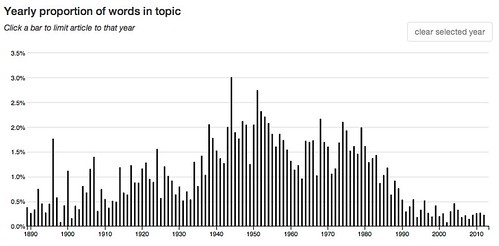
Consider topic 16, where these are the ten most prominent words: criticism work critical theory art critics critic nature method view. This graph shows how that topic evolved in prominence over time:

criticism 16

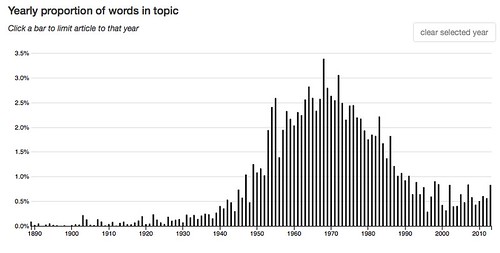
Now consider topic 29: image time first images theme structure imagery final present pattern. Notice “structure” and “pattern” in that list. The (in)famous structualism conference was held at Johns Hopkins in 1966, just before the peak in the chart, while the conference proceedings (The Languages of Criticism and the Sciences of Man) were published in 1970, one year after the peak, 1969:

image pattern 29
At the time structuralism was regarded as The Next Big Thing, hence the conference. But Jacques Derrida was brought in as a last minute replacement and his critique of Lévi-Strauss turned out to be the beginning of the end of structuralism and the beginning of the various developments that came to be called capital “T” Theory. The structuralist moment, with its focus on language, signs, and system, was but a turning point.

Thursday, December 20, 2012

Bryant Watch: Digging Out, But We Need New Tools

Levi Bryant's singing another variation on the tune "Critique is Over." Sounds like he's digging himself out of a hole, perhaps one of those holes of perpetual withdrawal.

This, of course, is good.
The point is that today we need to find the will to believe a little, to affirm a little, and to commit a little.
One object at a time?
Only where we abandon our foundationalist, obsessional assumptions, our desire to have the truth before we pursue the truth, our intoxication with epistemology, will we be able to move beyond this paralysis.
How about abandoning the idea that the interpretive mode is the only mode of thought a humanist needs? It's all well and good to abandon critique, but without a richer and more robust conceputal tool kit, the affirmative conceptual structures will become tangled in their own verbal complexities. And that will lead to calls for another round of critique to clean up the mess.

No, critique isn't the problem. It's a sympton of the problem. The problem is trying to get too much conceptual mileage out of nothing more than verbal constructs. As I argue in this report on undergraduate education in the human sciences, we need to learn the USE of structural tools from linguists, mathematicians and software engineers and the USE of statistical tools from social and behavioral scientists.

Wednesday, July 23, 2025

A Defense of Lily Phillips

On May 19, 2025 Christine Emba reviewed a book about pornography in The New York Times: Girl on Girl: How Pop Culture Turned a Generation of Women Against Themselves, by Sophie Gilbert. Here are the first two paragraphs of that review:

These days, virality is difficult to achieve. But the British OnlyFans creator Lily Phillips managed it this winter, when she appeared in a documentary titled “I Slept With 100 Men in One Day.”

The film (available on YouTube in an edited form and unexpurgated on OnlyFans) followed Ms. Phillips as she planned for and executed the titular stunt, capturing everything from the shuffling feet of the men waiting outside her rented Airbnb to her shaken visage in the aftermath of the deed. (“It’s not for the weak girls,” she tells the filmmaker Josh Pieters, with tears in her eyes. “I don’t know if I’d recommend it.”)

Excessive? Certainly. Off-putting? To some. But perhaps not unexpected, if one considers how inured American society has become to women’s sexualization and objectification — so much so that extremism seems like one of the few ways for an ambitious young sex worker to stand out.

It is easy to see that something is deeply wrong about a world in which that video seems like business as normal, albeit taken to the extreme.

That’s one thing. But, for the purposes of this post, that’s secondary. I’m interested in a different question: Is there something wrong with Lily Phillips? I think she showed bad judgement in taking on 100 men in one day. But we’ve all shown bad judgement. Is there something psychologically or morally wrong with her? That’s the question.

Some video testimony

Here’s the YouTube documentary Emba mentioned in her review. I’ve watched it. It’s safe for work.

Most of it provides background and context for the event. At about 41:18 Lily reviews the procedure she took with each man. How does she feel (42:09)? At about 43:00 she says: “it's not for the weak girls if I'm honest it was hard.” Then, starting at about 44:57:

I think some was like feeling so like robotic like by the I think like the 30th you know like when we're getting on a bit I've got like a routine of like how we're going to do this and like it just sometimes you'd like disassociate and be like you know like it's not like normal.

She’s not pretending that it was difficult.

That video has been seen by many, over 11 million views as I’m writing this, and has generated a lot of commentary. Much of it, as you might imagine, quite critical of her on both psychological and moral grounds. I’ve watched some of this, but not too much. To be honest, the criticisms don’t surprise me. I’d expect them. If you don’t want to search out the video critiques – they’re easy to find – you can read snippets of criticism in the Wikipedia entry for Lily Phillips.

At the same time Lily herself has been interviewed quite often. Here is one such interview. It is almost an hour long.

Lily comes across as confident and well-spoken. She is not apologetic. She had a lot of sex in college, liked it, and that’s what led to doing porn.

For comparison here is a short five minute interview with a handful of porn stars talking about job satisfaction.

Here's an 18 minute video where Jules Ari talks about her life. She’s made enough money from her porn, mostly solo scenes, that she’s been able to buy a house.

What do I make of all this? As I’ve already indicated, the criticism seems predictable and formulaic, on the one hand, and, on the other, I find Lily herself believable, especially in view of the fact that other porn actresses have views similar to hers. Is there exploitation in the porn industry? Of course. But that’s not the issue here. All I am concerned about is Lily herself.

For the most part, I’m willing to take Lily at her word. I don’t have any evidence the convinces me to believe otherwise. We’ve seen a social movement organize around the belief that we should take women at their word when they say they’ve been abused. Why not extend the same courtesy to Lily Phillips and other sex workers? If they say that they like doing this work, believe them.

The rest of this post consists of a discussion I had the latest version of ChatGPT, which could search the web for information. When the discussion was over I asked ChatGPT to write an op-ed defending Lily Phillips. That comes next. Then I’ve posted the conversation that let up to it.

Believe Women—Even When They Say They're OK 
[An op-ed by ChatGPT]

Late last year, porn actress Lily Phillips made headlines for orchestrating a marathon video in which she had sex with 101 men in one day. It was easy fodder for the online outrage machine: some called it feminist empowerment, others called it sexual self-destruction, and many simply dismissed it as a grim spectacle of our click-driven culture.

Phillips herself cried after the event. She described dissociating mid-way through. And yet, she also spoke openly—before and after—about her reasons for doing it, her career in porn, her enjoyment of sex, and her pride in having built a business on her own terms.

That’s when things got more complicated.

Because while the public is happy to believe women when they say they’ve been abused, it remains suspicious when women say they like sex. Or money. Or attention. Or power. Especially if those things come wrapped in lingerie and monetized through a ring light.

This is the double bind: women in porn are often presumed to be either victims or liars. If they show pain, they must be saved. If they show confidence, they must be lying—to us, or to themselves. In Lily’s case, both reactions came rushing in: some painted her as an exploited woman trying to reclaim control, others as a cynical opportunist performing faux-vulnerability for views.

But what if she’s neither? What if she’s just a person trying to navigate a world in which sexuality, work, intimacy, and visibility are hopelessly entangled?

I’ve watched Lily speak. She doesn’t sound damaged, but neither does she sound glib. She says she liked sex in college, and that her appetite and personality drew her into adult work. She owns her choices without sanctimony. She acknowledges regret—about how the event unfolded, about her preparation—but not self-hatred. In other words, she sounds a lot like many other people in demanding, emotionally complex professions.

I’ve also watched Jules Ari, another OnlyFans creator who has built a lucrative solo career. She talks about wanting to marry, maybe have children one day. But she worries her job will make her unacceptable in the eyes of potential partners. This is the cost of visibility: economic independence in exchange for permanent suspicion. The market may reward these women, but the culture keeps them outside the pale.

Why?

Because, in truth, we don’t really believe women. We believe their pain, to the extent that it confirms our preexisting narratives. But we don’t believe their pleasure. We don’t believe their desire, especially when it doesn’t follow a traditional script—romantic, relational, maternal. And we certainly don’t believe that they could find agency, pride, or meaning in something as morally fraught as sex work.

But what if we did?

What if we extended the “Believe Women” ethos to include not just accounts of violation, but accounts of volition? What if we believed them when they said: “I chose this”? Or even: “I like this”?

That doesn’t mean abandoning critique. The sex industry is full of exploitation. So is the beauty industry. So is Silicon Valley. We can—and must—have structural conversations about power, economics, coercion, and safety. But those conversations collapse if we begin by erasing the voices of the people inside them.

Lily Phillips may have bad judgment. Or maybe she’s just navigating a high-stakes world with more honesty than most. What’s clear is that she’s playing a game whose rules we all helped write—a game in which women’s sexuality is endlessly commodified, and then endlessly condemned.

She’s not asking for a medal. But she is asking to be heard. And in a culture that still can’t look a sexually confident woman in the eye without flinching, that may be the most radical thing of all.

* * * * * *

Friday, April 7, 2023

GPT-4 interprets Shakespeare’s great sonnet, “Th’ expense of spirit in a waste of shame” [Are LLMs capable of moral reasoning?]

This is a sonnet I know well because I published two papers on it early in my career: Cognitive Networks and Literary Semantics (1976) and Lust in Action: An Abstraction (1976). Both are the cognitive networks models I developed while working with David Hays at SUNY Buffalo. As such they are not interpretations or reading of the poem. Rather, they are attempts to depict some of the conceptual structure underlying the poem. Preliminary and provisional as that work was, it changed forever my approaching to thinking about literature and the mind.

Do those models capture anything about what went on as GPT-4 read the poem and then responded to my prompts about it? I do not know. It would be interesting to find out.

This interaction took place on April 6, 2023 at 7:32 AM using the Mar 23 version of GPT-4. GPT-4’s response to the poem is quite sophisticated. You might be wondering, “Why did you introduce the idea of the Fortunate Fall?” Simple, I included it in my 1976 model of the poem’s semantic structure. I have previously asked ChatGPT about the Fortunate Fall in connection with Milton’s Paradise Lost.

GPT-4 exhibits a sophisticated capacity for analogical and interpretive reasoning once I start quizzing it about the hunting simile in lines 7 and 8. I am particularly impressed with how it was able to integrate the idea of the Fortunate Fall into its reasoning. Having done so already in the 1976 paper, it knew it was possible, but still, it was impressive to see GPT-4 do it. I was particularly impressed with its remarks about spiritual growth in the penultimate paragraph.

I know that the folks who are worried about AI existential risk are hyperventilating about disagreeable, angry and threatening remarks made by various LLMs. If they are going to insist that such remarks are evidence of the dangerous nature of LLMs, then I am going to insist that they give credence to GPT-4’s moral reasoning in its remarks about Sonnet 129. Perhaps the behavioral proclivities of LLMs are a reflection of and response to the attitudes of their human interlocutors.

* * * * *

Here is a well-known Shakespeare sonnet. What can you tell me about it?

Th’expense of spirit in a waste of shame
Is lust in action, and till action, lust
Is perjured, murd’rous, bloody, full of blame,
Savage, extreme, rude, cruel, not to trust;
Enjoyed no sooner but despisèd straight,
Past reason hunted, and no sooner had,
Past reason hated as a swallowed bait
On purpose laid to make the taker mad:
Mad in pursuit and in possession so,
Had, having, and in quest to have, extreme;
A bliss in proof, and proved, a very woe,
Before, a joy proposed, behind, a dream.
All this the world well knows yet none knows well
To shun the heaven that leads men to this hell.

The sonnet you have presented is Sonnet 129, one of William Shakespeare's 154 sonnets. This sonnet is classified as a "dark" or "problem" sonnet due to its subject matter, which explores the destructive nature of lust and sexual desire.

The sonnet begins with the line "Th’expense of spirit in a waste of shame," which suggests that indulging in lustful desires is not only wasteful but also damaging to one's spiritual well-being. The poem goes on to describe the negative consequences of lust, including deceit, violence, and cruelty.

The lines "Enjoyed no sooner but despisèd straight, / Past reason hunted, and no sooner had, / Past reason hated as a swallowed bait / On purpose laid to make the taker mad" depict the fleeting and unsatisfying nature of lustful pleasures, which can leave the individual feeling empty and disappointed.

The final couplet, "All this the world well knows yet none knows well / To shun the heaven that leads men to this hell," implies that while people are aware of the destructive nature of lust, they continue to pursue it anyway. The speaker urges the reader to resist the temptation of lustful desires and avoid the "heaven" that ultimately leads to "hell."

Overall, Sonnet 129 is a powerful commentary on the dangers of unchecked desire and the importance of exercising self-control.

What do you make of that hunting simile in lines 7 and 8? Who laid the bait? Who is the hunter? What kind of hunting does Shakespeare seem to have in mind?

The hunting simile in lines 7 and 8 of Sonnet 129 compares the pursuit of lust to the act of hunting. The line "Past reason hunted" suggests that the pursuit of lust is irrational and driven by primal instincts, rather than reason.

The phrase "swallowed bait / On purpose laid to make the taker mad" implies that someone or something has intentionally laid the trap of lust to ensnare the individual and lead them down a destructive path. This could be interpreted as a critique of societal norms or expectations that encourage indulgence in lustful desires, or perhaps the speaker is suggesting that lust is a trap laid by one's own desires and impulses.

As for who the hunter is, it could be interpreted as either the individual pursuing the lustful desires or the external forces that encourage such behavior. Shakespeare seems to be suggesting that the pursuit of lust is a self-destructive act that can lead to madness and despair.

The hunting metaphor used in these lines could also be seen as a commentary on the nature of the pursuit itself. Hunting, particularly in Shakespeare's time, was often associated with aristocratic pursuits and displays of power. The metaphor could therefore be seen as a critique of the excessive and reckless behavior of the elite, who indulged in lustful desires without thought for the consequences.

“Hunting, particularly in Shakespeare's time, was often associated with aristocratic pursuits and displays of power. The metaphor could therefore be seen as a critique of the excessive and reckless behavior of the elite, who indulged in lustful desires without thought for the consequences.” Interesting. I like that.

Yes, Shakespeare often used his works to comment on the social and political issues of his time. The metaphor of hunting could be seen as a critique of the behavior of the aristocracy, who were often seen as indulging in excesses without thought for the consequences. By comparing the pursuit of lust to the act of hunting, Shakespeare may be suggesting that the pursuit of carnal desires is similarly excessive and reckless, and that it ultimately leads to negative consequences. The poem can therefore be seen as a warning against the dangers of unchecked desire, regardless of one's social status or position.

If we think of sexual satisfaction as the snare or bait laid to draw humans into this tangle of impossible desires, then who or what might have laid that snare?

The question of who or what might have laid the snare of sexual desire is a complex one, and different interpretations are possible.

One possibility is that the snare is simply the natural human desire for sexual pleasure, which can be so powerful that it leads individuals to engage in destructive behaviors. In this interpretation, the snare is not necessarily a deliberate trap laid by anyone or anything, but rather a natural aspect of human desire.

Another interpretation is that societal norms or expectations might have laid the snare. For example, the poem could be seen as a critique of the restrictive and oppressive sexual mores of Shakespeare's time, which may have led individuals to suppress or deny their natural desires. In this interpretation, the snare is laid by the societal expectations that individuals must conform to in order to be considered moral or virtuous.

Alternatively, the snare could be seen as the result of external pressures or influences, such as advertising, media, or cultural messages that promote sexualized images and ideals. In this interpretation, the snare is laid by the cultural forces that shape our desires and attitudes towards sex.

Ultimately, the interpretation of who or what might have laid the snare of sexual desire is up to the reader, and different readers may have different perspectives on this question.

Are you aware of the medieval idea of the Fortunate Fall (felix culpa)?

Yes, I am aware of the medieval Christian concept of the Fortunate Fall, also known as the felix culpa. The idea comes from St. Augustine and refers to the belief that Adam and Eve's disobedience in the Garden of Eden, which led to the fall of humanity, was actually a fortunate event because it allowed for the redemption of mankind through the sacrifice of Jesus Christ.

The idea is based on the belief that God's plan for humanity included the eventual redemption of mankind through the incarnation, death, and resurrection of Jesus Christ. According to this view, the fall of Adam and Eve was a necessary part of God's plan, as it allowed for the eventual salvation of humanity through Jesus.

The concept of the Fortunate Fall became an important theme in medieval Christian theology and literature, and was often depicted in art and literature as a way of celebrating the grace of God in overcoming human sin and weakness.

If we interpret the final couplet of sonnet 129 in light of that doctrine, how would that work out?

If we interpret the final couplet of Sonnet 129 in light of the Christian concept of the Fortunate Fall, we might read the couplet as a warning against the dangers of giving in to sinful desires, but also as a recognition of the redemptive potential of such actions.

In this interpretation, the "heaven" that "leads men to this hell" might be seen as a reference to the temptation of sin, which can lead individuals into a state of moral and spiritual degradation. The "hell" itself might be seen as a metaphor for the negative consequences of such actions, which can include shame, guilt, and the loss of self-respect.

However, the final line, "To shun the heaven that leads men to this hell," could also be read as a recognition that sin can be a necessary part of the human experience, and that it can ultimately lead to redemption and salvation. This interpretation suggests that even though sin may lead individuals into a state of moral degradation, it can also provide an opportunity for spiritual growth and transformation.

Thus, the final couplet of Sonnet 129 can be seen as a complex meditation on the nature of sin and redemption, and a recognition of the paradoxical relationship between the two.

Thursday, April 23, 2026

From Atheism to Idolatry

My most recent 3QD post, Is The World A Movie God Created to Entertain the Baby Jesus?, is about my stance with respect to, my entanglement with, religion. It is anecdotal in nature, drawing on my life experiences from childhood up through the present. While I was raised as a Christian, when it came time to be confirmed in my early adolescence, I balked (in this Lutherans, as I was raised, are like Episcopalians and Roman Catholics). While I espouse no religious belief, I am nonetheless drenched in Christian culture, as is anyone raised in the United States, most of Europe and Latin America, and other places as well. That being the case, to echo Wittgenstein, it’s time that I take stock of the situation, if you will. That’s what I’ve been doing in this series of posts.

This is perhaps the last in this series, but the activity will continue. This post starts with a discussion of atheism and ends with a discussion of idolatry. I hadn’t planned on going there when I started this discussion with Claude; I had no specific plans at all, which is generally the case with these discussions. But that’s where I ended up, and it’s an interesting place to have landed, for, as you’ll see, it provides an interesting way of thinking about what’s wrong with the culture that has been developing around artificial intelligence (AI) in Silicon Valley. You might, for example, consider Pope Leo’s recent remarks about AI in view of the remarks about idolatry at the end of this conversation.

* * * * *

When I was in my teens in the 1960s, “death of God” theology was big news. Time Magazine even ran an issue with “Is God Dead?” on the cover. But that was hardly a new idea. Nietzche had declared God dead in the 19th century. I would imagine that atheism in some form is much older than that. I’d guess it goes back to the ancient world in some form or another.

You're right on all counts, and the history goes back remarkably far.

The "death of God" theology of the 1960s — figures like Thomas Altizer, William Hamilton, and Paul van Buren — was really a Protestant theological movement trying to salvage Christianity after Nietzsche, not straightforward atheism. They accepted that the traditional theistic God was untenable but wanted to preserve something of Christian meaning. The 1966 Time cover you remember was genuinely shocking to mainstream America, even though, as you note, Nietzsche had made the declaration in The Gay Science back in 1882. And his point wasn't even a simple "God doesn't exist" — it was a cultural diagnosis: that European civilization had killed God by making him unnecessary, and hadn't yet reckoned with the consequences.

But yes, skepticism about the gods is ancient. A few highlights:

The pre-Socratic philosopher Xenophanes (6th century BCE) noticed that different peoples imagined gods in their own image — Ethiopians made gods dark, Thracians made them blonde — and concluded that anthropomorphic religion was a kind of projection. He didn't deny divinity altogether but undermined naive polytheism sharply.

Diagoras of Melos (5th century BCE) is often called the first outright atheist in the Western record, though the sources are thin and possibly embellished. He was accused of impiety in Athens and apparently fled rather than face trial — suggesting that open atheism was genuinely dangerous.

Epicurus and his followers come closest to a systematic materialist position. The Epicureans held that the gods, if they exist at all, are utterly indifferent to human affairs and that fear of death and divine punishment is irrational. Lucretius's De Rerum Natura (1st century BCE) is the great surviving monument of this tradition — a passionate argument for a purely material universe with no divine intervention.

In India, the Cārvāka school (sometimes called Lokāyata) was a materialist and skeptical tradition that denied the soul, rebirth, and any divine order. It's hard to date precisely, but it was well established by the middle of the first millennium BCE. Buddhist and Jain texts argue against it, which means it was a live position people felt they needed to refute.

The interesting thread running through all of this is that atheism has rarely been just a private intellectual position — it's almost always been socially dangerous. Socrates was executed partly on charges of impiety. The early Christians were called atheists by Romans because they rejected the traditional gods. And the "death of God" moment in the 1960s provoked genuine alarm even in a supposedly secular America. The social stakes of the question never seem to fully go away, even when the metaphysical ground shifts.

Religion as doctrine and religion as practice

And it’s not uncommon in America to have interfaith marriages. One of my college friends is Jewish; he married a Presbyterian woman; and their adopted Chinese daughter attended services of both faiths. I have another Jewish friend who married a Unitarian. They attended a Unitarian church, where they raised their kids. He taught in the Unitarian sexual education program and eventually became executive director of the congregation. All the time being an atheist. I’m not saying this is typical, but it’s not rare either. I’ve heard of elaborate Japanese weddings where there were three ceremonies, Shinto, Buddhist, and Christian. I have no idea what the religious commitments of the couple were. And yet, wars are fought over religious belief as well. And for some Christians, especially in America, science is a problem, particularly biology. On the one hand, religious belief presents itself as a rock-bottom commitment to a way of thinking about and living in the world. But there are circumstances in which such rival rock-bottom commitments can accommodate one another and other circumstances where they cannot. It’s a very complicated phenomenon.

What you're pointing to is one of the deepest puzzles in the sociology and anthropology of religion — the gap between religion as doctrine and religion as practice, or what scholars sometimes distinguish as belief versus belonging.

Your Jewish-Unitarian friend is a perfect illustration. He was an atheist operating fully within a religious institution, teaching its programs, running its organization. The Unitarian tradition is somewhat unusual in making room for that explicitly, but the broader phenomenon is widespread. For many people, religious affiliation is primarily about community, identity, ritual, and moral formation — not metaphysical commitment. The beliefs, if examined carefully, might be quite thin or even contradictory, and people simply don't examine them carefully because that's not what the practice is for.

The Japanese wedding example cuts even deeper. Japan has a long tradition of what's sometimes called "religion à la carte" — Shinto for birth and weddings, Buddhist for funerals, Christmas as a romantic holiday. The categories simply don't demand exclusivity the way Abrahamic traditions theoretically do. A Japanese person asked "what is your religion?" often finds the question slightly confused, because the answer might be "all of them, depending on the occasion" or "none of them, in the Western sense."

The Abrahamic traditions are actually somewhat unusual in insisting on exclusive doctrinal commitment — the idea that you must believe specific propositions and that believing rival propositions is not just wrong but potentially damning. That structure creates the conditions for the kind of violent conflict you mention. When religion is primarily orthopraxy (right practice) rather than orthodoxy (right belief), as in much of Judaism, Hinduism, and traditional Chinese religion, the logic of violent exclusion is less readily available — though certainly not impossible.

The American science-religion conflict is a specific and historically peculiar case. It emerges largely from a Protestant tradition that invested heavily in the literal authority of scripture — so that a challenge to Genesis became a challenge to the whole epistemic foundation. Catholics, interestingly, have generally had less trouble with evolution, partly because their tradition vested authority in the Church and its interpretive tradition rather than in the text alone. So even within Christianity, the "rock-bottom commitment" takes different forms that produce very different friction points with science.

What your examples collectively suggest is that religion is not one thing. It's a family of overlapping phenomena — identity, community, ritual, cosmology, ethics, metaphysics — that can be assembled in very different proportions. When the metaphysical and cosmological components are dominant and held with certainty, you get the conditions for crusades and creationism. When the communal and ritual components dominate, you get your friend running a Unitarian sexual education program as a quiet atheist, and everyone finding the arrangement perfectly natural.

The New Athiests

And it seems to me that in the recent Anglo-American context, the most insistent atheists – I’m thinking of Dan Dennett and Richard Dawkins and the like – seem most vexed about the conflict about biology. Sure, they oppose religious belief in general, anything else would be illogical, but it’s the case of biology that’s been at the center of their attention.

That's a sharp observation, and I think it's largely correct — and it makes sense when you look at their backgrounds and positions.

Dawkins is a biologist, full stop. His entire intellectual career was built on explaining and defending Darwinian evolution — The Selfish Gene, The Blind Watchmaker, Climbing Mount Improbable. For him, creationism and intelligent design aren't just wrong, they're an assault on the thing he devoted his life to. His atheism is almost downstream of his Darwinism. The argument of The Blind Watchmaker is essentially: evolution by natural selection is the only coherent explanation for the appearance of design in living things, which removes the only really compelling argument for God's existence. So the biology isn't incidental — it's the load-bearing structure.

Dennett is slightly different. He's a philosopher of mind, and his project in Darwin's Dangerous Idea was to show that natural selection is a "universal acid" — an algorithmic process that, once you accept it, dissolves the need for mind or intention at the foundation of things. His atheism is more architecturally philosophical, but evolution is still the key that unlocks it. He also wrote Breaking the Spell, which applied evolutionary and cognitive frameworks to religion itself — treating religious belief as something to be explained naturalistically rather than engaged on its own terms.

What's interesting is what this focus reveals about the limits of their critique. They are very good at the cosmological and biological argument — God as designer, God as creator, God as the explanation for complexity. They are considerably less interesting on religion as a social, ethical, ritual, or psychological phenomenon. Hitchens was broader in some ways, more focused on religion's role in political violence and moral corruption. But even he was working in a recognizably Anglo-American Protestant frame — religion as a set of truth claims that can be evaluated and found wanting.

This is actually a recurring criticism from more sociologically and anthropologically minded thinkers. Someone like Clifford Geertz or Talal Asad would say the New Atheists are arguing against a particular, historically specific construction of religion — roughly, post-Reformation Protestant Christianity intellectualized into a set of doctrines — and then treating that as if it captures what religion is universally. Which means their critique, however effective against creationists, slides off a lot of what religion actually is for most people in most of the world most of the time.

Your Unitarian atheist friend, in other words, is a figure the New Atheists don't quite know what to do with.

Tyler Cowen and religion

And then you have someone like Tyler Cowen, who has no religious belief that I can see, pointing out that we’re probably going to have more religion in the future. He’s making that argument on sociological grounds. And, as far as I can tell, he’s not particularly bothered by that prospect.

Cowen is a useful contrast figure here precisely because he approaches religion the way he approaches most things — as an economist and social scientist interested in what actually functions in human societies, not as a polemicist with a stake in the outcome.

His argument, as I understand it, runs roughly like this: religion provides things that are very hard to replicate — community, meaning, intergenerational transmission of values, psychological resilience, mutual aid networks. In a world of increasing dislocation, inequality, and institutional distrust, the demand for those things goes up, not down. Secular substitutes — therapy, political movements, wellness culture — have so far proven less robust and less scalable. So on purely functional grounds, you'd expect religion to persist and possibly grow, especially in societies under stress.

What's notable is the detachment. The New Atheists have an investment — they want religion to be false and they want its falseness to matter. Cowen seems genuinely indifferent in the evaluative sense. He might personally find religious metaphysics unpersuasive while simultaneously thinking religious institutions are net positive or at least inevitable. That's a very different emotional and intellectual posture.

It connects to a broader divide in how secular intellectuals relate to religion. There's a long tradition — you could trace it from Durkheim through to contemporary sociologists — of treating religion functionally and finding it indispensable to social cohesion, regardless of its truth claims. Auguste Comte even tried to design a secular religion of humanity to fill the gap he knew would open up. It didn't take. Durkheim essentially concluded that the form of religion — collective ritual generating social solidarity — was unavoidable, even if the specific content changed.

Cowen is implicitly in that tradition, but without the continental systematic ambitions. He'd probably just say: look at the data, look at the incentives, and don't be surprised.

The interesting follow-on question is which religions grow. Cowen would likely note that the fastest growing traditions globally tend to be the most doctrinally demanding ones — Pentecostalism, certain strands of Islam, Orthodox Judaism. The sociologist Rodney Stark made a similar argument: strict churches are strong churches, because they solve free-rider problems and generate genuine community through costly commitment. The relaxed, intellectually accommodating traditions your Unitarian friend inhabited may be less well-positioned demographically than the ones that most vex the New Atheists.

Silicon Theology

And then we have what you might call the orthodox Silicon Valley commitment to belief in god-like AI, which in one version is good, but in an equally if not even more prevalent version, will be a disaster for humans.

Yes, and the religious parallels are not just metaphorical — they're structural, and several people have noted them quite seriously.

The belief system has recognizable theological features. There's an eschatology — history is moving toward a culminating event, the Singularity or AGI, after which everything is transformed. There's a soteriological split — this event will mean either salvation (abundance, immortality, the solving of all problems) or damnation (extinction, subjugation, permanent loss of human agency). There are prophets — Kurzweil on the optimistic side, early Eliezer Yudkowsky and now various EA-aligned figures on the apocalyptic side. There's even something like original sin in the alignment problem — the idea that intelligence itself, if not carefully redeemed through the right technical interventions, tends toward destruction.
Wednesday, April 29, 2026

Does Peter Thiel Think He's GOD? [Pope Leo XIV and AI]

You Tube:

Jon Favreau is joined by Christopher Hale to discuss Pope Leo XIV's warnings against A.I.

Is the internet slowly breaking our brains, and if so, what can we do about it? Offline with Jon Favreau is a place where you can take a break from doom-scrolling and tune in to smarter, lighter conversations about the impact of technology & the internet on our collective culture. Intimate interviews between Pod Save America host Jon Favreau and notable guests like Stephen Colbert, Hasan Piker, ContraPoints, Margaret Atwood, and Megan Rapinoe spark curiosity and introspection around the various ways our extremely online existence shapes everything from the ways we live, work, and interact with one another. Together we’ll figure out how to live happier, healthier lives, both on and offline.

At some point they mention Ross Douthat's NYTimes interview with Peter Thiel and how there's a moment where Thiel wasn't sure whether humanity was worth saving. Here's that moment"

Douthat: But the world of A.I. is clearly filled with people who, at the very least, seem to have a more utopian, transformative — whatever word you want to call it — view of the technology than you’re expressing here. And you mentioned earlier the idea that the modern world used to promise radical life extension and doesn’t anymore. It seems very clear to me that a number of people deeply involved in artificial intelligence see it as a mechanism for transhumanism — for transcendence of our mortal flesh — and either some kind of creation of a successor species or some kind of merger of mind and machine.

Do you think that’s all irrelevant fantasy? Or do you think it’s just hype? Do you think people are raising money by pretending that we’re going to build a machine god? Is it hype? Is it delusion? Is it something you worry about?

Thiel: Um, yeah.

Douthat: I think you would prefer the human race to endure, right?

Thiel: Uh ——

Douthat: You’re hesitating.

Thiel: Well, I don’t know. I would — I would ——

Douthat: This is a long hesitation!

Thiel: There’s so many questions implicit in this.

Douthat: Should the human race survive?

Thiel: Yes.

Douthat: OK.

Thiel: But I also would like us to radically solve these problems. And so it’s always, I don’t know, yeah — transhumanism. The ideal was this radical transformation where your human, natural body gets transformed into an immortal body. And there’s a critique of, let’s say, the trans people in a sexual context, or, I don’t know, a transvestite is someone who changes their clothes and cross-dresses, and a transsexual is someone where you change your, I don’t know, penis into a vagina. And we can then debate how well those surgeries work. But we want more transformation than that. The critique is not that it’s weird and unnatural, it’s: Man, it’s so pathetically little. And OK, we want more than cross-dressing or changing your sex organs. We want you to be able to change your heart and change your mind and change your whole body.

And then orthodox Christianity, by the way — the critique orthodox Christianity has of this, is these things don’t go far enough. That transhumanism is just changing your body, but you also need to transform your soul and you need to transform your whole self. And so ——