Showing posts sorted by relevance for query busy bee brain. Sort by date Show all posts

Saturday, February 14, 2015

Coupling and Human Community: Miscellaneous Notes on the Fundamental Physical Foundations of Human Mind, Culture, and Society

Another working paper is available:

IMGP8297rd

Abstract: Coupling exists when two or more individuals interact in such a tightly coordinated way that we may consider them to be, effectively, a single system. The coupled system has a state space that is smaller than the total state space of the individual members and has fewer degrees of freedom. Coupling is considered in a variety of situations – music, conversation, and sports – and in relationship to the brain. A number of thought experiments are considered along with a variety of different disciplines.

Introduction: Coupling is Fundamental to Human Community

This miscellaneous grab bag of posts is as fundamental as anything I’ve put online. By coupling I (suppose I) the interaction of two or more people in such a close way that we can most effectively analyze them as a single system in which some signal paths go between individuals while most are within the nervous system and bodies of the coupled individuals. I devote two chapters of Beethoven’s Anvil to this, the second, “Music and Coupling”, and third, “Fireflies: Dynamics and Brain States”, and it is the foundation for much of the rest of the book.

Some excerpts from that book are included in these posts, as well as excerpts from my notes. Some posts consist of an abstract or two and some commentary; others work up an argument. But there is no argument in the working paper as a whole, just snapshots and vignettes.

Since there is no overall argument, there is no logical arrangement, but it didn’t make sense to arrange them chronologically either. In the following arrangement the first four posts more or less cover the territory. The other sections are loosely thematic. The short descriptions should give you some idea of what’s going on.

* * * * *

Taken as a group, these are perhaps the most important four posts and pretty much cover the territory. The first is purely anecdotal while the next two are more conceptual; the third, in particular, is substantial, not so much in itself as in the material it references. The fourth is again anecdotal and retains to the same kind of material as in the first, percussion.

Musician's Journal: The Magic of the Bell: An anecdote about four musicians in rehearsal and how, through precise coupling their interaction produced audible sounds that no one of them was playing. In effect, the interactions between the four individuals in this post are not so different from that of the many (hypothetical) bees in the next one.

The Sound of Many Hands Clapping: Group Intentionality: This is built on a passage from Beethoven’s Anvil where I consider work that’s been done on synchronized applause where the activity is analyzed as a case of coupled oscillation. I amplify this passage with some old notes where I speculate about the neuro-muscular underpinnings of synchronized applause.

Cooperation, Coupling, Music, and Soccer: This post compares the state-space argument for coupling that I argued in chapter 3 of Beethoven’s Anvil with research based on the so-called degrees of freedom problem identified by the Russian psychologist, Nikolai Bernstein, in the 1960s. In Beethoven’s Anvil I argued that the state-space of a music-making group is no larger than the state space of any one member. Michael Riley et al. demonstrate that people interacting on a common neuro-motor task experience dimensional compression so that they have fewer degrees of freedom than they would have when considered individually.

Time after Time: Music and Memory in the Group: This is about the peculiar way that individual players in traditional African percussion ensembles depended on the group to be able to remember and execute their individual parts. “The drummer cannot access motor patterns in his own brain and body without help from others.”

Tuesday, November 24, 2026

The Busy Bee Brain [& swarms of agents]

Now that swarms of agents are all the rage, I thought I'd repost this from 2010. 


Ordering Mark Moffett’s Adventures Among Ants got me to thinking about a science fiction novel that knocked my socks off when I was 12 or 13: Man of Many Minds, by E. Everett Evans. It’s about George Hanlon, a man who had the ability to project his mind into other creatures. At a critical point in the book, when – I believe – Hanlon is about to be tortured, he projects his whole mind, every last bit of it, into a swarm of bees, thereby escaping the pain of torture. [See excerpt below.]

I thought that was pretty neat.

But what does it have to do with Moffett’s book? That’s pretty simple. Ants, like bees, live in groups, and it’s not unusual to think of such groups as being some kind of superorganism – a notion that, according to this blog entry, Moffett subjects to a critical workout. That swarm of bees in Man of Many Minds is such a superorganism.

But when it “absorbed” Hanlon’s mind, what did it become then? The question is a rhetorical one; after all; it’s about something never really happened. It’s just fiction. But a very suggestive fiction.

Could the human brain be something like a hive of bees?

Yes.

There is now a pretty strong consensus that the cerebral cortex (which is, by no means, the entire brain, but it is likely that this is where culture is carried) is organized into small columns of neurons. In a 1978 essay Vernon Mountcastle called these minicolumns and suggested that they have about 100-300 neurons each. He estimated that the neocortex consists of 600,000,000 of these minicolumns. He also suggested that these minicolumns are organized into macrocolumns, about 600,000 of them -- implying that there are hundreds of minicolumns per macrocolumn. (Mountcastle was clear that these numbers were just order of magnitude estimates & that is all I need for my purposes.) That makes these macrocolumns roughly the size of a typical invertebrate nervous system of 10K to 100K neurons. So, here’s my metaphor: Your neocortex consists of 600,000 buzzing bees going about their business.
 
The point of the metaphor is that, just as individual bees are autonomous agents (which must, nonetheless, feed and reproduce in a group), so the macrocolumns are autonomous agents (which are physically coupled to many other such agents). Bees go about their business by sensing optical and chemical gradients and features and by moving their bodies and excreting chemicals. The macrocolumns are not directly connected to the external world, but they have extensive inputs and outputs to other macrocolumns and to other regions of the brain and nervous system. From a purely information processing point of view, they are as capable of action as are bees. They “sense” neurochemical gradients in the intersynaptic space and act on their sensations by excreting chemicals into that space.

This loose metaphor really gets interesting, however, when we begin to think about human interaction, which of course implies interaction between brains. Some interactions are pretty loose, such as those between people strolling the aisles at a supermarket. Other interactions are tighter, such as people having a conversation over a meal. And some interactions are very tight, such as musicians making music with one another. And that brings us back to insects, fireflies in particular.

Allow me to quote a passage from Chapter 3 of Beethoven’s Anvil:
Physicists do understand one element of dance, simple repetitive rhythm. This understanding has been applied to many biological systems, one of which is male fireflies in Southeast Asia. These fireflies gather in large groups on river banks, flashing on and off in unison to signal their availability to females. When they begin gathering around sunset their flashings are uncoordinated. But, as dusk darkens into night, regions of synchronized flashing emerge and spread until whole trees are cloaked in fireflies flashing in synchrony.
That is to say, in some sense, the nervous systems of those flies have become temporarily coupled together into a single physical system where some some signals are transmitted within nervous systems through electro-chemical means while other signals are transmitted from one nervous system to another by energy transduction (sending: chemicals → photons, and receiving: photons → chemicals) and light (i.e. photons). I go on to say:
There is no reason to believe that this activity is directed in the way that a conductor directs an orchestra. There is no lead firefly setting the pace of the others. The flashing simply emerges; it is self-organized. Each firefly is making his own decisions about when he’ll flash, influenced by the activities of his neighbors. This activity has been analyzed as a system of coupled oscillators, a phenomenon first noticed by the seventeenth century Dutch physicist Christiaan Huygens, who invented the pendulum clock—the pendulum being a prime example of an oscillator. One day Huygens saw that the pendulums of two clocks on the same wall were swinging in perfect synchrony. He disturbed one of them so that the synchrony dissolved, but it returned within half an hour. After a bit of experimentation he concluded that the clocks were affected by the vibrations each transmitted to the wall behind them. These vibrations led them to synchronize their periods and thereby minimize their collective energy expenditure.

Any phenomenon common to systems as different as pendulum clocks and fireflies must be very general.
I then go on to develop an argument that music works like that as well. As I say in my review of Steven Mithen’s The Singing Neanderthals, “what musicking does is bring all participants into a temporal framework where the physical actions - whether dance or vocalization - of different individuals are synchronized on the same time scale as that of neural impulses, that of milliseconds. Within that shared intentional framework the group can develop and refine its culture. Everyone cooperates to create sounds and movements they hold in common.” While making music, I argue, we may consider the nervous systems of individuals as being physically coupled together so as to constitute a single dynamical system that is distributed across separate individuals. When the music-making stops, the distributed system dissolves into its individual components; individuals, that is to say, their brains, are free once again to operate independently of one another.

The point of this exercise is that, by (the reductive step of) insisting on thinking of brains as physical systems, and therefore insisting that interactions between brains is physical interaction, we can arrive at a concept of a very special human group – one engaged in music-making – as a single distributed nervous system. That is possible only because the fundamental coupling requirements are very simple, simple enough that fireflies and neurons can meet those requirements.

If fireflies can teach us about how we can make music, than surely ants have much to teach us as well. I look forward to reading Moffett’s book.

Virtual Fly Brain

If you're at all curious about what a bee brain might actually be like, well Nature Precedings has something similar, an account of the brain of the fruit fly:


David J. Osumi-Sutherland1, Mark Longair & J. Douglas Armstrong

Abstract:
Drosophila neuro-anatomical data is scattered across a large, diverse literature dating back over 75 years and a growing number of community databases. Lack of a standardized nomenclature for neuro-anatomy makes comparison and searching this growing data-set extremely arduous.

A recent standardization effort (BrainName; Manuscript in preparation) has produced a segmented, 3D model of the Drosophila brain annotated with a controlled vocabulary. We are formalizing these developments to produce a web-based ontology-linked atlas in which gross brain anatomy is defined, in part, by labeled volumes in a standard reference brain.

We have developed new relations that allow us to use this well-defined gross anatomy as a substrate to define neuronal types according to where they fasciculate and innervate as well as to record the neurotransmitters they release, their lineage and functions. The resulting ontology will provide a vocabulary for annotation and a means for integrative queries of neurobiological data.

The ontology and associated images, queries and annotations will be integrated into the Virtual Fly Brain website. This will provide a resource that biologists can use to browse annotated images of Drosophila neuro-anatomy and to get answers to questions about that anatomy and related data, without any need for ontology expertise.
Man of Many Minds
 
8.31.20: It turns out that the Evans book is available on Project Gutenberg. And that I mis-remembered the incident. Such is memory. It turns out that he sent most of his mind into pigeons:
Hanlon didn't struggle when they bound him firmly in the chair with manacles on hands and feet. He knew it would be useless anyway. He let his body slump into his chair, and again directed his mind through that vent. He must not let them defeat him! He had to survive—to get word—to the Corps!

Then his searching mind contacted another—a weak, primitive one, but a mind. Avidly he fastened onto it, merged with it ... and found himself inside the brain of one of those Simonidean pigeons.

Ah! This is wonderful! Pigeons seldom fly alone. Where you find one you almost always find a number. Activating the bird's brain he sent out a call to others of its kind that it had found food in abundance. Soon more and more of them flew down to where the now enslaved pigeon was standing, and as each one came, Hanlon sent into its brain all of his mind it would hold.
He summoned the birds to his aid, to no avail. One of them was shot. He had to withdraw his mind from it and then...
The other parts of his mind were flying all about the enclosed park that was a part of the great palace, searching, desperately seeking some other form of life that could be used as a housing for the dying part of Hanlon's mind.

Suddenly one of them uttered a cry that drew the rest to it on swift pinions, to see attached to one of the trees a huge swarm of Simonidean bees.

"Will the queen do?" the one mind-portion asked anxiously.

There was a convulsive shudder in all the minds, for the birds knew—and Hanlon had heard—how deadly poisonous these native bees were; how they were hunted down and exterminated when found. They were twice the size, and many, many times more vicious and deadly than Terran bees. Even now two gardeners were running toward the tree with a great metal net and flame-throwers.

But Hanlon was desperate. "She will have to do," the aggregate mind decided.
And he got the queen to relieve him of his torturers.

Saturday, September 26, 2015

What the worm's brain tells the neuroscientist

Cornelia Bargmann is co-chair of the Brain Initiative, created two years ago by the Obama administration to fund research into new tools for studying the brain. She's done seminal research on C. elegans, a small worm whose every cell, and thus every neuron, as been mapped. Its brain has "roughly 7,000 connections and 300 neurons", she told the NYTimes.
You could look at a brain cell — which you could see because the creature is transparent — and say, “I know what that cell does. I know what it’s connected to. I know what genes it expresses.” For a researcher, that’s a lot.
It's a far cry from the human brain,but the fact that we have mapped the whole thing and, in some sense, have access to it all makes it a very useful organism for learning some basic things about how nervous systems work.
...one of the biggest surprises in modern biology is that the genes are not that different between the different animals. Almost every gene we are interested in with humans is recognizable in a mouse. Most are recognizable in a worm or in a fly.

So what have you learned from your worm?

In 1993, we did an experiment showing that worms could smell. This wasn’t known before. Our next experiment, I think the most important my lab did, is that we made a worm neuron smell an odor it had never smelled before, and we made the animal completely change its opinion of that odor by doing that.

We had an animal that loves an odor that smells like a certain food it likes. Usually, the worm runs right toward the odor. We took the gene that is a sensor for the food from where it was normally supposed to be. We put it into a different neuron that senses things the worm finds dangerous.

Then, we “asked” the worm what it thought of this smell it usually loves. It ran away from the smell, as if it were dangerous.

This said that the odor-sensing nerve cells form an innate map where each one knows whether something is good or bad about the environment. There’s a completely unlearned internal set of preferences, a set of instincts about what’s good and bad.
The cortex of mammalian brains is arranged as a crumpled sheet of neurons organized into columns of neurons that are perpendicular to the surface of the sheet. The neurons in these columns are tightly connected with one another and some of them have connections outside the column as well. Each column is roughly the scale of the entire nervous system of C. elegant. Cf. Busy Bee Brain.

Thursday, August 15, 2019

Jeff Hawkins on the brain [Thousand Brains Theory of Intelligence]

Hawkins invented the Palm Pilot and then took his money and became a neuroscientist (he founded Numenta). Steve2152 over at Lesswrong summarizes a podcast Hawkins gave about his Thousand Brains Theory of Intelligence (cf. my post on the Busy Bee Brain). Here's a couple paragraphs I found particularly interesting:
He brought up his paper Why do neurons have thousands of synapses?. Neurons have anywhere from 5 to 30,000 synapses. There are two types. The synapses near the cell body (perhaps a few hundred) can cause the neuron to fire, and these are most similar to the connections in ANNs. The other 95% are way out on a dendrite (neuron branch), too far from the neuron body to make it fire, even if all 95% were activated at once! Instead, what happens is if you have 10-40 of these synapses that all activate at the same time and are all very close to each other on the dendrite, it creates a "dendritic spike" that goes to the cell body and raises the voltage a little bit, but not enough to make the cell fire. And then the voltage goes back down shortly thereafter. What good is that? If the neuron is triggered to fire (due to the first type of synapses, the ones near the cell body), and has already been prepared by a dendritic spike, then it fires slightly sooner, which matters because there are fast inhibitory processes, such that if a neuron fires slightly before its neighbors, it can prevent those neighbors from firing at all.

So, there are dozens to hundreds of different patterns that the neuron can recognize—one for each close-together group of synapses on a dendrite—each of which can cause a dendritic spike. This allows networks of neurons to do sophisticated temporal predictions, he says: "Real neurons in the brain are time-based prediction engines, and there's no concept of this at all" in ANNs; "I don't think you can build intelligence without them".
You can run on over to Numenta for a paper on this theory,  A Framework for Intelligence and Cortical Function Based on Grid Cells in the Neocortex:
Rather than learning one model of the world, the Thousand Brains Theory of Intelligence states that every part of the neocortex learns complete models of objects and concepts. Long range connections in the neocortex allow the models to work together to create your perception of the world.
Here are the high points of the theory:
  • Every cortical column has a location signal that we propose is implemented by grid cells.
  • We propose an extension of grid cells, called “displacement cells”. Displacement cells enable us to learn how objects are composed of other objects, also known as object compositionality.
  • Learning an object’s behavior is simply learning the sequence of movements tracked by displacement cells.
  • A location-based framework can be applied to concepts and high-level thought in the same way it can to physical objects.
  • We discuss how the “what” and “where” pathways of the brain can be thought of as performing the same computations, but modeling different object centered and body centered location spaces.
  • Our hypothesis that every cortical column can learn complete models and the brain creates thousands of models simultaneously, rather than one big model of the world, leads to a rethinking of hierarchy in the cortex. We refer to this idea as the Thousand Brains Theory of Intelligence.
Color me skeptical about location signals, but YES to the idea that concepts and high-level thought are implemented in the same neural constructs as physical objects (and processes). 


    Monday, May 24, 2010

    Moffett & the Ants: Mode, Embedding & Emergent Complexity

    Rather than read Mark Moffet, Adventures Among Ants, from beginning to end and only then write a review, I thought I’d post notes in the process of reading. Why? To see how it goes, that’s why.

    As Moffett’s title tells us, the book’s about ants. I understand that ants are quite important in the world, and I have no problem understanding why someone would be fascinated by them, or, for that matter, by many other things as well. But I’m not myself fascinated by them.

    I’m interested in human behavior and culture. So, what do ants have to tell us about ourselves? Moffett promises a lot on that score: the dust jacket copy talks of them “displaying behaviors strikingly like those of humans – yet on a different scale and at a faster tempo . . . warriors, builders, big-game hunters, and slave owners.” We’ll see.

    Mode and the Reticular Formation

    Let’s start with a passage on page 18:
    Regardless of species, once an ant detects food, her searching behavior stops and is replaced by a series of very different harvesting activities: tracking, killing, dissecting, carrying and defending. In the majority of species, an ant can mobilize others to assist her. This communication practice is known as recruitment and usually involves chemical signals called pheromones. Often a wayfaring ant releases a scent from one of a battery of glands in her body, a mixture that serves to stimulate or guide her nestmates.
    This reminds of Warren McCulloch’s concept of behavioral mode. The idea is that an animal must always be in one of several mutually exclusive modes of behavior. In a classic paper* McCulloch lists 15 different modes, including, for example, sleeping, eating, fighting, hunting and grooming. That seems roughly in the same ball park as Moffett’s list: searching, tracking, killing, dissecting, carrying, defending, and recruitment. Is ant behavior modal in the sense the McCulloch was arguing for vertebrate behavior? Perhaps.

    McCulloch was specifically arguing about one of the most primitive structures in the vertebrate nervous system, the reticular formation, which is at the central core of the nervous system. The reticular formation has reciprocal connections with the rest of the brain, giving it a broad and pervasive influence on the global state of the nervous system. It’s that pervasive influence that McCulloch is thinking of as modal control. The ant’s nervous system is considerably smaller than that of even the most primitive vertebrate, so it’s not clear to me just how applicable McCulloch’s concept of control is, but . . . let’s not worry to much about that. Let’s just note the issue and press on.

    Moffett tells us that ants use pheromones – bioactive chemical signals – to recruit the help of other ants to the cause. So reticular system uses biochemical signals to recruit the rest of the nervous system to a behavioral mode. It’s not just that neural transmission is electro-chemical in nature, but that specific neurotransmitters are keyed to specific behavioral modes and that those neurotransmitters are chemically the same as hormones that circulate through the blood system and are associated with specific behaviors.** Just as ants use chemical signals to recruit other ants, so the reticular formation uses chemicals to recruit the rest of the brain. Now consider the notion that the human brain is, in effect, 600,000 busy bees buzzing around inside the cranium. So, we have the reticular bees using pheromonal “trails” (“laid” in axons) to signal bees elsewhere in the brain.

    Mere analogy? Perhaps. Let us continue on.

    Thursday, March 31, 2011

    Music, the Brain, and the Group – OOO

    I thought I’d make another gesture in the direction of object-oriented ontology (OOO) and Tim Morton. It’s not something I know much about, nor do I have any immediate plans to go there myself. Yet, for whatever reason, I’m intrigued by what Tim has to say, and others as well.

    One notion, as I understand it, is that humans have no more ‘being’ than, say, a fungus; fungi have no more being than, say, a rhino virus, which has no more being than a grain of sand, and that has no more being than a quark. Being is the same all over.

    I’ve got no quarrel with that. Yet, at the same time, I do believe that humans are more complex than fungi. And I’m pretty sure Morton would object to that. Still, I’m intrigued.

    So let’s take that as a ‘measure’ of the distance between us.

    And go on.

    Let me tell you about my book on music, Beethoven’s Anvil. The whole argument depends on two conceptual decisions:
    1. Music is fundamentally and irreducibility a group phenomenon.
    2. That ‘groupiness’ is to be understood as a physical connection between brains, albeit mediated by sound waves.
    It works through coupling, aka coupled oscillation. You know, you attached two pendulum clocks to the wall. Start them up so they swing independently of one another. In time, they become synchronized. It’s a purely physical interaction.

    Wednesday, June 28, 2017

    Humans as pattern-seekers

    Last week I’d posted a video in which Jeremy Lent sketches out a transformation in which humankind manages to escape climate catastrophe. He’s recently published The Patterning Instinct: A Cultural History of Humanity’s Search for Meaning. While I’m leery of the term “instinct” in this context, I certainly believe that we are pattern seeking creatures, and that we seek meaning (unity of being?).

    What I’m wondering is if we can deriving this pattern seeking from the fact that each individual neuron is, of course, a living agent, seeking to increase its inputs (nutrients) through its actions (its outputs) – see my old post on The Busy Bee Brain. Of course that’s true of every kind of brain, not just human brains. What is it that sets the human brain free to seek patterns of every kind everywhere? Conversely, what is it that keeps the brains of butterflies, octopi, iguanas, rabbits, parrots, and so forth from such untethered pattern seeking?

    I think it’s the (special) nature of human society, our ability to walk about in one another’s minds though language and the arts and sciences, that’s what does it. Alas, I don’t know how to turn that into an explicit argument. How is it that seeking and finding patterns energizes individual neurons, for the seeking and finding of patterns requires the coordinated efforts of millions and billions of neurons distributed across many brains. How can we formulate that in a coherent way?

    Tuesday, March 31, 2015

    Time after Time: Music and Memory in the Group

    Or, messing around in one another’s mind space for fun and funk
    This is about a simple, but profound, matter: that we cannot always and reliably access the contents of our own minds. In some circumstances we need external prompts. For reasons that I'll have to explain in a later post, this absolutely sinks the superficial notions of "information transfer" from one mind to another that seem to be the norm in discussions of cultural evolution. Certain activities seem to be irreducibly GROUP activities. And THAT's why I'm bumping this post from 2011 to the top of the stack.
    John Miller Chernoff has an interesting observation in his book, African Rhythm and African Sensibility. It’s about playing one’s part in a percussion choir. Each of three, four, five, etc. players has a specific, simple, repetitive pattern to play. These individually simple patterns interlock to create a rich sonic wall of rhythm.

    Chernoff notes that even highly skilled percussionists often have a difficult time playing a specific part without also hearing the other accustomed parts. This suggests that what the percussionist has learned is not just a motor pattern, but an auditory-motor gestalt that includes the whole rhythmic soundscape and not just one specific part of it. In such a gestalt the motor and auditory components would so intertwined that one cannot simple ‘extract’ the sound of one’s own phrase, along with the motor pattern, in order to execute in isolation. Rather, proper execution requires the entire gestalt and that includes the sounds executed by other players, the group sound, not the individual sounds.

    It is thus not just that individual parts only sound correct in the context of other parts, but that the motor schema for executing one part is interwoven with the auditory schema for hearing the entire complex of parts. The drummer needs to hear the sound that the others are playing in order properly to activate his own motor schemas. The performance is thus inextricably a collective one.

    In order to be as explicit as possible I want to suggest a very strained analogy. I am imagining a scene in a certain kind of action movie where it is time to launch the nuclear missiles. The process requires that two people insert keys into locks and turn them simultaneously. In the case of our African drummer, his auditory-motor schema for a rhythm is analogous to the launch of the nuclear missles. The drummer has the key to one lock, but that isn’t sufficient. Think of the auditory gestalt of the entire pattern as being the other key. Both keys are necessary. The drummer cannot access motor patterns in his own brain and body without help from others. Again: The drummer cannot access motor patterns in his own brain and body without help from others. Both keys must be inserted into their respective locks and then turned in order for the drummer to play his component of the rhythm. Without the full sound the drummer can certainly play something, but it will not be just exactly the appropriate part.

    What is so very peculiar about my argument is that it contravenes a deep an unquestioned assumption of almost all of our thinking about the human mind. That assumption is that we are masters of our own mind and body. To be sure, there is, for example, the Freudian unconscious, which I do not here deny. But that does not seem germane in this situation. Our drummer’s inability to drum alone is not a matter of neurotic repression. It is quite different.

    Monday, May 27, 2013

    Watch Out, Dan Dennett, Your Mind’s Changing Up on You!

    I want to look at two recent pieces by Daniel Dennett. One is a formal paper from 2009, The Cultural Evolution of Words and Other Thinking Tools (Cold Spring Harbor Symposia on Quantitative Biology, Volume LXXIV, pp. 1-7, 2009). The other is an informal interview from January of 2013, The Normal Well-Tempered Mind. What interests me is how Dennett thinks about computation in these two pieces.

    In the first piece Dennett seems to be using the standard-issue computational model/metaphor that he’s been using for decades, as have others. This is the notion of a so-called von Neumann machine with a single processor and a multilayer top-down software architecture. In the second and more recent piece Dennett begins by asserting that, no, that’s not how the brain works, I was wrong. At the very end I suggest that the idea of the homuncular meme may have served Dennett as a bridge from the older to the more recent conception.

    Words, Applets, and the Digital Computer

    As everyone knows, Richard Dawkins coined the term “meme” as the cultural analogue to the biological gene, or alternatively, a virus. Dennett has been one of the most enthusiastic academic proponents of this idea. In his 2009 Cold Spring Harbor piece Dennett concentrates his attention on words as memes, perhaps the most important class of memes. Midway through the paper tells us that “Words are not just like software viruses; they are software viruses, a fact that emerges quite uncontroversially once we adjust our understanding of computation and software.”

    Those first two phrases, before the comma, assert a strong identification between words and software viruses. They are the same (kind of) thing. Then Dennett backs off. They are the same, providing of course, that “we adjust our understanding of computation and software.” Just how much adjusting is Dennett going to ask us to do?
    This is made easier for our imaginations by the recent development of Java, the software language that can “run on any platform” and hence has moved to something like fixation in the ecology of the Internet. The intelligent composer of Java applets (small programs that are downloaded and run on individual computers attached to the Internet) does not need to know the hardware or operating system (Mac, PC, Linux, . . .) of the host computer because each computer downloads a Java Virtual Machine (JVM), designed to translate automatically between Java and the hardware, whatever it is.
    The “platform” on which words “run” is, of course, the human brain, about which Dennett says nothing beyond asserting that it is there (a bit later). If you have some problems about the resemblance between brains and digital computers, Dennett is not going to say anything that will help you. What he does say, however, is interesting.

    Notice that he refers to “the intelligent composer of Java applets.” That is, the programmer who writes those applets. Dennett knows, and will assert later on, that words are not “composed” in that way. They just happen in the normal course of language use in a community. In that respect, words are quite different from Java applets. Words ARE NOT explicitly designed; Java applets ARE. Those Java applets seem to have replaced computer viruses in Dennett’s exposition, for he never again refers to them, though they figured emphatically in the topic sentence of this paragraph.
    The JVM is “transparent” (users seldom if ever encounter it or even suspect its existence), automatically revised as needed, and (relatively) safe; it will not permit rogue software variants to commandeer your computer.
    Computer viruses, depending on their purpose, may also be “transparent” to users, but, unlike Java applets, they may also commandeer your computer. And that’s not nice. Earlier Dennett had said:
    Our paradigmatic memes, words, would seem to be mutualists par excellence, because language is so obviously useful, but we can bear in mind the possibility that some words may, for one reason or another, flourish despite their deleterious effects on this utility.
    Perhaps that’s one reason Dennett abandoned his talk of computer viruses in favor of those generally helpful Java applets.

    Wednesday, August 3, 2016

    The Sound of Many Hands Clapping: Group Intentionality

    I originally posted this in March 2014. I'm bumping it to the top of the queue as this topic is much on my mind these days.
    * * *

    In my earlier post on the busy bee brain I quoted some passages from Beethoven’s Anvil in which I discussed synchronized flashing among fireflies. Now I’d like to quote a somewhat longer passage, one about synchronized clapping (pp. 67-68):
    You may be familiar with the synchronized clapping that routinely rewards a successful performances—music, drama, circus, etc.—in eastern European communities, but which is less common in western Europe and North America. Z. Néda and colleagues have investigated this phenomenon, recording applause for a number of performances in Romania and Hungary. The applause would start out randomly and then quickly become strongly synchronized. Synchronized clapping would continue for a short while and then disintegrate into random clapping, from which synchronized clapping would reemerge, and so forth.

    Analysis of the recordings revealed two things:
    1. The average noise level was greater during the random clapping than during the synchronized clapping.
    2. During random clapping individuals clapped at roughly twice the frequency they used during synchronized clapping.
    Clearly the greater volume during random clapping came because individuals were clapping faster. But during this phase, the time between individual claps varied more than when people clapped at the lower rate. That variability made it impossible for the group to synchronize at the higher rate—a result that has emerged in a number of studies of groups of globally coupled oscillators.

    Néda concluded that audience members were caught in a conflict. On the one hand, they can express one value clapping as rapidly as possible, thereby making the loudest noise. If, however, they wish to express another value by synchronizing their clapping, then they have to clap more slowly, thereby lowering the volume. It is impossible simultaneously to maximize these two aims. The group deals with this conflict by switching back and forth between two different expressive regimes.

    We would, of course, like to know what these two values are. The investigators assume that the loudness of the clapping reflects the audience members’ enthusiasm for the performance, while synchronous clapping expresses group solidarity. This seems reasonable enough. For our purposes, however, what is significant is the mechanism by which these two values, whatever they are, were expressed by the group. That mechanism is clearly self-organizing. No one leads audiences in this behavior. It just happens.

    Walter Freeman has techniques for identifying and studying intentionality in the brains of individual animals. Néda and colleagues have demonstrated a method for studying group intentionality in this one very simple case—a simple case, however, that is grounded in coupled behavior. If we are to understand musicking we need techniques that work in more complicated cases, … , or the bell magic, or the jam session we turn to next. The important point is simply that group intentionality is amenable to empirical study.
    What’s particularly interesting about this example is that we have two modes of behavior, synchronized clapping (expressing group solidarity) and loud random clapping (expressing enthusiasm for the performance), and they alternate with one another at quasi-periodic intervals. No one is directing this behavior. It just happens.

    How? What’s the neural mechanism?

    Wednesday, May 26, 2010

    Cultural Evolution 3: Performances and Memes

    n the first post in this series I showed that, while Peter Richerson and Joseph Carroll apparently differ on the importance of cultural evolution in relation to biological, their common acceptance of gene-cultural evolution gives them no “sharp” way of defining their difference – a problem that’s worse for Richerson than Carroll, as his is the more subtle position. My second post expressed dissatisfaction with Richerson’s position on informal intuitive grounds – I called it a phenomenological gut-check – similar to those Carroll used to dismiss Miller and Pinker on the adaptiveness of the arts, and Dawkins used to dismiss a purely biological approach to human behavior. Now I’m ready to begin laying out my own views on cultural evolution, views which are very much in flux.

    But first, some preliminary throat-clearing.

    Thoughts on where Dawkins went wrong

    While I don’t by any means dismiss biology as being relevant to the study of human behavior – I’ve got too heavy an investment in brain-based approaches – I do think that the evolution of culture needs to be approached as a phenomenon more or less “within” culture itself, much as Martindale or Dawkins approach it. Though on the whole he seems a bit muddled on this point, Dawkins’ key insight is that, in the cultural evolutionary process, selection operates on cultural entities and not on human phenotypes. That is to say, the evolutionary costs and benefits accrue directly to cultural entities, not to the human beings who create and consume them. There are cases where cultural entities seem to thrive at the expense of humans, but this is a secondary matter and, in the large scope, not worth the attention that’s been lavished on them in popular discussions.

    In the biological realm, of course, it is phenotypes, bodies, that are the object of selection. But Dawkins says otherwise with respect to culture (The Selfish Gene, p. 199, using his standard anthropomorphic language): “Selection favours memes that exploit their cultural environment to their own advantage. This cultural environment consists of other memes which are also being selected.” Some confusion arises because Dawkins thinks of memes as the cultural analog to genes, and genes are not the direct target of biological selection. Selection works directly on phenotypes, and only indirectly on genes. It is the phenotypes that thrive or die through interaction with the environment. Dawkins has no clear conception of what the cultural analogy to the phenotype might be – nor do his followers. Better, perhaps, they have no clear conception of how to draw a distinction between a cultural phenotype and cultural gene and so tend to use memes in both roles as seems locally expeditious. In fact, Dawkins often abandons the meme-gene analogy and thinks of the meme as a virus, thus obviating the need for a phenotype analog.

    I suspect one thing that’s throwing Dawkins off is his (and everyone else’s it would seem) implicit theoretical imagery. Considered as physical entities, phenotypes are relatively large while genes are relatively small. Further, genes are physically contained within phenotypes, not vice versa. When we transfer this implicit imagery into the cultural realm we are led to think of memes as relatively little things that must be enclosed in some relatively large thing, such as the human brain. Hence, we have the common notion of memes as quasi-autonomous agents hopping around from brain to brain, taking over mental real estate, and often driving their “hosts” to irrational acts, like believe in God, psychoanalysis, or Marxism.

    This kind of thinking has led nowhere. It’s time to hit the resent button. We need cultural analogs for both the gene and the phenotype, and individual human phenotypes are not going to play either role. How can we do this?

    Musical performance as a cultural analog to the phenotype

    What’s important are the causal relations among our theoretical entities. As reconceived in the 20th century, the basic Darwinian process is one of random variation among gene entities and selective retention of phenotype entities. Thus it is the phenotypical entity that interacts with the environment. The gene entity plays a different role.

    On this point Martindale (1990) has it right. People like certain cultural things and not others. Those they prefer get passed around while the others are forgotten. So the cultural entities (practices or objects) must be our phenotypical entities and the social group is the environment in which they must survive. Why do I say this? Because this seems to me the most obvious fit between cultural process as we observe it and the causal roles available in the Darwinian paradigm. That doesn’t make it correct, however, but why not start there and see where it leads?

    Wednesday, February 16, 2022

    Some problems with Angus Fletcher’s account of neurons, logic, and narrative

    A week or so ago a conversation on Twitter led me to this article:

    Angus Fletcher, Why Computers Will Never Read (or Write) Literature: A Logical Proof and a Narrative, Narrative, Volume 29, Number 1, January 2021, pp. 1-28 DOI: https://doi.org/10.1353/nar.2021.0000

    I read it with some care, highlighting, underlining, and even commenting in the margins, as one does.

    I don’t know what expectations the title conjures up for you, but if you expect a lot of prose about computers, you’ll be disappointed. There is some, running in tandem with prose about nervous systems, but that’s only the last third of the article. The article’s initial sections sketch out a historical account of how academic literary studies reached their current state. It ranges over I. A. Richards, Aristotle, Francis Bacon, C. S. Pierce and various others and concludes that interpretive criticism is allied with semiotics, if not an actual species of it, and joins logic in the world of computers. I suspect that most literary critics will find this account rather inventive.

    Fletcher hitches his wagon to Bacon and Eric Kandel (a Nobelist in neuroscience) to proclaim a science of literature. That’s where computers come in. Computers, being logical engines, will never be adequate to narrative. Narrative is about causality, which comes naturally to neurons. This is the part of Fletcher’s argument that interests me.

    Nervous systems

    Let’s jump right in (p. 16):

    But there’s one feature of human learning that computers are incapable of copying: the power of our synapses to control the direction of our ideas. That control is made possible by the fact that our neurons fire in only one direction, from dendrite to synapse. So when our c synapse creates a connection between neuron A and neuron C, the connection is a one-way A → C route that establishes neuron A as a (past) cause and neuron C as a (future) effect. It’s our brain thinking: “A causes C.”

    First, there’s the question of direction. Which direction is it? Earlier he had said (p. 15):

    And when the synapse is triggered (typically by an electrical signal from the neuron’s axon), it carries a signal across the juncture, becoming the “middle” that connects the two neurons together.

    Which direction is it, from axon through synapse to dendrite, or from dendrite to synapse? (For what it’s worth, Wikipedia’s entry about synapses says it’s the first.)

    However, while Fletcher’s confusion on this matter is unfortunate, it is a relatively minor matter. What’s important is the fact of direction. Whether the direction is from axon through synapse to dendrite on the opposite, that doesn’t matter for his argument.

    But just what does that get us? While the night, for example, infallibly follows the day, is that a causal relationship? Does night cause day, or, for that matter, day cause night? Is temporal order sufficient for causality? David Hume didn’t think so. All we actually have is correlation, reliable correlation to be sure, but still, it is only correlation. It is all well and good to assert (p. 16), “Cause-and-effect encodes the why of causation, while if-then encodes the that-without-why of correlation.” But Fletcher hasn’t told us how that is done. He just asserts, without further argument, that temporal order is sufficient to encode the why.

    There is, however, a more fundamental problem with Fletcher’s argument. He seems to be assuming that the only way a brain (or a computer) can deal with causal relations in the world is if the causal process in the brain (or computer) is like the process in the world. Thus, since causes are prior to effects, the neural representation of the cause must be prior to the effect: “neuron A as a (past) cause and neuron C as a (future) effect”). A bit later Fletcher will assert (p. 17): “And since the human neocortex contains over 20 billion neurons (far more than any other species), our brains each possess tens of trillions of neocortical connections that can be stretched into long and branching chains of cause-and-effect.”

    Is that so? Consider this well-known causal chain:

    This is the farmer sowing his corn,
    That kept the cock that crow’d in the morn,
    That waked the priest all shaven and shorn,
    That married the man all tatter’d and torn,
    That kissed the maiden all forlorn,
    That milk’d the cow with the crumpled horn,
    That tossed the dog,
    That worried the cat,
    That killed the rat,
    That ate the malt,
    That lay in the house that Jack built.

    Is Fletcher telling us that this sequence (with its mixture of causal and quasi-causal links between episodes) is carried in the brain by eleven neurons linked in order? What evidence does he offer that narratives are encoded in such a simple and direct fashion? Or is he merely suggesting that things might be so? Well, then, they might not. For what it’s worth, my own thinking has been strongly influenced by thinkers who see even relatively simple sensations, objects, and events as being encoded in populations of neurons (e.g. Walter Freeman). I do not believe that the nervous system encodes any narrative as a chain of neurons that mirrors the cause-and-effect chain in the narrative.

    Computers

    What does he say about computers? Here he is talking about the Arithmetic Logic Unit of a digital computers central processor (p. 16):

    That unit (as we saw above) is composed of syllogistic logic gates that run mathematical equations of the form of “A = C.” And unlike the A → C connections of our synapses, the A = C connections of the Arithmetic Logic Unit are not one-way routes. They can be reversed without altering their meaning: “A = C” means exactly the same as “C = A,” just as “2 + 2 = 4” means exactly the same as “4 = 2 + 2,” or “Bob is that man over there” means exactly the same as “That man over there is Bob.”

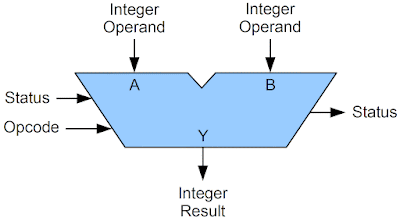
    Well, yes, it is true that “A = C” and “C = A” are equivalent. But Fletcher is talking about physical signals traveling in physical circuits. Here’s a stylized conceptual diagram of the circuitry of an Arithmetic Logic Unit that I got from Wikipedia. 

    The OpCode indicates the logical operation to be performed on the operands coming in at the top to yield the result at the bottom. That’s a one-way circuit: A, B to Y. If direction of signal flow is all you need to for causal modeling, then it would seem that a computer’s ALU satisfies that condition.

    Alas, now things get complicated. The hardware, the ALU, switches simple electrical signals. What those signals represent, however, is a function of the software the computer is running at the time. This distinction between hardware and software doesn’t exist for nervous systems. Nervous systems consist of living cells more or less fixed in place but which, as Fletcher noted, can modify the way each interacts with the others.

    Digital computers are very versatile and have been programmed to function in many domains. The domain is encoded in the software and the data drawn upon and generated through the software. Whether or not a computer is simulating the causal interactions of light photons in a CGI rendering package, of atoms in protein folding, or the more modest ordering of alphanumeric characters in a word processor, the logic gates of the ALU switch the signals on which the software depends.

    Yes, the ability of computers to generate coherent narrative is limited, though researchers have been working on it half a century. They’ve been working on reading narrative – for various senses of “read” – as long, with limited results. Will computers ever be able to deal with narrative as fluently as humans do? I doubt it, but I’m not inclined the blame the limitations on the operations of ALUs.

    Monday, January 6, 2020

    The Human Swarm @3QD [Mark Moffett @ New Savanna]

    I’ve just posted my review of The Human Swarm at 3 Quarks Daily: Of Ants And Humans: Some Principles Of Social Organization.

    I’ve also written some posts about his previous book, Adventures Among Ants, which is filled with his marvelous photos of ants:
    Here’s a post on a major article Moffett wrote about ant supercolonies, an article which is certainly one of the sources of The Human Swarm:
    And this is an post I wrote in anticipation of Adventures Among Ants:
    You might want to think of that in conjunction with an earlier post on The Human Swarm:

    Sunday, September 4, 2011

    Reading Latour 11: Plug-ins and Couplings

    Bruno Latour. Assembling the Social: An Introduction to Actor-Network Theory. Oxford UP, 2005. From the chapter “Second Move: Redistributing the Local,” pp. 191-218.

    Much as I’d like to say something about each chapter of this book. I can’t. Don’t have time. Read it yourself. Please.

    I’m skipping over 50+ pages so I can rejoin Latour in “Redistributing the Local.” And I’m skipping much of that so I can pick up the trail here (p. 207)—with just enough language from the skipped-over text to offer a taste of what you’re missing:
    Surely the question we need to ask then is where are the other vehicles that transport individuality, subjectivity, personhood, and interiority? If we have been able to show that glorified sites like global and local were made our of circulating entities, why not postulate that subjectivities, justifications, unconscious, and personalities would circulate as well? And sure enough, as soon as we raise this very odd but inescapable question, new types of clamps offer themselves to facilitate our enquiry. They could be called subjectifiers, personnalizers, or individualizers, but I prefer the more neutral term of plug-ins, borrowing this marvelous metaphor from our new life on the Web. . . . What is so telling in this metaphor of the plug-in is that competence doesn’t come in bulk any longer but literally in bits and bytes. You don’t have to imagine a ‘wholesale’ human having intentionality, making rational calculations, feeling responsible for his sins, or agonizing over his mortal soul. Rather, you realize that to obtain ‘complete’ human actors, you have to compose them out of so many successive layers, each of which is empirically distinct from the next.
    So that’s what we are, a bunch of plug-ins ‘downloaded’ from the web of our acquaintances. There’s the eat-breakfast module, the pick-up-a-package module, another for writing a research paper, one performing a Beethoven quartet, raising a barn, planting tobacco, canoeing through rapids, and so on. Each of us has our own set of apps, but there are some we all share, at least within a group, such as language.

    Latour’d mentioned language a bit earlier (p. 177) but didn’t discuss it much. This one bootstraps though some built-in equipment, as do many others and, in the theory advanced by Vygotsky, is an internalized other (which I discuss in some detail in both this paper, on the self, and this one on Coleridge’s “This Lime-Tree Bower My Prison”). At first the young child listen as others talk around her and to her, directing her movements and her attention through their words. As the infant gains verbal fluency she talks to herself so becomes capable of using language to direct her movements and attention. Then the self-talking goes silent and is completely internal. Now it has become ‘thinking.’ Plug-in fully installed and ready, of course, for new submodules and upgrades.