It was only on Day 4 that I began appreciating the ways in which the elegant $650 computer on my wrist was more than just another screen. By notifying me of digital events as soon as they happened, and letting me act on them instantly, without having to fumble for my phone, the Watch became something like a natural extension of my body — a direct link, in a way that I’ve never felt before, from the digital world to my brain. The effect was so powerful that people who’ve previously commented on my addiction to my smartphone started noticing a change in my behavior; my wife told me that I seemed to be getting lost in my phone less than in the past. She found that a blessing.
Wednesday, April 8, 2015
In praise of Apple's new watch
Dennett on the De-Darwinizing of Culture
This recent video (talk given 19 March 2015) gathers many of Dennett's recent themes and examples. The central thread is worthwhile – Dennett's only idea on culture that's caught my interest – but it is festooned with his typical assembly of brilliant obfuscating rhetorical ornamentation. One has the impression that he's thought more and more deeply about biology than about culture. And so he's using biology as a vehicle for understanding culture. That's not unreasonable providing, of course, that you have a robust understanding of culture than is not piggybacking on biology. Dennett seems rather poor in that sort of understanding of culture.
Dennett's rhetoric would reward a close analysis, but not by me, not at this time. I've already done some of that in my working paper, Cultural Evolution, Memes, and the Trouble with Dan Dennett; see the appendix. "Turtles All the Way Down: How Dennett Thinks: An Essay In Cognitive Rhetoric".
As for De-Darwinizing, the idea seems to be something like this: There are things whose design is the result of what we might call a "full Darwinian" process, what Donald Campbell characterizes as blind variation and selective retention (BVSR). A lot of language seems rather like that, but in the cultural rather than the biological sphere. But there are also words that have been deliberately coined and introduced into the language, such as "meme". So, not "full Darwinian". It's De-Dawinized.

Monday, April 6, 2015
Lewontin: There is no niche without an organism
David Sloam Wilson (DSL) interviews Richard Lewontin (RL) on adaptation and evolution. They start the conversation with the classic article Lewontin co-authored with Stephen Jay Gould, “The Spandrels of San Marco and the Panglossian Paradigm: A Critique of the Adaptationist Programme”. And then things get interesting. Wilson brings up cultural evolution and Lewontin says, in effect, what's wrong with cultural history? Wison's reply, more or less, is that it covers too; history is everything. It's in that context that Lewontin makes this remark:
RL: But the problem, here, is that it’s a form of adaptation that hasn’t been studied enough in animals and plants, which is that each change in the species changes what we call the environment, so there is a co-evolution of organism and environment. Historical change in our species has been increasingly the consequence of the organism itself. We’re inventing it all. As the brain grew into what we now have, it became the chief mechanism by which organisms constructed their environment. Look, let me interject here. I think it is extremely important to go to a fundamental issue, which is organisms create their own environments. All organisms make their niches. The whole notion of ecological niche is a very bad notion. There are no niches without organisms. This notion that there is a hole in the world that the organism evolves to fill. The organism by its evolution changes the conditions of its life and changes what surrounds it. Organisms are always creating their own hole in the world, their own niche.
DSW: You pioneered the concept of niche construction, which has become a hot topic.
RL: I think that one mustn’t see niche construction as a special issue. There are niches and then there is reconstruction of the niches. My claim is a very strong one and I could be wrong: there is no niche without an organism.
There is no niche without an organism – that seems right to me, and I'd figured that out back in the 1970s. As I put it in this post about patterns, "a niche was a pattern that some organism “traced” or “inscribed” in an environment." A bit later, at the end of the talk:
RL: Oh no, I’m with you! If I could convince people to use that notion of niche, not as a fixed thing, but as something that is manufactured by the organism, I would be very very happy. But when I talk to biologists about it, they’re always surprised.
DSW: It is still a new idea, in part of course because it’s a complex idea. Complexity is complex, it’s hard to study. We’re always trying to keep things simple, even when we should be embracing complexity in some sense.
Yikes! Still a new idea? If that's so, then biologists aren't so sophisticated as I'd thought/hoped.
Just before that, Wilson said this:
History seems to me too broad. Sure everything is history but we’d like to say something more specific. If there is a process of adaptation going on, even if it’s one of rapid niche construction and coevolution, that’s still a more specific set of ideas than just plain history, which really does encompass everything and therefore nothing. Don’t we want to use some of those more specific ideas about adaptation and coevolution and niche construction? That’s more than just history!
OK, "a more specific set of ideas" is a bit vague. But I'll take it.
Bell Magic and Spirits at 3 Quarks Daily
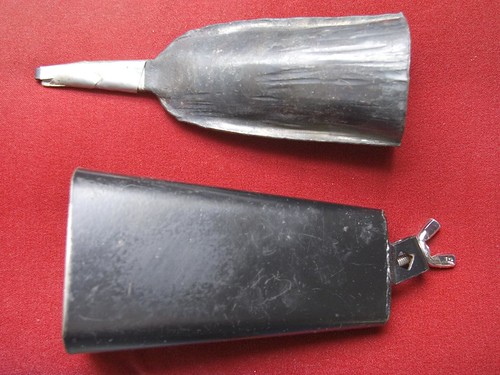
My intellectual life has tended to revolve around various specific examples that I examine closely and revisit from time to time. Coleridge’s “Kubla Khan” is perhaps the most important literary example but of course there are others, most recently Conrad’s Heart of Darkness.
My thinking about music has been strongly influenced by a particular incident that occurred in rehearsal sometime in the 1980s. I was playing bells with three others and “magic” happened: the appearance of high twittering sounds that no one was playing. I used that incident to open the second chapter of Beethoven’s Anvil; I’ve blogged about it; and elaborated it into a 10,000 word working paper: The Magic of the Bell: How Networks of Social Actors Create Cultural Beings (see below).
I’ve now taken part of the working paper and revised it into my most recent post for 3 Quarks Daily: The Magic of the Bell and a Glimpse of Spirits. I’ve listed the working paper below along with its abstract and table of contents.
* * * * *
The Magic of the Bell: How Networks of Social Actors Create Cultural Beings
Academia.edu: https://www.academia.edu/11767211/The_Magic_of_the_Bell_How_Networks_of_Social_Actors_Create_Cultural_Beings
Abstract: It is well known that music can engender altered states of consciousness that are difficult to interpret scientifically except as odd malfunctions in the nervous system. In this paper I report a phenomenon known among some musicians as “the magic of the bell”: the emergence of high-pitched twittering sounds when a group is playing interlocking rhythms on different bells. These sounds cannot be attributed to any of the musicians and they emerge only when the group is a group is playing bells with passion and precision. I argue that those sounds arise through interpersonal coupling among the musicians and that the ‘naïve’ temptation to attribute them to a ‘spirit’ or ‘spirits’ can be reconciled with a close description that does not presuppose non-physical entities. Those spirits should be conceived as the embodiment of non-mysterious and physically coherent group process. This argument has ramifications for how we think of time and how we think of longer cycles of group life.
Introduction: Composing Strange Objects
Instrument Matter in the Musician’s Mind
Time and Again, the Curse of Linear Time
How to Compose a Spirit
Explain or Explain Away? Composition and Cultural Beings
Bibliographical References
Sunday, April 5, 2015


Homeostasis: What's the cultural analogue?
Oliver Sacks has an essay on wellness and dis-ease that ranges over migraines and his recent cancer treatment. His opening paragraph reminded me of Dawkins on stability as being fundamental to the universe and to evolution. Here's Sacks' paragraph (two actually):
Nothing is more crucial to the survival and independence of organisms—be they elephants or protozoa—than the maintenance of a constant internal environment. Claude Bernard, the great French physiologist, said everything on this matter when, in the 1850s, he wrote, “La fixité du milieu intérieur est la condition de la vie libre.” Maintaining such constancy is called homeostasis. The basics of homeostasis are relatively simple but miraculously efficient at the cellular level, where ion pumps in cell membranes allow the chemical interior of cells to remain constant, whatever the vicissitudes of the external environment. More complex monitoring systems are demanded when it comes to ensuring homeostasis in multicellular organisms—animals, and human beings, in particular.Homeostatic regulation is accomplished by the development of special nerve cells and nerve nets (plexuses) scattered throughout our bodies, as well as by direct chemical means (hormones, etc.). These scattered nerve cells and plexuses become organized into a system or confederation that is largely autonomous in its functioning; hence its name, the autonomic nervous system (ANS). The ANS was only recognized and explored in the early part of the twentieth century, whereas many of the functions of the central nervous system (CNS), especially the brain, had already been mapped in detail in the nineteenth century. This is something of a paradox, for the autonomic nervous system evolved long before the central nervous system.
What's the socio-cultural analogue to physiological homeostasis?
Now, for good measure, his third paragraph:
They were (and to a considerable extent still are) independent evolutions, extremely different in organization, as well as formation. Central nervous systems, along with muscles and sense organs, evolved to allow animals to get around in the world—forage, hunt, seek mates, avoid or fight enemies, etc. The central nervous system, with its sense organs (including those in the joints, the muscles, the movable parts of the body), tells one who one is and what one is doing. The autonomic nervous system, sleeplessly monitoring every organ and tissue in the body, tells one how one is. Curiously, the brain itself has no sense organs, which is why one can have gross disorders here, yet feel no malaise. Thus Ralph Waldo Emerson, who developed Alzheimer’s disease in his sixties, would say, “I have lost my mental faculties but am perfectly well.”
I note that, from a logical point of view, the internal environment is external to the brain as is the external world, though the brain and the internal environment are encapsulated in the same physical system. This interesting fact seems to me central to any attempt to make sense of human culture. Thus it became on of a handful of named principles in my music book, Beethoven's Anvil:
Two Environments: The central nervous system operates in two environments, the external world and the internal milieu, and it regulates the relationship between the external world and the interior milieu on behalf of that milieu. [p. 33]
And, in turn, it led to another principle a few pages later:
But, going back to where we started: what's the cultural equivalent of physiological homeostasis? Until we know what that is, and how it works, we're not going to understand how and why culture changes.Facing Principle: As a vehicle for expressing emotion, the body presents the inner experience of individuals both to the external world and to higher brain centers. [p. 40]
On the Sacks article, h/t 3QD.
Saturday, April 4, 2015
Kids: tickle danger, tinker, learn, and grow
From a NYTimes oped by Allison Arieff:
Tulley created a school in San Francisco based on tinkering, The Tinkering School:If we want to raise kids to be independent thinkers and change-makers, one of the best things we can do is give them the tools to figure stuff out for themselves. And a terrific manual for that is “50 Dangerous Things (You Should Let Your Children Do),” by Gever Tulley, a self-taught software engineer.“There are not enough opportunities in a child’s life to be taken seriously, to be given autonomy and to learn authentically,” says Tulley. “I think they need learning opportunities that respect and incorporate their ideas.”Tulley’s book presents 50 challenges (with instructions), each utterly at odds with today’s rampant helicopter parenting, such as Stand on a Roof, Taste Electricity (by licking a 9-volt battery), Dam a Creek and (I’ll admit I’m not ready to allow this one yet) Cross Town on Public Transportation.“50 Dangerous Things” emphasizes the importance of introducing risk, facilitating autonomy and letting kids know that with danger comes discovery. This book comes to life at The Tinkering School, a program Tulley started here in San Francisco in 2000. (There is also a K-12 school, Brightworks, and a sleepaway camp down the coast; the program has recently expanded to Los Angeles, Chicago, Austin and Buffalo.)
This isn’t just a bunch of kids messing around with stuff. Behind the chaos you can see the gears turning. There is no template, no set of instructions (and no screens). They need to be attentive, engaged and curious. As they begin a project, they’re learning how to collaborate, identify the skill sets of their group and deploy those talents accordingly, and problem-solve creatively. “The use of real tools dramatically increases agency,” says the Tinkering School’s manager, Joshua Rothhaas. “It’s like learning Spanish and suddenly realizing you can talk to about 400 million more people in the world than you could before you knew Spanish. It fundamentally changes the way your kid thinks about the world, how it works, and what they are capable of.”
Friday, April 3, 2015
Friday Fotos: Ghosts Along the Hudson
[taken this afternoon]
The building in the middle is the church of St. John the Divine, on NYC's upper West Side:

The George Washington Bridge in the distance:

Near distance, a Hoboken pier; middle distance, Weehawken pier:

In the background, Manhattan's West Side; in the foreground, a pier in Hoboken; between the two, fog on the Hudson:

Buoys associated with Hoboken's Pier 13, a party place more or less, with docking for small pleasure boats and kayaks:

Thursday, April 2, 2015


Maps of Musical Genres
Bumped to the top to highlight added material. Originally published in August 2014.Find it HERE. Click on links to listen to examples.
This is an ongoing attempt at an algorithmically-generated, readability-adjusted scatter-plot of the musical genre-space, based on data tracked and analyzed for 1264 genres by The Echo Nest. The calibration is fuzzy, but in general down is more organic, up is more mechanical and electric; left is denser and more atmospheric, right is spikier and bouncier.
Courtesy of Glenn McDonald.
Addendum, April 2015: More at this article in Vox, which quotes McDonald:
Addendum, April 2015: More at this article in Vox, which quotes McDonald:
This map builds on essentially everything else we do at the Echo Nest from parsing the contents of scraped web pages to analyzing the psycho-acoustic properties of the actual audio files…I focus on trying to make sense of data, and extract useful insights from it. Besides genres, I work on similarity calculations, personalization, data quality, sanity-checking, emerging-music discovery, contextual playlist generation, audio analysis and whatever else seems to have the potential to help people experience music.The identification of genres is, of course, foundational to the study of cultural evolution.
Mad Men on the Moon
“That's one small step for [a] man, one giant leap for mankind.”
– Neil Armstrong, July 21, 1969
I don't know whether you've been following Mad Men, but I have (though a bit displaced since I don't get cable and am viewing it thru Netflix). I've just watched episode 85, “Waterloo”, which is the conclusion to the first half of season 7. There’s a sequence near the end where we go into the homes of many of the principals and see them watching TV. What are they watching? Freakin’ Neil Armstrong landing on the freakin’ Moon at the culmination of the Apollo 11 mission.
From the Wikipedia episode summary:
Over the weekend, members of SC&P watch the moon landing from various locations: Don, Peggy, Pete and Harry are together in Indianapolis where they are preparing the pitch to Burger Chef; Roger, Mona, Brooks, and Ellery are together in his apartment; and Bert is home watching with his maid. The Francises have company for the weekend and are also tuned in. Sally seems smitten with the family's oldest son but immediately after the landing goes out to the back yard and kisses the younger, more bookish son who is closer to her age.
I’m sure you can appreciate the IMPORTANCE of THAT. But here, of course, that event is being reprised in a QUALITY TV series about/set in the 60s. As Sun Ra intoned, “Space is the [freakin’] place”.
In the world of “must-see TV” it sure beats the 2003 “shock and awe” bombing of Baghdad. Back in the 60s, of course, they got to watch the war in Vietnam, though not in real time.
Wednesday, April 1, 2015
Some fairly standard Photoshoppery
This photo has been turning up regularly in my "most viewed" stats at Flickr:
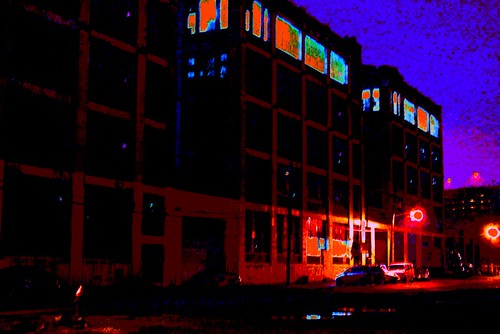
It's a night-time shot of an industrial building in Jersey City. I took it some time ago, 2006, and don't really remember what I did to it in Photoshop, but it looks like I mostly just ramped up the saturation, though I don't think that would account for the colors of the top-floor windows. This is the caption I have it:
super secret government laboratory in a place that nobody can ever know about
Yeah.
This shot isn't nearly so popular, but seems to have modest following and it's showed up today:

The site is within a quarter or half mile of where I took the other photo. ZAR is an old school north Jersey writer whose been working these walls since the 1980s. That weird mess to the right of ZAR is by Plasma Sluggs, a writer from Brooklyn. As for what I did to get those colors, Damfino!
Here's the description I gave it:
Monolith 2007 wacko style.jpgI suppose you had to be there.
Rendered this way, though, makes it easy to see the alien messages on it. What're they smokin' on Planet Graff X-009.33qpx?
Documentary About John Von Neumann
Von Neumann was one of the greatest thinkers of the previous century, perhaps best known for his work on computing and game theory. But he made contributions in many other areas, including quantum mechanics and weather modeling. Here's a one-hour documentary prepared by the American Mathematical Society.
H/t Tyler Cowen.
Notes Toward a Natural Philosophy of Cultural Evolution in the Music Domain
The title of my book about music, Beethoven’s Anvil, was suggested by my agent, Richard Curtis. I made up the subtitle (I think): Music in Mind and Culture. I am now thinking that the subtitle could have been the phrase I’m using as the title of this post: Notes Toward a Natural Philosophy of Cultural Evolution in the Music Domain. To be sure, I didn’t conceive of it as a study of the cultural evolution of music (“cultural evolution” has only five entries in the index), but in the context of my current efforts to figure out what cultural evolution is about, that’s a good way to think about Beethoven’s Anvil.
For it places the evolutionary aspects of musical phenomena in the context of substantial discussions of psychology and neuroscience, of interpersonal interaction and group processes, of origins and history, and of social context and function broadly considered. In particular, when I discuss the musical equivalents of the biological gene and phenotype, those discussions are embedded in discussions of neuroscience and perceptual, cognitive, and motor psychology that are well-thought out. I’m not just hunting for analogues to the biological notions and attaching terminological handles to them, which is, alas, what all too much discussion of micro-scale cultural evolution has been doing.
In the rest of this post I do two things: 1) justify the talk of natural philosophy, and 2) say a bit more about Beethoven’s Anvil.
Natural Philosophy
The term is of course an old one. But I have a specific contemporary source in mind, Massimo Pigliucci’s recent review of The Singular Universe and the Reality of Time: A Proposal In Natural Philosophy by Lee Smolin (a scientist by trade) and Roberto Unger (a philosopher). Smolin and Unger explain their use of the term and Pigliucci discusses that use, approvingly, quoting this passage from their book:
Today, natural philosophy has not disappeared completely. It lives under disguise. Scientists write popular books, for the general educated public, professing to make their ideas about the science that they practice accessible to non-scientists. They use these books to speculate about the larger meaning of their discoveries for our understanding of the universe and of our place within it. They also have another audience, however: their colleagues in science, addressed under the disguise of popularization. (p. 82)
While I’m a humanist by training, not a scientist, I suppose that I’ve become something of a natural philosopher in the sense of that paragraph and more or less for the same purpose.
Beethoven’s Anvil assumes no particular specialized intellectual background and so is broadly accessible both to “civilians” if you will, but also to a broad range of intellectual specialists in a variety of human sciences (the phrase, “human sciences” is European and encompasses the humanities as well as the social and behavioral sciences). The book also assumes, and I hope rewards, a fair level of intellectual sophistication and adventurousness.
Some Propositions from Beethoven’s Anvil
How then to present the contents of a moderately dense 280 page book (plus notes and references) in a compact form?
In the course of writing the book I composed a handful of short paragraphs to which I gave specific names. These key propositions are not distributed uniformly throughout the book – half of them are in chapters 2 and 3 (out of 11), which I’ve put online HERE – and so don’t represent the full scope of the book. But they indicate enough of it to show why the book would be valuable for students of cultural evolution.
To be embarrassingly blunt, if you want to see cultural evolution discussed in a rich interdisciplinary intellectual context, I know of nothing else quite like Beethoven’s Anvil. If you are thinking of cultural evolution as a vehicle for consilience in the human sciences, Beethoven’s Anvil makes a good complement to e.g. Alex Mesoudi, Cultural Evolution: How Darwinian Theory can Explain Human Cultural and Synthesize the Social Sciences but is itself free of broad claims about intellectual unification of that sort. I am making some such claim in this post.
To be sure, music is not the whole of human culture, not by a long shot. But it is a significant chunk of human culture. I would like to think that a detailed albeit speculative account of it has something to offer those with no particular interest in music, but with some interest in human culture and its evolution.
To be sure, music is not the whole of human culture, not by a long shot. But it is a significant chunk of human culture. I would like to think that a detailed albeit speculative account of it has something to offer those with no particular interest in music, but with some interest in human culture and its evolution.
Subscribe to:
Posts (Atom)