Friday, August 24, 2018

Friday Fotos: Crazy shots into the sun

I love these kind of crazy shots. I mean, no sane person points the camera into the morning sun without filters and expects to get a decent shot. The sensor gets flooded with light so these photos tend come come out of the camera very dark, with a bright spot or two – one for the sun and one or two for whatever (camera flare perhaps). Then you have to figure out how to make an image out of it. I start by cranking up the exposure (in Lightroom) and cranking down highlights and see what I've got. The thing is, there's almost no point in trying to get the photo to look like what you saw because 1) you can't remember, and 2) you didn't see it anyhow. That is, you generally don't stare directly into the sun, not for more than a moment or two. So there really is no "natural" look for these images. But you don't want it to look plastic or fake or whatever.

20170809-_IGP9413

Monochrome works:

20170809-_IGP9466

Meanwhile:

20170809-_IGP9452

Is this what I saw:

20170809-_IGP9414

Or was it this:

20170809-_IGP9414-2

Neither? Just what did I see, anyhow?

And what does he see?

20170809-_IGP9453

Is this what the sun sees?

20170809-_IGP9371

Life on Mars is no joke, so says Tyler Cowen

When I think of settling other planets, my base case is one of extreme scarcity and fragility, at least at first and possibly for a long time. Those are not the conditions that breed liberty, whether it is “the private sector” or “the public sector” in charge.

Maybe corporations will settle space for some economic reason. Then you might expect space living to have the liberties of an oil platform in the sea, or perhaps a cruise ship. Except there would be more of a “we are in this all together” attitude, which I think would favor a kind of corporate autocracy.

Another scenario involves a military settling space, possibly for military reasons, and that too is not much of a liberal or democratic scenario.

You might also have religiously-motivated settlements, which presumably would be governed by the laws and principles of the religion. Over time, however, this scenario might give the greatest chance for subsequent liberalization.

Play-car on a Finnish train

Thursday, August 23, 2018

Gaia Redux, WTF!

Bruno Latour talks with James Lovecock and writes an essay, Bruno Latour Tracks Down Gaia, Los Angeles Review of Books.
We cannot hide from the fact that there is a fundamental misunderstanding about Gaia. We think we are using the name of this mythological figure to designate the quite common time-honored idea that the Earth is a living organism. Lovelock is renowned, they say, simply because he recast in cybernetic language the ancient idea that the Earth is finely tuned. The words “regulation” and “feedback” replace the antique idea of “natural balance” or even providence.
Except, Latour is about to inform us, that's not what he did, no, not at all. The idea arose as the result of a thought experiment:
The first Gaia idea came about with the following line of reasoning: “If today’s humans, via their industries, can spread chemical products over the Earth that I can detect with my instruments, then it is certainly possible that all terrestrial biochemistry could also be the product of living beings. If humans can so radically modify their environment in so little time, then other beings could have done it as well over hundreds of millions of years.” Earth is well and truly an artificially conceived kind of technosphere for which living things are engineers as blind as termites. You have to be an engineer and inventor like Lovelock to understand this entanglement.

So Gaia has nothing to do with any New Age idea of the Earth in a millennial balance, but rather emerges, as Lenton emphasizes over dinner, from a very specific industrial and technological situation: a violent technological rupture, blending the conquest of space, plus the nuclear and cold wars, that we were later to summarize under the label of the “Anthropocene” and that is accompanied by a cultural rupture symbolized by California in the 1960s. Drugs, sex, cybernetics, the conquest of space, the Vietnam War, computers, and the nuclear threat: this is the matrix from which Gaia was born, in violence, artifice, and war.
Whoops!
Before Gaia, the inhabitants of modern industrial societies saw nature as a domain of necessity, and when they looked toward their own society they saw it as the domain of freedom, as philosophers might say. But after Gaia these two distinct domains literally don’t exist anymore. There is no living or animated thing that obeys an order superior to itself, and that dominates it, or that it just has to adapt itself to, and this is true for bacteria as much as lions or human societies. This doesn’t mean that all living things are free in the rather simple sense of being individuals, since they are interlinked, folded, and entangled in each other. This means that the issue of freedom and dependence is equally valid for humans as it is for the partners of the above natural world.

Sunflower and seeds

IMGP8130rd

IMGP0202rd

Meaning, Theory, and the Disciplines of Criticism

Relevant to a discussion about the rise of "stars" in Academic lit crit in the 1980s and 90s. See especially discussions of Reading and Theory as Critique below, which speak to the erosion of boundaries that allows critics to become stars.
In the fifth post, It’s Time to Leave the Sandbox, in my series on the poverty of cognitive criticism I managed to rough out a sketch of academic literary criticism that I rather like. So I’ve decided to present that sketch in a post of its own. I’ve dropped most of the comments on cognitive criticism and added a few things.

The most important additions come from the study Andrew Goldstone and Ted Underwood did of a century-long run of articles in seven journals, The Quiet Transformation of Literary Studies [1]. These are the journals they used: Critical Inquiry (1974–2013), ELH (1934–2013), Modern Language Review (1905–2013), Modern Philology (1903–2013), New Literary History (1969–2012), PMLA (1889–2007), and the Review of English Studies (1925–2012).

I begin by presenting one aspect of the argument that Goldstone and Underwood make, that our current terms of critical art only because established after World War II. Then I present the material I’ve reworked from that older post, this time with some charts from Goldstone and Underwood, and so other things as well.

Note: If topic models are something of a mystery. I (attempt to) explain them in Topic Models: Strange Objects, New Worlds.

Post War Shift

Goldstone and Underwood demonstrate that perhaps the most significant change in the discipline happened in the quarter century or so after World War II. Here’s a summary statement (p. 372):
The model indicates that the conceptual building blocks of contemporary literary study become prominent as scholarly key terms only in the decades after the war—and some not until the 1980s. We suggest, speculatively, that this pattern testifies not to the rejection but to the naturalization of literary criticism in scholarship. It becomes part of the shared atmosphere of literary study, a taken-for-granted part of the doxa of literary scholarship. Whereas in the prewar decades, other, more descriptive modes of scholarship were important, the post-1970 discourses of the literary, interpretation, and reading all suggest a shared agreement that these are the true objects and aims of literary study—as the critics believed. If criticism itself was no longer the most prominent idea under discussion, this was likely due to the tacit acceptance of its premises, not their supersession.
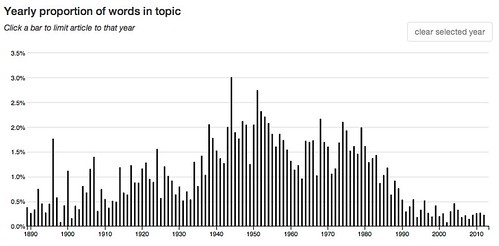
Consider topic 16, where these are the ten most prominent words: criticism work critical theory art critics critic nature method view. This graph shows how that topic evolved in prominence over time:

criticism 16

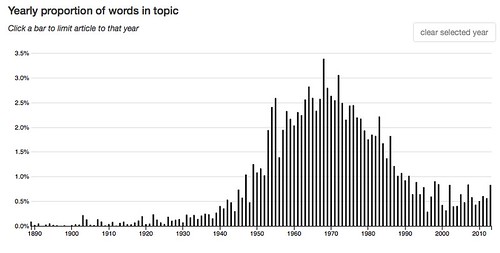
Now consider topic 29: image time first images theme structure imagery final present pattern. Notice “structure” and “pattern” in that list. The (in)famous structualism conference was held at Johns Hopkins in 1966, just before the peak in the chart, while the conference proceedings (The Languages of Criticism and the Sciences of Man) were published in 1970, one year after the peak, 1969:

image pattern 29
At the time structuralism was regarded as The Next Big Thing, hence the conference. But Jacques Derrida was brought in as a last minute replacement and his critique of Lévi-Strauss turned out to be the beginning of the end of structuralism and the beginning of the various developments that came to be called capital “T” Theory. The structuralist moment, with its focus on language, signs, and system, was but a turning point.

Tuesday, August 21, 2018

The dumbing down of mechanism

Jessica Riskin, Alive and ticking, in Aeon.
The model of nature as a complex, clockwork mechanism has been central to modern science ever since the 17th century. It continues to appear regularly throughout the sciences, from quantum mechanics to evolutionary biology. But for Descartes and his contemporaries, ‘mechanism’ did not signify the sort of inert, regular, predictable functioning that the word connotes today. Instead, it often suggested the very opposite: responsiveness, engagement, caprice. Yet over the course of the 17th century, the idea of machinery narrowed into something passive, without agency or force of its own life. The earlier notion of active, responsive mechanism largely gave way to a new, brute mechanism.

Brute mechanism first developed as part of the ‘argument from design’, in which theologians found evidence for the existence of God in the rational design of nature, and therefore began treating nature as an artefact. The natural world of late-medieval and early Renaissance Europe had contained its own spirits and agencies; but arguments from design evacuated these to a location decisively outside the physical realm – leaving a fundamentally passive machinery behind. Since theology and natural science were not yet distinct fields of inquiry, brute mechanist ideas pervaded both. Between the mid-17th and early 19th centuries, the principle of passive matter became a foundational axiom in science, to the point that few people today recall its theological origins.

A key moment in the establishment of brute mechanism in science took place one Sunday evening in Edinburgh, in November 1868. The English naturalist Thomas Henry Huxley – friend and defender of Charles Darwin, as well as a professor of natural history, anatomy and physiology – gave a lecture. He chose the subject of protoplasm, or, as he defined it for the uninitiated, ‘the physical basis of life’. Huxley’s main point was simple: we should be able to understand what brings something to life simply by reducing it to its component parts. There should be no need to invoke any special something, any force or power such as ‘vitality’. After all, Huxley quipped, water has extraordinary properties too; but we needn’t rely on something called ‘aquosity’ to explain how hydrogen and oxygen produce water under certain conditions. To be sure, Huxley couldn’t say how the properties of either protoplasm or water arose from their composition; but he was confident that science would find its way to the answer, as clearly as ‘we are now able to deduce the operations of a watch from the form of its parts and the manner in which they are put together’.

Moments in time: two views

20180803-_IGP3077

20180803-_IGP3075

Change seems more fundamental than time

From at interview posted at Backreaction. Tam Hunter interviews Carlo Rovelli about the nature of time:
TH: In the quote from your book I mentioned above, what are the “traces” of temporality that are still left over in the windswept landscape “almost devoid of all traces of temporality,” a “world without time,” that has been created by modern physics?

CR: Change. It is important not to confuse “time” and “change.” We tend to confuse these two important notions because in our experience we can merge them: we can order all the change we experience along a universal one-dimensional oriented line that we call “time.” But change is far more general than time. We can have “change,” namely “happenings,” without any possibility of ordering sequences of these happenings along a single time variable.

There is a mistaken idea that it is impossible to describe or to conceive change unless there exists a single flowing time variable. But this is wrong. The world is change, but it is not [fundamentally] ordered along a single timeline. Often people fall into the mistake that a world without time is a world without change: a sort of frozen eternal immobility. It is in fact the opposite: a frozen eternal immobility would be a world where nothing changes and time passes. Reality is the contrary: change is ubiquitous but if we try to order change by labeling happenings with a time variable, we find that, contrary to intuition, we can do this only locally, not globally.

TH: Isn’t there a contradiction in your language when you suggest that the common-sense notion of the passage of time, at the human level, is not actually an illusion (just a part of the larger whole), but that in actuality we live in a “world without time”? That is, if time is fundamentally an illusion isn’t it still an illusion at the human scale?

CR: What I say is not “we live in a world without time.” What I say is “we live in a world without time at the fundamental level.” There is no time in the basic laws of physics. This does not imply that there is no time in our daily life. There are no cats in the fundamental equations of the world, but there are cats in my neighborhood. Nice ones. The mistake is not using the notion of time [at our human scale]. It is to assume that this notion is universal, that it is a basic structure of reality. There are no micro-cats at the Planck scale, and there is no time at the Planck scale. [...]

TH: I’m surprised you state this degree of certainty here when in your book you acknowledge that the nature of time is one of physics’ last remaining large questions. Andrew Jaffe, in a review of your book for Nature, writes that the issues you discuss “are very much alive in modern physics.”

CR: The debate on the nature of time is very much alive, but it is not a single debate about a single issue, it is a constellation of different issues, and presentism is just a rather small side of it. Examples are the question of the source of the low initial entropy, the source of our sense of flow, the relation between causality and entropy. The non-viability of presentism is accepted by almost all relativists.
In part two, “The World without Time”, Rovelli puts forward the idea that events (just a word for a given time and location at which something might happen), rather than particles or fields, are the basic constituents of the world. The task of physics is to describe the relationships between those events: as Rovelli notes, “A storm is not a thing, it’s a collection of occurrences.” At our level, each of those events looks like the interaction of particles at a particular position and time; but time and space themselves really only manifest out of their interactions and the web of causality between them.
Color me sympathetic. Back to Hunt's interview of Rovelli:
TH: You argue that “the world is made of events, not things” in part II of your book. Alfred North Whitehead also made events a fundamental feature of his ontology, and I’m partial to his “process philosophy.” If events—happenings in time—are the fundamental “atoms” of spacetime (as Whitehead argues), shouldn’t this accentuate the importance of the passage of time in our ontology, rather than downgrade it as you seem to otherwise suggest?

CR: “Time” is a stratified notion. The existence of change, by itself, does not imply that there is a unique global time in the universe. Happenings reveal change, and change is ubiquitous, but nothing states that this change should be organized along the single universal uniform flow that we commonly call time. The question of the nature of time cannot be reduced to a simple “time is real”, “time is not real.” It is the effort of understanding the many different layers giving rise to the complex phenomenon that we call the passage of time.

Monday, August 20, 2018

Would you jump from an airplane at 25,000 feet without a parachute?


Star struck and broken down: How did literary criticism come to this foul pass? [#AvitalRonell]

Over the weekend the humanities Twitterverse, at least the part of it that I frequent, broke out in a flurry of discussion concerning the Avital Ronell case.

Briefly, Ronell is a very distinguished literary scholar at NYU. In 2017 Nimrod Reitman, a former graduate student, filed a Title IX complaint against her. The university dismissed the sexual assault, stalking, and retaliation charges, but found her responsible for sexual harassment and suspended her for the 2018-2019 academic year. At about that time a group of very senior humanists issued a letter of support, arguing, more or less, that a scholar of such distinction couldn’t possibly be guilty of such behavior.

It was that support letter, its claim of privilege for one of its own, as much as the case itself, that prompted the weekend’s Twitterverse chatter. Ronell was a “star” in the humanities firmament. What is it about the star system that permits and sustains such behavior? Power, yes. Still, where’d we go wrong? Was there something about humanities practice that contributed to this state of affairs?

I think there is, and that’s what this post is about. But first I want to present a tweet by Cory Robin about the Ronell case, one in a string of ten tweets. Robin read the 56-page lawsuit (PDF) that Reitman had filed against both Ronell and NYU and asks us to set the sexual matters aside. There’s something more fundamental at stake:

It’s as though Ronell recognized no boundary between herself and Reitman. That’s what this post is about, boundaries, how the collapse of boundaries in academic literary criticism created an milieu that favored personal excess and indulgence.

The stars are born

During the weekend’s Twitter activity Ted Underwood pointed to a 1997 article that David Shumway published in PMLA, The Star System in Literary Studies (Vol. 112, No. 1, 1997, 85-100). Shumway argued (p. 95):
Theory not only gave its most influential practitioners a broad professional audience but also cast them as a new sort of author. Theorists asserted an authority more personal than that of literary historians or even critics. As we have seen, the rhetoric of literary history denied personal authority; in principle, even Kittredge was just another contributor to the edifice of knowledge. Criticism was able to enter the academy only by claiming objectivity for itself, so academic critics could not revel in personal idiosyncrasy. They developed their own critical perspectives, to be sure, but all the while they continued to appeal to the text as the highest authority. In the past twenty years theory has undermined the authority of the text and of the author and replaced it with the authority of systems, as in the structuralist and poststructuralist privileging of langue over parole or in the mystifying readings of Marxism or psychoanalysis. Sometimes the theory seems to be to eschew all authority, as in some renderings of deconstruction. And yet these claims are belied by the actual functioning of the name of the theorist. It is that name, rather than anonymous systems or the anarchic play of signifiers, to which most theoretical practice appeals.
That’s an interesting set of claims. Let’s start with objectivity and use Northrop Frye’s 1957 Anatomy of Criticism as a touchstone text. In his “Polemical Introduction” Frye observes:
If criticism exists, it must be an examination of literature in terms of a conceptual framework derivable from an inductive survey of the literary field. The word "inductive" suggests some sort of scientific procedure. What if criticism is a science as well as an art? Not a “pure” or “exact” science, of course, but these phrases belong to a nineteenth-century cosmology which is no longer with us. The writing of history is an art, but no one doubts that scientific principles are involved in the historian’s treatment of evidence, and that the presence of this scientific element is what distinguishes history from legend. It may also be a scientific element in criticism which distinguishes it from literary parasitism on the one hand, and the superimposed critical attitude on the other. The presence of science in any subject changes its character from the casual to the causal, from the random and intuitive to the systematic, as well as safeguarding the integrity of that subject from external invasions. However, if there are any readers for whom the word “scientific” conveys emotional overtones of unimaginative barbarism, they may substitute “systematic” or “progressive” instead.

It seems absurd to say that there may be a scientific element in criticism when there are dozens of learned journals based on the assumption that there is, and hundreds of scholars engaged in a scientific procedure related to literary criticism. Evidence is examined scientifically; previous authorities are used scientifically; fields are investigated scientifically; texts are edited scientifically. Prosody is scientific in structure; so is phonetics; so is philology.
There you have it, literary study is a kind of science, not “pure” or “exact” but science nonetheless,. The repetition of morphological variants of science in this passage is quite stunning, as though Frye wanted to club subjectivity to death with word magic. With all that science going on literary criticism had little choice but to yield to objectivity.

But a decade later things weren’t so clear. All these objective critics kept disagreeing about their interpretations. Is there a standard against which interpretations can be measured so as to determine their validity? Strenuous efforts were made to make authorial intention such a standard, but those efforts failed to win the day. Instead the author was bracketed out in favor of systems, the unconscious, signs, social structure, power, whatever. And objectivity was gone, dismissed as a mirage of scientistic desire.

Another photo of the Met Life tower, plus link to my 3QD reflections of new York 2140

20180818-P1150635

See that slender tower in the middle? That's the Met Life tower, which is one of the central actors – yes, that's clearly how KSR conceived it, following Latour – in Kim Stanley Robinson's New York 2140. I'm standing at the northern end of Hoboken, NJ, across the Hudson River from Lower Manhattan.

I've written about New York 2140 before and I'll likely write about it again. Here's my current piece in 3 Quarks Daily, Through a 3D Glass Starkly, New York 2140 Redux.

Sunday, August 19, 2018

Sacrifice and sunk costs


Computation, Semantics, and Meaning: Adding to an Argument by Michael Gavin [#DH]

I've completed a new working paper. Title above. You can download it here:
Abstract, table of contents, and introduction below.

network distribution 2

Abstract: Michael Gavin has published an article in which he uses ambiguity as a theme for juxtaposing close reading, a standard procedure in literary criticism, with vector semantics, a newer technique in statistical semantics with a lineage that includes machine translation. I take that essay as a framework of adding computational semantics to the comparison, which also derives from machine translation. After recounting and adding to Gavin’s account of 18 lines from Paradise Lost I use computational semantics to examine Shakespeare “The expense of spirit”. Close reading deals in meaning, which is ontologically subjective (in Searle’s usage) while both vector semantics and computational semantics are ontologically objective (though not necessarily objectively true, a matter of epistemology).

Introduction: I heard it in the Twitterverse 3
Warren Weaver, “Translation”, 1949 4
Multiple meaning 5
The distributional hypothesis 6
MT and Computational semantics 8
A connection between Weaver 1949 and semantic nets 9
Abstraction and topic analysis 12
Two kinds of computational semantics 13
The meanings of words are intimately interlinked 14
Concepts are separable from words 14
Models and graphics (a new ontology of the text?) 16
Comments on a passage from “Paradise Lost” 17
Some computational semantics for a Shakespeare sonnet 21
Three modes of literary investigation and two binary distinctions 25
Semantics and meaning 25
Two kinds of semantic model 26
Where are we? All roads lead to Rome 27
Appendix 1: Virtual Reading as a path through a high-dimensional semantic space 28
Appendix 2: The subjective nature of meaning 30
Walter Freeman’s neuroscience of meaning 30
From Word Space to World Spirit? 32

Introduction: I heard it in the Twitterverse

Michael Gavin recently published a fascinating article in Critical Inquiry, Vector Semantics, William Empson, and the Study of Ambiguity , one that has developed some buzz in the Twitterverse. I liked the article a lot. But I was thrown off balance by two things, his use of the term “computational semantics” and a hole in his account of machine translation (MT). The first problem is easily remedied by using a different term, “statistical semantics”. The second could probably be dealt with by the addition of a paragraph or two in which he points out that, while early work on MT failed and so was defunded, it did lead to work in computational semantics of a kind that’s quite different from statistical semantics, work that’s been quite influential in a variety of ways.

In terms of Gavin’s immediate purpose in his article, however, those are minor issues. But in a larger scope, things are different. And that is why I’d composed the posts I’ve gathered into the working paper. Digital humanists need to be aware of and in dialog with that other kind of computational semantics. Gavin’s article provides a useful framework for doing that.
Caveat: In this working paper I’m not going to attempt to explain Gavin’s statistical semantics from the ground up. He’s already done that. I assume a reader who is comfortable with such material.
Warren Weaver, “Translation”, 1949

Let us start with a famous memo Warren Weaver wrote in 1949. Weaver was director of the Natural Sciences division of the Rockefeller Foundation from 1932 to 1955. He collaborated Claude Shannon in the publication of a book which popularized Shannon’s seminal work in information theory, The Mathematical Theory of Communication. Weaver’s 1949 memorandum, simply entitled “Translation” , is regarded as the catalytic document in the origin of machine translation (MT).

He opens the memo with two paragraphs entitled “Preliminary Remarks” (p. 1).
There is no need to do more than mention the obvious fact that a multiplicity of language impedes cultural interchange between the peoples of the earth, and is a serious deterrent to international understanding. The present memorandum, assuming the validity and importance of this fact, contains some comments and suggestions bearing on the possibility of contributing at least something to the solution of the world-wide translation problem through the use of electronic computers of great capacity, flexibility, and speed.

The suggestions of this memorandum will surely be incomplete and naïve, and may well be patently silly to an expert in the field - for the author is certainly not such.
But then there were no experts in the field, were there? Weaver was attempting to conjure a field of investigation out of nothing.

I think it important to note, moreover, that language is one of the seminal fields of inquiry for computer science. Yes, the Defense Department was interested in artillery tables and atomic explosions, and, somewhat earlier, the Census Bureau funded Herman Hollerith in the development of machines for data tabulation, but language study was important too.

A bit later in his memo Weaver quotes from a 1947 letter he wrote to Norbert Weiner, a mathematician perhaps best known for his work in cybernetics (p. 4):
When I look at an article in Russian, I say "This is really written in English, but it has been coded in some strange symbols.
 I will now proceed to decode."
Weiner didn’t think much of the idea. Yet, as Gavins explains, crude though it was, that idea was the beginning of MT.

The code-breaker assumes the message is in a language they understand but that it has been disguised by a procedure that scrambles and transforms the expression of that message. Once you’ve broken the code you can read and understand the message. Human translators, however, don’t work that way. They read and understand the message in the source language–Russian, for example–and then re-express the message in the target language–perhaps English.

Toward the end of his memo Weaver remarks (p. 11):
Think, by analogy, of individuals living in a series of tall 
closed towers, all erected over a common foundation. When they try to communicate with one another they shout back and forth, each from his own closed tower. It is difficult to make the sound penetrate even the nearest towers, and communication proceeds very poorly indeed. But when an individual goes down his tower, he finds himself in a great open basement, common to all the towers. Here he establishes easy and useful communication with the persons who have also descended from their towers.

Thus may it be true that the way to translate from Chinese to Arabic,
or from Russian to Portuguese, is not to attempt the direct route, shouting 
from tower to tower. Perhaps the way is to descend, from each language, down
 to the common base of human communication - the real but as yet undiscovered universal language - and then re-emerge by whatever particular route is convenient.
The story of MT is, in effect, one in which researchers find themselves forced to reverse engineer the entire tower in computational terms, all the way down to the basement where we find, not a universal language, but a semantics constructed from and over perception and cognition.