Tuesday, September 4, 2018

The moral significance of a finite lifespan

Nigel Warburton, On going on and on and on, Aeon:
In his essay ‘The Makropulos Case: Reflections on the Tedium of Immortality’ (1973), the English moral philosopher Bernard Williams suggested that living forever would be awful, akin to being trapped in a never-ending cocktail party. This was because after a certain amount of living, human life would become unspeakably boring. We need new experiences in order to have reasons to keep on going. But after enough time has passed, we will have experienced everything that we, as individuals, find stimulating. We would lack what Williams called ‘categorical’ desires: ie, desires that give us reasons to keep on living, and instead possess only ‘contingent’ desires: ie, things that we might as well want to do if we’re alive, but aren’t enough on their own to motivate us to stay alive. For example, if I’m going to carry on living, then I desire to have my tooth cavity filled – but I don’t want to go on living simply in order to have my cavity filled. By contrast, I might well want to carry on living so as to finish the grand novel that I’ve been composing for the past 25 years. The former is a contingent, the latter a categorical, desire.
But there's more to it, surely. Doesn't life have a shape?
The moral philosopher Samuel Scheffler at New York University has suggested that the real problem with a fantasy of immortality is that it doesn’t make sense as a coherent desire. Scheffler points out that human life is intimately structured by the fact that it has a fixed (even if usually unknown) time limit. We all start with a birth, then pass through many stages of life, before definitely ending in death. In turn, Scheffler argues, everything that we value – and thus can coherently desire in an essentially human life – must take as given the fact that we are temporally bounded beings. Sure, we can imagine what it would be like to be immortal, if we find that an amusing way to pass the time. But doing so will obscure a basic truth: that because death is a fixed fact, everything that human beings value makes sense only in light of our time being finite, our choices being limited, and our each getting only so many goes before it’s all over.

Scheffler’s case is thus not simply that immortality would make us miserable (although it probably would). It’s that, if we had it, we would cease to be distinctively human in the way that we currently are. But then, if we were somehow to attain immortality, it wouldn’t get us what we want from it: namely, for it to be some version of our human selves that lives forever. A desire for immortality is thus a paradox: it would frustrate itself were it ever to be achieved. In turn, Scheffler implies, once we’ve reflected carefully on this deep fact about ourselves, we should junk any residual desire to live forever that we might still have.
Is that all there is to it? Warburton thinks not, but...Final paragraph:
Immortality is, obviously enough, an impossible fantasy – hence it cannot be a genuine solution to the unfortunate yet elemental facts of the human condition, nor an answer to the fraught complexities surrounding euthanasia as regards both social policy and moral judgment. Nonetheless, the reason such a fantasy endures in popular imagination – as well as being a target for philosophical reflection – is that it taps into something important about our attitudes towards death. We are not simply afraid of death, we also resent it, because it is experienced as an assault on our personal agency. We can fully control our own deaths in only one direction – and that, of course, is usually no comfort at all.
Not very convincing.

More work to do.

Paris at the end of the world (1914)


Monday, September 3, 2018

The fine art of the cross cultural put-on

Learned Helplessness and Voter Apathy

In view of recent developments in presidential politics I've decided to bump this 2012 post to the top of the queue.
* * * * * 
This is rude and crude. Don't know whether or not I believe it. But it's worth thinking about. Bleg: Does anyone know of anything along these lines, pro or con, that's well thought-out and documented?
There are things that are important to us, and things that are not. There are things that we can control, and things that we cannot. Our ability, or not, to control unimportant things is of little consequence. It is otherwise with our ability to control important things.

We cannot control the weather, for example, not very much. Nor can we control the fact that we, and everyone we know, is going to die. Yes, we may have some limited control over the timing and circumstances but the fact of death itself is beyond our control.

So how do we deal with those things that are enormously important to us, but which we cannot control?

Learned Helplessness

I want to come back to that, but for now let’s set it aside and think about learned helplessness, a phenomenon identified by Martin Seligman and his colleagues in the late 1960s. Here’s a typical experiment as explained in the Wikipedia entry:
In Part 1 of Seligman and Steve Maier's experiment, three groups of dogs were placed in harnesses. Group 1 dogs were simply put in the harnesses for a period of time and later released. Groups 2 and 3 consisted of "yoked pairs." A dog in Group 2 would be intentionally subjected to pain by being given electric shocks, which the dog could end by pressing a lever. A Group 3 dog was wired in series with a Group 2 dog, receiving shocks of identical intensity and duration, but his lever didn't stop the electric shocks. To a dog in Group 3, it seemed that the shock ended at random, because it was his paired dog in Group 2 that was causing it to stop. For Group 3 dogs, the shock was apparently "inescapable." Group 1 and Group 2 dogs quickly recovered from the experience, but Group 3 dogs learned to be helpless, and exhibited symptoms similar to chronic clinical depression.
That is to say, the dogs in Groups 1 and 2 did not appear to be depressed. The experiment had a second part:
In Part 2 of the Seligman and Maier experiment, these three groups of dogs were tested in a shuttle-box apparatus, in which the dogs could escape electric shocks by jumping over a low partition. For the most part, the Group 3 dogs, who had previously learned that nothing they did had any effect on the shocks, simply lay down passively and whined. Even though they could have easily escaped the shocks, the dogs didn't try.

FAKE NEWS?

IMGP3333

Meaning & texts: objectivity, subjectivity

I have asserted that meaning is inherently subjective (e.g. here). By that I meaning that the phenomenon of meaning is ontologically subjective, but it may not thereby be epistemologically subjective, to use a distinction made by John Searle. Color is subjective in the same sense, but it is also epistemologically objective: Different observers agree on the color of a given object.

Consider these propositions:
1) That cat is gray.

2) The moon is full tonight.
Taken in context they are surely epistemically objective; no one is going to disagree about what they mean. Now consider these propositions:
3) Cats are mammals.

4) Gray is a color.
Like 1 and 2, they are epistemically objective. However, 1 and 2 are statements about the world while 3 and 4 seem rather like statements about the meanings of words (more or less – this requires a bit of thinking).

Now consider this:
5) The earth revolves around the sun.
It seems rather like 1 and 2, no? Yes, I agree. However, it also seems a bit culture specific. We didn’t always know that the earth revolved around the sun. For millennia we humans thought that the earth was flat and the sun moved through the sky above the earth and disappeared at night; some people still believe that, or something like it (and I’m not thinking about flat-earthism, which strikes me as having an essential element of opposition to modernism).

It required time an effort to establish that the earth revolved around the sun. For that is not something that’s perceptually apparent. Once established, however, it has become epistemologically objective. But, and here’s the point, it DID have to become established.

Now, what do we say about the following text by William Blake, The Sick Rose?
O Rose, thou art sick.
The invisible worm,
That flies in the night
In the howling storm:

Has found out thy bed
Of crimson joy:
And his dark secret love
Does thy life destroy.
Like every other text, its meaning is ontologically subjective. But epistemically, what of that?

I note that it is only relatively recently that we have systematically inquired about the meaning of such texts. Our means of conducting such inquiry are those of literary interpretation, chiefly close reading and its descendants. And the results of such inquiry suggest that their meaning is epistemically subjective as well, not withstanding the assertions of “minimal reading” that Attridge and Staton have made in The Craft of Poetry.

Why should the meaning of such texts remain epistemically subjective while the meaning of 1-5 is epistemically objective (with appropriate qualifications for 5? The obvious meaning would be that texts like The Rick Rose don’t have a public locus of reference like those of 1-5. Is that all there is to it?

What of those poetic texts absent the effort of explicit interpretation? What is their epistemic dimension then? Do they even have one?

Neon paradise

20180901-P1150716

20180901-P1150685

Computational linguistics & NLP: What’s in a corpus? – MT vs. topic analysis [#DH]

What’s in a corpus? Words, words organized into texts. Of course.

But that obvious answer not quite what I’m after. I’m interested in how we think about corpora, their role in our work. “We”, who’s that? I’m not sure it much matters, not exactly. It will emerge.

How are these corpora connected to the world? What do we hope to understand about the world by analyzing these corpora? What are our intuitions in these matters. To some extent I’m trying to track down something I don’t know how to conceptualize. This post from October 20, 2017 is a good example of that:
Borges redux: Computing Babel – Is that what’s going on with these abstract spaces of high dimensionality? [#DH], http://new-savanna.blogspot.com/2017/10/borges-redux-computing-babel-is-that.html
But when stalking such an abstract beast, it helps to have specific examples in mind. So I’m thinking about the role of corpora in statistical machine translation (MT) vs. their role in topic analysis. Roughly speaking, in MT statistical analysis of corpora are is a means to an end. In topic analysis statistical analysis of a corpus is the end. That difference entails a somewhat different way of thinking about corpora.

Martin Kay, an “ignorance model”

I’m basing this post on some observations by Martin Kay, one of the grand old men of MT. Kay apprenticed with Margaret Masterman at the Cambridge Language Research Unit in the 1950s. In 1951 David Hays hired him to work with the RAND group in MT. He went on to a distinguished career in computational linguistics at the University of California, Irvine, the Xerox Palo Alto Research Center, and Stanford.

Research in MT was undertaken to achieve a practical end, the translation of texts from one language to another. The United States government was particularly interested in obtaining translation of Russian texts. The researchers who undertook this work had various motivations, but some of them were interested in linguistic science and were happy enough to have their work funded by a government agency, the Department of Defense, with a practical goal.

In 2005 the Association for Computational Linguistics gave Kay a Lifetime Achievement Award. On that occasion he looked back over his career and made some observations about the relative merits of statistical and symbolic approaches to MT [1]. He speaks as a man fundamentally interested in basic knowledge who has, however, at times undertaken work with practical ends.

At the beginning of the following passage Kay distinguishes between computational linguistics and natural language processing (NLP). The distinction is a common one, albeit a bit problematic as well [2]. But the distinction Kay makes is clear enough (p. 5):
Computational linguistics is not natural language processing. Computational linguistics is trying to do what linguists do in a computational manner, not trying to process texts, by whatever methods, for practical purposes. Natural Language Processing, on the other hand, is motivated by engineering concerns. I suspect that nobody would care about building probabilistic models of language unless it was thought that they would serve some practical end. There is nothing unworthy in such an enterprise. But ALPAC’s conclusions are as true today as they were in the 1960’s—good engineering requires good science. If one’s view of language is that it is a probability distribution over strings of letter or sounds, one turns one’s back on the scientific achievements of the ages and foreswears the opportunity that computers offer to carry that enterprise forward.
I agree with Kay’s fundamental point, though I note that humanists using NLP techniques are often pursuing basic knowledge rather than a practical end.

Kay wrote that passage in 2005. I don’t know just when literary critics first began exploring NLP techniques, but I first became aware of digital humanities work in topic modeling sometime in 2012 [3]. That’s well after Kay wrote those words.

Let’s return to his remarks. Nearing the end of his talk, Kay remarks (p. 12):
My professional life almost encompasses the history of computational linguistics. But I was only fourteen when Warren Weaver wrote his celebrated memorandum drawing a parallel between machine translation and code breaking. He said that, when he saw a Russian article, he imagined it to be basically in English, but encrypted in some way. To translate it, what we would have to do is break the code and the statistical techniques that he and others had developed during the second world war would be a major step in that direction. However, neither the computer power nor large bilingual corpora were at hand, and so the suggestions were not taken up vigorously at the time. But the wheel has turned, and now statistical approaches are pursued with great confidence and disdain for what went before. In a recent meeting, I heard a well known researcher claim that the field had finally come to realize that quantity was more important than quality.

The young Turks blame their predecessors, the advocates of so-called symbolic systems, for many things. Here are just four of them. First, symbolic systems are not robust in the sense that there are many inputs for which they are not able to produce any out- put at all. Second, each new language is a new challenge and the work that is done on it can profit little, if at all, from what was done previously on other languages. Third, symbolic systems are driven by the highly idiosyncratic concerns of linguists rather than real needs of the technology. Fourth, linguists delight in uncovering ambiguities but do nothing to resolve them. This is actually a variant of the third point.
Kay mounts a quick defense on the first three points, but says a bit more about the fourth, ambiguity (pp. 12-13):
This, I take it, is where statistics really come into their own. Symbolic language processing is highly nondeterministic and often delivers large numbers of alternative results because it has no means of resolving the ambiguities that characterize ordinary language. This is for the clear and obvious reason that the resolution of ambiguities is not a linguistic matter. After a responsible job has been done of linguistic analysis, what remain are questions about the world. They are questions of what would be a reasonable thing to say under the given circumstances, what it would be reasonable to believe, suspect, fear or desire in the given situation. If these questions are in the purview of any academic discipline, it is presumably artificial intelligence. But artificial intelligence has a lot on its plate and to attempt to fill the void that it leaves open, in whatever way comes to hand, is entirely reasonable and proper. But it is important to understand what we are doing when we do this and to calibrate our expectations accordingly. What we are doing is to allow statistics over words that occur very close to one another in a string to stand in for the world construed widely, so as to include myths, and beliefs, and cultures, and truths and lies and so forth. As a stop-gap for the time being, this may be as good as we can do, but we should clearly have only the most limited expectations of it because, for the purpose it is intended to serve, it is clearly pathetically inadequate. The statistics are standing in for a vast number of things for which we have no computer model. They are therefore what I call an “ignorance model”.
That last point is very important.

By the mid-to-late 1960s computational linguists began to realize that they would have to tackle semantics, which covers the relationship between language and the world, in contrast to syntax, morphology, and phonology, which are all internal to the language system. And so computational linguists did that, along with cognitive psychologists and researchers in artificial intelligence. The work then, and now, was interesting and fruitful, but not terribly useful for practical tasks, such as MT. By the 1990s the conjunction of large amounts of cheap computing power and large bodies of digital texts gave statistical approaches a definitive edge in practical applications, an edge which remains.


AI yanks the chain (the Great chain of Being)

Kathryn Hume, Artificial Intelligence and The Fall of Eve, at Stanford's Arcade:
Most foundational narratives about the future of AI rest upon an implicit hierarchy of being that has been around for a long time. While proffered by futurists and atheists, the hierarchy dates back to the Great Chain of Being that medieval Christian theologists like Thomas Aquinas built to cut the physical and spiritual world into analytical pieces, applying Aristotelian scientific rigor to the spiritual topics.
Yes! There's a reason Ray Kurzweil entitled his book, The Age of Spiritual Machines (1999), in which, so I'm told, he waxed rhapsodic about the time when machine intelligence will exceed human intelligence and usher in a new era...of just exactly what I'm not sure. This book established Kurzweil as Cheerleader-in-Chief for The Singularity.

Continuing on with Hume:
The hierarchy provides a scale from inanimate matter to immaterial, pure intelligence. Rocks don’t get much love on the great chain of being, even if they carry the wisdom and resilience of millions of years of existence. They contain, in their sifting-shifting grain of sands, the secrets of fragility and the whispered traces of tectonic plates and sunken shores. Plants get a little more love than rocks ... Humans are hybrids, half animal, half rational spirit, our sordid materiality, our silly mortality, our mechanical bodies ever weighting us down and holding us back from our real potential as brains in vats or consciousnesses encoded to live forever in the flitting electrons of the digital universe. There are a shit ton of angels... And then God is the abstract patriarch on top of it all, the omnipotent, omniscient, benevolent patriarch who is also the seat of all our logical paradoxes, made of the same stuff as Gödel’s incompleteness theorem, the guy who can be at once father and son, be the circle with the center everywhere and the circumference nowhere ...
And so:
...what I see time and again are narratives that depict AI within a long history of evolution moving from unicellular prokaryotes to eukaryotes to slime to plants to animals to chimps to homo erectus to homo sapiens to transhuman superintelligence as our technology changes ever more quickly and we have a parallel data world where we leave traces of every activity in sensors and clicks and words and recordings and images...So we evolve, evolve, make our evolution faster with our technology, cut our genes crisply and engineer ourselves to be smarter. And we transcend the limitations of bodies trapped in time, transcend death, become angel as our consciousness is stored in the quick complexity of hardware finally able to capture plastic parallel processes like brains. 
And so we we arrive at
John Milton’s Paradise Lost, the epic to end all epics, the swan song that signaled the shift to the novel, the fusion of Genesis and Rome, an encyclopedia of seventeenth-century scientific thought and political critique as the British monarchy collapsed under the rushing sword of Oliver Cromwell.

Most relevant is how Milton depicts the fall of Eve.
At this point Hume explicates some passages from Paradise Lost, arriving at, "The point is that we’ve had a complex relationship with our own rationality for a long time." She concludes:
Why not free ourselves of the need for big picture narratives and celebrate the fact that the future is far more complex than we’ll ever be able to predict?

How can we do this morally? How can we abandon ourselves to what will come and retain responsibility? What might we build if we mimic animal superintelligence instead of getting stuck in history’s linear march of progress?

I believe there would be beauty. And wild inspiration.

Saturday, September 1, 2018

Broken promise

IMGP0796rd

A revisionist view of the first moon landing


"Xanadu" in 2005 and 2018

Back in January of 2005 I investigated the occurrence of Xanadu on the web, producing a series of Google queries that allowed me to get a sense of the contexts in which the term appeared. About a year later I made use of that work in an online symposium devoted to Franco Moretti’s Graphs, Maps, Trees. I reported those results in a post entitled, One Candle, a Thousand Points of Light: Moretti and the Individual Text. In 2010 I reworked those results into a working paper, One Candle, a Thousand Points of Light: The Xanadu Meme (at Academia.edu, at SSRN).

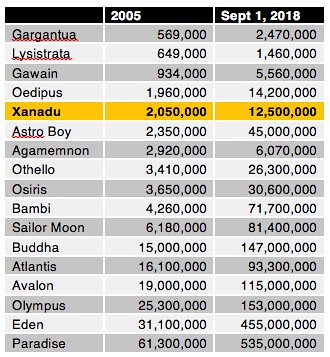
I’ve now updated one small bit of that work. In order to get some sense of what my Xanadu numbers mean I googled a number of other terms and sorted them in order of hits from lowest to highest. Here’s a table showing those results for both January 2005 and now for September 2018; the table is sorted according to the 2005 results from lowest to highest:

Xanadu comparison 2005 sort

Perhaps the most obvious difference is that the 2018 numbers are much larger than the 2005 numbers, which isn’t at all surprising. Agamemnon shows only a 208% increase over 2005, the smallest; Astro Boy shows a 1915% increase, the largest; and Xanadu shows a more modest 610% increase. The average increase was 849%.

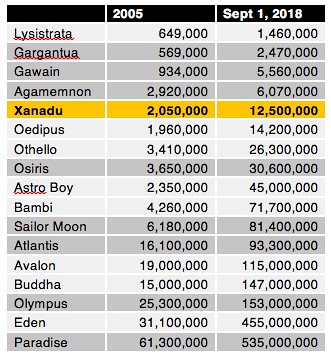
But sheer magnitude isn’t the only difference. The relative ordering shifted a bit as well. This table shows the results sorted by the 2018 results:

Xanadu comparison 2018 sort

Notice that Xanadu is fifth smallest (out of 17) in both lists while Paradise is the largest. However, whereas the count for Astro Boy was only a bit larger than that for Xanadu in 2005 (2,350,000 vs. 2,050,000 or 115%), it was considerably larger in 2018 (45,000,000 vs. 12,500,000, or 360%). That would seem to indicate that the cultural importance of Astro Boy increased more in the intervening decade than that of Xanadu.

There was also some change in relative order. Thus Agamemnon had more hits than Xanadu in 2005 (2,920,000 vs. 2,050,000) and fewer in 2018 (6,070,000 vs. 12,500,000). Conversely, Oedipus had fewer hits than Xanadu in 2005 (1,960,000 vs. 2,050,000) but more in 2018 (14,200,000 vs. 12,500,000). There are other changes in ordering as well, but those are the only ones with respect to Xanadu.

It’s not at all obvious to me that there is any neat way to summarize these various changes. I feel safe in attributing the overall increase in numbers to the overall growth of the web. I’m not sure what to say about the position of Xanadu relative to the others. I had no systematic principle of selection in choosing terms. Though I don’t recall just what I did, I feel pretty certain that I didn’t formulate a list and then run the queries. Rather, I ran queries until I had a nice range of results, both smaller and larger than Xanadu.

On the other hand, I certainly didn’t pull those terms out of a hat. Xanadu is the second word in “Kubla Khan”, one of the most important poems in the English language; Paradise is the last word in the poem while  Eden is a Christian paradise. Lysistrata, Gargantua, Gawain, Agamemnon, Othello, Atlantis, Avalon, and Olympus all reference important literary/cultural works in the Western tradition. So does Oedipus, but it also has a significant use outside of literature, in psychoanalytic discourse. Buddha, of course, is non-Western; Bambi belongs to popular culture; and Astro Boy and Sailor Moon are Japanese titles that have become fairly well known in the English-speaking world.

That Xanadu’s relative position hasn’t changed most likely indicates that little happened to change its relative visibility. There was a Xanadu musical on Broadway that opened in 2007 and ran for 500+ performances. It has also had touring versions.

I’m willing to attribute the dramatic increase for Astro Boy and Sailor Moon (1915% and 1317% respectively) to spreading interest in Japanese popular culture–both are popular manga and anime titles. But I have no suggestions for Bambi (up 1683%) and Eden (1463%). Agamemnon and Lysistrata had the lowest increases (208% and 225%). Why? A decline in classics majors? Who knows?

And so it goes.

Metaphor above Fujisan