Wednesday, March 7, 2018
Mnozil @3QD, plus notes on repertoire and comedy
My latest 3QD piece went up on Monday, A look under the hood through the insane musical genius that is Mnozil Brass (now located HERE at New Savanna) I took some of the pieces I’ve written here and edited them together along with some new material. Basically, I’m trying to figure out what these guys are doing. I’ve got more thinking to do.
Lurking in the back of my mind is the question: Why isn’t there more of this kind of thing, whatever it is?
Repertoire & cultural fluidity
Last week I began thinking about their repertoire, which ranges across classical, pop, jazz, movies, and folk. That in itself is perhaps not so unusual. The Canadian Brass has been doing that for years. My childhood hero, Rafael Mendez, did it as well, putting out records with selections from at least two or three genres. And then we have the variety shows that were once a staple of television programming. Of course such shows had different kinds of acts – music, comedy, dance, magic – but the musical acts were often enough from different genres.
But then we have single pieces that crossed genres. That’s been around for awhile as well. In the early 1940s Harry James performed “Concerto for Trumpet” in a movie – which Mnozil has performed recently. It was about three minutes long and combined classical, swing, klezmer (as it’s now called). Rafael Mendez had and arrangement of Brahms’ “Hungarian Dance No. Five” that includes swing sections. Mnozil’s “Remixes of Concerto of Arutiunian” combines classical, the “Arutiunian Trumpet Concerto”, folk, “Mexican Hat Dance”, and a bit of a TV theme, from Bonanza.
This kind of eclecticism presupposes an audience that can respond to it. In particular, I think it presupposes an audience that recognizes many of these different sources. You may not be able to identify all the sources – I certainly can’t – but you need to be able to identify many of them. It’s not enough that you are willing to listen to these different kinds of music, and even like them, but you need to recognize that they have different origins. This is music that’s about cultural fluidity.
Comedy
And then there’s the comedy. Not all of their pieces have a comedic element. But many, perhaps most, do. In some cases it is relatively slight, in others it is pervasive. And in some cases the piece becomes a kind of performance art. For example, here’s Der Drache (The Dragon):
The musicians occupy the stage, facing to the left, milling about and playing. There is a “dragon” off stage to the right. We never see it, but it occasionally delivers a musical blast that sends our musicians scattering. The entire nine-minute piece is about the musicians coming to terms with this dragon. Which they do with various kinds of music, all – I assumed – composed for this piece.
That’s it.
That’s very different from “Moldavia”, which I discussed in the 3QD piece (and here). The music is rooted in East European and Balkan folk traditions. If you simply listen to the music you’d hear them playing a technically and rhythmically complex piece of music with utter conviction. The comedy is in actions and gestures that accompany some sections. But what’s that comedy about? Are they satirizing the musical idiom, or the performance (of that idiom)? I’m not sure; I’m not even sure what that question means?
When I think over all the pieces I’ve seen the most obvious object of their satire seems to be male arrogance and aggression. These are men strutting about and posturing while they somehow manage to make music together. Are we bearing witness to the power of music to tame the male ego? Is this about civilization versus animal being?
* * * * *
And why isn’t there more of this kind of thing, whatever it is? The closest comparable acts I can think of are the Victor Borge and Peter Schickele’s P.D.Q. Bach. Is this blending of music and comedy difficult to do, requiring a skill set that few have? Or is the audience so small that it can’t support many such acts? Are those the right questions to ask?
A 2011 interview with Wilfried Branstötter (tuba) and gerhard Füssl (trombone).
* * * * *
A 2011 interview with Wilfried Branstötter (tuba) and gerhard Füssl (trombone).
Saturday, March 3, 2018
The longue durée of human history is complicated
Conventional wisdom has it that over the course of, say, the last 50,000 years or so, human society evolved from small egalitarian bands of hunter-gatherers through a series of stages of ever larger and more unequal forms of social organization as we moved through the agricultural and then the industrial evolutions. We are thus stuck with inequality forever. David Graeber and David Wengrow challenge this in an important article in Eurozone, How to change the course of human history (at least, the part that's already happened). Here's their final paragraph:
The pieces are all there to create an entirely different world history. For the most part, we’re just too blinded by our prejudices to see the implications. For instance, almost everyone nowadays insists that participatory democracy, or social equality, can work in a small community or activist group, but cannot possibly ‘scale up’ to anything like a city, a region, or a nation-state. But the evidence before our eyes, if we choose to look at it, suggests the opposite. Egalitarian cities, even regional confederacies, are historically quite commonplace. Egalitarian families and households are not. Once the historical verdict is in, we will see that the most painful loss of human freedoms began at the small scale – the level of gender relations, age groups, and domestic servitude – the kind of relationships that contain at once the greatest intimacy and the deepest forms of structural violence. If we really want to understand how it first became acceptable for some to turn wealth into power, and for others to end up being told their needs and lives don’t count, it is here that we should look. Here too, we predict, is where the most difficult work of creating a free society will have to take place.
These paragraphs will give you a feel for their argument:
Why are these seasonal variations important? Because they reveal that from the very beginning, human beings were self-consciously experimenting with different social possibilities. Anthropologists describe societies of this sort as possessing a ‘double morphology’. Marcel Mauss, writing in the early twentieth century, observed that the circumpolar Inuit, ‘and likewise many other societies . . . have two social structures, one in summer and one in winter, and that in parallel they have two systems of law and religion’. In the summer months, Inuit dispersed into small patriarchal bands in pursuit of freshwater fish, caribou, and reindeer, each under the authority of a single male elder. Property was possessively marked and patriarchs exercised coercive, sometimes even tyrannical power over their kin. But in the long winter months, when seals and walrus flocked to the Arctic shore, another social structure entirely took over as Inuit gathered together to build great meeting houses of wood, whale-rib, and stone. Within them, the virtues of equality, altruism, and collective life prevailed; wealth was shared; husbands and wives exchanged partners under the aegis of Sedna, the Goddess of the Seals.
Another example were the indigenous hunter-gatherers of Canada’s Northwest Coast, for whom winter – not summer – was the time when society crystallised into its most unequal form, and spectacularly so. Plank-built palaces sprang to life along the coastlines of British Columbia, with hereditary nobles holding court over commoners and slaves, and hosting the great banquets known as potlatch. Yet these aristocratic courts broke apart for the summer work of the fishing season, reverting to smaller clan formations, still ranked, but with an entirely different and less formal structure. In this case, people actually adopted different names in summer and winter, literally becoming someone else, depending on the time of year.
Perhaps most striking, in terms of political reversals, were the seasonal practices of 19th-century tribal confederacies on the American Great Plains – sometime, or one-time farmers who had adopted a nomadic hunting life. In the late summer, small and highly mobile bands of Cheyenne and Lakota would congregate in large settlements to make logistical preparations for the buffalo hunt. At this most sensitive time of year they appointed a police force that exercised full coercive powers, including the right to imprison, whip, or fine any offender who endangered the proceedings. Yet as the anthropologist Robert Lowie observed, this ‘unequivocal authoritarianism’ operated on a strictly seasonal and temporary basis, giving way to more ‘anarchic’ forms of organisation once the hunting season – and the collective rituals that followed – were complete.
Scholarship does not always advance. Sometimes it slides backwards. A hundred years ago, most anthropologists understood that those who live mainly from wild resources were not, normally, restricted to tiny ‘bands.’ That idea is really a product of the 1960s, when Kalahari Bushmen and Mbuti Pygmies became the preferred image of primordial humanity for TV audiences and researchers alike. As a result we’ve seen a return of evolutionary stages, really not all that different from the tradition of the Scottish Enlightenment: this is what Fukuyama, for instance, is drawing on, when he writes of society evolving steadily from ‘bands’ to ‘tribes’ to ‘chiefdoms,’ then finally, the kind of complex and stratified ‘states’ we live in today – usually defined by their monopoly of ‘the legitimate use of coercive force.’ By this logic, however, the Cheyenne or Lakota would have had to be ‘evolving’ from bands directly to states roughly every November, and then ‘devolving’ back again come spring. Most anthropologists now recognise that these categories are hopelessly inadequate, yet nobody has proposed an alternative way of thinking about world history in the broadest terms.

Friday, March 2, 2018
Scot Peterson's reluctance to go charging in to confront the Parkland shooter makes sense (obviously?)
Joshua Holland, A Former SWAT Operator Says the Cop Who Stood Outside Is Another Victim of the Parkland Massacre, The Nation. First:
By all accounts, Scot Peterson had been a model cop until he became a national disgrace. “His personnel record is filled with commendations,” reported the Sun-Sentinel. “Four years ago, he was named school resource officer of the year. A year ago, a supervisor nominated him for Parkland deputy of the year.” But like most of us, he had never faced a situation like he did on the day that Nikolas Cruz shot 33 of his former classmates, teachers, and coaches with an AR-15...the reality is that, even though they undergo extensive training designed to inoculate them against natural human stress reactions, it’s not uncommon for soldiers to freeze up the first time they experience combat. It’s not a sign of cowardice. In most cases, those same troops perform well—or even heroically—after that first exposure to real-life combat. We can’t expect police officers to behave any differently.
Second:
The gun lobby’s heroic-gunslinger fantasy also animates Donald Trump’s repeated calls for arming school teachers. It’s a distraction from the real issue—mass shootings, on and off campus, accounted for fewer than 4 percent of gun murders last year.
Third (from the interview with David Chipman, who has been on SWAT teams):
There’s this famous book called On Killing, by David Grossman, who studied how training in the military has evolved over the years. They used to qualify by shooting at round targets, and what they found is that once they got into combat, many of them did not fire their guns, and even when they fired their guns, they would purposely fire over the enemy. So they had to train people to actually shoot at targets that looked more like humans, and that’s why police qualify today on targets that aren’t round but are shaped like people.
So I think that unless you are trained—and you’re trained over and over again, and you practice like you play, which means you’re training in simulated life or death environments—the likelihood of you even firing your gun is small. And then the likelihood that you would actually hit a moving target surrounded by other moving targets—any trained operator knows the fallacy in that. It’s highly unlikely that it would turn out well...I’ve never talked about this before, but for me personally, to get through these operations, I would actually pretend that I was already dead. And in that way, I had the courage to do what I needed to do to safely to protect my team and do the operation. How many other people do that? I don’t know. I can just share my own experience...Yes, most [gun owners] practice, but they’re not practicing with rounds of ammunition zinging past their head.
Do no harm:
Some aspects of law enforcement are like being a doctor. You never want to do harm. You don’t want to make the situation worse. And it seems to me that this idea of putting a gun in teachers’ hands is like giving up in this issue.
Wednesday, February 28, 2018
Turning schools into prisons is not a good idea
Here's a note that Alex Tabarrok (Marginal Revolution) sent to the principal of his son's high school before the Parkland shooting:
Dear Principal _____,
Thank you for requesting feedback about the installation of interior cameras at the high school. I am against the use of cameras. I visited the school recently to pick up my son and it was like visiting a prison. A police car often sits outside the school and upon entry a security guard directs visitors to the main office where the visitor’s drivers license is scanned and information including date of birth is collected (is this information checked against other records and kept in a database for future reference? It’s unclear). The visitor is then photographed and issued a photo pass. I found the experience oppressive. Adding cameras will only add to the prison-like atmosphere. The response, of course, will be that these measures are necessary for “safety.” As with security measures at the airports I doubt that these measures increase actual safety, instead they are security theater, a play that we put on that looks like security but really is not.
Moreover, the truth is that American children have never been safer than they are today. Overall youth mortality (ages 5-14) has fallen from 60 per 100,000 in 1950 to 13.1 per 100,000 today (CDC, Vital Statistics). Yet we hide in gated communities, homes and schools as never before.
When we surround our students with security we are implicitly telling them that the world is dangerous; we are whispering in their ear, ‘be afraid, do not venture out, take no risks.’ When going to school requires police, security guards and cameras how can I encourage my child to travel to foreign countries, to seek new experiences, to meet people of different faiths, beliefs and backgrounds? When my child leaves school how will the atmosphere of fear that he has grown up in affect his view of the world and the choices he will make as a citizen in our democracy? School teaches more than words in books.
Yours sincerely,
Alex Tabarrok
Tuesday, February 27, 2018
A computational perspective on mood
Clark JE, Watson S, Friston KJ. What is mood? A computational perspective. Psychological Medicine, February 2018.
Abstract: The neurobiological understanding of mood, and by extension mood disorders, remains elusive despite decades of research implicating several neuromodulator systems. This review considers a new approach based on existing theories of functional brain organisation. The free energy principle (a.k.a. active inference), and its instantiation in the Bayesian brain, offers a complete and simple formulation of mood. It has been proposed that emotions reflect the precision of – or certainty about – the predicted sensorimotor/interoceptive consequences of action. By extending this reasoning, in a hierarchical setting, we suggest mood states act as (hyper) priors over uncertainty (i.e. emotions). Here, we consider the same computational pathology in the proprioceptive and interoceptive (behavioural and autonomic) domain in order to furnish an explanation for mood disorders. This formulation reconciles several strands of research at multiple levels of enquiry.
Are we approaching a tipping point on gun control?
Tyler Cowen seems to think so. His latest column for Bloomberg View is entitled "Why Gun Laws May Finally Change: Kids Are Leading". A few paragraphs:
Today, President Donald Trump dominates media cycles in an unprecedented manner. It’s thus not surprising that two of the social movements that seem to be breaking through -- #NeverAgain and the immigration reform pleas from the Dreamers -- have children in prominent roles. Young people, like our president, are somewhat fresh and unfiltered, albeit with different content. They are harder to mock than, say, Hillary Clinton or Jeb Bush. Emma González, an attack survivor, only joined Twitter this month (@Emma4Change), and she already has more followers than does the National Rifle Association.The involvement of children also indicates that their elders see the situation as somewhat desperate. Adults are willing to take some chances by allowing their children to be so publicly exposed and so vulnerable to criticism, and even death threats. That too is a sign that the social movement is ready to succeed. The U.S. is coming off a phase of “helicopter parenting,” in which parents try to remove their children from as much risk as possible, even if it’s only the risk of getting a B+ in a class and damaging one’s chances of going to a top college. The rise of a children’s movement during such a time is a sign that social momentum is shifting.Some critics of #NeverAgain are charging that parents or external activists are “putting up” the children to acts of protest and social media activism. I don’t know how much that is true, but because parents are usually more risk-averse than their children, a coordinated parent-child campaign is not a possibility the NRA should take much comfort in.
Monday, February 26, 2018
The Political Economy of Black Panther's Wakanda
Subrick, J. Robert, The Political Economy of Black Panther's Wakanda (February 25, 2018). Available at SSRN: https://ssrn.com/abstract=3129750
Abstract: Black Panther is the hereditary leader of the African nation of Wakanda, a small, natural resource rich country, which lacks access to the sea. Historically the political leadership has tried to hide Wakanda ‘s existence from other countries which has limited its eco-nomic integration with the rest of the world. In spite of its geographic endowments, nota-bly the incredibly rare ore vibranium, Wakanda has attained unprecedented technological development. This chapter explores the political economy of Wakanda and its leader, Black Panther. After explaining the origins of Black Panther, the chapter turns to the economic puzzle of Wakanda by exploring the geographic and economic implications of isolation. This is followed by an investigation into the way Wakanda has avoided the re-source curse that has plagued so many other countries. Next, a comparison is made be-tween Wakanda and the nation of Botswana. While there are some telling similarities, the lack of democracy in Wakanda is a glaring difference. It will discuss how it has de-veloped high-levels of technology that help advance the Black Panther’s dictatorship. Fi-nally, it will address the potential for democracy to emerge in Wakanda. Black Panther offers an opportunity to understand the role of political institutions in affecting the long-run economic, political, and technological development of a country.
H/t Tyler Cowen.
Sunday, February 25, 2018

Free Jazz: A William Parker Workshop
On Wednesday 13 February 2002 I attended a workshop conducted by William Parker. It was held in downtown Manhattan at 228 W. Broadway. The participants included two guitarists (electric), a vocalist, a trumpeter (me) and, of course, Parker himself, playing tuba for this occasion (he’s best known for his work on stand-up bass). Not your standard jazz ensemble.
Free jazz was the idiom. Of course “free jazz” is a big territory, but it doesn’t much matter just where in that territory we were located.
Parker made some general statements about this and that, and had variously wry, witty, and informative comments about the working methods of many of the folks he’s played with – Cecil Taylor, Ornette Coleman, Don Cherry, Muhal Abrams, and so forth. But mostly we made music. And it really was music that we made. And pretty good music at that. The kind of music where, when it’s over, you don’t want to talk. You just remain silent for a moment, collecting yourself, deploying your parachute so as to slow down your descent into lower Manhattan.
We started with something Parker called “Number 14” — which he concocted on the spot. As he said, it starts with four fours. “What’s that?” you ask. You play four notes at a rapid clip, and do that four times in a row. “What four notes?” you ask. “He didn’t tell us, and none of us asked.” We all picked the notes we wanted when it came time to play the piece. But there’s more to “Number 14” than four fours. After four fours there’s a pause, that’s so, just like that, long. After the pause everyone picks a high note and does a long descending gliss(ando) to some low note. “What high note to what low note?” you ask. “Do you really think there’s a specific answer to that question?” says I. And then we play a long trill. “On notes of your choice,” you remark. “Yes, that’s it.” After that, guitar one plays a simple one two figure and repeats it four times. Then the ensemble does another high to low gliss to trill. That’s the “head” to “Number 14.” After the head, it was up to us and the music to negotiate the flow.
So we went through the head a couple of times and then played it down. It must have gone for twenty or thirty minutes. It started out pretty raggedy, but then things started to settle in—though “settle “ is not a particularly good word to use here. There’s no easy way to describe the music that evolved. Sometimes there was a pulse, sometimes there wasn’t. Even when there was a pulse, there where times when some people didn’t follow it. Sometimes everyone was playing, sometimes only one or two were. Sometimes loud, sometimes soft, sometimes fast, sometimes slow, always shifting. Sometimes full-tilt bozo, sometimes approaching serene.
You need to understand that this is different from, say, your standard mainstream jazz quintet (there were five of us) in various ways. For one thing, the head wasn’t particularly definite; and there were no set chord changes or modes, no set back-up figures or ensemble passages. But, major though that may seem, those differences from the mainstream are, in fact, secondary. More profoundly, the traditional instrumental roles were gone. Traditionally there’s a rhythm section (piano and/or guitar, drums, and bass) and a front line (horns, vocal, guitar). The front line players do the head and then they play solos; meanwhile the rhythm section provides support (and gets a bit of solo action as well, depending on the format). Within the rhythm section, the drums, bass, and piano each has a role to play.
Well, in our music, all that disappeared. There’s no distinction between front line and rhythm section, and no fixed division of rhythm section responsibilities. It’s all up in the air, to be negotiated and reconfigured moment by moment. What this implies is that the old head-solos-head format disappears as well. There are no solos as such. This is collective improvisation, a conversation among equals, true democracy (to put a Ken Burns twist on the proceedings). Now, at this or that moment, one player might be more out front — either because she stepped out there or the others stepped back — but this is not dictated by any plan. It just happens. So we’ve got a floating mélange of quasi-solos, duos, trios and quartets all within the framework of the overall quintet.
How do you cope with a situation like that? I can’t answer the question in general, but I can say a little about how I approached it: With my ears. I’m always aware of what’s going on. Now sometimes I’m focused on what I’m doing and not so much on anyone or everything else. But I’m aware of it nonetheless. And when I’m focused on my own playing I might be doing complex stuff, or I might be repeating a simple three-note riff, or even a long tone. But I also make it a practice to spend some time explicitly focusing on what each other player is doing and to orient myself to those sounds in some way. Perhaps I’ll imitate them, or play an answer to them, or support them, or create a counter line. There are lots of ways to orient yourself to what other people are doing and it’s very important that you do so with each player, one at a time. It’s part of your responsibility as a citizen in this improvisatory democracy.
To return to traditional ways of thinking, what this means for me is that some of the time I’m thinking and playing like a soloist — my instrument’s traditional role in mainstream jazz — but that I spend more time thinking and playing like a bass player (though the trumpet is a soprano instrument, but that’s no reason I can’t provide an anchoring ostinato) or pianist (playing arpeggios) or even like a drummer (playing staccato hits). And when the vocalist would sing long tones, I might support her by playing long tones (more or less) with her.
It’s like going into a theatrical costume shop and trying on all the different costumes. Everyone else is doing the same thing. You meet in various configurations and improvise a little skit that’s consistent with your costumes. Then you change costumes and do it again, and again.
Until it’s over. And that’s the interesting thing. How do you know it’s over? Since there’s no set plan, no check list of things to accomplish (as in the head-solos-head format), you need some other way to end it. You might think that, since William Parker was leading this workshop, that he ‘d end it. But he didn’t. We all ended it, and at the same time.
That was the first time through “Number 14.” We did it a second time. Then we worked on some conceptions from other workshoppers. And then it was over. We didn’t have time for “Number 15.”
A most satisfying experience.
Addendum: Check out this interview with Steve Swell, a trombonist who knows the drill.
Addendum: Check out this interview with Steve Swell, a trombonist who knows the drill.
Saturday, February 24, 2018

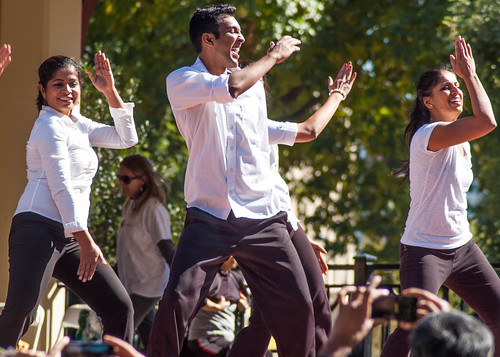
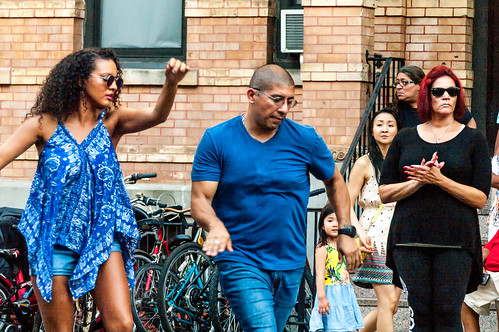
Dance to the Music: the Kids Owned the Day
You've seen Dancing with the Stars, and such? Well that's the top of a pyramid. This post from five years ago is about what's more or less at the base of that pyramid. Fun. Yes, fun!
It IS, after all, about them, no?
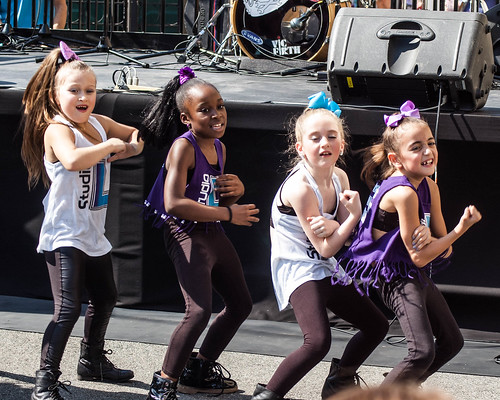
Here’s the scene: A middle school auditorium in suburban New Jersey. It’s late Saturday afternoon on the second day of a dance competition. The auditorium is filled—but only loosely—with young dancers and their parents, other family, and friends. They’re all waiting for the last performance of the competition.
Some hip hop comes up on the sound system and a few of the dancers begin moving to the music. Some of them are standing up from their positions in the audience and are dancing in place. A couple others, at the far-left and far-right down front, are dancing in the outside aisles. More start joining in.
Down front, in the center, the action photographer—the guy who’s there to shoot photos of each dance number so they can then be sold to parents—is sitting down front on his high swivel chair. He’s smiling, swiveling in the chair to survey the scene, and he starts clapping on the back-beat.
That’s me.
Now another hip hop number comes up and, in a whooshhh! dancers get up out of their seats, rush to the aisles, and the aisles are jammed with kids joyously dancing. Five, six, eight, eleven, fifteen years old, a few older. Even the dancers waiting in the wings on stage for the final number, they danced too.
All dancing. 100, 200, maybe more. Dancing.
It was wonderful.
It made the day
How so?
Competitive dance.
What’s that?
What it is is an industry. There are some 200 companies in the USA that hold dance competitions, regional and then, in some cases, national.
Oh, You Mean Like Dancing with the Stars, only for kids?
Something like that. I don’t really know how it works because I’ve only seen this one day’s worth. What was going on that afternoon is that various dance studios would enter students in the competition as solos, duets or trios, small groups and so on, and they’re divided into a bunch of age groups so you don’t have four year olds competing against fourteen year olds.
And they dance in various styles too: lyrical, ballet, hip hop, jazz, tap, flamenco, and so forth. I must have seen dance moves from three or four continents up there, not to mention costumes.
I mean I was there as a photographer. I had to take 50+ pictures of every single dance number. Maybe 150 dances in 10 hours or so. It was pretty intense. But every once in awhile I saw something so joyful that I just had to laugh a little, even as I kept snapping the shutter.
You just wanted to hug those kids.
But what about the competition?
Oh, yeah, the competition. There were three judges, sitting down in front, right in front of me as a matter of fact. They had scoring sheets and microphones they talked into. I assume they were making oral notes for the kid’s dance teachers.
What’d the kids win in the competition?
To be honest, I’m not really sure. There WAS one awards ceremony early in the afternoon, but I took that as an opportunity to eat some lunch. I did catch a bit of it though. There were plaques, for kids and teachers, and trophies. Some of the trophies were almost as big as the kids. There was another ceremony at the end of the day, after the last dance. By that time, though, I was anxious to get on the road and get home, so I didn’t stick around for it.
What I think about the competition is mostly that the kids got to stand up in front of their friends and get a prize. What mattered was having fun dancing and just having people see that you did good.
What David Said
A couple days later I talked to my friend David about it. He has a daughter who was a serious competitive gymnast in her youth. She eventually made it to the state championships in New York and, I believe, won in this or that event.
He said it was great for her poise and self-confidence and he can see what it did for her even today, when she’s just become a mother herself and is running a small non-profit.
Of course, at the root of it, whether gymnastics or dance, is fun, physical fun. And for very young children physical fun is mostly what there is. Because they’re all body. Sure, they can talk and draw pictures and dream and tell stories. Sorta. But what they do best is move around.
So in gymnastics and in dance they get to move around all they want. And they learn to do so with grace and they learn that there is a special pleasure in being graceful. That’s a valuable and important lesson.
Plus, they get to dress up in a colorful costume! They get to put on an act.
Thursday, February 22, 2018

Subscribe to:
Posts (Atom)