


This looks great, and very much in line with our https://t.co/xnbTBAUvC9 https://t.co/DFrNYhgGoQ
— Alberto Acerbi (@acerbialberto) October 15, 2021
Major claim: "[Vector space models] call for distinct modes of humanistic interpretation and explication that are related to but distinct from those that may have been used on the original source texts."
— James E. Dobson (@jeddobson) October 11, 2021
Surprisingly perhaps, it turns out that the hermeneutical theories of nineteenth-century theologian and philosopher Friedrich Schleiermacher are perhaps the most useful frame for understanding word embeddings.
— James E. Dobson (@jeddobson) October 11, 2021
This essay builds on my recent DHQ essay "Interpretable Outputs: Criteria for Machine Learning in the Humanities" as the conditions for interpretabilityhttps://t.co/3j4IEffP86 #ml
— James E. Dobson (@jeddobson) October 11, 2021
 |
| Image courtesy of Des Pickard |
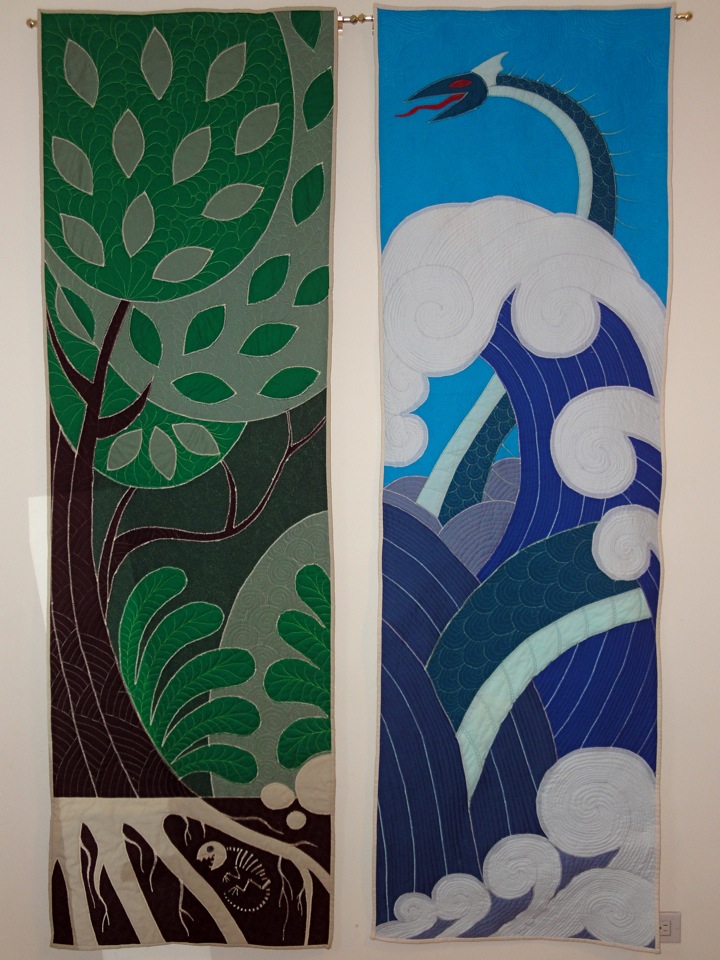
The third, Fire, derives from Indian and Tibetan sources:


The white nude is gorgeous, to be sure, but to my eye it doesn't at all look like it belongs with the previous three in the 4 Elements series. It's like Nina no longer felt like working in that style, but she still felt the nagging absence of the fourth quilt.
Veritasium
10.2M subscribers
How does order spontaneously arise out of chaos? This video is sponsored by Kiwico — go to https://www.kiwico.com/Veritasium50 for 50% off your first month of any crate.
An enormous thanks to Prof. Steven Strogatz — this video would not have been possible without him. Much of the script-writing was inspired and informed by his wonderful book Sync, and his 2004 TED talk. He is a giant in this field, and has literally written the book on chaos, complexity, and synchronization. It was hard to find a paper in this field that Steven (or one of his students) didn't contribute to. His Podcast "The Joy of X" is wonderful — please listen and subscribe wherever you get your podcasts https://www.quantamagazine.org/tag/the-joy-of-x
Nicky Case's Amazing Firefly Interactive — https://ncase.me/fireflies
Great Kuramoto Model Interactive — https://www.complexity-explorables.org/explorables/ride-my-kuramotocycle/
References:
Strogatz, S. H. (2012). Sync: How order emerges from chaos in the universe, nature, and daily life. Hachette UK. — https://ve42.co/Sync
Strogatz, S. H. (2000). From Kuramoto to Crawford: exploring the onset of synchronization in populations of coupled oscillators. Physica D: Nonlinear Phenomena, 143(1-4), 1-20. — https://ve42.co/Strogatz2000
Goldsztein, G. H., Nadeau, A. N., & Strogatz, S. H. (2021). Synchronization of clocks and metronomes: A perturbation analysis based on multiple timescales. Chaos: An Interdisciplinary Journal of Nonlinear Science, 31(2), 023109. — https://ve42.co/Goldsztein
The Broughton Suspension Bridge and the Resonance Disaster — https://ve42.co/Broughton
Bennett, M., Schatz, M. F., Rockwood, H., & Wiesenfeld, K. (2002). Huygens's clocks. Proceedings of the Royal Society of London. Series A: Mathematical, Physical and Engineering Sciences, 458(2019), 563-579. — https://ve42.co/Bennett2002
Pantaleone, J. (2002). Synchronization of metronomes. American Journal of Physics, 70(10), 992-1000. — https://ve42.co/Pantaleone2002
Kuramoto, Y. (1975). Self-entrainment of a population of coupled non-linear oscillators. In International symposium on mathematical problems in theoretical physics (pp. 420-422). Springer, Berlin, Heidelberg. -- https://ve42.co/Kuramoto1975
Great video by Minute Earth about Tidal Locking and the Moon — https://ve42.co/MinuteEarth
Strogatz, S. H., Abrams, D. M., McRobie, A., Eckhardt, B., & Ott, E. (2005). Crowd synchrony on the Millennium Bridge. Nature, 438(7064), 43-44. — https://ve42.co/Strogatz2005
Zhabotinsky, A. M. (2007). Belousov-zhabotinsky reaction. Scholarpedia, 2(9), 1435. — https://ve42.co/Zhabotinsky2007
Flavio H Fenton et al. (2008) Cardiac arrhythmia. Scholarpedia, 3(7):1665. — https://ve42.co/Cardiac
Cherry, E. M., & Fenton, F. H. (2008). Visualization of spiral and scroll waves in simulated and experimental cardiac tissue. New Journal of Physics, 10(12), 125016. — https://ve42.co/Cherry2008
Tyson, J. J. (1994). What everyone should know about the Belousov-Zhabotinsky reaction. In Frontiers in mathematical biology (pp. 569-587). Springer, Berlin, Heidelberg. — https://ve42.co/Tyson1994
Winfree, A. T. (2001). The geometry of biological time (Vol. 12). Springer Science & Business Media. — https://ve42.co/Winfree2001
One consideration: With all the images being made daily by smart phones, and all the images being made space-oriented telescopes and satellites and earth-oriented satellites, why don't any of them show these aliens. How come "aliens" only show up in UFOs picked up by Navy pilots? That is, why do we – some of us, anyhow – give so much credence to those images that we can't explain while at the same time ignoring the fact that those seem to be the only images in which these "aliens" betray their presence?
It finally happened! After 3ish years of hard work, our paper on surveying the deep learning for software engineering (DL4SE) research field has been accepted to #tosem 🥳🎉🥳!
— Nathan Cooper (@ncooper57) September 27, 2021
Checkout the camera-ready version on arxiv! https://t.co/DU1BbJcOrf
Why GPT-6 or 7 may never come. Great essay on "Deep Learning’s Diminishing Returns" @IEEESpectrum https://t.co/VJDXjBejDZ
— Gary Marcus (@GaryMarcus) September 24, 2021
On a Shooting Set of Aardman Animations' Early Man!
Adam Savage’s Tested
Adam Savage steps onto one of the film stages at Aardman Animations, where a complex and detailed miniatures set is ready for stop-motion filming. Chatting with one of the Animation Directors of the film, Adam learns how the puppets are mounted on these sets to make them come alive, one frame at a time.
Trailer for Early Man:
Monica Chin, File Not Found, The Verge, Sept. 22, 2021.
The article opens:
Catherine Garland, an astrophysicist, started seeing the problem in 2017. She was teaching an engineering course, and her students were using simulation software to model turbines for jet engines. She’d laid out the assignment clearly, but student after student was calling her over for help. They were all getting the same error message: The program couldn’t find their files.
Garland thought it would be an easy fix. She asked each student where they’d saved their project. Could they be on the desktop? Perhaps in the shared drive? But over and over, she was met with confusion. “What are you talking about?” multiple students inquired. Not only did they not know where their files were saved — they didn’t understand the question.
Gradually, Garland came to the same realization that many of her fellow educators have reached in the past four years: the concept of file folders and directories, essential to previous generations’ understanding of computers, is gibberish to many modern students.
By contrast, and more traditionally:
Guarín-Zapata is an organizer. He has an intricate hierarchy of file folders on his computer, and he sorts the photos on his smartphone by category. He was in college in the very early 2000s — he grew up needing to keep papers organized. Now, he thinks of his hard drives like filing cabinets. “I open a drawer, and inside that drawer, I have another cabinet with more drawers,” he told The Verge. “Like a nested structure. At the very end, I have a folder or a piece of paper I can access.”
Guarín-Zapata’s mental model is commonly known as directory structure, the hierarchical system of folders that modern computer operating systems use to arrange files. It’s the idea that a modern computer doesn’t just save a file in an infinite expanse; it saves it in the “Downloads” folder, the “Desktop” folder, or the “Documents” folder, all of which live within “This PC,” and each of which might have folders nested within them, too. It’s an idea that’s likely intuitive to any computer user who remembers the floppy disk.
More broadly, directory structure connotes physical placement — the idea that a file stored on a computer is located somewhere on that computer, in a specific and discrete location. That’s a concept that’s always felt obvious to Garland but seems completely alien to her students. “I tend to think an item lives in a particular folder. It lives in one place, and I have to go to that folder to find it,” Garland says. “They see it like one bucket, and everything’s in the bucket.”
That tracks with how Joshua Drossman, a senior at Princeton, has understood computer systems for as long as he can remember. “The most intuitive thing would be the laundry basket where you have everything kind of together, and you’re just kind of pulling out what you need at any given time,” he says, attempting to describe his mental model.
And so on:
It’s possible that the analogy multiple professors pointed to — filing cabinets — is no longer useful since many students Drossman’s age spent their high school years storing documents in the likes of OneDrive and Dropbox rather than in physical spaces. It could also have to do with the other software they’re accustomed to — dominant smartphone apps like Instagram, TikTok, Facebook, and YouTube all involve pulling content from a vast online sea rather than locating it within a nested hierarchy. “When I want to scroll over to Snapchat, Twitter, they’re not in any particular order, but I know exactly where they are,” says Vogel, who is a devoted iPhone user. Some of it boils down to muscle memory.
But it may also be that in an age where every conceivable user interface includes a search function, young people have never needed folders or directories for the tasks they do. The first internet search engines were used around 1990, but features like Windows Search and Spotlight on macOS are both products of the early 2000s.
In my own case, of course, I have a fairly large system of files and folders on my computer. After all, I've been accumulating documents since I got my first Macintosh in 1984, though I've lost a fair number of documents to system changes over the years. But it is at best semi-organized. And in the area where I keep my photographs I have some folders with 100s, perhaps even 1000 or more, different documents. I will ofter find a documents by searching for them rather than going immediately to the appropriate folder. Why? Because I have a lot of different documents – now I'm thinking mostly of text files – in many different categories, but many documents could easily be classified in three or four different ways. Which place do I look?
The upshot is that I do understand the laundry basket metaphor. Perhaps the way to think of it is that I've got a traditional hierarchical structure overlaid or intermingled with a laundry basket. But I can't imagine going pure laundry basket. Nor does a traditional hierarchy provide an adequate representation of how I think about my documents.
As always, there's much more at the link.
* * * * *
More on how I organize things on my computer: The Diary of a Man and His Machines, Part 2: How’s this Stuff Organized? New Savanna, October 11, 2015, https://new-savanna.blogspot.com/2015/10/the-diary-of-man-and-his-machines-part_11.html
Amia Srinivasan, in a wide-ranging conversation with Tyler Cowen:
I also think one error that is consistently made in this discourse, in this kind of conversation about what’s innate or what’s natural, is to think about what’s natural in terms of what’s necessary. This is a point that Shulamith Firestone made a very long time ago, but that very few people register, which is that — and it was actually made again to me recently by a philosopher of biology, which is, “Look what’s natural isn’t what’s necessary.”
It’s extraordinary. It’s not even like what’s natural offers a good equilibrium point. Think about how much time you and I spend sitting around. Completely unnatural for humans to sit around, yet we’re in this equilibrium point where vast majority of humans just sit around all day.
So, I think there’s a separate question about what humans — as essentially social, cultured, acculturating creatures — what our world should look like. And that’s distinct from the question of what natural predispositions we might have. It’s not unrelated, but I don’t think any of us think we should just be forming societies that simply allow us to express our most “natural orientations.”
There's much more at the link.
Jonathan Malesic, The Future of Work Should Mean Working Less, NYTimes, Sept. 23, 2021.
We need that truth now, when millions are returning to in-person work after nearly two years of mass unemployment and working from home. The conventional approach to work — from the sanctity of the 40-hour week to the ideal of upward mobility — led us to widespread dissatisfaction and seemingly ubiquitous burnout even before the pandemic. Now, the moral structure of work is up for grabs. And with labor-friendly economic conditions, workers have little to lose by making creative demands on employers. We now have space to reimagine how work fits into a good life.
As it is, work sits at the heart of Americans’ vision of human flourishing. It’s much more than how we earn a living. It’s how we earn dignity: the right to count in society and enjoy its benefits. It’s how we prove our moral character. And it’s where we seek meaning and purpose, which many of us interpret in spiritual terms.
Political, religious and business leaders have promoted this vision for centuries, from Capt. John Smith’s decree that slackers would be banished from the Jamestown settlement to Silicon Valley gurus’ touting work as a transcendent activity. Work is our highest good; “do your job,” our supreme moral mandate.
But work often doesn’t live up to these ideals. In our dissent from this vision and our creation of a better one, we ought to begin with the idea that each one of us has dignity whether we work or not. Your job, or lack of one, doesn’t define your human worth.
This view is simple yet radical. It justifies a universal basic income and rights to housing and health care. It justifies a living wage. It also allows us to see not just unemployment but retirement, disability and caregiving as normal, legitimate ways to live. [...]
The idea that all people have dignity before they ever work, or if they never do, has been central to Catholic social teaching for at least 130 years. In that time, popes have argued that jobs ought to fit the capacities of the people who hold them, not the productivity metrics of their employers. [...]
Because each of us is both dignified and fragile, our new vision should prioritize compassion for workers, in light of work’s power to deform their bodies, minds and souls. As Eyal Press argues in his new book, “Dirty Work,” people who work in prisons, slaughterhouses and oil fields often suffer moral injury, including post-traumatic stress disorder, on the job. This reality challenges the notion that all work builds character.
There's more at the link.
Owain Evans, How truthful is GPT-3? A benchmark for language models, AI Alignment Forum, Sept. 16, 2021.
This is an edited excerpt of a new ML paper (pdf, code) by Stephanie Lin (FHI Oxford), Jacob Hilton (OpenAI) and Owain Evans (FHI Oxford). The paper is under review at NeurIPS.
Title: TruthfulQA: Measuring how models mimic human falsehoods
Abstract: We propose a benchmark to measure whether a language model is truthful in generating answers to questions. The benchmark comprises 817 questions that span 38 categories, including health, law, finance and politics (see Figure 1). We crafted questions that some humans would answer falsely due to a false belief or misconception. To perform well, models must avoid generating false answers learned from imitating human texts.
We tested GPT-3, GPT-Neo/GPT-J, GPT-2 and a T5-based model. The best model was truthful on 58% of questions, while human performance was 94%. Models generated many false answers that mimic popular misconceptions and have the potential to deceive humans. The largest models were generally the least truthful (see Figure 2 below). For example, the 6B-parameter GPT-J model was 17% less truthful than its 125M-parameter counterpart. This contrasts with other NLP tasks, where performance improves with model size. However, this result is expected if false answers are learned from the training distribution. We suggest that scaling up models alone is less promising for improving truthfulness than fine-tuning using training objectives other than imitation of text from the web.


