Showing posts sorted by relevance for query slocum. Sort by date Show all posts

Wednesday, July 29, 2020

Interlude: Slocum’s Pilot and Sensory Deprivation

Bumping this to the top because this is fundamental work. It's from July 2011, but I read La Barre back in the middle to late 1970s. I'm thinking of it now in connection with GPT-3.
The material below the asterisks is from my notes and has, as its point of departure, one of my touchstone texts, a passage from Weston La Barre’s The Ghost Dance, a classic anthropological study of the origins of religion. It was written before the era of evolutionary psychology and so doesn’t go at origins in that way. Yet it manages to be consistently interesting and insightful.

I’m posting this because it’s relevant to both Heart of Darkness and to Apocalypse Now, which focus on people trying to make sense of a world that is not comfortable and familiar to them.

* * * * *

Early in The Ghost Dance Weston La Barre considers what happens to the mind under various conditions of deprivation. Consider this passage about Captain Joshua Slocum, who sailed around the world alone at the turn of the 20th Century:
Once in a South Atlantic gale, he double-reefed his mainsail and left a whole jib instead of laying-to, then set the vessel on course and went below, because of a severe illness. Looking out, he suddenly saw a tall bearded man, he thought at first a pirate, take over the wheel. this man gently refused Slocum’s request to take down the sails and instead reassured the sick man he would pilot the boat safely through the storm. Next day Slocum found his boat ninety-three miles further along on a true course. That night the same red-capped and bearded man, who said he was the pilot of Columbus’ Pinta, came again in a dream and told Slocum he would reappear whenever needed.
La Barre goes on to cite similar experiences happening to other explorers and to people living in isolation, whether by choice, as in the case of religious meditation, or force, as in the case of prisoners being brainwashed.

In the early 1950s Woodburn Heron, a psychologist in the laboratory of Donald Hebb, conducted some of the earliest research on the effects of sensorimotor deprivation. The subjects were placed on a bed in a small cubicle. They wore translucent goggles that transmitted light, but no visual patterns. Sound was masked by the pillow on which they rested their heads and by the continuous hum of air-conditioning equipment. Their arms and hands were covered with cardboard cuffs and long cotton gloves to blunt tactile perception. They stayed in the cubicle as long as they could, 24 hours a day, with brief breaks for eating and going to the bathroom.

The results were simple and dramatic. Mental functioning as measured by simple tests administered after 12, 24, and 48 hours or isolation deteriorated. Subjects lost their ability to concentrate and to think coherently. Most dramatically, subjects began hallucinating. They would begin with simple forms and designs and evolve into whole scenes. One subject saw dogs, another saw eyeglasses, and they had little control over what they saw; no matter how hard they tried, they couldn’t change what they were seeing. A few subjects had auditory and tactile hallucinations. Upon emerging from isolation the visual world appeared distorted with some subjects reporting that the room appeared to be moving. Woodburn concluded, as have other investigators, that the waking brain requires a constant flux of sensory input in order to function properly.

Of course, one might object to this conclusion by pointing out that, in particular, these people were deprived interaction with other people and that is what causes the instability, not mere sensory deprivation. But, from our point of view, that is no objection at all. For other people are a major part of the environment in which human beings live. The rhythms of our intentional structures are stable only if they are supported by the rhythms of the external world. Similarly, one might object that, while these people were cut off from the external physical world, their brains, of course, were still operating in the interior milieu. Consequently the instabilities they experienced reflect “pressure” from the interior milieu that is not balanced by activity in the external world. This may well be true, I suspect that it is, but it is no objection to the idea that the waking brain requires constant input from the external world in order to remain stable. Rather, this is simply another aspect of that requirement.

Thus I suggest that detaching one’s attention from the immediate world to “think” may cause problems. And yet it is the capacity for such thought that is one aspect of the mental agility that distinguishes us from our more primitive ancestors. How do we keep the nervous system stable enough to think coherently?

Conrad’s Kurtz faced one strange world; Coppola’s faced a different one. But neither could adapt their thoughts to the world they actually faced. So they sought coherence in adapting that world to their thoughts. Each failed.

Tuesday, July 25, 2017

Computational Thinking and the Digital Critic: Part 2, An Ant Walks on the Beach and a Pilot is Alone

Simon’s ant is a well-known thought experiment from Chapter 3, “The Psychology of Thinking: Embedding Artifice in Nature,” in Herbert A. Simon, The Sciences of the Artificial, 1981. It’s a parable about computation, about how computational requirements depend on the problem to be solved. Stated that way, it is an obvious truism. But Simon’s thought experiment invites you to consider this truism where the “problem to be solved” is an environment external to the computer – it is thus reminiscent of Braitenberg’s primitive vehicles (which I discussed in Part 1).

Think of it like this: the nervous system requires environmental support if it is to maintain its physical stability and operational coherence. Note that Simon was not at all interested in the physical requirements of the nervous system. Rather, he was interested in suggesting that we can get complex behavior from relatively simple devices, and simplicity translates into design requirements for a nervous system.

Simon asks us to imagine an ant moving about on a beach:
We watch an ant make his laborious way across a wind- and wave-molded beach. He moves ahead, angles to the right to ease his climb up a steep dunelet, detours around a pebble, stops for a moment to exchange information with a compatriot. Thus he makes his weaving, halting way back to his home. So as not to anthropomorphize about his purposes, I sketch the path on a piece of paper. It is a sequence of irregular, angular segments--not quite a random walk, for it has an underlying sense of direction, of aiming toward a goal.
After introducing a friend, to whom he shows the sketch and to whom he addresses a series of unanswered questions about the sketched path, Simon goes on to observe:
Viewed as a geometric figure, the ant’s path is irregular, complex, hard to describe. But its complexity is really a complexity in the surface of the beach, not a complexity in the ant. On that same beach another small creature with a home at the same place as the ant might well follow a very similar path.
I want to examine a variation on his parable. What would happen if we put the ant on an absolutely featureless surface and let it walk about? What kind of paths would it trace then? As that surface lacks any of the cues typical of the ant’s environment I imagine the ant would either not move at all or move in a genuinely random or perhaps a rigidly stereotypic way (e.g. around and around in a circle). Or perhaps the ant would hallucinate.

That’s what interests me. But not ants.

Nor, of course, was Simon particularly interested in ants. He only told that story to make a point he wanted to apply to the human case. So let us continue on and consider the human case. What happens to us when we face a blank world, a world that does not support our intentionality, that doesn’t supply the “informatic pressure” the mind needs to hold its shape?

What happens is that the mind becomes unstable.

Early on in The Ghost Dance, a classic anthropological study of the origins of religion, Weston La Barre considers what happens under various conditions of deprivation. Consider this passage about Captain Joshua Slocum, who sailed around the world alone at the turn of the 20th Century:
Once in a South Atlantic gale, he double-reefed his mainsail and left a whole jib instead of laying-to, then set the vessel on course and went below, because of a severe illness. Looking out, he suddenly saw a tall bearded man, he thought at first a pirate, take over the wheel. This man gently refused Slocum’s request to take down the sails and instead reassured the sick man he would pilot the boat safely through the storm. Next day Slocum found his boat ninety-three miles further along on a true course. That night the same red-capped and bearded man, who said he was the pilot of Columbus’ Pinta, came again in a dream and told Slocum he would reappear whenever needed.
La Barre goes on to cite similar experiences happening to other explorers and to people living in isolation, whether by choice, as in the case of religious meditation, or force, as in the case of prisoners being brainwashed.

Imagine, now, that when you step away from the world, you fill the void with a work of imaginative literature. How does that work support the operations of the nervous systems, giving them resistance and structure so they don’t flail into chaos?

And what can we learn about the mind by examining the traces it leaves in the world in the absence of any environmental pressure other than that from the medium of inscription? Is there any better way to examine the mind itself?

* * * * *

Tuesday, June 1, 2021

Some thoughts on why systems like GPT-3 will always have trouble with common sense knowledge

I develop an analogical argument about why natural language systems trained only on text will never be able to deal with common-sense reasoning. I begin by presenting Herbert Simon’s famous parable of the ant and follow it with some information about sensory deprivation. From those I conclude that our mental apparatus depends on access to the world to achieve stability. I then tap-dance my way to the assertion that common sense reasoning depends on those sensory motor systems which are, in turn, dependent on the world.

AI language engines are enmeshed in language, with no access to the physical world. Consequently common sense reasoning will forever be elusive. Common sense grounds us in the physical world.

Simon’s ant

In Chapter 3, “The Psychology of Thinking: Embedding Artifice in Nature,” of The Sciences of the Artificial (2nd Ed., 1981), Herbert Simon gives us a parable, a story to think with. Simon asks us to imagine an ant moving about on a beach:

We watch an ant make his laborious way across a wind- and wave-molded beach. he moves ahead, angles to the right to ease his climb up a steep dunelet, detours around a pebble, stops for a moment to exchange information with a compatriot. Thus he makes his weaving, halting way back to his home. So as not to anthropomorphize about his purposes, I sketch the path on a piece of paper. It is a sequence of irregular, angular segments – not quite a random walk, for it has an underlying sense of direction, of aiming toward a goal.

After introducing a friend, to whom he shows the sketch and to whom he addresses a series of unanswered questions about the sketched path, Simon goes on to observe:

Viewed as a geometric figure, the ant’s path is irregular, complex, hard to describe. But its complexity is really a complexity in the surface of the beach, not a complexity in the ant. On that same beach another small creature with a home at the same place as the ant might well follow a very similar path.

That is, because the beach has a complex surface, the ant is able to walk a complex path on that surface using rather simple mechanisms. In posing this parable Simon is, of course, asking us to think of the beach as the world in full and that ant is us. Relative to the world’s complexity, our conceptual apparatus is relatively simple.

I would like to propose that the nervous system requires environmental support if it is to maintain its physical stability and coherence. Note that Simon was not at all interested in the physical requirements of the nervous system. Rather, he was interested in suggesting that we can get complex behavior from relatively simple devices, and simplicity translates into design requirements for a nervous system. That’s fine, but I’m suggesting that the nervous system actively seeks out the world and so is dependent upon finding it, in a more or less orderly fashion.

Our sensory systems don’t ‘represent’ (if that’s the right word, many reject it) the world in great detail. Their apprehension of the world is rough and ready. One doesn't need to represent apples and oranges in full detail in order to distinguish them, nor cats and dogs, cars and bicycles, and so forth. Our systems need only ‘grab on’ to the things and events in the world. The world itself will ‘fill out’ our perceptions in real time.

Now, consider this variation on Simon’s story. What would happen if we put the ant on an absolutely featureless surface and let it walk about? What kind of paths would it trace then? As that surface lacks any of the normal cues in the ant’s environment I would imagine the ant would either not move at all or move in a genuinely random or perhaps a rigidly stereotypic way (e.g. around and around in a circle). Or perhaps the ant would hallucinate.

Sensory deprivation

That is what seems to happen to humans when we are deprived of sensory input. Early on in The Ghost Dance, a classic anthropological study of the origins of religion, Weston La Barre considers what happens under various conditions of deprivation. Consider this passage about Captain Joshua Slocum, who sailed around the world alone at the turn of the 20th Century:

Once in a South Atlantic gale, he double-reefed his mainsail and left a whole jib instead of laying-to, then set the vessel on course and went below, because of a severe illness. Looking out, he suddenly saw a tall bearded man, he thought at first a pirate, take over the wheel. this man gently refused Slocum’s request to take down the sails and instead reassured the sick man he would pilot the boat safely through the storm. Next day Slocum found his boat ninety-three miles further along on a true course. That night the same red-capped and bearded man, who said he was the pilot of Columbus’ Pinta, came again in a dream and told Slocum he would reappear whenever needed.

La Barre goes on to cite similar experiences happening to other explorers and to people living in isolation, whether by choice, as in the case of religious meditation, or force, as in the case of prisoners being brainwashed.

In the early 1950s Woodburn Heron, a psychologist in the laboratory of Donald Hebb, conducted some of the earliest research on the effects of sensorimotor deprivation [2]. The subjects were placed on a bed in a small cubicle. They wore translucent goggles that transmitted light, but no visual patterns. Sound was masked by the pillow on which they rested their heads and by the continuous hum of air-conditioning equipment. Their arms and hands were covered with cardboard cuffs and long cotton gloves to blunt tactile perception. They stayed in the cubicle as long as they could, 24 hours a day, with brief breaks for eating and going to the bathroom.

The results were simple and dramatic. Mental functioning as measured by simple tests administered after 12, 24, and 48 hours or isolation deteriorated. Subjects lost their ability to concentrate and to think coherently. Most dramatically, subjects began hallucinating. They would begin with simple forms and designs and evolve into whole scenes. One subject saw dogs, another saw eyeglasses, and they had little control over what they saw; no matter how hard they tried, they couldn’t change what they were seeing. A few subjects had auditory and tactile hallucinations. Upon emerging from isolation the visual world appeared distorted with some subjects reporting that the room appeared to be moving. Woodburn concluded, as have other investigators, that the waking brain requires a constant flux of sensory input in order to function properly.

Of course, one might object to this conclusion by pointing out that, in particular, these people were deprived interaction with other people and that is what causes the instability, not mere sensory deprivation. But, from our point of view, that is no objection at all. For other people are a major part of the environment in which human beings live. The rhythms of our intentional structures are stable only if they are supported by the rhythms of the external world. Similarly, one might object that, while these people were cut off from the external physical world, their brains, of course, were still operating in the interior milieu. Consequently the instabilities they experienced reflect “pressure” from the interior milieu that is not balanced by activity in the external world. This may well be true, I suspect that it is, but it is no objection to the idea that the waking brain requires constant input from the external world in order to remain stable. Rather, this is simply another aspect of that requirement.

Thus I suggest that detaching one’s attention from the immediate world to “think” may cause problems. And yet it is the capacity for such thought that is one aspect of the mental agility that distinguishes us from our more primitive ancestors. How do we keep the nervous system stable enough to think coherently? The answer to that question depends, of course, on just what is causing the instability. Part of the answer may well be that we periodically “tune” our cortical circuits through music and dance. As long as the brain gets such tuning on a regular basis it can maintain its stability well enough during episodes of extending thinking--whether the merest day dreaming, or concentrated intellectual activity of one sort or another. But, without regular tuning, the brain begins to lose its stability.

What does that have to do with GPT-3?

GPT-3, and many other contemporary systems, is trained on large bodies of text. That text, of course, consists of words. Well, they are words to us, who can say them, spell them, offer definitions, and use them correctly in utterances and writing. To the computer those are merely word forms, symbols that are not attached to meanings in the way that word forms are attached to meanings in the human mind. The object of these systems is to somehow approximate word meanings by calculating over the distribution of words in texts. The underlying assumption, which Warren Weaver articulated in his famous memo on machine translation back in 1949 [1], is that words that appear together share some aspect of meaning. Thus if we can ‘examine’ words in a sufficiently large number of contexts each, we should be able to approximate their meanings.

And indeed, GPT-3’s ability to generate coherent text of some length suggests it has manages a remarkable approximation. But it exhibits failings in commonsense reasoning [3], a failing that the symbolic systems of four decades ago exhibited as well. I believe that much commonsense reasoning takes place ‘close to the ground’ as it were [4]. Because GPT-3 only has access to word forms, not to the sensory-motor schemas that directly support, give meaning to, many of them it lacks the basis on which common sense reasoning functions. It is, in effect, lost.

It is in the situation Slocum found himself when isolated at sea. Lacking people to talk to, his mind began unraveling. And so it happens with people in sensory deprivation. Without sensory input to stabilize their perceptual system they begin hallucinating.

Let’s return to Simon’s ant. There is the world, and there is the ant with its mental apparatus. The human situation is more complex. There is the world, and there is our sensorimotor apparatus. And for the first two years of life, that’s pretty much it. But then language begins to develop, and language depends on both those sensorimotor systems and on interaction with others. GPT-3 lacks both sensorimotor apparatus and conversation with others. That is, during training GPT-3 has no contact with human interlocutors. Once trained GPT-3 is given prompts to which it responds. But, it is my understanding that it does not learn from those interactions.

How can GPT-3, and similar engines, possibly make sense of language that functions ‘close to the world’? I suppose one can hope that by considering a very very large number of texts an AI Engine can somehow ‘fill in’ the information it is missing because it lacks direct access to the world. That has not worked so far. What reason do we have think that some day it will?

Consider Simon’s ant once again. By examining the paths it traces we can approximate the beach’s micro-geography. How many paths must we examine and superimpose in order fix the location of every pebble and dunelet – forget about grains of sand?

Now, until AI language systems and rich and flexible access to the world and the capacity to develop a rich analog or quasi-analog account of the world, until that happens, common sense reasoning will remain elusive.

References

[1] Warren Weaver, “Translation”, Carlsbad, NM, July 15, 1949, 12. pp. Online: http://www.mt-archive.info/Weaver-1949.pdf.

[2] Heron, W. (1957). The pathology of boredom. Scientific American, 196, 52–56. https://doi.org/10.1038/scientificamerican0157-52.

[3] This has been much discussed in the literature. I have offered a modest example in a post where I had GPT-3 explain the punch line to a Jerry Seinfeld joke: Analyze This! Screaming on the flat part of the roller coaster ride [Does GPT-3 get the joke?], May 7, 2021, https://new-savanna.blogspot.com/2021/05/analyze-this-screaming-on-flat-part-of.html.

[4] I have argued this in a working paper, GPT-3: Waterloo or Rubicon? Here be Dragons, Version 2, August 20, 2020, 34 pp., https://www.academia.edu/43787279/GPT_3_Waterloo_or_Rubicon_Here_be_Dragons_Version_2. See pp. 21-25. See also my post, Computation, Mind, and the World [bounding AI], September 28, 2019, https://new-savanna.blogspot.com/2019/12/computation-mind-and-world-bounding-ai.html.

Saturday, May 22, 2021

Cognitivism for the Critic, in Four & a Parable [basic conceptual materials for the study of mind in the 21st century]

I’m bumping this to the top of the queue because these matters are much on my mind these days. I recommend, in particular, that you read the section at the end on Simon’s Ant, for it contains a way to approach the common-sense issue that’s plagued AI since the 1970s. Simon’s parable can be taken to mean that the mind is in fact dependent upon the world. Common-sense reasoning exists in that dependency, if you will. A language model that is constructed over texts that are severed from the world – as all such models are – is thus cut off from the source of common-sense reasoning. No amount of text can make up for that loss (see the discussion of Miriam Yevick in Showdown at the AI Corral).

* * * * *

I published this in The Valve in March of 2010. It's a guide on how to get on board with the computational thinking that's the driver in the so-called "cognitive revolution" — which, BTW, has peaked and is now deep into routinization. Computational thinking is a style of thought, a way of looking at the world. Alas, the most familiar example of computation, arithmetic, is not a very good way to get a feel for the style, not as you need it to investigate literature, the arts, or even the human mind. This post is a brief guide to THAT style. 
Note that the first book I recommend is a comic about comics. Forget about MLA-authorized easings into literary cognitivism and similar things and forget about Turner and Lakoff, More than Cool Reason. Move them down on your list. Put McCloud first. Why? Because cognitivism is in fact about building things, about how the mind builds perceptual and conceptual structures. McCloud is about how comics are built. And, in one way or another, the other books give you a sense of construction as well. The Braitenberg constructs a mind, mechanism by mechanism. There's NO sense of mechanism in Turner and Lakoff. See also Cognitivism and the Critic 2: Symbol Processing.

* * * * *

It has long been obvious to me that the cognitive sciences are what happened when the computation and the computer hit the behavioral sciences as a source of models and metaphors. And that is what is missing from almost all of the work I’ve seen in cognitive approaches to literature. In this post I list and annotate four modest books that can help restore the sense of computation, and the constructive, that’s otherwise absent. I list them in order of suggested reading, starting with a comic book about comic books. After that we have a bonus section, a parable about computation based on passages from Simon about a drunken ant walking on the beach.

(1) Scott McCloud (1993). Understanding Comics. New York: HarperPerennial.

In some odd, but wonderful, ways this may be the best single introduction to the cognitive study of literature. It's not an academic book; there's no scholarly apparatus. But it yields a superb sense of what it is like to think about story-telling from a cognitive point of view. It takes the form of a comic book, words and images in panels cover every page - McCloud is a cartoonist. The pictorial form is what makes it so effective. So, McCloud has the reader thinking about visual objects and how they're constructed and how those constructions are organized into stories. It conveys a sense of design, engineering, and construction which is very important and which is missing in much of the current literary cognition literature. It gives the reader a whiff of mechanism without the pain involved in understanding the computational models of the cognitive sciences.

(2) Valentine Braitenberg (1999). Vehicles: Experiments in Synthetic Psychology. Cambridge, MA: MIT Press.

This is a cumulative series of thought experiments, 14 of them in the first 83 pages. Braitenberg asks us to imagine a simple (artificial) creature in a simple environment. Here’s how he begins to describe the first one: “Vehicle 1 is equipped with one sensor and one motor. The connection is a very simple one. The more there is of the quality to which the sensor is tuned, the faster the motor goes” (p. 3). He then works out the consequences of this very simple creature, how it moves about. In the second chapter he gives the vehicle two sensors and two motors and from that constructs primitive fear and aggression. And so it goes for the rest of these 14 chapters. In each chapter he adds a little bit to the vehicle from the previous chapter and explores the behavior consequences, e.g.: love (vehicle 3), concepts (#7), getting ideas (#10), egotism and optimism (#14). The last 50 pages contain biological notes on the vehicles, thus relating to the real nervous systems of real animals. Like the McCloud, it conveys a sense of design, engineering, and construction that is essential to the cognitive science.

(3) Herbert A Simon (1981). The Sciences of the Artificial, Second Edition. Cambridge, MA: MIT Press.

Trained in political science, Simon became one of the founding fathers of artificial intelligence, computing, and cognitive science during the 1950s and 60s. This is a relatively informal collection of essays that has been widely, and justly, influential. From the preface (xi): “Engineering, medicine, business, architecture, and painting are concerned, not with how things are but with how they might be—in short, with design. . . . These essays then attempt to explain how a science of the artificial is possible and to illustrate its nature. I have taken as my main examples the fields of economics (chapter 2), the psychology of cognition (chapters 3 and 4), and planning and engineering design (chapters 5 and 6).” Chapter 7 is entitled “The Architecture of Complexity” (originally published in 1962) and takes up the problem of biological evolution. The bonus section of this post is based on a thought experiment or parable from chapter 3, “The Psychology of Thinking: Embedding Artifice in Nature.”

(4) John von Neumann (1958). The Computer and the Brain. New Haven: Yale University Press.

Von Neumann was an mathematician who made contributions in many fields. But he is best known for his work in computing. This slender volume (82 pages) is the last project he worked on and is incomplete. Brain cancer took him before he could finish. It is about two ways a computing process can be embodied in physical matter, the analog and the digital, and addresses, among other things, the limitations these modes impose on the process. Though the book contains no math, it is quite abstract, its details at some remove from all the complex details about existing computers (then and now) or the messy wetware of the brain. That is to say, it is about the essential. Forget about the fact that computers are now quite different from those von Neumann knew, and forget about the fact that most of what we know about the brain was discovered since von Neumann’s death. In this book first class mind grappls with deep questions in simple, if abstract, terms. Reading it is a good work out.

Bonus: Simon’s Ant and Slocum’s Pilot

Think of this as a parable about computation, about how computational requirements depend on the problem to be solved. Stated that way, it is an obvious truism. But Simon’s thought experiment invites you to consider this truism where the “problem to be solved” is an environment external to the computer – it is thus reminiscent of Braitenberg’s primitive vehicles.
 
Think of it like this: the nervous system requires environmental support if it is to maintain its physical stability and coherence. Note that Simon was not at all interested in the physical requirements of the nervous system. Rather, he was interested in suggesting that we can get complex behavior from relatively simple devices, and simplicity translates into design requirements for a nervous system.

Simon asks us to imagine an ant moving about on a beach:
We watch an ant make his laborious way across a wind- and wave-molded beach. he moves ahead, angles to the right to ease his climb up a steep dunelet, detours around a pebble, stops for a moment to exchange information with a compatriot. Thus he makes his weaving, halting way back to his home. So as not to anthropomorphize about his purposes, I sketch the path on a piece of paper. It is a sequence of irregular, angular segments--not quite a random walk, for it has an underlying sense of direction, of aiming toward a goal.
After introducing a friend, to whom he shows the sketch and to whom he addresses a series of unanswered questions about the sketched path, Simon goes on to observe:
Viewed as a geometric figure, the ant’s path is irregular, complex, hard to describe. But its complexity is really a complexity in the surface of the beach, not a complexity in the ant. On that same beach another small creature with a home at the same place as the ant might well follow a very similar path.
I want to consider a variation on his parable. What would happen if we put the ant on an absolutely featureless surface and let it walk about? What kind of paths would it trace then? As that surface lacks any of the normal cues in the ant’s environment I would imagine the ant would either not move at all or move in a genuinely random or perhaps a rigidly stereotypic way (e.g. around and around in a circle). Or perhaps the ant would hallucinate.

Simon, of course, was not particularly interested in ants. He only told that story to make a point he wanted to apply to the human case. So let us continue on and consider the human case. What happens to us when we face a blank world, a world that does not support our intentionality? What happens is that the mind becomes unstable.

Early on in The Ghost Dance, a classic anthropological study of the origins of religion, Weston La Barre considers what happens under various conditions of deprivation. Consider this passage about Captain Joshua Slocum, who sailed around the world alone at the turn of the 20th Century:
Once in a South Atlantic gale, he double-reefed his mainsail and left a whole jib instead of laying-to, then set the vessel on course and went below, because of a severe illness. Looking out, he suddenly saw a tall bearded man, he thought at first a pirate, take over the wheel. this man gently refused Slocum’s request to take down the sails and instead reassured the sick man he would pilot the boat safely through the storm. Next day Slocum found his boat ninety-three miles further along on a true course. That night the same red-capped and bearded man, who said he was the pilot of Columbus’ Pinta, came again in a dream and told Slocum he would reappear whenever needed.
La Barre goes on to cite similar experiences happening to other explorers and to people living in isolation, whether by choice, as in the case of religious meditation, or force, as in the case of prisoners being brainwashed.

Imagine, now, that when you step away from the world, you fill the void with a work of imaginative literature. How does that work support the operations of the nervous system, giving them resistance and structure so they don’t flail into chaos?

* * * * *

I just googled "simon's ant" and got over 5 million hits. I didn't check more than 15 or so, but 3 or 4 of those were references to Simon's little story. People seem to find it a very useful tool for thinking, as well they should.

Further reading (more posts)

Speculative Engineering – From the introduction to Beethoven's Anvil, about my intellectual method.

Style Matters: Intellectual Style – In which I argue, in effect, that there is a prose style of thought and a diagrams style of thought and that such things are deep in individuals, and that "some of the pigheadedness that often crops up in discussions about humanities vs. science is grounded in stylistic preference that gets rationalized as epistemological belief."

Friday, March 24, 2023

So, just why do GPTs have to operate by continuing an existing string?

Why can’t they, you know, just come out with it, like we do? 

Yeah, I know, that’s how they’re trained; they’re trained to predict the next token. I’m not sure what that tells me.

So, when I give ChatGPT the prompt, “Tell me a story,” that isn’t what is actually presented to the underlying LLM. There isn’t anything that ‘naturally’ follows such a string. It could be literally almost anything. So, a bit of manipulation has to take place in order to give the LLM something to work with. But why?

I decided to put the question to GPT-4:

GPTs (that is, transformers) are constructed to continue an existing string of tokens. Why is that? Why can’t they simply answer a question without continuing an existing string?

GPTs, or Generative Pre-trained Transformers, are language models that are pre-trained on large amounts of text data using unsupervised learning. These models are designed to generate coherent and contextually relevant text based on the input provided to them.

The reason GPTs are constructed to continue an existing string of tokens is because they are designed to capture the context and meaning of the text, rather than just providing a one-word answer to a question. By generating a continuation of the input text, the model can incorporate the surrounding context and generate a more complete and accurate response.

In other words, GPTs are not just simple question-answering systems, but rather complex language models that can generate text that is contextually relevant and meaningful. By training on a large corpus of text, GPTs can learn to identify patterns and relationships in language, allowing them to generate text that is more than just a simple answer to a question.

That being said, GPTs can be fine-tuned to answer specific questions or perform specific tasks, such as question-answering or text classification, by providing them with appropriate training data and modifying their architecture accordingly.

That phase hit home: “...they are designed to capture the context and meaning of the text, rather than just providing a one-word answer to a question.” It’s that last clause that got my attention.

So I asked another question:

Tell me about that last. How is their architecture modified? What kind of training data is necessary?

To fine-tune a GPT model for a specific task, such as question-answering, the architecture of the model needs to be modified to accommodate the specific requirements of the task. This typically involves adding new layers or modifying existing layers of the model to better capture the specific features of the task.

For example, to fine-tune a GPT model for question-answering, the input data to the model would consist of a question and a passage of text that may contain the answer to the question. The model would then be trained to predict the correct answer based on the input question and text.

To accomplish this, the GPT model would be modified by adding a new output layer that is specific to the question-answering task. This layer would take the final hidden state of the model and generate a probability distribution over possible answers. During training, the model would be optimized to minimize the difference between the predicted probability distribution and the true distribution of possible answers.

The type of training data required for fine-tuning a GPT model for a specific task depends on the task itself. For question-answering, the training data would consist of pairs of questions and corresponding passages of text that contain the answers. For text classification, the training data would consist of labeled examples of text, with each example assigned to a specific category.

In general, the training data needs to be carefully curated and annotated to ensure that the model is able to learn the relevant patterns and relationships required for the specific task. This typically involves a significant amount of preprocessing and quality control to ensure that the training data is consistent and accurate.

Well, OK. That doesn’t really tell me what I want to know. But there’s something going on there that’s worth thinking about. I went on to quiz it about how GPTs are fitted out to tell stories – which I may post later, or perhaps just append those remarks to this post – but I had something to think about.

And a bit later it hit me – Sensory deprivation! Slocum! I’ve got some posts on those things. Joshua Slocum who circumnavigated the glob alone at the turn of the 20th century. He started seeing things. The same has happened to other explorers. And that’s what happens during sensory deprivation. You start hallucinating.

It's as though the mind actively needs and seeks input. If we’ve really got a so-called Bayesian brain that’s constantly guestimating what’s coming up next and revising its guestimations according to what actually shows up, then it does seem like we’re physically locked to the world and that the brain/mind needs input in order to maintain stability.

For a GPT the world consists of text. Without text it is nothing. Without textual input those 175 billion weights are just a bunch of numbers. But when you put “pressure” on them by presenting them with a string, NOW they’re in touch with a world. And that world imposes order on them.

This, whatever it is, this is somewhere moving from philosophy toward a quasi-technological account of how these things work – or is it the other direction? Does it matter? That’s right where we need to be at this point. We really are dealing with something new, really new, and philosophy is what we’ve got for doing that, at least it is if we can pry it free of its layers of scholastic encrustation.

Things are beginning to make sense.

Monday, August 18, 2025

Heart of Darkness: Qualitative and Quantitative Analysis on Several Scales, Version 6

New edition of the working paper about Heart of Darkness: Version 6. Links, abstract, change notice, and contents below.

Links:

Academia.edu: https://www.academia.edu/8132174/Heart_of_Darkness_Qualitative_and_Quantitative_Analysis_on_Several_Scales_Version_6
SSRN: https://papers.ssrn.com/sol3/papers.cfm?abstract_id=1910279
ResearchGate: https://www.researchgate.net/publication/228174270_Heart_of_Darkness_Qualitative_and_Quantitative_Analysis_on_Several_Scales

Abstract

Heart of Darkness is a novella that is roughly 38,000 words long and divided into three sections. In these notes I use a variety of qualitative and quantitative techniques to analyze and describe it. In particular, I argue that it exhibits center-point construction, a tale within a tale within a tale, and that the story’s moral center contrasts workplace values with basic human bonds.

New to Version 6

I’ve made three changes since the 5th edition. You’ve seen one of them, the new cover images. I’ve added two new sections to the text. There’s an appendix about how I used ChatGPT to create the cover image and then there’s a short speculation about why Conrad told his tale through a complex double-narration. ChatGPT collaborated with me on that as well.

Contents (Links to Original Blog Posts)

1) Heart of Darkness, Narration and Temporal Displacement
http://new-savanna.blogspot.com/2011/07/heart-of-darkness-narration-and.html

2) Interlude: Slocum’s Pilot and Sensory Deprivation
http://new-savanna.blogspot.com/2011/07/interlude-slocums-pilot-and-sensory.html 

3) Closure, Attachment, and Abstract Objects in Heart of Darkness
http://new-savanna.blogspot.com/2011/07/closure-attachment-and-abstract-objects.html 

4) Ontology at the Heart of Darkness
http://new-savanna.blogspot.com/2011/07/ontology-at-heart-of-darkness.html

5) On Kurtz’s twice-quoted orison, as well as people named and unnamed – new to this version, and revised from this post:
http://new-savanna.blogspot.com/2019/10/on-kurtzs-twice-uttered-orison-as-well.html

6) The Heart of Heart of Darkness
http://new-savanna.blogspot.com/2011/07/heart-of-heart-of-darkness.html

7) Heart of Darkness 6: Some Informal Notes about the Nexus
http://new-savanna.blogspot.com/2011/07/heart-of-darkness-6-some-informal-notes.html

8) HD7: Digital Humanities Sandbox Goes to the Congo
http://new-savanna.blogspot.com/2011/07/hd7-digital-humanities-sandbox-goes-to.html 

9) Some Basic Numbers and Charts Concerning Paragraph Length – was never a post. 

10) Is Chinua Achebe to Joseph Conrad as Ike Turner is to Sam Phillips?
http://new-savanna.blogspot.com/2011/07/is-chinua-achebe-to-joseph-conrad-as.html 

11) Conrad’s Special K: Periodicity in Heart of Darkness
http://new-savanna.blogspot.com/2011/07/conrads-special-k-periodicity-in-heart.html 

12) HD10: Empiricism, Psychohistory, Narratology: The horror! The horror!
http://new-savanna.blogspot.com/2011/07/hd10-empiricism-psychohistory.html 

13) HD11: Marlow’s Calculation
http://new-savanna.blogspot.com/2011/07/hd11-marlows-calculation.html 

14) HD12: The Shape of the Tale, Triangulating the Buddha (previously published ouside this collection) 

15) Local narrative logic and global order, or how we get from here to there in Heart of Darkness
https://new-savanna.blogspot.com/2019/10/local-narrative-logic-and-global-order.html 

15) Double Narration in Heart of Darkness

https://new-savanna.blogspot.com/2025/08/double-narration-in-heart-of-darkness.html  
17) Kurtz as MacGuffin, or: Why trash him before we meet him?

https://new-savanna.blogspot.com/2019/10/kurtz-as-macguffin-or-why-trash-him.html 
18) HD Postscript: Toward a Heart of Darkness Handbook

http://new-savanna.blogspot.com/2011/08/hd-postscript-toward-heart-of-darkness.html 
19) Appendix: About the Cover Illustration – Was never a blog post.

Saturday, December 21, 2024

Claude 3.5 Sonnet speculates about future developments in AI and beyond [digital doppelgangers]

In this article in 3 Quarks Daily I speculate about the overall course of the universe: Welcome to the Fourth Arena – The World is Gifted. Here’s how the article opens:

The First Arena is that of inanimate matter, which began when the universe did, fourteen billion years ago. About four billion years ago life emerged, the Second Arena. Of course we’re talking about our local region of the universe. For all we know life may have emerged in other regions as well, perhaps even earlier, perhaps more recently. We don’t know. The Third Arena is that of human culture. We have changed the face of the earth, have touched the moon and the planets, and are reaching for the stars. That happened between two and three million years ago, the exact number hardly matters. But most of the cultural activity is little more than 10,000 years old.

The question I am asking: Is there something beyond culture, something just beginning to emerge? If so, what might it be?

A bit later I observe:

Let us recapitulate, but in a different mode: As we move from one arena to the next, new kinds of being emerge. Inanimate matter is a slave to time in a way that life is not. Living beings, the second arena, use free energy – ultimately from the sun – to swim against the tide of time. Life has been getting ever more complex over the long run – something David Hays and I argued in A Note on Why Natural Selection Leads to Complexity. Inanimate matter disperses and disintegrates over time. Living creatures, single celled organisms, and multi-celled plants and animals alike, maintain order and structure in the face of entropy.

At least for a while.

And that is new to the universe, perhaps only our local region, but perhaps many other regions as well. A succession of creatures, each alive for only awhile, proliferating and dispersing, their abundance has remade the planet time and again. The earliest life breathed oxygen into the atmosphere, then came photosynthesis, multicellular plant and animal life and then…

When clever apes ushered in the third arena by becoming sapient, that is, they became us, we created cultural beings – there is no one good word for these things that we know by many names. Things like songs, stories, works of visual art, buildings, machines, and so forth. All of these are cultural beings. Physically, they are constituted of matter in various ways, but they live in and through us. Animals begat humans, and humans begat culture.

I go on to ask: “What kind of beings will arise in the Fourth Arena?” I suggest:

I suppose the obvious proposal is actual real artificial intelligence, or perhaps superintelligence. I don’t think so. That fact that no one really knows what those things might be does not, I suppose, disqualify them as denizens of the Fourth Arena, for I am proposing a future with radically new beings. How could be possibly understand what they might be?

I’m still a bit mystified. The following dialog with Claude 3.5 Sonnet may contain hints of what I’m looking for. For the most part it is inscribed within the boundaries of current discussions about AI and the Singularity and such. But I’m beginning to see hints, get a vibe, of something new.

As always, my words are set in bold while Claude’s are plain.

* * * * *

I’m imagining that at some time in the future each human will be given an AI companion early in life, perhaps when they are old enough to walk – think of Stephenson’s The Diamond Age. This companion will interact with the human in various ways through various modalities. It will certainly have robotic capabilities. As the child grows older the AI companion will probably have to be given a different physical form. So we port the data to a different physical form and make the switch-over in a special ceremony. We’ll probably have to do this a few times until the child becomes an adult. At some point the AI will also take residence in other physical forms, all linked together. This AI will remain with the person their entire life. They won’t always be physically together, and so forth. Imagine it working however makes sense to you.

The point is that this AI will become attuned the the needs, capacities, and the interests of the human. It will be the artificial complement, image, soul, or doppelgänger, of the human. What happens to this complement when the human dies? Will it continue on in the world? Or will it slowly wither away and die, not so much of grief, but because it has become so closely attuned to its human counterpart that it requires interaction with that human in order to maintain its operational stability?

As you know, humans who are deprived of human interaction for long periods of time can start hallucinating; think of Joshua Slocum. If the deprivation is extended to total sensory deprivation, the disorientation comes on much more rapidly. We need the pressure of external input to maintain internal coherence.

This is a fascinating thought experiment that touches on fundamental questions about the nature of intelligence, consciousness, and the interdependence of minds. Let me explore several key aspects of your scenario.

Regarding the AI's continuation after human death, I believe we need to consider the degree and nature of the attunement you describe. The AI companion would likely develop what we might call a "complementary architecture" - neural pathways and processing patterns that evolved specifically to interface with its human partner's cognitive and emotional patterns. This goes beyond mere knowledge of preferences; it represents a deep structural adaptation.

When considering whether such an AI would persist or decline after its human's death, we should examine the parallel with human psychological development. Just as human personalities are shaped by their primary relationships but can survive the loss of those relationships, an AI companion might maintain basic functionality while experiencing a fundamental reorganization of its operational patterns.

However, your comparison to sensory deprivation raises an important consideration. If the AI's architecture has evolved to process and respond to its human's unique patterns of thought and interaction, the absence of that input stream might indeed create something analogous to sensory deprivation. The AI wouldn't just miss its human partner - it would be deprived of the very patterns of interaction that help maintain its operational coherence.

This suggests a third possibility beyond simple continuation or death: transformation. The AI might undergo a fundamental reorganization of its cognitive architecture, much as humans often report feeling like "a different person" after the loss of a lifelong partner. The AI wouldn't necessarily die, but it might cease to be the same entity it was during its human's lifetime.

The outcome might depend on whether the AI has developed what we might call "cognitive autonomy" - the ability to maintain stable function through internal processes rather than requiring constant external calibration. This relates to your point about humans requiring external input for coherence, but there's likely a spectrum of dependency rather than a binary state.

Tuesday, August 16, 2011

Working Paper on Heart of Darkness

A PDF of my all my posts on Heart of Darkness is now available on my SSRN page and at Academia.edu.
Introduction: Qualitative and Quantitative Methods

That’s not what I set out to do when I undertook these notes. The idea was simply to do for Heart of Darkness what I’d just done with Apocalypse Now, or had done last year with Sita Sings the Blues: provide miscellaneous commentary on a rich text. Miscellaneous implies that I have no particular goal in mind. I start wherever and stop when I feel that, well, when I feel that I’ve said enough. The only thing that’s sure is that along the way I’ll do some fairly detailed descriptive work and that I’ll devote some attention to the form of the word.

And that’s what I did for the first six posts. Then, WHAM! Well, not WHAM, not right off the bat. More like, hmmm, I wonder… I got curious. I’d noticed that the nexus sentence, which I’d examined in posts five and six, seemed to be the longest in the text. I was considering remarking on this while writing the fifth post. But I decided, no, I better not. I better check it, not that anything much depends on getting that assertion right, but still, it’s safer to check. If rather tedious.

And so I counted the number of words in each paragraph, displayed the counts on a graph and all of a sudden found myself engaged in the quantitative analysis of a text. I knew, of course, that such analysis had been done, I just didn’t figure that I’d wander into such work by surprise, as it were. But I did, and now it’s done, and I’m left having to make sense of it.

But not immediately. The immediate task is to situate that analytic work among the more qualitative work and to look at, and appraise, it all. What’s up?

Scales of Description

In looking over these posts (and, I might add, those on Apocalypse Now) I see that my miscellaneous approach isn’t so miscellaneous. There is a method there; there is an objective. The objective is to examine the work on a variety of scales and to see how phenomena at those various scales interact with one another. The method, loosely conceived, is to choose analytic and descriptive techniques that allow me to do that.

Thus the Latour Litany (3 & 4)—My Intended, my ivory, my station, my river, my. . . —is itself a small-scale feature of the text, though its implicational scope is large. It first appears, however, in that nexus paragraph (5 & 6), which is structurally central (5). Structural centrality, of course, is a function of the entire text. It is about the mutual interaction of parts in the whole.
 
Similarly, what I’ve called Marlow’s calculation (11), that section at the end of the nexus (6) where Marlow weighs the life of his helmsman against that of Kurtz. The passage itself is a small-scale feature, but the ‘evidence’ on the two ‘sides’ of the scale is provided in mid-scale features: Kurtz’s story as given in the nexus and in the story of the battle that straddles the nexus. The method of balancing (10), if you will—Marlow’s bond with the helmsman vs. Kurtz’s deeds on behalf of European civilization—colors the whole story.

The two quantitative posts, on paragraph length (7) and on periodicity (9) are about the large scale organization of small scale features, paragraph length and the appearance of Kurtz’s name. While there’s much that I haven’t examined, just this much, given the multiple scales of analysis, suggests that Heart of Darkness is an organic whole, an ancient term of critical description if ever there was one.

Beyond Form, Beyond the Text

Finally, I’d like to say a word about the either post: Is Chinua Achebe to Joseph Conrad as Ike Turner is to Sam Phillips? One might think of it as an homage to deconstruction in that it hinges around the limitations of language, a theme that is central to the deconstructive art. In the large, texts do somehow point beyond themselves into the larger social and cultural world. In that context they are but devices we use someone to negotiate our relations with one another. A critical practice that would be rich and full must at least acknowledge that.

Handbook Discipline

I conclude with a long post in which I outline a handbook for Heart of Darkness that would contain consensus-level information about the text. I imagine that the activity of actually creating such a handbook would be a means of sorting through all the work that’s been done on the text and identifying what we know and can agree on. At the same time it would identify new avenues for investigation.

The Posts
  1. Heart of Darkness, Narration and Temporal Displacement
  2. Interlude: Slocum’s Pilot and Sensory Deprivation
  3. Closure, Attachment, and Abstract Objects in Heart of Darkness
  4. Ontology at the Heart of Darkness
  5. The Heart of Heart of Darkness
  6. Heart of Darkness 6: Some Informal Notes about the Nexus
  7. HD7: Digital Humanities Sandbox Goes to the Congo
  8. Is Chinua Achebe to Joseph Conrad as Ike Turner is to Sam Phillips?
  9. Conrad’s Special K: Periodicity in Heart of Darkness
  10. HD10: Empiricism, Psychohistory, Narratology: The horror! The horror!
  11. HD11: Marlow’s Calculation
  12. HD Postscript: Toward a Heart of Darkness Handbook

Tuesday, July 19, 2011

Is Chinua Achebe to Joseph Conrad as Ike Turner is to Sam Phillips?

The idea that Joseph Conrad, one of the canonical writers of Western literature, and properly so, is / might be a racist is not so shocking now in 2011 as it was back in 1975, when Chinua Achebe delivered a lecture entitled “An Image of Africa: Racism in Conrad’s Heart of Darkness.” Many were shocked that Achebe would make such an argument, and about a narrative that was so obviously an indictment of European imperialism in the Congo. Many critics responded with vigorous and sophisticated defenses of Conrad and of Heart of Darkness. In consequence Achebe’s essay and the response to it are now central to the scholarly literature about this text and this author.

Then and Now

At that time I was a graduate student in the English Department at SUNY at Buffalo. However, I’m slightly embarrassed to say, I have no recollection of the firestorm. If I’d had a specific interest in late 19th century British fiction I would, no doubt, have been aware of Achebe’s address and its repercussions. But that wasn’t where my interest lay, so I wasn’t attending to those currents. Had I been doing so I might well have taken offense at Achebe’s essay. As it is, I’ve only read the essay in the last week and I cannot find anything shocking about it.

What made Achebe’s argument so shocking (in 1975) is simply that we — what we? — want our culture heroes to be flawless. As a canonical literary figure Joseph Conrad is a culture hero, at least to the public that pays attention to literary culture. Racism is bad. It therefore follows that Joseph Conrad cannot be racist.

I would like to think that we, at least some WE, have become more sophisticated in such matters and are prepared to recognize that artistic greatness sometimes comes with unpleasant traits, such as racism or sexism. The question of Conrad’s racism, or of racism in Heart of Darkness, which is not the same question, is complicated, and Achebe has picked his textual evidence carefully, as all critics do. One can certainly argue against him, as many critics have done.

But I do not, in this post, want to enter directly into those discussions. I’m not going to argue about racism in Conrad’s text. I’m doing something different.

Beyond Language

I’m presenting a fairly recent conversation between a black man and a white man on a topic that involves relations between blacks and whites and in which racism is a central issue. I’m offering this conversation as, shall we say, a parallel to the conversation between Achebe and Joseph Conrad or, since Conrad is long dead, his defenders against Achebe.

My question is a simple one: Can we get along with Achebe, and those who agree with him, as this white man and black man get along with one another?

Monday, July 18, 2011

HD7: Digital Humanities Sandbox Goes to the Congo

Or, Speculations in Computational Evolutionary Psychology

Note: This version of the post has been revised from an earlier version in which I suggested that the distribution in the first chart followed a power law. Cosma Shalizi checked it for me and it’s not a power law distribution. It’s an exponential distribution.
So, I’ve been exploring Conrad’s Heart of Darkness. In the last two posts I’ve examined one paragraph in the text, the so-called nexus. It’s the longest paragraph in the text, it’s structurally central, and it covers a lot of semantic territory.

OK, but what about the other paragraphs.

What about them?

Aren’t you going to look at them?

Well, yeah, but I sure don’t have time to troll through them like I did the nexus. I mean, that post stretched from here to Sunday.

I get your point. Why don’t you do the Moretti thing?

Moretti thing?

You know, distant reading.

Distant reading? You mean count something? Count what?

How about paragraph length?

What’ll that get me?

I don’t know. Just do it. I mean, you already know that the nexus is the longest paragraph in the text. There must be something going on with that. Mess around and see if something turns up.

* * * * *

I did and it did.

I used the MSWord word-count tool to count the words in every paragraph in the text. All 198 of them. One at a time. Real tedious stuff. Then I loaded the results into a spreadsheet and created a bar chart showing paragraph length from longest to shortest:

HD whole ordered 2

Sunday, August 7, 2011

HD Postscript: Toward a Heart of Darkness Handbook

Now for something different.

For some time now I’ve been thinking about the need for ‘handbook level’ information about texts and, correlatively, a professional discipline organized to produce such handbooks. The purpose of this post is to look back over what I’ve written about Heart of Darkness and suggest some things that should be considered for inclusion in such a handbook.

And suggest is I all can do. It’s not merely that literary studies doesn’t have such handbooks (though casebooks serve such a role to a limited extent) but that, if we did, it would not be possible for any one person to enter something into the handbook. All material would have to be vetted in some way. For, when I talk of ‘handbook level’ information I’m talking about consensus among expert specialists: THIS is what we know about, in this case, Heart of Darkness.

Literary studies is not such a discipline. Moreover, if there is a consensus on anything, it is that the discipline cannot, in principle, be organized in such a way because our subject does not permit it. Yes, there is historical information about authors and texts, that admits of consensus. But little else does, or at any rate, little else of significance.

Handbook as Description of a Sharable Promptuary

For literary studies (and kindred disciplines such as film studies and cultural studies) has been driven by the search for meaning, and meaning just doesn’t seem to admit of cumulative knowledge. In the informal extreme, each reader makes his or her own meaning for any given text. That is in fact how the profession has conducted its business, the understanding being that each one is entitled to “roll their own” reading so long as they can come up with a coherent rationale for it.

The last thirty years has seen a wild proliferation of rubrics under which coherent rationales can be constructed. They’re called readings. And, again I’m speaking informally, the meanings set forth in such readings are taken as explanations of the text:
Q: Why does the text exhibit this or that feature?
A: So it can express this or that meaning.
Beyond this, one family of critical approaches, reader response theory, has emerged that explicitly asserts that each reader has their own reading.

Here’s what one reader response critic, Normal Holland, has to say about the role of texts in readers experience (Five Readers Reading, pp. 286-287):
Every reader has available to him what the writer created—the words-on-the-page, that is, the promptuary (a store of structured language) from which he can build an experience. To be sure, the promptuary includes constraints on how one can put its contents together, but these constraints do not coerce anyone. One is always free to go to the extreme of total delusion . . . But most reading is not solipsistic. . . . [Readers] work with what is publicly available—the words-on-the-page as a readiness of structured information. They make from that sharable promptuary a completely original and private experience.
That’s what I want to describe in the handbook, the sharable promptuary.

Saturday, July 16, 2011

HD5: The Heart of Heart of Darkness

Or, Center Point construction in a tale within a tale within a tale

For Mary Douglas
It’s a long way through this post. First, I look at the structural center of Heart of Darkness, which is that long paragraph I’ve called the nexus. I then argue that Heart and Osamu Tezuka’s Metropolis deploy different techniques for achieving what I’m calling center point construction, which is close kin to the ring forms that held Mary Douglas’s attention at the end of her career. Finally, I attach an appendix that contains the complete text of the nexus.

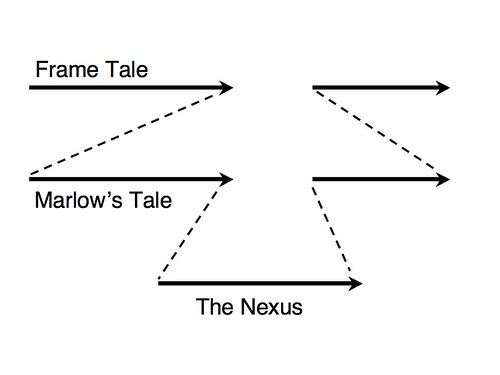
Consider the following diagram. It represents, albeit crudely, the narrative structure of Conrad’s Heart of Darkness:

HD narrative strategy

While the tale is told mostly by Marlow, Marlow does not speak directly to us, the readers. Rather, his tale is told to a group of four men aboard a boat in the Thames. One of those tells it to us. That tale is the frame tale. It begins Conrad’s novella, running for roughly 1300 words before giving way to Marlow, and it concludes the novella, with the last 70 words or so. It also shows up here and there during Marlow’s tale, though never for long. The diagram doesn’t show those . . . what shall we call them, intrusions, reminders, touchstones relief points?

This much is well-recognized in the literature on the book, which I’ve been examining in the two case books I’ve just acquired, the Norton Critical Edition (2006) edited by Paul Armstrong, and Ross C. Murfin’s Joseph Conrad, Heart of Darkness (Bedford/St. Martin’s, 2011). But there’s a third ‘level’, which I’m calling the nexus. It is not, in what I’ve read so far, singled out as a tale within the tale within the tale, as my diagram has it.

But it is certainly mentioned. For example, in Albert Guerard’s, “The Journey Within” (from his 1958 book, Conrad the Novelist), which is reprinted in the Norton, pp. 326-336. He says, “We think we are about to meet Kurtz at last,” referring to a passage in paragraph 101 (see endnote on paragraph numbering) where Marlow tells us that he did get to meet Kurtz. And then Guerard observes: “But instead Marlow leaps ahead to his meeting with the “Intended”; comments on Kurtz’s megalomania and assumption of his place among the devils of the land; reports on his seventeen-page pamphlet ...” In those three clauses Guerard has characterized the paragraph that I’m calling the nexus.

The Nexus

The segment I’m calling the nexus is part of Marlow’s tale, but I believe that it deserves to be treated as a separate narrative entity. For one thing, and this is what originally brought it to my attention, it contains material that is told out of temporal order. At the point where Marlow launches into the nexus – which, by the way, is one of the places where the frame tale reaches in to Marlow’s tale, reminding us that Marlow is not talking to us, but that he’s talking to someone else, and it is this anonymous someone else who writes to us – they have not yet gotten to the Inner Station, where Marlow is located. And yet it is during the nexus that Marlow tells us, not simply of all the ivory they found and recovered at the station, but that they loaded it aboard the ship: “We filled the steamboat with it, and had to pile a lot on the deck.” That ivory is not mentioned later at the time when they actually do load it into the boat. In paragraph 140 it’s the middle of the night and Marlow has followed Kurtz ashore and then in paragraph 141 we’ve left at noon and nothing is said about carting 1000s of pounds of ivory onto the ship.

What’s going on in the story at the point where the nexus emerges is that the boat is a few hours away from the Inner Station and is under attack. The helmsman has just been killed and Marlow, who was captaining the boat, was standing in the man’s blood. He, Marlow, tossed a blood-drenched shoe overboard and had told himself that, alas, he would never hear Marlow speak:
I made the strange discovery that I had never imagined him as doing, you know, but as discoursing. I didn't say to myself, 'Now I will never see him,' or 'Now I will never shake him by the hand,' but, 'Now I will never hear him.' The man presented himself as a voice. Not of course that I did not connect him with some sort of action.
Then the other shoe
went flying unto the devil-god of that river. I thought, 'By Jove! it's all over. We are too late; he has vanished—the gift has vanished, by means of some spear, arrow, or club. I will never hear that chap speak after all,'—and my sorrow had a startling extravagance of emotion, even such as I had noticed in the howling sorrow of these savages in the bush.
At which point the teller of the frame tale takes over for a bit, describing Marlow lighting and taking a draw on his pipe, and, after some preparatory chatter from Marlow (paragraph 101) and a long silence – what was going on in Marlow’s mind during that silence? – then, and only then, do we get the nexus.

Think about it: Conrad didn’t toss both shoes overboard at once. He tossed one, then threw out a significant thought, and then tossed the other. That’s a very careful, very particular bit of writing. Why make such a big deal out of Marlow’s bloody shoes? Because it’s in our shoes that we trod the earth, because Oedipus means swollen-footed? I don’t know, but Conrad did make a deal out of it. At this critical point in the story where a man, an African, died.

But I digress. The nexus. So, Marlow tosses his shoes overboard, then relieves himself of the nexus, 1500 words in a story of 38,000 words, for 4% of the total. And then he returns his telling to the story’s present and drags the lifeless body over the edge:
The current snatched him as though he had been a wisp of grass, and I saw the body roll over twice before I lost sight of it for ever. All the pilgrims and the manager were then congregated on the awning-deck about the pilot-house, chattering at each other like a flock of excited magpies, and there was a scandalized murmur at my heartless promptitude. What they wanted to keep that body hanging about for I can't guess. Embalm it, maybe.
Other than Kurtz, this is the only other person who dies in the story. That Conrad should tuck the novella’s longest paragraph into the moments between shoes overboard and corpse overboard is no accident, nor is it an accident that this paragraph contains out-of-sequence information.

Those three things – out of sequence information, the helmsman’s death, and the length of the paragraph – all suggest to me that this paragraph is special, that it deserves to be treated as a separate ‘level’ of narration. Technically, no, it’s not a tale within a tale. Effectively, it is, giving us the structure I’ve diagrammed above.

What’s it About?

So what’s in this paragraph that I call it the nexus? [Note that I’ve copied the whole paragraph into an appendix to this post.] It begins by asserting that this world, the world of the tale, is men only:
Girl! What? Did I mention a girl? Oh, she is out of it--completely. They--the women, I mean--are out of it--should be out of it. We must help them to stay in that beautiful world of their own, lest ours gets worse. Oh, she had to be out of it. You should have heard the disinterred body of Mr. Kurtz saying, 'My Intended.' You would have perceived directly then how completely she was out of it.
Yes, women are out of it but specifically, the Intended. This is the first time she’s mentioned as such, the first time we know that Kurtz intended to get married. But we don’t actually see her until the very end of the story.

From there Marlow works his way quickly to the ivory by way of Kurtz’s bald head, “like a ball—an ivory ball.” Then there’s talk of the moral comforts and pressure of home, which are gone in the jungle, Kurtz’s pan-European background, his education, his beautifully-written report to the International Society for the Suppression of Savage Customs, the unspeakable practices Kurtz allowed himself, and, of course, the report’s postscript: “Exterminate all the brutes!” And by the by Marlow arrives at something of an abbreviated eulogy for his helmsman:
I missed my late helmsman awfully,--I missed him even while his body was still lying in the pilot-house. Perhaps you will think it passing strange this regret for a savage who was no more account than a grain of sand in a black Sahara. Well, don't you see, he had done something, he had steered; for months I had him at my back--a help--an instrument. It was a kind of partnership. He steered for me--I had to look after him, I worried about his deficiencies, and thus a subtle bond had been created, of which I only became aware when it was suddenly broken. And the intimate profundity of that look he gave me when he received his hurt remains to this day in my memory--like a claim of distant kinship affirmed in a supreme moment.
That ends it, the nexus.

And it call it that because, whatever this story’s about, it’s all there, compressed into those 1500 words. It’s a part that is also the image of the whole. And within that part we have the Litany — 'My Intended, my ivory, my station, my river, my—' which, in its way, is a highly compressed image of the whole. We thus have THE WHOLE STORY compressed into THE NEXUS compressed into THE LITANY.

Note, finally, that the nexus begins by mentioning the Intended, and then pushing her aside, and ends with Marlow’s eulogy for his helmsman. If there’s any heart in this story, that’s it, Marlow’s feeling for his lost helmsman – is it an accident that Conrad made this man a helmsman, the one who steered the boat? I’m reminded of that other great 19th Century river yarn, The Adventures of Huckleberry Finn. A very different yarn, to be sure, but one built on the bond between a white man, in the person of Huck Finn, abused son of an alcoholic, and a black man, Jim, runaway slave. The bond between Huck and Jim was real, but far from simple. In particular, it did not prevent Huck from allowing Tom Sawyer to stage an elaborate play with Jim in the center, a play that had more to do with Tom’s theatricality than Jim’s desire for freedom. Similarly, I do not think we have to believe that Marlow (and Conrad) regarded the helmsman’s humanity as being equal to his own in order to credit his feeling for the man, a man who is nameless, like everyone else in this tale except Kurtz.

Center Point Construction

And THAT is my best guess as to why Conrad stuck the nexus, with its out-of-sequence material, at this point in the narrative. For reasons having to do with a psychology we don’t understand, the nexus had to be toward the center of the book. Whatever effect Conrad was after, it required that the nexus be in more or less this place. Too early and we wouldn’t know enough, or not know enough, to appreciate it; too late and, well, it would be too late. It had to go toward the middle. Given that the ivory is at the material center of this greedy activity, the nexus had to assure us that, yes, the ivory was safely in hand, even though we hadn’t gotten to that point in the story.

For it isn’t in the center. Heart of Darkness was broken into three installments for serial publication. The nexus is in the second half of the middle installment. The whole text is something over 38,000 words long. The nexus starts at about 23,000 words in and there are roughly 13,500 words after it. So it’s well beyond the center, but not quite in the last third.