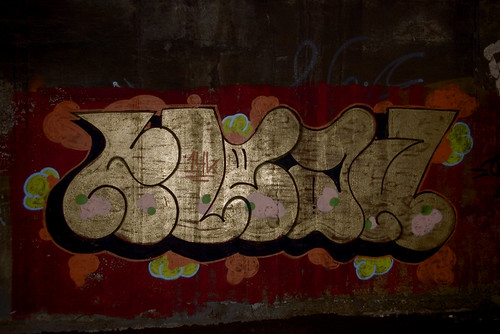
I continue to read the web about and to think about The Underbelly Project. Basically, I don’t know what to make of it, and perhaps that’s the point. I don’t know.
My initial reaction, on reading the NYTimes article and seeing the photos was: COOL! I wanna see it! The article made it clear, of course, that I couldn’t see it – not for me the adventure of sneaking into a hidden space likely to be guarded by police by the time I get there. The article also indicated the contradiction inherent in framing the project as a protest against the absorption of the street into the gallery and then broadcasting the hidden art to the world. I read about that, nodded OK and moved on, propelled by the basic coolness of what Workhorse, PAC, and all the others had done.
And my sense of that coolness was rooted in the time and effort I’ve put into photographing graffiti over the past four years, mostly in a small area in Jersey City. As I said in an earlier post, I know what it’s like to encounter graffiti in a dark enclosed space. That experience is very real, very compelling to me. I felt like I was an explorer in an exotic land, perhaps the first ever to visit those ruins. And the experience certainly was real and compelling to the curators, Workhorse and PAC, and, I would imagine, to all the artists who participated.
The problem, of course, is that The Underbelly Project doesn’t make that experience available to others. It is hidden and inaccessible. It is in accessible mostly because it is illegal to go onto the property and, secondarily, because access is physically awkward. To be sure, Workhorse and PAC took steps to see that no one actually knew where the place was, but, as we’ve seen, that didn’t last long – a matter I’ll return to at the end.
Let’s set that aside for a moment and imagine, instead, that Workhorse and PAC were funded by a billionaire – make it a mysterious billionaire – who’d arranged to buy the site and to fit it out so access was easier. Now what? It all depends. But much of the mystery would be gone, even if the interior space remained much as it is. And if twenty or thirty or more people go in there at a time, well then, still more mystery is gone. Now it’s become a somewhat funky museum, or, horror of horrors! a sophisticated fun house.
It would seem, then, that the experience can’t be domesticated. It has to be wild. Not guns blazing in Afghanistan wild, or even let’s go rafting down the Colorado River wild, but somehow wild. The thing is, that’s how art itself is supposed to be, no? Wouldn’t the art on the walls do that? I don’t know, I’ve not seen it, only photos.
And now you’re beginning to see how and why I’m tying my brain in knots when I try think through this. No matter how I start thinking it through, I always end up stepping all over myself.
Out on the web I find various reactions. Some people just think it’s cool. A few of those have even made their way there. Some have come back with photos. Others have gotten arrested.
There are others for whom the only thing that matters is that the project involved a lot of trespassing over a long period of time. It’s trash. Lock ‘em up.
And then there’s the graffiti writers who are pissed at the so-called hipsters invading their turf. This particular beef is not new. It’s been around as long as street art has been getting up on walls next to graffiti. So The Underbelly Project is just another occasion to exercise this particular resentment.
One thought the writers have is that the curators shouldn’t have blabbed. They should have just done it and kept quiet. After all, the writers have their secret spots, and they don’t broadcast the locations to the world. Why can’t these hipsters do likewise?
But: could this project have been done on this basis?