Wednesday, July 20, 2011

Why OOO is lookin’ good

Es ist klar, daß sich die Ethik nicht aussprechen läßt.
Die Ethik is transzendental.
(Ethik und Ästhetic sind Eins.)

It is clear that ethics cannot be put into words.
Ethics is transcendental.
(Ethics and aesthetics are one and the same.)

— Ludwig Wittgenstein

Yep, another one of my ‘why am I following OOO?’ posts.

Here’s the thing. For decades I’ve been trying to figure out how the study of literature can become more objective. Yeah, I know, objectivity is problematic, yadda yadda. So stuff it! Anyhow, that’s what I’ve been doing.

It’s clear to me that the newer psychologies are part of the deal, a big part, as basic background knowledge and a source of models and theories. But so is developing better descriptive techniques. We need to gain descriptive control over our texts, like that paragraph distribution stuff I just bumped into (HD7: Digital Humanities Sandbox Goes to the Congo) – about which, more later.

At the same time it seems clear to me that this objective lit crit I’m stalking isn’t going to be very good on the political, ethical, and aesthetic issues that have been and remain central to literary studies. Isn’t very good? Perhaps it’s: Not good at all.

What to do?

One possibility is simply to jettison those concerns. Now, I have no problem in saying that there are whole fields of literary and cultural study where those value-laden concerns are not central. But to kick those concerns out of the discipline, out of the academy? I don’t think so.

Here’s where object oriented ontology comes in: as a way of bringing the descriptive work and the newer psychologies into political, ethical, and aesthetic conversations. I’m not talking unification, I’m not talking “bridge the gap between the two cultures.” It’s not like that; that’s old stuff. It’s dead and gone. Forget about it.

I’m just talking about conversation. The central tenet of OOO is a flat ontology, all things are the same with respect to Being. Nothing has more Being than anything else. Ants, computers, dust, galaxies, flocks of geese, E. coli, off-shore wind farms, sewing circles: anything, everything. The same with respect to Being. In conversation. Negotiating mutual living arrangements.

I think that can work.

Mimi Redux?

Apocalypse Now Redux, Reconsidered?

The reconsideration I have in mind isn’t mine, it’s A.O. Scott’s, movie critic for The New York Times. He hasn’t actually reconsidered. But would he do so if he accepted the account of the film’s ending that emerges from two of my posts: Apocalyptic Confusion, and Ritual in Apocalypse Now.

Of course I don’t know the answer to the question, but I have a reason for asking it. In a 2001 review of Apocalypse Now Redux he states unequivocally that the film is a great one. He also states that the ending doesn’t work. Given that the not-working ending takes considerable time on the screen, I’m wondering why he doesn’t hold that against the film so as to make it, say, only near-great?

You see, his review tells us what he thinks about the film, how he understands it, comprehends it, but it doesn’t tell us how he felt it. Was he bored by the ending? Or did the film grip him to the end, but when he thought about it, he found himself unable to rationalize the ending and so had to say it didn’t work?

Let’s take a look at his review. I don’t expect to answer those questions, but I do want to show that, in view of what he actually said, they are reasonable questions.

Tuesday, July 19, 2011

Great Expectations, by Mimi and Eunice

Is Chinua Achebe to Joseph Conrad as Ike Turner is to Sam Phillips?

The idea that Joseph Conrad, one of the canonical writers of Western literature, and properly so, is / might be a racist is not so shocking now in 2011 as it was back in 1975, when Chinua Achebe delivered a lecture entitled “An Image of Africa: Racism in Conrad’s Heart of Darkness.” Many were shocked that Achebe would make such an argument, and about a narrative that was so obviously an indictment of European imperialism in the Congo. Many critics responded with vigorous and sophisticated defenses of Conrad and of Heart of Darkness. In consequence Achebe’s essay and the response to it are now central to the scholarly literature about this text and this author.

Then and Now

At that time I was a graduate student in the English Department at SUNY at Buffalo. However, I’m slightly embarrassed to say, I have no recollection of the firestorm. If I’d had a specific interest in late 19th century British fiction I would, no doubt, have been aware of Achebe’s address and its repercussions. But that wasn’t where my interest lay, so I wasn’t attending to those currents. Had I been doing so I might well have taken offense at Achebe’s essay. As it is, I’ve only read the essay in the last week and I cannot find anything shocking about it.

What made Achebe’s argument so shocking (in 1975) is simply that we — what we? — want our culture heroes to be flawless. As a canonical literary figure Joseph Conrad is a culture hero, at least to the public that pays attention to literary culture. Racism is bad. It therefore follows that Joseph Conrad cannot be racist.

I would like to think that we, at least some WE, have become more sophisticated in such matters and are prepared to recognize that artistic greatness sometimes comes with unpleasant traits, such as racism or sexism. The question of Conrad’s racism, or of racism in Heart of Darkness, which is not the same question, is complicated, and Achebe has picked his textual evidence carefully, as all critics do. One can certainly argue against him, as many critics have done.

But I do not, in this post, want to enter directly into those discussions. I’m not going to argue about racism in Conrad’s text. I’m doing something different.

Beyond Language

I’m presenting a fairly recent conversation between a black man and a white man on a topic that involves relations between blacks and whites and in which racism is a central issue. I’m offering this conversation as, shall we say, a parallel to the conversation between Achebe and Joseph Conrad or, since Conrad is long dead, his defenders against Achebe.

My question is a simple one: Can we get along with Achebe, and those who agree with him, as this white man and black man get along with one another?

Monday, July 18, 2011

HD7: Digital Humanities Sandbox Goes to the Congo

Or, Speculations in Computational Evolutionary Psychology

Note: This version of the post has been revised from an earlier version in which I suggested that the distribution in the first chart followed a power law. Cosma Shalizi checked it for me and it’s not a power law distribution. It’s an exponential distribution.
So, I’ve been exploring Conrad’s Heart of Darkness. In the last two posts I’ve examined one paragraph in the text, the so-called nexus. It’s the longest paragraph in the text, it’s structurally central, and it covers a lot of semantic territory.

OK, but what about the other paragraphs.

What about them?

Aren’t you going to look at them?

Well, yeah, but I sure don’t have time to troll through them like I did the nexus. I mean, that post stretched from here to Sunday.

I get your point. Why don’t you do the Moretti thing?

Moretti thing?

You know, distant reading.

Distant reading? You mean count something? Count what?

How about paragraph length?

What’ll that get me?

I don’t know. Just do it. I mean, you already know that the nexus is the longest paragraph in the text. There must be something going on with that. Mess around and see if something turns up.

* * * * *

I did and it did.

I used the MSWord word-count tool to count the words in every paragraph in the text. All 198 of them. One at a time. Real tedious stuff. Then I loaded the results into a spreadsheet and created a bar chart showing paragraph length from longest to shortest:

HD whole ordered 2

Saturday, July 16, 2011

HD5: The Heart of Heart of Darkness

Or, Center Point construction in a tale within a tale within a tale

For Mary Douglas
It’s a long way through this post. First, I look at the structural center of Heart of Darkness, which is that long paragraph I’ve called the nexus. I then argue that Heart and Osamu Tezuka’s Metropolis deploy different techniques for achieving what I’m calling center point construction, which is close kin to the ring forms that held Mary Douglas’s attention at the end of her career. Finally, I attach an appendix that contains the complete text of the nexus.

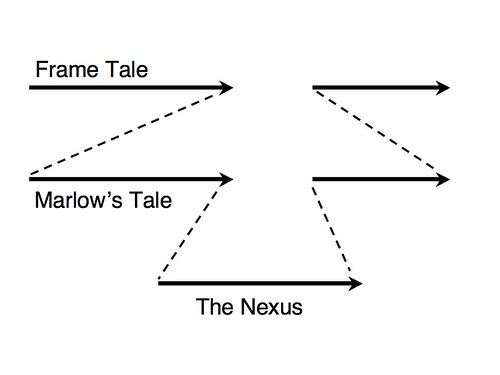
Consider the following diagram. It represents, albeit crudely, the narrative structure of Conrad’s Heart of Darkness:

HD narrative strategy

While the tale is told mostly by Marlow, Marlow does not speak directly to us, the readers. Rather, his tale is told to a group of four men aboard a boat in the Thames. One of those tells it to us. That tale is the frame tale. It begins Conrad’s novella, running for roughly 1300 words before giving way to Marlow, and it concludes the novella, with the last 70 words or so. It also shows up here and there during Marlow’s tale, though never for long. The diagram doesn’t show those . . . what shall we call them, intrusions, reminders, touchstones relief points?

This much is well-recognized in the literature on the book, which I’ve been examining in the two case books I’ve just acquired, the Norton Critical Edition (2006) edited by Paul Armstrong, and Ross C. Murfin’s Joseph Conrad, Heart of Darkness (Bedford/St. Martin’s, 2011). But there’s a third ‘level’, which I’m calling the nexus. It is not, in what I’ve read so far, singled out as a tale within the tale within the tale, as my diagram has it.

But it is certainly mentioned. For example, in Albert Guerard’s, “The Journey Within” (from his 1958 book, Conrad the Novelist), which is reprinted in the Norton, pp. 326-336. He says, “We think we are about to meet Kurtz at last,” referring to a passage in paragraph 101 (see endnote on paragraph numbering) where Marlow tells us that he did get to meet Kurtz. And then Guerard observes: “But instead Marlow leaps ahead to his meeting with the “Intended”; comments on Kurtz’s megalomania and assumption of his place among the devils of the land; reports on his seventeen-page pamphlet ...” In those three clauses Guerard has characterized the paragraph that I’m calling the nexus.

The Nexus

The segment I’m calling the nexus is part of Marlow’s tale, but I believe that it deserves to be treated as a separate narrative entity. For one thing, and this is what originally brought it to my attention, it contains material that is told out of temporal order. At the point where Marlow launches into the nexus – which, by the way, is one of the places where the frame tale reaches in to Marlow’s tale, reminding us that Marlow is not talking to us, but that he’s talking to someone else, and it is this anonymous someone else who writes to us – they have not yet gotten to the Inner Station, where Marlow is located. And yet it is during the nexus that Marlow tells us, not simply of all the ivory they found and recovered at the station, but that they loaded it aboard the ship: “We filled the steamboat with it, and had to pile a lot on the deck.” That ivory is not mentioned later at the time when they actually do load it into the boat. In paragraph 140 it’s the middle of the night and Marlow has followed Kurtz ashore and then in paragraph 141 we’ve left at noon and nothing is said about carting 1000s of pounds of ivory onto the ship.

What’s going on in the story at the point where the nexus emerges is that the boat is a few hours away from the Inner Station and is under attack. The helmsman has just been killed and Marlow, who was captaining the boat, was standing in the man’s blood. He, Marlow, tossed a blood-drenched shoe overboard and had told himself that, alas, he would never hear Marlow speak:
I made the strange discovery that I had never imagined him as doing, you know, but as discoursing. I didn't say to myself, 'Now I will never see him,' or 'Now I will never shake him by the hand,' but, 'Now I will never hear him.' The man presented himself as a voice. Not of course that I did not connect him with some sort of action.
Then the other shoe
went flying unto the devil-god of that river. I thought, 'By Jove! it's all over. We are too late; he has vanished—the gift has vanished, by means of some spear, arrow, or club. I will never hear that chap speak after all,'—and my sorrow had a startling extravagance of emotion, even such as I had noticed in the howling sorrow of these savages in the bush.
At which point the teller of the frame tale takes over for a bit, describing Marlow lighting and taking a draw on his pipe, and, after some preparatory chatter from Marlow (paragraph 101) and a long silence – what was going on in Marlow’s mind during that silence? – then, and only then, do we get the nexus.

Think about it: Conrad didn’t toss both shoes overboard at once. He tossed one, then threw out a significant thought, and then tossed the other. That’s a very careful, very particular bit of writing. Why make such a big deal out of Marlow’s bloody shoes? Because it’s in our shoes that we trod the earth, because Oedipus means swollen-footed? I don’t know, but Conrad did make a deal out of it. At this critical point in the story where a man, an African, died.

But I digress. The nexus. So, Marlow tosses his shoes overboard, then relieves himself of the nexus, 1500 words in a story of 38,000 words, for 4% of the total. And then he returns his telling to the story’s present and drags the lifeless body over the edge:
The current snatched him as though he had been a wisp of grass, and I saw the body roll over twice before I lost sight of it for ever. All the pilgrims and the manager were then congregated on the awning-deck about the pilot-house, chattering at each other like a flock of excited magpies, and there was a scandalized murmur at my heartless promptitude. What they wanted to keep that body hanging about for I can't guess. Embalm it, maybe.
Other than Kurtz, this is the only other person who dies in the story. That Conrad should tuck the novella’s longest paragraph into the moments between shoes overboard and corpse overboard is no accident, nor is it an accident that this paragraph contains out-of-sequence information.

Those three things – out of sequence information, the helmsman’s death, and the length of the paragraph – all suggest to me that this paragraph is special, that it deserves to be treated as a separate ‘level’ of narration. Technically, no, it’s not a tale within a tale. Effectively, it is, giving us the structure I’ve diagrammed above.

What’s it About?

So what’s in this paragraph that I call it the nexus? [Note that I’ve copied the whole paragraph into an appendix to this post.] It begins by asserting that this world, the world of the tale, is men only:
Girl! What? Did I mention a girl? Oh, she is out of it--completely. They--the women, I mean--are out of it--should be out of it. We must help them to stay in that beautiful world of their own, lest ours gets worse. Oh, she had to be out of it. You should have heard the disinterred body of Mr. Kurtz saying, 'My Intended.' You would have perceived directly then how completely she was out of it.
Yes, women are out of it but specifically, the Intended. This is the first time she’s mentioned as such, the first time we know that Kurtz intended to get married. But we don’t actually see her until the very end of the story.

From there Marlow works his way quickly to the ivory by way of Kurtz’s bald head, “like a ball—an ivory ball.” Then there’s talk of the moral comforts and pressure of home, which are gone in the jungle, Kurtz’s pan-European background, his education, his beautifully-written report to the International Society for the Suppression of Savage Customs, the unspeakable practices Kurtz allowed himself, and, of course, the report’s postscript: “Exterminate all the brutes!” And by the by Marlow arrives at something of an abbreviated eulogy for his helmsman:
I missed my late helmsman awfully,--I missed him even while his body was still lying in the pilot-house. Perhaps you will think it passing strange this regret for a savage who was no more account than a grain of sand in a black Sahara. Well, don't you see, he had done something, he had steered; for months I had him at my back--a help--an instrument. It was a kind of partnership. He steered for me--I had to look after him, I worried about his deficiencies, and thus a subtle bond had been created, of which I only became aware when it was suddenly broken. And the intimate profundity of that look he gave me when he received his hurt remains to this day in my memory--like a claim of distant kinship affirmed in a supreme moment.
That ends it, the nexus.

And it call it that because, whatever this story’s about, it’s all there, compressed into those 1500 words. It’s a part that is also the image of the whole. And within that part we have the Litany — 'My Intended, my ivory, my station, my river, my—' which, in its way, is a highly compressed image of the whole. We thus have THE WHOLE STORY compressed into THE NEXUS compressed into THE LITANY.

Note, finally, that the nexus begins by mentioning the Intended, and then pushing her aside, and ends with Marlow’s eulogy for his helmsman. If there’s any heart in this story, that’s it, Marlow’s feeling for his lost helmsman – is it an accident that Conrad made this man a helmsman, the one who steered the boat? I’m reminded of that other great 19th Century river yarn, The Adventures of Huckleberry Finn. A very different yarn, to be sure, but one built on the bond between a white man, in the person of Huck Finn, abused son of an alcoholic, and a black man, Jim, runaway slave. The bond between Huck and Jim was real, but far from simple. In particular, it did not prevent Huck from allowing Tom Sawyer to stage an elaborate play with Jim in the center, a play that had more to do with Tom’s theatricality than Jim’s desire for freedom. Similarly, I do not think we have to believe that Marlow (and Conrad) regarded the helmsman’s humanity as being equal to his own in order to credit his feeling for the man, a man who is nameless, like everyone else in this tale except Kurtz.

Center Point Construction

And THAT is my best guess as to why Conrad stuck the nexus, with its out-of-sequence material, at this point in the narrative. For reasons having to do with a psychology we don’t understand, the nexus had to be toward the center of the book. Whatever effect Conrad was after, it required that the nexus be in more or less this place. Too early and we wouldn’t know enough, or not know enough, to appreciate it; too late and, well, it would be too late. It had to go toward the middle. Given that the ivory is at the material center of this greedy activity, the nexus had to assure us that, yes, the ivory was safely in hand, even though we hadn’t gotten to that point in the story.

For it isn’t in the center. Heart of Darkness was broken into three installments for serial publication. The nexus is in the second half of the middle installment. The whole text is something over 38,000 words long. The nexus starts at about 23,000 words in and there are roughly 13,500 words after it. So it’s well beyond the center, but not quite in the last third.

Friday, July 15, 2011

Just the Basics

Hearts and Graffiti, Again

IMGP1022rd

Last September I did a post on some heart motifs in graffiti: Graffiti Mystery Theatre: Same Old Same Old. The mystery began which I observed the heart motif in this piece, by Zen1:

rackgaki 2 heart arrow

It’s just to the right of center at the bottom of the left stroke of the ”n”. As I went on to explain, that piece is in Osaka, Japan and appeared in a DVD that accompanied RackGaki, by Ryo Sanada and Suridh Hassan.

The heart motif, in that form, seemed interesting to me because, 1) I haven’t seen it very often, and 2) but I have seen it in graffiti I’ve photographed. Here it is in a piece by Then or Then One that I photographed in 2006:

IMGP0841rd

Most of that post was devoted to describing the characteristics of this motif and then to tracking it down. Did Then One in Jersey City and Zen One in Osaka invent this motif independently, or did they get it from a common source. I don’t know, but there is a well-known book that they might have gotten it from, Subway Graffiti by Martha Cooper and Henry Chalfont. If you look at the cover you’ll see it near the bottom at the right edge. There’s a piece by Heart, and the motif is on the bottom of the first stroke of the “H.” (Here’s a link to the book at Amazon.com. If you click on the cover image, you’ll get one large enough so you can see the piece I’m talking about.)

Well, I’ve now photographed three more examples of that motif, all in the Erie Cut (aka Bergen Arches) in Jersey City. Here, near the East end of the cut, you can see it at the bottom of the “n” in Blank:

Thursday, July 14, 2011

Cognitivism and the Critic 2: Symbol Processing

It has long been obvious to me that the so-called cognitive revolution is what happened when computation – both the idea and the digital technology – hit the human sciences. But I’ve seen little reflection of that in the literary cognitivism of the last decade and a half. And that, I fear, is a mistake.

Thus, when I set out to write a long programmatic essay, Literary Morphology: Nine Propositions in a Naturalist Theory of Form, I argued that we think of literary text as a computational form. I submitted the essay and found that both reviewers were puzzled about what I meant by computation. While publication was not conditioned on providing such satisfaction, I did make some efforts to satisfy them, though I’d be surprised if they were completely satisfied by those efforts.

That was a few years ago.

Ever since then I pondered the issue: how do I talk about computation to a literary audience? You see, some of my graduate training was in computational linguistics, so I find it natural to think about language processing as entailing computation. As literature is constituted by language it too must involve computation. But without some background in computational linguistics or artificial intelligence, I’m not sure the notion is much more than a buzzword that’s been trendy for the last few decades – and that’s an awful long time for being trendy.

I’ve already written one post specifically on this issue: Cognitivism for the Critic, in Four & a Parable, where I write abstracts of four texts which, taken together, give a good feel for the computational side of cognitive science. Here’s another crack at it, from a different angle: symbol processing.

Operations on Symbols

I take it that ordinary arithmetic is most people’s ‘default’ case for what computation is. Not only have we all learned it, it’s fundamental to our knowledge, like reading and writing. Whatever we know, think, or intuit about computation is built on our practical knowledge of arithmetic.

As far as I can tell, we think of arithmetic as being about numbers. Numbers are different from words. And they’re different from literary texts. And not merely different. Some of us – many of whom study literature professionally – have learned that numbers and literature are deeply and utterly different to the point of being fundamentally in opposition to one another. From that point of view the notion that literary texts be understood computationally is little short of blasphemy.

Not so. Not quite.

The question of just what numbers are – metaphysically, ontologically – is well beyond the scope of this post. But what they are in arithmetic, that’s simple; they’re symbols. Words too are symbols; and literary texts are constituted of words. In this sense, perhaps superficial, but nonetheless real, the reading of literary texts and making arithmetic calculations are the same thing, operations on symbols.

Wednesday, July 13, 2011

Green

IMGP1138rd

HD4: Ontology at the Heart of Darkness

Let’s recap. At the thematic center of Conrad’s novella we have a litany. It first appears in the long paragraph I’ve called The Nexus (paragraph 103), 1503 words long: “’My Intended, my ivory, my station, my river, my—‘ everything belonged to him.” It is repeated later on in paragraph 148, while the steamer is on its return trip with Kurtz on board: “My Intended, my station, my career, my ideas--these were the subjects for the occasional utterances of elevated sentiments.” Notice, FWIW, that while it is Kurtz who produces the phrase the first time it appears in the text – I assume that’s what Conrad meant by the single quotes – it is Marlow himself who produces it the second time.

If we take the two statements together, we have this list: (1) Intended, (2) ivory, (3) station, (4) river, (5) career, and (6) ideas, all prefaced, of course, with “my”. Ivory and river are physical things. But ivory is, in this usage, a formless substance, though any piece of ivory, such as a tusk, must necessarily have particular form. So is station in its use to designate Kurtz’s compound beside the river. But station could conceivably be abstract as well, where it could mean his position within the company, which is a matter of some discussion here and there in the story, or his station in life more generally. Those things are positions in a network of social relationships and, as such, are rather more abstract. Career and ideas are both abstract, with ideas being possibly more abstract than career.

As for the Intended, that is a person. People are physical things, of course, like ivory tusks, or rivers. But they are living things and so they have . . . what? Classically they have souls, with plants having vegetative souls, animals having (additionally) sensitive souls, and humans having (additionally) rational souls – think of Aristotle, De Anima, and of the Great Chain of Being. Within that list the Intended is the “link” between ivory and ideas, as it were. She is a physical thing, like ivory, and, as the possessor of a rational soul, is capable of having ideas.

Burn, Baby, Burn!

Apocalypse Now: Working Papers

I've now taken my posts about Apocalypse Now and gathered them into a single downloadable PDF, which you will find at my Social Science Research Network Site. I've appended both the Abstract and the Introduction to this post.

* * * * *

Abstract

This is series of informal essays about Apocalypse Now that argues that the movie as a whole takes the from of a classic rite of passage as described by Durkheim and van Gennep. Particular attention is given to the opening montage, the trip into the jungle for mangoes, the sampan massacre, the final parallel killings of Kurtz and the caribao, and parallels between characters. There is a descriptive précis of the whole film that organizes it into five large sequences and screen shots throughout.

Introduction: Shakespeare Couldn’t Do This

I don’t know just when I bought Apocalypse Now: The Complete Dossier. But it was several years ago. I watched the film, most likely the original first, and was blown away: Shakespeare didn’t do this, I thought. In the spectacle department there’s no contest, just as Shakespeare wins the poetry competition.

Was I then thinking that Apocalypse Now was comparable to The Bard?

Yep, that’s what I was thinking.

[The horror! The horror!]

I still think so, but won’t bother to argue it. The Bard, after all, is untouchable, mythic, beyond category. Francis Ford Coppola, on the other hand, makes wine on the side.

When, for whatever reason, I finally decided to post something on the film, I decided to post doubts (see listing of posts below). And I had no firm intention to do any more than that. But, once I was in, I was in. I figured I’d do two, maybe three more posts. I had no intention of doing eleven posts, and I’d have done a twelfth if I hadn’t decided to start working on Conrad’s Heart of Darkness.