Thursday, April 30, 2015

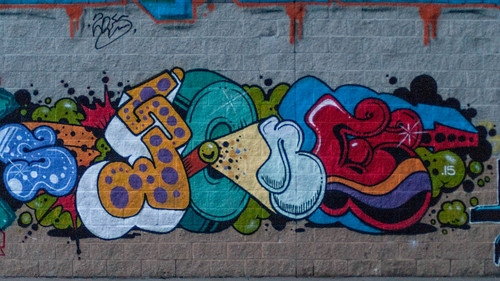
"OK to Destroy" #GVM004

20150430-_IGP3294

Been thinking about what to call the Green Villain First Annual Jersey City Invitational Graffiti Jam besides the GVFAJCIGJ. "OK to Destroy" seems metaphysically appropriate. The name comes from one of the stickers on a pipe at the rear of the building. There's two of them and they're there to protect a meter. You can see the sticker at the lower left:

20150430-_IGP3292

You might that "OK to Destroy" is a bit nihilistic. You might think that, but I urge you to reconsider. Compare it with, say, "Rage to Destroy". Very different, no? No, I think it's just right.

What Letterman Thinks about the Mind

As we all know, David Letterman is retiring from the "Late Show" after, well, not forever, but a long time. He gave a long interview to the good folks at The New York Times and they then boiled it down to 11 highlights. I've picked two of them.
On his heart surgery in 2000:

I was concerned that I’ll never be able to run again — that was my big concern. Because I had so relied on running, all my life, to get myself clearheaded. And of course, I was worried that somebody would go on while I was off with my heart surgery, and be good enough that they didn’t want me back. As I’m trying to recover from quintuple bypass surgery, I’m paranoid that my life is ending. And then, six weeks after the surgery, I ran for five miles. So let’s face it, I am a hero. There’s no two ways of looking at it.
The general issue is, of course, we all need ways of keeping in balance. But just what IS that about? What're we trying to balance with what? What is it about brain and body that's getting balanced, what chemicals and connections?
On what he’ll do after his final show:

I will be completely in the hands of my family. I will be going, later in the month, to the Indianapolis 500. And then beyond that, for the first time since Harry’s been alive, our summer schedule will not be dictated by me. It will be entirely dictated by what my son wants to do. And I think that’s pretty good. After you take a good, solid punch to the head, you’re just a little wobbly. I think in that state it would be good to have others making my decisions. That’s how he’s describing his retirement. A good solid punch to the head.
This is about balance as well, but from a different angle. For the last two decades this TV show has dominated his life; it's been one of the things he's been balancing against/with his running. And now it's gone. Whoosh! There's a big hole. How do you fill it?

I remember how, back in my university days, the Spring semester would come to an end and I wasn't teaching anymore. Teaching no longer took up a big chunk of my tine and mind-space. I spent the summer doing research. And it would take me a good two or three weeks to transition to an efficient and focused research mindset. I figured my brain was reorganizing itself around my new regime (I've got some more remarks along these lines at the end of "The Evolution of Narrative and the Self").

Wednesday, April 29, 2015

Graffiti: From Art Crimes to Family Day #GVM004

20150425-_IGP3164

Back in the day, when graffiti was just getting started in the late 1960s and early 1970s, it was a criminal act. A minor crime, to be sure, but still criminal. And it still is, for the most part, vandalism.

But things have changed as well. By the 1990s graffiti had been picked up by hip-hop, extreme sports, and had gone international. It was a crime all over the world.

20150425-_IGP3154

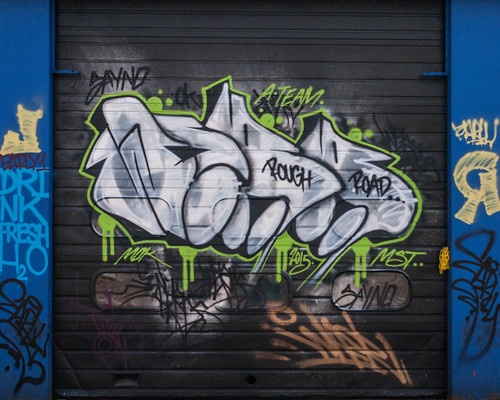
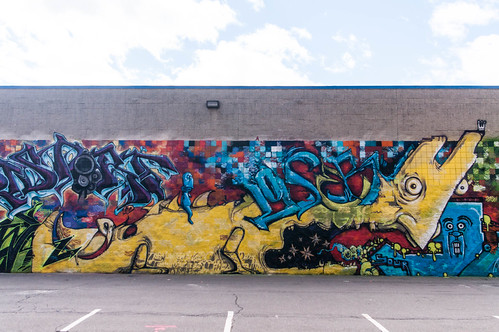
And now, what happened in downtown Jersey City this past Saturday, April 25, 2015? The Green Villain, aka Greg Edgell, organized a graffiti jam at the Newport Pep Boys store.

In the Spring of 2014 Greg Edgell started his plan to take over walls in Jersey City, where he lives, and New York City, across the river. Find a good wall, contact the owner, get permission to put graff or street art on it. The Newport Pep Boys in Jersey City was the fourth hit: #GVM004.

20150425-_IGP3148

Why this building? Because the rear wall is big and visible. It faces the Hudson-Bergen Light Rail, where it is seen by 1000s of commuters a day. All systems were Go. By November 2014 the AIDS crew had that huge rear wall covered. Five months later word came down that the building had been sold and would be demolished to make way for new construction.

Tuesday, April 28, 2015

Is knowledge the opiate of intellectuals?

Neuroscientists have proposed a simple explanation for the pleasure of grasping a new concept: The brain is getting its fix. 
The "click" of comprehension triggers a biochemical cascade that rewards the brain with a shot of natural opium-like substances, said Irving Biederman of the University of Southern California. He presents his theory in an invited article in the latest issue of American Scientist.

"While you're trying to understand a difficult theorem, it's not fun," said Biederman, professor of neuroscience in the USC College of Letters, Arts and Sciences.

"But once you get it, you just feel fabulous."

The brain's craving for a fix motivates humans to maximize the rate at which they absorb knowledge, he said.
H/t Dan Everett. 

SP One, What’s he thinking? #GVM004

Look at this flick, taken at 1:17 PM, Saturday 25 April 2015, at the Pep Boys Memorial Graffiti Jam in Jersey City:

20150425-_IGP3139

SP One’s working on a piece, standing in front of a letter form at the left. But what’s immediately to the left of that letter form?

Now look at this shot, taken at 1:48 PM:

20150425-_IGP3160

No one’s standing in front of it, so we can see it clearly. Knowing this is by SP One it’s easy to see that letter form at the left as a combination of “S” and “P”. The “One” to the right is obvious enough. Given the way I framed the shot we can’t see much at the far left, but what’s there seems to be pretty much what was there in the previous shot.

Now look at this shot, which I took much later in the day (early evening, 6:49 PM, hence the different light):

20150425-_IGP3210

There’s a very obvious “S” over there at the left, on top of what appeared to be just background in the previous two shots. Was it part of the original design, of did it insert itself in process?

Monday, April 27, 2015

The Green Villain at Work, Pep Boys, 25 Apr. 2015, #GVM004

20150425-_IGP3142

20150425-_IGP3140

20150425-_IGP3201

On the Direction of Cultural Evolution: Lessons from the 19th Century Anglophone Novel

I've got another working paper available (title above):

Most of the material in this document was in an earlier working paper, Cultural Evolution: Literary History, Popular Music, Cultural Beings, Temporality, and the Mesh, which also has a great deal of material that isn’t in this paper. I’ve created this version so that I can focus on the issue of directionality and so I’ve dropped all the material that didn’t related to that issue. The last section, The Universe and Time, is new, as is this introduction.

* * * * *

Abstract: Matthew Jockers has analyzed a corpus of 19th century American and British novels (Macroanalysis 2013). Using standard techniques from natural language processing (NLP) Jockers created a 600-dimensional design space for a corpus of 3300 novels. There is no temporal information in that space, but when the novels are grouped according to close similarity that grouping generates a diagonal through the space that, upon inspection, is aligned with the direction of time. That implies that the process that created those novels is a directional one. Certain (kinds of) novels are necessarily earlier than others because that is how the causal mechanism (whatever they are) work. This result has implications for our understanding of cultural evolution in general and of the relationship between cultural evolution and biological evolution.

1. Introduction: Direction in Design Space, Telos? 2
2. The Direction of Cultural Evolution: The Child is Father or the Man 6
3. Nineteenth Century English-Language Novels 9
4. Macroanalysis: Styles 10
5. Macroanalysis: Themes 13
6. Influence and Large Scale Direction 15
7. The 19th Century Anglophone Novel 18
8. Why Did Jockers Get That Result? 20
9. What Remains to be Done? 21
10. Literary History, Temporal Orders, and Many Worlds 22
11. The Universe and Time 30

Introduction: Evolving Along a Direction in Design Space

In 2013 Matthew Jockers published Macroanalysis: Digital Methods & Literary History (2013). I devoted considerable blogging effort to it 2014, including most, but not all, of the material in this working paper. In Jockers’ final study he operationalized the idea of influence by calculating the similarity between each pair of texts in his corpus of roughly 3300 19th century English-language novels. The rationale is obvious enough: If novelist K was influenced by novelist F, then you would expect her novels to resemble those of F more than those of C, who K had never even read.

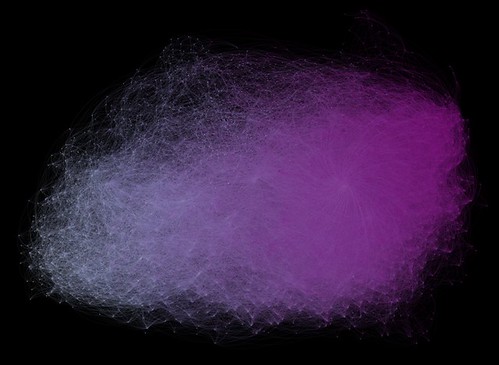
Jockers examined this data by creating a directed graph in which each text was represented by a node and each text (node) was connected only to those texts to which it had a high degree of resemblance. This is the resulting graph:

9dot3

It is, alas, almost impossible to read this graph as represented here. But Jockers, of course, had interactive access to it and to all the data and calculations behind it. What is particularly interesting, though, is that the graph lays out the novels more or less in chronological order, from left to right (notice the coloring of the graph), though there was no temporal information in the underlying data. Much of the material in the rest of this working paper deals with that most interesting result (in particular, sections 2, 6, 7, 8, and 10).

What I want to do here is, first of all, reframe my treatment of Jockers’ analysis in terms of something we might call a design space (a phrase I take from Dan Dennett, though I believe it is a common one in certain intellectual circles). Then I emphasize the broader metaphysical implications of Jockers’ analysis.


Sunday, April 26, 2015

Ian Morris on Why Societies Collapse

Stanford's Ian Morris, a classicist by training, is one of 32 fellows in the inaugural class of Andrew Carnegie Fellows in the humanities and social sciences. Here's a passage from a recent interview published on the Stanford website:
A few years ago I designed a quantitative index of social development, allowing us to measure the ability of different societies to master their physical, intellectual and political environments. This suggested that social development has been rising for most of the 15,000 years since the end of the last ice age, but also showed that there have been several great collapses, plunging societies into dark ages that last for centuries.

The same five factors recur in all the major collapses: uncontrollable migrations, new epidemic diseases, state failures, famine and – always involved, but never in quite the same way – climate change. All five of these factors, of course, seem to be pressing on us in the early 21st century. The greatest past collapses began in Song-dynasty China about 1,000 years ago, and all the way from the Roman Empire to Han China 2,000 years ago. In both cases, the societies in question seem to have developed about as far as was possible in a purely agricultural system.

The only way to go further was by having an industrial revolution; but because neither the Romans nor the Song managed this, both stagnated and then fell apart. The lesson of past collapses seems to be that every economic system has its limits, and we may now be approaching the boundaries of what is possible in a fossil-fuel, industrial world. If that is right, then the 21st century will be a race between innovation, transforming our fossil-fuel economies into something entirely new, and stagnation, leading us into a new dark age.

Energy and the origin of life

The Financial Times reviews Nick Lane, The Vital Question:
The key moment for the evolution of life on Earth, Lane says, came at some point between 2bn and 1.5bn years ago. Then, in a rare and remarkable act of “endosymbiosis”, an archaean absorbed a bacterium — and this combination survived to divide into a rapidly evolving chain of descendants. All eukaryotic creatures, including ourselves, come from this once-in-4bn-years union.

Lane puts energy at the centre of his story, deploying thermodynamic and chemical arguments that will be challenging but not incomprehensible for the general reader. Although all living creatures generate energy by pumping protons across a membrane, the combined cell could deploy energy resources far beyond the scope of bacteria or archaea on their own. The absorbed bacteria multiplied within their archaean host cells, losing their independent identity and evolving into the minute power packs that we know as mitochondria. In the process they lost most of their DNA but retained a tiny genome critical for energy processing. 
This internal specialisation enabled eukaryotic cells to generate many thousands of times more energy per gene than prokaryotes.
I'm wondering about the informatics of this. Years ago Dave Hays and I argued that evolution produces complexity by using a relatively small amount of energy to buy information that in turn allows the purchase of more energy than the cost of the information increment plus the energetic cost of the purchase. Is that what's going on here?

H/t 3QD.

The basics of graffiti culture #GVM004

These photos were taken on Saturday, 25 April, 2015, at the Green Villain Pep Boys Invitational Greffiti Jam and Building Farewall.

The Writer

20150425-_IGP3198

The Photographer

20150425-_IGP3183

The Image

20150425-_IGP3211

Friday, April 24, 2015

Friday Fotos: Pep Boys, Newport, Jersey City: #GVM004

The Pep Boys in Newport in Jersey City has closed and the building's been sold. Next month it will be demolished to make way for new construction. My amigo, the Green Villain, has secured permission to paint the whole thing before it goes. That's happening tomorrow. Earlier today I went by to get a few shots before the fun begins. Well, actually, it's already begun. But tomorrow it's party time.

20150424-_IGP3117

20150424-_IGP3118

20150424-_IGP3116

20150424-_IGP3103

20150424-_IGP3123

20150424-_IGP3092

Wednesday, April 22, 2015

Communicating with Yourself, Some Data Points in the Contemporary Intellectual Situation

But first, not so contemporary: E. M. (“only connect”) Forster is known for various things, including the assertion, “How do I know what I think until I see what I say?” That’s about why he writes.

Think about if for a moment, considering the fact the Forster is one of the great writers of the 20th century. And that’s not a casual remark. What’s it mean? I mean, writing is hard, often very hard; why should it be necessary to write in order to know what you think? Can’t you just, you know, sit and take thought?

Well, yes, you can, and it won’t get you as far as the labor of writing. I could likely say quite a bit about just why that is so; but I have no reason to believe that, in so doing, I’d nail it to the wall. Maybe I would, maybe I wouldn’t. But that’s not the point. I just want you to think about it, the labor of making marks on paper as being a way of thinking about what’s in your own mind. If it’s in your mind, why do you need to put marks on paper in order to know it?

Just what is a mind and what does it mean for something to be IN a mind?

Sender-Receiver Systems

Philosopher Peter Godfrey-Smith has been interested in what he calls a Sender-Receiver Configuration model of communication, which owes fundamental debts to philosopher David Lewis and mathematician Claude Shannon. You can find papers on this HERE. One of the most recent is a lecture he gave at George Washington University in 2012: The Evolution of Meaning (PDF). It builds the idea from (a fairly sophisticated) ground zero.

He ends with a nod to one of my favorite and seminal thinkers, Lev Vygotsky. Here’s what he says (pp. 14-15):

Photos and Forsythia

When I was young I looked to the blossoming of forsythia as a sign of Spring. I still do. But this isn’t a post about forsythias or Spring. It’s about photos, such as this:

20150419-_IGP3040

I’m in fairly close, so you don’t see the whole bush. That, of course, is deliberate. Much of the image is in focus, but by no means all of it. There seems to be more in focus on the left than on the right. How deliberate is that.

For deliberation is an important issue. I take these photos while walking out and about. Many are taken quickly, some with a bit more deliberation and care. I suspect that that first photo was taken rather quickly. That’s likely the case with this rather different one:

20150419-_IGP3044

Compositionally, this is very different. To a first approximation, that first photo was (almost) all yellow. This is not. I’m sure that’s what caught my eye as I was scanning the bush with the camera (I sorta’ remember taking this shot), looking for images. We’ve got right, bottom, and left yellow around a deep darkish background. Yes.

And almost none of this image is in focus, just some petals and leaves below center. The rest of the shot is out of focus, often very much so. How deliberate is that?

There’s two kinds of deliberation. My choosing to upload this photo can’t help but be deliberate. I don’t have a policy of posting everything. Even before I can upload an image, however, I have to get it from the camera and realize it through Photoshop’s Lightroom. That is generally not a long-involved process, but it does take a minute or two for me to adjust this or that, and perhaps to crop. No cropping here, but some adjusting of shadows, brightness and contrast, and saturation.

In that process I certainly saw that most of the image was out of focus, and that didn’t bother me. In fact, I rather like it. It’s something I play around with, though in a somewhat constrained way.

The point is that I’ve spent enough time with the image to be fully aware that most of it is out of focus. Yet I choose to render it and then to upload it (my basic policy is to upload any image I take time to render).

Tuesday, April 21, 2015

Scientia Salon on Sperber’s Cultural Attraction

Scientia Salon recently had a discussion of Nicolas Claidière, Thomas C. Scott-Phillips and Dan Sperber, How Darwinian is cultural evolution? Philosophical Transactions of the Royal Society (Series B, Biological Sciences), 31 March 2014.

Both Scott-Phillips and Sperber showed up, as well as their colleague, Olivier Morin. The discussion was lively and intelligent and highlights some of the difficulties that crop up in thinking about cultural evolution. Alas, no one spoke to my particular hobbyhorse about this approach – that the notion of attractor seems a bit distorted from its source in complex dynamics – so no clarification has been achieved on that score. There was a useful discussion of Morin’s work on eye gaze in portraits, which is one of the examples cited in the article.

Here’s fragments of two comments that do speak to my hobbyhorses, though they are not specifically directed to attractor theory. Helga Vierich noted:
Cultures are not designed by human host populations, but rather represent a replicator best compared to the kind of quorum sensing mechanisms that exist in bacteria and insects, an analogy to other species’ behavioural algorithms also suggested by E.O. Wilson.
It’s the quorum sensing that I like. SocraticGadfly remarked:
Philip I know what an algorithm, is. My eye roll is at the idea that evolution can be reduced to an algorithm, and my bigger eye roll is that, per “Darwin’s Dangerous Idea,” all Darwin-like, or quasi-Darwinian evolution, is algorithmic. It’s exactly why I also do an eye roll whenever Dennett talks about “greedy reductionism” and fails to include himself.
I too roll my eyes at Dennett’s notion of the Darwinian algorithm. I know very well that various kinds of evolutionary algorithms have been in used in computing for decades, but that quite different from Dennett’s claim that biological evolution is an algorithmic process. That claim strikes me as somewhere between problematic and incoherent.