Monday, December 12, 2016

Presidential Politics 2016: The Real, the Ritual, and Beyond the Pale – A Report from Mars (@ 3QD)


Title, of course, is ridiculous, which is the point. I figure I worked on it off and on for an hour or so, picking words, moving them around. It was only late in the process that I decided to use “singularity,” and it took a bit of manouvering to slip it in. Still, I slipped. It should have been “Lord High Singularity” rather than “Grand High Singularity.”

What can I say? You win some, you lose some.

The essay itself took 5 or 6 hours, along with two tumblers of scotch. Some of the prose – the middle section, about The Crown – had already been written. And I’d been thinking about it, of course, for weeks. Alas, it could use more work. Like, maybe I should have written 10K words and then extracted the essay from that.

The problem, of course, is I don’t know what to think about this event. Neither does anyone else. Of course, everyone’s saying this and that because they have to. Maybe eventually we’ll get a handle on it. Maybe.

But what if events unfold more rapidly than we construct categories to make sense of them? The old categories no longer work – and that’s where most of the explication and punditry is going these days, the existing, the old categories – but we don’t have time to construct new ones. We don’t even know that’s what we need to do. Maybe that’s what I meant by singularity. For better of worse we’re never going to catch up.
But have we ever, caught up I mean?

Meanwhile I’ve been wondering if the reign of King Trump were a Shakespeare play, which one would it be? Perhaps King Lear. I know, it’s a great play and Trump’s a power-mad buffoon. But then Lear was rather foolish and gullible, wasn’t he? He actually gathered his children together and asked which loved him most. Frankly, sounds like something Trump might do. Sounds like something he is, in effect, doing all the freakin’ time: Do you love me? – to his kids, his staff, his entourage, the world – Do you love me? Perhaps for a few of them, yes – even more than a few (I’m thinking of those who voted for him, but have never had to deal with him day after day). For most of them, though, they want to use him. But he knows that, as did Lear. Hence the no win lose lose questions.

Will the reign of The Donald Supreme be a think of Shakespearean tragedy, or Marxist farce? Only time will tell.

What will happen with his businesses? He clearly wants to keep his hand in. I can appreciate that. And unwinding his connections to his businesses would be a tough one, but then he should have thought of that when he decided to run. Except, of course, he didn’t really think he’d win, did he? He may never had said to himself, I’m doing it for the fame and the brand; he would have kept that hidden. Nor did he ever think about actually governing, the day-to-day, the long-term strategy. He just ran, ran to see if he could beat those other chumps.

He did. Now he’s stuck with it. And the White House just doesn’t have enough bling for his taste. He doesn’t really want to leave friends and family in New York. And the meetings. Oh, the meetings. And being in the press all the time. PR is PR but this is ridiculous.

OTOH, something might come of his midnight tweeting. Yes, it’s absurd, but also kind of interesting – here I’m thinking in terms of myth, symbol, and ritual. Donald Trump, Tweeter in Chief. That might amount to something. Evolution. In the old days rulers could fight battles by proxy. Each chooses a champion and the champions fight it out. Now its Tweet against Tweet.

I’m thinking there’s some kind of reality media thing here. Not TV. The web. Yes, the tweet streams, by all means. But with graphic interpretation, amplification, and explication:

GiTS2 Innocence 1 data

matrix beyond

matrix1 characterflow

tron2 gamers

Viewers vote on the winner. Obviously a lot depends on the graphics teams.

Hello World!

* * * * *

Frame grabs from (top to bottom): Ghost in the Shell 2: Innocence, Animatrix: Matriculated, The Matrix, Tron.

Sunday, December 11, 2016

Going down river on the Hudson, at noon, past Manhattan

20141130-_IGP0802

Alan Liu on Birth of the Cool

Yesterday I'd posted about Olivier Morin & Alberto Acerbi (2016): Birth of the cool: a two-centuriesdecline in emotional expression in Anglophone fiction, Cognition and Emotion. Alan Liu now has a series of tweets about Morin and Acerbi.


For the beginnings of an answer to Liu, see my recent post, Change in national mood shows up in patterns of word usage observed in historical databases, which is links to a recent article on "linguistic positivity bias" (LPB).

Saturday, December 10, 2016

Two-centuries decline in emotional expression in Anglophone fiction

Olivier Morin & Alberto Acerbi (2016): Birth of the cool: a two-centuries decline in emotional expression in Anglophone fiction, Cognition and Emotion, DOI:10.1080/02699931.2016.1260528


Abstract: The presence of emotional words and content in stories has been shown to enhance a story’s memorability, and its cultural success. Yet, recent cultural trends run in the opposite direction. Using the Google Books corpus, coupled with two metadata-rich corpora of Anglophone fiction books, we show a decrease in emotionality in English-speaking literature starting plausibly in the nineteenth century. We show that this decrease cannot be explained by changes unrelated to emotionality (such as demographic dynamics concerning age or gender balance, changes in vocabulary richness, or changes in the prevalence of literary genres), and that, in our three corpora, the decrease is driven almost entirely by a decline in the proportion of positive emotion-related words, while the frequency of negative emotion-related words shows little if any decline. Consistently with previous studies, we also find a link between ageing and negative emotionality at the individual level.

* * * * *

In a concluding section Morin and Acerbi considered a number of possible explanations. An increase in impersonal interactions due to urbanization is one of them:
Another hypothesis would see the decline of positive emotional expression as a consequence of the devel- opment of impersonal interactions. The period we consider was a time of massive urbanisation; it also saw a marked decline in problematic behaviours such as theft or murder (Elias, 1978; Pinker, 2012). In other words, living peacefully among strangers became the norm, not the exception (Seabright, 2010). There is some empirical evidence (and some informed speculation as well) that such impersonal coexistence involves a decrease in displays of positive emotions. In Daniel Nettle’s study of Tyneside Neigh- bourhoods (Nettle, 2015), two communities are compared, one where incivilities, conflict and crime are rampant, the other a picture of peaceful coexistence. As Nettle finds out, life in the less tranquil of the two neighbourhoods involves considerably more socialisa- tion (not less). Greetings, in particular, are much more frequently seen in the deprived neighbourhood. Greetings are known to involve a great deal of positive emotional displays (genuine or assumed) in every society that has been studied from this angle (Duranti, 1997); by this and other means, inhabitants of the deprived neighbourhood, where social life is much less anonymous and much less peacable, con- stantly monitor one another. Nettle’s account chimes in with the view that modernisation saw the rise of a new and somewhat more tempered bourgeois ethos (Hirschman, 2013; McCloskey, 2010): a quiet search for personal improvement took precedence over the exclusive quest for honour and reputation. A decrease in displays of positive emotions could make sense in this light. One first step to confirm this hypothesis would be identifying the decrease in positive emo- tionality in non-literary material from the period. Even if one did, however, a number of questions would remain unanswered: Why do negative emotions fail to follow the same course as positive ones? Why did early urbanising elites give rise to the romantic movement?
This merits comparison with the article in Ryan Heuser and Long Le-Khac, A Quantitative Literary History Of 2,958 Nineteenth-Century British Novels: The Semantic Cohort Method (68 page PDF), which demonstrates a shift from abstract to concrete words, from telling to showing. Heuser and Le-Khac suggest this is due to urbanization. I discuss this in my post, From Telling to Showing, by the Numbers.

Also, my recent post, Change in national mood shows up in patterns of word usage observed in historical databases, which is links to a recent article on "linguistic positivity bias" (LPB).

* * * * *

Acerbi has a blog post about this article HERE. In that he references,  Feelings from the Past—Adapting Affective Lexicons for Historical Emotion Analysis (PDF), which he glosses:
...finds the same emotional decline in a sample of German texts of 18th and 19th century, using a different metric for quantifying emotions (the Valence-Arousal-Dominance dimensions), and adapting historically the affective lexicon to “prior language stages”. In sum, this convergence (including other sources we mention in the paper) suggests that this may be a real phenomenon.

Friday, December 9, 2016

Friday Fotos: Madam Wayquay's Salon for the Stressed and Distressed

IMGP3683

IMGP4263

IMGP4333

IMGP4633

IMGP5283

The Sins of Steven Pinker: Or, Let’s Get on with It

Over at Crooked Timber John Holbo has recently initiated a discussion with "evolutionary psychology" in the title:  Hazards of Evolutionary Psychology, Royalty Edition. The title is ironic, as is the short post. It has, however, erupted into something of a battle royal about evolutionary psychology. Though I don't know what Holbo had in mind, I'm guessing he wasn't looking for what he in fact got. As these things go, Steven Pinker got dragged into the fray as scapegoat for the sins of evolutionary psychology. So I'm moving this old post up to the top of the queue. It's about the battle that ensued at Crooked Timber in the wake of Pinker's Better Angels of Our Nature. The post was made by Chris Bertram, who observes,
It presents me with a problem. In order to evaluate its claims properly, I’d actually have to read the book, but everything tells me that doing so would be an immense waste of valuable time, so I probably won’t. I can, however, comment snippily on the material that surfaces in interviews and reviews … so here goes.
And there beginneth the lesson.

* * * * *

Steven Pinker has finally published the book he has been working on for the last several years, The Better Angels of Our Nature: The Decline of Violence in History and its Causes. Having only read one or two reviews and snippets here and there, I have little overall sense of its reception. I’ve not read it myself, though I’ve read shorter pieces here and there where Pinker lays out at least preliminary versions of the argument, and I’m not likely to read it any time soon. But I’m sympathetic to his project, having produced my own version (see papers at this site) of what some of his vociferous detractors call the Whig version of history, that it’s progress over the long haul.

It’s those detractors who interest me, at least the small group who commented on Pinker’s work in a recent discussion at Crooked Timber. That discussion produced over 350 comments in addition to the original post; the word total tops 50,000. What’s particularly interesting about these critics is that most have NOT read the book, and some of those are quite proud of that.

How does a group generate 50K words of critique about a book that almost no one has read?

Perhaps more to the point, why? What is so threatening about Pinker’s work? And it's Pinker himself that HAS to be the source of the trouble, isn’t it? because most of these critics haven’t even read the book. In that situation the only reasonable way to dismiss the book is to dismiss the man who wrote it, no?
Caveat: Since this kind of discussion has a flavor of “who are you to say that and why are you saying it” I should point out that I’ve read a good bit of Pinker's work, including some of his technical cognitive science. I disagree with him on some substantial issues, but I DO regard him as a substantial thinker. The notion that pops up here and there in the discussion (sometimes explicit, sometimes veiled) that Pinker is an incompetent lightweight is nonsense.
Pinker’s Three+ Sins

Pinker proposes a large-scale shape to history, that violence has been declining over the long term. That’s sin the first. There shalt be no master narratives in the post-modern era. We are done with masters.

Sin the second is that the West looks pretty good in Pinker’s account. It’s the bringer of light, the Enlightenment, and it’s this Enlightenment that’s propelling the last phase of his master narrative. Thou shalt not exalt the West above any other nations, for it is the bringer of evil, domination, pestilence, and capitalism.

Tuesday, December 6, 2016

What you see is what you get

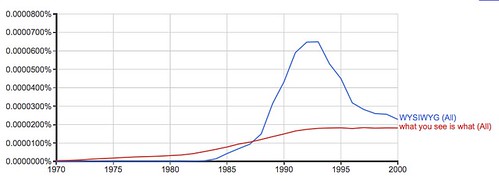
The graphic computer interface that became common with Apple's Macintosh computer is sometimes known as WYSIWYG, where "WYSIWYG" = "what you see is what you get." The following chart shows an Ngram query on both "WYSIWYG" and "what you see is what" (Ngram won't handle phrases of more than five words).

WYWIWG Ngram

You can see "WYSIWG" on the rise starting in the mid-1980s, which coincides with the MacIntosh, which was released in 1984. But "what you see is what you get" extends back into the 1970s.

What's going on?

In the fall of 1970 Flip Wilson debuted a comedy show on NBC. He was perhaps best known for playing a character named Geraldine, a sassy, brassy, black woman. Geraldine has a number of catch phrases, including "The devil made me do it" and "What you see is what you get." WYSIWIG!

Did the computer industry get the phrase from Flip Wilson, or was it independently invented? Inquiring minds want to know.

Monday, December 5, 2016

Looking up the Hudson River

20161203-_IGP8258

20161203-_IGP8257

Beyond Broca and Wernicke

Abstract: Broca and Wernicke are dead, or moving past the classic model of language neurobiology

With the advancement of cognitive neuroscience and neuropsychological research, the field of language neurobiology is at a cross-roads with respect to its framing theories. The central thesis of this article is that the major historical framing model, the Classic “Wernicke-Lichtheim-Geschwind” model, and associated terminology, is no longer adequate for contemporary investigations into the neurobiology of language. We argue that the Classic model (1) is based on an outdated brain anatomy; (2) does not adequately represent the distributed connectivity relevant for language, (3) offers a modular and “language centric” perspective, and (4) focuses on cortical structures, for the most part leaving out subcortical regions and relevant connections. To make our case, we discuss the issue of anatomical specificity with a focus on the contemporary usage of the terms “Broca’s and Wernicke’s area”, including results of a survey that was conducted within the language neurobiology community. We demonstrate that there is no consistent anatomical definition of “Broca’s and Wernicke’s Areas”, and propose to replace these terms with more precise anatomical definitions. We illustrate the distributed nature of the language connectome, which extends far beyond the single-pathway notion of arcuate fasciculus connectivity established in Geschwind’s version of the Classic Model. By illustrating the definitional confusion surrounding “Broca’s and Wernicke’s areas”, and by illustrating the difficulty integrating the emerging literature on perisylvian white matter connectivity into this model, we hope to expose the limits of the model, argue for its obsolescence, and suggest a path forward in defining a replacement.

“Broca and Wernicke are dead, or moving past the classic model of language neurobiology” by Pascale Tremblay and Anthony Steven Dick in Brain and Language. Published online August 30 2016 doi:10.1016/j.bandl.2016.08.004

You can find the paper here (behind a paywall):


There's a news article here:


From that article: Tremblay and Dick call for a “clean break” from the Classic Model and a new approach that rejects the “language centric” perspective of the past (that saw the language system as highly specialised and clearly defined), and that embraces a more distributed perspective that recognises how much of language function is overlaid on cognitive systems that originally evolved for other purposes.

Sunday, December 4, 2016

Neurolinguistics of Language

Here's links to a bunch of recent articles in Journal of Neurolinguistics (H/t Dan Everett). Note that all are behind a paywall, but you can at least link through to see some abstracts.  I've listed two articles (plus abstracts) that caught my attention on a quick look:

* * * * *
Volume 42, May 2017, Pages 49–62
A re-visit of three-stage humor processing with readers' surprise, comprehension, and funniness ratings: An ERP study

Highlights

•
The roles of surprise, comprehension, and amusement levels in humor processing were examined.
•
Participants were divided into high/low score groups based on their behavioral ratings to verbal jokes.
•
Highly surprised, comprehended, and amused group elicited larger N400, P600, and LPP effects, respectively.
•
These intergroup variances supported the three-stage model of humor processing.

Abstract

Humor processing can be divided into three sub-stages including incongruity detection, incongruity resolution, and elaboration (2, 3 and 10). However, few studies have investigated the three-stage model of humor processing with readers' surprise, comprehensibility and funniness levels, and little discussion has been devoted to its biological underpinning. To verify the credibility of the three-stage model, electroencephalography (EEG) was utilized in corroboration with two types of stimuli including jokes and non-jokes in the present research. Participants were categorized into high vs. low score groups based on their rating scores of surprise, comprehension, and funniness to joke stimuli. The between-group analyses showed that compared with the less surprised group, highly surprised people elicited a primarily larger N400, which may suggest more incongruity perceived in reading jokes. Additionally, good comprehenders mainly elicited a larger P600, probably indicating a more successful resolution of detected incongruity in comparison with poor comprehenders. Finally, the highly amused group elicited a larger late positive potential (LPP) compared with the less amused group, which could reflect more affective elaboration of jokes. Participants' surprise, comprehension, and funniness levels had smaller impacts on other chief electrophysiological components, with the effects varying with different group contrasts. These results provided the evidence that different degrees of surprise, comprehensibility, and amusement to jokes would influence the three sub-stages (incongruity detection, incongruity resolution, and elaboration) respectively in humor processing. The current study thus generally re-verified the stability of the three-stage model through participants' behavioral ratings which had seldom been touched upon.

* * * * *
Volume 40, November 2016, Pages 112–127
Individual differences in the bilingual brain: The role of language background and DRD2 genotype in verbal and non-verbal cognitive control

Highlights

•
Bilingual language control is associated with activity in the inferior frontal gyrus.
•
Non-verbal control is associated with activity in the anterior cingulate cortex.
•
Specific genotypes predict fMRI activity during language control and task switching.
•
Bilingual experience predicts fMRI activity during language control and inhibition.

Abstract

Bilingual language control may involve cognitive control, including inhibition and switching. These types of control have been previously associated with neural activity in the inferior frontal gyrus (IFG) and the anterior cingulate cortex (ACC). In previous studies, the DRD2 gene, related to dopamine availability in the striatum, has been found to play a role in neural activity during cognitive control tasks, with carriers of the gene’s A1 allele showing different patterns of activity in inferior frontal regions during cognitive control tasks than non-carriers. The current study sought to extend these findings to the domain of bilingual language control. Forty-nine Spanish-English bilinguals participated in this study by providing DNA samples through saliva, completing background questionnaires, and performing a language production task (picture-naming), a non-verbal inhibition task (Simon task), and a non-verbal switching task (shape-color task) in the fMRI scanner. The fMRI data were analyzed to determine whether variation in the genetic background or bilingual language background predicts neural activity in the IFG and ACC during these three tasks. Results indicate that genetic and language background variables predicted neural activity in the IFG during English picture naming. Variation in only the genetic background predicted neural activity in the ACC during the shape-color switching task; variation in only the language background predicted neural activity in the ACC and IFG during the Simon task. These results suggest that variation in the DRD2 gene should not be ignored when drawing conclusions about bilingual verbal and non-verbal cognitive control.


Another RGB Series

Here is the original scene:

20161203-_IGP8323

It is an object of no particular interest, a plastic milk bottle with part of its top cut off. It's on window sill and you can see its reflection in the window and you can see the screen in the window as well. It is what it is.

And then we have three versions of that scene, in red, green, and blue tones, respectively:

20161203-_IGP8323R

20161203-_IGP8323RG

20161203-_IGP8323RGB

Why those three colors? Because those are the primary colors of video and computer monitors (RGB). I've done many such RGB series. And some of the extend beyond the basic RGB triplet.

Why do I do it? it's fun. It's an exercise. It's basic.

20161203-_IGP8323RGB Eq LoSat

Friday, December 2, 2016

Friday Fotos: Fr8s

GASP.jpg

BM 33 03.jpg

IMGP7862rd.jpg

IMGP9971rd

IMGP0024rd

An Executive Guide to the Computer Age


William Benzon, "An Executive Guide to the Computer Age." Raymond T. Yeh and Paul B. Schneck, Co-Directors, Computer Science: Key to a Space Program Renaissance: Final Report of the 1981 NASA/ASEE Summer Study on the Use of Computer Science and Technology in NASA. University of Maryland, Computer Science Technical Report Series, No. 1168, Vol. II: F-1 - F-14, January 1982.

Abstract: Computing technologies have the potential to radically transform the way we live. Such a transformation is not inevitable, nor is it necessarily good. The purpose of this paper is to place this possibility into its proper historical perspective and to consider, in a general way, how one plans for it. The first section considers the place of the "Information Age" in history, suggesting that it is the fourth major transformation in human cultural evolution. The next section develops a five-dimensional metaphor outline certain basic factors which may be considered in a strategic plan for the use of computing technology. The final section discusses a specific aspect of that planning – the relationship between computing and productivity – and suggests that the transforming power of computing technology lies in the possibility of dramatically increasing productivity as intelligent computer becomes routine and reliable.