Thursday, October 4, 2018

Trump Works the Presidency: Imperial Boss and Cyborg Operator

Another working paper; title above; abstract, contents, and introduction below. Download here:

Academia.edu: https://www.academia.edu/37531960/Trump_Works_the_Presidency_Imperial_Boss_and_Cyborg_Operator
SSRN: https://ssrn.com/abstract=3260841

Abstract: One feature of Trump’s Presidency is that he consistently blurs the line between his personal interests and duties and his duties to and responsibility for the nation. This kind of distinction has been dramatized in various works, such as Shakespeare plays (Henry V, Part II) and current TV series, The Crown, and NCIS. General behavior and policies aside, there are two specific mechanisms Trump employs that act to blur that crucial distinction: 1) He issues a constant stream of tweets on political matters and on national policy. 2) He conducts regular campaign-style rallies around the nation. Using these two mechanisms he projects his unbridled Id over the nation, thereby connecting with his “base” and, in effect, fusing with it to form a hybrid cybernetic organ of national control.

Contents

King Tyrant Lizard-in-Chief 2
Trump, Falstaff, and the Queen 3
The Rejection of Falstaff 3
The Humbling of Philip Mountbatten 4
Donald Trump is no Leroy Jethro Gibbs 6
The honor to serve 6
Everything in its place 7
Personal interest vs. public duty 8
What would Donald do? 10
God save the Queen! 11
Feed Me Donald! – Trump, Musk, the Internet, and Monsters from the Id 13
Limbic Resonance 14
Trumposaurus Rising 15
Feed Me Donald 16
Yes, I mistrust those organic metaphors 17
Trumposaurus Rex – Toward a cybernetic interpretation 18
Appendix: Salvation and Democracy, or How One's Personal Relationship with Christ Underwrites Governmental Legitimacy 22

King Tyrant Lizard-in-Chief

This working paper isn’t about President Trump’s politics, his views and policies. It’s about how he runs/enacts/executes the Presidency.

The first two pieces, “Trump, Falstaff, and the Queen” and “Donald Trump is no Leroy Jethro Gibbs”, are about his flagrant disregard for the distinction between his personal interests and responsibilities and his responsibilities and duties to the nation as its president. Shakespeare marks the distinction in Henry V, Part II by having Prince Hal reject his old carousing buddy Falstaff once he’s ascended the throne to become King Henry V. In The Crown Elizabeth enforces the distinction by having her husband bow down before her, in public, during the coronation ceremony. In the last episodes of season seven of NCIS we learn that while he was a Marine sniper Leroy Gibbs (the central character in the show) had murdered a drug lord who was responsible for the deaths of his wife and young daughter. Abby Sciuto, a Forensic Specialist, has discovered this and is reluctant issue a report that would reveal this fact, thereby exposing Gibbs to arrest and trial. Gibbs gives her permission to issue the report.

In each of these cases a character is faced with a decision that pits their duty to a position against deep bonds of personal affection. Prince Hal has had been a close companion to Falstaff for several years. Elizabeth loves her husband and does not want to humiliate him. Abby feels a deep personal loyalty to Gibbs and he, of course, has no desire to go on trial for murder. But he knows what duty demands. This last case is particularly important in this context because NCIS is known to be popular among Trump supporters, who respond to its patriotic sentiment and respect for authority.

The next two pieces, “Feed Me Donald! – Trump, Musk, the Internet, and Monsters from the Id” and “Trumposaurus Rex – Toward a cybernetic interpretation”, are about, if you will, Trump’s procedural innovations, the personal tweet stream and his series of campaign-style rallies. The provocative nature of Trump’s tweets allows him to dominate the 24-hour news cycle and to keep in emotional contact with his base by monitoring the effects of his tweets through Fox News and other programs. The rallies give him an immediate performative buzz, allowing him to bask in the glow of fan approval – for we ARE talking about fans here – and, of course, allows his fans to experience his powers.

At the same time we must realize that Trump is all but powerless in the face of his need for emotional release and fan approval. Equally, there is a sense in which his base is constantly demanding that he feed them with his anger, rage, and, beneath it all, his fear. He needs them, they need him. It is a technologically mediated marriage of convenience. A conversation between Elon Musk and Joe Rogan outlines that cybernetic man-machine hybrid. A clip from the 1986 film, Little Shop of Horrors, illustrates the hunger.

The concluding appendix is about the structure of governmental legitimacy as expressed in The Declaration of Independence. The federal government gets its legitimacy from the people, though the mechanism of voting. The people are endowed with their powers from God. This stands in contrast to a monarchy where the monarch gets their powers directly from God. The mechanisms of government thus depend on the separation of church and state. Though Trump does not claim divine authority, he is quite willing to enact policies that erode the distinction between church and state. And, of course, his mode of governance is perhaps close to that of the authoritarian monarch than that of any previous president. That mode comes into play through his inability to distinguish between his private person and his role as president and it is amplified by his tweets and rallies.
Computation BURNS energy, it IS a physical process, it's NOT etherial spirit

From David Wolpert, Why Do Computers Use So Much Energy?, Scientific American (4 oct 2018)
Precise estimates vary, but currently about 5 percent of all energy consumption in the U.S. goes just to running computers—a huge cost to the economy as whole. Moreover, all that energy used by those computers ultimately gets converted into heat. This results in a second cost: that of keeping the computers from melting.
The brain, too:
This particular computer uses some 10–20 percent of all the calories that a human consumes. Think about it: our ancestors on the African savanna had to find 20 percent more food every single day, just to keep that ungrateful blob of pink jelly imperiously perched on their shoulders from having a hissy fit. That need for 20 percent more food is a massive penalty to the reproductive fitness of our ancestors. Is that penalty why intelligence is so rare in the evolutionary record?
And then we have the various cellular systems that can be considered to be computers:
For example, a large fraction of the energy budget of a cell goes to translating RNA into sequences of amino acids (i.e., proteins), in the cell’s ribosome. But the thermodynamic efficiency of this computation—the amount of energy required by a ribosome per elementary operation—is many orders of magnitude superior to the thermodynamic efficiency of our current artificial computers.
Tradeoffs:
Conventional computer science is about all about trade-offs between the memory resources and number of timesteps needed to perform a given computation. In light of the foregoing, it seems that there might be far more thermodynamic trade-offs in performing a computation than had been appreciated in conventional computer science, involving thermodynamic costs in addition to the costs of memory resources and number of timesteps. Such trade-offs would apply in both artificial and biological computers.
There you have it, the physicality of computing involves time, storage, and energy.
“...computers...are often very-far-from-equilibrium systems.”
But the article says nothing to answer the question posed in the title: Why? More likely than not, the title was written by an editor, not Wolpert himself.

Mystery


Jump like a frog,
Buzz like a bee,
Burn like a log,
Invite mystery.


Lost in Math: Sabine Hossenfelder at Stevens Institute

20181003-P1150854

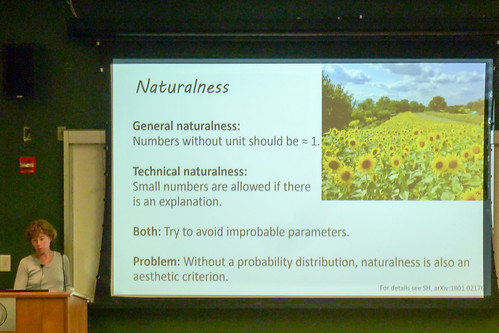
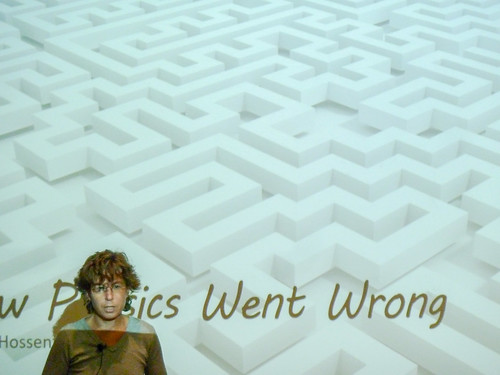
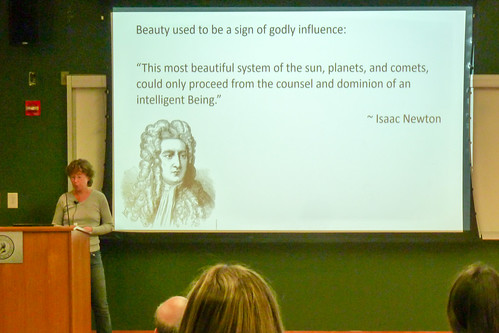
My buddy John Horgan brought Sabine Hossenfelder to Stevens Instituted to talk about her current book, Lost in Math: How Beauty Leads Physics Astray. Her argument is simple: The foundations of physics – general relativity (space and time) and the standard model of particle physics – is in trouble because it has become besotted with beauty. Theory no longer generates testable prediction. It just generates more and more theory.

But what’s beauty? I’ve been hearing about intellectual beauty all my life. I even believe in it, sorta’. It seems that theoretical physicists are obsessed with it.

20181003-P1150857

I’ve been reading about Hossenfelder’s book for some time now, and I’ve even visited her blog, Backreaction, so I’m familiar with her thesis. Still, I was struck when she put up slide after slide of physicists extolling beauty. Why?

It seems that beauty has become a quasi-technical idea among physicists working on foundations. She interviewed a number of physicists to get an idea of what they meant. It boils down to simplicity, naturalness, and elegance.

20181003-P1150861

Wednesday, October 3, 2018

Lady Gaga as star

When I met Lady Gaga on a hazy afternoon a few days after her Venice tour, at her house so high up in the Hollywood Hills that I broke through the fog line before I reached it, she was still in full Marilyn mode. Her duckling-blond hair was molded into a halo around her face. Her lips were matte red, slightly overdrawn, an enthusiastic valentine. She was wearing the same towering patent-leather stilettos from the boat and a brown tiger-print wiggle dress, a midcentury silhouette favored by celluloid bombshells that vacuum-seals the calves into place. Her earrings, obsidian chandelier dangles heavy as hood ornaments, cast prismatic shadows on her clavicle and seemed to threaten the general integrity of her otherwise regal posture.

Wheeee! Fun!

20180930-_IGP3516

20180930-_IGP3524

20180930-_IGP3526

Frank Sinatra as mother?

I've been going through a a bunch of passages I cut from my book, Beethovens's Anvil, for one reason or another. This one is about Frank Sinatra's singing style. I'm not quite sure where this dyadic analysis comes from; that is, I don't know what line of thought I was following. It's interesting. If I were to open this up for further thought, would I retain it, or abandon it? I do not know.

* * * * *

Here I'm going to pull a rabbit out of the hat. Obviously the relationship between Sinatra and his back-up is dyadic and so is his relationship to the audience -- in general, we've got a dyadic situation where the audience listens passively. But I think he's exploiting a very special dyadic relationship, that between mother and infant. He's the mother and the audience is the infant. His almost compulsive hypermasculinity is a defense the female nature of his role.

Now, why you might ask, would I suggest such a crazy thing? Sinatra's fans are forever talking about the intimacy of his singing, of how he is singing just to them. That's what I'm after.

I know about his careful diction, I know about his breath control and what that means for his phrasing. I also know about the informal, almost conversational style, of his delivery. And I know and understand about his microphone technique. But none of this quite seems to fix it.

Now, I don't know whether his magic includes something entirely of his own invention, or whether he's just perfecting something he learned from Bing Crosby, Mabel Mercer, Louis Armstrong, and others – I simply don't know that music well enough to make a judgment. But if Sinatra really did invent something, I'd say it was figuring out how to package all this within the maternal half of the mother/child dyad.

Why that particular dyad? Mostly just a guess. The obvious alternative would be the mating dyad, given that so much of his repertoire is about love. But that's just the stance he assumes within the performance situation. What I'm claiming is that the performance situation itself is governed by the mother/child dyad. Within that dyad Sinatra can assume whatever pose is needed to project the lyric – just as mothers do when singing to/with their children.

And note, in particular, that Sinatra's speciality, his beloved saloon songs, is lost love, grief. He's a mother easing his child to sleep, to a complete loss of the world.

If this take on Sinatra is more or less correct, then I've got a sort of poetic closure. For the book opens with Bette Midler singing one of Sinatra's beloved saloon songs to Johnny Carson on his penultime night on TV.

Signs

20180930-_IGP3555

Tuesday, October 2, 2018

The hermeneutic hairball: Intuition, tracking, and sniffing out patterns

This post serves three purposes: 1) It’s an elaboration on the middle section of a post from last month, Still, why do literary critics find it so difficult to focus on form? 2) It continues my reflections on intuition. 3) It’s push-back on the idea that the humanities are valuable as a means of teaching critical thinking.

On the last, gimme a break! What learning doesn’t require critical thinking skills? But you have to find something on which to ground your criticism, something to pull it from the sludge. That’s what this post is about.

What was so good about Derrida?

Let’s start with some observations J. Hillis Miller made almost a decade ago in an interview with Jeffrey Williams in the minnesota review [1]:
I learned a lot from myth criticism [referring to Northrup Frye], especially the way little details in a Shakespeare play can link up to indicate an “underthought” of reference to some myth or other. It was something I had learned in a different way from Burke. Burke came to Harvard when I was a graduate student and gave a lecture about indexing. What he was talking about was how you read. I had never heard anybody talk about this. He said what you do is notice things that recur in the text, though perhaps in some unostentatious way. If something appears four or five times in the same text, you think it's probably important. That leads you on a kind of hermeneutical circle: you ask questions, you come back to the text and get some answers, and you go around, and pretty soon you may have a reading.
That’s it, noticing patterns in texts, unostentatious patterns. That’s where the good stuff is.

Derrida was good at it as well. Referring to a passage in Remembrance of Things Past:
What Derrida did that I never would have thought of was to notice that the whole passage is based on words in pris: apprendre, comprendre, prendre. Those words are perfectly translatable, but lose their play on pris—I understood: j'ai compris. Derrida noticed these words and their recurrence in a way that helps you to understand the way the passage is put together and the meaning it has. Derrida was a genius in doing that sort of reading. That's why Derrida for me is even more important for his way of reading than for his invention of big concepts like différance.
There’s that notion again, “recurrence”. And why would Miller think Derrida’s ability to spot such patterns is more important that his ability to invent “big concepts”? Could it be that (at least some of) those big concepts are about what you uncover as you come to terms those unobtrusive patterns. If you’re out to deconstruct something, if that’s your critical game, those patterns tell you where to start pulling on the threads to unravel the cloth.

But how do you LEARN to do that, notice interesting things, diagnostic signs, in texts? Surely you learn it by doing it. A teacher works though it in lecture, and prods and nudges during class discussion. You read examples. You write your own examples, getting feedback from teachers and more experienced students. Getting good at it takes years. There are no shortcuts.

Markings and patterns

And that’s what I was doing, largely for myself, during those months and years working on “Kubla Khan” decades ago at Johns Hopkins. By that time I had had four years of undergraduate instruction in various subjects, including literature. I’d written, say, a dozen or more critical papers, and gotten them critiqued. I had the example of what Lévi-Strauss had done with myth, in The Raw and the Cooked, and in various essays, including one on some Winnebago myths. And there was some essays about poems as well, by Lévi-Strauss, Roman Jakobson, and Michael Riffaterre. But it was mostly Lévi-Strauss on myth.

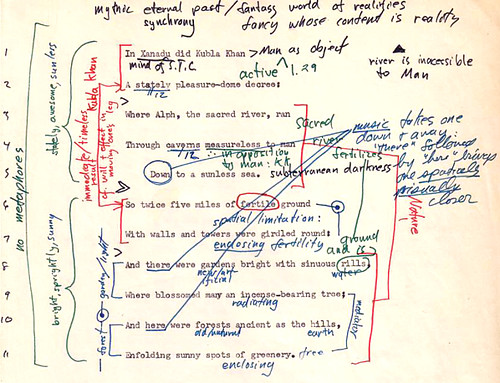
That got me started. But it wasn’t enough to bring me home. I made worksheets, worksheet after worksheet. I’d type out the text of “Kubla Khan” in double-space or triple-space and then mark it up. I must have done that half a dozen times or so. Here’s a fragment from one such sheet:

KK-working-text-old-2cr72.jpg

Notice that I’ve numbered the lines (down the left edge) and that I’ve made various kinds of notations in three, maybe four colors of in, black, blue, red, and I believe green (running vertically in the left margin). I’ve underlined and circles various words and phrases, used various lines and brackets to connect things across lines – in this I was inspired by an illustration in the notes to “Kubla Khan” in the edition I was working from, edited I believe by Kathleen Coburn. And I’ve written various kinds of comments all over the place. Some comments seem descriptive: “spatial limitation” (line 6), “enclosing fertility” (7), “water” (8), “radiating” (9), and “earth” (10). Others are more interpretive: “music takes one down & away” (to the right of ll. 3 & 4), “Nature” (on the rightmost red bracket), and “Man as object” (line 1). Notice, though, that the interpretation is rather “shallow”. I’m not trying to decode symbols. I’m classifying and organizing. I’m looking for patterns.

Howard Rheingold is leaving Facebook

As many of you know, Howard’s been in the vanguard of thinking about and building online communities since the 1980s – see the online version of his 1993 book, The Virtual Community. He was teaching at Stanford when Facebook was founded, with membership restricted to Harvard, Princeton, and – you guessed it – Stanford. So he signed up. Why not?

In a new piece on Medium Howard goes on to note, “I was there when students were shocked that their drunken Facebook postings and photos affected their graduate school and employment prospects.” Whoops! Didn’t see that coming.

Didn’t see a lot of things coming.

He didn’t like FB’s rigid format – nor do I, but, like Howard and many others, I work in other online spaces. But that’s small potatoes.
As I have noted here before, I wrote in the mid 1990s about coming massive dataveillance — and very very few people seemed to care. I knew that Amazon was using data collected about my purchases and interests to suggest books to me, and although I recognized it as creeping dataveillance, I was one of many who not only didn’t care — I welcomed the convenience. When Facebook ads started trying to sell me things that I had looked at via other websites, that was creepy. But I did not comprehend what has come to be known as “surveillance capitalism” and the degree to which extremely detailed dossiers on the behavior of billions of users could be used to microtarget advertising (including, it turns out, to use gender and racial criteria to filter job and housing advertisements), and I don’t think anybody understood how that microtargetting could be joined with armies of bots and human trolls to influence public opinion, sow conflict, and (probably) swing elections.

Then there were the data breaches. It’s become clear that Facebook didn’t understand their inability to control such detailed surveillance of so many people, and to keep such a huge, widespread, and complex mechanism secure. It will never be secure. There will be breach after breach. [...] And most recently, I learned that Facebook had sold my phone number to spammers after I had provided it (privately, I thought) to use to retrieve my account in case it was hacked.
And so, despite the fact that FB has allowed him “to stay in contact with people’s lives — many of whom would fall off my radar otherwise”, and to have fun in many ways, Howard’s decided to leave it behind sometime before the election.

I intend to stick around for awhile. But Howard’s right about FB’s limitations and about the dangers it presents “to the public sphere and individual privacy.” FB is the Borg. The corporatized internet is the Borg.

How do we change it?

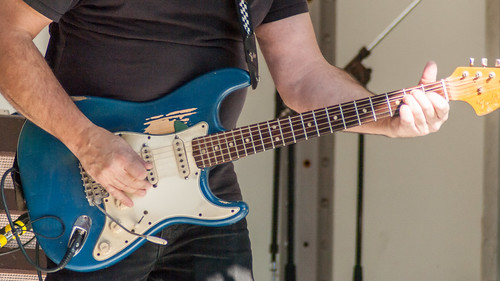
Two hands and a guitar

20180930-_IGP3416

Musical high: Free, rockin’ and tight as a frog’s bottom

This is cobbled together from notes and from out-takes from my book, Beethoven's Anvil: Music in Mind and Culture, and my personal notes.

Zoom!!!

How are we to weigh and understand the following testimony, the first by Branford Marsalis, the second by Eric Clapton?
High, you feel high. It's easy to do it physically, but it's hard to do it mentally. I feel that musicians who say it happens every time they play are full of shit. The sublime cannot be routine. Three times, and you never forget them. It's with a combination of musicians, it's never just me.

It's a massive rush of adrenaline which comes at a certain point. Usually it's a sharing experience; it's not something I could experience on my own. . . . other musicians . . . an audience . . . Everyone in that building or place seems to unify at one point. It's not necessarily me that's doing it, it may be another musician. But it's when you get that completely harmonic experience, where everyone is hearing exactly the same thing without any interpretation whatsoever or any kind of angle. They're all transported toward the same place. That's not very common, but it always seems to happen at least once a show [1].
Are these guys talking about the same thing? Branford’s experience happened only three times whereas Clapton’s seems quite common and almost predictable, despite his disclaimer. Is one a better musician than the other? Or do rock and jazz make different demands and give different rewards? All of the above?

As for myself, I had a powerful experience in my mid-20s. During the early 1970s I’d played for two years with a rock band called St. Matthew Passion – a 4-piece rhythm section plus three horns, sax, trumpet, trombone. On “She’s Not There” the three horns would start with a chaotic improvised freak-out and then, on cue from the keyboard player, the entire band would come in on the first bar of the written arrangement. On our last gig it was just me and the sax player; the trombonist couldn't make it. We started and got more and more intense until Wham! I felt myself dissolve into white light and pure music. It felt good. And I got scared, tensed up, and it was over. After the gig the sax player and I made a few remarks about it—“that was nice”—enough to confirm that something had happened to him too. One guy from the audience came up to us and remarked on how fine that section had been.

That's the only time I've ever experienced that kind of ego loss in music. For a few years I was very ambivalent about that experience, wanting it again, but fearing it. But the memory's faded & the ambivalence too. I'm playing better than I ever did. What I can now do on a routine basis exceeds what I did back then.

Still, there are gigs and there are gigs.

Group Grok

For about a decade near the end of the previous century I played with the Out of Control Rhythm and Blues Band in upstate New York. We had about three or four gigs a month—mostly local clubs, private parties, and weddings. In my six or seven years with the band two gigs stand out above all the others, and one of the two was just a bit better than the other one. We played these gigs within the space of a month—I believe, in fact, they were no more than a week or two apart. The gigs were in very different venues. The first one was for a Parent’s Day dance at Skidmore College, an exclusive private school in Saratoga Springs. The second gig, the better of the two, was a club date in a sports bar in North Troy that had a large biker clientele that nite. Two very different venues, two different crowds, but both were dancing crowds, which certainly affected the band’s performance.

Band personel shifted from year to year, but none of the players were full-time professional musicians. During the period in question the band consisted of a lawyer, an advertising executive, a commercial photographer, a car salesman, two men who drove trucks for beverage distributors, and me, a freelance technical writer and independent scholar. I don’t know whether the other players judge these gigs as highly as I do—though they certainly felt they were good at the time. And I should emphasize that my judgement of these gigs is not a judgement about my own playing. I got a fair amount of solo space in general, and I had my usual slots for these gigs. However, I don’t remember anything outstanding in my performance at these particular gigs—that’s a different list. I remember these gigs because the band felt loose, free, rockin’ and tight as a frog’s bottom. We were in synch, among ourselves and with the crowd.

I do not know whether or not anyone in that band was ecstatic on either of these nights. I certainly was not. Nor do I think it matters much, aesthetically, morally. Intellectually, that’s a different matter. That’s about understanding what happens. We’ve hardly even begun that journey.

Transcending

Every athelete and every musician has her routine game. And at some point in her life, and maybe more than one, she plays above her routine level. Most of us have had an experience in some sphere of our lives that lifts us out of ourselves and thereby becomes a touchstone against which we measure our lives. If we live long enough and well enough we may even grow beyond measuring our lives against those moments while still treasuring them and telling stories about them, to our children and grandchildren, our nieces and nephews, to our friends and their children. Those story-tellings are themselves moments of sympathetic communion with our fellows and the connected tissue of those tellings is one of the means by which we preserve and assert our values.

Reference 

[1] These passages are from Jenny Boyd, Musicians In Tune, New York: Simon and Schuster, 1992, pp. 173 and 185 respectively

Monday, October 1, 2018

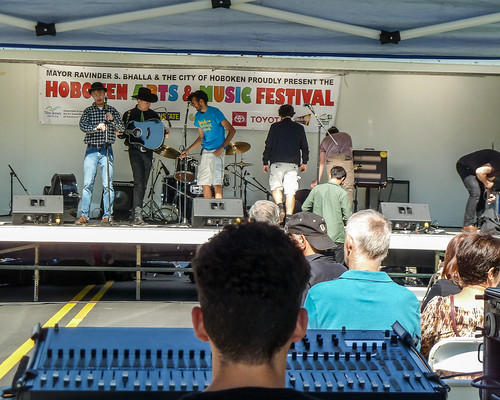
Hoboken Arts and Music Festival, September 30, 2018

20180930-P1150808

20180930-P1150826

20180930-P1150820

Ben and the Boys: Some Casual Remarks about Violence, Authority, and Sex in Bonanza

Bumping this to the top of the queue as it is relevant cultural background to current news about sexual abuse and a nominee for the Supreme Court (Brett Kavanaugh)..
A couple of weeks ago I watched my way through the first season of Bonanza, a TV western that I had watched in my youth. As some of you may know, it was one of the most popular shows on television at the time and ran for 14 seasons from 1959 to 1973. It was set in Nevada in the 1860s and centered on the Cartwright family, father Ben and his three adult male sons, proprietors of the Ponderosa, a large cattle ranch bordering on lake Tahoe and near Virginia City, a mining town.

This post consists of two casual notes about the show. The first concerns sexual violence against women and the second is about the structure of (political) power.

Rape in the Old West

After I’d watched about a dozen episodes a thought struck me: there’s a lot of sexual violence against women in this show. That thought stayed with me to the end of the season, 34 episodes. I wasn’t taking notes or keeping count but I’d say that half the episodes depicted sexual violence.

What do I mean? As I said, I wasn’t keeping notes, but typically a man would embrace a woman and try to kiss her. She would resist but he wouldn’t stop. At this point either the camera would cut away, leaving us to imagine what happened next, or a Good Guy, such as one of the Cartwrights, would come along and rescue the woman. The violence wasn’t nearly as graphic as we’d see on Deadwood, set in a similar place a decade later, but then Deadwood wasn’t made for a family audience watching on primetime network television back in the day when network television was much more important than it is now. Bonanza WAS made for a family audience.

Was this typical of primetime television back in the 1960s? I don’t know, but I suspect it was more common than I remember. Was this typical of westerns? I don’t know.

I know that it is not typical of The West Wing, a more recent and very different television show that I’m now watching. As you may know The West Wing is a political drama set in the west wing of the White House, which contains offices for the President, Vice President, and high-level staffers. While sexual violence comes up as a topic every now and then, the show doesn’t have a lot of scenes where a man forces himself on a woman. In fact I cannot think of one such scene off hand, and I’ve been through the whole run of the show.

Why then is it so common in Bonanza? Westerns are typically set in a world where the rule of law is tenuous. Westerns are about violence: cattle rustling, disputes over land, conflicts with Indians (aka Native Americans), bank robbery and other forms of theft, and, in the case of Bonanza, rape. What about other TV Westerns? I don’t know off hand; though I watched many TV Westerns when I was young, I don’t recall many of them.

Whatever the more general case, the first season of Bonanza was concerned about sexual violence against women. In some cases the women were saloon girls, prostitutes I (now) assume, though that was certainly not explicit (unlike Deadwood). In other cases the women were married or simply single; in one episode two Indian women were raped at a trading post.

Were the other 13 seasons like this? I don’t know and I don’t intend to watch them. It would be interesting to know, though.

Tyler Cowen on Kavanaugh: asymmetry between male and female perceptions

There is an asymmetry between male and female perceptions.

Most men are not abusers, yet very large numbers of women have been abused. So if a man is an abuser, there is a good chance he has abused a fair number of women.

That means many well-meaning men experience sexual abuse as a relatively rare phenomenon. They haven’t done it, and most of their male friends haven’t either. At the same time, most women have abuse, rape or #MeToo stories, and they experience these phenomena as relatively common and often life-altering. Probably they also have heard multiple such stories from their female friends. This structural asymmetry of perspectives is crucial to understanding the discourse and the often fundamental differences in opinion.

Our criminal justice system isn’t very good.

Whether you think Kavanaugh is innocent or guilty, we can all agree there are large numbers of intelligent people on both sides of the debate, and even after a week of intense national scrutiny there is no resolution. The reality is that ordinary accused people, who are basically presumed guilty by the criminal justice system, don’t receive very fair judgments. And if Kavanaugh is innocent, might we hope that this experience will make him more sympathetic to the plight of the unjustly imprisoned and accused?
The passage above is posted at Marginal Revolution (where there is also discussion). Complete column at Bloomberg (also has discussion, but not as much as at MR).