Wednesday, September 17, 2014

MacArthur Fellowship Update 2014: Still favoring elite institutions

Last year I wrote a series of posts on the MacArthur Fellowship Program (tagged “MacArthurFP” on New Savanna) in which I argued that they should stop giving out grants to people with university gigs. Why? Because those people have an income and can function; they don’t need MacArthur money to maintain a baseline level of functioning. MacArthur money would foster more innovation by going to people without that basic financial security.

Well, they’re at it again. They’ve just announced the 2014 fellows. There’s 21 fellows in all, of which I score 11 at university (or similar) gigs, and 10 non-university. That makes a majority of university gigs: 52%. Call that the cop-out ratio. The cop-out ratio for 2014 was 63%: 24 fellows, with 15 at university gigs. So the Foundation is moving in the right direction. Who knows, maybe next year the cop-out ratio will drop below 50%.

* * * * *

Here’s the Foundation’s page for the current class: http://www.macfound.org/fellows/class/class-2014/

Here’s the NYTimes article: MacArthur Awards Go to 21 Diverse Fellows.

Here’s how I scored the current class (phrases from the NYTimes article):

University Gigs:
  • Danielle S. Bassett, 32, a physicist at the University of Pennsylvania.
  • Terrance Hayes, 42, a poet and writing professor at the University of Pittsburgh.
  • Jennifer L. Eberhardt, 49, a social psychologist at Stanford University.
  • Sarah Deer, 41, a professor at William Mitchell College of Law in St. Paul.
  • Tami Bond, 50, an environmental engineer at the University of Illinois, Urbana-Champaign.
  • Craig Gentry, 41, a computer scientist at the IBM Thomas J. Watson Research Center in Yorktown Heights, N.Y.
  • Mark Hersam, 39, a materials scientist at Northwestern University in Evanston, Ill.
  • Jacob Lurie, 36, a mathematician at Harvard.
  • Khaled Mattawa, 50, a translator and poet at the University of Michigan, Ann Arbor.
  • Tara Zahra, 38, a historian of modern Europe at the University of Chicago.
  • Yitang Zhang, 59, a mathematician at the University of New Hampshire in Durham.
Non-University Gigs:
  • Ai-jen Poo, 40, a labor organizer in Chicago.
  • John Henneberger, 59, a housing advocate in Austin, Tex.
  • Jonathan Rapping, 48, president and founder of Gideon’s Promise in Atlanta, which teaches public defenders to be more effective.
  • Mary L. Bonauto, 53, a civil rights lawyer with the Gay and Lesbian Advocates and Defenders in Boston.
  • Rick Lowe, 53, who was trained as a painter but founded Project Row Houses in Houston.
  • Steve Coleman, 57, a composer and alto saxophonist in Allentown, Pa..
  • Joshua Oppenheimer, 39, a documentary filmmaker in Copenhagen.
  • Samuel D. Hunter, 33, a New Yorker and the author of a widely produced 2012 play, “The Whale.”
  • Alison Bechdel, 54, a cartoonist and graphic memoirist in Bolton, Vt.
  • Pamela O. Long, 71, [is] a historian of science and technology in Washington.
* * * * *

I gathered last year’s posts into a working paper, The Genius Chronicles: Going Boldly Where None Have Gone Before? (download HERE). The abstract:
This is an informal evaluation of the MacArthur Fellowship Program, the so-called "genius grants." I argue that the program functions basically as a PR vehicle for the MacArthur Foundation and for the foundation world in general. I also suggest that it could achieve better results by not awarding grants to people who already have jobs at elite institutions. There are discussions of how talent is evaluated, the cultural factors in genius, accounts of three elite institutions (Johns Hopkins, RPI, and SUNY Buffalo), and discussions of Louis Armstrong, John von Neumann, and Richard Feynman.


Tuesday, September 16, 2014

Throw It All Away: American Heartache Sick of Society

20140915-IMGP0416 V4

It started with an email to Jon Naar: Let’s meet. Naar, as you may recall, did the first book on graffiti. He took the photos back in '72, found a publisher, and his publisher coupled him with a writer, Norman Mailer. Cay 161 gave Mailer a truth, “the name is the faith of graffiti,” and from that truth a book title was born: The Faith of Graffiti. The book went on to become the “bible” of graffiti.

In his reply, Naar copied graff writer EKG. In my reply to both, I told them about American Heartache, a nice sized roller in an abandoned building in Jersey City:

IMGP6464

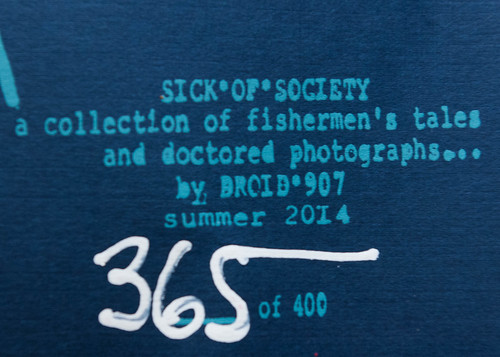
EKG says, that was by Droid907, I’ll let him know. Thus it was that I got an email from Droid907 asking for a mailing address so he could send me his latest book. A day or two ago the book arrived in the mail: Sick of Society, a collection of fisherman’s tales and doctored photographs. And with it, three stickers and a decal:

20140915-IMGP0379 V4

20140915-IMGP0428 V4

Zines have been around at least since Plato. That’s not what they called them in ancient days, but that’s what they were, artisanal books, hand crafted and NOT hot off the presses. There were no presses back then, just scribes, writing away, one at a time. Zines aren’t scribal, but you know a human hand touched each page.

Monday, September 15, 2014

How It's Done, Part 2: Tools and Methods (GVM008)

In the middle we have aerosol cans, the traditional medium of graffiti writers and used by street artists as well. The water is for thinning bucket paint. In the back we have a roller handle:

20140907-IMGP0170 V4

Touch-up with short-handled roller:

20140907-IMGP0161 V4

Drawing the body with a long-handled roller:

20140905-IMGP9918

Versions of Little Nemo


A bit of history and comparison of Little Nemo in animation. The first pilot, after McCay's original short film, is actually directed by Yoshifumi Kondo, though Miyazaki was involved. There's also a third, unreleased pilot film by Sadao Tsukioka but it hasn't been released anywhere.

Do all evolutionary roads lead to Rome?

Emily Singer in Quanta Magazine:
In his fourth-floor lab at Harvard University, Michael Desai has created hundreds of identical worlds in order to watch evolution at work. Each of his meticulously controlled environments is home to a separate strain of baker’s yeast. Every 12 hours, Desai’s robot assistants pluck out the fastest-growing yeast in each world — selecting the fittest to live on — and discard the rest. Desai then monitors the strains as they evolve over the course of 500 generations. His experiment, which other scientists say is unprecedented in scale, seeks to gain insight into a question that has long bedeviled biologists: If we could start the world over again, would life evolve the same way?

Michael Desai, a biologist at Harvard University, uses statistical methods to study basic questions in evolution. Many biologists argue that it would not, that chance mutations early in the evolutionary journey of a species will profoundly influence its fate. “If you replay the tape of life, you might have one initial mutation that takes you in a totally different direction,” Desai said, paraphrasing an idea first put forth by the biologist Stephen Jay Gould in the 1980s.

Desai’s yeast cells call this belief into question. According to results published in Science in June, all of Desai’s yeast varieties arrived at roughly the same evolutionary endpoint (as measured by their ability to grow under specific lab conditions) regardless of which precise genetic path each strain took. It’s as if 100 New York City taxis agreed to take separate highways in a race to the Pacific Ocean, and 50 hours later they all converged at the Santa Monica pier.

The findings also suggest a disconnect between evolution at the genetic level and at the level of the whole organism. Genetic mutations occur mostly at random, yet the sum of these aimless changes somehow creates a predictable pattern. The distinction could prove valuable, as much genetics research has focused on the impact of mutations in individual genes. For example, researchers often ask how a single mutation might affect a microbe’s tolerance for toxins, or a human’s risk for a disease. But if Desai’s findings hold true in other organisms, they could suggest that it’s equally important to examine how large numbers of individual genetic changes work in concert over time.

Does Evolution Have a Direction?

Of course.
In press, corrected proof.

John E. Stewart, The direction of evolution: The rise of cooperative organization, Biosystems, June 2014, DOI: 10.1016/j.biosystems.2014.05.006
Abstract. Two great trends are evident in the evolution of life on Earth: towards increasing diversification and towards increasing integration. Diversification has spread living processes across the planet, progressively increasing the range of environments and free energy sources exploited by life. Integration has proceeded through a stepwise process in which living entities at one level are integrated into cooperative groups that become larger-scale entities at the next level, and so on, producing cooperative organizations of increasing scale (for example, cooperative groups of simple cells gave rise to the more complex eukaryote cells, groups of these gave rise to multi-cellular organisms, and cooperative groups of these organisms produced animal societies). The trend towards increasing integration has continued during human evolution with the progressive increase in the scale of human groups and societies. The trends towards increasing diversification and integration are both driven by selection. An understanding of the trajectory and causal drivers of the trends suggests that they are likely to culminate in the emergence of a global entity. This entity would emerge from the integration of the living processes, matter, energy and technology of the planet into a global cooperative organization. Such an integration of the results of previous diversifications would enable the global entity to exploit the widest possible range of resources across the varied circumstances of the planet. This paper demonstrates that it's case for directionality meets the tests and criticisms that have proven fatal to previous claims for directionality in evolution.

Saturday, September 13, 2014

Bicycle Rider at Night

20140904-IMGP9791

Symposium on Universal Basic Income (UBI)

Appearing in the Boston Review, discussion took place back in 2000. Philippe Van Parijs makes the opening statement and then replies to comments on it. Here's the first few paragraphs of that statement:
Entering the new millennium, I submit for discussion a proposal for the improvement of the human condition: namely, that everyone should be paid a universal basic income (UBI), at a level sufficient for subsistence.

In a world in which a child under five dies of malnutrition every two seconds, and close to a third of the planet’s population lives in a state of "extreme poverty" that often proves fatal, the global enactment of such a basic income proposal may seem wildly utopian. Readers may suspect it to be impossible even in the wealthiest of OECD nations.

Yet, in those nations, productivity, wealth, and national incomes have advanced sufficiently far to support an adequate UBI. And if enacted, a basic income would serve as a powerful instrument of social justice: it would promote real freedom for all by providing the material resources that people need to pursue their aims. At the same time, it would help to solve the policy dilemmas of poverty and unemployment, and serve ideals associated with both the feminist and green movements. So I will argue.

I am convinced, along with many others in Europe, that–far from being utopian–a UBI makes common sense in the current context of the European Union.
Responses by: Herbert A. Simon, Emma Rothschild, Brian Barry, Anne L. Alstott, Fred Block, Katherine McFate, Gar Alperovitz, William A. Galston, Wade Rathke, Edmund S. Phelps, Elizabeth Anderson, Ronald Dore, Robert E. Goodin, Peter Edelman, Claus Offe.

Multimodal Biofeedback facilitates "inner harmony"

The Sensorium is a neurofeedback environment that allows people to experience signals from their nonperceptible body processes visually and auditorily. Various (neuro-)physiological rhythms and frequencies are projected simultaneously as soundscapes and “lightscapes” into the environment. A wireless physiological amplifier device sends signals such as EEG and ECG to a computer for real-time processing using the modified brain-computer interface software “Thought Translation Device” (TTD). The TTD performs signal filtering, parametric orchestral sonification, and light control. In a pilot study, 20 participants have been exposed to their ongoing brain and heart signals while sitting inside the Sensorium, a small room equipped with a speaker and lighting system. Almost all of them reported an increase in contentment, relaxation, happiness, and inner harmony. They also reported a widening in their body consciousness. In future, therapeutic paradigms will be developed and the treatment effects on people with psychosomatic diseases will be evaluated.

Friday, September 12, 2014

Literature, Emotion, and Unity of Being

I've uploaded a new working paper. Here's the SSRN link:
Abstract and introduction are below.

* * * * *

Abstract: Unity of being is both an aesthetic and an ethical ideal and it is about organizing desire, action, and emotion into a pattern of overall coherence. Such patterns are necessarily culture specific and somewhat arbitrary in their disposition of underlying biological materials. Stories involving often painful and embarrassing aspects of human behavior provide a means of publicly acknowledging and affirming the bewildering diversity of our behavior. Thus publically affirmed, these nonfictions are the means of constructing the neural 'scaffolding' on which we recall and organize the events of our lives.

Introduction: Unity of Being Through Literary Experience

When I first introduced the term “unity of being” it was a placeholder. I needed a concept and I knew why I needed that concept, but I didn’t quite know to define or discuss it. So I named it and talked around it. This set of notes is an initial attempt to discuss unity of being.

Unity of being is central to my thinking about literature and my thinking about the disciplines of literary criticism, for it is at the border between naturalist criticism and ethical criticism, connecting and dividing them at the same time. One central task for the naturalist critic is to infer a culture’s realization of unity of being through an examination of its literary texts. But the naturalist critic is not in the business of asserting what unity of being should be, not for his or her own culture, much less for any other culture.

That is the job of the ethical critic. What is beautiful? What is the good life? What texts advance the good and the beautiful, and why? Those are the central pursuits of ethical criticism. They are about how one should achieve unity of being.

A given critic may, of course, practice both naturalist and ethical criticism. But they are different disciplines with different requirements. We must learn to make the separation so that we can deliberately choose to function in the naturalist or the ethnical mode, as the occasion demands.

Two Meanings

When I introduced the term “unity of being” in a post entitled Unity of Being and Ethical Criticism I gave it two meanings, more or less, as follows:
In real time, unity of being is, well, unity of being. I don’t mean to be perverse, but I don’t know of any general term, though perhaps Csikszentmihalyi’s concept of flow will do, or the phrase “being in the moment.” As far as I know flow always happens spontaneously in that we cannot flip the mind’s flow switch at will—I rather doubt there’s such a thing as a flow-switch, rather it’s a matter of balance. But we can do things that will increase the likelihood that the mind will flip into flow.

One of those things is to read, in the basic ordinary sense of the word, a literary text. Or listen to a story, watch a play or movie. Whatever. In this sense, unity of being is psychological, it happens in the mind/brain in real time.

But unity of being, I believe, is also a reasonable way to talk about how individuals and peoples live their lives in the large, from years to decades to centuries. One wants everything one does, 24/7/365, to fall into a coherent pattern. A pattern more or less attributed to the nature of the world. To the extent that one cannot achieve unity of being one feels, well, perhaps alienated is the most general concept for it. In that literary texts are (always) about the world, they point toward unity of being in the large.

As far as I know there is no one way of life that yields unity of being in the large nor is there one way of organizing texts that yields it in the small. In the large it is a matter of how one chooses to live, where that one can be an individual or a group. In the small it is a matter of craft and one’s knowledge of its ways and means.
While these two senses – (1) as aesthetic flow, (2) as a coherent way of life – are related in that literary texts are about the world and how we live in it, it is the former sense that most interests me in this brief working paper.

As aesthetic flow, unity of being is a phenomenon that happens in the brain and nervous system. I currently believe, but cannot argue strongly, that this phenomenon can be defined in universal terms but that the means of constructing and enabling it are culturally specific. The means must be discovered by an encultured group and must be learned individuals in the group.

Friday Fotos: Flowers

IMGP0461rd

IMGP3978rd

IMGP5830rd

Thursday, September 11, 2014

Dyslexia is different for Chinese than for Europeans

Learning to read a language with an alphabet requires learning to sound out words; the visual form maps on to the sound of the word. Chinese, by contrast, maps the graphic form, the character, on to the meaning. The phonetic sound of the character does not necessarily correspond to the form of it. Reading English requires sounding out words segment by segment. The letter-sound conversion does not apply in Chinese.

"The fact that Chinese and Western dyslexics show brain abnormalities in different brain regions suggests that dyslexia may even be two different brain disorders in the two streams of culture," Ms Siok writes. One lesson from her study, she adds, is that a dyslexic Chinese reader may not suffer the same problem with an alphabetic language. The reverse is also true: some non-Chinese dyslexics can also master Chinese script more easily than the alphabet.

Has Adulthood been Demolished?

What all of these shows grasp at, in one way or another, is that nobody knows how to be a grown-up anymore. Adulthood as we have known it has become conceptually untenable. It isn’t only that patriarchy in the strict, old-school Don Draper sense has fallen apart. It’s that it may never really have existed in the first place, at least in the way its avatars imagined. Which raises the question: Should we mourn the departed or dance on its grave?
Scott ventures into territory NS recently explored through Macroanalysis:
Huck Finn is for Fiedler the greatest archetype of this impulse, and he concludes “Love and Death” with a tour de force reading of Twain’s masterpiece. What Fiedler notes, and what most readers of “Huckleberry Finn” will recognize, is Twain’s continual juxtaposition of Huck’s innocence and instinctual decency with the corruption and hypocrisy of the adult world.

Huck’s “Pap” is a thorough travesty of paternal authority, a wretched, mean and dishonest drunk whose death is among the least mourned in literature. When Huck drifts south from Missouri, he finds a dysfunctional patriarchal order whose notions of honor and decorum mask the ultimate cruelty of slavery. Huck’s hometown represents “the world of belongingness and security, of school and home and church, presided over by the mothers.” But this matriarchal bosom is as stifling to Huck as the land of Southern fathers is alienating. He finds authenticity and freedom only on the river, in the company of Jim, the runaway slave, a friend who is by turns Huck’s protector and his ward.
Of our fiction, Scott concludes, following Fiedler: "Instead, notwithstanding a few outliers like Henry James and Edith Wharton, we have a literature of boys’ adventures and female sentimentality. Or, to put it another way, all American fiction is young-adult fiction." The upshot:
Maybe nobody grows up anymore, but everyone gets older. What happens to the boy rebels when the dream of perpetual childhood fades and the traditional prerogatives of manhood are unavailable? There are two options: They become irrelevant or they turn into Louis C. K. (fig. 5). Every white American male under the age of 50 is some version of the character he plays on “Louie,” a show almost entirely devoted to the absurdity of being a pale, doughy heterosexual man with children in a post-patriarchal age. Or, if you prefer, a loser.
Enter, the women:

TO WAR! Part 3: Graffiti Edition: Say "No" to War

NO2WAR

Innocent Screams - Komar

TO WAR! Part 2: A Marx Brothers Analysis of America's War Craziness

Another old time good one. The post is from 2011, the movie from 1933. And, at this rate, the movie will still be relevant in 2033. Think we'll be over it by 2133?
 
 
Or, The Right Hand of Good Fellowship

I grew up watching Groucho Marx on his “You Bet Your Life” television show. My father assured me that the Marx Brothers films were the funniest ever. But I didn’t get to see any of them until I went to The Johns Hopkins University, which had an excellent film series curated by Richard Macksey.

Then I saw at least some of their feature films and laughed myself silly. My favorite, and certainly one of their best, is Duck Soup (1933). It’s about war between two minor nations, Freedonia and Sylvania, with the four brothers playing both sides of the conflict against the muddle.

Groucho plays Rufus T. Firefly, who is installed as head of Freedonia by Mrs. Gloria Teasdale, played by Margaret Dumont, Groucho’s foil in several films. I won’t go into the absurd intricacies of the clap-trap plot as I’m interested in only one scene, the scene where war is finally declared between Freedonia and Sylvania.

duck soup 1 chico in the dock

Chicolini (Chico Marx) is on trial in Freedonia for spying. Firefly has, for whatever reason, decided to act as his defense council, though he’s the one who caught Chicolini. This that and the other happens and the news comes that Sylvania troops are at the Freedonia’s border. This causes some distress as “war would mean a prohibitive increase in our taxes”—maybe back then, but not now; now we cut taxes and spend even more money on undeclared war. There’s some wordplay on “taxes” and “dollars” = “Dallas, Dallas, Texas.” It’s eerie, you’d think those guys were reading the future.