Sunday, August 19, 2018
Saturday, August 18, 2018
The brain is driven by a difference between prediction and and actuality
New research bolsters a controversial theory of how the brain works — from how we see and hear, to how we remember and make decisions.https://t.co/NAftwdr5NL pic.twitter.com/9hTLCbZ4Iy— Quanta Magazine (@QuantaMagazine) August 17, 2018
Well of course. The fact that his idea is controversial is mind-blowing and disconcerting. William Powers are argued this in his 1973 book, Behavior: The Control of Perception. Where have these people been all these years? Asleep?
Powers had a nine-level model in 73, though I believe he may have added two more later on. David Hays and I adopted Powers's first five levels and then provided a somewhat different "top" for the system.
Strangers in a strange land – More on ‘useless’ philosophical arguments about brains and computers
I’ve been thinking about those philosophical arguments I find so useless and have an idea about what they might be up to. Let’s look at this statement early in a classic paper by Wilfrid Sellars, Philosophy and the Scientific Image of Man (1963):
For the philosopher is confronted not by one complex many-dimensional picture, the unity of which, such as it is, he must come to appreciate; but by two pictures of essentially the same order of complexity, each of which purports to be a complete picture of man-in-the-world, and which, after separate scrutiny, he must fuse into one vision. Let me refer to these two perspectives, respectively, as the manifest and the scientific images of man-in-the-world.
Those philosophical arguments that I find so unsatisfying are about the manifest image while the investigations in neuroscience, cognitive science, and artificial intelligence are articulated within the scientific image. Thus we find that the formulations and arguments that interest me are always couched in the specialized language of some intellectual discipline while the philosophical arguments are relatively free of specialized terminology, though they may often be abstract and difficult to grasp – I’m thinking particularly of Searle’s Chinese Room argument.
I'm thinking in one world. The philosophers are in a different one. The connection between the two is obscure.
The problem is an ontological one: What kind of a thing is a computer (at its most sophisticated)? Is it a machine or is it human? In some ways it’s like a machine: they’re non-living, made of inorganic materials, and don’t look at all like animals or humans. But in some ways they’re like a human: they do things that only humans have heretofore done, calculation, sorting, tabulation, and so forth; and we interact with them through language. To be sure, computer languages are rigid in a way that natural languages aren’t, but still, they are languages. They call on our language facilities. So the philosophers are trying to fit computers into a system of ontological categories that has no place for them.
Why not just recognize computers as a separate category of thing, neither human nor mechanical, but something else, something equally fundamental and hence irreducible?
Like an iron horse
We’ve been there before. Consider this passage from Thoreau’s “Sound” chapter in Walden (1854):
When I meet the engine with its train of cars moving off with planetary motion ... with its steam cloud like a banner streaming behind in gold and silver wreaths ... as if this traveling demigod, this cloud-compeller, would ere long take the sunset sky for the livery of his train; when I hear the iron horse make the hills echo with his snort like thunder, shaking the earth with his feet, and breathing fire and smoke from his nostrils, (what kind of winged horse or fiery dragon they will put into the new Mythology I don’t know), it seems as if the earth had got a race now worthy to inhabit it.
There’s quite a bit of figurative language in that paragraph, but I’m interested in two metaphors, iron horse and fiery dragon. The iron horse is a well-known metaphor for a steam locomotive, perhaps from all those old Westerns where Indians use the term. Fiery dragon is not so common, but it’s use in that context is perfectly intelligible.
What was Thoreau doing when he used those figures? He certainly recognized them as figures. He knew that the thing about which he was talking was some glorified mechanical contraption. He knew it was neither horse nor dragon, nor was it living.
Or was it? Did he really know that it wasn’t alive? Or did he think slash fear that it might be a new kind of life? We live in a world where everyone is familiar with cars and trains and airplanes from an early age, not to mention all sort of smaller self-propelling devices. We find nothing strange about such things. They’ve always been part of our world. And so, as we learned to talk, as we learned to think, we made places for these things in our worldview, along with rocks, a dandelions, raccoons, the wind, and other humans.
But Thoreau and his fellows did not grow up in such a world. They grew up, and learned to think about, a world in which things which moved across the surface of the earth did so either under animal power or human power. When steam locomotives first appeared, even primitive ones, that was the first time in history that people saw inanimate beings, mere collocations of things, move over the surface of the earth under their own power.
So where would they fit into the conceptual system? With other mechanical devices, like pumps, and stationary engines, or with mobile animals and humans? They had properties of each. In physical substance they were like the mechanical devices. But in what they did, they were like animals and humans. Fact is, they didn’t fit the conceptual system. Maybe they WERE a new form of life.
Well, they weren’t and they aren’t. But they did pose conceptual problems. So I suspect that, when Thoreau used those figures, iron horse and fiery dragon, he used them to capture the in-betweenness of the steam locomotive, the fact that their nature seemed to belong between the cracks in the category system.
And so our imaginative life is populated with things that are neither human nor machine, but somehow both: cyborgs, androids, “artificial beings” (I’m thinking of Tezuka Osamu’s Michi in Metropolis), and so forth.
Trillions of moving parts
As a telling, if minor example of this ontological confusion, consider a passage from an Dan Dennett video from 2013, The Normal Well-Tempered Mind:
What Turing gave us for the first time (and without Turing you just couldn’t do any of this) is a way of thinking in a disciplined way about phenomena that have, as I like to say, trillions of moving parts. Until late 20th century, nobody knew how to take seriously a machine with a trillion moving parts. It’s just mindboggling.
There are other places where Dennett expresses the same idea but talks instead of “building blocks” rather than “moving parts”. “Building blocks” is certainly the more accurate phrase because the units Dennett is talking about don’t move. They aren’t mechanical things like gears, levers, pulleys, and wheels.
They’re physically static elements in electronic circuits. But they are active. They do things. They channel the motions of electrons. But electrons are not very tiny billiard balls moving through very small pipes. They’re a different kind of creature.
I thus suspect that Dennett himself is still thinking in a world where we have machines, of the familiar kind with moving parts, on the one hand, and humans (and perhaps animals) on the other, biological beings constructed of living molecules. And that world computers must be one or the other. So Dennett thinks of computers as machines, and, as human minds are computers, they must machines as well. Ergo, we are machines, meat machines.
He hasn’t figured out that computers are something else, but fundamental. Not machines, not biological beings either. And minds, they’re not machines either. And, though they are organic, they’re different in some fundamental way from hearts, muscles, livers, and so on.
It’s a strange new conceptual world we find ourselves in, isn’t it? Once again, a brave new world has made us strangers in a strange land.

250 mile optical telegraph in the Byzantine Empire in the 9th century CE
The Byzantine Empire used a system of beacons (an optical telegraph) to transmit messages across Asia Minor to Constantinople. The main line of beacons stretched over some 450 miles (720 km). A message could be transmitted the entire length of the line within an hour. #Seshat pic.twitter.com/QhTJ3ffET9— Seshat (@SeshatDatabank) August 18, 2018
It turns out there IS a quick way to find your nearest neighbor
I'm sure this mathematical result is important, I even suspect that it's important to me, that is, that it will be useful in some of the problems I look at. But, whatever my mathematical intuitions may be, my technical skills are weak. Someone will have to explain it to me.
Kevin Hartnett, Universal Method to Sort Complex Information Found, Quanta magazine:
If you were opening a coffee shop, there’s a question you’d want answered: Where’s the next closest cafe? This information would help you understand your competition.This scenario is an example of a type of problem widely studied in computer science called “nearest neighbor” search. It asks, given a data set and a new data point, which point in your existing data is closest to your new point? It’s a question that comes up in many everyday situations in areas such as genomics research, image searches and Spotify recommendations.And unlike the coffee shop example, nearest neighbor questions are often very hard to answer. Over the past few decades, top minds in computer science have applied themselves to finding a better way to solve the problem. In particular, they’ve tried to address complications that arise because different data sets can use very different definitions of what it means for two points to be “close” to one another.
Aretha's jazz foundations
How Aretha Franklin's jazz beginnings predicted her genre-transcending career (by @natalieweiner in @RollingStone). https://t.co/vciIsMtn2H pic.twitter.com/8WGCDlT9lf— Ted Gioia (@tedgioia) August 18, 2018
Friday, August 17, 2018
Friday Fotos: Triangulating the Met Life Tower
As you may know, I'm involved in a group reading New York 2140, which centers on the Met Life Tower in Lower Manhattan.So, I've been taking a particular photographic interesting in that building. What I want to show in thie series of photos is how the Met Life Tower's position with respect to other buildings appears to shift as I move from North to South in taking photos.
Here I'm standing at the border between Hoboken and Weehawken to the north. The sailboats are in the Weehawken Basin:
The Met Life Tower is the slender building to the fight of center. It's got a small gold dome at the top and a clock face in the center. Notice the prominent building near the shore to the tower's left, the building just right of center.
I'm now definitely in Hoboken. The trees are on an abandoned pier in Hoboken and the Met Life Tower is in the center of the picture. Notice the building at the far left edge:
It appears to have moved further north of the Tower. It hasn't moved at all, of course, but we (well, I) have, hence the apparent shift in position. Notice also that we're looking pretty directly at the Tower's West face. We can't see any of the North or South faces from this POV. As we move to the South, the South face will come into view.
I'm now standing on the 11th St. pier. You can see the Tower right of center where it's partially obscured by a Jean Nouvel apartment house (the building with the elaborate facade).
That other building, the one we'd been looking at, is nowhere to be seen; it's off there to the left somewhere.
I've now moved a bit south of the 11th St. pier. The Tower has almost disappeared from vies:
Almost, but not completely. You can see its top-most spire sticking up above the Nouvel.
Continuing on south, the Tower has almost disappeared. That's right, but not completely. You can see its topmost spire sticking up in the center:
But notice that it is now to the right of that building under construction at the left edge of the photo. It had been to the right of it in the previous photo. Also, notice the Marine Aviation building to the right of center along the shore.
We're not below the Marine Aviation building, which extends of the photo to the left. The Met Life Tower is clearly visible in the center of the photograph, as is its south facing side:
The building at the left that looks a bit like an open book standing up on edge, that's the Standard Hotel. The fabled High Line passes beneath it. You can see the Tower to it's right, the most of the Tower is hidden behind other buildings:
That slender structure along the right edge is a light. It's on a small park along the Hoboken shore; the park is build out into the river. Now, notice the white building to the left of that light, the white building along the shore. That's the Whitney Museum, designed by Arno Penzias.
Here's our last photo. I'm standing on a small park on a large pier at the south end of Hoboken. I'm roughly a mile south of where I was when I took the first photo.
The Met Life Tower is in the center of the image and we appear to be facing almost directly at the southwest edge of the building – I think we're just a smidge to the south of that diagonal.
Given that I've got New York 2140 in mind, and that that novel posits a 50 foot rise in sea level, I've been under water for every one of these shots. That nice little park in the last photo doesn't exist anymore, neither does the pier in the second photo (from the top), nor the park light in the next to last photo. For the matter, the Marine Aviation building would be gone as well, and so forth. A LOT gets swamped in the 50 foot rise in water level.
Thursday, August 16, 2018
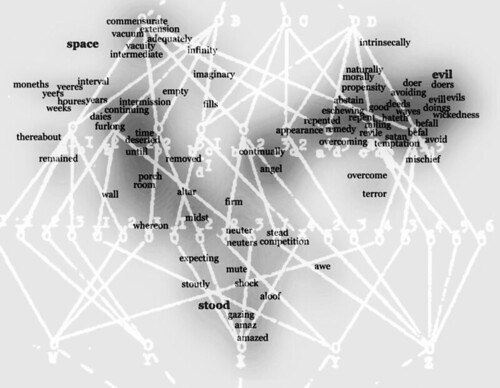
Gavin 5: Three modes of literary investigation and two binary distinctions [#DH]
Now that we’ve got two modes of semantic investigation on the table, statistical semantics and computational semantics, it’s time to add a third to the group. It’s been there all along, of course: close-reading. But it’s not about semantics at all, at least not as I’m using the term in this discussion. It’s about meaning. Semantics and meaning, that’s our first binary distinction.
Semantics and meaning
I hold that meaning – the meaning of literary works or of any work of art – is inherently subjective. Semantic analysis, in contrast, takes place in the object realm, if you will. That doesn’t mean that semantic analysis is necessarily or inherently objective in the sense of objective truth. That’s a different issue.
Here we need a distinction made by John Searle [1]. Both subjective and objective must be considered in ontological and epistemological senses. Color is ontologically subjective in this sense though, allowing for color blindness (which is fairly well understood), it is epistemologically objective. That is, color exists in minds of perceivers, not in phenomena, but the perceptual apparatus of perceivers is such that they agree on colors, where agreement is ascertained by matching color swatches (are they the same or different?), rather than naming the colors, which can vary from one individual to another, not to mention variation in cultural conventions about color names.
The meaning of texts is subjective in the ontological sense. That is the kind of phenomenon meaning is; it exists within the minds of subjects. Attempts to assay meaning through critical essays, moreover, seem to be subjective in the epistemological sense; they vary from one literary critic to another. I note, however, subjects may and often do converse with one another; intersubjectivity is possible.
Now consider Gavin’s vector semantics, or any type of statistical semantics. Whatever the specific statistical technique, it is grounded in a corpus. In Gavin’s case the corpus consists of 18,351 documents from 1640 to 1699 [2]. Gavin then constructed a Word Space using an explicit set of procedures. It is that Word Space that Gavin queried with words and sets of words from Paradise Lost, again using explicit procedures.
First, there is a clear and explicit distinction between the words of Milton’s text and the constructions of Gavin’s Word Space model and his queries against that model. The visualizations Gavin uses are one thing, Milton’s texts is another. They are different objects, though related by an explicit procedure [3].
That is not the case with ordinary interpretation. Whatever the critic believes may being going on in an author’s or a reader’s mind, the critic has no way of talking about that except through the words in the text under discussion – plus any interpretive apparatus they bring to bear on those words. The relationship between the terms and concepts of that interpretive apparatus and the words in the text exists in the critic’s mind and is not open to public inspection and, for that matter, resists introspection as well.
Moreover what Gavin did is, at least in theory, reproducible. In practice, not quite. He has noted in supporting material [4]:
Here's where I must apologize to any readers interested in recreating the exact images that appear in the article. I failed to preserve the scripts used when generating the charts and so I'm not sure exactly which parameters I used. As a result, following the commands below will result in slightly different layouts and slightly different most-similar word lists. These differences do not, I trust, affect the main points I'm hoping to make in the article, but they are worth noting. Following the instructions below will closely but not perfectly replicate what appears in Critical Inquiry. Also, it's worth noting that when creating the images in R, I exported them to PDF and tweaked them in Inkscape, adjusting the font and spacing for readability.
If he’d preserved those scripts, then others could run them and get the same results.
The point then is that we’re working in a world where there’s a great deal of explicit inference and construction, far more than is the case with traditional criticism – a point David Ramsey has made somewhere, though I’ve forgotten the citation.
The some is true for computational semantics. However a computational model is constructed, it is clearly a different conceptual object from and text one applies it to. In the example I gave in my previous post [5] the computational model I outlined is clearly distinct from the words of Shakespeare’s sonnet. Just how and why a specific construction is included in the model – there may be a reason grounded in empirical evidence from psychology, or there may be a more or less arbitrary computational reason – that’s a secondary issue at this point. My only point here is that these models are explicit, open to public inspection, and distinctly different from any text. Whether or not they represent are valid accounts of the human mind, that’s a different issue. It’s an important issue, but not my immediate concern.
Two kinds of semantic model
As I’ve already discussed the differences between statistical semantics and computational semantics in previous posts [6] I won’t go into any detail here. Statistical semantics is a way of analyzing semantic relationships between words. Computational semantics was devised to enact a semantic process. Some investigators conceive of that process as a simulation of a human mind while others are content to think of it as an artificially conceived process designed to achieve a practical result. In the large that’s an important difference, but for the purposes of this post, that difference is not so significant. What’s important is that we conceive of language processes as being computational in kind.
I note that there is a discipline called computational narratology [7] that draws on this work. The people who program computer games draw on techniques pioneered in this work. And why not, they’re in the business of telling stories, albeit interactively with the help of game players.
Female Founders Please Apply
I love this look at statistical variation in hypothesizing why cognitively diverse teams help explain why mixed gender teams do better than all-male founding teams. #FemaleFoundersPleaseApply @SOSVvc“what female founders bring to the table” by @kdkirkpat https://t.co/UJhxNje5C8
— Sean OSullivan (@sean_sosv) August 16, 2018
Wednesday, August 15, 2018
Interpreting Melania’s Jacket [#melaniasjacket #melania + #omarosa]
Extra! Extra! Omarosa weights in, see addendum below.
Addendum: From Rebecca Jennings, Racked, Aug 15, 2018:
* * * * *
Do you really think a former model going out in front of cameras doesn’t consider her clothing a statement? #melaniasjacket pic.twitter.com/4U2p5We2dl— Jackie Brown (@bluesinvitation) June 21, 2018
A couple of weeks ago First Lady Melania Trump was photographed in a jacket which had “I REALLY DON’T CARE, DO U?” written on the back. Chaos ensued. Well, not exactly chaos, but rampant speculation about what she meant by that statement.
The statement itself seems harmless enough, a vague undirected statement of detachment or nonchalance. But such a statement seems, on the surface, in conflict with the context in which she wore the jacked. In the photo above (to the left) she is boarding an airplane to fly to a detention center for immigrant children. The children’s families attempted an illegal border crossing, had been caught, and the children had been separated from their parents. This policy was (and is) enormously controversial and is strongly identified with her husband, President Donald Trump, who’d made cracking down on immigration a cornerstone of his policy. That controversy was at a fever pitch when the First Lady got on the plane.
Such a trip is ordinarily an expression of sympathy. But if the First Lady was sympathetic to the children, then why wear a jacket that expresses detachment on its back? Is she saying, in effect, that she’s not at all concerned about/for the children? If so, isn’t that a terrible thing? But then, isn’t her husband a terrible president? And thus the full force of anti-Trump sentiment became directed at Melania and her jacket.
Abstractly considered, it’s possible that she just grabbed the jacket on the way out the door without thinking about it. But, as the tweet above points out, she once made a living by wearing clothes for the camera. It seems unlikely that she’d be so cavalier. She had some intention, but what?
I surely don’t know. It’s possible that she had something specific in mind, for a specific audience. It’s also possible that she thought about it and picked that jacket on a purely intuitive basis, sure that it was just the thing, but without an explicit sense of what that thing is. I don’t know.
* * * * *
To what degree or in what way are literary texts like the writing on Melania’s jacket? So-called formalists have argued that literary texts contain their meaning within themselves. Hence we don’t need to know anything about the author or the historical context in order to determine the meaning of the text. But not all literary critics are formalists, not by a long shot. For these critics, context is essential.
In the case of Melania’s jacket context, yes, is essential. But it is not definitive, not for those of us without access to Melania’s mind. And maybe not even for Melania herself. She had a certain intention when she first put the jacket on and was photographed wearing it. Has that intention remain intact through the ensuring controversy?
Today’s visit w the children in Texas impacted @flotus greatly. If media would spend their time & energy on her actions & efforts to help kids - rather than speculate & focus on her wardrobe - we could get so much accomplished on behalf of children. #SheCares #ItsJustAJacket— Stephanie Grisham (@StephGrisham45) June 21, 2018
* * * * *
Addendum: From Rebecca Jennings, Racked, Aug 15, 2018:
Between the “salacious allegations,” “wild tales,” and “gossipy asides,” as Vox put it comes Omarosa’s opinion of how Melania used her style — and specifically the jacket — to send a message not to the media but to her husband:
I believe Melania uses style to punish her husband. It’s my opinion that Melania was forced to go to the border that day in June, essentially, to mop up her husband’s mess. She wore that jacket to hurt Trump, setting off a controversy that he would have to fix, prolonging the conversation about the administration’s insensitivity, ruining the trip itself, and trying to make sure that no one asked her to do something like that again. Not that Melania doesn’t have compassion for immigrant children; I’m sure she does. But she gladly, spitefully, wrecked her husband’s directives to make him look foolish.If true, it falls squarely into the suggestion, often coming from liberals, that Melania is somewhat of a prisoner in her marriage (e.g., the chorus of “Melania, blink twice if you need help” posters at the Women’s March).
It also echoes the widely held belief that even though Melania doesn’t say much, she’s constantly communicating through her clothes.
Leg exercise is critical to brain and nervous system health (in mice)
Here's the original paper:Groundbreaking research shows that neurological health depends as much on signals sent by the body’s large, leg muscles to the brain as it does on directives from the brain to the muscles. Published in Frontiers in Neuroscience, the study fundamentally alters brain and nervous system medicine — giving doctors new clues as to why patients with motor neuron disease, multiple sclerosis, spinal muscular atrophy and other neurological diseases often rapidly decline when their movement becomes limited.“Our study supports the notion that people who are unable to do load-bearing exercises — such as patients who are bed-ridden, or even astronauts on extended travel — not only lose muscle mass, but their body chemistry is altered at the cellular level and even their nervous system is adversely impacted,” says Dr. Raffaella Adami from the Università degli Studi di Milano, Italy.
Adami Raffaella, Pagano Jessica, Colombo Michela, Platonova Natalia, Recchia Deborah, Chiaramonte Raffaella, Bottinelli Roberto, Canepari Monica, Bottai Daniele, Reduction of Movement in Neurological Diseases: Effects on Neural Stem Cells Characteristics, Frontiers in Neuroscience, 12, 2018, Article 336.
DOI=10.3389/fnins.2018.00336
ISSN=1662-453X
Abstract: Both astronauts and patients affected by chronic movement-limiting pathologies face impairment in muscle and/or brain performance. Increased patient survival expectations and the expected longer stays in space by astronauts may result in prolonged motor deprivation and consequent pathological effects. Severe movement limitation can influence not only the motor and metabolic systems but also the nervous system, altering neurogenesis and the interaction between motoneurons and muscle cells. Little information is yet available about the effect of prolonged muscle disuse on neural stem cells characteristics. Our in vitro study aims to fill this gap by focusing on the biological and molecular properties of neural stem cells (NSCs). Our analysis shows that NSCs derived from the SVZ of HU mice had shown a reduced proliferation capability and an altered cell cycle. Furthermore, NSCs obtained from HU animals present an incomplete differentiation/maturation. The overall results support the existence of a link between reduction of exercise and muscle disuse and metabolism in the brain and thus represent valuable new information that could clarify how circumstances such as the absence of load and the lack of movement that occurs in people with some neurological diseases, may affect the properties of NSCs and contribute to the negative manifestations of these conditions.
Tuesday, August 14, 2018
The sordid truth about true romance as revealed by online dating markets
Dating in Seattle: write a lot of stuff that's kind of negative. https://t.co/QtWzOvkdMq pic.twitter.com/5iQvs74wSQ— Simon DeDeo (@SimonDeDeo) August 14, 2018
The article's abstract:
Elizabeth E. Bruch1, and M. E. J. Newman, Aspirational pursuit of mates in online dating markets, Science Advances 08 Aug 2018: Vol. 4, no. 8, eaap9815Romantic courtship is often described as taking place in a dating market where men and women compete for mates, but the detailed structure and dynamics of dating markets have historically been difficult to quantify for lack of suitable data. In recent years, however, the advent and vigorous growth of the online dating industry has provided a rich new source of information on mate pursuit. We present an empirical analysis of heterosexual dating markets in four large U.S. cities using data from a popular, free online dating service. We show that competition for mates creates a pronounced hierarchy of desirability that correlates strongly with user demographics and is remarkably consistent across cities. We find that both men and women pursue partners who are on average about 25% more desirable than themselves by our measures and that they use different messaging strategies with partners of different desirability. We also find that the probability of receiving a response to an advance drops markedly with increasing difference in desirability between the pursuer and the pursued. Strategic behaviors can improve one’s chances of attracting a more desirable mate, although the effects are modest,
DOI: 10.1126/sciadv.aap9815
Subscribe to:
Posts (Atom)