Thursday, September 20, 2018

Is something rotten in the heart of Wikipedia?

For example:
First, Wikipedia no longer has over 100,000 editors. The number of active editors has been declining for over a decade, even as fewer new editors join the site. MIT researchers found the “complex bureaucracy” and “hard-line responses to newcomers’ mistakes” were the primary reasons why would-be editors opted not to stick around. Meanwhile, the site’s core of “active” editors decreased from 2007 to 2015 by 40%, dropping to about 30,000.1 In 2017, Purdue University reported that just one percent of those editors had made 77% of the total edits.2 The rate of changes rejected climbed from 6% in 2006 to 25% in 2010,3 and the site bans 1,000 IP addresses a day.4 “Edit wars” are resolved by silencing them. Editors who hang on long enough to become administrators capable of freezing and deleting entries no longer feel compelled to abide by Wikipedia’s rules, and statistics show that the number of editors approved to become administrators has plummeted since 2007.5 Wikipedia is an oligarchy with all the problems that entails. One set of rules exists for the user-citizen, and one for the ruling class of administrators and senior editors.
More at Helen Buyniski, Wikipedia: Rotten to the Core?

Like this, for example:
“Charitable organizations” like Wikimedia are barred from operating for the benefit of “private interests,” with no part of a group’s “net earnings” accruing “to the benefit of any private shareholder or individual.”19 Yet Wales was so fond of his Wikimedia credit card he was relieved of it in 2006, after it was revealed that he was billing $1,300 steak dinners and other outsize expenses to the “charity.”20 Wales, like some of his editors, takes Wikipedia’s rules as mere suggestions. From minor tweaks to entries belonging to his famous friends21 to more extensive reputational rehab for a girlfriend22 to wholesale rewriting of his own history,23 he has earned the “god king” nickname bestowed upon him by his adoring public. Openly disregarding Wikipedia’s laws while enforcing them on everyone else, Wales has made Wikipedia a microcosm of the society that birthed it. Is it any wonder that the same injustices so rife in America today are playing out on our computer screens as well – that the wealthy and well-connected are subject to different rules than the rest of us?
The list goes on and on.

Frank Zappa meets Philly Joe Jones, what a concept...and there's more!


Wednesday, September 19, 2018

In days of old...

IMGP6025rd

20141123-_IGP0170

Star struck and broken down: Reflections on the case of Avital Ronell, Nimrod Reitman, and the rest

A new working paper, title above, link, abstract, contents, and introduction below:


Abstract: In the summer of 2018 a scandal broke out at New York University concerning the way a senior literary critic, Avital Ronell, had exploited a graduate student, Nimrod Reitman. This paper examines this scandal in the general context of academic literary criticism as it developed in the third quarter of the 20th century, eventuating in the phenomenon of the “star” critic. Ronell is such a star. Stardom is one thing, however, and is specific to the particular conditions of literary criticism. Abuse is a different phenomenon, tied to personal behavior and informal local norms. The paper includes a close analysis of a short article Ronell wrote on the occasion of the death of Jacques Derrida, her teacher and mentor.

Contents

Introduction: Sorting things out 2
How did literary criticism come to this foul pass? [#AvitalRonell] 4
Lit crit stars, real or an illusion? 9
The case of Paul de Man 12
Identity, gossip, and the personal 13
The lure of the esoteric 15
Comments on a short text Avital Ronell wrote to honor and remember Derrida 18
Roshomon redux, the case of Avital Ronell, Nimrod Reitman, and NYU 24
Appendix: The triumph of interpretation (aka “reading”) 28
 
Introduction: Sorting things out

Until several weeks ago Avital Ronell was little more than a name that I associated with Continental thought, I don’t know, maybe I even associated it with deconstruction. Then the scandal broke. I read a tweet Corey Robin posted in mid-August (see p. 4) in which he examined the complaint Reitman had filed against Ronell and NYU. That’s what got me interested in the case. Robin’s point was simple, regardless of what had actually happened between Reitman and Ronell, regardless of Ronell’s star status, it was clear that this relationship took up an enormous amount of Reitman’s time, as though Ronell recognized no boundary between herself and Reitman.

That’s what interested, this lack of boundaries. Why? Because I’ve spent a fair amount of time thinking about what happened to literary criticism in the 1960s and 1970s. Critics started referring to analytic interpretation as reading, thus eliding a boundary between ordinary reading, which any literate person does, and interpretation, a professional activity normally expressed in written articles or conference papers (see the appendix, p. 28 ff.). Was there some connection here, a connection between boundary loss within critical practice, where interpretation collapses into reading, and in pedagogical practice, where Ronell elided the boundary between herself and her student?

I posed and explored that question in my first post, “How did literary criticism come to this foul pass? [#AvitalRonell]” (pp. 4 ff.), where I also examined a 1997 article David Shumway had published about “stars” in literary theory, which I continued to explore in a second post, “Lit crit stars, real or an illusion?” (pp. 9 ff.). In another post I noted the star status of Paul de Man and the controversy that arose around his anti-semitic journalism during World War II (pp. 12 ff.). A fourth post, “Identity, gossip, and the personal” (pp. 13 ff.) considered the relationship between the critic’s identity and the valence of their critical statements and a fifth looked at the use of often obscure technical terminology, “The lure of the esoteric” (pp. 15 ff.).

The upshot is that, rightly or wrongly, I satisfied myself that there is a relation ship between the collapse of critical interpretation into mere reading in the 1960s and 1970s and the emergence of the literary star in the 1980s and 1990s. We must be careful, however, for, as Shumway was careful to point out, the phenomenon of the star literary critic is a bit different from intellectual prominence in other disciplines. The star critic assumes a status that is, in a way, like that of the canonical authors they study and interpret. The significance of such a critic’s writings is thus dependent on their personal imprimature, their charisma, above and beyond any arguments they may make. Hence the importance of word play and allusion, which have little evidentiary or logical value, but are a vehicle for virtuoso display, for the expression of personal charisma.

And so I undertook an analysis of a short piece by Ronell, “Comments on a short text Avital Ronell wrote to honor and remember Derrida” (pp. 18 ff.). She had been a student of his. In this piece, one of eighteen published in a special section in PMLA in 2005, she rather boldly declares herself to be his intellectual heir and successor. No, she doesn’t say so explicitly, but that is what she DOES, with great virtuosity and wit, and no little vanity, vanity either acceptable to the journal’s editors or simply unrecognized as such.

That leaves us with one more piece, “Roshomon redux, the case of Avital Ronell, Nimrod Reitman, and NYU” (pp. 24 ff.). Here I present statements by six others, without any comment from me: Marjorie Perloff (a senior academic now retired), Andrea Long Chu (a graduate student who had studied with Ronell), William Cheung
 (another graduate student), Bernd Hüppauf (a retired academic who had hired her at NYU), Heidi Haitri (an artist and, I assume, a friend), and Corey Robin (an academic political scientist).

What have I learned from this? That’s hard to say. There’s a lingering sadness, and anger, sadness over the pain and suffering at the heart of this story, anger at the institutional conditions that allowed it to happen. By institutional conditions I mean both the evolution of literary and cultural criticism that eventuated in the star phenomenon and the administrative arrangements that gave Ronell the power to exploit Reitman in this way.

I also learned something more specific. When I started this line of exploration I was looking for a connection between the intellectual conditions of literary theory, on the one hand, and Ronell’s treatment of Reitman on the other. I’ve decided that the connection is not so direct as I had set out to discover. Yes, there is a connection between those intellectual conditions and the phenomenon of the lit crit star, and Ronell was certainly such a star. That is one thing.

But lit crit stars do not necessarily exploit graduate students in the way Ronell exploited Reitman. This is a matter both of individual behavior and local informal norms. I certainly don’t have any general knowledge of the relationship between such stars and their students, though I have known a star or two (before they’d become stars), but I have no reason to believe they all comport themselves like this, though some might. On the other hand, there have been a number of cases abuse and exploitation by prominent and influential academics in other fields, fields that never had stardom in this sense. That is the other thing.

So we have stardom on the one hand, exploitation and abuse on the other. They are separate phenomena which happened to be conjoined in this particular case. In retrospect that seems obvious.

In this particular case it seems to me that much of the reaction to this case is closely tied to widespread animus against postmodern, deconstructionist literary criticism (aka theory) of the kind practiced by Ronell (and many of her defenders). Concern for and about Ronell and Reitman, who after all are strangers to most of us, is secondary. I know that assertion would benefit from a kind of argument that I’ve not really made in this paper. But I offer it as an indication of the atmosphere in which I undertook this work. It’s the smoke in that atmosphere, if you will, that I had to cut though in order to arrive at the otherwise obvious conclusion of the previous paragraph.

The craft of curve-fitting [FAKE SCIENCE!]


Quantum computing explained for you and me


H/t 3QD.

Tuesday, September 18, 2018

Dancing, drumming

20140928-IMGP0943

20170924-_IGP0574

20160827-_IGP7102

For the love of all that jazz is, by what authority does Houston A. Baker, Jr. claim John Coltrane for deconstruction? – A parable about truth and fiction in the form of a close reading

Yes, in the scheme of things it’s a minor matter, I know. But still.

Back in 2005 PMLA published eighteen short pieces in honor of Jacques Derrida, who had died the previous year:
Forum: The Legacy of Jacques Derrida, PMLA 120:2 (Mar. 2005) 464-494.
Houston A. Baker, Jr. contributed one of them. While most of the pieces were about some aspect of Derrida’s thought, Baker’s was more informal. It was a set of anecdotes about how he became acquainted with Derrida’s ideas, one of which was about meeting Derrida.

The first anecdote is set during Baker’s first job, at Yale in 1969:
My new office mate was Joseph Graham, of Yale’s French department. He was cosmopolitan in every way that matters to a young academic male: dress, ambition, gustatory predilection, intellect, foreign language fluency—a vernacular cache that consistently produces genuflection in the United States. Joe was a man of European sophistication. At our first meeting, he held a single, unbroken orange peel before me like a rabbit from a magician’s hat. (466)
That orange peel returns twice more before the end of that paragraph, and some orange or another shows up in five other places in the piece. It’s a motif, or given Baker’s vernacular proclivities, a riff, that helps tie the whole thing together.

It’s an artistic device, and this is more an artistic piece than an intellectual one. As I said, it’s built around anecdotes, a set of narratives. The last anecdote – the climactic one? – is about having dinner with Derrida.

It’s the summer of 1988 and Baker’s giving a seminar at the School for Criticism and Theory at Dartmouth. Derrida visited SCT to present a lecture on Zionism and the Jewish state. Baker and his wife were among the group invited to dine with him.
He was unpretentious, yet scintillating.

He talked softly and brilliantly of Algerian and African matters and shared his own calm realization that Afro-American literary and cultural studies might benefit (enormously) from an agon with Western metaphysics. The coup de grâce arrived, however, when Jacques assured my wife that he deeply admired John Coltrane. He chuckled: “People in France ask me, What does Giant Steps mean? I tell them it is like everything else: ‘It don’t mean a thing!’” Arguably, I want to assert that at that moment he pulled out his pipe (which was not, of course, a pipe) and quietly relaxed into his own joyous cosmopolitan sagacity. (467-68)
Passing over that unpretentious but scintillating rosé and setting aside Derrida’s joyous pipe-smoking sagacity, there’s a noticeable mismatch here. Giant Steps has a fairly specific place in jazz history. Derrida’s answer to the query doesn’t address that specificity.

If Baker’s piece had ended here, however, I likely would have dropped it. But it didn’t, and I can’t.

Baker decided to double down on Coltrane. The fourth and last section of the piece was entitled “Coda”. The term, as you know, is a musical one, surely no accident in a piece that’s referencing John Coltrane. A coda is the final section of a piece, one that is generally outside the piece’s basic structure.

I note, by way of larger context, that Baker’s is the only one of the eighteen pieces that has subtitles. They are all, after all, short pieces. The others didn’t call for subtitles. Why does Baker’s have them?

I’m surmising that, like the orange peel, it’s a matter of artistic craft. Baker mentions one of his books, Blues, Ideology, and Afro-American Literature: A Vernacular Theory, noting that it “is as antimetaphysically and profoundly indebted to Derrida as anything I have ever written” (467). Well the blues is typically a three-part form. Baker knows that, readers of PMLA know that, heck, everyone knows that, no? The coda is Baker’s fourth section. What about the other tree? Is that formal division an oblique reference to the three-part form of the blues? Is Baker’s homage to Derrida a blues homage, a performance in the African-American vernacular?

Here’s the first paragraph, of three, in Baker’s coda:
The loss is unspeakable. We are emptied. The last word has been spoken. Denigrations of the amazing openings created by Derrida come from men and women who do not — they really, really do not — appreciate Coltrane, nor do they love the all-inclusive spectral black light of multiplicity or have any capacity to savor bright oranges on a summer day.
What does John Coltrane have to do with deconstruction. What? Does the fact that Derrida likes Coltrane somehow link him to deconstruction? Derrida liked many things. Are we thereby going to link them all to deconstruction? That doesn’t make much sense. And how did oranges get roped into deconstruction? I can half-way imagine constructing an actual argument linking Coltrane to deconstruction, one that makes reference to the technical language of jazz analysis. But oranges!? That’s not even wrong; it’s nonsense. It’s assertion pure and simple, a power play.

Monday, September 17, 2018

A bit of friendly conversation

Impeach them all.jpg

Trumposaurus Rex @ 3QD – Toward a cybernetic interpretation

That’s what my current piece at 3 Quarks Daily is about, Feed Me Donald! – Trump, Musk, The Internet, And Monsters From The Id. I start with Elon Musk’s conversation with Joe Rogan. For example:
Elon Musk: A company is essentially a cybernetic collective of people and machines. That’s what a company is. There’s different levels of complexity in the ways these companies are formed. ...

Joe Rogan: Humans and electronics all interfacing, and constantly now, constantly connected.
And then on to my buddy David’s report of Trump’s performance at AIPAC (American Israel Public Affairs Committee) in 2016:
These were not Trump supporters. It is AIPAC’s tradition to cheer for good rousing lines. Standing ovations are not endorsements. On the other hand, you can see how the cameras may have shown us being turned into a Trump mob. And maybe we were. Maybe you would have stood and cheered, too. Yet at the very moment I became part of the mob, I had this sudden schizoid flash of rational clear sight into Trump. I saw, I mean really saw, the Trumposaur in its naked, primitive state.
And then I toss some lines from Little Shop of Horrors, a 1986 rock horror musical comedy. These lines are being sung by a blood-drinking carnivorous plant with luscious lips and no eyes:
Feed me! Feed me! Feed me!
Feed me, Seymour
Feed me all night long
That's right, boy
You can do it
Feed me, Seymour
Feed me all night long
‘Cause if you feed me, Seymour
I can grow up big and strong
Except that you’re supposed to hear it as “Feed me Donald” and the plant is Trump’s smart phone, the one he uses to issue his tweets, the personal ones that go zinging into the cyberverse at three in the morning where they end up on Fox News and scoot under the skirt of The Gray Lady (aka The New York Times), giving her a vile thrill she experiences as $$$$.

All night, baby, all night long. Just you and me. So good! So good!

And if Trump feeds his smart phone, what’s he get from it? Why satisfaction of course. Just what gives him satisfaction, only he knows, and he probably doesn’t know it all that well, though he’s been feeding it all its life. Word is that he’s got an endless need for praise and approval and he does whatever he can to get it. For the purposes of this piece I’m willing to let it go at that.

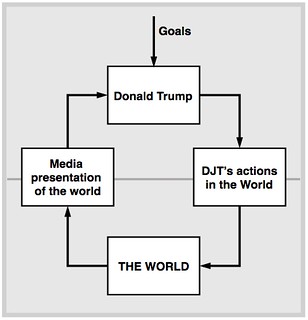
Consider this diagram, which is a standard cybernetic diagram I’ve adapted from William Powers, Behavior: The Control of Perception (1973) – a classic, if you haven’t read it, you should:

T-Rex1

We’ve got Donald Trump at the top; he’s governed by his goals (aka reference levels), endless praise and approval. At the left we’ve got the media’s presentation of the world, which is DJT's Input Function. THAT’s what Trump attends to; that’s what he cares about. Everything he does is intended to have effects there. That’s what he’s trying to control.

He attempts to control them through various actions (aka Output Function), which I’ve grouped together at the right. Those actions in turn have some effect on the world; there it is, at the bottom. The world is big and complicated, lots going on. While Trump, as President of the United States, is undoubtedly one of the most powerful men in the world, if not THE most powerful man in the world, the sorry (or fortunate, depending on your POV) fact is there’s not a lot he can do to affect the world. He can certainly do something, more than you and me, but not a lot.

Whatever it is that Trump does, it scatters and dissipates into the world, the world does what it does, and the media takes note. That brings us back to the box there at the left (aka input function). Of course Trump does pay attention to everything in the media, just a little bit of it.

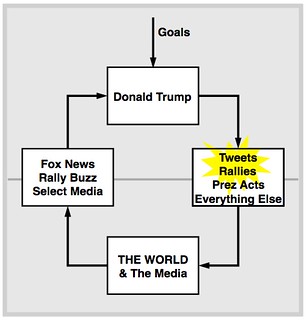
Let’s add a little detail to the diagram:

T-Rex 2c

I’ve divided his actions into four categories: 1) Tweets, 2) campaign-style Rallies, 3) Presidential Actions of all kinds, and 4) Everything Else. Over at the left I’ve singled out Fox News, which apparently is his favorite source of media input and grouped his other media into Select Media (of whatever kind, cable TV, print, internet, etc.). That box now contains only the media Trump attends to, nothing else, and I’ve shuffled everything else down there into the world (where it is in any case). But I’ve also added Rally Buzz to Trump’s input function. That’s clearly important to him, and that isn’t mediated by any media at all. He gets that directly.

Trump’s major innovations are those (unofficial) tweets and those rallies. Forget about all those ways he violates presidential norms, including keeping some undisclosed degree of control over his businesses. It’s not that they’re unimportant – certainly they are. But all presidents have bent the rules and gone off the farm now and then. It’s not new, though Trump may well be doing more of it than any others. But none of them have produced flotilla after flotilla of personal tweets and none have done all those campaign-style rallies. Those are new.

Why’s he do it? Isn’t that obvious? The rallies and the tweets are his most direct means of gaining some control over what appears in his input function. The rallies give him precious direct real-time feedback. Alas, he can’t do them every day.

But those tweets, he can do them every day. The effect is not so immediate as the rally buzz, and it is often unpleasant rather than favorable, but it’s fairly predictable. Those tweets show up on Fox and they show up in all sort of media, including that august bastion of FAKE NEWS, The New York Times. In fact, even when the feedback is nasty, that’s OK for Trump as long as he’d anticipated that nasty feedback. Those tweets also reach his Base, and thus primes them for the rallies where they share the mutual satisfactions of direct interaction.

Of course, his tweets have other effects out there in the world, diffuse effects. Those effects he cannot control. As for the various actions he undertakes as president, well, it’s complicated. I’ll leave those complications as an exercise for the reader.

I note that one of the biggest and most important complications is time scale. A tweet may show up on the radar screen (Input Function) within hours, but, depending on its content, it may have effects the diffuse out across days or even weeks. The same is true for everything else Trump does as president. What about those tariffs? He calls for them in a tweet, a speech, whatever, then the chatter. In time the orders are issued. And then, and then the results come rippling in over weeks, months, years.

Sorting all those things out in order to fine-tune the system, that’s tough. Heck, it takes a whole federal bureaucracy to do that. But Trump can always emit another tweet and see what sticks.

Always.

Tweet.

Sunday, September 16, 2018

Ghost crane

20180901-P1150742 Ct BWVrt

The original FAKE NEWS

Radio, though, was also a tool of tyrants. Joseph Goebbels, Hitler’s minister of propaganda, had a device installed in his office that allowed him to pre-empt national programming. He also hoped to sow division in the United States, partly through a shortwave radio system, the ministry’s “long-range propaganda artillery.” It spread lies about a “Communist Jewish conspiracy” that sounded like news reports, which the newspapers at the time referred to as “fake news.”

In 1938, Orson Welles tried to raise the alarm about fake news with his notorious radio broadcast of “War of the Worlds.” Fifteen minutes into the program, listeners began to call the station in terror, believing that the earth was really being invaded by Martians. A station supervisor asked Welles to halt the broadcast; Welles refused. Dorothy Thompson was grateful to him, writing in her column in The New York Herald-Tribune that Welles had “made a greater contribution to an understanding of Hitlerism, Mussolinism, Stalinism, anti-Semitism, and all the other terrorism of our times, more than will all the words about them that have been written.”

Religion among Trump supporters

The survey was conducted by the Cato Institute’s Emily Ekins for the Voter Study Group, who analyzed the views of Trump voters based on their frequency of church attendance — from “never” to “weekly” or more often. The trend was consistent: The more often a Trump voter attended church, the less white-identitarian they appeared, the more they expressed favorable views of racial minorities, and the less they agreed with populist arguments on trade and immigration.

The differences were particularly striking on race. For instance, a quarter of Trump voters who never attend church describe being white as “very important” to their identity; for the most frequent churchgoers voters, it was 9 percent. Among non-churchgoing Trump voters, only 48 percent had warm feelings toward black people, compared to 71 percent of weekly churchgoers; the same sort of pattern held for views of Hispanics, Asians and Jews.

Churchgoing Trump voters were still more culturally conservative than Hillary Clinton voters — more likely to support the death penalty, more skeptical of immigration — and their views of Muslims, interestingly, seemed to have been influenced by Trump’s own rhetoric, becoming more hostile between 2016 and 2017.

But in general, churchgoing Republicans look more like the party many elite conservatives wanted to believe existed before Trump came along — more racially-tolerant, more accepting of multiculturalism and globalization, and also more consistently libertarian on economics. Secularized Trump voters look more like the party as Trump has tried to remake it, blending an inchoate economic populism with strong racial resentments.