Friday, November 23, 2018

Power in Cultural Evolution and the Spread of Prosocial Norms


Abstract

According to cultural evolutionary theory in the tradition of Boyd and Richerson, cultural evolution is driven by individuals' learning biases, natural selection, and random forces. Learning biases lead people to preferentially acquire cultural variants with certain contents or in certain contexts. Natural selection favors individuals or groups with fitness-promoting variants. Durham (1991) argued that Boyd and Richerson's approach is based on a "radical individualism" that fails to recognize that cultural variants are often "imposed" on people regardless of their individual decisions. Fracchia and Lewontin (2005) raised a similar challenge, suggesting that the success of a variant is often determined by the degree of power backing it. With power, a ruler can impose beliefs or practices on a whole population by diktat, rendering all of the forces represented in cultural evolutionary models irrelevant. It is argued here, based on work by Boehm (1999, 2012), that, from at least the time of the early Middle Paleolithic, human bands were controlled by powerful coalitions of the majority that deliberately guided the development of moral norms to promote the common good. Cultural evolutionary models of the evolution of morality have been based on false premises. However, Durham (1991) and Fracchia and Lewontin's (2005) challenge does not undermine cultural evolutionary modeling in nonmoral domains.

How the Mercator projection misleads us about relative sizes of nations


Thursday, November 22, 2018

The Great Pumpkin?

20181022-P1160147

Yet more notes about the state of literary criticism, with an eye toward a somewhat different conceptual ontology

Yes, I know, I’ve been over this ground many times before, nor will this (ever) be the last. In particular, I’m thinking of this as following my recent post, Innovation, stagnation, and the construction of ideas and conceptual systems (Nov. 18, 2018). The field is obviously stagnant and that post is about the necessity for new conceptual foundations in the face of such stagnation. Literary criticism is in need of new conceptual foundations.

The lay of the current land

Since World War II interpretation has been the central activity of academic literary criticism and so-called close reading has been the method. The basic assumptions run something like this:
  • Literary texts have hidden meanings.
  • Those meanings are to be construed as assertions about the world.
  • Depending on one’s preferences those assertions may be assertions about facts or expressions of value (critique).
  • Again depending on conceptual preferences these meanings may be construed as being wholly ‘internal’ to the text (formalism) or as being dependent upon historical context (historicism).
Critical theory arose in the late 1960s and 1970s as a set of rubrics under which to construe those facts or critiques. New historicist methods simply ask the critic to place those assertions in historical context while the various identity based methods provide specific rubrics governing these assertions.

While the cognitive and evolutionary critical movements of the 1990s set themselves in opposition to ‘theory’, they nonetheless operate under the same general set of motivating assumptions. They simply offer different terms in which to couch statements about the factual implications of literary texts. The same holds for Rita Felski’s critique of critique.

It’s not clear to me what the neo-descriptivists are up to, mainly because they seem to spend more time theorizing description that actually doing it. While they recognize a distinction between description and interpretation it is not clear to me that they are interested in actually describing texts as opposed to describing, you know, the world (that happens to be represented in texts).

And then we have digital/computational criticism, ‘distant reading’, whatever you call it. As far as I can tell they pretty much accept those same basic assumptions, but they just want to do something else. Yes, that something else embodies a different and more specialized conception of language from the one operative in standard criticism, but they don’t quite focus on it. Rather, they treat it as a complex apparatus that’s ‘bolted onto the side’ of the standard critical approach.

And so we have the problem of ‘meaning’ vs. ‘distant reading’. The standard critic notices all the strange apparatus and doesn’t know what to make of it, but suspects that there’s something deeply wrong there. The digital critic recognizes that it is just different, and it is because it is JUST different, it is no threat. Why not? Because, you know, it’s just bolted onto the side.

How do we think of language?

Getting back to fundamentals, the standard view of criticism is committed a the commonsense view of language centered on the common sense notion of the word. The central thing about words is that they have meanings and its those meanings the critic is interested in. Yes, the words can taken over into a specialized conceptual domain and be analyzed into a signifier and a signfied, but that’s at best a secondary notion. When Geoffrey Hartman observes “modern ‘rithmatics’—semiotics, linguistics, and technical structuralism—are not the solution” (The Fate of Reading, p. 272), he is rejecting a specialized conception of language. He is, in effect, rejecting the concept of “NaCl” in favor of that of “salt” [1].

And that, I suspect, is why the kind of descriptive activity that is some obvious and straightforward to me appears to be at best awkward and secondary to ordinary literary critics. It isn’t centered on, focused on, meaning. That is to say, it doesn’t take the common sense notion of a word at face value. Rather, I am operating in a world, using a conceptual ontology, where the distinction between signifier and signified is central, not peripheral. When I am describing formal features of texts, I am focusing, not on the order of signifieds, but on the order of signifiers.

What interests literary critics about signifiers is that they can bear multiple meanings, hence the interest in complexity and ambiguity (cf. Empson). What interests me about signifiers is that they can be ordered and that order then ‘drives’ our reception and construal of signifieds. It represents, dare I say it? a Copernican shift in conceptual and analytic perspective. They look at words and are interested in meaning; I look at signs and am interested in formal arrangements of signifiers.

We’re operating in different conceptual worlds, different ways of construing the same phenomena.

Reference

[1] See this post, Ontology in Perception and Thought, New Savanna, September 27, 2014, https://new-savanna.blogspot.com/2011/05/ontology-in-perception-and-thought.html. For a more complete discussion, see William Benzon, Ontology of Common Sense, Handbook of Metaphysics and Ontology, Philosophia Verlag, 1991, pp. 159-161, https://www.academia.edu/28723042/Ontology_of_Common_Sense.

Around and about hte mouth of the Long Dock Tunnel in Jersey City


Wednesday, November 21, 2018

"Pattern" as a Term of Art [niche | TALENT SEARCH]

I'd originally posted this in July 2014. I'm bumping it to the top of the queue as it is directly relevant to my current interrogation of Tyler Cowen's Emergent Ventures

* * * * *

In continuing to think about pattern I remembered some old notes I’d made about the concept of a biological niche. I’d decided that a niche was a pattern that some organism “traced” or “inscribed” in an environment.

Back THEN I was using the concept of pattern to explicate the concept of niche. In this current context, the focus, of course, is on pattern.

That is, I am developing “pattern” as a term of art and so I want to recast the ordinary notion just a bit. The ordinary notion of patterns is that, well, they’re everywhere. The ordinary notion is indifferent to how patterns are identified. The means of identification is off stage; it’s not even implicit; it’s simply not there.

I’ve decided that that won’t do for my purposes. As a term of art the concept of pattern is inherently relational. As a tentative formulation, a PATTERN can be said to be inscribed in a matrix by a vehicle. In the case of a biological niche, the organism is the vehicle, the environment is the matrix, and adaptation (or perhaps merely living) is the means of inscription.

What I like about the niche discussion is that it isn’t about humans. The niche is not a pattern conceived by humans. That’s one thing.

The other is that patterns emerge as the result of a process. Niches emerge as organisms live and become adapted to their environment. The patterns I’m interested in are the result of human perception and cognition.

Here are my old notes, from 1988, somewhat edited.

* * * * *

Niche as Pattern

The last time I looked (in the 1970s) I was unable to find a clean definition of the niche, and of correlative terms such as environment and habitat. Environments are complex and so are organisms. The niche seems to be a pattern which exists only in the relationship between an organism and its environment.

There are biologists who talk about a niche as existing independently of any organism. The niche exists and the organism moves into it. This really isn't satisfactory. For there is a sense in which organisms create niches. And I’m not thinking of the concept of niche construction, where an animal actively modifies its environment by building nests and trails and so forth, though that is obviously as aspect of the process.

One can think of an organism as a set of capacities. Given some pre-existing organism, it creates a niche when placed into the appropriate environment, namely, an environment whose structure corresponds to the organism's capacities.

But, in fact, there is no such thing as a pre-existing organism. Organisms always exist in environments, to which they are always (more or less) adapted.

In the abstract we can imagine talking about the material, energetic, and informatic patterns which are such that organisms, perhaps of a specific chemistry (such as one based on carbon and oxygen), are evolved to exploit them. Consider the following definition (which presupposes the arguments in A Note on Why Natural Selection Leads to Complexity, or here as well):
A niche is a collection environmental phenomena in which low energy utilization of information allows an organism economically to obtain the energy and materials it needs to maintain its life.
As far as I can tell they only way to identify such a collection of environmental phenomena is to design and an organism which can successfully exploit them. And the best way to “design” such an organism is to evolve it.

I take it then that there is no way to identify a pattern of environmental affordances (to borrow a term from J. J. Gibson) independently of identifying an organism that utilizes them. To be sure, you may read a biologist talking about such things as “a niche for two kilogram night foraging herbivore,” but that’s only because they know that such creatures exist and have one in mind when writing those words. Such formulations sound like the biologist is simply looking at an environment and spelling out a niche pattern based on general theoretical notions. But those theoretical notions are based the examination of real organisms in real environments.

It’s irreducible: Niches are patterns, and those patterns are “identified” by the organisms that occupy the niches. That’s the simplest way. And it’s not very simple. The universe is irreducibly complex.

* * * * *

Pattern: Some Cases

We have this tentative definition from above:
A PATTERN can be said to be inscribed in a matrix by a vehicle.
Now we have something to think about more generally. But not now. For now I offer these lists:
Biological niche:
matrix: environment
vehicle: organism
inscription: adaptation
Perceptual pattern:
matrix: environment
vehicle: nervous system (animal or human)
inscription: learning
Cultural pattern:
matrix: the world
vehicle: the human group
inscription: cultural evolution

Lest we forget, they'll be back [an iris]

What’s a (metaphorical) moonshot? [TALENT SEARCH]

“Throughout the past year, Mercatus scholars have explored their personal and policy moonshots; Emergent Ventures is a step to making those moonshots a reality,” said Tyler Cowen, faculty director of the Mercatus Center. “By finding and taking chances on risk-taking, talented people with bold ideas, I believe we can reinvent the capacity for an intellectually-oriented philanthropy to improve the world.”
Why this talk of moonshots? It seems to be a popular term at Mercatus. A search of their site for “moonshot” turned up 77 hits (today, November 21, 2018 at 11:39 AM; it produced 92 hits when I searched it last night).

The term is being used metaphorically, of course, where America’s Project Apollo is the vehicle, to use a term of art, that conveys the intended meaning about some tenor, another term of art, some other project or venture. What meaning is supposed to be conveyed?

Let's list some moonshots

In an article, Deep Technologies & Moonshots: Should We Dare to Dream?, posted on September 18, 2018, Senior Research Fellow Adam Thierer, observes:
Don Boudreaux defines moonshots as, “radical but feasible solutions to important problems” and Mike Cushing has referred to them as “innovation that achieves the previously unthinkable.” “Deep technology” is another buzzword being used to describe such revolutionary and important innovations. Swati Chaturvedi of investment firm Propel[x] says deep technologies are innovations that are “built on tangible scientific discoveries or engineering innovations” and “are trying to solve big issues that really affect the world around them.”
A bit later:
More concretely, when people use these terms in reference to existing technologies, or ones currently on the drawing board, they often mention innovations like:
  • Artificial intelligence / machine learning / robotics
  • 3D printing / additive manufacturing
  • Self-repairing / self-building objects
  • Driverless cars / flying cars (VTOL), supersonic transport
  • Private space travel / lunar mining
  • Clean power / alternative energy production
  • Genetic editing & life extension technologies
  • Implantable tech / human augmentation
  • Hyper-connected devices / wearable fitness / sensor tech / IoT
  • Precision medicine
  • Neural networks
  • Quantum computing
  • Nanotechnology / synthetic biology
  • Immersive technology (AT & VR)
This is just a partial list of the type of technologies that experts mention when discussing “moonshots,” deep tech,” and other “disruptive” or “transformative innovations.” What unifies them more than anything else is the potential for major improvements in human well-being. Significant advancements in these areas could lead to substantial jumps in human welfare, health, and longevity.
The question I’m thinking about is whether or not Project Apollo was a moonshot in this sense.

In what sense did it “lead to substantial jumps in human welfare, health, and longevity”? Oh, yes, there were side effects aplenty, from Tang to computers to propulsion systems and who knows what else, but what benefits have accrued from actually landing human beings on the moon?

So far the only benefits that I can see have been largely symbolic: We did it! We actually set foot on the moon. But how has that lead to benefits in human welfare?

Or, going back to his earlier paragraph, in what sense was landing on the moon a solution to an important problem? The problem it solved, if that’s how you want to put it, was boosting national morale in a technological race with the Soviet Union. And even at that Congressional funding was a bit iffy.

Crapshoots and sure things

Over two years ago Robert Graboyes and Thomas Stossel argued Curing Cancer Is Not a Moonshot (January 15, 2016). They set things up with this observation:
When President John F. Kennedy articulated his moonshot project in May 1961, it was a narrowly focused, clearly defined engineering problem. While costs and timelines were somewhat uncertain, tried-and-true principles of physics informed the engineers and made a successful lunar landing highly likely.
That is to say, landing humans on the moon was a difficult, but not particularly uncertain technological problem. It was expensive and so required substantial commitment, but it was not a long shot. The major risk was born by the astronauts themselves. Three died in a prelaunch test prior to Apollo 1 and Apollo 13 suffered an accident on route that made a lunar landing impossible, but the crew returned safely to Earth.

Graboyes and Stossel go on to observe:
Cancer, in contrast, is many different diseases demanding diverse treatments. Compared with the high-precision physical sciences that reliably guided NASA to the moon, the principles of biology are obscure and agonizingly unpredictable.
They then go on to argue curing cancer is not the sort of thing to be tackled by a large centrally controlled government organization. Rather, the private sector, with its entrepreneurial skills and drive is better suited to this mission. They may well be correct in that, but that’s secondary to my argument. Their contrast between the two projects, landing a man on the moon, curing cancer, is not. The second is still pretty much of a crapshoot, but the first was not.

An urban pastoral: Looking at Lower Manhattan from Liberty State Park in Jersey city [feel the heat]

Tuesday, November 20, 2018

How is Facebook going to regulate hate speech on its platform? An independent Supreme Court of Facebook?


Mark Zuckerberg has suggested that an independent oversight body should "determine the boundaries of acceptable speech on the platform". This raises a host of issues, most centrally:
What standards, past decisions and values will it consider when evaluating, for example, whether a particular post is “hate speech”?

This is not an easy question. Indeed, the difficulty of answering that question seems to be one of the reasons Zuckerberg wanted such an independent body in the first place. In March 2018, Zuckerberg told Recode, “I feel fundamentally uncomfortable sitting here in California at an office, making content policy decisions for people around the world. … [T]hings like where is the line on hate speech? I mean, who chose me to be the person that [decides]?” No doubt his unease with this situation was only furthered when he sparked off controversy by suggesting in a later interview that he didn’t think Holocaust deniers should be removed from Facebook—a perfect example of the difficulty Facebook faces. The U.S. has a famously expansive interpretation of free speech, and the court rulings that the First Amendment protected the right of Nazis to march in Skokie is remembered as one of the “truly great victories” in American legal history. By contrast, Holocaust denial is a crime in Germany. Putting aside the wisdom of either position, how should Facebook—a global platform connecting over two billion monthly users—respect conflicting standards of free speech, of which the example of Holocaust denial is only one?

Unfortunately, Zuckerberg’s Nov.15 Facebook post suggests he hasn’t given this issue enough attention. His post itself suggests several, sometimes contradictory, options. When he writes of the forthcoming independent body, he says, “How do we ensure their independence from Facebook, but also their commitment to the principles they must uphold?”—implying that the values in question are Facebook’s. These are embodied in the company’s Community Standards—which, along with its internal guidelines, are the rules that determine what content is allowed on the platform and which the 30,000 content reviewers use to make individual calls. Given these are the rules that the first-instance decision-maker will be applying, it makes sense that the tribunal should also be guided by them. This is consistent with Facebook’s goal that the standards “apply around the world to all types of content.”

But in his post, Zuckerberg also notes that “services must respect local content laws.” So will the Supreme Court of Facebook be charged with interpreting this local law? In deciding whether a post was justifiably taken down, will it interpret Thailand’s Lèse-Majesté laws prohibiting criticism of the Thai monarchy? Will it try and interpret the sometimes differing decisions of German regional courts on what is hate speech under German law?

Zuckerberg also suggests that “it's important for society to agree on how to reduce [harmful content] to a minimum—and where the lines should be drawn between free expression and safety.” If it’s society that decides the lines for free expression, how will the independent body determine what society’s views are? Will it take polls? If so, will those polls be national, regional or global? Will Facebook take into consideration national voting ages? Furthermore, doesn’t leaving the decisions to “society” risk undermining protection of minorities?

These options by no means exhaust the possibilities raised by Zuckerberg’s proposal in his post.
And:
Though Zuckerberg appears to be seriously pursuing the idea, currently his conception of the independent body is more soundbite than substance. When he says that the SCOF [Supreme Court of Facebook] will “ultimately make the final judgment call on what should be acceptable speech in a community that reflects the social norms and values of people all around the world,” he sets an impossible goal. There is no homogenous global community whose norms can be reflected in the decisions of a single body deciding contentious issues. But that doesn’t mean the proposed body cannot be an important development in online governance, creating a venue for appeal and redress, transparency and dialogue, and through which the idea of free speech in the online global community develops a greater substantive meaning than simply “whatever the platform says it is.”

How the independent body is set up will determine whether it furthers or hinders rights to freedom of expression and due process. There is a rich literature in comparative law showing that decisions of institutional design can have significant impacts not only on outcomes but the entire stability and legitimacy of a governance structure.

Take me to your leader

20181013-P1160004

Even modest musical training enhances cognitive function, especially executive ability

Most of those enhanced abilities were limited to what they referred to as "music experts"—people who started training early in life, and kept at it for at least a decade. But one very important skillset, "executive functioning," was also bolstered for lightly trained amateur players.

This suggests that even limited training and practice can provide significant cognitive benefits.

In recent years, many studies have concluded that musical training enhances brain function. The goal of this new research was to confirm that link using the National Institute of Health's Toolbox Cognition Battery, a standardized set of tests that measure the key cognitive functions that together constitute fluid intelligence.

These include focus, processing speed, working memory (the ability to temporarily retain information and use it to learn, reason, or make informed decisions), and executive function (the ability to plan, organize, and accomplish goals).

The participants were 72 college undergraduates, who were grouped into three categories: Musical experts (people who began formal training at age 10 or younger, and kept up their practice for at least a decade); musical amateurs (those with at least one year of musical training); and non-musicians.

Combining the results of all the tests, "musicians with extensive experience scored significantly higher than non-musicians and less-trained musicians," the researchers write in the journal Psychology of Music. Specifically, they did better on four of the five cognitive skills that the tests measured.

These included attention ("ensemble performance requires the ability to focus on one's own part without being distracted by other parts," the researchers note); working memory (presumably strengthened by the process of memorizing music); and processing speed (which is enhanced by learning to react rapidly to the demands of the music, as well as to those of collaborators).

The results of the executive-function test, which involved rapidly sorting pictures by shape and color, were arguably the most intriguing, in that modestly trained musicians performed significantly better than non-musicians (although not as well as highly trained musicians).

If that finding is confirmed using a larger sample, "then as a society, we should be interested in universal musical education, perhaps starting in elementary and pre-school-aged children," the researchers argue.

Monday, November 19, 2018

TALENT SEARCH: Tyler Cowen on the value of sole proprietor pop-up philanthropic shops [plus a widely shared blind spot in his thinking and a plug for a NASA administrator]

A week or so ago Tyler Cowen ran up a post on his philanthropic method, The philosophy and practicality of Emergent Ventures. He notes that traditional philanthropies have large staffs “which means relatively conservative, consensus-oriented proposals emerge at the end of the process.” Moreover “the high fixed costs of processing any request discriminate against very small proposals” and such foundations tend to become “captured by their staffs”, who tend to be treated as valued proxies for the foundation’s audience and thus further increase the conservative insularity of the decision process.

A sole proprietor pop-up philanthropic shop

All of which makes sense to me. In contrast, his approach in Emergent Ventures is quite different. He has no staff. Though he may seek advice from others, he makes all the decisions. The process is quick and cheap and the “arrangement also can promise donors 100% transmission of their money to recipients, or close to that.”

And so:
The solo evaluator — if he or she has the right skills of temperament and judgment — can take risks with the proposals, unencumbered by the need to cover fixed costs and keep “the foundation” up and running. Think of it as a “pop-up foundation,” akin to a pop-up restaurant, and you know who is the chef in the kitchen. It is analogous to a Singaporean food stall, namely with low fixed costs, small staff, and the chef’s ability to impose his or her own vision on the food.
Once a fixed sum of money is given away, and the mission of the project (beneficial social change) has been furthered, “the foundation” goes away. No one is laid off. Rather than crying over a vanquished institutional empire and laid off friends/co-workers, the solo evaluator in fact has a chance to get back to personally profitable work. It was “lean and mean” all along, except it wasn’t mean.
What’s not to like?

He goes on to suggest: “In my view, at least two percent of philanthropy should be run this way, and right now in the foundation world it is about zero percent.” He goes on to suggest: “The ideal scaling is that other, competing ‘chefs’ set up their own pop-up foundations.” YES to all of this.

In particular, what I like about this last suggestion is that it speaks to a blind spot in Cowen’s perception of what he’s up to, a perception that seems almost universally shared by people in the philanthropy business. What is that blind spot? Simple, that what they’re looking for is an attribute of individuals.

Talent, whatever that is, may well be an attribute of individuals. But, to the extent that Cowen is trying to increase innovation by identifying individuals whose work will be widely valued and used, he is in fact looking for a GOOD FIT between individual talent and social need and capacity. Let me repeat that in slightly different terms. Cowen is looking for individuals with a talent that has the capacity to fill a socio-cultural need. What’s missing from his formulation is explicit recognition of that fit, of the importance of socio-cultural context in determining whether or not individual talent will flourish.

Many sowers, many seeds

I’ll say a bit more about that later, but first I want to explain why his suggestion of limited-term sole-proprietor pop-up philanthropic shops speaks to that blindness. It’s simple, really. We are in an era of tremendous social cultural change. It’s pretty clear, at least to many of us, that the future cannot be extrapolated from the past. Something new and different is required. But just what that is, just what will work, no one really knows, though many have opinions. In particular, we don’t know what potentials are latent in the world today.

In that situation it makes sense to sow many seeds widely and quickly. Who should do the sowing? Talented people who are in touch with other talented people. Each of these people will have their own sense of the needs and potentials of the current cultural moment, each will have their own vision about the proper fit between talent and cultural opportunity. But don’t give any one of them too much philanthropic capacity. By endowing many talented people with limited philanthropic capacity you guarantee the placement of many bets over a wide range of future possibilities and potentialities.

Trees on trees

20181117-P1160580-2

20181111-P1160469-2

How am I doing at regulating my action at Academia.edu?

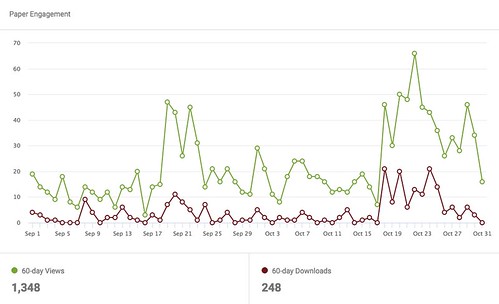
On Oct. 31 I posted this chart in a post that was otherwise about Donald Trump and his tweeting activity:

Academia 10-31-18 10AM

The chart depicts action on my page at Academica.edu, my main repository of articles and working papers. The green (upper) line shows how many papers views I got each day while the brown (lower) line shows downloads.

The point of the chart is that there are two periods of markedly increased activity, activity caused by my deliberate and conscious action. I then asked: “What are the chances that I can keep it going? Off hand, not good. I just don’t have that much of what seems to be the right material to keep it going.” That is, I knew what I did to drive the numbers up but I wasn’t prepared to keep doing that.

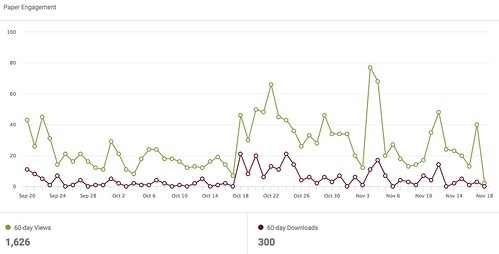
This chart depicts my action as of November 16 and 10:32 PM:

Aca 11-16-18 1032p

That certainly looks like I’ve managed to keep the action up for roughly the past month. To be sure, the action is spiky but it does appear that, on average, interest is up.

Here’s a chart I grabbed at 5:52 this morning, November 19, 2018:

Academia 11-19-18 552a

We’ve got a new spike there at the right edge of the chart. While it’s low in relation to the action for Nov 4 and 5, the high point of the chart (and I forget just what I did to produce that), it’s high in relation to the chart as a whole and, in particular, it’s in the range of the mid-September action that started this roll (and which is now trailing off the left edge of the graph).

I know exactly what I did this time. I sent the following note to the Humanist Discussion Group:
I don’t know how old you are, Jim (if i may), but I’ll be 71 in a few weeks and was publishing on literature and computation in the mid-1970s:

"Cognitive Networks and Literary Semantics", MLN 91: 1976, 952-982. Here I used a computational model to examine the semantic structure of Shakespeare’s sonnet 129. There’s a downloadable version of that article here: https://www.academia.edu/235111/Cognitive_Networks_and_Literary_Semantics

That same year David Hays and I published this, “Computational Linguistics and the Humanist”, Computers and the Humanities, Vol. 10. 1976, pp. 265-274. There we proposed something we called Prospero, a computer system for reading Shakespeare in some interesting way. Alas, the more we learn about both computing and about the mind/brain, the most distant that Prospero seems, but still, it’s worth thinking about. You can download that here: https://www.academia.edu/1334653/Computational_Linguistics_and_the_Humanist

Best,

Bill Benzon
That recent spike consists mostly of interest in those two papers, which is much stronger on views than actual downloads (as is generally the case).

I have no idea what will happen today. Of course, I do expect the numbers to rise above the floor, after all it’s 6 AM here on the East Coast of the USA, but just how high they’ll go, I still don’t know. Nor will I hazard a prediction about the future. But I’m pretty sure that if I want to keep the numbers up, I’ve got to upload a paper to the “sweet zone” pretty soon, and I don’t have anything that’s quite ready for upload.

We’ll see.