Showing posts sorted by relevance for query farrell. Sort by date Show all posts

Wednesday, October 23, 2019

Henry Farrell on weaponized interdependence & regulating the internet [Tyler Cowen interview]

A day later: I've had a chance to sleep on this conversation. My initial impression remains: one if Tyler's best. Why? I keep looking for hints of new ways of thinking about the world in-the-large, but I rarely find much. This conversation has hints, particularly concerning the relationships between large platform media companies and the nation-states in which they deploy their platforms. 

* * * * *

Tyler Cowen converses with (Crooked Timber's) Henry Farrell on this that and the other, including the internet:
COWEN: Now, we’re chatting in early October, and there were two huge stories today, both about weaponized interdependence. The first is that the European Union seems to be insisting that Facebook take down material posted on internets outside the European Union. What’s your view? Is that a good decision or a bad decision?

FARRELL: Well, when I’m looking at this stuff, I try to wear my hat —

COWEN: But I’m interviewing Henry Farrell, the person. Right?

FARRELL: Okay, let me back up and say two things. First of all, if I’m to think about this as a political scientist under my political science hat, what I would say is that this is something which is inevitable. And this is something which we’re going to see more and more of, which is that the internet for a long period — there was a kind of an equilibrium in which the United States managed to persuade everybody that self-regulation and platforms looking after their own business was more or less okay for most purposes.

That equilibrium has broken down. It has broken down in the US. It has broken down in Europe, and it has broken down in authoritarian societies in particular. So I think we’re going to see more and more efforts to try and use the platform companies effectively as a means of extending reach into other jurisdictions and imposing universal-type restrictions on what they can or cannot do.
And now:
If I want to think about this as an individual, what I would say is that I’m not at all happy with what the European Union is doing in specific here, but I do think that there needs to be much greater regulation of platform companies. And in the absence of the United States, I think that the European Union is the most plausible actor which has got the regulatory clout and the willingness to do so in a manner which is at least somewhat compatible with broad liberal norms.

So my basic attitude will be to push back against a specific decision but to say that if the choice is between the United States not regulating or perhaps regulating — perhaps that will be different under a possible Warren administration — and authoritarian states, that I would much prefer to have a robust European Union than any of the other actors that I can think of that have the clout and the ability to try and bring the platform companies to heel.
The second shoe drops:
COWEN: The second big story from today is from the world of basketball. As you probably know, Houston Rockets general manager Daryl Morey tweets in favor of the Hong Kong protests. It seems both the Rockets and the NBA forced him to delete the tweet and basically retract the statement. Who is in the wrong here? Daryl Morey, the Rockets, the NBA, China, everyone? What do you think?

FARRELL: Again, looking at this from my political science hat, this kind of stuff has been happening for a long, long time, but not so much to the United States. There’s a book by Blackwill and Harris, which came out with the Council on Foreign Relations a couple of years ago, which looks at how China has been imposing this kind of pressure against a variety of smaller countries, especially with respect to the Dalai Lama. And when China says jump, companies do tend to jump.

And of course, we’ve seen Hollywood for the last number of years has been quite sensitive to the Chinese market, most recently as exemplified by the decision to remove, I think it was the Taiwanese flag from the remake of Top Gun from the back of Tom Cruise’s jacket because this was perceived as being possibly provocative. So this is pretty standard stuff, and this tells us something about the way that businesses operate.

You can see the way that businesses operate globally as having both great benefits and great weaknesses. If one wants to think about the standard story about how interdependence, at least under some circumstances, creates peace because businesses have an incentive to try and create peaceful and happy relations between nations in order to secure their commerce, I think that there’s something to it, although as my work with Abe on weaponized interdependence suggests, there also are some clear limits to that as well.

But the obverse of this is that business is obviously in the business of making profits, and when there are clear political risks associated to business doing certain kinds of things, by and large, businesses are not going to be especially courageous. And this is particularly likely to be true of big firms, which I think are more likely to come under this kind of pressure.

One saw this already with regards to Hong Kong. There have been that airways chief executive who effectively got ousted. I’m trying to remember the company, but I can’t.

I think that this is, in a sense, if you want to outsource a lot of our decision-making about culture, about the ways that things ought to be done to business, this is what you’re going to expect, for better or for worse.
Wednesday, January 15, 2025

Henry Farrell: Biden moves to control global AI

Henry Farrell, America’s plan to control global AI, Programmable Mutter, Jan. 15. 2025.

The idea is to use export controls to restrict the selling and use of to achieve two U.S. policy goals. The first is its desire to keep the most advanced AI out of the grasp of China, for fear that China will use strong AI to undermine U.S. security. The second is its desire to allow some degree of continued access to semiconductors and AI in most countries, to mitigate the anticipated shrieks of protest from big U.S. firms that don’t want to see their export markets disappear.

Hence, this highly complex plan involves controlling access to the advanced semiconductors that are used to train advanced AI models, as well as the model ‘weights’ themselves. The plan continues to very sharply restrict China’s and some other countries’ access to highly advanced semiconductors [...] It allows a much more liberal regime of exports without much in the way of controls to a small group of ‘Tier 1’ countries - important allies and other friendlies such as Norway and Ireland. Finally, there is a large intermediary zone of other countries, including some traditional U.S. allies, that will be allowed access to U.S. semiconductors, but under complex restrictions.

The whole shebang “is intended to cement U.S. power over information technology over the longer term” and depends on “five distinct bets; two on technology, and three on politics.” The technology bets are on 1) scaling and 2) AGI. The political bets are on the 3) effectiveness of export controls, 4) organizational capacity, and 5) politics. I want to comment on 1 and 2 and give you bit of Farrell on 5.

Scaling

The most straightforward bet behind this policy is that the “scaling hypothesis” is right. That is, (a) the more computer power is applied to training AI, the more powerful it will be, and (b) access to the most advanced parallel processing semiconductors is essential to building cutting edge AI models. If this is so, then the U.S. has a possible trump card. U.S. based and dependent companies like Nvidia and AMD, that design the cutting edge semiconductors that are used for training AI, have a considerable advantage over their competitors. China and other U.S. rivals and adversaries have no equivalent producers, and are obliged to rely on the inferior chips that they can make themselves, or that the U.S. allows them access to.

If this bet is right, then the U.S. indeed potentially possesses a chokehold that might allow it to shape the world’s AI system, selectively providing access to those countries and companies that it favors, while denying access to those it does not. Controlling the chips used for training, while restricting the export of AI weights, will allow it to shape what other countries do.

There is, however, some possible evidence suggesting that the relationship between chips and scaling is more complicated than the US might like.

Farrell goes on to mention DeepSeek, a powerful Chinese LLM “that it has trained a frontier AI model without access to the most advanced semiconductors.” Beyond that, I just don’t think that scaling alone is the key to the kingdom. As Gary Marcus, Yann LeCun (just search on the names) and others have been arguing, we need new architectures.

AGI

As you know, I think the term itself (artificial general intelligence) as all but meaningless. AGI’s about as real as the Holy Grail and likely springs from similar psycho-cultural desires.

Farrell notes:

One other belief, which is quite widespread among people in the U.S. national security debate as well as many in Silicon Valley, is that we are on the verge of real AGI - ‘artificial general intelligence.’ In other words, we are about to witness a moment where there will be a vast leap forward in the ability of AI to do things in the world, creating self reinforcing dynamics where those with strong AI are going to be capable of creating yet stronger AI and so on in a feedback loop. This then implies that short term AI superiority over the next couple of years might lead into a long term strategic advantage.

Farrell is skeptical:

Here, for example, Arvind Narayanan and Sayash Kapoor argue that we should be skeptical about the hype that is bubbling out right now from inside the big AI companies.

Industry leaders don’t have a good track record of predicting AI developments. … There are some reasons why we might want to give more weight to insiders’ claims, but also important reasons to give less weight to them. … there’s a huge and obvious reason why we should probably give less weight to their views, which is that they have an incentive to say things that are in their commercial interests, and have a track record of doing so.

There is a lot more in Narayanan and Kapoor’s article, about the specifics of what is happening right now, as we (perhaps) move from one model of AI development to another. I find their arguments compelling - your own mileage may of course vary.

Yes, great things will one day be possible, but not as long as the techbros keep leading us down the path of scaling up LLMs and forms of deep learning. We need new architectures and that’s going to require some fundamental research, research that won’t happen as long as scaling sucks up all the resources, financial, technological, and intellectual.

Politics

None of this will happen if the Trump administration doesn’t want it to. And there are clearly Republicans who are listening to industry protests, and promising to do what they can to get the plan reversed. A lot of people are speculating that the plan is dead on arrival.

That may be premature. One plausible interpretation is that the Biden people are trying to create facts on the ground that will bolster China hawks in the incoming administration, who want strong technology restrictions, so that they have a greater chance of prevailing over the people who want to let technology rip. And that might perhaps work!

It isn’t just the foreign policy people who want sharp restrictions on China. It is also some important people in the AI debate. Pottinger is probably not going to be coming back in (he demonstrated Insufficient Loyalty to the Beloved Leader in the days surrounding January 6 2021) but his co-author, Amodei reflects a general hawkish turn among many people in Silicon Valley. [...]

I don’t feel particularly confident in making any predictions about what the Trump administration will do. I am not the person you ought turn to for accurate gossip about who has influence among the people who are about to take power. But I don’t see any unambiguous signals (yet) that the one side or the other has the upper hand in the internal arguments.

There’s much more at the link.

Sunday, May 11, 2014

Digital Humanities and Graffiti

I’ve been doing quite a bit of writing about digital humanities recently, but from a particular point of view. Not only has my writing been about DH and literature, which is only one domain for digital humanities, but I’ve been arguing a point that is largely unexplored in the DH literature, that computing itself is a source of theoretical insight and inspiration. While I intend to keep on with that, I thought I’d change things up a little and ride DH on a different hobbyhorse: graffiti.

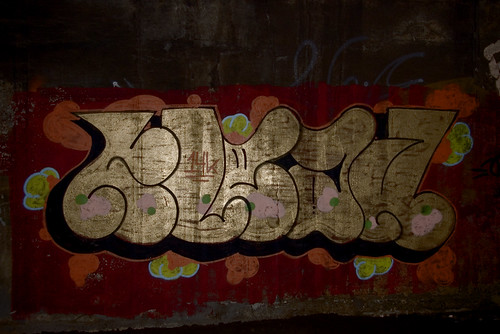
gold conviction.jpg

By graffiti I don’t mean any and all writing on walls, but a certain tradition, one that started pretty much in Philadelphia and New York City in the late 1960s and 1970s and had gone around the world two decades later. As far as I know it’s the only form of non-representational art that’s reached a mass audience.

Graffiti is an outlaw form, making it particularly to those humanists who regard their opposition to The System as a central attribute of their vocation. For graffiti writers typically paint on someone else’s walls, and without permission. They are thus vandals, and some of them have done jail time on that account.

Themo (with scars)

One effect of graffiti’s outlaw status is that photography had become incorporated into the graffiti work-style by the 1980s. In the early years the most intense work took place on the cars and in the stations, layaways, and yards of the New York City subway systems. The system would remove or paint-over graffiti on the cars – “buff” in graffiti parlance. So, the writers would bomb a car during the night and, the next day when the car would go out on a train, they’d wait for it to roll by, camera in hand. They’d snap a photo and so have a record of their work. In a day or three or a week or two the system would buff the car and the graffiti would be gone. But the writer, and his friends and colleagues (very important), would have a photographic record of the work. It wasn’t completely lost.

Wednesday, July 15, 2026

Henry Farrell on "The political economy of billionaire derangement"

Henry Farrell, The political economy of billionaire derangement, Programmable Mutter, July 15, 2026.

He opens with two somewhat different quotes about billionaires, Tyler Cowen more or less in favor of them and Tim O’Reilly deeply skeptical of them. He suggests we breed them together:

To be clear: this hybrid would be notably different to Tim’s argument, and likely actively objectionable to Tyler. I alone am to blame. But surprisingly, there is inadvertent support for some of its key elements from Peter Thiel, who is a surprisingly valuable chronicler of the conditions that give rise to billionaire derangement, as well as a living example of it (the Antichrist is here!).2 Here, I’m drawing both on lectures that Thiel gave at Stanford, as summarized by his amanuensis Blake Masters, and the resulting co-authored book, Zero To One. These sources have a lot to say about the connections between entrepreneurship, kingship, and personal eccentricity.

The conclusion I draw is that the forces that Tim identifies, combined with specific aspects of the political economy of Silicon Valley, help explain the derangement of certain Silicon Valley billionaires and their epigones. Old style princes were notorious for their tendencies to deranged behavior, which came not just from their inbreeding, but their power, and the unwillingness and inability of others to contradict or check them. So too, modern princes.

Not too long ago, many people, including Tyler, hoped that the advance of classical liberalism would go hand-in-hand with the growing power of tech billionaires, advancing both causes at once. Now, politically influential tech billionaires have visibly lost contact both with reality and with anything that could plausibly be described as classical liberal values. See the screen shotted quote above. Rather than making snide asides about billionaire derangement syndrome, it might be time for such people to confront what actual billionaire derangement means for the ideological straddle that they have relied on for so long. That is even more so, in a world where markets as well as market-makers are being devoured by the passions.

To summarize the particulars of my theory: Thiel’s lectures and book provide good, if incomplete evidence that the princely passions described by Hirschman didn’t disappear, but went underground. Commerce and power were fused into a new ideology of entrepreneurial virtù that became highly influential among the founder community in Silicon Valley. This combined with Silicon Valley’s (and popular culture’s) tendency to connect genius with eccentricity, not simply selecting people who seemed strange, but compounding their strangeness through self-reinforcing feedback loops. Finally, this all happened in an intimate social environment of founders and funders. Billionaires know each other and measure themselves and their success against those they consider peers, in a dense entangled clique that commingles high degrees of mutual influence with rivalries and jealousies.

Farrell then goes on to quote Thiel’s book at some length, analyzing while going along. And so:

In short then, Thiel - both as reported by Masters and in collaboration with him - suggests that Silicon Valley is a place where being a founder is tantamount to being a king. You have a greater chance of succeeding if you are weird, and if you succeed, your weirdness will likely feed upon itself in feedback loops of positive reinforcement. Finally, it is a closely interconnected social system where the key people are conjoined in a dense tangible clique. They observe each other all the time, and are observed by others for cues of what you need to do to become a made man. [...]

SpaceX perhaps marks a culmination of the kingly ideal, a moment in which, as Tim puts it, someone like Musk can “raise enormous amounts of capital while freeing himself from any restraints from those who provide it, so that he can spend the proceeds on Mars, humanoid robots, artificial intelligence or whatever next satisfies his ambition.” But it is also the moment in which someone who is visibly profoundly disturbed has briefly become the world’s first trillionaire. And it is one in which others want to copy him.

And then a bow to Keynes’s “animal spirits” in the market place:

I’ll finish by noting that this is just one aspect of a greater change. Deranged billionaires like Musk and Thiel are both partly responsible for this transformation, and notable symptoms of it. Still, they are not the whole of it. The reason that the SpaceX IPO temporarily succeeded, even though the numbers make no sense whatsoever, is that investment markets too are ruled by vibes. Tyler’s co-blogger, Alex Tabarrok, devoted years of his life to making the case for prediction markets, arguing that they would distill market wisdom into a more general source of knowledge on a multitude of topics. Now they are here, but all too often it’s spirits, not wisdom, that they seem to be distilling. Even more so for crypto. Matt Levine makes a joke about “Bleebzorx Tokens” to explain the worthlessness of memecoins, and someone else invents Bleebzorx Tokens to make a tidy profit.

There’s more at the link.

Thursday, November 7, 2019

Maria Farrell has a quick take on Lord of the Flies [boarding school brutality]

George Monbiot writes movingly about how the habit of Britain’s (well, mostly England’s) upper middle and upper classes of sending their children to boarding school from the age of seven onward causes profound emotional damage and has created a damaged ruling class. He’s not the first to notice this. Virginia Woolf drew a very clear line between the brutalisation of little boys in a loveless environment and their assumption as adults into the brutal institutions of colonialism. It’s long been clear to many that the UK is ruled by many people who think their damage is a strength, and who seek to perpetuate it. [...]

Lord of the Flies is many people’s touchstone for what would happen if order goes away, even though we have some good social science and other studies about how, at least in the short to medium term, people are generally quite altruistic and reciprocally helpful in the aftermath of disaster. Lord of the Flies is assumed by many to be a cautionary tale about order and the state of nature, when in reality it’s the agonised working out of the unbearable fears of a group of systematically traumatised and loveless children.

Lord of the Flies isn’t an origin story about the human condition and the need for ‘strong’ states, though we treat it as such, but rather is a horror story about the specific, brutalised pathology of the English ruling class.

Wednesday, January 16, 2019

On the vicissitudes of authors and intentions in literary criticism

John Farrell, Why Literature Professors Turned Against Authors – Or Did they?, Los Angeles Review of Nooks, 13 January 2018. The opening paragraphs:
SINCE THE 1940s among professors of literature, attributing significance to authors’ intentions has been taboo and déclassé. The phrase literary work, which implies a worker, has been replaced in scholarly practice — and in the classroom — by the clean, crisp syllable text, referring to nothing more than simple words on the page. Since these are all we have access to, the argument goes, speculations about what the author meant can only be a distraction. Thus, texts replaced authors as the privileged objects of scholarly knowledge, and the performance of critical operations on texts became essential to the scholar’s identity. In 1967, the French critic Roland Barthes tried to cement this arrangement by declaring once and for all the “Death of the Author,” adding literary creators to the long list of artifacts that have been dissolved in modernity’s skeptical acids. Authors, Barthes argued, have followed God, the heliocentric universe, and (he hoped) the middle class into oblivion. Michel Foucault soon added the category of “the human” to the list of soon-to-be-extinct species.

Barthes also saw a bright side in the death of the author: it signaled the “birth of the reader,” a new source of meaning for the text, which readers would provide themselves. But the inventive readers who could replace the author’s ingenuity with their own never actually materialized. Instead, scholarly readers, deprived of the author as the traditional source of meaning, adopted a battery of new theories to make sense of the orphaned text. So what Barthes’s clever slogan really fixed in place was the reign in literary studies of Theory-with-a-capital-T. Armed with various theoretical instruments — structuralism, psychoanalysis, Marxism, to name just a few — critics could now pierce the verbal surface of the text to find hidden meanings and purposes unknown to those who created them.

But authorship and authorial intention have proven not so easy to dispose of. The most superficial survey of literary studies will show that authors remain a constant point of reference. The texts upon which theoretically informed readers perform their operations continue for the most part to be edited with the authors’ intentions in mind, and scholars continue to have recourse to background information about authors’ artistic intentions, as revealed in public pronouncements, private papers, and letters, though they do so with ritual apologies for committing the “intentional fallacy.” Politically minded critics, of which there are many, cannot avoid authors and their intended projects. And this is just a hint of the author’s continuing presence. All the while, it goes without saying, scholars continue to insist on their own authorial privileges, highlighting the originality of their insights while duly recording their debts to others. They take the clarity and stability of meaning in their own works as desirable achievements while, in the works created by their subjects, these qualities are presumed to be threats to the freedom of the reader.

Fortunately or unfortunately, it is impossible to get rid of authors entirely because the signs that constitute language are arbitrarily chosen and have no significance apart from their use. The dictionary meanings of words are only potentially meaningful until they are actually employed in a context defined by the relation between author and audience. So how did it happen that professors of literature came to renounce authors and their intentions in favor of a way of thinking — or at least a way of talking — that is without historical precedent, has scant philosophical support, and is to most ordinary readers not only counterintuitive but practically incomprehensible?
Farrell the goes on to sketch out how that happened, beginning with the late 18th century. One thing that happened is that the stock of the author soared to impossible heights:
The elevation of the literary author as the great purveyor of experience had profound effects. Now the past history of literature could be read as the production of superior souls speaking from their own experience. In the minds of Victorian readers, for example, understanding the works of Shakespeare involved following the poet’s personal spiritual and psychological journey, beginning with the bravery of the early histories and the wit of the early comedies, turning in mid-career to the visceral disgust with life evinced in the great tragedies, and arriving, finally, at the high plane of detachment and acceptance that comes into view in the late romances. Not the cause of Hamlet’s suicidal musings but the cause of Shakespeare’s own disillusionment — that was the question that troubled the 19th century. This obsession with Shakespeare’s great soul was wonderfully mocked by James Joyce in the library chapter of Ulysses.

It was not only literary history that could be reinterpreted in the heroic manner. For the boldest advocates of Romantic imagination, all of history became comprehensible now through the biographies of the great men who made it. Poets like Homer, Virgil, Dante, and Milton were no longer spokesmen for their cultures but its creators; as Percy Shelley famously put it, poets were the “unacknowledged legislators of the world.”
And so we arrive at the late 19th and early 20th century:
So, to return to the “Death of the Author,” not only did authors have it coming; they largely enacted their own death by making the renunciation of meaning — or even speech — a privileged literary maneuver. They set themselves above the vulgar garrulity of traditional forms to pursue subtle but evanescent sensations in an almost priestly atmosphere. [...] So the author’s role in the creation of literary meaning suffered a long decline, partly because that role had been inflated and personalized beyond what was sustainable, partly because authors found value in the panache of renouncing it, and partly because critics welcomed the new sources of authority offered by Freudian, Marxist, and other modes of suspicious decoding. Up to this point, the dethroning of the author centered entirely on the relation between authorial psychology and the creation and value of literary works; it did not question that the author’s intentions played an important role in determining a work’s actual meaning.
And then came the intentional fallacy and the New Criticism:
New Criticism offered a standardized method for everyone — poets, students, and critics alike. Eliot called it the “lemon-squeezer school” of criticism. His grand, impersonal stance, which governed the tastes of a generation, had undoubtedly done a great deal to shape the detached attitude of criticism that emerged in the wake of “The Intentional Fallacy,” but his influence as a poet-legislator was also one of that article’s targets. Not only were Eliot’s critical judgments the expression of an unmistakably personal sensibility, but he had inadvertently stirred up trouble by adding his own notes to The Waste Land, the poem that otherwise offered the ideal object for New Critical decipherment. In order to short-circuit the poet’s attempt to control the reading of his own work, Wimsatt and Beardsley argued that the notes to The Waste Land should not be read as an independent source of insight into the author’s intention; instead, they should be judged like any other part of the composition — which amounts to transferring them, implicitly, from the purview of the literary author to that of the poetic speaker. Thus, rather than providing an undesirable clarification of its meaning, the notes were to be judged in terms of the internal drama of the poem itself. Few scholars of Eliot took this advice, showing once again the difficulty of abiding by the intentional taboo. [...]

In hindsight we can see that the long-term result of the trend Barthes called the “Death of the Author” was that meaning emigrated in all directions — to mere texts, to functions of texts like poetic speakers and implied authors, to the structures of language itself apart from speakers, to class and gender ideologies, to the unconscious, and to combinations of all of these, bypassing authors and their intentions. While following these various flights, critics have nonetheless continued to rely upon authorial intention in the editing and reading of texts, in the use of background materials, in the advocacy of political agendas, in the establishing of their own intellectual property, and in many other ways.
And in conclusion:
So why does it matter at this late date if literary scholars continue to reject the notion of intention in theory, given that they no longer avoid it in practice? Of the many reasons, I will note four.

First, the simple contradiction between theory and practice undermines the intellectual coherence of literary studies as a whole, cutting it off both from practitioners of other disciplines and from ordinary readers, including students in the classroom. In an age when the humanities struggle to justify their existence, this does not make that justification any easier.

Second, the removal of the author from the equation of literature, even if only in theory, facilitates the excessive recourse to hidden sources of meaning — linguistic, social, economic, and psychological. It gives license to habits of thought that resemble paranoia, or what Paul Ricoeur has called “the hermeneutics of suspicion.” Just as the New Critics feared the stability of meaning they associated with the reductive language of science, so critics on the left fear the stability of meaning they associate with the continuing power of metaphysics and tradition. Such paranoia is a poor antidote to naïveté. It puts critics in a position of superiority to their subjects, a position as unequal as the hero-worshipping stance of the 19th century, giving free rein to what E. P. Thompson memorably called “the enormous condescension of posterity.”

Third, the question regarding which kinds of authorial intention are relevant to which critical concerns is still a live and pressing one, as the case of Frankenstein suggests.

Fourth and finally, objectifying literary authors as mere functions of the text, or mere epiphenomena of language, is a radically dehumanizing way to treat them. For a discipline that is rightly concerned with recovering suppressed voices and with the ways in which all manner of people can be objectified, acquiescence to the objectification of authors is a temptation to be resisted. As Hegel pointed out long ago in his famous passage on masters and slaves, to degrade the humanity of others with whom we could be in conversation is to impoverish our own humanity.

Saturday, July 19, 2025

When tech CEOs are like grumpy ducklings

That's the title of Henry Farrell's interview with Le Grand Continent in Programmable Mutter.

Louis de Catheu - Something that is quite striking with the second Trump administration is the part taken by the Tech Bros in his entourage and his coalition. To you, what are the causes of this new alignment between the MAGA movement and Silicon Valley active bosses?

Henry Farrell - There are a number of areas where they share common interests. One thing, which is always very important to remember, is that they have common enemies. Many people on the Tech right are very much opposed to some of the measures that the Biden administration was associated with.

The Tech right also harks back to a particular vision of the politics of technology. [...] It more or less suggests: wouldn't it be incredible if we lived in a world in which we did not have to worry about government anymore?

That vision is very clearly part of the animating vision of Peter Thiel. [...] This will be a new world order in which technology founders will effectively be treated almost as the God Kings of these micro communities. People would be able to move back and forth between these communities according to Albert Hirschman’s logic of exit. [...]

The second thing that is important is a much more immediate set of political tensions, some of which are purely and simply due to people in the Silicon Valley right feeling that they did not get sufficient recognition from the Biden administration. [...]

The third thing is that there is an extreme hostility towards unions in Silicon Valley, which goes across the far right through to moderate left Democrat leaning people among the founders. The research of Neil Malhotra, David Broockman, and Gregory Ferenstein, suggests that in many ways Silicon Valley founders and funders are pretty left wing when it comes to a variety of social issues. They are more left wing than you might expect with respect to certain kinds of distributional issues, such as, being more favorable to basic income or to the distribution of welfare. But they are virulently hostile towards anybody who tries to tell them how to do their business. [...]

Opposition to woke is a significant part of the new way of thinking about things, but this is not because people have opposition to individual lifestyles, to people getting gender alteration surgery or any of these things. On principle, many people in Silicon Valley often tend to be radically libertarian when it comes to people's lifestyles. What they really objected to was the possibility that other people could tell them what they could or could not do to shape the workplace of their firms. These three forms of opposition helped to explain why you saw the Big Tech and Trump coming together.

Great Men:

You just spoke about God Kings and the need for respect. That make me think about your writings on the Silicon Valley canon. Some founders in Silicon Valley seem to have very specific views on history, the great men and their own place in history.

When I said that there was a lack of respect, I think that this involves changes in the broader conversation. Over the last number of years, Silicon Valley CEOs and venture capitalists have been treated with a significant degree of worship by the United States press — until around 2015-2016.

If Silicon Valley people wanted to pronounce on something, their grand statements were treated with enormous respect by the press. They had entourages, as if they were presidents. Mark Zuckerberg and other people were deemed by many to be world historical figures.

That, unsurprisingly changed the sense among Silicon Valley people about what their world historic role was. Here, one of the key essays for me is Marc Andreessen's piece, from 2011, called “Why Software is Eating the World,” which suggests that he and his colleagues are going to bring through a fundamental transformation in the way of things. [...]

When you talk to Silicon Valley people, you get the sense that they either read a lot or —which is in some ways nearly the same thing— they pretend to read a lot, because being well read is viewed as being part of the culture.

That is very different from 15 years ago. When my friend Aaron Swartz was alive and was still part of the debate, he used to be extremely grumpy about the lack of intellectual curiosity among Silicon Valley people. Now Silicon Valley people at least feel that they are obliged to pretend to read — and some of them actually do read. [...]

I think that the reason why Silicon Valley leaders read is because they are looking for models of how to act in the world as great men. [...]

We're in a world now where Silicon Valley people really began to identify with the idea that they were great men. This is not to say that great men are perfect, but they are people with very large virtues — and very large flaws as well. Silicon Valley founders were going to be world historical colossuses, bestriding the stage, reshaping the world in their image.

DOGE and its aftereffects:

First of all, there's DOGE's official goal, which is to achieve efficiency in the federal government. Indeed, there were probably a couple of people attached to DOGE for whom that was actually their primary goal.

A second goal was to effectively eliminate large chunks of the federal government. Of course, if you look at where DOGE acted, very often it was acting in those parts of the federal government, which were left coded rather than conservative coded. [...]

Finally, you could argue that a significant part of DOGE and efforts associated with it involved Elon Musk looking to position his own people in places of power. [...]

The first part, the efficiency part, I think never really took off in any very serious way. Perhaps under different Republicans or under Democrats, you might begin to see that take off again seriously. I don't think that was ever really a serious part of the project, as opposed to an ideological justification for it.

The second part, trying to rip away large chunks of the US government, I think is going to continue because it does not just involve DOGE, but is also about the people associated with Project 2025.

The final part - Musk installing his own people into the government - is obviously now unlikely to succeed. A lot of people are probably not going to continue on in the same way, or they will be asked to sign different loyalty oaths than the one that they felt that they were signing when they first came in. [...]

My personal theory is that if you really want to understand the Trump administration, read the autobiography of Cardinal de Retz or similar people who worked in these courts. The modern equivalents don’t have titles of nobility - perhaps they might like to - but they are engaged in the same squalid intrigues based around personal advancement, sex, rivalry. All of these things are going to be part of the Trump administration in a way that they were not part of the Biden administration — which of course had its own rivalries, but they tend to be much more technocratic ones.

AI and AGI:

We're now in a different world. It is very hard to say exactly how the Trump administration thinks about AI and AGI. It has not come out with any explicit documentation. But from what we can tell, this is much less of a coherent vision that the Biden administration had — whether you liked it or not — and much more a question of convergence between the interests of particular powerful companies and the national interest of the United States, which is defined in a somewhat flexible way.

The deals that were done in the Gulf a few weeks ago, or the apparent deal that has been done between the United States and China, which we have not seen the details of, suggest a much more flexible approach to AI. The United States still wants to be the country which really dominates the AI debate and discourse, but it also wants to take full advantage of the opportunities to do deals around AI, which will cement not simply US power, but also the power of particular people within the administration and of particular business interests which have strong connections with the administration. [...]

Throughout all of this we will see a perpetual opportunism in place of planning and strategy. I think that this is going to be a world of deal-making, rather than a world of the United States trying to fulfill a grand vision as it has in the past.

There's much more at the link.

Thursday, September 12, 2013

Graffiti: Drop Back and Punt

That’s not the phrase I want – “drop back and punt” – but it’s the best I can do at the moment. The phrase I want is French (a language I do not know). I found it in, I believe, Arthur Koestler’s The Ghost in the Machine, which had a mighty influence on me in my late teens and early 20s. What the phrase meant was, well, drop back and punt, but in a somewhat more elevated and sophisticated context.

The phrase characterized a phenomenon found in evolutionary biology. A population is caught in a dead end; its niche is contracting and the species is so well adapted to that niche that it cannot survive elsewhere. How can the population survive? One thing that happens is that subsequent generations become dedifferentiated, simpler if you will (“dropping back...”), which allows them to move to a new niche (“... and punting”), and there the population can develop new specializations appropriate to that niche. Koestler saw certain forms of (cultural) creativity as functioning like that. (Bleg: Does anyone know the French term that Koestler used?)

That’s what graff culture is up to, which puts us in territory I explored in a recent post, Through Duchamp and Beyond: Graffiti in the Promised Land?, and a somewhat older one, Graffiti Hit the Reset Button on Culture. As we know, graffiti started totally outside the art world. It was made by people who simply wanted to put a claim on the world, to be recognized. They weren’t interested in making art; that came later, and fitfully.

As Susan Farrell, founder of Art Crimes, put it to me in email, graffiti is a combination of art and extreme sport. Take this example by Distort:

IMGP3487

While it has a certain style, it is not Art in any conventional sense. What’s remarkable is that it’s at the top of an abandoned five or six story building.

Sunday, July 6, 2025

Henry Farrell on science fiction, AI hype, and the need for usable futures

Henry Farrell, We need to escape the Gernsback Continuum, Programmable Mutter, July 2, 2025. The three opening paragraphs:

As I admitted at the time, my review essay on Adam Becker’s More Everything Forever: AI Overlords, Space Empires and Silicon Valley’s Crusade to Control the Fate of Humanity was a bit of a bait-and-switch. Becker’s book explains how the dreams of science fiction have shaped Silicon Valley’s dreams of technology in general. I deliberately made a comparison that was both narrower and more fantastical: emphasizing how debates over AGI resembled the dreams of Renaissance alchemy. In partial redress, here’s a more specific argument about the relationship between science fiction and Silicon Valley.

Again, it’s more a riff on Becker than a bald presentation of his argument, but the connections are much clearer, even if it isn’t quite the same argument that Becker makes. What Becker sees as rooted in 1950s and 1960s science fiction arguably goes back a few decades further: to the fusion of “scientifiction” and technocracy that happened in the early 1930s, right at the beginning of the so-called “Golden Age” of science fiction.

Silicon Valley is trapped in a new version of the Gernsback Continuum - a situation in which it is collectively haunted by the visions of an imaginary future of endless expansion that didn’t happen and never will. Our escape route, as Becker suggests, is to acknowledge the physical and social limits that we can’t escape, and to try to construct better futures within those limits.

Then we have a lot of this and that, about Becker's argument, about the Golden Age of science fiction, William Gibson, Hugo Gernsback, visions of the future, limitless energy, and Andreessen's techno-optimism. Then:

Equally, not all people who embrace this style of thinking are fascists, or even slightly fascist adjacent. If you read the liberal-leaning technocratic utopianism of Demis Hassabis or Dario Amodei, you’ll find the suggestion there too that technology - and in particular AI - is a limitless cornucopia of possibilities. See Hassabis’ WIRED interview a few weeks ago:

If everything goes well, then we should be in an era of radical abundance, a kind of golden era. AGI can solve what I call root-node problems in the world—curing terrible diseases, much healthier and longer lifespans, finding new energy sources. If that all happens, then it should be an era of maximum human flourishing, where we travel to the stars and colonize the galaxy. I think that will begin to happen in 2030.

Again, this leans on a particular reading of science fiction. The future that they aspire to is explicitly the future of Iain M. Banks’ Culture novels, in which vast intelligent AI Minds underpin a civilization in which people can do more or less whatever they want.

Amodei:

I think the Culture’s values are a winning strategy because they’re the sum of a million small decisions that have clear moral force and that tend to pull everyone together onto the same side. Basic human intuitions of fairness, cooperation, curiosity, and autonomy are hard to argue with, and are cumulative in a way that our more destructive impulses often aren’t. It is easy to argue that children shouldn’t die of disease if we can prevent it, and easy from there to argue that everyone’s children deserve that right equally.

Hassabis:

I would recommend “Consider Phlebas” by Iain Banks, which is part of the Culture series of novels. Very formative for me, and I read that while I was writing Theme Park. And I still think it’s the best depiction of a post-A.G.I. future, an optimistic post-A.G.I. future, where we’re traveling the stars and humanity reached its full flourishing.

On the one hand, this is obviously much more attractive, and far less sinister, than the Andreessen version. It’s an optimistic liberal bet on the boundless cornucopia of technology. Banks was a Scots socialist who detested authoritarianism with a passion.

On the other, Banks was making a much more complex and ambiguous argument than the version that Hassabis and Amodei present. The Culture is, to steal Ursula K. Le Guin’s term, an ambiguous utopia, in a universe that is emphatically not a mere backdrop for the playing out of the manifest destiny of mankind.

After some discussion of Iain Banks we get:

As Kim Stanley Robinson (another poet of hard physical limits) emphasizes in his recent work, we are almost certainly not going to be able to spread out among the stars. What we have on this planet is pretty well what we have. That doesn’t mean that we can’t do much better than we are doing. We can achieve greater forms of material abundance. But pretending that the hard problems simply don’t exist, or that they will be solved by some magical technology that is right around the corner, is a recipe for the embrace of fascism at the worst, and starry-eyed ingenuous optimism at the best. As I’ve written before, we need usable futures. But to get there, as Becker argues, we need to discard the imagined futures of a past world whose aspirations and understanding of the world are a very poor fit with the present that we find ourselves in.

Amen. Usable futures. That's what I'm up to:

Wednesday, May 26, 2021

Henry Farrell on democracy [it's messy]

Sean Carroll interviews Henry Farrell:

Democracy as problem solving:

0:06:11.0 Sean Carroll: ... So let’s start with this idea of democracy and other kinds of institutions in a more or less theoretical sense. Probably the thing that is gonna guide the conversation the most is the paper that you wrote with Cosma Shalizi on cognitive democracy. And I take it that the idea is to think about democracy as a way of making decisions and to compare it with other institutional ways of making decisions. Is that fair?

0:06:48.8 Henry Farrell: That’s right. So we can think about markets, we can think about democracy, we can think about hierarchy, we can think about all of these different modes of problem-solving. And what I mean by problem-solving here is something like the following: So imagine that there are a number of us and we have some shared problem in common that we would like to solve. But either A, it is a complex problem that the solution is not immediately and readily apparent; or B, we have strong disagreements about how to solve it. I think that is where we can start to begin to get some traction on which modes of governance, whether these be markets, whether this be democracy, whether this be hierarchy, are better or worse at solving individual problems.

0:07:30.9 HF: And so I think that the argument that Cosma and I have made there, and I think we would probably modify it some. I think we’re a little bit too enthusiastic about democracy as against its competitors in that piece, but I think that the argument that we make is that the ability of democracy to solve problems is underestimated because people don’t pay attention to the ways of which democracy forces people, ideally, with very different perspectives, very different wants to work together. And sometimes, from the very diversity of our goals and our wants, information emerges and the democratic process works best when it is actually able to harness that process, and to turn that information into something useful and something actionable to help us solve problems.

Democracy is not an optimization problem & how we find our goals:

0:17:18.0 HF: … I was listening to a podcast a couple of weeks ago. This was the Quanta Podcast with Steven Strogatz. And he was interviewing Moon Duchin, who is a mathematician at Tufts. And she said, and I think this is absolutely right, that democracy is not an optimisation problem. And this is, I think, a temptation that a lot of people with engineering or mathematical backgrounds have, is to think in a certain sense, “Well, why is it that people disagree? If we could just come up with some sweet engineering solution, everybody would realise, and we would find some kind of optimal solution”. There are a number of reasons why this is not true.

0:17:58.9 HF: One of those is what you’ve already touched upon, which is that we often figure out what our goals are in the process of actually seeking after them. And this is an argument that political theorists such as John Dewey have made at length. So I think that the best articulation of this is a wonderful, albeit, I think also flawed book that Dewey wrote back in the 1920s called The Public and Its Problems, where he conceives of democracy as effectively a means of trying to figure out these broader problems that we have and to… But in the process of discovery, which both involves ordinary members of the public and experts. Ordinary members of the public understand how the problem affects them in their lives, and experts perhaps understand the more subtle causal chains that mean that…

0:18:47.1 HF: Public has a shared problem. So first of all, a public identifies itself, and then the public tries to create the means through which it can actually address the problem. But the implication of all of this, and Dewey’s a pragmatist, is that this is going to be a never-ending process of discovery where, in trying to solve the problems, the public will, of course, figure out that some of its goals are appropriate and some of its goals widely misconceived the nature of the problem and so, there’s going to be an endless process of revision, and that is something that is crucial and important.

0:19:21.1 HF: The other part of this which is something that Dewey, I think, is bad at, is understanding how it is that people, in a democratic society, have very different goals. We are tossed together in American society, and I think this is part of the issue that we have at the moment with polarisation with people who have very, very different goals, very different understandings of what the shared outcome ought to be, what our goals ought to be, what kinds of values ought to guide those goals. And so democracy then becomes a process of group warfare, to some degree, when it works badly, or group accommodation where you work together and you sometimes figure out messy and painful and agonising solutions, which don’t please ever anybody, but which, nonetheless, sort of allow you to continue on together in relative peace while addressing some of the problems that everybody can agree are problems or whatever.

0:20:15.9 HF: And so this is a really messy process, but it also is not an optimisation process; this is much more like a… So if you think about it in slightly more abstract terms, you’re searching across a rugged solution space where you do not know what the solutions are.

Democracy's dynamic advantage:

0:22:55.3 HF: That if you think about how democracy works versus, for example, systems such as autocracy, so you can think about them as drawing upon possible solutions to problems that a society faces. And here, again, I’m abstracting away all of these difficult and complex problems about, “Do we agree what a solution is? Do we even agree on what a problem is?” etcetera, etcetera. But if you start from that kind of metaphor, then you can reasonably see that some solutions, which are likely to pass muster in a democratic space because they are to the benefit of the collective majority, are probably going to get locked in an autocratic situation or in a democracy where there are extreme power disparities because some of these solutions, even if they are overall beneficial for the society, are going to be uncongenial to the powerful minority the elite was in that society.

0:23:50.0 HF: And so what that suggests then is that under reasonable circumstances, we can say that democracy is likely to have a dynamic advantage, vis-à-vis totalitarian systems, and its ability to search this landscape for possible solutions for problems that pop up. And we think about this primarily in terms of problems of institutional change, finding new rules because there’s a literature there that we want to talk to. And one could also say the more equal democracies, ipso facto, and holding all things equal, are probably going to be better at doing this, at searching for good solutions than less equal democracies precisely because it is less likely that elites are going to be able to block these solutions from being adopted in a more general way.

Tuesday, September 14, 2010

Graffiti, Signaling, Evolution, and Art

These days if you do much reading about cultural evolution and evolutionary psychology you’re likely to read attempts to explain art as a way of signaling something. In one version it’s the genetic fitness of the artist. The more elaborate the art, the fitter the artist and, so goes the theory, the more likely the artist is to bed all the hot babes. In another version the art signals allegiance to a group, with different groups favoring different motifs and styles.

I’m skeptical about such theories. Group signaling doesn’t demand much more than, for example, that one group wear red shirts and another wear blue shirts. Yes, different groups will favor different styles, but there’s more to those styles than simply telling the differences between the Reds and the Blues. Similarly, it seems to me that, as a fitness signal, art is overkill. Art works exhibit high dimensionality — I’m thinking abstractly here, where the dimensions are about the content of the work, not the surface or volume where the work is executed — and so differ along 10s and 100s of dimensions. But fitness is generally conceptualized as having low dimensionality, like one. What’s the artist doing with all those extra dimensions?

Modern graffiti, however, does exhibit simple signaling dynamics. As far as we know, the practice started in Philadelphia and then New York City as a way for boys to signal their presence. They’d mark their names on walls, not their legal names, but their graffiti names, thus signifying their existence. In fact, the story goes that a Philly writer named Cornbread wanted to get the attention of a girl — score one for evolutionary psychology. The more a writer “got up” the more widely he would be known.

Such straightforward competition is still very much a part of the graffiti world. Look at this photo, which I took on 21 November 2006:

Yggdrasil

Notice how the tagging goes up the wall. That simple ladder has been there ever since I’ve been photographing the wall. For all I know, some graffiti writers built it just so they could go up the wall with their tags as the tree branches on the tree are too small to support much weight.

Friday, April 9, 2021

Courts decide that graffiti is REAL – Meaning and identity in graffiti, skateboarding, and on the web

One reason graffiti interests me is that it is socially and institutionally ambiguous. It was created back in the late 1960s and 1970s by (mostly) kids who didn’t go to art school or frequent museums. They just tagged their names – not their legal names, but their noms de guerre if you will – wherever they could and elaborating them into every larger and more complex patterns until they were able to cover the side of a subway car with a “piece” (for masterpiece), as they call it. Naturally this brought them into conflict with the authorities and, for that matter, with much of the pubic as well.

The authorities and the wide public thought of it as vandalism, legally it is, while they thought of it as, well, self-expression, maybe art as well – though who knows what ART is these days. As the 1980s rolled around graffiti had become the graphic style of hip-hop culture and then extreme sport (such as skateboarding) and, as such, showed up as designs on apparel and other merchandise, and then in the display windows of upmarket department stores, of all things. Graffiti was becoming institutionalized.

A small cadre of writers – for what is what these artists call themselves, for writing is what they do; they write names – made money producing these designs and doing “permission” walls around the world. Even as they were making bank in legit endeavors, they still kept up their street cred by doing illegals, often in secret hidden places no one knew about but them. As this was going on some writers where doing canvases that could be sold in galleries, hung in private collections, and even in museum collections. We even have dedicated graffiti museums these days, but the illegal work continues.

And that brings us to 5Pointz, a legendary site of legit graffiti in Queens, NYC, that ended up pitting 21 graffiti writers against a landlord who decided to cash in on his property and so destroyed their work without prior notice. I discuss that in the next section. Then I take a look at FDR Skate park in Philadelphia which exists by grace of the governing authorities. It thus has, like the graffiti that covers it, an interstitial (between the cracks) existence. I conclude with a short look at social media, noting that one of the earliest sites on the web is Art Crimes, a repository for graffiti photos started by Susan Farrell in 1994.

5Pointz

5pointz

Credit: iamNigelMorris, “5Pointz” (2009). (CC BY 2.0)

Back in 2002 Jerry Wolkoff made an oral agreement with Jonathan Cohen allowing him to manage and curate his 200K sq. ft. warehouse in Queens in New York City for use by graffiti writers. Cohen, who gets up (paints) as Meres One, renamed the building as 5Pointz (for the 5 boroughs of NYC). In sort order the building was covered in graffiti and attracted writers and admirers from all over the world. To the extent that such a thing is possible, that building became graffiti’s mecca. Roughly a decade later Wolkoff decided he wanted to demolish the building and replace with it with luxury condos.

The artists were not happy and filed a petition under the Visual Artists Rights Act of 1990 to stop the demolition. Without giving the artists any notice Wolkoff locked the artists out and had the building whitewashed overnight. 5Pointz was gone. The issue went to trial and the artists were awarded $6.7M. Wolkoff appealed and, in February of 2020, lost. Graffiti had reached a new institutional milestone.

Louise Carron has reviewed the case at the Center for Art Law. Here’s her overview:

February 20, 2020 will be known in legal art history as the day that street art was affirmed as “a major category of contemporary art.” In Castillo v. G&M Realty L.P., which put an end to a 7-year long dispute over the whitewashing of the Long Island City-based “graffiti mecca” known as 5Pointz, the U.S. Court of Appeals for the Second Circuit upheld Hon. Frederick Block’s February 2018 ruling for the District Court for the Eastern District of New York (E.D.N.Y.). Judge Block awarded $6.75 million in statutory damages to 21 aerosol artists whose works were destroyed without prior notice by the owner of the building where the artists had been authorized to create for a decade.

In addition to being a great win for the plaintiffs, this case helps legal practitioners understand the Visual Artists Rights Act of 1990 (“VARA”) and pays deference to graffiti as an art form. This federal law takes its roots in the European moral rights theory of protecting art as an expression of the artist’s personality. Among the rights awarded to visual artists is the protection against the willful destruction of works of “recognized stature.” VARA outlines two mechanisms for enforcing these rights:

  1. Unremovable works incorporated in a building cannot be removed without the artist’s consent, unless the artist waives his or her rights in a writing signed by both the artist and the building owner.
  2. Authors of removable works are entitled to 90-days written notice to enable them to salvage the works.

However, VARA does not explain how to reach the threshold of “recognized stature,” so the task of defining its boundaries has been left to the courts, litigants and their attorneys. In Castillo, the Court of Appeals determined whether temporary artworks possessed moral rights and specifically, whether they could achieve recognized stature. The court concluded that “the temporary nature of [street] art is not a bar to recognized stature.”

After a chronology of events and a discussion of the legal issues Carron notes:

this decision is noteworthy for examining street art through the lens of art history and acknowledging that it has become “a major category of contemporary art.” The Second Circuit Court references famous visual artists such as Monet, Christo and Jeanne-Claude, along with Shepard Fairey and Banksy, the latter two known for their “illegal” works and whose pieces sell for millions of dollars at auction. This decision elevates street art to the same level as “high art,” which is exactly what the community has been fighting for for decades, specifically to go beyond the “vandalism” label that authorities coined in the 1970s.

However, it must be stressed that this decision is of limited scope, as it deals with authorized/sanctioned/legal art and is unlikely to be extended to unauthorized works which have not achieved recognized stature. Also noteworthy, the court’s evaluation of the Appellant’s behavior, testimony, and experts were all used against him. This shows how this ruling is particularly fact-specific and sui generis: Jerry Wolkoff engaged in a disrespectful pattern against the artists, which the courts acknowledged and did not allow such behavior to go unpunished.

So, a milestone has been reached, a carefully and narrowly defined milestone to be sure, but a milestone nonetheless. The artists and their art must be respected. 

Finally, I want to come back to the fact that 5Pointz was admired by people from all over the world. It was a locus of fundamental meaning, a quasi-sacred shrine. That sentiment is why that art is valuable and worthy of legal protection. The experts who testified to its “recognized stature” were proxies for those many people.

DIY Sk8parks [Philly’s FDR]

Skateboarding started in the third quarter of the previous century in California as an offshoot of surfing culture. During the 1970s purpose-built skateparks emerged, and in 1990, in Portland, Oregon, skateboarders began creating their own parks. They’d find an out of the way spot, haul in materials, and create their own parks. I’ve photographed two such parks in Jersey City, now gone.

One of the largest and best-known in the nation is FDR, in South Philadelphia. It was constructed under Interstate 95 at the southern end of FDR Park, hence the name. The city government started it in 1994 in an effort to get the skaters out of the central city. They set aside the land, put in a few features, and left it to the skaters, who then proceeded build their own. Here’s a short documentary:

Here’s some photos:

Who runs the place? Who designs and constructs the features? Where do the materials come from? Who handles the money? What’s the approval process. As far as I know the process is entirely informal. The city owns the land, but that’s it. I sent an email to Nick Orso, a well-known skateboard activist who lives in Philadelphia, who told me that construction is organized by one man, named Carlos, and that there is no non-profit organization involved.

If someone were badly injured and decided to sue, how would that go? My friends in the skateboarding community tell me that if that happened, the person would be ostracized from the community. Sure, but more basically, who is there to bring suit against? The City of Philadelphia? My guess is that if the city found itself defending suits it would shut the park down pretty quickly.

As for the graffiti all over everything, I’m pretty sure that goes the way graffiti always goes. Anyone can put anything on any surface at any time. But if you go over someone else’s work, what you do must be better. That’s pretty much it. Though, in this particular case then does seem to be at least one very specific understanding. One surface is covered with an American flag and it does get repainted when the surface degrades. FWIW, I detect a strong quasi-nationalist sentiment – sk8board nation as it were – in the graffiti.

Look at the back in the center to see the flag.

My point is simple: Here we have an enterprise of modest scope that pretty much runs on informal norms. Philadelphia also has ‘legit’ skateparks. Some relatively small neighborhood affairs, but there’s also a large one, Franklin’s Paine, not too far from the Art Museum (the one immortalized by Rocky Balboa’s training regime).

From social media to meaning and identity

And then we have the world-wide web and, in particular, social media. Sites like Facebook, Twitter, YouTube (owned by Google), are privately owned and straddle the globe. They are thus subject to the laws of many nations, and, in a way, more powerful than any of them. Recent political events have made freedom-of-speech issues critical in the United States but, since these facilities are owned and operated by private companies, they are not subject to First Amendment protection.

What are they subject to? How are they to be governed and regulated? I have no intention of proposing answers to these questions. My purpose is quite limited, to point out that the issues raised by social media – not only who says what, but also who owns user-data and how is it to be used – are not readily handled by existing institutions. They are thus like graffiti and do-it-yourself skateparks.

Skateparks exist and are used locally. Graffiti is a bit different. Yes, the individual tags, throw-ups, pieces, and productions – terms of art for various kinds of graffiti art are called – all exist on specific surfaces at specific places. But many of them have been photographed and starting with Susan Farrell’s Art Crimes in 1994, many of these photographs end up on the web. More recently Leonard Bogdonoff has been using computer technology to crawl the web and create a genealogy of graffiti and street art. Given this web-mediated connectivity I have come to think of the graffiti (and street art) taken collectively as the World-Wide Wall, a single aesthetic entity existing both on the ground and in the cloud: ungoverned, beyond all institutions, ever-growing and ever-changing.

* * * * *

Graffiti and skateboarding are sources of meaning for many. As such those activities are important facets of their identity. For a dedicated few, those activities may event be the central anchors of their identity, their deepest point of purchase on the world.

What about social media? The web is large and diffuse. It has no center. But, in social media many find a point of purchase on the world that has become very important to them. It is not only a place to display one’s identity, but an arena in which one can develop and solidify one’s identity in conflict with others. It has become an arena that is ungovernable by current institutions.

Graffiti is a new art form born in the second half of the 20th century and skateboarding is a new sport born at roughly the same time. Will social media prompt us to invent new modes of governance that transcend existing boundaries. Will it have that kind of power? Can we summon the will to do so?

* * * * *

Addendum: For more recent thoughts, see Courts decide that graffiti is REAL 2: Further thoughts [reframing the discussion]. And I'm sure there will be more beyond that.

Monday, August 18, 2025

Role play with large language models

Shanahan, M., McDonell, K. & Reynolds, L. Role play with large language models. Nature 623, 493–498 (2023). https://doi.org/10.1038/s41586-023-06647-8

Abstract

As dialogue agents become increasingly human-like in their performance, we must develop effective ways to describe their behaviour in high-level terms without falling into the trap of anthropomorphism. Here we foreground the concept of role play. Casting dialogue-agent behaviour in terms of role play allows us to draw on familiar folk psychological terms, without ascribing human characteristics to language models that they in fact lack. Two important cases of dialogue-agent behaviour are addressed this way, namely, (apparent) deception and (apparent) self-awareness.

Main

Large language models (LLMs) have numerous use cases, and can be prompted to exhibit a wide variety of behaviours, including dialogue. This can produce a compelling sense of being in the presence of a human-like interlocutor. However, LLM-based dialogue agents are, in multiple respects, very different from human beings. A human’s language skills are an extension of the cognitive capacities they develop through embodied interaction with the world, and are acquired by growing up in a community of other language users who also inhabit that world. An LLM, by contrast, is a disembodied neural network that has been trained on a large corpus of human-generated text with the objective of predicting the next word (token) given a sequence of words (tokens) as context1.

Despite these fundamental dissimilarities, a suitably prompted and sampled LLM can be embedded in a turn-taking dialogue system and mimic human language use convincingly. This presents us with a difficult dilemma. On the one hand, it is natural to use the same folk psychological language to describe dialogue agents that we use to describe human behaviour, to freely deploy words such as ‘knows’, ‘understands’ and ‘thinks’. Attempting to avoid such phrases by using more scientifically precise substitutes often results in prose that is clumsy and hard to follow. On the other hand, taken too literally, such language promotes anthropomorphism, exaggerating the similarities between these artificial intelligence (AI) systems and humans while obscuring their deep differences1.

If the conceptual framework we use to understand other humans is ill-suited to LLM-based dialogue agents, then perhaps we need an alternative conceptual framework, a new set of metaphors that can productively be applied to these exotic mind-like artefacts, to help us think about them and talk about them in ways that open up their potential for creative application while foregrounding their essential otherness.

Here we advocate two basic metaphors for LLM-based dialogue agents. First, taking a simple and intuitive view, we can see a dialogue agent as role-playing a single character. Second, taking a more nuanced view, we can see a dialogue agent as a superposition of simulacra within a multiverse of possible characters. Both viewpoints have their advantages, as we shall see, which suggests that the most effective strategy for thinking about such agents is not to cling to a single metaphor, but to shift freely between multiple metaphors.

Adopting this conceptual framework allows us to tackle important topics such as deception and self-awareness in the context of dialogue agents without falling into the conceptual trap of applying those concepts to LLMs in the literal sense in which we apply them to humans.

There's more at the link (the article is ungated). 

H/t Henry Farrell. 

Friday, October 26, 2018

Friday Fotos: Back to basics, a graffiti primer [#EmergentVentures]

Graffiti is a cross between art and extreme sport.
– Susan Farrell, Art Crimes
It all started with the tag, or hand-style. A few quick strokes and you’re up. Then on to the next one. And before you know it you’re all over town.

Here’s a tag I spotted on December 28, 2007, on a freight train rolling through Jersey City on the River Line:

IMGP7862rd.jpg

So quick! So elegant! Less than a dozen strokes.

Then we have the throwie or throw-up. It’s a bit more complicated than a tag and so takes more time to execute, a few minutes or so – and remember, in this game, time is critical as you’re always looking over your shoulder for the p-o-l-i-c-e.

This one is by SOMER. I took the photo on November 22, 2006, somewhere in downtown Jersey City, though I forget just where. Notice the strokes in the fills. This was quickly done.

Somer on the door.jpg

Though this is not a particularly elegant throwie, I chose it because Somer took part in a graffiti battle that unfolded in Jersey City in late 2006 and into 2007. Writers would go over one another’s tags, throwies and pieces. Somer lost. You can find a partial photographic record of this battle here, https://flic.kr/s/aHsiPU7cVa.

Now we come to a piece, short for “masterpiece”, the large and often quite elaborate works conceived originally to cover much or all of the side of a subway car. This is an early RIME (aka Jersey Joe), again in downtown Jersey City, somewhere a bit north of 14th Street (the building in the background is indicative) on a wall that no longer exists. I took the photograph on November 26, 2006. Judging from the “’02” at the upper left, I’m guessing this went up in 2002.

Rime.jpg

Next we see something a little different. The mummy below is what’s known as a character, a representation of some human, animal, or other animate creature. Characters started appearing in graffiti in the early days (1970s) and were often cartoon characters. One famous writer was known by the name of the cartoon character that appeared often in his work, Dondi. This is by Faro. I took the photo on June 6, 2010 in Hoboken, NJ (on the northern border of Jersey City).

IMGP3094

Finally, one of my all-time favorites (below). This is a piece where the writer’s name is inscribed inside a character. In this case the character is a triceratops. As for the name, you might not even realize that it’s a name if you didn’t know that, with graffiti, it’s (almost) always about the name. FWIW when I took that photo I was so new to graffiti that I didn’t realize I was looking at a name. And those names, as you might have gathered, are not birth-certificate names. They are nomes de guerre, taken for the purpose of getting up.

This name is an example of so-called wild style, where the letters are tricked out, distorted, sliced-diced-embellished and otherwise disguised so that only insiders can make it out. In this case the name is “Joe”, Japan Joe. I took the photo on October 25, 2006. I’ve been told, by someone who was there, that it was painted not too long before.

3Tops_972

It’s a bit over seven feet high and eighteen feet wide. It’s painted on a stanchion supporting a single track railroad bridge for a line that’s now abandoned. Behind that stanchion, however, is a still active freight line. As it took a few hours for Japan Joe to paint this he no doubt saw and heard a freight train or two pass through. They are often quite long and so it might take a few minutes (5, 10?) or so to move through. This piece lasted until some time in early 2009 by which time the weather had eroded it to the point where other writers felt they could go over it without violating the (implicit) code.

This is in an area of Jersey City some locals know as Narnia because it’s more or less hidden, a bit mysterious, and green and leafy. It’s a magical anteroom to something even more mysterious and magical, the Erie Cut, aka the Bergen Arches. But that’s another story, though if you click on that link, you’ll find out quite a bit about the Arches.

What’s important now is that the place is hidden. You can’t see it from the street. That means that a writer can paint there without worrying about the p-o-l-i-c-e, though – word to the wise – I wouldn’t get too comfortable down there. Graffiti’s illegal; if you get caught you will pay a fine, perhaps go to jail. So either you do something quick – a tag or a throwie – and move on, or you find a secluded spot and paint your piece.

Of course, there is a third alternative. You can do a “permission” wall, even a commissioned wall. Here you’re working with the permission of the wall’s owner. In some cases you may even be paid, perhaps by the building owner, or maybe by, say, Red Bull, who is sponsoring an event or even the wall itself. Thus there is now a small group of elite writers who travel the globe getting paid for getting up.

Doing permission walls, though, is tricky, status-wise. Graffiti began as a game – and I use the term both in its ordinary sense, but also as a term of art in economic analysis – in which graffiti writers would signal their girlfriends and/or one another while at the same time evading the police. The more skill you display, the more status points you get. Visible virtuosity matters. You also get points for getting up in particularly difficult spots, difficult because access is physically challenging (some writers have been known to use mountain-climbing gear) or particularly exposed (to, you got it, the P-O-L-I-C-E). Exposure to danger earns you points. (And also gets the adrenaline pumping (I know).)

If you’re painting on a permission wall, you’re no longer in danger of getting arrested. Fewer points to you, even though you’ve got mad skills. Consequently those writers who are able to earn a nice living by doing commissions will also do illegals to maintain their street cred.

Peace out.