Showing posts sorted by relevance for query hiromi. Sort by date Show all posts

Monday, December 23, 2024

Hiromi's Sonicwonder - Live from Jazz à Vienne Festival (2024) | Qwest TV

From the YouTube page:

The Japanese pianist Hiromi matches spontaneity, technique and communication in her sets, possessing the ultimate in serious intent and lightening humor. As is increasingly the case with many artists nowadays, Hiromi is finding fresh routes. With Sonicwonder she’s now heading up an electronically-flecked quartet that also includes dazzling New York trumpeter Adam O’Farrill, Hadrien Feraud (bass) and Gene Coye (drums).

The Vienne stage sits in the midst of a vast outdoor amphitheater, dwarfed until Hiromi exudes her intimate communication skills, fully inhabiting this potentially inhibiting space. But now we can view the entire 75 minute set on Qwest TV anyway, close-up and sonically pristine. Hiromi always solos joyfully, emitting palpable pleasure and wonderment on her visage, throwing the energy of her entire body into keyboard runs that alternate between crystal detail and devilish power. She moves between acoustic and a pair of Nord keyboards, the smallest of which perches on her piano lid. Her bandmates are slowly invited to reveal their abilities, with O’Farrill awarded an equal place beside Hiromi, showing off his trumpet eloquence. He hardly uses a mute, choosing to play with an open crackle, spraying fireflies directly into space. Bass (from Paris) and drums (from Chicago) deliberately adopt more of a supporting, structural role. Hiromi toys with retro synth-bass vamps, the funk rising up, but then she’ll rein back in to the delicate flow of her acoustic, altering the mood mid-tune.

– Martin Longley

Monday, September 16, 2019

How music works, Hiromi edition

Do you want to know how music works? Watch this clip of Hiromi Uehara taking a piano lesson.


Here's some quick and crude observations from an email I just sent to a friend:
A younger Hiromi takes a lesson. Alas, not in any language I can understand. But at least you get to see a lot of supple fingers. And the left-hand gesture at 10:22. This is getting really interesting. But you have to watch their whole bodies, no?

You know about the lizard brain, right? Well, within the lizard brain there’s the worm’s brain (the reticular activating system, RAF). How does the RAF modulate whole body motion and the “long line” of the performance? There must be some kind of hierarchy of motor activation, from whole body/trunk, to arms, to fingers, whatever.

And it’s interesting how easily they slip in and out of intense playing mode.

So much to observe. So much to understand.

And the moments they play together. You notice how sometimes the teacher only tracks Hiromi on a note here and there, not every note in the passage.

Saturday, September 8, 2018

How stupid is machine translation? No common sense at all, none


So I tweeted a clip of an interview and performance by the Japanese pianist, Hiromi Uehara. The interview is in Japanese, a language I don't know, and the clip is labeled in Japanese. But I'd listened to the clip and figured out what was going on. She was asked to play a song, "My Way", a grandiloquent turkey which Frank Sinatra had made into a hit. She gigled, complied, and then, as any jazz musician would, proceeded to improvise.

So, when I posted the clip I added a short English preface to the Japanese, "Hiromi does it her way". Out of curiosity, when I saw my tweet, I asked for the translation Twitter offered. Not knowing any better, the computer also translated my bit of prefatory English, despite the fact that it was already in English, into "Hiromi do it her way". Why, I ask, why? Because it doesn't know any better.

Friday, October 3, 2025

Hiromi, interviewed by Rick Beato

YouTube:

In this interview, I sit down with Japanese piano virtuoso Hiromi to talk about her playing, her influences, and her approach to improvisation. We cover her career, her unique style, and what drives her as a musician.

Hiromi is AWESOME!

Wednesday, December 6, 2023

Blue Giant

With English subtitles:

Kevin Nguyen, Jazz anime Blue Giant hits all the high notes, The Verge, Oct. 7, 2023.

The setup of Blue Giant is familiar anime territory: a young boy from a small town moves to Tokyo to pursue his dream. This boy, Dai, is a saxophone obsessive. He practices all day under a bridge, honking and warbling until he wears out his reed. Naturally, Dai wants to be the greatest jazz musician in the world.

For all his audacious ambition, Blue Giant is largely restrained. The movie focuses on the trio that forms the band — and even shifts its attention away from Dai at around the halfway mark. There’s also Sawabe, a savvy and smug pianist who knows how the club performance circuit operates. And then there’s Dai’s roommate, Tamada, a high school friend who improbably becomes the band’s rhythm section after trying the drums just once. They decide to form JASS, a name that, strangely, no one bats an eye at.

As JASS, they practice, they perform, they get better. Much of the film’s success hinges on the music being excellent — which it absolutely is. This isn’t the jukebox roulette of the Cowboy Bebop. Blue Giant has a legit soundtrack composed by Japanese jazz pianist Hiromi Uehara, who does a compelling homage to the American sax legends of the ’60s. It’s less the jazz of cool sophistication but one of bravado and squeaky high notes. Think of the muscular brass of Sonny Rollins’ Saxophone Colossus or John Coltrane’s Giant Steps (probably the record the film’s title most strongly evokes).

Not to mention the fact that Sonny Rollins famously practiced on the Williamsburg Bridge in 1959 and then came out with an album entitled The Bridge.

The stage dynamics of the trio are a thrill when they come together, as the three of them get into harmony. As the film progresses, these sequences get more ecstatic, more abstract. Swirls of color, brushes with the cosmic, an attempt to go sublime. I’m at a loss for words to describe how much fun these sequences are. I guess I’ll just go with… “hot” and “intense”?

There's more at the link. 

As for Hiromi, I've got some posts about her, and an article at 3 Quarks Daily: Sukiyaki and beyond: Hiromi Uehara, music, war and peace, Chick Corea, and others.

Tuesday, March 2, 2021

Hiromi Uehara @ 3 Quarks Daily

My latest post at 3 Quarks Daily is about the Japanese pianist and composer, Hiromi Uehara:

Sukiyaki and beyond: Hiromi Uehara, music, war and peace, Chick Corea, and others

I don’t know how I first discovered her – this post originally went up in 2010. It had to have been on YouTube. But why did I click on one of her videos? I don’t know. Perhaps it was nothing more than that she is Japanese. Whatever the reason, I’m glad I did. She’s phenomenal.

Here she is playing a jazz standard, “Softly as in a Morning Sunrise,” considerably reworked in a contemporary vein.

Monday, July 8, 2013

"Ue wo muite arukou" 50 years later

I've been thinking about how culture is remix. Old stuff is constantly being repurposed, recontextualized, recovered, and redone: REMIX. This post from September 2010 is a single example, a song that I knew in my youth by the odd name of "Sukiyaki."
Back in 1961 Kyu Sakamoto had a hit in Japan with a wistful ballad called "Ue wo muite arukou."


It quickly became an international hit, more often than not being known as "Sukiyaki," the name given to it in the English-speaking world. The song has nothing whatever to do with sukiyaki, but ... it got covered in instrumental and vocal versions and has been recorded ever since. Here's two recent versions. An acoustic ballad by Kina Grannis, sung in Japanese:


Here's an instrumental version by an astonishing young pianist, Hiromi Uehara:


This version completely reconceptualizes the tune. From this version you'd hardly guess that the song started as a wistful ballad. I also suspect that that Uehara wanted to reclaim the song from all those really crappy instrumental versions that are out there.

Friday, September 23, 2011

Juggling: What to do?

At the moment I’ve got more blogging and blogging-related tasks than I know what to do with. They’re all piling up so bad I can’t think. Here’s an accounting, more or less, of what I’m trying to sort out.

Disney’s Fantasia
I started blogging about this film several years ago with an argument that it was a masterpiece. Then I added posts on individual episodes with no intention of doing the whole thing. But I’m now so close that I should go all the way and then wrap the whole thing in a single downloadable Working Paper PDF at SSRN.
Literary Studies
Perhaps my intellectual anchor, certainly my longest focus. I’ve got, at least, a longish post on description as the core discipline in a revised literary studies. Then I can wrap a bunch of posts into a Working Papers for SSRN.
Graffiti
I’ve had a request for more graffiti posts. Of course, I’ve got tons of photos I could post and comment on. I should probably do something on the Underbelly Project now that I’ve got a clearer focus on the graffiti site. I might PDF the posts I’ve done on the graffiti site. And there’s Juliet Fleming’s Graffiti and the Writing Arts of Early Modern England; not about the contemporary movement, but useful perspective.
Latour
Need to finish ‘reading’ Reassembling the Social and PDF the series. What about the ‘Compositionist Manifesto’?
Such Stuff of Dreams
Keith Oatley’s book on the psychology of fiction, mostly empirical work. Very good. Need to review it.
In Praise of Women’s Hands
A post I’ve been planning: Disney’s inker’s and painters, Betty Busby and quilters, Japanese musicians (Hiromi!), Miyazaki’s view in Porco Rosso (“Forgive us for building a fighter plane with the hands of women.”)
Object-Oriented-Ontology (OOO)
Lots of stuff. A piece on trumpet players and their mouthpieces as a complement to Jane Bennett’s recent presentation on hoarding. Something on two books I’ve started reading: Graham Harman, The Quadruple Object, and Jane Bennett, Vibrant Matter: A Political Ecology of Things. I should probably PDF a bunch of the posts I’ve done so far. And there’s scads of material I could work on. In particular: What’s the relationship between OOO and the work DGH and I did on the cognitive structure of ontological thought? How does that affect the philosophical game, if at all?

All this is a big puzzle: what to do? What’s worth doing? Don’t know.
Truth and Traditions Party
This is a project I’m working on with Charlie Keil which I blog separately from New Savanna and The Valve. The big deal there is to draft a c. 30K to 40K book that can serve as a political manifesto and campaign platform in 2012. Books I’m reading to this end include three by Walter Mosley (Life Out of Context, What Next, and Workin’ on the Chain Gang) and one by William “Upski” Wimsatt, Please Don’t Bomb the Suburbs Perhaps a post on the old World Island project.
Odds and Ends
Lots of them coming in, including a book by Les Spence for review.
The Chronicle of Jivometric Johnson and the Lady Irene
Don’t know whether I’ll do this or not. Not only is it a new project – as if I didn’t have enough already in the works – but it’s a new KIND of project, and one that might well fail. It’s fiction.

It would be set in that old jivometrics universe I created back in the mid-90s. The general idea is to riff on the Exodus story. We’ve got a bunch of folks piled up on the banks of the River Jordan who’s great grandparents wanted to get ovah! But now, getting’ ovah’s mostly a dream and a topic of idle chat. Until Jivometric Johnson meets the Lady Irene. And somehow, they make real plans to cross the river, finally.

That old jivometrics universe is a whacked out cross between Jorge Borges and Lord Buckley and so has room for lots of stuff. It may be my best bet for putting all this stuff together. But I don’t know whether I can do it. At all. I did that original piece on inspiration, not craft. But craft's all I got though, who knows, maybe the inspiration will come. As they say, fake it 'till you make it.

We’ll see.
Any votes?

Friday, May 15, 2026

New Savanna has 911 tags as of 13 May 2026 [my 16-year production function is 57 tags per year]

Here’s my previous post on this topic: New Savanna has 665 tags as of 13 Nov 2023 [my 13-year production function is 48 tags per year]. You can find all my posts on this topic at this tag: tag_count.

This is how I explained my production function in that earlier post:

If you are a fan of Tyler Cowen, as I am, then you know that in his Conversations with Tyler he often asks his guests about their production function, how they do whatever it is they do. Well, I now have a way of estimating the output of my production function over the course of this blog. Let’s divide the total number of tags, 655, by the age of the blog in years, 13 years and 7 months is 13.6 years, giving me an output of 48 tags per year.

Given that a large fraction of my intellectual output turns up on New Savanna in one way or another, that’s not an unreasonable number to consider. It would be easy enough to calculate how many posts I produce a year if I wished, but I’m not going to do that, because that particular number is not what I have in mind. What I’m thinking is that that count would thereby give me two measures.

As a first approximation, I’m going to say they measure different things. The post count is a simply a word count, or rather, a words-plus-photos count. The tag count is a new-idea count. To be sure, it’s a very crude approximation to new ideas, but, on first glance, it does seem to me that that’s what it is. I only add tags when I want a convenient way to refer to a new topic. One could, of course, write about the same thing year after year, in which case the tag list would remain constant from year to year. That’s how you succeed in the academy, publish the same three ideas year after year after year until you go emeritus. That’s just not how I roll.

For this time out the number of tags is 911 and the age of the blog is 16.1 years. Divide the former by the latter and you get 57 tags per year.

Here’s the full list of tags as of May 13, 2026:

(the) singularity #Canon/Archive #ccourses #ccresearch #DH #gpt3 #GVM002 #GVM003 #GVM004 #GVM008 #GVM019 #GVM021 #GVM022 #GVM023 #GVX #HEX01 #HumanProgress #LARB #longwoodgardens #nugget #whyiteach 2_war 2set 3300 node graph 3blue1brown 3QD 51 Alley 51 Pacific 5FF 60s abstraction abundance academia academia_stats activism Adam Savage Adam_neeley Adam_Roberts ADHD adolescence adulthood adventure aesthetics affective_tech Africa African-American AI AI Alchemy AI Limit AI values AI_Agents AI_Backlash AI_Chess_Lang AI_companion AI_Emo_Support AI_hallucination AI_idolatry AI_Paradox AI-creativity AI-epistemology AI-future AI-integrate AI-whaling AI30 Alan Liu alien alien phenomenology alignment altered states of consciousness altieri Altman America American myth Amodei analog-computing analogical_reasoning Andreessen Andrew_Piper animals animation anime Anthropic anthropology anti-nuke anti-Semitism ants anxiety AOC apocalypse Apocalypse Now Araki archaeology Arena Arena_4 arithmetic art art_club artificial minds arts ASC attachment Attractor-net Attridge&Staten autobiography awesome B_Russell bacon Baltimore_Years BAM BAnvil BAPC bardolatry BB & Computing BB-reflects BBjazzEdu BCSmith bees behavior behavioral mode bell benchmarks Bennett Bergen Arches BFJO Bill_Gates billionaires-in-space biology bird black black church blogistan blogs blues body Bordwell Born2Groove Bostrom Bostrom-simulation Bourdain brain-as-computer brain-to-brain brains breakfast breaking bad Brian Phillips British Bruce_Jackson Bryant Buddhism Buffalo bundling business C_Keil Carroll cartoon CE Direction CE workshop center-point Chain_of_Thought change change-mind Changizi charting-AI-space Chat_paints chatbots ChatGPT ChatGPT conversation ChatGPT interpretation ChatGPT MTL ChatGPT stories ChatGPT summary ChatGPT_poems ChatGPT-memory cherry_blossoms chess chess_lang_core Chess_Lang_Series childhood children chimpanzees China Chinese-room chocolate factory Chomsky chrysler bulding chuck jones citizen science classify Claude Claude stories claude_colab Claude_describes Claude_partner claude_summary Cld_melancholy_notes clouds coaching Coates Cobra_Kai cog poetics cog-poverty cogart cognition cognitive science Coleridge collapse collective creativity Collier color comedy comfort common sense knowledge communication community complexity compositionism computation computational envelope computers conduit metaphor connect-course consciousness contrail control copyright corruption cosmos coupling COVID-19 creativity culler Cultural Beings cultural evolution cultural identity cultural ranks culture cyberization cybernetics cyberspace daffodil DamiLee danah boyd dance dandelion davidsimon death deep learning DeepSeek default mode deGrasse_Tyson demonstration Dennett depression DeptofPeace description design development DGH Diamond_Age Dick_Macksey digital humanities digital wilderness digital_doppelganger disarmament Disney Dizzy Gillespie DOGE dolls Douthat Douthat-decadence downsize drugs duckdodgers Duke_Ellington Dumbo Dwarkesh eating Ebert eclipse ecology econ_growth economics economy ecstasy education Egypt emergence emergent-ventures emotion empire state building EndofScience energy engineering entangle environment epistemic_struct_cosmos Eric_Jang Erie Cut erotic essay Ethan_Iverson ethical criticism Everett evol-force evolution EVs exploration expressive systems eye Ezra_klein F Me Pump Facebook family Fantasia Farrell fast lane Father Faust FBorFreedom FDR federal government Felski Feyerabend fictional characters Fifty_Shades film flix flow flowers fluid mind food foraging foreign_policy form forsythia fractal free range kids Freeman French toast Friday Fotos Fridman FTH FTH_Class fun funny fusion future G_Hinton g-zone gags game theory garden Gärdenfors Gary_Marcus Gavin Gavriil gender genius genji genre gift Girard GITS glenn_loury glia global warming globalization GOATLiC god Godfrey-Smith Goethe gojira golf Golumbia Gopnik GPT GPT_classroom GPT-3 GPT-4 gpt-4.5 GPT-5 graf-then-now graffiti graffiti aesthetics graffiti chaos graffiti detail graffiti essay graffiti site graphic novel grass Great Chain greatest siam green grief Groucho groups Guillory Haggard Halloween hallucinate hallucinated-city handbook happiness Harman Harold-Bloom Hartman Hassabis HCRichardson HCW health heart darkness Heather_Cox_Richardson Henry Lau high culture Hillis Miller Hiromi history Hoboken Hoboken_2225 Hollis_Robbins home homeless Homo_economicus Homo_ludens hope Horgan Hossenfelder House_MD Howard_Jam Hudson River human nature human_origins human-swarm humanities humans vs. machines humor hunter-gatherer Hurricane Sandy hydraulic_press hyperobjects identity ideology-intellect Iliza_Shlesinger illusion immigration implementation improvise India Industrial_Revolution inequality information Inside_Out Instagram institutions_broken intel_case intellectual history intelligence intention interdisciplinary international affairs internet interpretability Interpretation intuition invent_future IP Iran irises Israel-Palestine Issues-in-CultEvol its complicated Jakobson Jamie jamming Japan jasmine Jaws jazz JC Rising JCPhotoEssay JCwall Jersey City JGGChronicles jim morrison jivometric Jockers Joe Rogan John_Oliver JumpandKong justice K-Pop Kambhampati kami Keil_12/8 Kelly Sax Keynes Kim Stanley Robinson Kimono Mom King Kong Kisangani2150 KK encounter Korea Kubla_Khan Kwak DaKyung LAARB Lafayette_Garden language language-computation-litform Lantz LARB-DH Latouor-modes Latour Latour Assemble laughter law leaks learning leaves LeCun Lee_Morgan Leonard_Bernstein Letterman Lévi-Strauss life light linguistics links literary criticism literary Darwinism literature LLM LLM_collab LLM-Meta Loser love low culture lump MacArthurFP MacPaint macroanalysis maestro magic maker malick man_machine man-in-space man-machine-interaction mana mandala manga manhattan Maplewood marilyn_monroe Mark_Twain mark-turner Mars Mary_Douglas masculinity math maynard McCarty McCulloch McDonalds meals meanderings meaning meaning_semanticity meaningful_life media notes medicine meeting_of_minds melancholy_mind memes memory mental health Meta_struct_world metalingual definition method mhacks Michael_Jordan microchips Miles Davis Millennium_Park mimi and eunice mind mind-inside mind-or-machine mindfulness Miyazaki Mnozil mom moon moral injury morality Moretti Morton Morton-Spacecraft MR-Notes music Musk my intellectual life my_mood myth-logic narrative NASA nation-state nationalism natural geometry naturalist criticism nature NCIS networks neural-holography neural-weather neuromorphic neuroscience neurosymbolic new government New Hope City new humanities new savanna New York City new-descriptivists next-word Nina Paley NLH rejection No_Kings Northrup Frye notes novel NY2140 NYTimes Obama object-oriented ontology objectification Occupy ontological cognition OOCRnB open letter OpenAI operadoc orange orgasm Oshii P_Thiel pansies parsons party Patriotism_3QD patterns PB Graff Jam peace peak experience perception percussion performance performing Perper personal perversion philosophy philosophy new photo photography photontology phrasal lex physics Piaget pinckney Pixar planning plants play pleasure pluri-core poem poetry politics pollution polyrhythm polyviscous polyviscous_core pond pop culture pop culture aesthetics Pope_Leo population Porco Pounds_typology poverty predict prehistory President 2020 Presidential 2016 printing_press prodigy progress projection protest psychedelic psychoanalysis psychology public-private-interest pyramids Queen Mary 2 race race-symbolic-universe Ramble Ramsay Rank5 ratatouille read_macroanal read-hyperobjects reading reading>reading reality regulate-mind RelationalNets religion research retire RGB rhythm Rick_Beato ring-form risk RNA-primer Supplement Road Not Taken Road Runner Robert Frost Robert_Wright robot-rights robots rock art RodneyBrooks Rogue-AI romantic love Rubicon-Waterloo Salerno-Sonnenberg sally Sant_Andreu Satch scale scaling_in_ML science science fiction Scott_Aaronson scratching my head search Searle Séb_Krier seder-masochism Segmented_sleep Seinfeld self selfie serendipity series_humans_loop sexuality sexuality25 Shakespeare shaky-cam shame Shine/Titanic shoes silver simulation SK8 sky sleep sleep_reorg SMP_linked snow social media society Sowa space speech Spider-Man sports SPSH SSTB stagnation StanfordLitLab star trek state_dependent_memory StateofAI statistics Steve Pinker Steven_Spielberg strange_land street art sunrise sunset superintelligence supreme_court surface_reading surveillance Sutskever swisher Sydney_Lamb synchrony tablescape taboo tag tag_count TalentSearch Tantra tassles tech evol techbro technology television tell me blues terror-management terrorism text texture Tezuka the rez the-crown theater theology theory of mind Theory stars therapy throwie time toast topic models touch toy being transformer transition transnational trees Trump trumpet tulips TV tweet Tweet-of-Day twitter Tyler Cowen UBI underbelly Underwood Underwood&Sellers2015 Unfrosted unityofbeing universal_kid_space urb design center urban urban geometry urban pastoral Utopia vacation Vehicularization Vermont Vexta vibe_coding video violence VirtFeud virtual reading vision visual resonance visualization wackyland waffles war war boys wayquay's weather web weeds Why CE Wickwire Wind Rises window_shot WiP wires_images wisdom WLB_art WLB_Mandala wlb_melancholy WLB_religion WLBjazz WmPowers Wolfram women word illusion work work-mode working paper World-spanning thoughts World-Wide Wall WorldIsland writing Wuthering Heights Xanadu yevick youth Yudkowsky ZAR Zeal_Greenberg Zhang Zizek zuckerberg

Sunday, May 19, 2019

In Praise of Women’s Hands

Once more I'm bumping this (originally from July 2014) to the top of the queue, this time to complement a NYTimes article on the math and physics of knitting.


* * * * *

I'm bumping this to the top of the queue in light of recent ghastly, but not, alas, terribly surprising, stories about the unconscionable behavior of Harvey Weinstein, Leon Wiesletier, and other powerful men – let's not forget 45!, nor Bill Clinton, JFK, and on and on and on. But, you know, Queen Elizabeth I knew the score, Nina Paley too.

* * * * *

Bless in a congregation, because they are so numerous, those industrious schoolgirls, stitching their alphabets; and the deft ones, with needles at lacework, crewel, knitting; and mistresses of spinning, weaving, dyeing; and daughters of tinsmiths painting their ornamental mottoes; and hoarders of rags hooking and braiding their rugs; and adepts in cutouts, valentines, stencils, still lifes, and "fancy pieces"; and middle-aged housewives painting, for the joy of it, landscapes and portraits; and makers of bedcovers with names that sing in the night – Rose of Sharon, Princess Feather, Delectable Mountains, Turkey Tracks, Drunkard's Path, Indiana Puzzle, Broken Dishes, Star of Lemoyne, Currants and Coxcomb, Rocky-Road-to Kansas.


Bless them and greet them as they pass from their long obscurity, through the gate that separates us from our history, a moving rainbow-cloud of witnesses in a rising hubbub, jubilantly turning to greet one another, this tumult of sisters.

—Stanley Kunitz, A Blessing of Women

We all know that the hand that rocks the cradle rules the world. We also know that’s nonsense, pious and sentimental nonsense. Which is why it has been said so often.

The subtext, of course, is that the cradle-rocking hand is connected, through appropriate anatomical intermediaries, to a foot that’s chained to the dishwasher, the oven, the vacuum cleaner, and the sewing machine.

I would like to praise that cradle-rocking hand, even, in a sense, in its cradle-rocking mode. This cradle-rocking hand, we are told, is better at delicate manual tasks – I learned that as a child – than are men’s hands, the hands that shoot the guns, pilot the ship of state, and keep charge of the shackles connecting that associated foot to those many domestic appliances. That’s what I’m interested in, this hand with its delicate and versatile ability to make things, to make a world.

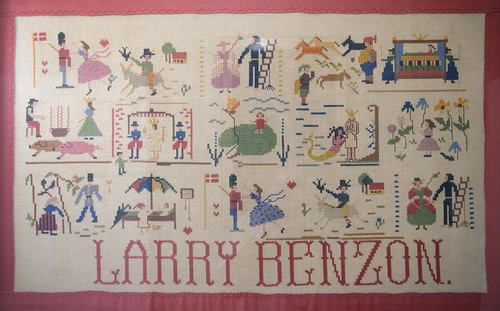
A Sampler

Here’s an example that I grew up with:

IMGP4159rd

It’s a sampler illustrating scenes from fairy tales by Hans Christian Anderson. It was done by a woman I never met, a great aunt who, I believe, was named Agnete. She was Danish, as were my paternal grandparents.

Such sewing skills – in this case, needlepoint embroidery – were routine for women of her generation, born in the 19th Century, and the making of a sampler was often a rite of passage for a young girl. My mother was born in the early 20th Century, when women were also expected to be able to sew well. I can still hear the sound of her sewing machine and remember how I marveled at her skilled hands moving cloth beneath the needle. She also embroidered in both needlepoint and crewel styles.

IMGP4159 mermaid

IMGP4159 tin soldier

IMGP4160rd
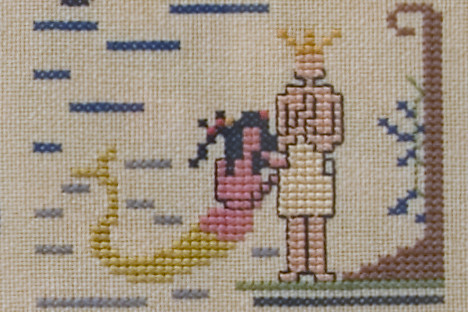
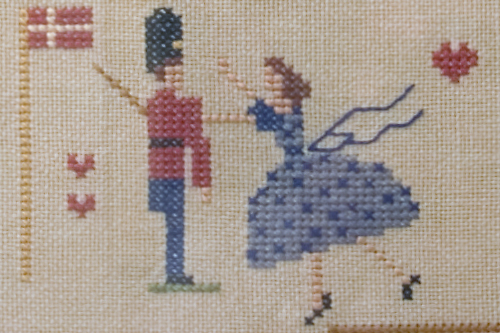
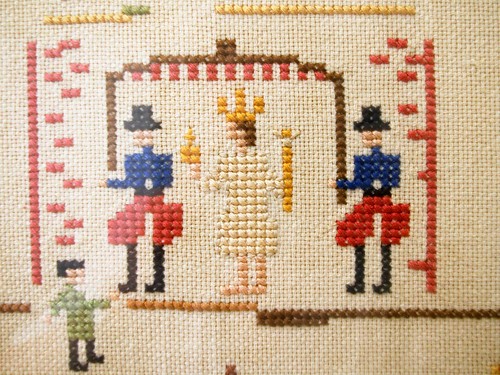
Close-ups from Aunt Agnete's sampler.
Such needlework was done in the home for family, though some women also did piecework for money.

Friday, June 6, 2025

Chapter Outline: Homo Ludens Rising: A Manifesto for the Fourth Arena

This is a preliminary outline for my current book project (title above).

Introduction: The Problem of Homo Economicus

The social institutions of the Western world have become “shrink-wrapped” around the requirements and capabilities of Homo economicus, economic man. That brought us the Industrial Revolution and thereby our prosperity. And it has brought us the AI technology that has swept the internet in the last two-and-a-half years. It has the potential for large scale economic disruption, leaving many people without jobs, and in despair despite the possibility that some form of Universal Basic Income will make it possible for them to live. Why despair? Because in a world shaped to the needs of Homo economicus, life’s meaning is anchored to one’s job. Jobless have no meaning in this world. Further, while Homo economicus has brought us the current regime of AI-as-deep-learning, it cannot take us beyond that. Going beyond will require new architectures and they only way to discover them is to conduct “blue sky” no holds basic research in Ludic mode. Now that Homo economicus is commandeering all resources for its own projects, there will be few resources available to move beyond.

Part 1: Basic Concepts 

Chapter 1: The Four Arenas

The universe has seen three Arenas (as I call them) so far: 1) The First Arena, inanimate matter. 2) The Second Arena, the world of living things (biosphere). 3) The Third Arena, human culture. We are now standing on the brink of the Fourth Arena in which, through the aid and support of artificial intelligences, Meaning will become a constitutive principle in the universe.

I have sketched this out in this article at 3 Quarks Daily: Welcome to the Fourth Arena – The World is Gifted.

Chapter 2: Complexity

In this chapter and the next I begin to lay out some basic conceptual equipment, making the point that complexity is different from complicated. Complication is about lots of stuff all mixed together. Complexity is about the nature of stuff, about how simple processes and rules can yield elaborate structures through repetition and amplification. A complex world is full of “lumpiness,” things with odd shapes and so is different from a “smooth” world of simple things that grade into one another (think of circles and ovals). I’ve sketched this 3 Quarks article: World, Mind, Learnability, Large Language Models, and the Metaphysical Structure of the Cosmos.

Moreover, important and interesting resources and concepts and distributed in an irregular manner. Think of how various mineral resources are distributed over the earth, e.g. gold, oil, or natural medicines. You have to go prospecting for them, with no clear map of where they are or certainty that you will find anything. Good ideas, whether for works of art or practical inventions are like that as well. I lay these ideas out, with illustrations, in this working paper: What economic growth and statistical semantics tell us about the structure of the world.

Chapter 3: Self-Organization and Evolution

Building on the previous chapter I develop the idea of self-organization, starting with a very simple example: You put a drop or two of black ink into a tumbler of water. The ink diffuses through the water in an irregular way, but over time the ink particles form into vertical currents circulating in adjacent cells. Why? Because the tumbler was exposed to the sun and the ink particle picked up energy from it. (For images, see photographs in A Primer on Self-Organization).

Building on that basic example I can discuss the origins of life and its evolutionary elaboration of every more complex ecosystems and species (see A Note on Why Natural Selection Leads to Complexity for some background concepts). From there we move to cultural evolution and Richard Dawkins’ concept of memes. Robert De Vany’s work on Hollywood movies shows how the film world is a self-organizing evolutionary system (blog post: Chaos in the Movie Biz: A Review of Hollywood Economics).

Part 2: The Mind Orders the World

Chapter 4: Animal, Vegetable, of Mineral: Patterns and Ontology

I introduce the idea of conceptual ontology by with the game of Twenty Questions. One person, the Answerer, chooses something that the others, the Questioners must guess. A typical variant is known as “animal, vegetable, or mineral”. Why? Because the Answerer starts by telling the Questioners that the object belongs to one of those three categories. Those categories are critical points in our conceptual ontology, the inventory of the kinds of things that exist in the world.

From there we examine the difference between “salt” and “sodium chloride.” Physically they are the same substance. But “salt” can be characterized by its taste and appearance while “sodium chloride” is an abstract concept about the physical world that is defined in terms of atoms, subatomic particles, and covalent bonds, concepts that didn’t exist until the 19th century. These ideas belong to different regions of our conceptual ontology.

The idea of conceptual ontology is completely general. Thus fairy tales and science fiction stories belong to different conceptual ontologies, and those are different from the conceptual ontology in which, for example, the news is reported. Fairy tales contain fairies, wizards, and magical objects of all kinds, none of which exist either in the real world or in science fiction. Science fiction stories contain faster-than-light travel to other galaxies, alien species, intelligent robots, none of which exist either in fairy tales or the real world (though we’re working on intelligent robots).

I use ChatGPT to illustrate these concepts in the way it tells stories. Above all, it demands ontological consistency among stories. For example, in one case it refused to add a robot named Gort to a story set in a fairy-tale world while in another case it refused to let a colorless green idea by the protagonist in a story because such things are not appropriate for that role. Using these and other example I show that stories set in very different worlds, with different conceptual ontologies, can nonetheless exhibit the same pattern of events.

These examples are based on experiments I report in this paper: ChatGPT tells stories.

Chapter 5: Lust in Action, Patterns West and East

Now we take the conceptual equipment we have built up and use it to create a fuller picture of the human condition using Shakespeare’s famous Sonnet 129, “The Expense of Spirit.” The poem depicts this pattern:

  • Lust begins in longing.
  • The act itself is framed by shame, fury, and a sense of betrayal.
  • The result is both the heaven of fulfillment and the hell of consequence.

I use Old School symbolic AI from the 1970s, the body of technique that precedes the current regime, to show that, against all appearances, I show that the poem exhibits a traditional Christian patter, the Fortunate Fall (felix culpa), which holds that man had to fall from innocence so that, through God’s grace, man could attain a higher level of spiritual discernment.

I then present the sonnet to ChatGPT and ask it to produce an esoteric reading in terms derived from Hindu and Buddhist philosophy. It does so, using the concept of Maya, the trap of worldly attachment, and samsara, the cycle of desire and suffering. The sonnet itself talks on the role of a koan, a paradoxical statement that tricks the reader into awareness and detachment.

In this process I will have demonstrated two things:

1. Old School symbolic AI, which is presumed to be made obsolete by the machine learning technology we examined in the previous chapter (ChatGPT), can serve as a useful way of thinking about the otherwise opaque structure that is latent in large language models (LLMs).

2. The presumably culturally specific Christian pattern of the Fortunate Fall does in fact have the same form as patterns that have arising in Hinduism and Buddhism.

Finally, this discussion sets the stage for Chapter 7’s of Homo economicus, economic man, which sees little value in the arts. If so, why have they been so important in all societies?

Part 3: The Mind Evolving in History 

Chapter 6: Cognitive Ranks

Cultural evolution is more than the accumulation of ideas, artefacts, and behaviors. It also involves basic cognitive architectures. Rank 1 cultures are built on an architecture enabled by the evolution of speech. Such architectures are characteristic of preliterate peoples living in hunting and gathering bands or small villages. Rank 2 architectures are based on writing and enabled the develop ancient civilizations with walled cities and extensive cultivation of the land. Rank 3 cultures emerged in Europe when mathematics from the East, India in particular, were transmitted to Europe by the Arabs and there encountered European mechanical ingenuity.

Note, in particular, that this story differs from the prevailing story that innovation in the early modern era was driven by the invention and adoption of the printing press in Europe. While the printing press enabled the spread of ideas, mechanically printed books have no cognitive affordances that manually printed books have. You read them in the same way. Using the so-called Arabic number system for arithmetic calculation, however, is quite different. It allows you to do calculations that heretofore were difficult or impossible and allows you to think in a new way. In particular it allows, for the first time, to conceive of a finite system, arithmetic, that is capable of generating infinite results, the real numbers. Conceptually this gave us the Scientific Revolution and the idea of the clockwork universe. Practically, it gave us efficient navigation enabling world-wide trade (and conquest) and the Industrial Evolution.

Rank 4 began emerging late in the 19th century with statistical thermodynamics in physics and evolution biology. Then came ideas about logic and meta-mathematics that resulted in the abstract idea of computation that was embodied in the idea of the Turing Machine. Shortly after World War II, John von Neumann showed how to embody these ideas in physical devices and the digital computer was born. That technology has been remaking the world for the last three-quarters of a century and has brought us to the brink of the Fourth Arena in which humankind assumes a new role in the cosmos, a role that we can only glimpse it is so new and strange.

These ideas are based on an extensive body of writing David Hays and I published in the 1990s. Here’s a short guide to that work: Mind-Culture Coevolution: Major Transitions in the Development of Human Culture and Society.