Showing posts sorted by date for query McCulloch. Sort by relevance Show all posts

Sunday, June 21, 2026

New Book Project: Language, Memory, and Mind: A Supplement to The Computer and the Brain

As you may know, I’ve been working on a book project, Play: How to Stay Human in the A.I. Revolution. For some reason I’ve been unable to finish the proposal, though I’ve got lots of stuff and a number of the chapters are substantially drafted. But I keep finding myself distracted into thinking about basics, very basic things about computing and A.I.

At the very end of his life, John von Neumann wrote a slim book, The Computer and the Brain (1958). It grapples with the problem of how computation can be implemented in a physical medium and does so in a way that is basic, both simple and straightforward and profound. We’ve learned a great deal about both the brain and the computer since then, but as far as I know, no one has revisited von Neumann’s project and extended it to include what we have since learned. That’s what I propose to do in this book.

Now, I have no intention of trying to summarize what we’ve learned on those two topics since 1958. That’s working at the wrong level. When von Neumann was writing he, and by extension, we, had no conception of distributed representation much less how it could be achieved physically. Now we do. That’s what needs to be added to von Neumann’s exposition.

I have no intention of repeating what von Neumann did. In particular, I will not revisit his material on analog computing. Rather, I want to augment his discussion. Fortunately the new material is of such a nature that I should be able to write short book that can be read as a stand-alone discussion or as a supplement to von Neumann’s book. I’m imagining a sophisticated general audience of the sort that reads 3 Quarks Daily.

My working title: Language, Memory, and Mind: A Supplement to The Computer and the Brain. I expect the book to be 100 to 120 pages long (30K to 40K words).

I have uploaded a bunch of material (100K words or more) to Claude and asked it to review that material and put together and initial outline. I’ve appended that below the asterisks.

* * * * *

Preface

How to use this book — with or without von Neumann. What it adds to his argument. What it doesn't attempt. Brief note on the collaboration with Claude that produced parts of the text.

Introduction: Von Neumann's Unfinished Argument

What he got right: the architectural mismatch between brains and computers — memory and computation separated in the digital machine, unified in the neuron. The energy efficiency puzzle he couldn't explain. His honest acknowledgment that the brain's organizational principles lay beyond the framework he'd built. The concepts he lacked that this book supplies.

Chapter 1: Two Paradigm Cases

The chess-language contrast as the entry point. Chess has a bounded, well-defined geometric footprint — 8×8 board, six piece types, explicit rules, finite tree. Language has an unbounded, poorly-defined geometric footprint — rooted in the full complexity of physical and social reality. Chess was AI's founding benchmark precisely because it seemed to demand the highest human intelligence while yielding to computational treatment. Moravec's paradox: the easy problems are hard and the hard problems are easy. Transcendent versus non-transcendent coding — programmers can observe and specify a chess engine completely from outside; nobody can specify an LLM from outside, including its creators. Where we now stand.

Chapter 2: Location and Content

A collection of photographs. Solid objects at specific locations — finding by address is natural, finding by content requires going to each photo in turn. The combinatorial explosion that follows. The formal argument: solidity localizes content; localized content can only be retrieved by address. What holography does physically — interference patterns distribute information about each stored object across the whole plate, so that any partial cue can activate the whole. Lashley's ablation experiments: memory didn't disappear when specific cortical tissue was removed because memory was never stored in specific locations in the first place. Von Neumann's energy efficiency puzzle, now answerable: the brain doesn't spend energy moving content to a processor because memory and processing are the same physical substrate.

Chapter 3: The Brain as Content-Addressed System

The McCulloch-Pitts neuron-as-logic-gate: computationally fruitful, architecturally wrong. What neurons actually are — active units and memory units simultaneously, connected in massive parallel. Distributed representations: concepts as patterns across populations of neurons, not stored at specific cell addresses. Yevick's logical necessity argument in plain terms: the world contains two categories of object, geometrically simple ones that sequential symbolic processing handles efficiently and geometrically complex ones that only holographic parallel processing handles efficiently; the world contains both; therefore any adequate cognitive system must implement both regimes. Path tracing and pattern matching as the two fundamental operations on any cognitive network. Freeman's cinematic model — global coherence frames at 10-12 Hz as the atomic unit of biological cognitive processing — and its correspondence to speech production rates.

Chapter 4: Language as a One-Dimensional Projection

The semantic network as the right model for conceptual structure: meaning as position, each node defined by its pattern of relations to other nodes. Sydney Lamb's principle. The multidimensional character of the conceptual network versus the one-dimensional character of any spoken or written string. Language strings as 1D projections of the multidimensional network — necessarily lossy, hence paraphrase and ambiguity. The colored beads thought experiment: strip away semantic content, replace each token with a color, and you have a 1D image — making visible the purely formal structure the LLM operates on. Words as abstract addresses in an abstract space. Why classical computational linguistics hit combinatorial explosion: it was trying to reconstruct the multidimensional structure in a location-addressed system.

Chapter 5: What Large Language Models Actually Are

The transformer architecture in plain terms. The weight space as distributed content-addressed memory — concepts are patterns smeared across billions of parameters, not stored at specific addresses. The forward pass as the atomic processing unit, corresponding to Freeman's global coherence frame: one complete transit through the weight space producing one output token. The token string as a path through the abstract address space, with each forward pass mediating between the 1D sequential surface and the multidimensional distributed interior. What LLMs do well — pattern matching over the weight space, which is what their architecture naturally supports. What they do poorly — sustained sequential path tracing requiring precise state maintenance, common sense grounded in embodied experience, continuous learning. Why these limitations aren't engineering failures awaiting a fix but structural consequences of implementing holographic-like processing on location-addressed hardware with training only on 1D projections.

Chapter 6: What the Analysis Implies.

The first principles of intelligence are not the first principles of computation. Why scaling won't close the gap: scaling improves the quality of the holographic approximation but doesn't change the architectural mismatch, provide embodied grounding, or enable continuous learning. The fast takeoff fantasy as physics-free reasoning — every self-improvement step requires moving billions of parameters between physically separated memory and compute on real hardware that consumes real energy. The TSMC problem: the most critical hardware infrastructure in the world runs on tacit knowledge distributed across human communities that no LLM can access or replicate. What a genuinely adequate artificial cognitive system would require, in the terms this book has developed. The research program that's needed and why it requires multi-generational public investment rather than industrial R&D on commercial timescales. The human-machine collaboration that's already underway and what it can and cannot achieve.

Conclusion: The Mismatch, Named

Von Neumann saw the gap and couldn't name what was on the other side of it. This book names it: content addressing, requiring distributed storage, implemented in biological tissue through interference-like neural dynamics, approximated in LLMs through distributed weights on location-addressed hardware, grounded in embodied experience that no text-trained system has. The naming matters because you can't close a gap you can't see clearly.

Appendix: A Chronology of Chess, Language, and AI

From the working paper, lightly edited.
Friday, May 15, 2026

New Savanna has 911 tags as of 13 May 2026 [my 16-year production function is 57 tags per year]

Here’s my previous post on this topic: New Savanna has 665 tags as of 13 Nov 2023 [my 13-year production function is 48 tags per year]. You can find all my posts on this topic at this tag: tag_count.

This is how I explained my production function in that earlier post:

If you are a fan of Tyler Cowen, as I am, then you know that in his Conversations with Tyler he often asks his guests about their production function, how they do whatever it is they do. Well, I now have a way of estimating the output of my production function over the course of this blog. Let’s divide the total number of tags, 655, by the age of the blog in years, 13 years and 7 months is 13.6 years, giving me an output of 48 tags per year.

Given that a large fraction of my intellectual output turns up on New Savanna in one way or another, that’s not an unreasonable number to consider. It would be easy enough to calculate how many posts I produce a year if I wished, but I’m not going to do that, because that particular number is not what I have in mind. What I’m thinking is that that count would thereby give me two measures.

As a first approximation, I’m going to say they measure different things. The post count is a simply a word count, or rather, a words-plus-photos count. The tag count is a new-idea count. To be sure, it’s a very crude approximation to new ideas, but, on first glance, it does seem to me that that’s what it is. I only add tags when I want a convenient way to refer to a new topic. One could, of course, write about the same thing year after year, in which case the tag list would remain constant from year to year. That’s how you succeed in the academy, publish the same three ideas year after year after year until you go emeritus. That’s just not how I roll.

For this time out the number of tags is 911 and the age of the blog is 16.1 years. Divide the former by the latter and you get 57 tags per year.

Here’s the full list of tags as of May 13, 2026:

(the) singularity #Canon/Archive #ccourses #ccresearch #DH #gpt3 #GVM002 #GVM003 #GVM004 #GVM008 #GVM019 #GVM021 #GVM022 #GVM023 #GVX #HEX01 #HumanProgress #LARB #longwoodgardens #nugget #whyiteach 2_war 2set 3300 node graph 3blue1brown 3QD 51 Alley 51 Pacific 5FF 60s abstraction abundance academia academia_stats activism Adam Savage Adam_neeley Adam_Roberts ADHD adolescence adulthood adventure aesthetics affective_tech Africa African-American AI AI Alchemy AI Limit AI values AI_Agents AI_Backlash AI_Chess_Lang AI_companion AI_Emo_Support AI_hallucination AI_idolatry AI_Paradox AI-creativity AI-epistemology AI-future AI-integrate AI-whaling AI30 Alan Liu alien alien phenomenology alignment altered states of consciousness altieri Altman America American myth Amodei analog-computing analogical_reasoning Andreessen Andrew_Piper animals animation anime Anthropic anthropology anti-nuke anti-Semitism ants anxiety AOC apocalypse Apocalypse Now Araki archaeology Arena Arena_4 arithmetic art art_club artificial minds arts ASC attachment Attractor-net Attridge&Staten autobiography awesome B_Russell bacon Baltimore_Years BAM BAnvil BAPC bardolatry BB & Computing BB-reflects BBjazzEdu BCSmith bees behavior behavioral mode bell benchmarks Bennett Bergen Arches BFJO Bill_Gates billionaires-in-space biology bird black black church blogistan blogs blues body Bordwell Born2Groove Bostrom Bostrom-simulation Bourdain brain-as-computer brain-to-brain brains breakfast breaking bad Brian Phillips British Bruce_Jackson Bryant Buddhism Buffalo bundling business C_Keil Carroll cartoon CE Direction CE workshop center-point Chain_of_Thought change change-mind Changizi charting-AI-space Chat_paints chatbots ChatGPT ChatGPT conversation ChatGPT interpretation ChatGPT MTL ChatGPT stories ChatGPT summary ChatGPT_poems ChatGPT-memory cherry_blossoms chess chess_lang_core Chess_Lang_Series childhood children chimpanzees China Chinese-room chocolate factory Chomsky chrysler bulding chuck jones citizen science classify Claude Claude stories claude_colab Claude_describes Claude_partner claude_summary Cld_melancholy_notes clouds coaching Coates Cobra_Kai cog poetics cog-poverty cogart cognition cognitive science Coleridge collapse collective creativity Collier color comedy comfort common sense knowledge communication community complexity compositionism computation computational envelope computers conduit metaphor connect-course consciousness contrail control copyright corruption cosmos coupling COVID-19 creativity culler Cultural Beings cultural evolution cultural identity cultural ranks culture cyberization cybernetics cyberspace daffodil DamiLee danah boyd dance dandelion davidsimon death deep learning DeepSeek default mode deGrasse_Tyson demonstration Dennett depression DeptofPeace description design development DGH Diamond_Age Dick_Macksey digital humanities digital wilderness digital_doppelganger disarmament Disney Dizzy Gillespie DOGE dolls Douthat Douthat-decadence downsize drugs duckdodgers Duke_Ellington Dumbo Dwarkesh eating Ebert eclipse ecology econ_growth economics economy ecstasy education Egypt emergence emergent-ventures emotion empire state building EndofScience energy engineering entangle environment epistemic_struct_cosmos Eric_Jang Erie Cut erotic essay Ethan_Iverson ethical criticism Everett evol-force evolution EVs exploration expressive systems eye Ezra_klein F Me Pump Facebook family Fantasia Farrell fast lane Father Faust FBorFreedom FDR federal government Felski Feyerabend fictional characters Fifty_Shades film flix flow flowers fluid mind food foraging foreign_policy form forsythia fractal free range kids Freeman French toast Friday Fotos Fridman FTH FTH_Class fun funny fusion future G_Hinton g-zone gags game theory garden Gärdenfors Gary_Marcus Gavin Gavriil gender genius genji genre gift Girard GITS glenn_loury glia global warming globalization GOATLiC god Godfrey-Smith Goethe gojira golf Golumbia Gopnik GPT GPT_classroom GPT-3 GPT-4 gpt-4.5 GPT-5 graf-then-now graffiti graffiti aesthetics graffiti chaos graffiti detail graffiti essay graffiti site graphic novel grass Great Chain greatest siam green grief Groucho groups Guillory Haggard Halloween hallucinate hallucinated-city handbook happiness Harman Harold-Bloom Hartman Hassabis HCRichardson HCW health heart darkness Heather_Cox_Richardson Henry Lau high culture Hillis Miller Hiromi history Hoboken Hoboken_2225 Hollis_Robbins home homeless Homo_economicus Homo_ludens hope Horgan Hossenfelder House_MD Howard_Jam Hudson River human nature human_origins human-swarm humanities humans vs. machines humor hunter-gatherer Hurricane Sandy hydraulic_press hyperobjects identity ideology-intellect Iliza_Shlesinger illusion immigration implementation improvise India Industrial_Revolution inequality information Inside_Out Instagram institutions_broken intel_case intellectual history intelligence intention interdisciplinary international affairs internet interpretability Interpretation intuition invent_future IP Iran irises Israel-Palestine Issues-in-CultEvol its complicated Jakobson Jamie jamming Japan jasmine Jaws jazz JC Rising JCPhotoEssay JCwall Jersey City JGGChronicles jim morrison jivometric Jockers Joe Rogan John_Oliver JumpandKong justice K-Pop Kambhampati kami Keil_12/8 Kelly Sax Keynes Kim Stanley Robinson Kimono Mom King Kong Kisangani2150 KK encounter Korea Kubla_Khan Kwak DaKyung LAARB Lafayette_Garden language language-computation-litform Lantz LARB-DH Latouor-modes Latour Latour Assemble laughter law leaks learning leaves LeCun Lee_Morgan Leonard_Bernstein Letterman Lévi-Strauss life light linguistics links literary criticism literary Darwinism literature LLM LLM_collab LLM-Meta Loser love low culture lump MacArthurFP MacPaint macroanalysis maestro magic maker malick man_machine man-in-space man-machine-interaction mana mandala manga manhattan Maplewood marilyn_monroe Mark_Twain mark-turner Mars Mary_Douglas masculinity math maynard McCarty McCulloch McDonalds meals meanderings meaning meaning_semanticity meaningful_life media notes medicine meeting_of_minds melancholy_mind memes memory mental health Meta_struct_world metalingual definition method mhacks Michael_Jordan microchips Miles Davis Millennium_Park mimi and eunice mind mind-inside mind-or-machine mindfulness Miyazaki Mnozil mom moon moral injury morality Moretti Morton Morton-Spacecraft MR-Notes music Musk my intellectual life my_mood myth-logic narrative NASA nation-state nationalism natural geometry naturalist criticism nature NCIS networks neural-holography neural-weather neuromorphic neuroscience neurosymbolic new government New Hope City new humanities new savanna New York City new-descriptivists next-word Nina Paley NLH rejection No_Kings Northrup Frye notes novel NY2140 NYTimes Obama object-oriented ontology objectification Occupy ontological cognition OOCRnB open letter OpenAI operadoc orange orgasm Oshii P_Thiel pansies parsons party Patriotism_3QD patterns PB Graff Jam peace peak experience perception percussion performance performing Perper personal perversion philosophy philosophy new photo photography photontology phrasal lex physics Piaget pinckney Pixar planning plants play pleasure pluri-core poem poetry politics pollution polyrhythm polyviscous polyviscous_core pond pop culture pop culture aesthetics Pope_Leo population Porco Pounds_typology poverty predict prehistory President 2020 Presidential 2016 printing_press prodigy progress projection protest psychedelic psychoanalysis psychology public-private-interest pyramids Queen Mary 2 race race-symbolic-universe Ramble Ramsay Rank5 ratatouille read_macroanal read-hyperobjects reading reading>reading reality regulate-mind RelationalNets religion research retire RGB rhythm Rick_Beato ring-form risk RNA-primer Supplement Road Not Taken Road Runner Robert Frost Robert_Wright robot-rights robots rock art RodneyBrooks Rogue-AI romantic love Rubicon-Waterloo Salerno-Sonnenberg sally Sant_Andreu Satch scale scaling_in_ML science science fiction Scott_Aaronson scratching my head search Searle Séb_Krier seder-masochism Segmented_sleep Seinfeld self selfie serendipity series_humans_loop sexuality sexuality25 Shakespeare shaky-cam shame Shine/Titanic shoes silver simulation SK8 sky sleep sleep_reorg SMP_linked snow social media society Sowa space speech Spider-Man sports SPSH SSTB stagnation StanfordLitLab star trek state_dependent_memory StateofAI statistics Steve Pinker Steven_Spielberg strange_land street art sunrise sunset superintelligence supreme_court surface_reading surveillance Sutskever swisher Sydney_Lamb synchrony tablescape taboo tag tag_count TalentSearch Tantra tassles tech evol techbro technology television tell me blues terror-management terrorism text texture Tezuka the rez the-crown theater theology theory of mind Theory stars therapy throwie time toast topic models touch toy being transformer transition transnational trees Trump trumpet tulips TV tweet Tweet-of-Day twitter Tyler Cowen UBI underbelly Underwood Underwood&Sellers2015 Unfrosted unityofbeing universal_kid_space urb design center urban urban geometry urban pastoral Utopia vacation Vehicularization Vermont Vexta vibe_coding video violence VirtFeud virtual reading vision visual resonance visualization wackyland waffles war war boys wayquay's weather web weeds Why CE Wickwire Wind Rises window_shot WiP wires_images wisdom WLB_art WLB_Mandala wlb_melancholy WLB_religion WLBjazz WmPowers Wolfram women word illusion work work-mode working paper World-spanning thoughts World-Wide Wall WorldIsland writing Wuthering Heights Xanadu yevick youth Yudkowsky ZAR Zeal_Greenberg Zhang Zizek zuckerberg

Sunday, March 15, 2026

On the relevance of intellectual history for understanding present events (AI)

Jim Olds, The Chronology Problem, Mar. 12, 2026.

We are surprisingly bad at knowing when things began.

I’ve been thinking about this for a while, partly because I lived through several of the transitions we now misremember. In 1987, I used the Internet for early text-based email, file transfers, and reaching colleagues at other universities. In August of 1991, in the face of an impending direct hit of Hurricane Bob, I moved all of my image data from Woods Hole to NIH in Bethesda in a matter of minutes. This was entirely unremarkable at the time. And yet when I mention it today, people often look mildly startled, as if I’ve claimed to have owned a smartphone in 1987. In their minds, the Internet began sometime around 1994 or 1995, when the Web arrived and made it visible to everyone. Before that, apparently, there was nothing.

Olds then goes on to say more about the (deep) origins of the web, artificial intelligence, climate science, and economics. Here's what he had to say about AI:

The field of artificial intelligence may be the most dramatic case study in collective chronological confusion we have. Most people who interact with today’s language models and image generators believe they are witnessing something genuinely unprecedented — a technology that sprang into being sometime around 2017. What happened is more complicated and more interesting.

The mathematical foundations for neural networks were laid in 1943, when Warren McCulloch and Walter Pitts published a paper describing how neurons could, in principle, compute logical functions. Frank Rosenblatt simulated a working perceptron at the Cornell Aeronautical Laboratory in 1958 — a system that could learn from examples. The 1986 backpropagation paper by Rumelhart, Hinton, and Williams, which most practitioners treat as a founding document, was itself a rediscovery and refinement of ideas that had been circulating since the early 1970s. Yann LeCun was training convolutional neural networks to read handwritten digits for the U.S. Postal Service in 1989. The architecture underlying those systems is recognizably the ancestor of what powers modern computer vision.

None of this was secret. It was published, presented, and in some cases deployed in real systems. What happened instead was a kind of institutional forgetting, accelerated by two “AI winters” — periods when funding dried up, interest collapsed, and computer science turned its attention elsewhere. Researchers who had spent careers on neural approaches moved on or retired. Graduate students who might have built on their work were instead trained in other paradigms. When the hardware finally caught up with the ambitions of the 1980s, around 2012, the rediscovery felt like a revolution. In some ways, it was. But the conceptual foundations were not new, and the people who had laid them got less credit than they deserved, partly because so many of the field’s new practitioners didn’t know they existed.

The practical cost here is the same as elsewhere: repeated investment in problems that had already been partially solved, frameworks that were novel mainly to their authors, and a set of origin myths that flatter the present at the expense of the past. The deeper cost is that we don’t understand what was tried and discarded and why — which algorithms were abandoned for reasons of computational expense rather than theoretical inadequacy, and which might be worth revisiting now that the expense has fallen.

To Olds’s list I would add Miriam Yevick's 1975 paper, Holographic or fourier logic, published in Pattern Recognition. Unfortunately that paper got lost as it didn't fit into either cognitive science or artificial intelligence. What she proved was the for one class of visual objects, those with a complex geometry, neural networks provided the best computational regime while for another class of objects, those with simple geometry, symbolic computation provided the best computational regime. That has a direct bearing on the current debate over whether or not new architectures involving symbolic processing are necessary.

Friday, January 24, 2025

Three modes: Search, Inference, Exploration [a quickie]

Computer science knows a great deal about search and inference. What about exploration? That’s what I’ve been tracking down these last few weeks. That’s what I’ve been noticing as I go over my photos.

In search you’ve got a specific goal. You’re looking through a collection of objects and you have a good characterization of what you’re looking for. But there are different kinds of collections, different sizes, and this affects the procedure you use to conduct the search.

Inference is different. You’re starting with something you know and looking for something else, something that follows from, depends on, what you already know. So you make inferences. Of course, there are various kinds of inference. Analogy is different from (strict) deduction. Etc.

Exploration is a distinctly different mode. I note that it’s one of the basic modes that McCulloch identified in his reticular activation system paper. You aren’t looking for anything in particular. But something might turn up. If and when it does, you need to search “around it” and draw inferences to figure out what it is. This, I think, is where the DMN (default mode network) comes into play.

Computationally, what does exploration look like? That’s the mode we need to deal with unstructured and open-ended situations. That’s a mode that isn’t tested by these benchmarks. Benchmarks are about search and inference.

More later.

Monday, June 17, 2024

Affective Technology @ 3QD

I’ve decided to do a three-part series at 3 Quarks Daily. The topic is affective technology, affective because it can transform how we feel, technology because it is an art (tekhnē) and, as such, has a logos. The first article is now posted:

Affective Technology, Part 1: Poems and Stories https://3quarksdaily.com/3quarksdaily/2024/06/affective-technology-part-1-poems-and-stories.html

In this first article I present the problem, followed by some informal examples, a poem by Coleridge, a passage from Tom Sawyer that echoes passages from my childhood, and some informal comments about underlying mechanism. The idea is simple. Although we do not have direct control over our emotions, that is, we cannot will them into existence nor extinguish or diminish them at all, we can manipulate them indirectly through art. In this series, at least in the first two articles, I’ll be concerned with literary texts.

The second article has a working title: Affective Technology, Part 2: Emotion recollected in tranquility. The title phrase is from Wordsworth’s well-known preface to the Lyrical Ballads:

I have said that poetry is the spontaneous overflow of powerful feelings: it takes its origin from emotion recollected in tranquility: the emotion is contemplated till by a species of reaction the tranquility gradually disappears, and an emotion, kindred to that which was before the subject of contemplation, is gradually produced, and does itself actually exist in the mind.

I expand on Wordsworth’s idea with two ideas: 1) Warren McCulloch’s concept of behavioral mode, which is a theory about the function of the reticular activating system, one of the oldest portions of the nervous system, and 2) an idea from the early 1970s, Charles Tart’s concept of state-specific learning. I illustrate this with an analysis of Shakespeare’s well-known Sonnet 129, Th’Expense of Spirit, which depicts the anguish of a man who cannot prevent himself from abusing women sexually even though he is inevitably overcome with recrimination afterward.

In the third article, Affective Technology, Part 3: Coherence in the Self, I’ll open with dissociative identity disorder (DID), in which an individual mind is fractured in two or more quasi-independent personalities. I will argue that that possibility is inherent in the structure and processes of a nervous system that operates according to McCulloch’s model. Artistic works, however, help us keep a unified personality by providing an affectively ‘neutral’ ground – the Wordsworthian space of tranquil recollection – in which the various modes can coexist.

Some of these ideas have been worked out in further detail in the following papers:

Lust in Action: An Abstraction, Language and Style 14, 1981, 251-270, https://www.academia.edu/7931834/Lust_in_Action_An_Abstraction.

The Evolution of Narrative and the Self, Journal of Social and Evolutionary Systems, 16(2): 129-155, 1993, https://www.academia.edu/235114/The_Evolution_of_Narrative_and_the_Self.

Talking with Nature in "This Lime-Tree Bower My Prison." PsyArt: A Hyperlink Journal for the Psychological Study of the Arts, November, 2004, https://www.academia.edu/8345952/Talking_with_Nature_in_This_Lime-Tree_Bower_My_Prison_.

Saturday, January 6, 2024

Meditation, Psychedelics, Computers, and the Mind

Early in the millennium I had an idea for a book, tentatively entitled, Mind Hacks R Us: Computing & Tripping to the Millennium's End, and I wrote a formal proposal under that title. I was unable to find a taker, but I kept the proposal around.

The rest of this post consists of two sections. The first is the prose introduction to the proposal. The second is a series of queries I put to ChatGPT about meditation, psychedelics, the computers, and the mind. What I’ve got on my mind, obviously, is what the future could hold:

Beyond AI displacing workers, creating new kinds of jobs, and solving all sorts of puzzles and problems, what are the possibilities for the general development of and flourishing of minds?

I’ve written about a Fourth Arena beyond the three arenas that the universe has so far evolved: inanimate matter, life, and culture. That’s where this post is headed. Note that I have a variety of posts under the tags, mhacks, and Arena.

Mind Hacks R Us

During the last half of the 20th century various groups of insiders and outsiders adopted mind-altering drugs and computer technology to create cultural spaces in which we imagined and realized new venues for the human mind. These spaces engaged fundamental issues of freedom and control, of emotion and reason, which have bedeviled humans everywhere, and elaborates them in the through modern science and technology. The psychoactive drugs which, in some sense, free us, have been synthesized through laboratory techniques we have invented, but only recently. The computers which extend our powers of control and order in often surprising ways embody logical forms that date back to Aristotle but where only recently brought to fruition in the late nineteenth century work of George Boole and others. Science and technology thus provide us with objective physical touchstones for the otherwise abstract powers and activities of our hearts and minds.

Taken together with that great Victorian invention, childhood innocence, the technologies of drugs and computers would constitute a cultural arena which served as incubator, nursery, and playground for some of the major lines of development in late twentieth century culture. For, if a society is to progress it needs cultural playgrounds where new ideas can be conceived, tested and developed. Psychedelic drugs and computing – and their associated cultures – functioned as such playgrounds in the latter half of the 20th century. They were, in fact, among the most important cultural playgrounds in America.

Given the fundamental differences between drugs and computers – what they are and how people use them, between Dionysian drugs and Apollonian computers – it is not surprising that different groups of people have been most interested in one or the other. What is most curious is that these people, and their creations, have often interacted, either directly or indirectly. In some cases, drug people and computer people are one and the same, as was the case in the San Francisco-Silicon Valley area during the 1970s.

Well before that, back in the 1950s, the Josiah Macy Foundation sponsored one series of high profile conferences about psychoactive drugs and another about computers. The cybernetics conferences – a series of about a half dozen of them – were chaired by MIT’s Grand Old Man of neuroscience, Warren S. McCulloch, and included such scientific luminaries as John von Neumann, Norbert Wiener, Claude Shanon, Gregory Bateson and Margaret Mead. Late in the decade, with the help of money from the CIA, the Foundation sponsored conferences on LSD; Bateson and Mead figured in those conferences as well. Both drugs and computers promised to reveal, in their different ways, the material basis of mind. And both were new in the 1950s, and so held forth only promise – but promise of what?

The answer to that questions depends, of course, on what people were looking for, what they wanted beyond what they knew and understood. In one way or another people looked to drugs and computers for powers beyond the ordinary, for transcendence of the human condition, and, more rarely, for insight into that condition. Thus if we are to understand the way in which drugs and computers have affected our culture over the last 50 years, we have to start with the aspirations we brought to drugs and computers.

Back in 1940s – and before – and continuing through the present. Animated films directed specifically at children (with their parents in tow) is the matrix in which these forces were brought together, a “universal kid space” in which fancy and fantasy are given full-rein. Walt Disney is the key catalytic figure. The images themselves came to depict human movement with a gravity-defying fluid grace heretofore realized only in the abstract designs of music, though shamans have imagined themselves in such flights while under the ritual influence of sacred drugs and sacred music. But the technology required to create those images embodied a relentless assembly-line logic that was new in the scope and precision of its repetitive actions. By directing these animated pictures specifically at children, film-makers freed themselves from the bonds of reality and allowed themselves freely to imagine idealized worlds quite unlike any places that humans had actually seen and inhabited. Disney’s Fantasia is the apotheosis of this cultural movement. It represents a fully-adult imaginative achievement that would have been impossible to those particular adults, raised as they were, without the facilitating guise of a commercial product aimed at children.

Fantasia, then, is the starting point for my main narrative. Psychedelic drugs take the mind to a different dimension, one that is often as more real than the mundane world. So it was with Fantasia. But Fantasia was constructed in a technological matrix which would soon give birth to the digital computer and, along with it, another series of idealized versions of human possibility, of a future in which machines relieved us of further work and toil. That too was part of the Disney vision.

From there I follow the development of computers and the emergence of psychedelic drugs as people use them to explore different ways of solving the same socio-cultural problem: How do you take the best aspects of the child-oriented world of animated films and make it the basis of a way of life? We have to drop the posture that this fantasy world is only for children and find a way to accept and rework selected aspects of it into lived adult reality.

Psychedelic culture dealt with this problem by trying out an ethic of in-the-moment hedonism that also included strains of romantic pastoralism, on the one hand, and Eastern mysticism on the other. Computer culture dealt with the same issues by offering a workplace ethic of libertarian entrepreneurship and dreams of a future where everyone can achieve a technologically-supported nirvana. These lines of cultural development have converged on science fiction, fantasy, and games as common venues for cultural exploration and expression. In either case, life is conceived along different lines than those described in the buttoned-down middle-class combat zone depicted in William Whyte, The Organization Man, David Riesman, The Lonely Crowd, or Vance Packard, The Status Seekers.

This cultural reworking is by no means complete. Nor has it been an easy matter. On the contrary, it has often been confusing, difficult, and painful. As such things always are. Always.

ChatGPT on meditation, psychedelics, the computers, and the mind

What can you tell me about the various styles and practices of meditation?

Meditation encompasses a wide range of practices and styles, each with its unique techniques, goals, and cultural origins. Here are some of the most popular styles and practices of meditation:

  1. Mindfulness Meditation (Vipassana):
    • Originating from Buddhist traditions, mindfulness meditation involves paying attention to the present moment without judgment. It often focuses on breath awareness and observing thoughts and sensations.
  2. Transcendental Meditation (TM):
    • TM is a mantra-based meditation technique. Practitioners repeat a specific mantra to achieve a state of relaxed awareness, promoting inner calm and stress reduction. TM has its roots in ancient Vedic traditions.
  3. Loving-Kindness Meditation (Metta):
    • This form of meditation emphasizes the cultivation of love and compassion. Practitioners focus on sending positive intentions and well-wishes to themselves and others, gradually expanding the circle of compassion.
  4. Zen Meditation (Zazen):
    • Rooted in Zen Buddhism, Zazen involves sitting in a specific posture and focusing on the breath or a koan (a paradoxical question or statement). The goal is to develop insight and experience a direct, unmediated awareness of existence.
  5. Yoga Nidra:
    • Also known as yogic sleep, Yoga Nidra is a guided meditation that induces a state of conscious relaxation. It's often used for deep relaxation and stress reduction, allowing practitioners to explore the inner world through guided imagery.
  6. Guided Meditation:
    • In guided meditation, a teacher or a recording leads participants through a series of visualizations or mental exercises. It can be tailored for various purposes, such as stress relief, personal growth, or healing.
  7. Body Scan Meditation:
    • This mindfulness-based practice involves systematically bringing attention to different parts of the body. It helps increase body awareness and release tension.
  8. Chakra Meditation:
    • Derived from Indian spiritual traditions, chakra meditation involves focusing on energy centers (chakras) within the body. Practitioners aim to balance and align these energy centers for overall well-being.
  9. Mantra Meditation:
    • Beyond TM, various meditation practices involve repeating specific sounds, words, or phrases (mantras). This repetition can help quiet the mind and deepen concentration.
  10. Movement-Based Meditation (Tai Chi, Qigong):
    • Practices like Tai Chi and Qigong combine meditation with gentle, flowing movements. These aim to cultivate mindfulness, balance, and harmony between mind and body.
  11. Breath Awareness Meditation:
    • Focusing on the breath is a common element in many meditation practices. Techniques range from simple breath awareness to more structured practices like Anapanasati in Buddhist traditions.

It's important to note that the effectiveness of meditation can vary from person to person, and individuals may find that different styles resonate with them at different times in their lives. Experimenting with various techniques can help you discover what works best for your preferences and goals.

Saturday, November 18, 2023

Once again, what’s computation? I’m thinking in relation to operations of the human brain?

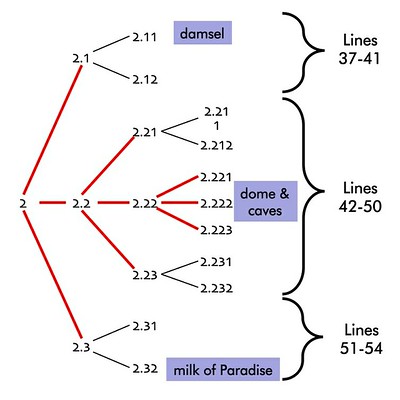
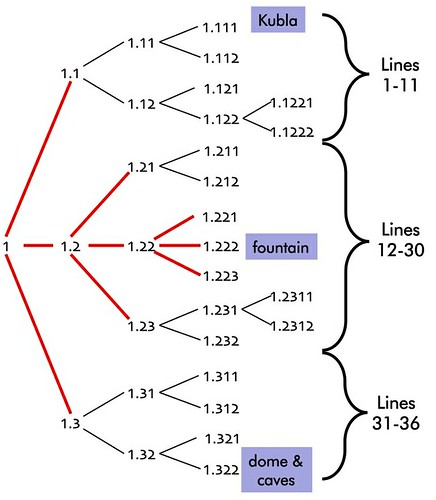
For me, those questions began when I was faced with the structure of “Kubla Khan”:

1 tree

That’s just the first 36 lines, but the last 18 look the same:

2 tree

That looked like the trace of some nested loops. If so, what then?

Let’s put that aside. After all, I’ve been working on that for a LONG time and still haven’t figure it out.

The problem I’m trying to figure out is this: How do we draw a principled line between those brain processes that are computational and those that are not?

Some (most, all?) computer scientists ‘seem to define a computer as “a physical mechanism that can theoretically calculate any computable function”.’ If I go with that notion, then it’s all computation and I have no reason to single out those tree structures in “Kubla Khan” for special attention, or any other linguistic tree structures for that matter. That’s not very helpful.

What if I think of the brain as a structured physical system? When Saty Chary advanced his Structured Physical System Hypothesis (SPSH) he was explicitly playing against the Physical System Hypothesis Hypothesis (PSSH) of Newell and Simon (1976). They advanced the PSSH as the central tenet of cognitive science and AI, and it echoes back to the 1943 paper in which McCulloch and Pitts argued that basic neuronal circuits are logic gates. It turns out that, no, they’re not. They’re quite a bit more complicated.

I like the SPSH. The question for me, then, is: Are their processes taking place in the brain that are NOT dominated by the internal physical activity of the nervous system? I should think so. The process of perception involves interaction with the external world, which necessarily implies that there are things happening in the brain that a driven, though not completely determined by, external physical circumstances. That, I believe, puts us in the world of William Powers, Behavior: The Control of Perception (1973). Language is among those circumstances; for humans it is one of the most important.

That, I think, will allow me to answer my question, though a proper answer will require more construction than I’m willing to undertake here. The relationship between the physical signifier and the signified is arbitrary. In particular, it is arbitrary with respect to the physical processes involved in both. It’s that arbitrary connection implies that language processes are not dominated by the internal physical dynamics of the brain. The basic language process is that of indexing, as Hays and I called it in Principles and Structure of Natural Intelligence. Newell and Simon called it designation.

Now, how can I formulate this idea so that it applies to large language models (in a useful way)? It seems to me that processes in LLMs are dominated by the statistics of the corpus that is modeled. That’s the nub of truth that’s captured by the otherwise reductive phrases, “stochastic parrots,” and “autocomplete on steroids.” The ideas that we require systems that both have access to the external world and that have robust symbolic capabilities, to a first approximation, those amount to freeing the system from being dominated by the statistics of some training corpus. Think about that, carefully.

More later.

Wednesday, November 15, 2023

A dialectical view of the history of AI, Part 1: We’re only in the antithesis phase. [A synthesis is in the future.]

The idea that history proceeds by way of dialectical change is due primarily to Hegel and Marx. While I read bit of both early in my career, I haven’t been deeply influenced by either of them. Nonetheless I find the notion of dialectical change working out through history to be a useful way of thinking about the history of AI. Because it implies that that history is more than just one thing of another.

This dialectical process is generally schematized as a movement from a thesis, to an antithesis, and finally, to a synthesis on a “higher level,” whatever that is. The technical term is Aufhebung. Wikipedia:

In Hegel, the term Aufhebung has the apparently contradictory implications of both preserving and changing, and eventually advancement (the German verb aufheben means "to cancel", "to keep" and "to pick up"). The tension between these senses suits what Hegel is trying to talk about. In sublation, a term or concept is both preserved and changed through its dialectical interplay with another term or concept. Sublation is the motor by which the dialectic functions.

So, why do I think the history of AI is best conceived in this way? The first era, THESIS, running from the 1950s up through and into the 1980s, was based on top-down deductive symbolic methods. The second era, ANTITHESIS, which began its ascent in the 1990s and now reigns, is based on bottom-up statistical methods. These are conceptually and computationally quite different, opposite, if you will. As for the third era, SYNTHESIS, well, we don’t even know if there will be a third era. Perhaps the second, the current, era will take us all the way, whatever that means. Color me skeptical. I believe there will be a third era, and that it will involve a synthesis of conceptual ideas computational techniques from the previous eras.

Note, though, that I will be concentrating on efforts to model language. In the first place, that’s what I know best. More importantly, however, it is the work on language that is currently evoking the most fevered speculations about the future of AI.

Let’s take a look. Find a comfortable chair, adjust the lighting, pour yourself a drink, sit back, relax, and read. This is going to take a while.

Symbolic AI: Thesis

The pursuit of artificial intelligence started back in the 1950s it began with certain ideas and certain computational capabilities. The latter were crude and radically underpowered by today’s standards. As for the ideas, we need two more or less independent starting points. One gives us the term “artificial intelligence” (AI), which John McCarthy coined in connection with a conference held at Dartmouth in 1956. The other is associated with the pursuit of machine translation (MT) which, in the United States, meant translating Russian technical documents into English. MT was funded primarily by the Defense Department.

The goal of MT was practical, relentlessly practical. There was no talk of intelligence and Turing tests and the like. The only thing that mattered was being able to take a Russian text, feed it into a computer, and get out a competent English translation of that text. Promises was made, but little was delivered. The Defense Department pulled the plug on that work in the mid-1960s. Researchers in MT then proceeded to rebrand themselves as investigators of computational linguistics (CL).

Meanwhile researchers in AI gave themselves a very different agenda. They were gunning for human intelligence and were constantly predicting we’d achieve it within a decade or so. They adopted chess as one of their intellectual testing grounds. Thus, in a paper published in 1958 in the IBM Journal of Research and Development, Newell, Shaw, and Simon wrote that if “one could devise a successful chess machine, one would seem to have penetrated to the core of human intellectual endeavor.” In a famous paper, John McCarthy dubbed chess to be the Drosophila of AI.

Chess isn’t the only thing that attracted these researchers, they also worked on things like heuristic search, logic, and proving theorems in geometry. That is, they choose domains which, like chess, were highly rationalized. Chess, like all highly formalized systems, is grounded in a fixed set of rules. We have a board with 64 squares, six kinds of pieces with tightly specified rules of deployment, and a few other rules governing the terms of play. A seeming unending variety of chess games then unfolded from these simple primitive means according to the skill and ingenuity, aka intelligence, of the players.

This regime, termed symbolic AI in retrospect, remained in force through the 1980s and into the 1990s. However, trouble began showing up in the 1970s. To be sure, the optimistic predictions of the early years hadn’t come to pass; humans still beat computers at chess, for example. But those were mere setbacks.

These problems were deeper. While the computational linguistics were still working on machine translation, they were also interested in speech recognition and speech understanding. Stated simply, speech recognition goes like this: You give a computer a string of spoken language and it transcribes it into written language. The AI folks were interested in this as well. It’s not the sort of thing humans give a moment’s thought to; we simply do it. It is mere perception. It was proving to be surprisingly difficult. The AI folks also turned to computer vision: Give a computer a visual image and have it identify the object. That was difficult as well, even with such simple graphic objects as printed letters.

Speech understanding, however, was on the face of it intrinsically more difficult. Not only does the system have recognize the speech, but it must understand what is said. But how do you determine whether or not the computer understood what you said. You could ask it: “Do you understand?” And if it replies, “yes,” then what? You give it something to do.

That’s what the DARPA Speech Understanding Project set out to do in over five years in the early to mid 1970s. Understanding would be tested by having the computer answer questions about database entries. Three independent projects were funded; interesting and influential research was done. But those systems, interesting as they were, were not remotely as capable as Siri or Alex in our time, which run on vastly more compute encompassed in much smaller packages. We were a long way from having a computer system that could converse as fluently as a toddler, much less discourse intelligently on the weather, current events, the fall of Rome, the Mongol’s conquest of China, or how to build a fusion reactor.

During the 1980s the commercial development of AI petered out and a so-called AI Winter settled in. It would seem that AI and CL had hit the proverbial wall. The classical era, the era of symbolic computing, was all but over.

Friday, March 24, 2023

Rodney Brooks sounds a cautionary note about GPTs

Brooks just made a post specifically directed at the type surrounding transformers. First a bit of historical perspective:

A few such instances of AI technologies that have induced gross overestimates of how soon we would get to AGI, in roughly chronological order, that I personally remember include:

John McCarthy’s estimate that the computers of the 1960’s were powerful enough to support AGI, Minsky and Michie and Nilsson each believing that search algorithms were the key to intelligence, neural networks (volume 3, perceptrons) [[I wasn’t around for the first two volumes; McCulloch and Pitts in 1943, Minsky in 1953]], first order logic, resolution theorem proving, MacHack (chess 1), fuzzy logic, STRIPS, knowledge-based systems (and revolutionizing medicine), neural networks (volume 4, back propagation), the primal sketch, self driving cars (Dickmanns, 1987), reinforcement learning (rounds 2 and 3), SOAR, qualitative reasoning, support vector machines, self driving cars (Kanade et al, 1997), Deep Blue (chess 2), self driving cars (Thrun, 2007), Bayesian inference, Watson (Jeopardy, and revolutionizing medicine), neural networks (volume 5, deep learning), Alpha GO, reinforcement learning (round 4), generative images, and now large language models. All have heralded the imminence of human level intelligence in machines. All were hyped up to the limit, but mostly in the days when very few people were even aware of AI, so very few people remember the levels of hype. I’m old. I do remember all these, but have probably forgotten quite a few…

None of these things have lived up to that early hype. As Amara predicted at first they were overrated. But at the same time, almost every one of these things have had long lasting impact on our world, just not in the particular form that people first imagined. As we twirled them around and prodded them, and experimented with them, and failed, and retried, we remade them in ways different from how they were first imagined, and they ended up having bigger longer term impacts, but in ways not first considered.

How does this apply to GPT world?

Then a caveat:

Back in 2010 Tim O’Reilly tweeted out “If you’re not paying for the product then you’re the product being sold.”, in reference to things like search engines and apps on telephones.

I think that GPTs will give rise to a new aphorism (where the last word might vary over an array of synonymous variations):

If you are interacting with the output of a GPT system and didn’t explicitly decide to use a GPT then you’re the product being hoodwinked.

I am not saying everything about GPTs is bad. I am saying that, especially given the explicit warnings from Open AI, that you need to be aware that you are using an unreliable system.

He goes on to say:

When no person is in the loop to filter, tweak, or manage the flow of information GPTs will be completely bad. That will be good for people who want to manipulate others without having revealed that the vast amount of persuasive evidence they are seeing has all been made up by a GPT. It will be bad for the people being manipulated.

And it will be bad if you try to connect a robot to GPT. GPTs have no understanding of the words they use, no way to connect those words, those symbols, to the real world. A robot needs to be connected to the real world and its commands need to be coherent with the real world. Classically it is known as the “symbol grounding problem”. GPT+robot is only ungrounded symbols. [...]

My argument here is that GPTs might be useful, and well enough boxed, when there is an active person in the loop, but dangerous when the person in the loop doesn’t know they are supposed to be in the loop. [This will be the case for all young children.] Their intelligence, applied with strong intellect, is a key component of making any GPT be successful.

At last, his specific predictions:

Here I make some predictions for things that will happen with GPT types of systems, and sometimes coupled with stable diffusion image generation. These predictions cover the time between now and 2030. Some of them are about direct uses of GPTs and some are about the second and third order effects they will drive.

  1. After years of Wikipedia being derided as not a referable authority, and not being allowed to be used as a source in serious work, it will become the standard rock solid authority on just about everything. This is because it has built a human powered approach to verifying factual knowledge in a world of high frequency human generated noise.
  2. Any GPT-based application that can be relied upon will have to be super-boxed in, and so the power of its “creativity” will be severely limited.
  3. GPT-based applications that are used for creativity will continue to have horrible edge cases that sometimes rear their ugly heads when least expected, and furthermore, the things that they create will often arguably be stealing the artistic output of unacknowledged humans.
  4. There will be no viable robotics applications that harness the serious power of GPTs in any meaningful way.
  5. It is going to be easier to build from scratch software stacks that look a lot like existing software stacks.
  6. There will be much confusion about whether code infringes on copyright, and so there will be a growth in companies that are used to certify that no unlicensed code appears in software builds.
  7. There will be surprising things built with GPTs, both good and bad, that no-one has yet talked about, or even conceived.
  8. There will be incredible amounts of misinformation deliberately created in campaigns for all sorts of arenas from political to criminal, and reliance on expertise will become more discredited, since the noise will drown out any signal at all.
  9. There will be new categories of pornography.

Thursday, February 16, 2023

The Long Story of How Neural Nets Got to Where They Are

This is a fascinating discussion between Stephen Wolfram and Terry Sejnowski. These guys, Sejnowski especially, are pulling names from all over the place. There are lots of isolated and semi-isolated figures in this story. But it’s (the beginnings of) a map of where all this came from. Should probably check it against Grace Lindsey's wonderful little book, Models of the Mind. Note that the early stuff about computational linguistics is messed up. Chomsky had nothing to do with it.

And so forth and so on. 

After about 3:00:31 Wolfram and Sejnowski make that point that, while the field of neural networks started with a small group of "true believers," as most intellectual enterprises do, in the case of neural nets (Wolfram) "there were all these separate little pockets, I think that's not so common." In many cases "the tree grows from one trunk, so to speak." To which Sejnowski responds, "Ah, OK, that's an interesting observation."  Wolfram notes that, for example, in the case of "quantum mechanics there were not multiple trunks." He goes on to say that, in a sense, it all grew from the initial McCulloch-Pitts 1943 paper, "and yet there were all these separate branches, same seed but it wasn't a single trunk from that." Moreover, "the time scale from the initial seed to  fruition is extremely long. Many generations." Sejnowski agrees "that it was very diverse. But one possible explanation is that you have a much bigger search space to explore." 

Sunday, July 24, 2022

Physical constraints on computing, process and memory, Part 1 [LeCun]

Yann LeCun recently posted a major position paper that has been receiving quite a bit of discussion:

Yann LeCun, A Path Towards Autonomous Machine Intelligence, Version 0.9.2, 2022-06-27, https://openreview.net/forum?id=BZ5a1r-kVsf

This post is a response to a long video posted by Dr. Tim Scarfe which raised a number of important issues. One of them is about physical constraints in the implementation of computing procedures and memory. I’m thinking this may well be THE fundamental issue in computing, and hence in human psychology and AI.

I note in passing that John von Neumann’s The Computer and the Brain (1958) was about the same issue and discussed two implementation strategies, analog and digital. He also suggested that the brain perhaps employed both. He also noted that, unlike digital computers, where you have and active computational unit linked to passive memory through fetch-execute cycles, that each unit of the brain, i.e. neuron, appears to be an active unit.

Physical constraints on computing

Here’s the video I was talking about. It is from the series Machine Learning Street Talk, #78 - Prof. NOAM CHOMSKY (Special Edition), and is hosted by Dr. Tim Scarfe along with Dr. Keith Duggar and Dr. Walid Saba.

As I’m sure you know, Chomsky has nothing good to say about machine learning. Scarfe is not so dismissive, but he does seem to be a hard-core symbolist. I’m interested in a specific bit of the conversation, starting about about 2:17:14. One of Scarfe’s colleagues, Dr. Keith Duggar, mentions a 1988 paper by Fodor and Pylyshyn, Connectionism and Cognitive Architecture: A Critical Analysis (PDF). I looked it up and found this paragraph (pp. 22-23):

Classical theories are able to accommodate these sorts of considerations because they assume architectures in which there is a functional distinction between memory and program. In a system such as a Turing machine, where the length of the tape is not fixed in advance, changes in the amount of available memory can be affected without changing the computational structure of the machine; viz by making more tape available. By contrast, in a finite state automaton or a Connectionist machine, adding to the memory (e.g. by adding units to a network) alters the connectivity relations among nodes and thus does affect the machine’s computational structure. Connectionist cognitive architectures cannot, by their very nature, support an expandable memory, so they cannot support productive cognitive capacities. The long and short is that if productivity arguments are sound, then they show that the architecture of the mind can’t be Connectionist. Connectionists have, by and large, acknowledged this; so they are forced to reject productivity arguments.

That’s what they were talking about. Duggar and Scarfe agree that this is a deep and fundamental issue. A certain kind of very useful abstraction seems to depend on separating the computational procedure from the memory on which it depends. Scarfe (2:18:40): “LeCun would say, well if you have to handcraft the abstractions then learning's gone out the window.” Duggar: “Once you take the algorithm and abstract it from memory, that's when you run into all these training problems.”

OK, fine.

But, as they are talking about a fundamental issue in physical implementation, it must apply to the nervous system as well. Fodor and Pylyshyn are talking about the nervous system too, but they don’t really address the problem except to assert that (p. 45), “the point is that the structure of ‘higher levels' of a system are rarely isomorphic, or even similar, to the structure of ‘lower levels' of a system,” and therefore the fact that the nervous system appears to be a connectionist network need not be taken as indicative about the nature of the processes it undertakes. That is true, but no one has, to my knowledge, provided strong evidence that this complex network of 86 billion neurons is, in fact, running a CPU and passive memory type of system.

Given, that, how has the nervous system solved the problem of adding new content to the system, which it certainly does? Note that here is their specific phrasing, from the paragraph I’ve quoted: “adding to the memory (e.g. by adding units to a network) alters the connectivity relations among nodes and thus does affect the machine’s computational structure.” The nervous system seems to be able to add new items to memory without, however, having to add new physical units, that is neurons, to the network. That is worth thinking about.

Human cortical plasticity: Freeman

The late Walter Freeman has left us a clue. In an article from 1991 in Scientific American (which was more technical in those days), entitled “The Physiology of Perception,” he discusses his work on the olfactory cortex. He’s using an array of electrodes mounted on the cortical surface (of a rat) to register electrical activity. Note that he’s NOT making recordings of the activity of individual neurons. Rather, he’s recording activity in a population of neurons. He then made 2-D images of that activity.

The shapes we found represent chaotic attractors. Each attractor is the behavior the system settles into when it is held under the influence of a particular input, such as a familiar odorant. The images suggest that an act of perception consists of an explosive leap of the dynamic system from the " basin" of one chaotic attractor to another; the basin of an attractor is the set of initial conditions from which the system goes into a particular behavior. The bottom of a bowl would be a basin of attraction for a ball placed anywhere along the sides of the bowl. In our experiments, the basin for each attractor would be defined by the receptor neurons that were activated during training to form the nerve cell assembly.

We think the olfactory bulb and cortex maintain many chaotic attractors, one for each odorant an animal or human being can discriminate. Whenever an odorant becomes meaningful in some way, another attractor is added, and all the others undergo slight modification.

Let me repeat that last line: “Whenever an odorant becomes meaningful in some way, another attractor is added, and all the others undergo slight modification.” That the addition of a new item to memory should change the other items in memory is what we would expect of such a system. But how does the brain manage it? It would seem that specific memory items are encoded in whole populations, not in one or a small number of neurons (so-called ‘grandmother’ cells). Somehow the nervous system is able to make adjustments to some subset of synapses in the population without having to rewrite everything.

In this connection it’s worth mentioning my favorite metaphors for the brain, as a hyperviscous fluid. What do I mean by that? A fluid having many components, of varying viscosity (some very high, some very low, and everything in between), which are intermingled in a complex way, perhaps fractally. Of course, the brain, like most of the body’s soft tissue, is mostly water, but that’s not what I’m talking about. I’m talking about connectivity.

Perhaps I should instead talk about a hyperviscous network, or mesh, or maybe just a hyperviscous pattern of connectivity. Some synaptic networks have extremely high viscosity and so change very slowly over time while others have extremely low viscosity, and change rapidly. The networks involved in tracking and moving in the world in real time must have extremely low viscosity while those holding our general knowledge of the world and our own personal history will have a very high viscosity.

In the phenomenon that Freeman reports, we can think of the overall integrity of the odorant network as being maintained at, say, level 2, where moment-to-moment sensations are at level 0. The new odorant is initially registered at level 1 and so will affect the level 1 networks across all odorants. That’s the change registered in Freeman’s data. But the differences between odorants are still preserved in level 2 networks. Over time the change induced by the new odorant will percolate from level 1 to level 2 synaptic networks. Thus a new item enters the network without disrupting the overall pattern of connectivity and activation.

That is something I just made up. I have no idea whether or not, for example, it makes sense in terms of the literature on long-term potentiation (LTP) and short-term potentiation (STP), which I do not know. I do note, however, that the term “viscosity” has a use in programming that is similar to my use here.

Addendum: Are we talking about computation in the Freeman example?

I have variously argued that language is the simplest operation humans do that qualifies as computation. Thus, earlier in the commentary on LeCun’s piece I have said:

I take it as self-evident that an atomic explosion and a digital simulation of an atomic explosion are different kinds of things. Real atomic explosions are enormously destructive. If you want to test an atom bomb, you do so in a remote location. But you can do a digital simulation in any appropriate computer. You don’t have to encase the computer in lead and concrete to shield you from the blast and radiation, etc. And so it is with all simulations. The digital simulation is one thing, and real phenomenon, another.

That’s true of neurons and nervous systems too. [...] However, back in 1943 Warren McCulloch and Walter Pitts published a very influential paper (A Logical Calculus of the Ideas Immanent in Nervous Activity) in which they argued that neurons could be thought of as implementing circuits of logic gates. Consequently many have, perhaps too conveniently, assumed that nervous systems are (in effect) evaluating logical expressions and therefore that the nervous system is evaluating symbolic expressions.

I think that’s a mistake. Nervous systems are complex electro-chemical systems and need to be understood as such. What happens at synapses is mediated by 100+ chemicals, some more important than others. It seems that some of these processes have a digital character while others have an analog character. [...] I have come to the view that language is the simplest phenomenon that can be considered symbolic, thought we may simulate those processes through computation if we wish. That implies that there is no symbolic processing in animals and none in humans before, say, 18 months or so. Just how language is realized in a neural architecture that seems so contrary to the requirements of symbolic computing, that is a deep question, though I’ve offered some thoughts about that in the working paper I mentioned in my original comment.

If the phenomenon Freeman describes is not about computation, and it is NOT according to my current beliefs, then how does the problem brought up by Fodor & Pylyshyn apply?

And yet there IS a problem, isn’t there. There is a physical network with connections between the items in the network. Those connections must be altered in order to accommodate a new phenomenon. We can’t just add a new item to the end of the tape. That is, it IS a physical problem of the same form. So perhaps this technicality doesn’t matter.

Sunday, May 1, 2022

What I've been up to in the last two weeks, across the Continental Divide and on to the Pacific [how the mind works]

Here's the most recent two entries from my intellectual diary, which is mostly just short notations. The second entry is unusually long.

* * * * *

Emergent Ventures Grant
4.28.22

Applied in April to work over my attractor-net stuff, run it through the brain paper, on to “Kubla Khan” and out into a differentiation between natural and artificial minds. It was turned down on April 25, 2022. By that time I’d started thinking my way back into the old work on Attractor Nets.

3rd Version of “The Theory”
4.30.22

By which I mean the theory I’d been working on with Dave Hays. The first version was based on Mechanisms of Language. That was in place when first met Hays in Spring of 1974. Hays wrote Cognitive Structures in the Spring of 1975. That marks the second version of the theory, where Hays grounded cognition in the servomechanical model developed by William Powers (Behavior: The Control of Perception). My 1978 dissertation, “Cognitive Science and Literary Theory,” advanced that a notch, mainly with the addition of what I call The TV Tube model. Then Hays and I wrote and published “Principles and Development of Natural Intelligence” (1988).

That marks the beginning of the third phase of the theory – though we’d published on metaphor the year before. We’d completed the “brain paper” in ’85, I believe, the review process took three years. The brain paper retained by four degrees from the stage 2 theory – sensorimotor, systemic, episodic, gnomonic – and added a fifth at the bottom, modal. That was based on McCulloch’s model of the reticular activating system (RAS). We stuck Pribram’s holographic ‘model’ in at the second degree, sensorimotor, and the Powers stack at three, systemic. But we didn’t actually know how to construct cognitive models (comparable to those of stage 1 & 2) in those terms.

I began that work in 2003 when I had the idea of taking Sydney Lamb’s relational notation and using it to make logical relations between the basins of attraction in patches of cortical tissue, such as Walter Freeman found in his work. That went well for two or three months until I decided that things were beginning to seem arbitrary and unmotivated. So I stopped working. But by that time I had a pile of very interesting diagrams and some provocative prose. I created two documents, a text document (MSWord), and a diagrams document (PowerPoint), and sent those around to various people. I also came up with the idea of an open-ended natural language front-end for end-user software. I sent that around as well. Sydney Lamb thought it was a good idea. A decade later I put those three documents on the web at on my Academia page.

And that was that, until a week or so ago. That’s when I decided it was time to get back into the fray. By then I’d been thinking seriously about work in machine learning, mostly in cognitive criticism. But I’d also been thinking about NLP, especially the machine translation work. Along came GPT-3 and I got serious. I wrote a working paper, “GPT-3: Waterloo or Rubicon? Here be Dragons”, in 2020. I made real progress on that, began to get a sense that what’s going on in those engines is intelligible. The work of Peter Gärdenfors was important.

The upshot: By the time I’d submitted the proposal to Emergent Ventures I’d begun to think my way back into it. When I got turned down, I couldn’t stop. Yesterday I figured it out:


physical substrate

data reduction

concepts

Hays

Powers stack

(analog servos)

parameters of perception

cognition

Gärdenfors

subsymbolic

neural net

conceptual spaces, dimensions

symbolic

What does that mean, figured it out? It means I finally made it across the continent and am viewing the Pacific Ocean. I’ve put a boundary around the territory. Most of the territory has yet to be explored, much less become settled and domesticated.

These diagrams are nice as well. This diagram relates to the work of Gärdenfors. Each rectangle is a domain in his terminology. Conceptual spaces (again, his terminology) exist in different domains.

This diagram relates to both Hays-Benzon and Gärdenfors. The rectangles are Gärdenfors. The network structure in Benzon-Hays.