



Friday, September 23, 2016

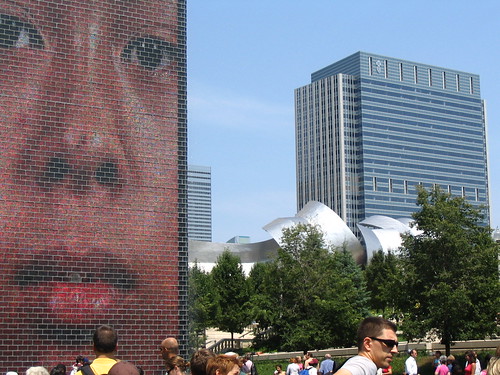
Chicago's Millennium Park the summer It Opened (2004)

I bought my first camera, a Canon PowerShot A75, so I could take these photos.

IMG_0238

IMG_0232

IMG_0375

IMG_0368

IMG_0301

In psychology, the times they are a changin'

Andrew Gelman has a long and very interesting post on the replication crisis in psychology, including a chronology of the major events that goes back to the 1960s (the passage is full of hyperlinks in the original:
1960s-1970s: Paul Meehl argues that the standard paradigm of experimental psychology doesn’t work, that “a zealous and clever investigator can slowly wend his way through a tenuous nomological network, performing a long series of related experiments which appear to the uncritical reader as a fine example of ‘an integrated research program,’ without ever once refuting or corroborating so much as a single strand of the network.”

Psychologists all knew who Paul Meehl was, but they pretty much ignored his warnings. For example, Robert Rosenthal wrote an influential paper on the “file drawer problem” but if anything this distracts from the larger problems of the find-statistical-signficance-any-way-you-can-and-declare-victory paradigm.

1960s: Jacob Cohen studies statistical power, spreading the idea that design and data collection are central to good research in psychology, and culminating in his book, Statistical Power Analysis for the Behavioral Sciences, The research community incorporates Cohen’s methods and terminology into its practice but sidesteps the most important issue by drastically overestimating real-world effect sizes....
2011: Various episodes of scientific misconduct hit the news. Diederik Stapel is kicked out of the pscyhology department at Tilburg University and Marc Hauser leaves the psychology department at Harvard. These and other episodes bring attention to the Retraction Watch blog. I see a connection between scientific fraud, sloppiness, and plain old incompetence: in all cases I see researchers who are true believers in their hypotheses, which in turn are vague enough to support any evidence thrown at them. Recall Clarke’s Law.

2012: Gregory Francis publishes “Too good to be true,” leading off a series of papers arguing that repeated statistically significant results (that is, standard practice in published psychology papers) can be a sign of selection bias. PubPeer starts up.

2013: Katherine Button, John Ioannidis, Claire Mokrysz, Brian Nosek, Jonathan Flint, Emma Robinson, and Marcus Munafo publish the article, “Power failure: Why small sample size undermines the reliability of neuroscience,” which closes the loop from Cohen’s power analysis to Meehl’s more general despair, with the connection being selection and overestimates of effect sizes....

Also, the replication movement gains steam and a series of high-profile failed replications come out. First there’s the entirely unsurprising lack of replication of Bem’s ESP work—Bem himself wrote a paper claiming successful replication, but his meta-analysis included various studies that were not replications at all—and then came the unsuccessful replications of embodied cognition, ego depletion, and various other respected findings from social pscyhology.

2015: Many different concerns with research quality and the scientific publication process converge in the “power pose” research of Dana Carney, Amy Cuddy, and Andy Yap, which received adoring media coverage but which suffered from the now-familiar problems of massive uncontrolled researcher degrees of freedom (see this discussion by Uri Simonsohn), and which failed to reappear in a replication attempt by Eva Ranehill, Anna Dreber, Magnus Johannesson, Susanne Leiberg, Sunhae Sul, and Roberto Weber....

2016: Brian Nosek and others organize a large collaborative replication project. Lots of prominent studies don’t replicate. The replication project gets lots of attention among scientists and in the news, moving psychology, and maybe scientific research, down a notch when it comes to public trust. There are some rearguard attempts to pooh-pooh the failed replication but they are not convincing.

Late 2016: We have now reached the “emperor has no clothes” phase. When seemingly solid findings in social psychology turn out not to replicate, we’re no longer surprised.
Gelman notes, however, that though the problems had been noticed long ago, it wasn't until quite recently the discipline started to see a crisis in its foundations. The rest of the post looks at two things: 1) the way the epistemological and methodological foundations of psychology have changed, and 2) how the rise of social media has taken the discussion outside the formal literature, which is to some extent controlled by the old guard.

On the first:
A paradigm that should’ve been dead back in the 1960s when Meehl was writing on all this, but which in the wake of Simonsohn, Button et al., Nosek et al., is certainly dead today. It’s the paradigm of the open-ended theory, of publication in top journals and promotion in the popular and business press, based on “p less than .05” results obtained using abundant researcher degrees of freedom. It’s the paradigm of the theory that in the words of sociologist Jeremy Freese, is “more vampirical than empirical—unable to be killed by mere data.” It’s the paradigm followed by Roy Baumeister and John Bargh, two prominent social psychologists who were on the wrong end of some replication failures and just can’t handle it.

I’m not saying that none of Fiske’s work would replicate or that most of it won’t replicate or even that a third of it won’t replicate. I have no idea; I’ve done no survey. I’m saying that the approach to research demonstrated by Fiske in her response to criticism of that work of hers is an style that, ten years ago, was standard in psychology but is not so much anymore. So again, her discomfort with the modern world is understandable.
On the second:
Fiske is annoyed with social media, and I can understand that. She’s sitting at the top of traditional media. She can publish an article in the APS Observer and get all this discussion without having to go through peer review; she has the power to approve articles for the prestigious Proceedings of the National Academy of Sciences; work by herself and har colleagues is featured in national newspapers, TV, radio, and even Ted talks, or so I’ve heard. Top-down media are Susan Fiske’s friend. Social media, though, she has no control over. That’s must be frustrating, and as a successful practioner of traditional media myself (yes, I too have published in scholarly journals), I too can get annoyed when newcomers circumvent the traditional channels of publication. People such as Fiske and myself spend our professional lives building up a small fortune of coin in the form of publications and citations, and it’s painful to see that devalued, or to think that there’s another sort of scrip in circulation that can buy things that our old-school money cannot.

But let’s forget about careers for a moment and instead talk science.

When it comes to pointing out errors in published work, social media have been necessary. There just has been no reasonable alternative. Yes, it’s sometimes possible to publish peer-reviewed letters in journals criticizing published work, but it can be a huge amount of effort. Journals and authors often apply massive resistance to bury criticisms.
H/t Alex Tabarrok.

Thursday, September 22, 2016

Someone to watch over me

IMG_0226

23 Big Macs for 2016: More special sauce for the elite few

Back in 2013 I did a series of articles on the MacArthur Fellows Program (collected as The Genius Chronicles) arguing that the Academy of Big Mac (aka the MacArthur Foundation) was copping out by giving the majority of its awards to people who don’t really need them because they had secure employment at prestigious institutions. If they wanted to be true to their original mandate, to seek out those not normally graced by the award fairies, they should avoid those institutions entirely. But they don’t listen. How could they? They’ve got to feed the vanity of the elite institutions on which they depend for advice, personnel, and approval.

Back in 1992 Anne Matthews wrote a full-dress review of the program for The New York Times Magazine, “The MacArthur Truffle Hunt,” in which she observed: “Officials at other foundations note the MacArthur fellows program has never really decided if its job is to reward creativity or to stimulate it, if it wants to be an American Nobel Prize or a fairy godmother to talents unappreciated by mainstream society.” Their solution seems to have been to aim for the Nobels while appearing to be a fairy godmother. So they favor those firmly entrenched in elite institutions, spawning ground for Nobels, but who have not yet reached the highest levels in those institutions, though some of them are pretty high indeed, with named professorships.

They’ve just announced their class of 2016 and they’re following true to form: 23 awards, of which 13 go to people who have lifetime employment at good universities. That’s 57%. They may well be fine and innovative people, probably are, but why not give those awards to people who work temp gigs, fast-food or low to mid-level office gigs, any kind of make-do gig, to support their creative efforts in the evenings and on weekends? Why not? Because it’s too hard to find them, requires too much imagination and a taste for risk, that’s why.

Waffle Tallies

Here’s the Big Mac “waffle” tally (awards to people with secure gigs) for the last four years:

2013: 63%
2014: 52%
2015: 54%
2016: 57%


MacArthur Fellowships: Let the Geniuses Free – This is the original post in the series and tallies the winners for 2013.

Wednesday, September 21, 2016

Flowers

IMG_0184

Emotional arousal of a drama increases social bonding

Royal Society Open Science

Emotional arousal when watching drama increases pain threshold and social bonding

R. I. M. Dunbar, Ben Teasdale, Jackie Thompson, Felix Budelmann, Sophie Duncan, Evert van Emde Boas, Laurie Maguire
Published 21 September 2016. DOI: 10.1098/rsos.160288

Abstract

Fiction, whether in the form of storytelling or plays, has a particular attraction for us: we repeatedly return to it and are willing to invest money and time in doing so. Why this is so is an evolutionary enigma that has been surprisingly underexplored. We hypothesize that emotionally arousing drama, in particular, triggers the same neurobiological mechanism (the endorphin system, reflected in increased pain thresholds) that underpins anthropoid primate and human social bonding. We show that, compared to subjects who watch an emotionally neutral film, subjects who watch an emotionally arousing film have increased pain thresholds and an increased sense of group bonding.

Introduction

Fiction, in the form of both storytelling and drama, is an important feature of human society, common to all cultures. Though widely studied in the humanities, the reasons why we become so engrossed in fiction, and the likely functions for this, have attracted very little attention from either psychologists or behavioural biologists. Yet, it is evident that people are willing to spend a great deal of time, and often money, to be entertained in this way, whether casually in social contexts or formally in the theatre or cinema, often incurring significant costs when doing so. Storytelling forms a major component of evening conversations around the campfire in hunter–gatherer societies [1]. One important function is that it enables us to pass on, in the form of origin stories or a corpus of commonly held folktales and folk knowledge, the cultural ideologies that create a sense of community. Shared knowledge forms part of the mechanism that binds friends [2–5] as well as communities [6,7].

As important as these cognitive aspects of storytelling may be for community bonding, they do not explain why we are willing to return again and again to be entertained by storytellers and dramatists. One plausible explanation for our enjoyment of comedy might be that comedy makes us laugh, and laughter activates the endorphin system [8–11], thereby providing a sense of reward and pleasure. Endorphins act as analgesics and increase tolerance of pain [12], being responsible for well-known phenomena like the ‘runner's high’ [13]. As a result, comedy that makes us laugh out loud results in an increase in pain threshold [8–10]. But why should we be just as engaged by emotionally stirring plots that ‘reduce us to tears’ (i.e. tragedies)? One possibility is that the emotional arousal triggered by such stories also activates the endorphin system, because the same areas of the brain that support or respond to physical pain are also involved in psychological pain [14–17]. There is now an extensive literature suggesting that social rejection or viewing emotionally valenced pictures, and even just musically induced mood change, elevate pain thresholds, thereby seeming to allow subjects to attenuate their responses to negative emotional experiences [18–22]. There is even some suggestion that watching a dramatic film increases pain threshold, albeit with small samples and somewhat mixed results [23,24].

While the cognitive component of social bonding is important in maintaining relationships through time in humans, primate social relationships and the bonding of social groups in humans, it is also underpinned by a psychopharmacological mechanism in what is effectively a dual mechanism process [25]. Endorphins, while part of the brain's pain management system [12,26–29], also play a central role in social bonding in anthropoid primates [30–33]. This latter effect is mediated through the afferent c-tactile neural system [34] by the light stroking that occurs during social grooming, and PET imaging has confirmed that this behaviour activates the endorphin system in humans [35]. It seems that a number of other social activities, including laughter [8], singing [36] and dancing [37], also activate this system and, through this, enhance the sense of bonding to the other individuals present.

We used live audiences to test the hypothesis that emotionally arousing film drama triggers an endorphin response (indexed by change in pain threshold) and, at the same time, increases the sense of belonging to the group (social bonding).

Tuesday, September 20, 2016

Why I Love Disney’s Nutcracker Suite

Another post from 2013, this one about one of my all-time favorites. I watched this many times as a child. It fascinated me on black-and-white TV. It entrances me in color.
* * * * *

The Nutcracker Suite episode in Walt Disney's Fantasia is one of my favorite episodes on film and, I believe, one of the most beautiful films ever made. Whatever beauty is, this film has got it. I've written about about its formal elegance, a ring form which is the same forwards as backwards. But that would mean little if it didn’t look good.

And it does look good.

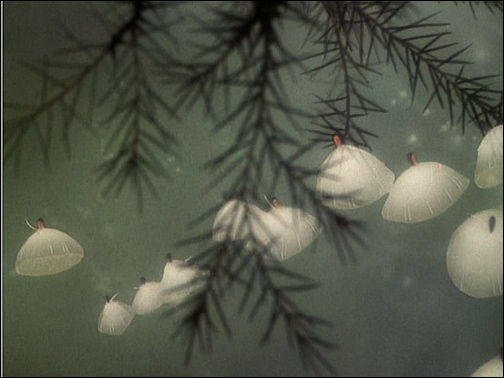
The following frame is, well, “typical” isn’t quite the word I want, perhaps “illustrative.” Yes, the following frame is illustrative:


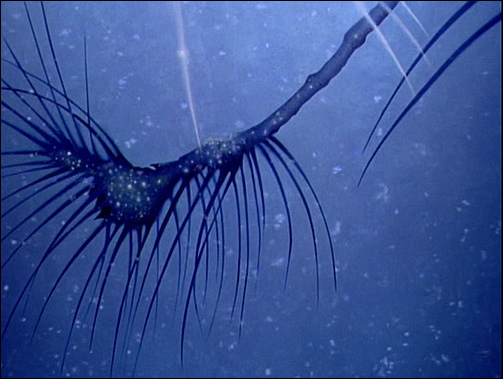
It’s a close-up of pine needles during a snow fall. The twig is maybe two, three, four inches long. The whole segment consists of such close-ups: intimate observations of the natural world. But also, this frame is monochromatic. While The Nutcracker Suite episode of Fantasia displays a full palette, there are many sequences where the palette is subtle, rather than using highly-saturated “cartoony” colors. In this frame, it’s all blues.

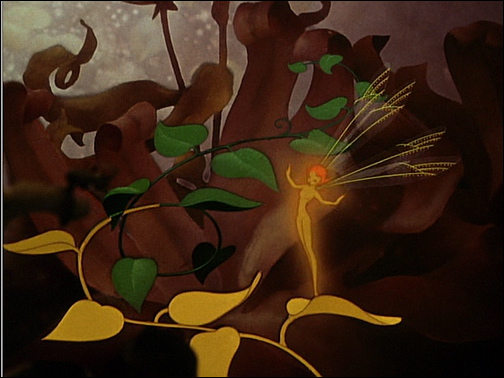
This next frame, in contrast, is in browns and greys, with some green and gold.


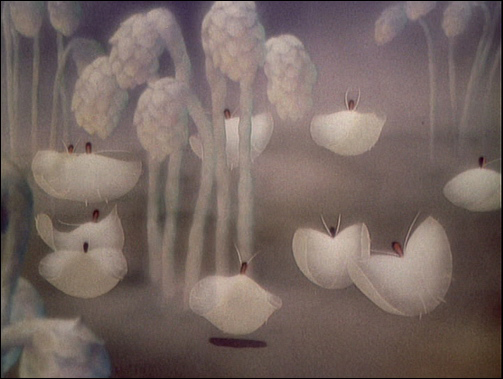
Here we see whites and grey-greens cut with green needles:


Of this “milkweed ballet” Disney said: “If you have a pod, and the fairies touch it, all the seeds fly out almost as if they’re alive . . . I think there’s something beautiful in those seeds ballet-ing through the air; I like to use them because we can get off the ground and have our ballet in air” (Culhane, p. 62). Their flight leads to another almost monochromatic scene:


A Brief for Description

An old one, from 2013, riding my favorite hobbyhorse (one of them, at any rate): description.
* * * * *

Writing at Edge, Ursula Martin praises description:
Once upon a time such observation, description and illustration was the bread and butter of professional and amateur scientists. My eight volume flora, on heavy paper with lovely illustrations that are now collectors' items, was well-thumbed by the original owner, a nineteenth century lady of leisure. It claims to be written for the "unscientific", but the content differs from a modern flora only by the inclusion of quantities of folklore, anecdotes and literary references.

Darwin's books and letters are full of careful descriptions. The amateur struggling with a field guide may take comfort reading how he frets over the difference between a stem with two leaves and a leaf with two leaflets. Darwin seems to have had a soft spot for fumitories, giving wonderfully detailed descriptions of the different varieties, whether and under what conditions they attracted insects, and how the geometry and flexibility of the different parts of the flower affected how pollen was carried off by visiting bees. He was looking for mechanisms that ensured evolutionary variability by making it likely that bees would occasionally transfer pollen from one flower to another, giving rise to occasional crosses—analysis later reflected in the Origin of Species....

No amount of image analysis or data mining can yet take the place of the attention and precision practiced by Darwin and thousands of other professional and amateur naturalists and ecologists.

Monday, September 19, 2016

Distorted Vision

20160830-_IGP7139

Martha Mills: Defending civil and voting rights in Mississippi @3QD

My friend, Martha A. Mills, is a very distinguished trial attorney and judge. Early in her career she worked in Mississippi and later Illinois as a civil rights attorney. She tangled with Grand Imperial Wizards, an Exalted Cyclops or two, good old boys on their worst behavior, and won some and lost some. She also directed a choir, was city attorney in Fayette, tried to explain “Sock it to me, baby!” to a racist judge, sweated the Mississippi bar exam, and took kids to swim in the pool at the Sun ‘N Sands Motel, prompting the locals to triple the dose of chlorine. She’s just published a memoir of those years, Lawyer, Activist, Judge: Fighting for Civil and Voting Rights in Mississippi and Illinois (2015). I’ve reviewed it around the corner at 3 Quarks Daily.

The first case she tried involved Joseph Smith, president of the Holmes Country NAACP. He was accused of running a red light. It was his four witnesses against the ticketing highway patrolman. The case was tried before a justice of the peace, who had no legal training (Mississippi doesn’t require it of JPs). Here’s how that went (112-113).

* * * * *

When we got to the town hall, Joseph Smith, myself, and the four witnesses were told to sit down and wait a few minutes. A police officer came over and asked if it was okay if he gave the oaths to the witnesses, as the JP did not know how. I said it was fine. The trial started with the officer intoning “Hear Ye, Hear Ye” and all that (just like an old British movie) and swearing in the witnesses. And then the JP looked at me and at the highway patrolman who, in addition to having written the ticket, was also acting as prosecutor.

“What am I supposed to do next?”

I answered, “The normal procedure would be for the state to present its case first, and then us.”

“That sounds fine, carry on,” he smiled.

The highway patrolman went on to tell his story–adding that he did not give the ticket because of race or anything like that.

I then put on our witnesses who gave uncontradicted testimony that they knew Smith and his car, were right in the vicinity where they could see everything perfectly, and they saw Smith come to a complete stop behind the stoplight. Smith, of course, personally denied running the stoplight. At that point, both the highway patrolman and I said we were finished. The JP and the patrolman got up and started to walk off, discussing the case.

I overheard the JP, “Now son, how do you think I ought to decide this here case?”

Upon hearing that I followed them, “You honor, this is all highly improper. I have to be present at any conferences you have about this case!”

“That’s fine,” both men nodded at me, but it did not temper their conversation at all.

After some argument between us, the highway patrolman said if I did not think his case was strong enough, he would put on another witness. The witness was the police officer who had administered the oaths. He testified that he was in the vicinity of the violation but that he did not see whether Smith stopped or not. That added evidence seemed to convince the JP, and he gave Smith a fine. We immediately posted an appeal bond. I felt like I was in a Gilbert and Sullivan operetta. It was an unbelievable farce.

Saturday, September 17, 2016

Zimmer @GVM019, Jersey City

20160903-_IGP7165

Consciousness, once more around the merry-go-round

HYPOTHESIS & THEORY ARTICLE

Front. Psychol., 03 September 2013 | http://dx.doi.org/10.3389/fpsyg.2013.00574

The wild ways of conscious will: what we do, how we do it, and why it has meaning

  • Director, Institute for Prospective Cognition, Department of Psychology, Institute for Prospective Cognition, Illinois State University, Normal, IL, USA
ABSTRACT: It is becoming increasingly mainstream to claim that conscious will is an illusion. This assertion is based on a host of findings that indicate conscious will does not share an efficient-cause relationship with actions. As an alternative, the present paper will propose that conscious will is not about causing actions, but rather, about constraining action systems toward producing outcomes. In addition, it will be proposed that we generate and sustain multiple outcomes simultaneously because the multi-scale dynamics by which we do so are, themselves, self-sustaining. Finally, it will be proposed that self-sustaining dynamics entail meaning (i.e., conscious content) because they naturally and necessarily constitute embodiments of context.
While the present paper addresses the relationship between consciousness and action control, its ultimate goal is to propose that terms such as “action” and “consciousness” are scientifically inadequate and, in the end, may have to be replaced in a scientific account of what we do, how we do it, and why it has meaning. This is because, as I will argue, the current conceptual framework used in cognitive science (e.g., perception, cognition, action, attention, intention, and consciousness) is not capable of addressing the complex array of causal regularities that have been discovered in cognitive science over the past 30 years.
In addition, the current conceptual framework has yet to give rise to a scientific conception of how we do what we do that renders the phenomenon of “consciousness” a necessary aspect of the causal story. That is, consciousness is described as either identical with the physical (i.e., identity theory), emergent from the physical (i.e., emergentism), as an informational property of causal relations (i.e., functionalism), or as an aspect of reality other than the physical (i.e., double-aspect theory and property dualism). In all of these positions, consciousness is not a logically necessary aspect of the causal story. That is, the scientific, causal description of how we do what we do is able to disregard consciousness as a causal factor.
While the notion that consciousness might not be logically necessary is certainly popular, one might also take it to indicate the need for an approach to “how we do what we do” that renders consciousness causal (i.e., non-ephiphenomenal). In what follows, I present Wild Systems Theory as an approach to causality and consciousness that renders the latter logically necessary. To be sure, by the time this has been explicated, the term “consciousness” will mean something different that what is referred to via constructs such as Access Consciousness, Metacognition, and Phenomenal Consciousness (Block, 19952001Cleeremans, 2005).

* * * * *

Full article HERE.

More on Chomsky

From a short note by Michael Covington, "Has Chomsky been blown out of the water?":
Chomsky’s first major contribution to linguistics was item 1 in the outline, mechanisms to describe syntax precisely. Before he came on the scene, linguists widely accepted the behaviorist dictum that science can only refer to observed behavior. Some took this so far as to forbid that the study of meaning (which is only observable within the mind), which greatly impeded the study of sentence structure. Chomsky argued cogently that abstract models are as appropriate in linguistics as in physics. He allowed syntactic theory to be abstract enough to do its job. 
Besides the tree structures that are now familiar, Chomsky introduced transformations, which are rules that turn one tree structure into another. At first these were used to turn one kind of sentence into another, such as declaratives into questions. They made the grammar more concise; after you accounted for one kind of sentence, the transformation gave you another kind of sentence with no extra work. 
Very soon, transformations took on a different function, to build observed sentences from more abstract structures that are not observed. This made it possible to simplify the grammar and make it more general. 
Since Chomsky's early work linguists have developed many methods for precisely describing syntax, some inspired by Chomsky, some not. More than anyone else, he got that ball rolling.

What's in doubt is his postulation of universal grammar:
He proposed that the principles of grammar are the same in all languages; the brain is pre-programmed for universal grammar. To learn a particular language, all you have to learn is the vocabulary and a set of “parameters” that establish how the grammar rules play out in that particular language. That is how children manage to learn to talk so quickly and efficiently, without being taught, from hearing incomplete examples of speech. [...] 
The second is advances in cognitive psychology. Back in 1957, there was almost no cognitive psychology. Chomsky was rebelling against Skinnerian behaviorism. Most psychologists at the time advocated an impossibly simple theory of how the mind works. Against that backdrop, he had to postulate inborn universal grammar in order to do everything that simple stimulus-response associations couldn’t do. Nowadays we know that the human mind has complex, powerful, abstract capabilities in many areas, not just language, and new possibilities are opening up for explaining language from general mechanisms of thinking and learning.
This judgment seems right to me:
What is pervasive is the expectation that other linguists will investigate questions that Chomsky raised, whether to prove him right, prove him wrong, or follow the evidence in some other direction entirely. That’s how science is done. This expectation is warranted because Chomsky has raised undeniably important questions.

Friday, September 16, 2016

Adam Smith on Music and Dance

Courtesy of Colwyn Trevarthen:

After the pleasures which arise from gratification of the bodily appetites, there seems to be none more natural to man than Music and Dancing. In the progress of art and improvement they are, perhaps, the first and earliest pleasures of his own invention; for those which arise from the gratification of the bodily appetites cannot be said to be his own invention.
Adam Smith ([1777] 1982: 187)

Time and measure are to instrumental Music what order and method are to discourse; they break it into proper parts and divisions, by which we are enabled both to remember better what has gone before, and frequently to forsee somewhat of what is to come after: we frequently forsee the return of a period which we know must correspond to another which we remember to have gone before; and according to the saying of an ancient philosopher and musician, the enjoyment of Music arises partly from memory and partly from foresight.
Adam Smith ([1777] 1982: 204)

Smith, A. ([1777] 1982). Of the Nature of that Imitation which takes place in what are called the Imitative Arts. In W. P. D. Wightman & J. C. Bryce (eds.) with Dugald Stewart’s account of Adam Smith (ed. I. S. Ross), D. D. Raphael & A. S. Skinner (General eds.), Essays on Philosophical Subjects (pp. 176–213). Indianapolis: Liberty Fund.

Thursday, September 15, 2016

Malick's "Voyage of Time", was Disney there first in "Fantasia"?


Richard Brody in The New Yorker, "Terrence Malick's Metaphysical Journey into Nature":
It’s a sort of vast and visually overwhelming nature documentary, albeit with brief acted sequences, and, as such, it’s an easy film to parody and to mock—say, as the Terrence Malick Science-Wonder Visual Encyclopedia, or “The Tree of Life” with the funny bits cut out. But that’s true of any intensely serious work of art. “Voyage of Time” inhabits a rarefied plane of thought, detached from the practicalities of daily life, that leave it open to a facile and utterly unjustified dismissal, given the breathtaking intensity of its stylistic unity and the immediate, firsthand force of its philosophical reflections.

“Voyage of Time” is, as its title suggests, a sort of cinematic cosmogony, a lyrical collage that looks at a broad spectrum of natural phenomena artistically and imaginatively. In “The Tree of Life,” macroscopic and telescopic images as well as C.G.I. reconstructions of prehistoric times recapture the wonder of a childhood contemplation of science, as inspired by the popular-science books of Malick’s own youth. “Voyage of Time,” working with similar images, recomposes them to an altogether different, yet crucially related, purpose: it seeks the very source of that wonder not in the child’s imagination but in the essence of nature, in the fundamental building blocks of the universe itself.
Sounds like what Disney was up to in (parts of) Fantasia. See my working paper: Walt Disney's Fantasia: The Cosmos and the Mind in Two Hours.

And: "For that matter, it’s often thrillingly difficult, even impossible, to tell what’s intergalactic and what’s intracellular, what’s infinitesimal and what’s immense, what’s biological and what’s astronomical." Check out Eames, Powers of Ten.