Wednesday, March 14, 2018

Trump in Korea, and some more personal reflections

There’s no doubt about it, North Korea has been a knotty challenge for American foreign policy, not–mind you–that I’m a fan of that foreign policy, which has long seemed, shall we say, excessively bellicose. Until quite recently President Trump simply amped up the aggression and seemed entirely too sanguine about the prospect of war with North Korea. Then, all of a sudden, Trump tells us that he’s accepted an overture from Kim Jong-un to talk about Korea’s nukes.

What? Just like that! That’s a good thing, no?

That’s what I felt for maybe a day. And then I began reading commentary by those more deeply informed in such matters than I am. These worthies were not at all encouraging. Quite the contrary, they’ve been rather discouraging and disparaging.

Forget about Trump’s many personal flaws – lack of impulse control, narcissism, megalomania, etc. (Not to mention his misogyny, though that doesn’t seem directly relevant in this matter.) It’s not that these aren’t issues, they are; but let’s just set them aside. Rather, this just isn’t how these things are done. The right way to do this is to have underlings and deputies hash things out for months and even years, ironing out all the kinks, and only then bring in Trump and Kim at the very end. They do a bit of sniffing about, find that it’s all good, and sign on the dotted lines their deputies have drawn. Very cautious, very deliberate.

Besides, for Trump to agree to talks with Kim is to give away half the game, or more, at the very start. Regardless of what the talks produce, if they produce anything at all, Kim wins prestige and legitimization points both at home and abroad. But is that so bad? Who knows, maybe that would settle him down. And maybe not.

But the fact is, business as usual – which is what the worthies want – hasn’t been working all that well, has it?

* * * * *

Meanwhile, I’ve had one of those moments I seem to have been having every few weeks or months. It’s generally during the night when I’m neither fully awake or fully asleep. They don’t last long, a matter of minutes at most. And they’re difficult to characterize.

It’s as though my mind were trying to detach itself from my person and become Mind Itself and thereby grasp the World Whole, if that makes any sense. On the one hand the world is what it is and cannot be escaped. It is utterly necessary. And at the same time seems utterly contingent, as though it could easily have been otherwise. All we need is for that butterfly over China to flutter its wings and history is changed. But what if it’s nothing but butterflies all the way down?

There’s so much human diversity in the world, so many different ways of life, so many different individual life histories. Taken individually, one at a time, each in its socio-historical context, they seem fixed and determinate. But when you consider the differences, each seems utterly contingent and arbitrary.

What if we could circulate minds freely from one to another?

* * * * *

Does The Donald have such moments? What I’ve just said seems rather too abstract and too intellectual for him. If he has such moments, they wouldn’t manifest in such terms. The terms would be different.

Is that what was going on in his insistence that more people attended his inaugural day than any other? In his absurd insistence that the photographs of people on the Mall were FAKE NEWS? Sure, his narcissism, his need to assert his power by forcing his deputies to participate in his delusion. All that.

But beneath it all, was he attempting to find a bit of freedom?

Count me among those who believes he didn’t really want to win–noting that there are various ways one can interpret that. But he won and now THUD! he’s stuck with the job. He’s trapped–in the White House, with all these obscure and difficult responsibilities. His world is changed, utterly.

What’s he think he can do sitting across a table from Kim Jong-un? Two men, with nuclear arms between them, and the world on their shoulders. Is that how they wrestle with the Real?

* * * * *

If I were a religious man I’d be praying for them to find peace in a handclasp.

Tuesday, March 13, 2018

Red cabbage

IMGP6943rd2

Paths Not Taken and the Land Before Us: An Open Letter to J. Hillis Miller

From three years ago (Jan 2015).

I’ve been thinking about writing a guide to my work in literary and cultural criticism, but there’s so much of it that that has seemed to be no simple task. I could list the pieces, but what use is that? And in any event, you can find that on my most recent CV. But I’ve decided to take a step in that direction by addressing an open letter to one of my teachers back at Johns Hopkins, J. Hillis Miller.

That gives me a fairly specific audience. It’s much easier to address a specific audience, with known interests, than to address the General and Undefined Other. I certainly don’t know Miller’s criticism in any detail, but I’ve read several recent pieces and interviews where he talks about the profession in general historical terms. That, plus resonance from ancient days at Hopkins, is enough for me.

For those of you in literary studies, J. Hillis Miller needs no introduction. He is one of the premier English language critics of the last half-century. For those in other disciplines, Miller’s career started at a time when interpreting texts was just becoming accepted in academic literary criticism and he became central in the use of philosophy, broadly understood, in that undertaking.

* * * * *

Dear Prof. Miller:

I’ve been mulling over the wonderful profile of Earl Wasserman that was recently published in the Hopkins Magazine. That got me thinking about the state of the profession, the transit from then to now, and where are we going anyhow? Wasserman, of course, was your colleague and he was my teacher. As it was the "structuralist moment" that ultimately captured my imagination, Wasserman was not so central as Dick Macksey, but he was still very important to me, in part through the exemplary force of his intellectual engagement. I also audited one of your graduate courses (as I recall, Carol Jacobs was a student in that course). I believe you even wrote a graduate school recommendation for me.

The profession used the structuralist moment to go in one direction and I used it to go in a rather different one. On the chance that you might be curious about where I’ve ended up I thought I would write you a letter. FWIW (an abbreviation for a phrase that titled one of the great protest songs of the 60s, “For What It’s Worth”) the open letter is a form I find congenial, having addressed letters to Steven Pinker, Alan Liu, and Willard McCarty.

A Fork in the Road

For the profession the structuralist moment rather quickly gave way to deconstruction, post-structuralism, cultural studies, and various identity-based criticisms, all of which somehow became snarled in a ball that became “Theory.” For me, however, structuralism gave way to cognitive science and that’s what I grafted to literary study at SUNY Buffalo. That English department was as wondrous in its own way as the Hopkins department was in a somewhat different way. One of the small wonders is that it granted me a degree despite the fact that no one in the department was deeply involved with cognitive science (I got that in the Linguistics Department, from a polymath named David Hays).

The profession, alas, was not ready for cognitive science at that time. By the time the profession began coming around to it in the mid-1990s I had come to believe that I had misjudged the significance of cognitive science. As important and interesting as those theories and models were (and still are) I decided that cognitive science had a different message, one that echoes an older one, a Wassermanian message: stick to the text.

It was the text of “Kubla Khan” that sent me to cognitive science in the first place and now cognitive science has sent me back, not simply to “Kubla Khan,” but to any and all texts. They all need to be looked at closely, not necessarily in a New Critical or a phenomenological, or a narratological, or a deconstructive way, but closely, more closely than ever before. I’m told that the kids these days call it surface reading.

Though I’ve been publishing in the formal literature off and on, perhaps your best route into what I’ve discovered would be through a series of informal working papers I’ve recently put online. I’ve spent quite a bit of time blogging over the past several years and, in particular, have specialized in “long-form” posts, posts running 2000 words or more. When I’ve accumulated a set of such posts on one topic I combine them into a single document and then make it available online for downloading.

Such working papers are more coherent than private notes, but not so polished as formal papers. The scholarly apparatus–references, discussions of other work–is a bit thin. And they’re a bit repetitious, for which I will not apologize as skipping over things is easy enough to do.

I’ve selected five working papers:
  1. Heart of Darkness: Qualitative and Quantitative Analysis on Several Scales (2011, 48 pp.): https://www.academia.edu/8132174/Heart_of_Darkness_Qualitative_and_Quantitative_Analysis_on_Several_Scales
  2. Apocalypse Now: Working Papers (2011, 51 pp.): https://www.academia.edu/7866632/Myth_From_Lévi-Strauss_and_Douglas_to_Conrad_and_Coppola
  3. Myth: From Lévi-Strauss and Douglas to Conrad and Coppola (2013, 12 pp.): https://www.academia.edu/7866632/Myth_From_Lévi-Strauss_and_Douglas_to_Conrad_and_Coppola
  4. Ring Composition: Some Notes on a Particular Literary Morphology (2014, 59 pp): https://www.academia.edu/8529105/Ring_Composition_Some_Notes_on_a_Particular_Literary_Morphology
  5. Reading Macroanalysis: Notes on the Evolution of Nineteenth Century Anglo-American Literary Culture (2014, 100 pp.): https://www.academia.edu/8183111/Reading_Macroanalysis_Notes_on_the_Evolution_of_Nineteenth_Century_Anglo-American_Literary_Culture
You are of course free to examine them in any order, but there is a reason for that particular order. I start with a set of posts on important text that I know you have written about, Conrad’s Heart of Darkness. Apocalypse Now is a rather different text in a different medium, but nonetheless intimately related with Heart of Darkness as Coppola kept a copy of Heart with him while shooting his film. Those two working papers each in its way harkens back to my structuralist roots, which come to the fore in the next two working papers. The fourth one (on ring composition) also discusses some poems: Dylan Thomas, “Author’s Prologue”, Coleridge, “Kubla Khan”, and Williams, “To a Solitary Disciple”.

The last working paper, and the longest by far, heads out into conceptual territory which I assume, perhaps mistakenly so, will be strange to you, the “distant reading” division of the so-called digital humanities. One of the things I do in that paper, however, is use Matthew Jockers’ large-scale analysis of a corpus of 3300 19th century English-language novels to make a case for the autonomy of the aesthetic realm. That is to say, I use (someone else’s) computational analysis to make a case for human freedom.

I don’t know what your thoughts are on the use of computers in literary study, but I do know that there are many who believe that they are a harbinger of the Apocalypse, which is what an earlier generation of critics thought about deconstruction and the rest. The sky didn’t fall then and it’s not falling now. But there are accommodations to be made, and they are not always easily accomplished.

Heart of Darkness

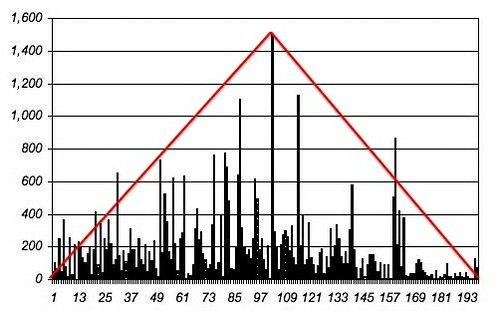
In some of your remarks about your career you talk about the importance of accidents. Well, I decided to read Heart of Darkness as a consequence of having immersed myself in Apocalypse Now, which we’ll get to in a bit. Once I’d been working on Heart of Darkness for a while I more or less stumbled into making this chart:

HD whole envelope

Each bar in the chart represents one paragraph in the text (the electronic version available from Project Gutenberg). The bars take the paragraphs in order from first to last, left to right. The length of a bar is proportional to the length of a paragraph. While the lengths vary wildly, there seems to be a shape to the distribution, which I’ve indicated by those red lines.

Is that shape real? If so, what is its significance and how did it come about? Did Conrad intend the text to be that way? Old questions, no?

I didn’t arrive at those questions and that chart through any prior interest in paragraph length. I got there because I’d become interested in one extraordinary paragraph. Until this particular paragraph Kurtz was little more than an enigma attached to a name. This paragraph gives us his history and some of his thoughts about the future. But that’s not what attracted me to it. What attracted me is that the paragraph contains proleptic elements, the only one in the text to do so. At this point in the narrative we’ve not yet arrived at Kurtz’s compound, but that paragraph contains hints of what we’re going to find there. So I was on the trail of a difference between story and plot: Russian Formalism, narratology.

Moreover, this paragraph is framed in an extraordinary way. Just before Marlow speaks this paragraph he tells us that his helmsman got speared and dropped bleeding to the deck. Just after this paragraph Marlow tells us of pushing the dead man off the deck and into the Congo. So Conrad inserts Kurtz’s story into the moments when the helmsman bleeds out on the deck.

What an extraordinary thing to do.

Well, as I was examining that paragraph, I couldn’t help but notice how very long it was. It seemed that it was the longest in the text by far. Since I had a digital text I decided, on a whim, to use MSWord’s count function to count the number words in each paragraph. It was tedious and took awhile – though not even remotely comparable to the tedium of constructing a concordance using 3 by 5 cards – but it was easy enough to do.

Once I’d done it I ran off that chart to see the results. Sure enough, that extraordinary paragraph was the longest one in the text, and by a considerable margin That’s it, at the peak of the pyramid. It was just over 1500 words long while the next two longest paragraphs weren’t even 1200 words long.

Given what’s actually said in that paragraph and its immediate context, I find it hard to believe that its length was an accident. I also find it hard to believe that Conrad was counting words. However, I have no trouble at all believing that he wanted to create some suspense by dropping the helmsman to the deck and then leaving him there while going on a grand digression. Laurence Sterne did that sort of thing some years earlier.

In that chart, it seems to me, we’re looking at the trace of a mental act, a trace we don’t know how to explain. It’s also a trace we don’t know how to convert into meaning through any of the usual conceptual tools. Maybe we need some new tools? Perhaps a different set of questions?

FWIW, I reported that chart to Mark Liberman at Language Log, a group log of linguists, because I wanted to see if linguists had done any work on paragraph length. He went to work on Nostromo and The Golden Bowl, a rather different text by one of Conrad's contemporaries, and reported the results in a post, Markov's Heart of Darkness.  This occasioned a fair bit of discussion about paragraphing.  I found it interesting and concluded, provisionally, that no one knew much about paragraphing.

In one section of that working paper I write a commentary on that paragraph. I quote the paragraph in full and insert observations into the text. I’m not looking for anything deep in those observations. I just note what’s there and establish links to other parts of the text.

Marlow’s tale of his trip up the Congo is, of course, embedded in a frame tale, set on the deck of a yacht in the Thames. If we think of that one very long and very strongly marked paragraph as a tale within the tale, that gives us a tale (Kurtz’s history in that paragraph), within a tale (Marlow’s trip), within a tale (the frame story). On that basis I argue that Heart of Darkness exhibits a loose version of ring-form composition, a topic that made its way into PMLA in 1976, where I noted it and set it aside, and that occupied the late Mary Douglas during the last decade or so of her career. I’d begun corresponding with her after she’d blurbed my book on music (Beethoven’s Anvil) and she asked me whether I had any idea of how the brain would do that. That set me on the trail of ring-composition, but I’ll get to that later.

There’s a good deal more in that working paper–a bit of Latour, some attachment theory (which I learned from Mary Ainsworth at Hopkins), a discussion of Achebe in relation to Ike Turner and Sam Phillips, psychohistory, and whatever else–but I won’t try to summarize it here. Let’s just say it’s an eclectic mix and leave it at that.

Monday, March 12, 2018

This photo has a surprising number of views on Fllickr (over 1K)

IMGP5565

Something bright

IMGP7418

Do Literary Texts Count as Strong Evidence about the Human Mind?

Once again, I'm reposting this. My concern, as before, is with taking literary texts seriously, as primary evidence. Just how do we do that? It seems to me that interpretive approaches, by directing our attention to "hidden" meaning, allow the text itself to be explained away. At the moment I'm interested in ring form, and I don't want that ring form explained away. It's doing work: what work? It's primary evidence about how the human mind works. We must understand it, not explain it away.

* * * * *

Given my recent comments on description and the teleome, where I argue that a robust descriptive understanding of the arts is our best source of clues about how the full range of neural systems operates in the course of living a life (Deep Learning, the Teleome, and DescriptionDescription and the Teleome, Part 2), this old post from The Valve deserves a re-post. I originally posted in on December 14, 2009.

Let me repeat my favoriate analogy about the relationship between biology and culture in human life, that of a board game such as chess. Biology provides the game board, the pieces, and the basic rules. Culture provides the strategies and tactics used in joining elementrary moves into viable games play. Literary texts are then records of strategy and tactics in action. The first job of criticism, then, is simply to describe the game as it happened. Interpreting the intentions animating strategies and tactics is secondary and utterly dependent on accurate description.

* * * * *

Now that Bérubé’s review of Boyd has got me thinking about “Darwinian criticism” or “evocriticism,” I want to look at a passage in Boyd’s book that is, in effect, the generalization of his criticism of the notion that romantic love is culturally specific. Here it is (Brian Boyd, The Origin of Stories, Harvard 2009, p. 385):
Evocriticism can offer a literary theory both theoretical and empirical, proposing hypotheses against the full range of what we know of human and other behavior, and testing them. Though compatible with much earlier theory and criticism [that is to say, before “Theory” and its immediate precursors], it will reject some possibilities, such as assumptions of radical disjunction between human minds of different eras or cultures based on a general cultural constructivism or particular “epistemic shifts.”
It may be the case these days that “radical disjunction” between different eras and cultures is simply assumed, but there was a time when the disjunction was argued on the basis of evidence and, as far as I know, people are still making such arguments and presenting evidence in their favor. Isn’t that what historicist criticism is about? That is to say, Boyd seems to be implying that people just made up stuff about disjunction because they felt like it but that they didn’t have an plausible reason. He’s wrong on that, no?

And the reasons that have been and still are given involve both literary texts and non-literary texts. You read texts of different eras and cultures, you read them closely, and come to the conclusion that they thought and felt about X Y & Z differently than we do know or than those folks over that at that time. Hence there is a disjunction between our mind, their mind, and theirs as well. (I’ll dispense with “radical” as it seems to me to function as something of a weasel word in this general context. Just how much of a disjunction qualifies as radical?)

What I want to know is whether or not these various texts count as primary evidence, evidence that can’t be interpreted away? In particular, is it valid always to subordinate the evidence of those texts to the evidence of evolutionary psychology?

Sunday, March 11, 2018

A quick take on civilization by Nina Paley


Time's Arrow in Literary Space: Irreversibility on Three Scales

Another bump to the top. A topic I still think about.
* * * * *
Here's a not-so-old post from The Valve (March 2010) on a topic that fascinates me. I first published it on New Savanna on June 6, 2011. I'm  bumping it to the top of the pile because it resonates with my recent work on Matt Jockers' Macroanalysis. Jockers found a  century-long pattern (one scale) in a large corpus of texts that just happens to be temporal, but wasn't defined in temporal terms. This post takes up the topic of literary temporality on two other scales: years (Osamu Tezuka) and decades (William Shakespeare). If this post interests you, you might want to go over to The Valve and read the discussion there, which is quite interesting.
Is literary time directional? In some sense the answer, obviously, is “yes.” There is no doubt that Pride and Prejudice was written before A Passage to India. The issue, however, is whether or not Pride and Prejudice must have been necessarily, in some sense, before A Passage to India and, if so, in what sense it must have been written first.

Stephen Greenblatt comes close to suggesting what I’m up to early in “The Cultivation of Anxiety: King Lear and His Heirs” (Learning to Curse, Routledge, 1990, pp. 80—98) which opens with a long passage from an early 19th century magazine article on the how the Reverend Francis Wayland broke the will of his 15-month old child. Greenblatt notes that “Wayland’s struggle is a strategy of intense familial love, and it is the sophisticated product of a long historical process whose roots lie at least partly in early modern England, in the England of Shakespeare’s King Lear.” To be sure, one need not read that as any more than a statement of historical contingency, that Shakespeare’s play just happened to have been written before Wayland’s article. But when one considers the larger institutional changes Greenblatt considers – from the public space of the king’s court (and Elizabethan stage) to the privacy of the bourgeois home – one may suspect that Greenblatt is tracking the directionality of literary time, that one text must necessarily have been earlier in the historical process in which both texts exist.

That directionality is what I want to look at, but not primarily on the scale of decades-to-centuries. My principle example involves three early texts by Osamu Tezuka, the great Japanese mangaka. He was born in Nov 1928, which puts him in his early 20s when these texts were written during the American occupation of Japan after World War II. The three texts have become known collectively as his SF trilogy: Lost World (1948), Metropolis (1949), and Next World (1951). Thus, they are early texts; in particular, they are before the Tetsuwan Atomu (Astro Boy) stories that became the centerpiece of his work for almost two-decades.

Prior to World War II Japan had an unbroken history as an independent state stretching all the way back to . . . the primordial times of Japanese mythology. The Japanese Emperor was the living embodiment of that continuity and connection. When he surrendered, that continuity was cut and with it the whole mythological and ideological apparatus that gave shape to the Japanese world, it was gone. Even for someone like Tezuka, who was not a partisan of the militarist regime that ruled Japan at the time, that must have created a profound existential problem. And so, one of the things we see Tezuka doing in this three texts is re-creating a sense of Japan. He is creating a new myth. Without that, how can there be any sense of order about the cosmos?

While there is much one could say about these texts, here I wish to raise a specific issue: Is the order in which Tezuka in fact wrote those three texts the order in which he must necessarily have written them. I don’t have a strong argument to offer. Rather, I simply want to raise the issue. Lurking behind this issue is, of course, another, for if the order IS necessary, whence the necessity?

Tezuka’s Rediscovery of Japan

The first of these texts, Lost World (1948; English translation, Darkhorse Comics, 2003), is set on two planets, Earth and Mamango, a twin of Earth that comes near to Earth every 5 million years. The geographical location of the Earth-bound events is not clear; no geographic locations are named, no cities, no countries. By default, a Japanese audience would be likely to locate these events in Japan (and some of the characters have Japanese names, e.g. Shikishima). But, when the story ends, two people, a man and a woman, remain on Mamango, and will create a new race of human beings. That is to say, in this story, the exciting new stuff of the future is going to take place somewhere else than on Earth.

The second of these texts, Metropolis (1949; English translation, Darkhorse Comics, 2003), is mostly set in some large city named Metropolis, which is explicitly not-Japan. Two of the central characters, Detective Mustachio and his nephew Kenichi, however, are identified as being from Japan and thus being Japanese. Mustachio announces himself as being from Japan (p. 46, cf. p. 53). Japan is now explicitly identified in the story, it is a named place that is differentiated from other names places, such as Metropolis and Long Boot Island. But Japan is not a site of action that is significant to the story.

The last of these texts, Next World (1951; English translation, Darkhorse Comics, two volumes, 2003), is set in locations all over the world. Much of it takes place in the capitalist Nation of Star (obviously the United States) and the socialist Federation of Uran (obviously the Soviet Union). But the story begins in Japan, has episodes there, and ends in Japan. In one plotline the Earth is being threatened by a large approaching mass of space gas. Once this phenomenon is perceived and categorized as an Earth-wide threat, there is a segment where the heads of Star and Uran say, “Let’s escape to Japan” (Vol. 2, p. 99) So Japan is an explicit destination for the most powerful politicians on Earth. Japan is on the map and it is the location of events significant to the story.

It turns out that the gas cloud somehow got neutralized before it reached Earth, so everyone survived. Star and Uran had gone to war, but that was stopped by the Fumoon, advanced humanoids that seemed to have been the product of radioactive fall-out from atomic tests done by Star and Uran. (Yeah, this is a complicated mess of a story.) The point is that Tezuka has positioned Japan outside the conflict between Star and Uran. That is its position in the world and, whatever the geographical relationships between the three nations, Tezuka has given it a political role to play in this, the last of the three books in his SF trilogy. Japan now has a differentiated identity.

On this one matter, Japan as a geographical and political entity, we see a clear progression that matches the order of publication. In the first text Japan is not mentioned at all; in the second it is named, but is peripheral to the action; in the third it is named and becomes a central locus of action on the international scene. Still, the fact that Tezuka wrote the text wrote the texts in that order does not necessarily imply that he had no choice but to write them in that order. To say that he had to write them in that order is to imply some process in his mind that takes place on the scale of months to years and that is linked to his story-telling activity in such a way as the place strong restrictions on the stories he can construct in any given period.

Let’s return to my assertion–merely assumed here, without argument–that Tezuka is using these texts as a vehicle for restoring some sense of order in the world in the wake of Japan’s defeat. We know that he found that transition to be traumatic. As Frederick Schodt has noted in The Astro Boy Essays (Stonebridge Press, 2007, pp. 29-30):
With the end of the war, new difficulties appeared. Tezuka also witnessed starvation among a once proud people, and during the wild, unstructured early days of the occupation, he suffered the humiliation and anger of being beaten by a group of drunken American GIs who could not understand his broken English. It was a brutal and direct experience in cultural misunderstanding that he never forgot. Like all young Japanese of his age, he had also seen how an authoritarian government—his own—had been able to manipulate information and public opinion, and how, after the war, the entire value system of the country was overturned and replaced by a new democratic ideology. It was horrifying, he later said, to realize that “the world could turn 180 degrees, and that the government could switch the concept of reality,” so that what had been “black” or “white” only days before was suddenly reversed.
All of that, I believe, is what Tezuka was working through while writing these three stories, Lost World, Metropolis, and Next World. I suggest that the process was comparable to mourning the death, for example, of one’s parents. As such it was a process that involved his whole psyche and not just some relatively localized notions about how the state functions and just who is in office now. And it is not just that Tezuka was working through the death of his nation during this period, but that he was using his fiction as a vehicle to work through that process and so to arrive at the beginnings of a new conception of Japan, its place in the world, and the place of individual Japanese in this emerging Japan.

We are still a long way from understanding just how and why the demands of this psycho-symbolic process influenced Tezuka’s manga so as “determine” the order in which certain themes and motifs appeared in them, but that is what I think is going on. That is the direction our investigations must take if we are to gain a deeper understanding, not only of Tezuka’s artistic work, but of artistic work in general, and of the human mind.

Longer Time Scales

Tezuka wrote these three texts over a period of three to four years. What about longer time spans? Many artists have been productive over decades and it is common to talk of early, middle, and late works, not as mere temporal markers, but as indicators of characteristic themes, concerns, and sometimes even of aesthetic quality. Some of this development may reflect technical command of the medium, but surely we are dealing with personal development and maturation as well.

Shakespeare presents an interesting case. Early in his dramatic career he tended to write comedies and histories; then he gravitated to tragedy; and he finished his career with curious tragic-comic hybrids, or romances. In a paper that looks at one play from each of these periodsMuch Ado About Nothing, Othello, and The Winter’s Tale—I relate this sequence to ideas about adult development by Erik Erikson, Daniel Levinson, and George Valliant. Thus, while we can read or see Shakespeare’s plays in whatever order we wish, and at whatever time in our lives we wish, Shakespeare himself was constrained to write certain kinds of plays during certain periods of his life. There was a certain necessary order to his artistic production. He could not have written Othello before he wrote Much Ado About Nothing, nor The Winter’s Tale before either of those others. His psyche made demands on his artistic work, and his artistic work was a vehicle for shaping his psyche.

But the life of literature is longer than the lives of any individual writers and readers. And so we are back at the time scale implied in Greenblatt’s interest in a Nineteenth Century article on childrearing and a Shakespeare tragedy, a time scale of centuries and—why not?—millennia. Is there an intrinsic ordering there as well? If so, what is that ordering about? Does the human mind develop, perhaps mature, and, dare I even suggest it? progress over the course of centuries? Are we allowed even to thing such thoughts without being struck dumb?

* * * * *

Meta comment: I've made no attempt to hide my affection for the newer psychologies in the study of literature. The subject of this post, however, owes little or nothing to those psychologies nor does it owe much to various post-structuralist approaches (I don't follow them), though I'd be happy to find out that some new historicists have something to say about it. Nonetheless it seems to me a matter central to the study of literature. It arose in my thinking simply from thinking about literary texts and relations between them.

Thursday, March 8, 2018

What’s Photography About, Anyhow?

This is from November, 2013. Do I still believe this? This is before I discovered shaky-cam, which was in the middle of 2014.
encircling.jpg

That’s something I think about a lot, though much of that thinking is in the form of the photographs themselves. I suppose the thinking began when I got my Canon point-and-shoot to photograph Millennium Park in Chicago. At that time I had no intention of becoming a serious photographer, but I nonetheless thought about what I was doing.

Things turned serious when I decided to pursue graffiti and got my trusty Pentax SLR. There the issue was: how do I photograph graffiti? I read advice that said to photograph it straight-on and four-square, no fancy stuff. That is, photograph it as though it were a painting hanging on a wall, any wall, somewhere. The focus is on the graffiti, not on what you as a photographer can do with a camera.

Fair enough. The trouble, though, is that graffiti isn’t hanging on any just wall. It’s not hanging at all; it’s painted directly on this or that particular wall. So that particular space becomes part of the experience of the graffiti. Context is important. Further, graffiti is often quite large so that moving back and forth, in and out, is part of your experience. All of this calls for context shots, and not just one or two, and detail shots of various scales. And what about time of day and season of the year?

At this point photographing graffiti is no longer so simple. It now calls on one’s powers of imagination and invention, one’s skills as a maker of images. That is, there is the graffiti writer’s skills, and there are your skills. What’s the (proper) relationship between the two?

Not obvious.

Meanwhile, I began photographing other subjects and I began experimenting with Photoshop. At first I was only interested in an accurate rending of what I saw. But just what does THAT mean? In some sense that’s physically impossible. There’s no way any photograph can match the light one sees with one’s eyes. Exact color fidelity is somewhere between impossible and meaningless. So just how do I handle color when rendering an image? Is it appropriate to boost the saturation and contrast? Why or why not? How much?

There’s no absolute answer to such questions.

Wednesday, March 7, 2018

We're being watched

20171112-P1140157-2

Mnozil @3QD, plus notes on repertoire and comedy

My latest 3QD piece went up on Monday, A look under the hood through the insane musical genius that is Mnozil Brass (now located HERE at New Savanna) I took some of the pieces I’ve written here and edited them together along with some new material. Basically, I’m trying to figure out what these guys are doing. I’ve got more thinking to do.

Lurking in the back of my mind is the question: Why isn’t there more of this kind of thing, whatever it is?

Repertoire & cultural fluidity

Last week I began thinking about their repertoire, which ranges across classical, pop, jazz, movies, and folk. That in itself is perhaps not so unusual. The Canadian Brass has been doing that for years. My childhood hero, Rafael Mendez, did it as well, putting out records with selections from at least two or three genres. And then we have the variety shows that were once a staple of television programming. Of course such shows had different kinds of acts – music, comedy, dance, magic – but the musical acts were often enough from different genres.

But then we have single pieces that crossed genres. That’s been around for awhile as well. In the early 1940s Harry James performed “Concerto for Trumpet” in a movie – which Mnozil has performed recently. It was about three minutes long and combined classical, swing, klezmer (as it’s now called). Rafael Mendez had and arrangement of Brahms’ “Hungarian Dance No. Five” that includes swing sections. Mnozil’s “Remixes of Concerto of Arutiunian” combines classical, the “Arutiunian Trumpet Concerto”, folk, “Mexican Hat Dance”, and a bit of a TV theme, from Bonanza.

This kind of eclecticism presupposes an audience that can respond to it. In particular, I think it presupposes an audience that recognizes many of these different sources. You may not be able to identify all the sources – I certainly can’t – but you need to be able to identify many of them. It’s not enough that you are willing to listen to these different kinds of music, and even like them, but you need to recognize that they have different origins. This is music that’s about cultural fluidity.

Comedy

And then there’s the comedy. Not all of their pieces have a comedic element. But many, perhaps most, do. In some cases it is relatively slight, in others it is pervasive. And in some cases the piece becomes a kind of performance art. For example, here’s Der Drache (The Dragon):


The musicians occupy the stage, facing to the left, milling about and playing. There is a “dragon” off stage to the right. We never see it, but it occasionally delivers a musical blast that sends our musicians scattering. The entire nine-minute piece is about the musicians coming to terms with this dragon. Which they do with various kinds of music, all – I assumed – composed for this piece.

That’s it.

That’s very different from “Moldavia”, which I discussed in the 3QD piece (and here). The music is rooted in East European and Balkan folk traditions. If you simply listen to the music you’d hear them playing a technically and rhythmically complex piece of music with utter conviction. The comedy is in actions and gestures that accompany some sections. But what’s that comedy about? Are they satirizing the musical idiom, or the performance (of that idiom)? I’m not sure; I’m not even sure what that question means?

When I think over all the pieces I’ve seen the most obvious object of their satire seems to be male arrogance and aggression. These are men strutting about and posturing while they somehow manage to make music together. Are we bearing witness to the power of music to tame the male ego? Is this about civilization versus animal being?

* * * * *

And why isn’t there more of this kind of thing, whatever it is? The closest comparable acts I can think of are the Victor Borge and Peter Schickele’s P.D.Q. Bach. Is this blending of music and comedy difficult to do, requiring a skill set that few have? Or is the audience so small that it can’t support many such acts? Are those the right questions to ask?

* * * * *

A 2011 interview with Wilfried Branstötter (tuba) and gerhard Füssl (trombone).

Saturday, March 3, 2018

The longue durée of human history is complicated

Conventional wisdom has it that over the course of, say, the last 50,000 years or so, human society evolved from small egalitarian bands of hunter-gatherers through a series of stages of ever larger and more unequal forms of social organization as we moved through the agricultural and then the industrial evolutions. We are thus stuck with inequality forever. David Graeber and David Wengrow challenge this in an important article in Eurozone, How to change the course of human history (at least, the part that's already happened). Here's their final paragraph:
The pieces are all there to create an entirely different world history. For the most part, we’re just too blinded by our prejudices to see the implications. For instance, almost everyone nowadays insists that participatory democracy, or social equality, can work in a small community or activist group, but cannot possibly ‘scale up’ to anything like a city, a region, or a nation-state. But the evidence before our eyes, if we choose to look at it, suggests the opposite. Egalitarian cities, even regional confederacies, are historically quite commonplace. Egalitarian families and households are not. Once the historical verdict is in, we will see that the most painful loss of human freedoms began at the small scale – the level of gender relations, age groups, and domestic servitude – the kind of relationships that contain at once the greatest intimacy and the deepest forms of structural violence. If we really want to understand how it first became acceptable for some to turn wealth into power, and for others to end up being told their needs and lives don’t count, it is here that we should look. Here too, we predict, is where the most difficult work of creating a free society will have to take place.
These paragraphs will give you a feel for their argument:
Why are these seasonal variations important? Because they reveal that from the very beginning, human beings were self-consciously experimenting with different social possibilities. Anthropologists describe societies of this sort as possessing a ‘double morphology’. Marcel Mauss, writing in the early twentieth century, observed that the circumpolar Inuit, ‘and likewise many other societies . . . have two social structures, one in summer and one in winter, and that in parallel they have two systems of law and religion’. In the summer months, Inuit dispersed into small patriarchal bands in pursuit of freshwater fish, caribou, and reindeer, each under the authority of a single male elder. Property was possessively marked and patriarchs exercised coercive, sometimes even tyrannical power over their kin. But in the long winter months, when seals and walrus flocked to the Arctic shore, another social structure entirely took over as Inuit gathered together to build great meeting houses of wood, whale-rib, and stone. Within them, the virtues of equality, altruism, and collective life prevailed; wealth was shared; husbands and wives exchanged partners under the aegis of Sedna, the Goddess of the Seals.

Another example were the indigenous hunter-gatherers of Canada’s Northwest Coast, for whom winter – not summer – was the time when society crystallised into its most unequal form, and spectacularly so. Plank-built palaces sprang to life along the coastlines of British Columbia, with hereditary nobles holding court over commoners and slaves, and hosting the great banquets known as potlatch. Yet these aristocratic courts broke apart for the summer work of the fishing season, reverting to smaller clan formations, still ranked, but with an entirely different and less formal structure. In this case, people actually adopted different names in summer and winter, literally becoming someone else, depending on the time of year.

Perhaps most striking, in terms of political reversals, were the seasonal practices of 19th-century tribal confederacies on the American Great Plains – sometime, or one-time farmers who had adopted a nomadic hunting life. In the late summer, small and highly mobile bands of Cheyenne and Lakota would congregate in large settlements to make logistical preparations for the buffalo hunt. At this most sensitive time of year they appointed a police force that exercised full coercive powers, including the right to imprison, whip, or fine any offender who endangered the proceedings. Yet as the anthropologist Robert Lowie observed, this ‘unequivocal authoritarianism’ operated on a strictly seasonal and temporary basis, giving way to more ‘anarchic’ forms of organisation once the hunting season – and the collective rituals that followed – were complete.

Scholarship does not always advance. Sometimes it slides backwards. A hundred years ago, most anthropologists understood that those who live mainly from wild resources were not, normally, restricted to tiny ‘bands.’ That idea is really a product of the 1960s, when Kalahari Bushmen and Mbuti Pygmies became the preferred image of primordial humanity for TV audiences and researchers alike. As a result we’ve seen a return of evolutionary stages, really not all that different from the tradition of the Scottish Enlightenment: this is what Fukuyama, for instance, is drawing on, when he writes of society evolving steadily from ‘bands’ to ‘tribes’ to ‘chiefdoms,’ then finally, the kind of complex and stratified ‘states’ we live in today – usually defined by their monopoly of ‘the legitimate use of coercive force.’ By this logic, however, the Cheyenne or Lakota would have had to be ‘evolving’ from bands directly to states roughly every November, and then ‘devolving’ back again come spring. Most anthropologists now recognise that these categories are hopelessly inadequate, yet nobody has proposed an alternative way of thinking about world history in the broadest terms.

Along the Hudson River

20171014-_IGP0781

20171014-_IGP0836

Friday, March 2, 2018

Scot Peterson's reluctance to go charging in to confront the Parkland shooter makes sense (obviously?)

By all accounts, Scot Peterson had been a model cop until he became a national disgrace. “His personnel record is filled with commendations,” reported the Sun-Sentinel. “Four years ago, he was named school resource officer of the year. A year ago, a supervisor nominated him for Parkland deputy of the year.” But like most of us, he had never faced a situation like he did on the day that Nikolas Cruz shot 33 of his former classmates, teachers, and coaches with an AR-15...the reality is that, even though they undergo extensive training designed to inoculate them against natural human stress reactions, it’s not uncommon for soldiers to freeze up the first time they experience combat. It’s not a sign of cowardice. In most cases, those same troops perform well—or even heroically—after that first exposure to real-life combat. We can’t expect police officers to behave any differently.
Second:
The gun lobby’s heroic-gunslinger fantasy also animates Donald Trump’s repeated calls for arming school teachers. It’s a distraction from the real issue—mass shootings, on and off campus, accounted for fewer than 4 percent of gun murders last year.
Third (from the interview with David Chipman, who has been on SWAT teams):
There’s this famous book called On Killing, by David Grossman, who studied how training in the military has evolved over the years. They used to qualify by shooting at round targets, and what they found is that once they got into combat, many of them did not fire their guns, and even when they fired their guns, they would purposely fire over the enemy. So they had to train people to actually shoot at targets that looked more like humans, and that’s why police qualify today on targets that aren’t round but are shaped like people.

So I think that unless you are trained—and you’re trained over and over again, and you practice like you play, which means you’re training in simulated life or death environments—the likelihood of you even firing your gun is small. And then the likelihood that you would actually hit a moving target surrounded by other moving targets—any trained operator knows the fallacy in that. It’s highly unlikely that it would turn out well...I’ve never talked about this before, but for me personally, to get through these operations, I would actually pretend that I was already dead. And in that way, I had the courage to do what I needed to do to safely to protect my team and do the operation. How many other people do that? I don’t know. I can just share my own experience...Yes, most [gun owners] practice, but they’re not practicing with rounds of ammunition zinging past their head.
Do no harm:
Some aspects of law enforcement are like being a doctor. You never want to do harm. You don’t want to make the situation worse. And it seems to me that this idea of putting a gun in teachers’ hands is like giving up in this issue.