Thursday, May 6, 2010

"This is the end, my only friend, the end . . . "

Mimi does Jim(my)? Channeling 60s rock! Yeah. Check it out (the history, I mean).
Paley's visuals sure take the piss out of the metaphysical pretensions of Morrison's Lizard King poetics.

Nina Paley is the creator of Mimi & Eunice and is unleashing them on the world under a copyleft license.


Wednesday, May 5, 2010

Under the Bergen Arches

Jersey City was a bustling port in the early 20th Century. To facilitate rail access to the waterfront a mile-long trench was cut into the southern end of the Jersey Palisades through the heart of Jersey City. It was called the Erie Cut and was between, say, 50 and 80 feet deep and 70 to 100 feet wide at the bottom. In three places the cut became short tunnels so that roads and buildings could go atop it; short bridges were built at two points. Collectively these are the Bergen Arches, the name by which this feature is known today.

Four railroad tracks were laid in it. They went to the Hudson river just yards south of the Holland Tunnel. Then, in the third quarter of the century, container ships were introduced and the freight facilities shifted to Elizabeth, NJ. Jersey City's docks were useless, and so were the railroad lines that fed them. So, three of the four tracks were ripped out of the Erie Cut and the eastern end was filled with dirt and rock.

The cut is all but abandoned. People throw trash over the edge, homeless people build huts under the arches, and graffiti writers paint on the walls. It is a strange urban paradise. When you're down there you feel profoundly isolated from the city, more so than, for example, when you are in New York City's Central Park. There's trash everywhere, but much of it is obscured by lush greenery. The western end of the cut is water-logged; I've never been down there when I wasn't walking though an inch or two of water & mud, except for the winter, when it's iced over.

And the graffiti, the graffiti tells of strange tribes and ancient civilizations. Except that they're not strange. They're my neighbors, some of them at least. 

Above: Looking through the last arch at the western end of the Erie Cut.


You can see some of the graffiti in this post, this one, and at my Flickr site.

Speech Recognition, with a theological coda

Machine translation, using a computer to translate from one natural language to another, is one of the earliest problems tackled by computer scientists in the decade after WWII. That effort was largely abandoned in the United States in the mid-1960s, but a variety of computational investigations into language did continue. By the 1970s two of them, among others, were going strong: speech recognition and speech understanding.

Speech understanding implies some underlying intelligence, some ability to reason about what is being said. For example, during the late 1970s ARPA (Advanced Research Projects Agency of the Department of Defense, now DARPA for Defense ... ) sponsored a project in which computers would take a spoken query as input and then return an answer. To answer the query the computer had to: 1) figure out what words were being said, 2) parse the sentence structure, 3) analyze the meaning, 4) formulate that meaning as a database query (about warships in this case), 5) run the query against the database to determine the answer, and 6) formulate the answer in English. A big problem.

Taken alone, that first step, determining what words were said, is speech recognition. Consider medical transcription, for example. The physician dictates notes orally into a recorder. Now we need to transcribe those notes into a written record. It would be nice to have that done by a computer. We don’t care whether or not the computer understands what the physician has said; we’re not going to ask the computer to do anything with or about what’s in the record. We just want it in written form. That turned out to be a difficult problem. But significant breakthroughs were made in the early 1980s that lead to an increasingly robust range of practical speech recognition technologies. This technology makes no attempt at “intelligence,” just lots of number crunching to conduct statistical analysis of large masses of speech data and, from that, to derive recognition "signatures" for words.

A couple of years ago I attended a seminar at Columbia University in which an IBM researcher, whose name I forget, reported that speech recognition technology was about to bottom out without, however, reaching human levels of performance. I was thus not surprised to read Robert Fortner’s recent article making that same point (h/t Tyler Cowen) – though, if you read the article, you should also read the comment by Jeff Foley. The current technology is “dumb.” This is, after all, speech recognition, not speech understanding.

Of course, we would like to know just why mere speech recognition is so difficult. That speech understanding should be difficult, that’s obvious, for understanding implies intelligence, and the construction of artificial intelligence has proven to be quite difficult. But we’re not talking about understanding, we’re talking about mere dumb recognition. Why is that difficult?

Tuesday, May 4, 2010

Tools of Civilization

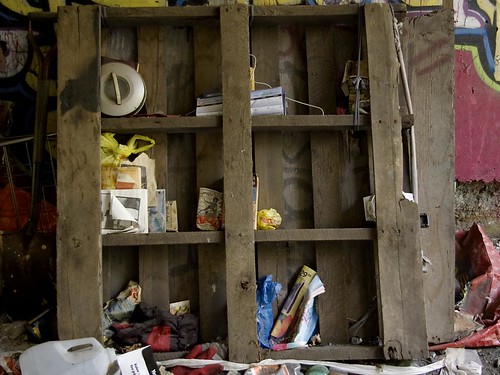
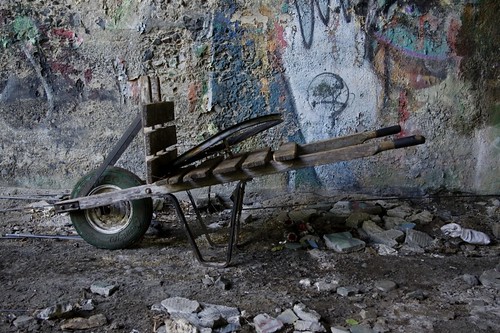
I took these photos in the same place, but at different times. Early in the 20th Century a trolley line went through this place, which is in Jersey City, in a place known locally as the Bergen Arches (this is under one of the arches). I don't know when the trolley line was abandoned, but this space is now given over to homeless people and graffiti writers. 


Monday, May 3, 2010

Blow Your Nose for Peace

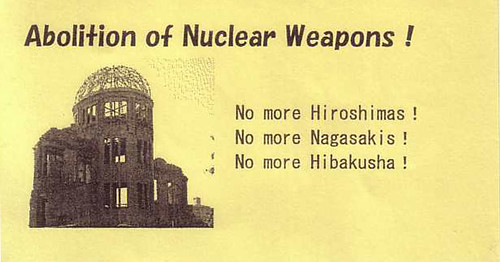
I attended yesterday's (2 May 2010) anti-nuke demonstration in Manhattan, at which the Japanese contingent out-numbered all others by three or four to one. Some of the Japanese were handing out small packets of facial tissue, like this:


I can't read Japanese, but I recognize the number 9 when I see it. In this context that means Article 9 of the Japanese Constitution, the constitution imposed on them after WWII. Article 9 prohibits the state from waging war. Perhaps the Japanese are telling us that the U.S. Constitution needs a similar article? Here's the other side of the pack of tissue:


. . . where you found this insert:


The Hibakusha are the survivors of Hiroshima and Nagasaki.

Godard on Apocalypse Now

David Bordwell muses on Coppola's Apocalypse Now Redux after seeing it on the big screen again at Ebertfest.
One of my favorite comments about the movie came during Dick Cavett’s television show circa 1980. Dick asked Jean-Luc Godard what he thought of Apocalypse Now. This was a period in which most of the press coverage obsessed about the film’s soaring budget. Godard remarked that Coppola had not spent enough. Cavett asked for an explanation. Godard: “Well, he spent only fifty million dollars and the war cost fifty billion. You cannot film this war on such a small budget.” That’s the way I remember it, anyhow.

Sunday, May 2, 2010

The Wall Street Potlatch

I want to play around with the idea that the orgy of bonus-giving that is a way of life among Wall Street investment banks (and related institutions) is a perverse form of the potlatch, the ceremony among Northwest Coast Indians in which leaders (Big Men) give away enormous quantities of food and goods to another tribal group. When I say “play around,” I mean that. I’m making this up as I go along. I’m not giving you a quick tour of a sophisticated piece of intellectual analysis that I or someone else has already done. Rather, I’m attempting to find out whether there is a sophisticated piece of analysis to be done and, of so, where one might begin.

Let me start with two confessions: I do not command the literature of potlatch ceremonies, nor to I have any direct experience with the inner workings of those large investment banks that have managed to bring our economy to its knees. With that out of the way, let’s proceed.

Potlatches have entered the public imagination as extravagant and often wasteful ceremonies in which enormous quantities of goods were often destroyed; though, according to Lewis Hyde, (The Gift, pp. 36 ff.) this represents a late and decadent form of the practice. At heart the practice was one of redistribution. A group leader and his followers would gather food and goods and give it all away in a big party for another group where all who attended were entitled to food and goods. The other group would then reciprocate at a later date, trying to outdo the first group in extravagant generosity. The long-term effect was to keep goods in circulation among the large group and to foster solidarity across that larger group.

At first glance, this seems to involve interaction between three of the four basic forms of social interaction Alan Fiske has found in all societies: Communal Sharing, authority ranking, and equality matching. That is to say, this is an aspect of the basic biological stuff out of which human communities are built. The relationship between a leader and the members of the group is one of authority ranking; the leader uses his authority to organize the work required to throw a potlatch – work that may take as much as a year. Communal Sharing takes place during the ceremony, in which all guests get something though they did nothing to produce the wealth being distributed. And, lastly, equality matching demands the potlatches be reciprocated. In effect, leaders (and their communities) are keeping score of who’s given a potlatch for whom.

Now let’s consider the Wall Street potlatch. At the top of each investment firm there is a small committee of top executives that determines how much of the firm’s profits are to go into the bonus pool and how that bonus pool is to be distributed. The members of this committee, in their day-to-day operating executive capacity, exercise authority over all other members of the firm (authority ranking). They are the tribal Big Men throwing the potlatch. The distribution of the bonus money is, in effect, the potlatch itself. That bonus distribution is communal sharing; everyone gets (a carefully graded) piece of the profit pie. While, as a practical matter, employees at such firms consider the bonus to be a proper part of their compensation package, the term itself, “bonus,” indicates that it is discretionary on the part of management. It is a gift, but one in which all share in communal fashion. It is this sharing that motivates them to work hard, not simply to please the executives, but to contribute to their work-place community. It is the sharing that, in some deep sense, makes the workplace into a community.

Saturday, May 1, 2010

Graffiti Chaos 1

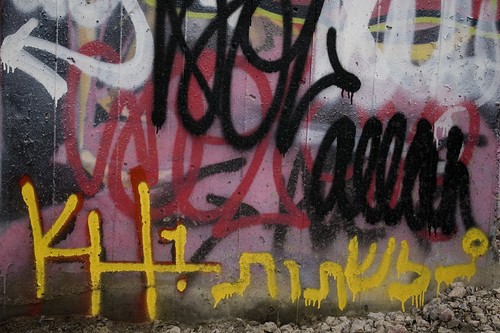
Just some writers painting over one another in odd spots here and there. This is, say, 30 inches wide and 20 inches high (and, yes, that's Hebrew at the lower right, by HK1, aka Kosher Howie):

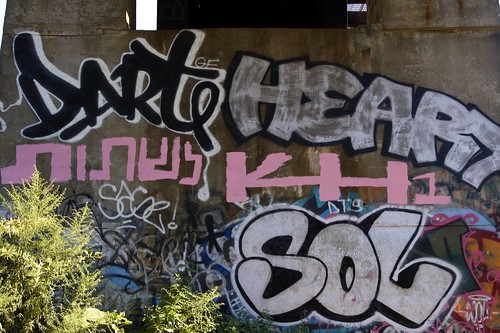
This, on the other hand, is quite large, say 15 to 20 feet wide and 10 to 13 feet high, and not so chaotic, just crowded:

And, yes, more Kosher Howie, and Sol, Dart, and Heart, among others in the top layer.

One of them old-time good ones

Nina Paley is the creator of Mimi & Eunice and is unleashing them on the world under a copyleft license.

Thursday, April 29, 2010

Question, Loaded for Bear, Boar, and Bull

Are gargantuan Wall Street bonuses a gross perversion of our gifting instinct*? It's perverse because the executives bestowing the gifts didn't earn their gift-goods in any obvious way. They simply get to distribute the largesse back to the people who, on a generous interpretation of their activities, actually did the earning. In the case of the recent financial scandals it's clear that the gift goods were stolen and that we, the tax payers, are on the hook for them.

*Ah, yes, I know, "instinct" is a tendentious word. But I'm sticking with it for the moment. I'll consider mounting a rigorous defense of the usage when those executives come clean about what they've done. Meanwhile, it might be interesting to re-read Shakespeare's Timon of Athens, which is about perverse gifting.

Wednesday, April 28, 2010

Natural Geometry


You can see larger versions of these images on my Flickr site, top, middle, and bottom, respectively.

Gifting in the New Economy

Having recently learned that Adam Smith divided income into wages, profits, and rents, I asked to myself: What about gifts? Well, I suppose they aren’t income; but gifts and gifting have been enormously important in human life. Nina Paley’s been arguing that gifting is the fundamental social dynamic of art, but it’s more general than that.

Consider these passages from an old (1995) article by Gifford Pinchot:
The first step toward a sustainable sense of success is taking pride in the value of our contributions to others rather than taking pride in the value of our possessions. By extension this means striving for quality in the use of whatever power we have rather than working to get more power over others as an end in itself. In this view, profit and wealth may help us to contribute, but they do not themselves constitute business success.
After mentioning the potlatches of Pacific Northwest peoples, and Lewis Hyde’s The Gift: The Erotic Life of Property (a Paley favorite), Pinchot talks about chemical-giant DuPont:
Companies that use sulfuric acid end up with a hazardous waste. DuPont, instead of distancing itself from the hazardous waste generated by its customers, saw this problem as an opportunity to differentiate its offering in one of the most basic of commodities. The company took back the spent sulfuric acid, purified it, and resold it. This was good business because once DuPont got good at it, recycling turned out to be cheaper than creating from scratch. It also gained the company market share and margins in what had become to others a low-profit, uninteresting commodity. In this case, DuPont does well by doing good, thus winning both the exchange and gift paradigms.

The sign of excellence in a new world of the larger self is not vast profit or possessions, but sufficient material success to allow large and thoughtful contributions to society.
In a world where business success increasingly depends on highly skilled employees
Employers must curry the favor of their talented employees who increasingly have an ethical agenda. Employees who can easily find work elsewhere are refusing to work on projects or for companies that offend their values, even if they would be well paid to do so. As this trend increases, as people take a stand for sustainability in choosing their work, even public corporations seeking the favor of bloodless institutional investors will find that sustainable companies have the best future because they have the best talent. In fields where creativity counts, sustainability is a competitive weapon.
He concludes by arguing that “The real game in the business world of the ecological age is running a business or a career so as to make a contribution to the community, the nation, and even to the planet as a whole.” And that required that we once again making gifting central to our economic life.

Chimpanzees Grieve

I’m not surprised. Both the BBC and Discover Magazine are reporting accounts of how chimpanzees deal with deaths of the old (Blair Drummond Safari and Adventure Park in Stirlingshire, Scotland) and the young (Bossou, Guinea).

I am, of course, glad that this behavior is being documented. But I’m a bit dismayed that it is being reported as news. Of course, chimpanzees grieve. They’re only human, no? Well, I suppose that’s the problem. We mustn’t anthropomorphize. And so we have to study and verify.

Still, I have this vague memory of having read that not so long ago doctors believed that neonates had no sense of pain. And so surgeons didn’t use anesthesia when operating on them. Did the little ones not scream?

Department of What?


Nina Paley is the creator of Mimi & Eunice and is unleashing them on the world under a copyleft license.
Tuesday, April 27, 2010