
Wednesday, August 1, 2012
A Note on Triple O’s Rhetoric of Objects
The rhetoric of object-oriented ontology was a matter of interest some weeks ago, and it remains so for me.
In particular, there is a rather traditional sort of ontology, associated with the Great Chain of Being, in which beings, objects, or substances, whatever term you prefer, are arranged in a scale, or ladder, from low to high. At the top one has God, and at the bottom, something like brute matter, perhaps atoms, while in between one finds the rest of the beings, kumquats, seraphim and the rest. Those things higher on the chain have more being than those low. It is thus a very different scheme from those offered under the rubric of object-oriented ontology and its conceptual fellows.
The Great Chain of Grammar
I’m interested in this great chain because a portion of it is written into our grammar, from which it erupts into the rhetorical practices of OOO. Consider this passage in which Levi Bryant comments on an account of soccer in which Michel Serres would have the ball in mastery over the players:
Second, as Serres’ example of the soccer ball as a subject where humans are quasi-objects for it–where the soccer ball is the seat of agency and the players are patients; in part, anyway–suggests, we need to develop an adequate notion of agency. What sorts of agency are there? What agency do we have?
That word “patients”, where did it come from? Bryant is certainly not suggesting that, all of a sudden, players become the objects of medical attention. That does happen, but that’s not what’s going on here. The word comes from linguistics, specifically, case grammar, where patient is a specific role that an object can play with respect to a verb, with agent, instrument, and object being other available roles. For example:
(1) John hit Jack with a stick.(2) Jack was hit by John.(3) John hit the wall.
In (1) John is playing the agent role, Jack the patient, and stick the instrument. In (2) John and Jack are playing the same roles as in (1), though the form of the sentence is different. In (3) John is the agent while wall is the object. Patients are generally construed as animate while objects may be inanimate.

Tuesday, July 31, 2012
Dumbo as Myth 2: Realigning the World
In Dumbo as Myth 1: Beginning and End I concentrated on the very beginning and the very end of the film, noticing that the end was the opposite of the beginning in mode of presentation. The story begins during a storm and asserts the difference between the sky and the ground. Birds live in the sky while other animals live on the ground. The story ends during the day and focuses on crows, creatures of the sky, sitting atop a telephone pole, which is sunk into the ground.
Now let’s take a look at the terms in which Dumbo takes his success and ask, once again: Why?
Success
Dumbo’s success comes, of course, during a circus act featuring him. He failed the first time, when he tripped on his ears and collapsed the elephant pyramid rather than landing triumphantly on top. He succeeded the second time, but was humiliated because he was made-up as a clown and was soaked in white goo. The third time, as the cliché has it, was a charm. He flew.
And in the Big City, which is important. The film started in winter quarters somewhere in South Florida and played in a few small towns. But Dumbo triumphs in the Big City where, of course, the clowns had been anticipating their own triumph.
Once Dumbo had dunked the clowns and shown off his flying skills he took mild revenge on those matrons who had spurned him an his mother, spraying them with peanuts as though his trunk were a machine gun:
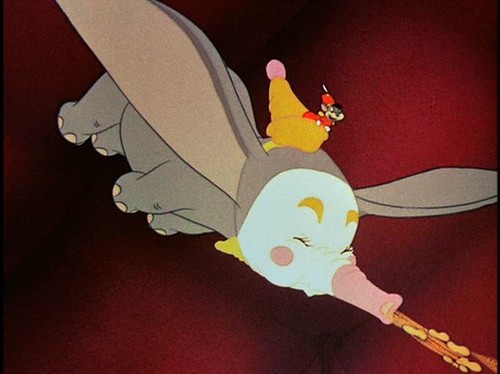
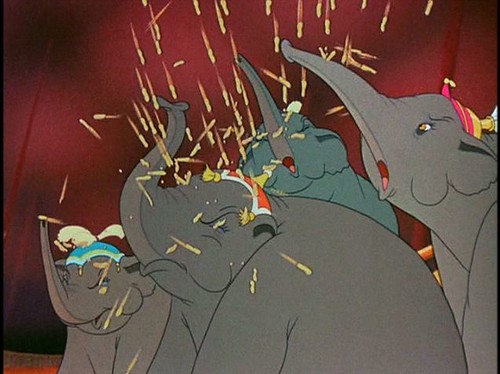
That’s the last thing we see in his act. Of course, it wasn’t planned. Then we see him flying with Timothy Mouse in his hat proclaiming: “You’re makin’ history!”
Monday, July 30, 2012


The Face: Will and Expression
Two more out-takes from Beethoven’s Anvil, both about the face, control of facial muscles, and the expression of emotion. We’ve all at one time or another struggled to control our face, attempting “hide” something that’s trying to “break out”. How is such a conflict physically possible?
The first section of the post is about the facial nerve and how it has two components, each mediating a different aspect of behavior and driven by different brain systems. The second indicates some consequences of that division. Other posts related to this general subject:
- A Jazzman Prepares
- Emotion in the Body: James-Lange
- Will in the Nervous System, and Its Consequences
The Facial Nerve
Let us consider a particular anatomical case, the facial nerve. The facial nerve is one of twelve pairs of cranial nerves that connect the brain to the sensors and muscles of the face and neck. (The spinal nerves do the same for the rest of the body. Taken together the cranial and spinal nerves constitute the peripheral nervous system.) It has both a sensory and a motor component. It is the motor component which is of interest to us now, for it controls muscles involved with facial expression.
If the motor component of the facial nerve is damaged in one region your ability to control your lower facial muscles in voluntary activity is weakened or lost. For example, it will be difficult to purse your lips or to hold food in your mouth while eating. But the muscles still respond to emotion. Conversely, damage in a different region will destroy emotional expression, but not voluntary use. Similarly Paul Ekman has noted that spontaneous smiles are different from voluntary ones. Thus we have one set of muscles subject to two different sources of control. The impulse to emotional expression would reflect one source of control--most likely located in the limbic system in the hypothalamus, the basal ganglia, and/or the cingulate gyrus--while the capacity for voluntary control--located in the motor cortex--would reflect a different source of control. When the facial muscles are strongly stimulated by both of these sources you might well have a conflict, for they might be moving those muscles in different ways.
Friday, July 27, 2012

Dumbo as Myth 1: Beginning and End
What does it mean to say that Dumbo is a myth? The word has various meanings, but I mean it in the sense used by anthropologists and literary critics. In that sense myths are stories that tell members of a culture something fundamental about the world, often about how the world itself came into being, but not stated in realistic or rationalistic terms.
More often than not the members of the culture regard their myths as true, but set in Old Times when things were different. Of course, no one in Disney’s audience regarded the movie as true in that sense, not quite. Nor do I. But Dumbo does have many of the features of myths proper and it’s those features that interest me.
Why do I think this is a mythic tale? What it comes down to is that that’s the best way to account for those pink elephants on parade. While they do provide dramatic cover for a besotted Dumbo to fly up into a tree, they do much more than that, as we saw in the post, Animals in Cartoons: Tripping the Elephants Electric, where following remarks by Akira Lippit, I argued that animals show up in Golden Age cartoons as “a gesture of mourning for the disappearing wildlife” (Lippit, Electric Animal, p. 196) and machines are anthropomorphized as a way of restoring an animal presence. That equivalence between animal and machine is stated most clearly in the pink elephants episode, but it resonates throughout the film.
That gives Dumbo a mythic dimension that is not inherent in a story of mother-infant separation that otherwise drives the dramatic action. Why is that story one about an odd-ball infant? What’s the point of that? Is it simply a variation on the ugly duckling story? I think not. While Dumbo’s oddness is a personal characteristic, if you will, it also carries mythic freight, as I’ll suggest a bit later in this post.
But the scope of this post is limited. I’m not going to try to unravel the whole mythic underpinning. I just want to set things up by looking at how the movie begins and how it ends.
Thursday, July 26, 2012


Bryant Watch: McArt
Levi Bryant was discussing cave art in the comments to one of his recent machinological manifestos (a mech manifesto or McManifesto?) and elicited a critical comment from a friend of his. He decided the matter required more elaboration than is typical of a comment. So he fired up the boiler, set the gears in motion, and cranked out another post. Here’s a couple early lines:
While I readily acknowledge that the cave painters were the cause of the paintings, I strongly disagree that the painters are a part of the being of the painting. Just as ones parents are the cause of one’s being while nonetheless the child is an autonomous being, the painting is an autonomous beings that have its own power that exceed any particular cultural or historical context.
Both sentences merit close attention. Let’s start with the first.
Just what does he mean by the being of a painting? There is no doubt that the pigments of a painting, whether on a wall in a cave or on a canvas in a museum, exist independently of the artist or artists and independently of any observers. That is a truism, and an utterly uninteresting one at that.
In his original post, Machinic Art: The Matter of Contradiciton, Bryant had asserted: “The art work does not represent a percept, affect, or sensation, it creates a percept, affect, or sensation that has now become an autonomous material being in its own right, liberated from dependence on the sense organs.” This is just confused.
Wednesday, July 25, 2012
Through the Wayback Machine: Bateson and Mead on Cybernetics and Stuff
I’m reading a fascinating interview that Stewart Brand conducted between Margaret Mead and Gregory Bateson. It was published in CoEvolution Quarterly in June, 1976. It oozes important intellectual history out its pores.
I’m only a partway through, but had to post a few snippits. Like this one on cybernetics (M=Mead, B=Bateson, SB=Stewart Brand):
M: They were talking almost entirely of negative feedback. By this time, Wiener and Bigelow and Johnny von Neumann of course, were members of the group, and Rosenblueth, Kurt Lewin, Molly Harrower, Evelyn Hutchinson, Leonard Savage, Henry Brosin and that Hungarian who always knew who was sleeping with who and it was the only thing he was interested in, I’ve forgotten his name. Well, the lists survive all right.There were three groups of people. There were the mathematicians and physicists - people trained in the physical sciences, who were very, very precise in what they wanted to think about. There was a small group of us, anthropologists and psychiatrists, who were trained to know enough about psychology in groups so we knew what was happening, and could use it, and disallow it. And then there were two or three gossips in the middle, who were very simple people who had a lot of loose intuition and no discipline to what they were doing. In a sense it was the most interesting conference I’ve ever been in, because nobody knew how to manage this things yet.SB: So you had one group of people that was to another group on a level they were not used to.M: Yes, and shifting back and forth between these levels and keeping everything straight was very interesting. So we used the model, ‘feedback,’ and Kurt Lewin - who didn’t understand any known language, but always had to reduce them to concepts - he went away with the idea of feedback as something that when you did anything with a group you went back and told them later what had happened. And he died before anything much else happened. So the word ‘feedback’ got introduced incorrectly into the international UNESCO type conferences where it’s been ever since.B: In the small group cult, feedback now means either telling people what they did, or answering.M: Yes. ‘I don’t get any feedback from you,’ or ‘I can’t go on with this without some feedback.’ It wouldn’t have survived if Kurt had lived. He would undoubtedly have got it right.
Dumbo: Six Nights, Six Days
I’m now working on a post, Dumbo as Myth: Disney’s Metaphysics of Modernity, in which I’m going to attempt to deal with the whole film. So I’ve been looking it over and decided to break down the scenes by night and day from beginning to end.
The story begins on a dark and stormy night. That then is the first night and the events of the following day would be the first day. I’m thus reversing our normal sense of night following the day. On the third, fourth, and sixth days we have Dumbo perform. Those performances seem to happen in the late evening and early night and I’ve so indicated. I also assume that we’re working on cartoon time, if you will, so that these various acts are not worked out in rehearsal over a period of days, if not weeks, as they would be in a real circus. And so I don’t allow for rehearsals that we never see.
Given these assumptions, the film takes place over six nights and days.

Tuesday, July 24, 2012
A Jazzman Prepares
In March of last year I posted a passage from Beethoven's Anvil in which I told about a few moments when the music had unusual power. Jeb's recent comment on acting reminded me of a passage from Stanislavski that I quoted in some commentary subsequent to that blues story. Here's that commentary, from Beethoven's Anvil, pp. 94-95.
* * * * *
While this account makes it seem like I was doing a lot of thinking and calculating while playing, I wasn’t. For one thing, there was no time; the whole solo couldn't have lasted much more than a minute and a half. The thinking was mostly a matter of a few quick intuitive judgments and was done in (imagined) music and images more than in words or verbal symbols. It more resembled the mental process of riding a bicycle or carrying on a conversation than playing chess. On a bicycle, if you see a pothole, you don’t need to explore and weigh alternatives; you just avoid it and continue pedaling. In conversation you say what you think; you don’t make conscious decisions about each word and phrase.
So it was with that solo. Once I had decided to take a solo I followed an improvisatory strategy I'd used thousands of times before: start simple and build from there. The details, particular notes and riffs (melodic fragments) simply fell into place without any specific effort. The decision to attempt a second chorus consisted of a brief moment of panic, followed by an image. I remembered a concert where Sonny Rollins, the great tenor saxophone player, ended a solo to great effect by going to his bottom register and playing with strength, force, and cajones. The flash of that image was, in effect, both my decision to continue playing and my strategy for how to do it. Once I started that second chorus I had a definite sense that another force had entered my playing.
I have no idea how common such momentary inspiration is among performers. Musicians don’t talk about such things among themselves, and journalists don’t ask. These moments certainly do not happen to me on a regular basis. Whatever their frequency, however, they are not unique to music. Constantin Stanislavski, the great director and acting teacher, talks of such things in An Actor Prepares. The book takes the form of an imaginary dialogue between a distinguished director and his students. At one point the director suggests that “you are playing the scene in the last act of Hamlet where you throw yourself with your sword on your friend Paul here, who enacts the role of the King, and suddenly you are overwhelmed for the first time in your life with a lust for blood.” The director goes on to ask whether or not “it would be wise for an actor to give himself up to such spontaneous emotions as that” and to assert that:
[T]hese direct, powerful and vivid emotions do not make their appearance on the stage in the way you think. They do not last over long periods or even for a single act. They flash out in short episodes, individual moments. In that form they are highly welcome. We can only hope that they will appear often, and help to sharpen the sincerity of our emotions, which is one of the most valuable elements in creative work. The unexpected quality of these spontaneous eruptions of feeling is an irresistible and moving force.
That is what we must understand, those “spontaneous eruptions of feeling.” Whether in music or theater, these eruptions enliven unite performer and audience in a single encompassing consciousness.
Links: Animism, Absorption
E-Flux journal is running a special issue on animism. From Anselm Franke's introduction:
A ghost is haunting modernity—the ghost of animism. It awaits us everywhere when we step outside modern reason’s cone of light, outside its firmly mapped order, when approaching its frontier zones and “outside.” We find it in the imagined darkness of modernity’s outside, where everything changes shape and the world is reassembled from the fragments that reason expels from its chains of coherences.The task is to bring those constitutive others at the “dark” side of modern reason—like “animism,” but also the “imaginary,” the “negative,” “otherness,” or even “evil”—back into the relational diagram of modernity. To take those universalized sites of otherness that receive names such as “a universal tendency of humankind” or even its “origin,” and bring them back into history, would be perhaps the only way to account for the relational constitution of the present, to face the sorcery of its double binds. To embark upon this task is thus to understand these are never given “universals” of the modern, but its very relational products. They are the sites that modern history is silent about, to the extent that the very narrative of the “the modern” is built upon this silence as its fundament. The narrative-imaginary vacuum of the present is the direct outcome of this silence. This silence tells us that it is actually not animism, but modernity that is the ghost—halfway between presence and absence, life and death. And the future grand narratives of modernity may well speak of this ghost from the perspective of its other, from its “animist” side.
Neuroanthropology has a guest post by Neely Myers on The Neuroanthropology of Embodiment, Absorption, and Dissociation. I've been reading on this kind of thing since the counter-cultural psychedelic 60s. Discussions of trance, Gongfu, meditation, possession, music, etc.
Subscribe to:
Posts (Atom)