Thursday, October 16, 2014

“I Have a Dream” – Remembrance of “Nuggets” Past

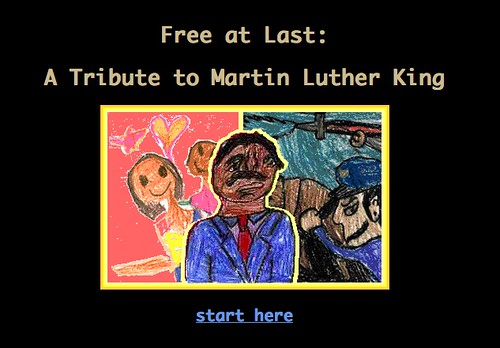
MLK splash

The phrase “I have a dream” is, of course, the refrain from Martin Luther King’s best known speech. “Nugget” is a term of art in the Connected Courses world that designates a bit of text that’s been tricked out and amplified by at least some of the wonders available on the web (scan down this page for a fuller explanation). Our assignment for this week is to create a nugget.

I’ve decided to substitute some old not-quite nuggets for making a new one. Back in the old days of the web, when you had to hand-code your html, I coupled up with Bill Berry to create a site that was first called “Meanderings” (after an email newsletter Bill had been circulating) but then became “Gravity” – a persistent black object to which everything was attracted, or at least that was the idea. One of the things we did was to create a tribute to Martin Luther King based on that famous speech. The idea was to pick words and phrases in the speech and use them as anchors for hyperlinks that would take you to some web page relevant to that topic, either directly or tangentially.
 
The execution, however, got a bit elaborate and took a crew two or three months of here-and-there now-and-then work.
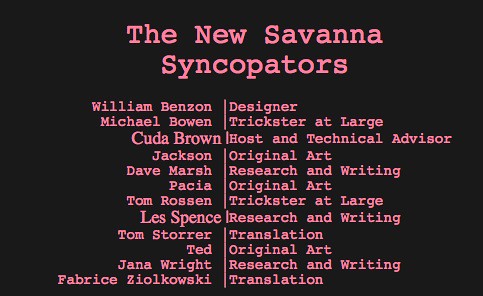
MLK credits

Notice the “original art” credits for Jackson, Pacia, and Ted. They were young primary school students on the West Coast (of the USA). In one of my many trips around the web I’d seen some charming illustrations they’d made of incidents in Martin Luther King’s life. I decided to use them in the tribute, though I worked the images over in some paint program I had at the time – Brush Strokes I believe. Of course I got informal permission to use them, though nothing in hard-copy.

Early days, early days.

As explaining the various presentations we offered is a bit tricky, I’ll skip it. But you can explore them if you wish, though I warn you that many of the links have rotted. After all, this first went up on the web almost 20 years ago.

Here’s the main presentation:
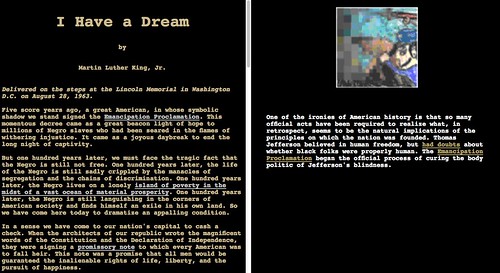
MLK1

On the left you see the text of the speech. If you look carefully you can see hyperlinks in the text. We had 25 of them scattered throughout the speech, five by five (two presentations involved a 5 by 5 matrix). When you clicked on a hyperlink another display would show up on the right. At the top is a picture that is derived from one of the original images created by those children. Below it is a bit of text that is somehow related to the word or phrase linked in King’s speech. That bit of text in turn has hyperlinks, and they go out to the web at large.

Most of those links, alas, have rotted. One of my favorites went out to photographs of the Mississippi Delta. Another went to a small city in Japan that had performed Beethoven’s Ninth Symphony every year since, I believe, 1912. You got to that through a hyperlink anchored in the word “harmony.”

Here’s the fourth paragraph of the speech and it has a single hyperlink in it:

MLK2 now-time

The under-lined phrase has deep resonance for any jazz fan, for “Now’s the Time” is one of the best-known tunes by Charlie “Yardbird” Parker, an alto sax player who was one of the progenitors of bebop. Accordingly, the gloss on that link is a short paragraph on the relationship between jazz and the Civil Rights movement (and, yes, I’m aware of problems in that paragraph that should have been copy-edited out):
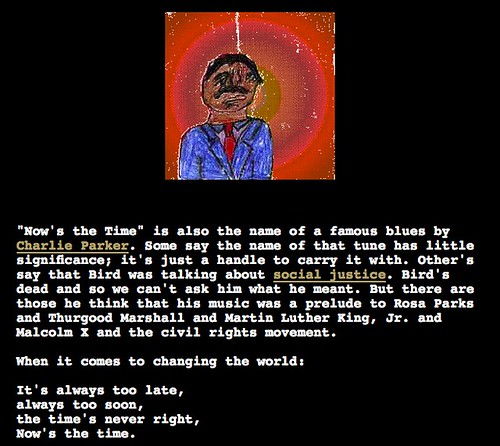
MLK3 C Parker

Both of the links in that paragraph are now rotten.

And so it goes.

I’ve not gone through the whole tribute to check all of the links. I wouldn’t be surprised if they’ve all rotted. Nor would I be surprised if one or two are still good. When I looked at the tribute a month or so ago I quickly found one good link. When I tried that link earlier today it had rotted.

No matter.

You get the idea.

I don’t know how many links went out to the web at large. Off hand I’d guess there were between 50 and 100. And we probably examined a dozen sites for every one that we actually used. Sorting through all that, creating the images, writing the html, testing it, and so forth, that took time. As I said up top, the tribute evolved over two or three months.

All of our interaction took place online through email. Though dial-up modems, too.

I’m still in touch with some of the New Savanna Syncopaters. Bill Berry (Cuda Brown in the credits) is a Facebook friend, as are Mike Bowen, Tom Rossen and Lester Spence. I’ve met both Bill and Mike face-to-face, but not Tom or Les, though I’ve come close. Back then Les was a graduate student in political science. He’s now a tenured professor at Johns Hopkins, where I did my undergraduate work back in the Civil Rights era.

Things change.

But the time’s still now.

As Shakespeare said, though Lear, ripeness is all.

David Byrne on contemporary visual art

The market and the disparity of wealth taints everything. The art world has increasingly become like one of those party magazines: you flip though the pages and see other people frolicking and living the glamorous life. In this case, we see the oligarchs and Wall Street dudes buying and selling art, going to art fairs and all the rest—the artists tagging along. I can’t see how this can be sustainable—how the work can maintain it’s value if the rest are losing interest as I am—but then, as long as the perceived value persists (there is no real value in artwork) and if these works maintain their status, there’s no reason for the bubble to burst. Like jewelry, artwork might be able to maintain its value (or even increase its value depending on rarity) and it can be displayed with pride every so often.

2-dimensional interaction of 1-dimensional objects in an implied space of 3 dimensions | what a mouthfull

20141008-IMGP1179

20141008-IMGP1177

20141008-IMGP1178

Disaster Narrowly Escaped, or Why Computers Suck and Worries about Superintelligence are Effing Crazy

Not too long ago I wrote a long-form post in which I argued that we are in no danger of having a superintelligent computer mysteriously emerge from the computational woodwork and take over the world, sending humanity permanently to the freakin’ showers – which, by the way, might not be a bad thing if the water temperature is right. Could we have hot tubs and high-def TV in there while we’re at it? Since then the following thought, in one form or another, has been rolling through my brain:
Software, for the most part, is buggy as all get-out; many a major software project gets stopped because the software just doesn’t work, and these folks are prattling on about a superintelligent computer!?! Gimme a break!
I mean, if the software substrate for this superintelligent computer is like the software in use on billions of computers around the world, that superintelligent computer wouldn’t even be able to tie its own shoelaces let alone rule the world.

Um, err, you’ve just made a category mistake.

Category mistake?

Yeah. Computers don’t have shoes, and so our Superintelligent Lord and Master wouldn’t have shoelaces to worry about.

My very point, Grasshopper. If your Computer Lord and Master is made from standard-issue buggy software it wouldn’t know that it didn’t have shoes or shoelaces...

...and My Computer Overlord would get stuck in an infinite loop looking for its non-existent shoelaces. Whoops!

You got it.

* * * * *

Why am I saying these things? Well, it’s been on my mind – I’ve got a computer, how can bugs not be on my mind? – but specifically, I just managed to escape a software disaster that was potentially devastating. At first it looked like some bug had trashed 90% of my intellectual work and my professional life. After 15 or 30 minutes of nervous trouble-shooting, however, I’d tentatively decided the worst I faced was hours and hours and hours of extra fiddling around over the next months and years.

* * * * *

Here’s what happened, more or less, as best I can reconstruct it without getting really picky.

I got up early this AM and starting browsing the web, checking things out here and there. My usual routine. And then I decided to write a post. Also standard. I went to open a text document and it wouldn’t open.

MSWord told me, unhelpfully, that the file I wanted to work on was locked or in use by another user. Now, there is no other user on this computer and I never locked that Word doc. This behavior occurs every once in awhile – monthly, maybe weekly – and it’s no big deal. I simply unlocked this file that I’d never locked and proceeded to open it. This had always worked in the past so I fully expected it to work now.

Wrong!

Wednesday, October 15, 2014

Separate Spheres: Motherhood and Raising Children || Sexuality

In the Yunnan and Sichuan provinces of China lives a small ethnic group called the Mosuo. Among the Mosuo, romantic and family life are separated into different spheres by design. Children are usually raised in the home of their maternal grandmother with the help of their mother. She may maintain a long-term, monogamous romantic relationship with the father but, unlike in the West, this is considered separate from her role as a mother.

The role of the biological father is discretionary. There is no word in their language, in fact, for husband or father. A father is allowed, but not required to provide financial support and he is usually permitted to visit the mother and their child(ren) only at night. They call it “Axia” or “walking marriage.” The children’s primary male role models are usually their uncles, who remain under the authority of the children’s grandmother as they live under her roof.

From the Mosuo point of view, separating marriage from the raising of children ensures that the vagaries of romance do not disrupt the happiness and health of the child and its mother. Nor can the father wield power over the mother by threatening to withdraw from the marriage.
H/t Dan Everett.

An interesting example of vocal coaching

As you watch, think about  what the coach is telling the student and how she responds. When he tells her to sing from her toes, think about that, and empathize. Feel it in your toes. How could THAT change the way you sing? What's going on with the mind/body?

The video's roughly nine minutes long and worth watching:


Here's a post from last year where I talk about a video of a trombone master class. The coach is helping the student give a more convincing performance of a trombone part from Wagner's "Ride of the Valkyrie."

Tuesday, October 14, 2014

Sex, Teleology, Cultural Evolution, and the Novel

Note: I revised this on 15 October to add several paragraphs to the final section.
After a couple of posts on music as a force in history it’s time to return to the main line, literature, in this current series on direction in cultural evolution.

For a long time historical direction was attributed to teleology. In the case of the British novel that could be taken to imply that, in Tristram Shandy, Laurence Stern was trying for Pride and Prejudice, but just couldn’t get there. And Jane Austen was trying for Tess of the D’Urbervilles, but didn’t know how to pull it off. Hardy, in turn, was really going for a Lady Chatterly's Lover, but missed by a mile, for some unknown reason.

Put that way, the notion of history as having a direction, of culture as evolving in a specific direction, seems absurd. And so the notion of teleology in history (and certainly in biological evolution) has been abandoned. And rightly so. I have no intention of trying to resurrect it.

And yet, in a long post at 3 Quarks Daily, Macroanalysis and the Directional Evolution of Nineteenth Century English-Language Novels, I argued that Matthew Jocker’s analysis of influence in 19th century novels shows clear sense of directedness. It’s not merely that earlier novelists influenced later ones – how else could influence operate? – but that the overall pattern of influence has the look of direction. Something, some cultural problematic, is being worked on in a coherent way over time. What is it?

Note that I have no intention of answering that question. Rather, I’m attempting to get a better understanding of what the issues are.

Sex in the Novel (?)

I want to look at the treatment of sex as I think that will give us some clues – and, of course, it links to my previous post in this series, Culture as a Force in History: the United States of the Blues, where I examined the force of sexual expressiveness in American popular music. Sexuality figures in all of the following novels in some way:

1759-1777 Tristram Shandy
1813 Pride and Prejudice
1847 Wuthering Heights
1859 Adam Bede
1891 Tess of the D’Urbervilles
1899-1903 Heart of Darkness
1928 Lady Chatterley’s Lover (privately published)

But it is one thing for sexuality to play a role in the plot, as it must, if only by implication, in any plot that ends in marriage. It is something else again for sexual activity to be directly depicted in the novel. That doesn’t happen until the 20th Century, and then it’s accompanied by obscenity trials. The 19th Century was rife with pornography, both in images and writing, but that was separate from polite letters.

Why? What’s going on? That’s certainly more than I can cover in a brief blog post, nor do I think a book or three would be adequate, not to get to the bottom of things. But I can offer some remarks on some of the novels to end this section. Then I’ll take a look at the 20th Century, starting with Heart of Darkness, and close with some more general observations.

No more dump truck, save Mother Earth

20141011-IMGP1455

Monday, October 13, 2014

Authority, Trust, and Responsibility in Education

I suspect if some of my younger friends were to see some of the videos and chats coming out of Connected Courses – I’m thinking of the ones that talk about co-learners and collaboration and such – they might respond, “hippies,” with a sneer in their voice. I don’t think the sneer is warranted but, to make sure, I want to talk about something that’s implicit in these discussions, but which has not been made sufficiently explicit:

authority

Education depends on the authority of the teacher and on the student’s willingness to, yes, submit to respect that authority.

Just how that authority operates varies greatly depending on the age and maturity of the students – first graders and graduate students have different needs and make different demands – on the nature of what’s being taught, say physics on the one hand and fiction writing on the other. With authority comes responsibility, of course, and trust can develop only where there is a mutual understanding of the limits and affordances of that authority.

Learning is Tough

Why do I raise the issue? Because education is often difficult – if it isn’t difficult, can it really be education? – and may require that students do things that don’t make sense at first. But, if they do them, they will in time learn: Yes, this makes sense. So THAT’S how it works.

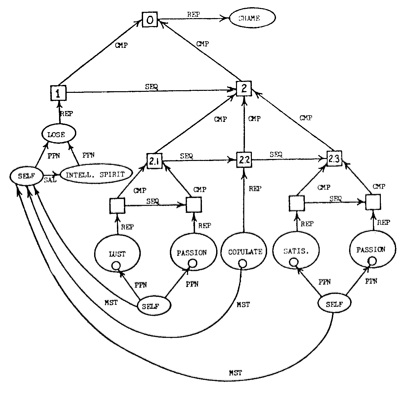
I remember back in my graduate school days when David Hays was tutoring me in cognitive networks, which involves diagrams like this, which depicts a bit of the conceptual structure underlying a Shakespeare sonnet:

Shame s129 mln76

We met once a week. I choose the concepts I wanted to work on and produce the diagrams. We’d discuss them. Often a diagram that seemed just right to me would strike Hays as being somewhere between wrong and superficial. We’d discuss it, he’d suggest a different approach, and I would adopt that approach as best I could. It took me three months or so to come up to speed, but once that happened I began making contributions to the overall model rather than simply learning the formalism.

Trees and Secrets

20141012-IMGP1487

20141012-IMGP1486

20141012-IMGP1482

Sunday, October 12, 2014

Computational Linguistics and Discourse Analysis

Abstract: The profound use of the computer in discourse analysis must employ a theory of discourse comprehension and production with which to conduct the analysis. Models currently employed in computational linguistics have a semantic basis and are goal-directed. The basic model is an associative cognitive network. The basic inventory of concepts of the system is given in the systemic network, which is organized into paradigmatic, syntagmatic, and componential structures. Since events happen in particular places at particular times, there is also an episodic structure. The gnomonic system defines abstract concepts over episodes. According to Phillips (1975), discourse coherence must be considered on two levels, the episodic and the gnomic. A discourse which engenders episodic and/or gnomonic expectations which are not then fulfilled is incoherent. A lower limit on coherence may be defined as a discourse so ill-formed that it makes no sense even to its creator. The upper limit on coherence is set by the most powerful creative minds. Between the two limits, discourse analysis, from the point of view of the computational linguist, probably requires nothing less than a full-blown computational theory of the human mind. (JB)

* * * * *

A conference presentation from March 1979. Download at SSRN: http://ssrn.com/abstract=2508667

German doubts about cowboy tactics of high-tech corporate behemoths

Anna Sauerbrey, an editor of the daily, Der Tagesspiegel, in today's NY Times:
How can Germany be both afraid of and in love with technology, and the companies that make it? The key is to look beyond those things, to the corporate model they represent.

The true origin of the conflict lies in the economic culture innate to those former Silicon Valley start-ups — now giants — that are taking the European markets by storm. To create and grow an enterprise like Amazon or Uber takes a certain libertarian cowboy mind-set that ignores obstacles and rules.

Silicon Valley fears neither fines nor political reprimand. It invests millions in lobbying in Brussels and Berlin, but since it finds the democratic political process too slow, it keeps following its own rules in the meantime. Uber simply declared that it would keep operating in Germany, no matter what the courts ruled. Amazon is pushing German publishers to offer their books on its platform at a lower price — ignoring that, in Germany, publishers are legally required to offer their books at the same price everywhere.

It is this anarchical spirit that makes Germans so neurotic. On one hand, we’d love to be more like that: more daring, more aggressive. On the other hand, the force of anarchy makes Germans (and many other Europeans) shudder, and rightfully so. It’s a challenge to our deeply ingrained faith in the state.
Very interesting. She's right to be skeptical about these high-tech corporate swashbucklers. And it's clear that the nation state is increasingly in trouble (see this post on virtual feudalism). If national governments can't regulate these behemoths, who can?

It's time to convene the Jivometric Advisory Committee of the New World Order.

Saturday, October 11, 2014

behold an eye

20140413-IMGP5925

Is the Origin of the Universe as We Know It But the Birth of Time?

That’s what I asked myself sometime within the last 10 or 15 minutes. As I’m not even a physicist, nor anything close to it, I’m not in a position to hazard an answer to that question, nor even to have a serious opinion on the subject. But I’m certainly entitled to a non-serious opinion – we all are – and so, in my non-serious but nonetheless carefully considered, opinion, the answer to that question is YES.

I’ve been thinking about that sort of thing a lot these days, mostly because I’ve been thinking about cultural evolution and, in particular, about the apparent directional evolution of 19th-century literary culture. That observation came out of the remarkable work Matthew Jockers reported in Macroanalysis: Digital Methods & Literary History. As I briefly explain in this recent post (which points to a more detailed account in 3 Quarks Daily) Jockers decided to examine the degree of similarity among the 3300+ books in his corpus. When he had his software visualize the result he found the books laid out more or less in chronological order from left to right.

How’d that happen? “Influence” is Jocker’s answer; the earlier authors influenced the later. “Evolution” is my answer. The difference is subtle, but secondary at the moment.

What makes that result so interesting is that there wasn’t any temporal information in the database. The database only contained information about some 600 descriptive features for each text. But when Jockers arranged the texts according to a high degree of similarity, time emerged as the left-to-right order.

Now, when we think about things like the 19th Century, we think of time as a framework which “contains” events and in terms of which can track their order. But, relative to the size of atoms, those 19th-century events are pretty large, and they last a pretty long time. But physicists had to shed the notion of time-as-framework early in the 20th Century. But, as Tim Morton points out in Hyperobjects, “time emanates from objects, rather than being a continuum in which they float ” (p. 33).

Academia: The Future Rising

Rise of the Rest: 
The Growing Impact of Non-Elite Journals

Anurag Acharya, Alex Verstak, Helder Suzuki, Sean Henderson,
Mikhail Iakhiaev, Cliff Chiung Yu Lin, Namit Shetty

In this paper, we examine the evolution of the impact of non-elite journals. We attempt to answer two questions. First, what fraction of the top-cited articles are published in non-elite journals and how has this changed over time. Second, what fraction of the total citations are to non-elite journals and how has this changed over time.

To answer these questions, we studied citations to articles published in 1995-2013. We computed the 10 most-cited journals and the 1000 most-cited articles each year for all the 261 subject categories included in Scholar Metrics. We considered the 10 most-cited journals in a category as the elite journals for the category and all other journals in the category as non-elite.

There are two main conclusions from our study. First, the fraction of highly-cited articles published in non-elite journals increased steadily over 1995-2013. While the elite journals still publish a substantial fraction of high-impact articles, many more authors of well-regarded papers in a diverse array of research fields are choosing other venues.

Our analysis indicates that the number of top-1000 papers published in non-elite journals for the representative subject category went from 149 in 1995 to 245 in 2013, a growth of 64%. Looking at broad research areas, 4 out of 9 broad areas saw at least one-third of the top-cited articles published in non-elite journals in 2013. All broad areas of research saw a growth in the fraction of top-cited articles published in non-elite journals over 1995-2013. For 6 out of 9 broad areas, the fraction of top-cited papers published in non-elite journals for the representative subject category grew by 45% or more.

Second, now that finding and reading relevant articles in non-elite journals is about as easy as finding and reading articles in elite journals, researchers are increasingly building on and citing work published everywhere. Considering citations to all articles, the percentage of citations to articles in non-elite journals went from 27% of all citations in 1995 to 47% in 2013. Six out of nine broad areas had at least 50% of total citations going to articles published in non-elite journals in 2013.
PDF of full text at arXiv.