Friday, February 6, 2015
Online "Session" on the Nature of Stories and the Discipline of Literary Criticism
As some of you may know, Academica.edu is a social networking site for thinkers. It’s central function is to serve as a repository for papers, whatever you want to upload. You can classify each paper however you wish, and receive notice of uploads in whatever categories interest you. And so forth.
They’ve recently added a "session" function. You upload a paper you want to discuss with others and Academica.edu notifies your mutual followers, that is people whose work you follow and who also follow your work. You can also tweet word of the seminar, Facebook it, and otherwise get the word out, which is what I’m doing here. You then have 20 days to discuss the paper.
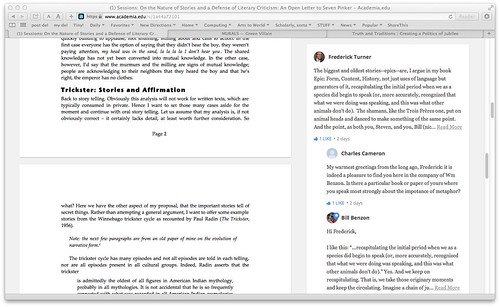
The paper displays on the left of the screen and comments display on the right. Some comments, annotations, are tied to specific points in the text:
That’s a shot from a session I’ve convened around an open letter I posted to Steven Pinker some years ago. It’s about the nature of stories, using the Winnebago Trickster cycle as an example, and also includes a capsule history of academic literary criticism from just after WWII to more or less the present. Pinker made a short reply.
You can join the session here:
Thursday, February 5, 2015
Good Morning, Vietnam & It’s a Wonderful World
I’ve watched this film three times, once when it came out, once some years ago on TV, and then again last night. It was, of course, built around its star, the late Robin Williams, who improvised his on-air DJ routines.
It would be interesting to compare this film with two earlier films, MASH (1970), set in Korea, but made immediately salient by the war in Vietnam, and Apocalypse, Now (1979). Like MASH, and unlike Apocalypse, Now, Good Morning, Vietnam (1987) is a comedy. While GMV is set mostly in Saigon and AN is mostly in the field, I can’t help but seeing some of shots in GMV through AN: the boat shots, helicopter shots, and some of the jungle shots, though the palate is a bit less saturated.
But this is not going to be a general commentary on the film. I want to mention one scene, a bit over two-thirds of the way through the film. Cronauer, the Robin Williams character, has just returned to the air by demand of the men in the field. He’d been taken off the air for insubordination and his replacement, a lieutenant who styled himself as a comedian, was a snoring disaster. So the good-guy commanding general demanded that he be reinstated. It took awhile to pull him out of his slump and get him back on air.
And when he did, the first song he played was It’s a Wonderful World, as recorded by Louis Armstrong in 1967. (I’ve got a post on a later version by the great Hawaiian musician, Israel Kamakawino’ole.) Armstrong is backed by strings, his voice is gentle, graceful, and ingratiating, and the sound is lush. As the song plays we see a montage. First the shorts are peaceful and pensive, but then they turn violent and bloody, continuing that way until the end. The effect, of course, is ironic, if lyrical as well (but then, AN was saturated in lyricism, wasn’t it?).
When that scene ends, with a close-up of Cronauer at the mike announcing the name of the song and the singer, we cut to a scene where his immediate superior–a by-the-book Sergeant Major with a mean streak (recall Col. Frank Burns from MASH)–sets him up for an ambush. The ambush fails, but the aftermath gets Cronauer removed from his post. The Sergent, too.
Back to the song. It had been recorded 20 years before this film came out. Armstrong himself had been dead for 15 years and so had pretty much disappeared from the scene, except for those of us who knew him as a jazz master. Good Morning, Vietnam put that recording back on the charts.
Beyond Lévi-Strauss on Myth: Objectification, Computation, and Cognition
Revised and extended from an earlier working paper
Another working paper, revised and extended from Lévi-Strauss on Myth: Some Informal Notes. Online at:
Abstract
This is a series of informal notes on the structuralist method Lévi-Strauss used in Mythologiques. What’s essential to the method is to treat narratives in comparison with one another rather than in isolation. By analyzing and describing ensembles of narratives, Lévi-Strauss was able to indicate mental “deep structures.” In this comparing Lévi-Strauss was able to see more than he could explain. I extend the method to Robert Greene’s Pandosto, Shakespeare’s The Winter’s Tale, and Brontë’s Wuthering Heights. I discuss how Lévi-Strauss was looking for a way to objectify mental structures, but failed; and I suggest that the notion of computation will be central to any effort that goes beyond what Lévi-Strauss did. I conclude by showing how work on Coleridge’s “Kubla Khan” finally led me beyond the limitations of structuralism and into cognitive science.
Contents
Prefatory Note 2
Introduction: He Saw More than He Could Grasp 3
1. The King’s Wayward Eye: For Claude Lévi-Strauss 4
2. Distant Reading in Lévi-Strauss and Moretti 11
3. Free Play and Computational Constraint 15
4. Into Lévi-Strauss and Out Through “Kubla Khan” 20
Appendix: Lévi-Strauss and Latour, Transformations of a Myth? 28
Online Articles and Discussion 30
Study: Window sill objects, light
What the title says, just objects on my window sill. Stacked at the left edge, a pack of kitchen matches on top of two plastic contains with pens and pencils in them. An empty milk bottle. An incense burner in the bottom of a take-out food contain. Just stuff.
From my point of view as a photographer, those things exist to modulate light, which is streaming in through the window at mid-day. You can see the light reflecting off the wires in the screen in the window. Through the window you see the apartment building across the street.
When rendering this image in Photoshop I ramped the saturation way up and then cut it back on a fade. The idea was to get some color in an image that was otherwise almost a monotone. I did the same thing with this one:
Wednesday, February 4, 2015
The Title “Heart of Darkness”
In the course of writing my open letter to J. Hillis Miller I reviewed the work I’d done on Conrad’s Heart of Darkness and realized that for all I’d written about the text, I’d said nothing about the title. That’s a minor matter, I suppose, but still: What about it? What’s the darkness, and where’s the heart?
King Lear and David Copperfield are named after principle characters and so, in an interesting way, is Moby Dick. Pride and Prejudice and A Passage to India are thematic. Since it’s not the name of a character, Heart of Darkness must be thematic as well.
If you knew only the title, and nothing else about the book, what would you think? If you knew the title and also knew that most of the story takes place in Africa or on the Congo, what then? I have no idea whether or not “darkness” alone would have triggered thoughts of Africa in Conrad’s readers, but “darkness” and “Africa” would likely have been strongly associated in many minds.
Between 1876 and 1877 Henry Morton Stanley traveled across central Africa from east to west. He published a book about the expedition in 1878, Through the Dark Continent. Roughly a decade later he traveled to relieve the besieged governor of Equatoria, Emin Pasha, and published the story of that expedition in 1890, In Darkest Africa. Both books were widely read.
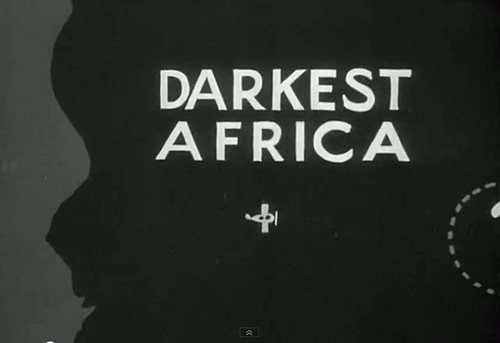
I don’t know whether Stanley originated the trope or adopted it from some other source, and how much responsibility he bears for disseminating it. (See the graph of a Google Ngram query at the end of the post showing the rise of those tropes.) I am simply taking his books as evidence that the trope was well established a decade before Conrad published his book. The trope continued well into the 20th century and showed up, for example, in cartoons, as we can see from this screen shot from Bob Clampett’s 1938 Porky in Wackyland:
So, the title draws our attention to Africa. That’s the darkness. Of is it? For Conrad’s book focuses our attention on the despicable nature of Europe’s activities in Africa. Is that the darkness? Is the darkness of a moral nature?
Of course.
What of the heart? Kurtz’s station was deep in the interior of central Africa, putting it at the geographical heart of Africa. In that it was a trading post where Kurtz collected elephant tusks, referred to as fossil, it was also at the center of the European economic exploitation of Africa.
But there is something else: Kurtz’s fiancé, known in the book simply as the Intended. He had gone to Africa to make his fortune so this woman’s relations would regard him as being worthy of her. She was on Kurtz’s mind as he lay dying; he would ramble on about “My Intended, my station, my career, my ideas…” Marlow’s last act was to tell this Intended about Kurtz’s last hours. She wanted Marlow to lie to her in telling her that Kurtz died with her name on his lips. And that is what Marlow did, though Kurtz’s last words, we know, were “The horror! The horror!”
Could this Intended, Kurtz’s fiancé and the woman who tended to his mother as she lay dying, could she be this heart of darkness? If so, what does that do to our sense of the book?
* * * * *
“Dark continent” shows a steep rise about the date of Through the Dark Continent; “darkest Africa” starts up a bit before the publication of In Darkest Africa. “Heart of Darkness” begins with the publication of Conrad’s text.
Tuesday, February 3, 2015
Trumpet Bell
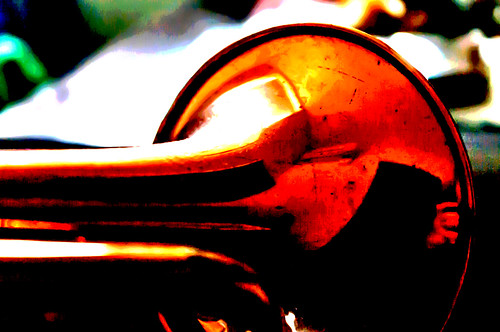
When I blow a trumpet, this is the trumpet I blow these days. Notice the photographer's hand inside the bell rim just below center-right:
Monday, February 2, 2015
Humanane Letters and Good Talk: Building Community in a Research Lab
Over at 3 Quarks Daily Jalees Rehman has an interesting post about research life in the life sciences: Literature and Philosophy in the Laboratory Meeting. He identifies a problem:
Over the years, I have noticed that the increasing complexity of the molecular and cellular signaling pathways and the technologies we employ makes it easy to forget the "big picture" of why we are even conducting the experiments. [...] When asked to explain the purpose or goals of our research, we have become so used to directing a laser pointer onto a slide of a cellular model that it becomes challenging to explain the nature of our work without visual aids.
Visual aids = PowerPoint. So:
This fall, I introduced a new component into our weekly lab meetings. After our usual round-up of new experimental data and progress, I suggested that each week one lab member should give a brief 15 minute overview about a book they had recently finished or were still reading. The overview was meant to be a "teaser" without spoilers, explaining why they had started reading the book, what they liked about it, and whether they would recommend it to others. One major condition was to speak about the book without any Powerpoint slides! But there weren't any major restrictions when it came to the book; it could be fiction or non-fiction and published in any language of the world (but ideally also available in an English translation). If lab members were interested and wanted to talk more about the book, then we would continue to discuss it, otherwise we would disband and return to our usual work. If nobody in my lab wanted to talk about a book then I would give an impromptu mini-talk (without Powerpoint) about a topic relating to the philosophy or culture of science.
He then briefly indicates some of the books and philosophical topics they've discussed.
I commented by saying a bit about my experience getting my Ph. D. at the State University of New York at Buffalo.
Some Quick Thoughts on Cultural Evolution
Here are some thoughts I’ve been having on cultural evolution. All of them need fuller exposition, but I don’t have time for that now.
1. Cultural Evolution, so What?
I’ve got a fairly sophisticated narrative account of some varieties of popular music in 20th century America. The account centers on the interaction between African- and European-American populations and musical forms. When I was doing that work–in the late 1990s–I kept thinking that this is the kind of phenomenon that begs for an account in terms of cultural evolution. But I didn’t once use the term “memes” (my term of choice at the time) in the paper nor did I talk of cultural evolution (except in passing at the very end). It’s not at all obvious to me how any existing account of cultural evolution would lead to a deeper understanding of that history. It would just be an exercise in terminology mongering.
This is a very big deal for me, and I don’t yet know what to do about it.
On African American music and so forth, see Music Making History: Africa Meets Europe in the United States of the Blues.
2. Information and Apple Pie
On information, sure, at the highest level of generality and abstraction cultural evolution involves information. But that doesn’t get us much in itself. Until we understand how that information is embodied in the brain and in various media and can measure it, the idea isn’t a very useful or deep one. It’s one of mere terminology, verbal packaging. But see comment six, below.
3. Information, DNA, the Brain and the Rest
In biology we know that genetic information is embodied in DNA and we know a great deal about how that works. And we are rapidly increasing our ability to manipulate DNA.
We don’t know how information is encoded in the nervous system. But that’s not so much my point here. It belongs in #2 above.
My point here is that, in long-held view, the genetic information for culture isn’t in the brain. It’s in publicly accessible traits of physical objects and processes. That means that, whereas the genetic information of life forms is encoded in the same medium, DNA, that is not the case for cultural genetic information. The genetic information for culture has various embodiments.
From the standpoint of theoretical elegance/parsimony, this is not so good. But the fact is, no matter what kind of model you choose, if you want to deal with information, you are going to have to deal with multiple physical embodiments and the transformations between them.
4. Mutual Information for Culture
We’re interested in the ‘conservation’ of information in the social group. That requires shared access to common reference points. The meaning of those reference points is, in effect, negotiated through interaction. Those agreed reference points are the ‘genes’ of the cultural process.
Compare this with DNA replication. The double strand divides and then each half constructs the necessary complement. The result is two identical DNA molecules where there had been one.
Shared access to a common public reference plays the role in cultural informatics that DNA replication plays in biological informatics.
On mutual information in culture, see my Open Letter to Steven Pinker.
5. The mind as computer program
Programs have variables and variables require values. Where do mental programs get values for their variables? Some of them are generated internally.
And some of them come from the external world. Among those we have the cultural genetic material. They function as values for variables in mental programs.
See this post for further specification of this thought: Memes as Data: Targets, Couplers, and Designators. That is collected in my working paper, Cultural Evolution, Memes, and the Trouble with Dan Dennett.
Moral Injury in Iraq
Garett Reppenhagen, writing in Salon about American Sniper:
See this old post on Breaking Bad.Unlike Chris Kyle, who claimed his PTSD came from the inability to save more service members, most of the damage to my mental health was what I call “moral injury,” which is becoming a popular term in many veteran circles.As a sniper I was not usually the victim of a traumatic event, but the perpetrator of violence and death. My actions in combat would have been more acceptable to me if I could cloak myself in the belief that the whole mission was for a greater good. Instead, I watched as the purpose of the mission slowly unraveled.I served in Iraq from 2004 to 2005. During that time, we started to realize there were no weapons of mass destruction, the 9/11 commission report determined that Iraq was not involved in the terrorist attacks on the World Trade Center, false sovereignty was given to Iraq by Paul Bremer, the atrocities at Abu Ghraib were exposed, and the Battle of Fallujah was waged.The destruction I took part in suddenly intersected with news that our reasons for waging war were untrue. The despicable conduct of those at Abu Ghraib was made more unforgivable by the honorable interactions I had with Iraqi civilians, and, together, it fueled the post-traumatic stress I struggle with today.My war was completely different than Chris Kyle’s war. That doesn’t mean his war is wrong, and mine was right. But it does mean that no one experience is definitive.
Sunday, February 1, 2015
Huck Finn and Anxiety about children
A new book, Huck Finn’s America: Mark Twain and the Era that Shaped His Masterpiece, argues that The Adventures of Huckleberry Finn was not primarily about race. Reviewing the book in Salon, Laura Miller writes that
... nobody, including Twain himself, considered race to be the primary theme of “Huckleberry Finn.” Rather, the novel emerged from and spoke to a society that was obsessed with wayward children, particularly boys, and most typically lower-class boys spurred to delinquency by the violent stories they read in dime novels. The papers were full of “stories of children committing crimes or dying young or killing each other,” to a degree that, Levy remarks, a modern reader would find “simply numbing.” In response to this perceived crisis, Americans were, for the first time, seriously discussing the establishment of a system of public education.
"Childhood in crisis" is, of course, a theme much still with us:
It’s easier to look back at the public conversation about bad boys when “Huckleberry Finn” was published and recognize it as an early incarnation of conversations we have right now. “Condemning the newest media because it markets violence to children is one of the oldest tropes in American politics,” Levy writes. “We forget that reading was the Xbox of the Victorian age, and dime novels their equivalent of violent video games,” but being reminded of this repetition is not that troubling.
However, Miller continues:
Race is another matter. Levy believes that Twain arrived at a conclusion that most Americans refuse to entertain. Huck might have experienced an epiphany about his kinship with Jim, but the novel ends with Tom Sawyer using both of them, and their lives, as a form of entertainment, then paying off the long-suffering Jim with the symbolically fraught sum of $40. Not much has changed in the course of “Huckleberry Finn” beyond the understanding of one wild heart, and that, as Twain himself realized in his old age, looking back on the failure of Reconstruction and railing about colonialism and King Leopold, does not actually amount to much. “Mistaking a dark comedy about how history goes round for a parable about how it goes forward is a classic American mistake,” Levy observes.
Free Play and Computational Constraint in Lévi-Strauss
This is another post in a series that I’ve devoted to explicating Lévi-Strauss’s work on myth (starting with The King’s Wayward Eye: For Claude Lévi-Strauss at The Valve). In his earlier work Lévi-Strauss had considered myths one or two at a time. In The Raw and the Cooked he examines a collection of myths, 187 of them, and treats them as an integrated system of stories. He’s after the grammar, if you will, that underlies the whole lot of them. He continues that project through three more volumes.
He used a language of transformation from one myth to another which is, unfortunately, misleading. This post is an attempt to clarify what’s going on. I attack the matter from two angles. In the first section I imagine that myths are actually created in the way that Lévi-Strauss writes, M1 begets M2 by some transformation Tx, M2 begets M3 by Tz, M4 begets M267 by Tw, and so forth.
When that falls apart I get serious and take a brief look at some work done back in the 1960s by brilliant British linguist named Margaret Masterman. I never met her, but her husband, the philosopher R. B. Braithwaite, visited Johns Hopkins while I was an undergraduate and I took a course in decision theory from him. Later on I got my Ph. D. at the State University of New York at Buffalo where I studied under David Hays, who knew of her work, held her in the highest regard, and had once hired one of her students, Martin Kay, to work with him at RAND.
George Goes to Gary, and then Things Get Confused
So, our Universal Mythographer (UM) starts with the classic, George Goes to Gary, in which George travels to Gary, Indiana, to visit his grandmother on her 95th birthday. While there she convinces him that he really ought to marry Gina, who is such a nice girl. So he applies to the bank for a home improvement loan, gets it, and he improves his home. Gina’s father is suitably impressed and grants Gary permission to marry her. They honeymoon in Hawaii, return home and find out that, alas, Gary’s grandmother has died. But she left him the key to a safe deposit box. He opens the box, drinks the magic elixir he finds there, and becomes impotent. End of story.
The UM decides to swap George’s grandmother for his uncle. Grandmother out, uncle in. What happens? Well, instead of giving George a home improvement loan, the bank forecloses on his mortgage. Now that he’s homeless his girlfriend’s parents forbid her to marry him. He joins the Navy, sees the world, and ends up as a used-car salesman in Anchorage, Alaska. He goes out in the woods hunting grizzly. Just when he’s spotted a grizzly WHAM! he comes upon his uncle attempting to rape his old girlfriend. He rescues the girl, she marries him, and they live happily ever after.
Very interesting, thinks UM, I wonder what’ll happen if I change the grizzly into a possum?
What happens is that the George comes upon his uncle being abducted by little green aliens. He rescues his uncle, his uncle gives him his lucky plaid sports jacket as a reward, and he becomes the best salesman on the lot. One day he sees the boss’s daughter. They fall in love. Marriage. Happily ever after.
Most interesting, indeed, says UM to himself. Let’s make it a Harris tweed sports jacket.
As soon as he puts the jacket on George decides he has to learn how to play golf. He signs up for lessons with the pro, Gary, at the local public course, falls in love with him, and they become gay activists in Sarah Palin country. Not quite so happy, but more interesting.
Whoa! didn’t see that one coming. Not at all.
And so it goes, change after change, story after story. Every once in a while a change is so drastic that the apparatus can’t adapt and, instead, just falls apart—I mean, when George became an olive that Frank put in a martini he handed to Ava, and then, when she put me to her lips, I became a mouse riding in the cap of a flying elephant while singing “Fly Me to the Moon”… I had to get off that bus, fast! But, for the most part, the system is able to cope with this fiddling and produce a new story that more or less works.
So, now we’ve got, say, 200 stories, one we were given to start with, George Goes to Gary, and 199 we’ve generated by this procedure. Now what? Just what have we learned? Presumably we want to know how the system works. We’ve put it through its paces, but the mechanisms are invisible. We know the story we started with, we know what we changed, and we know how the system responded. That’s some kind of a clue to what’s going on, but not much. Since we’ve done this 199 times we’ve got 199 such clues, plus whatever we can infer from the overall order.

Saturday, January 31, 2015
The Autonomous Aesthetic: A Graduate Syllabus in Naturalist Literary Criticism
I'd originally posted this at The Valve in July of 2007 under a slightly different title: The Autonomous Aesthetic: A Graduate Syllabus in Literary Theory. Now that I have clearly distinguished between naturalist and ethnical criticism, and provided a rationale for the distinction, it seems best to restrict the title of this syllabus to naturalist criticism, for that IS its scope. Beyond that, the syllabus holds up pretty well. I've added Brian Boyd's book, On the Origin of Stories, which makes a bear of a course even worse, but the first half has a lot of useful psychology in it, making it a valuable supplement to me, Tsur, and Herman.
Note that I'd originally republished this in October of 2013. I'm bumping it to the top in the context of my open letter to Hillis Miller. Finally, if this post at all interests you, I urge you to go over to The Valve (link above) and read the discussion we had there. It's quite good. For on thing, there's some commentary on the notion of an autonomous aesthetic, and that's something I've been thinking about steadily for awhile. I came up in my letter to Miller, where it referenced my working paper on Matthew Jocker's Macroanalysis.
John Holbo's recent post on Mark Bauerlein's proposed antidote (that link, alas, is dead as The Valve has finally bit the dust) for leftist politics in the Theory curriculum got me thinking about the question of how, given a free hand, I'd teach literary theory. In the spirit of a thought experiment I've put together a syllabus for a graduate course in literary theory, that is, the theory of literature.
On the one hand, I want to demonstrate that one could teach a course in literary theory that pretty much avoids High Theory and yet is intellectually contemporary rather than an exercise in nostalgia. If I myself have pursued these ideas, however, it has not been out of any desire to avoid Theory as though it were a disease (and, of course, it is very proud of the fact that it is grounded in dis-ease) but simply because these are the ideas that have interested me. They are compelling on their own terms and not simply as an alternative to something else.
As a way of setting an overall objective for such a course, a pole star if you will, I offer a passage from a very political High Theorist, the late Edward Said. This passage is from one of his last essays, “Globalizing Literary Study,” published in 2001 in PMLA. He says:
I myself have no doubt, for instance, that an autonomous aesthetic realm exists, yet how it exists in relation to history, politics, social structures, and the like, is really difficult to specify. Questions and doubts about all these other relations have eroded the formerly perdurable national and aesthetic frameworks, limits, and boundaries almost completely. The notion neither of author, nor of work, nor of nation is as dependable as it once was, and for that matter the role of imagination, which used to be a central one, along with that of identity has undergone a Copernical transformation in the common understanding of it.
I too believe that “an autonomous aesthetic realm exists,” and that one can conceptualize it without having to ignore either the human mind, nor society, nor their joint interaction through and embedding in history. The objective of this course in literary theory, then, is to begin understanding how literature partakes of this aesthetic autonomy while being embedded in the contingencies of history.
First I list the proposed texts, in the order that I would use them, and then I explain why.
David Herman. Story Logic: Problems and Possibilities of Narrative. University of Nebraska Press, 2002.Claude Lévi-Strauss. “The Story of Asdiwal,” in Structural Anthropology II. Basic Books, 1976, pp. 146-197.Reuven Tsur. Toward a Theory of Cognitive Poetics. North-Holland, 1992.William Benzon. Beethoven's Anvil: Music in Mind and Culture. Basic Books, 2001.
Brian Boyd. On the Origin of Stories: Evolution, Cognition, and Fiction, Harvard 2009. My review is HERE.
Dan Sperber. Explaining Culture: A Naturalistic Approach. Blackwell, 1996.Franco Moretti. Graphs, Maps, Trees: Abstract Models for a Literary History. Verso, 2005.Alistair Fowler. Kinds of Literature: An Introduction to the Theory of Genres and Modes. Harvard University Press, 1982.
Subscribe to:
Posts (Atom)