Thursday, October 25, 2018

Chairman Xi has, shall we say, limitations

Note what happens at the very end of this clip:

Chairman Xi is shown delivering a speech at the celebration of the 90th anniversary of the founding of the Chinese People's Liberation Army. The live-action camera accidentally caught the use of Hanyu Pinyin on the teleprompter to phonetically annotate the character kuī 岿 / 巋 ("grand, stately; secure, lasting; imposing") in the expression "kuīrán bù dòng 岿然不动" ("motionless; steadfastly stand one's ground").

Kuī 岿 / 巋 ("grand, stately; secure, lasting; imposing") is not among the top 9,933 highest frequency characters. The fact that Xi's speechwriter(s) felt it was necessary to phonetically annotate the character kuī 岿 indicates that they lacked confidence in his ability to read it correctly. If so, then why did they choose such an obscure character for him to have to read in such broadly exposed circumstances? Clearly, it was to make him seem more learned than he actually is. "Kuīrán bù dòng 岿然不动" ("motionless; steadfastly stand one's ground") is a fixed phrase from the philosophically eclectic classical text known as the Huáinánzǐ 淮南子 ([Writings of] the Masters [at the Court of the Prince of] Huainan), which dates to sometime before 139 BC.

it's Fall, time for decorative gourds of all kinds

20181022-P1160148

Once again, Latour [in the NYTimes] – "the traditional image of facts was never sustainable to begin with"

Ava Kofman, The New York Times Magazine, Oct. 25, 2018:
The election of Donald Trump, a president who invents the facts to suit his mood and goes after the credibility of anyone who contradicts him, would seem to represent the culmination of this epistemic rot. “Do you believe in reality?” is now the question that half of America wants to ask the president and his legion of supporters.

“I think we were so happy to develop all this critique because we were so sure of the authority of science,” Latour reflected this spring. “And that the authority of science would be shared because there was a common world.” [...] “Even this notion of a common world we didn’t have to articulate, because it was obvious,” he continued. “Now we have people who no longer share the idea that there is a common world. And that of course changes everything.” [...]

But Latour believes that if the climate skeptics and other junk scientists have made anything clear, it’s that the traditional image of facts was never sustainable to begin with. “The way I see it, I was doing the same thing and saying the same thing,” he told me, removing his glasses. “Then the situation changed.” If anything, our current post-truth moment is less a product of Latour’s ideas than a validation of them. In the way that a person notices her body only once something goes wrong with it, we are becoming conscious of the role that Latourian networks play in producing and sustaining knowledge only now that those networks are under assault.

This, in essence, is the premise of Latour’s latest book, “Down to Earth,” an illuminating and counterintuitive analysis of the present post-truth moment, which will be published in the United States next month. What journalists, scientists and other experts fail to grasp, Latour argues, is that “facts remain robust only when they are supported by a common culture, by institutions that can be trusted, by a more or less decent public life, by more or less reliable media.” With the rise of alternative facts, it has become clear that whether or not a statement is believed depends far less on its veracity than on the conditions of its “construction” — that is, who is making it, to whom it’s being addressed and from which institutions it emerges and is made visible. A greater understanding of the circumstances out of which misinformation arises and the communities in which it takes root, Latour contends, will better equip us to combat it.
The traditional division between facts and values is not, alas...
"In a formulation that was galling to both sociologists and scientists, he once argued that Louis Pasteur did not just, as is commonly accepted, discover microbes; rather, he collaborated with them."
...so simple as we might wish. 

While finishing his dissertation Latour was working in the Ivory Coast and found himself tasked with finding out when French companies in postcolonial Abidjan were having trouble finding suitable black executives.
It took less than a day for Latour to realize that the premise was flawed. “The question was absurd because they did everything not to have black executives,” he told me. In the French-run engineering schools, black students were taught abstract theories without receiving any practical exposure to the actual machinery they were expected to use. When they were subsequently unable to understand technical drawings, they were accused of having “premodern,” “African” minds. “It was clearly a racist situation,” he said, “which was hidden behind cognitive, pseudohistorical and cultural explanations.”

In Abidjan, Latour began to wonder what it would look like to study scientific knowledge not as a cognitive process but as an embodied cultural practice enabled by instruments, machinery and specific historical conditions.
And so it goes, especially if you're not familiar with Latour.
The more socially “networked” a fact was (the more people and things involved in its production), the more effectively it could refute its less-plausible alternatives. The medical revolution commonly attributed to the genius of Pasteur, he argued, should instead be seen as a result of an association between not just doctors, nurses and hygienists but also worms, milk, sputum, parasites, cows and farms. Science was “social,” then, not merely because it was performed by people (this, he thought, was a reductive misunderstanding of the word “social”); rather, science was social because it brought together a multitude of human and nonhuman entities and harnessed their collective power to act on and transform the world.
Come clean, guys:
Latour believes that if scientists were transparent about how science really functions — as a process in which people, politics, institutions, peer review and so forth all play their parts — they would be in a stronger position to convince people of their claims. Climatologists, he says, must recognize that, as nature’s designated representatives, they have always been political actors, and that they are now combatants in a war whose outcome will have planetary ramifications. We would be in a much better situation, he has told scientists, if they stopped pretending that “the others” — the climate-change deniers — “are the ones engaged in politics and that you are engaged ‘only in science.’ ”
The machinery behind the curtain:
At a meeting between French industrialists and a climatologist a few years ago, Latour was struck when he heard the scientist defend his results not on the basis of the unimpeachable authority of science but by laying out to his audience his manufacturing secrets: “the large number of researchers involved in climate analysis, the complex system for verifying data, the articles and reports, the principle of peer evaluation, the vast network of weather stations, floating weather buoys, satellites and computers that ensure the flow of information.” The climate denialists, by contrast, the scientist said, had none of this institutional architecture. Latour realized he was witnessing the beginnings a seismic rhetorical shift: from scientists appealing to transcendent, capital-T Truth to touting the robust networks through which truth is, and has always been, established.

Is this the beginning of the #WorldWideWall ?

What's the World-Wide Wall? All the world's graffiti, considered as a single aesthetic object, photographically assembled and indexed in virtual space via the web.


Emergent Ventures at Work:


Wednesday, October 24, 2018

A Review of Daniel Everett, Dark Matter of the Mind

Now up at Academia.edu: https://www.academia.edu/37643210/A_Review_of_Daniel_Everett_Dark_Matter_of_the_Mind.
Abstract: Everett’s core assertion is simple: There is no language without culture. Culture is the dark matter of the mind. Everett defines culture as: “... an abstract network shaping and connecting social roles, hierarchically structured knowledge domains, and ranked values. Culture is dynamic, shifting, reinterpreted moment by moment. Culture is found only in the bodies (the brain is part of the body) and behaviors of its members. Culture permeates the individual, the community, behaviors, and thinking.” The book, which is at heart a work of philosophy, is based on Everett’s work among the Pirahã and contains many examples from his work there, including a crucial argument about recursion and fascinating examples about evidentials. However, I strongly suspect that computation will play a major role in constructing the new accounts of language and culture that Everett’s work calls for. In this I probably differ from Everett, who is skeptical about computation.


Advice on buying a horse from a 17th c. Chinese magistrate


On the waterfront [Yes, this waterfront. The movie was shot in Hoboken.]

20181022-P1160138

20181022-P1160141

20181022-P1160140

First Man, Where’s the adventure?

There’s a nice little conversation about First Man over at Tyler Cowen’s joint. The opening line of Tyler’s review:
I enjoyed this movie, although I would not describe it as a must-see. It is best for showing the rickety and claustrophobic nature of the moon landing program.
Hmmm... Not sure about that as a judgment about the movie, but that’s kinda what I thought when I saw when I saw a lunar lander at Kennedy Space Center. But that Saturn was HUGE. Tyler’s last sentence: “By the way, this movie has bombed at the box office, perhaps not a good sign for the revival of adventure in contemporary culture.”

During the ensuing conversation several Transnational Pants Machine remarked, “The movie bombed precisely because it utterly lacked all sense of adventure, and decided to be about a guy who misses his dead daughter.” And then hoof_in_mouth, “This was not an adventure movie, it was a personal drama against the backdrop of the space program. I was hoping for the opposite.”

I think that’s right. Not (primarily) an adventure movie. But then neither was 2001: A Space Odyssey, which was more of a quasi-religious revelation. Star Wars was adventure, though with all that mystical Force razzmatazz it pretended to be a mystical quest. But that was only pretense. The quest motif was subordinated to adventure.

Maybe that’s the problem with First Man, Chazelle didn’t quite know what kind of movie he wanted to make. It wasn’t an adventure film, though it has adventure aspects. It wasn’t fully a personal drama, but that surely was in the mix. Nor was it a quasi-religious revelation, thought it seemed headed in that direction.

What is it?

* * * * *
See also:

Two Tweets of the Day: Paul Klee's notebooks, citizen science


Ghee on a Saturday Evening [#JerseyCity]

From the archives, 2003.

It was Saturday evening, August 16, 2003, two days after the blackout that shut down most of the Northeastern quadrant of the country. I decided to take a walk down by the waterfront. For me, living in the Hamilton Park area of Jersey City, the waterfront means the west bank of the Hudson River at the point where the Holland Tunnel crosses into lower Manhattan, an area given over to a concrete walkway, buildings of various sorts, some deserted tracts of scrubby land, and the Newport Marina. I first set foot in this area some five or six years ago when I went to meet Bill Doyle, an old friend and, at that time, a business associate in a small software company. He was sailing his boat up from Baltimore and docking it at the marina.
Newport in the early morning.
 
At that time there were perhaps three or four high-rise apartments at Newport – as the area was called – two office towers, a parking garage, a fitness club, several shops, and, a couple of hundred-yards back from the shore, the Newport Mall, with a Sears, a J.C. Penny, a Sterns (now Macys), a multiplex theatre, food court, and assorted shops, stands, and kiosks. Now the number of apartment towers had more than doubled, there were five or six office buildings, a half dozen restaurants – American, Italian, Chinese, Japanese, Mexican, Indian – several bars, two hotels, more parking, a florist, a large drug store, and a (private) primary school will be opening in the Fall. One of my colleagues, Xiaohui Wang, from the (now defunct) software company lives in one of those apartment towers. He tells me that his young son, Eric, can recite 20 ancient Chinese poems.

There were, as one might expect, a lot of people out that evening; there usually is. Judging from the languages they speak and their appearances, most of them are not native to America. The majority of them appear to be from Asia while some appear to be of African descent. There are some, but not many in overall proportion, Caucasians of European heritage.

Most of the people are relatively young. Many are walking with infants of toddlers. All are relaxed.

The evening is a pleasant one. But I cannot forget the recent blackout – though it had been quite mild in this area – nor could I allow myself to completely forget the political climate. In fact, the immediate context, being surrounded by Third World professionals living in America, kept that climate bitterly in mind. How will the increasing xenophobia affect their lives? They came to work, to raise families, indeed, I suspect many came for freedom. Xiaohui is one of the students who had demonstrated at Tiananmen Square. He came to this country to study, then to work. Now he and his wife have two children.

As I continue strolling along the shore, with all these people, such thoughts haunt me. The buildings are, at best, nondescript modern towers, bland, faceless, sterile. The people too are thoroughly modern, but they are not nondescript nor, on the evidence, were they sterile. To the contrary, they dressed in clothes of many lands and were happily fertile. Those fearful thoughts were in stark contrast to these people and to the New York skyline, one of the Great Wonders of The Modern World, across the river.

At some point I angled inland from the shore, cutting across the north edge of the apartment complex to Washington Avenue. I then turned left and headed south along the very broad sidewalk in front of the office towers. There, a football field away, was a curious sight, a unexpected bright patch. It was outside one of those new bars that had been settled in the area. People had gathered, most of them seated, behind a low railing demarcating an area of the sidewalk for use of the bar’s patrons. At the far end of this area I saw a small white canopy with decorative gold filigree on its supporting pillars. The seated people were well dressed, the men in suits, the women in elegant evening wear.

As I drew near, it became clear that this was a wedding. I concluded that it must be a Hindu ceremony, though I have never seen one, or even read a description of one. The (veiled) bride and groom wore Indian clothing, maroon for him, gold-trimmed crimson for her, both in silk. The officiating priest wore Indian dress as well – white slacks and a maroon closed-neck jacket – as did many others. The couple stood in front of two ornate chairs placed at the back of the canopy. There were flowers and flower petals scattered about and several people wore garlands of flowers around their necks. That seemed Hindu, as did the small altar – a rectangular tray a few inches off the ground – near the front of the canopy. A small flame flickered in a dish on the altar, and the priest would occasionally throw some powder on the flame – incense perhaps? But the tip-off is a jar near the altar. Its label said “ghee.” Ghee is a clarified butter that is often used as an offering in Hindu ceremonies, that much I remembered having read.

As one faced the altar from the audience the bride stood behind the altar and to the right, while the groom was to the left. The priest was to the right as well. He said quite a bit, most of it in a tongue foreign to me, though he did speak a few words in English. These words sounded like wedding vows, suggesting that one or both of the married couple may not have been a native speaker of . . . whatever language was being used for the ceremony. At times the priest’s voice would rise in pitch and his speech would transform into chant.

The bride appeared to be of Indian descent, so I assumed that the English was for the groom’s benefit. He appeared to be of African descent. Thus the older couple to the right of the altar must have been his parents while the older couple to the left of the altar must have been her parents. It is possible, of course, that both families were native to, say, Trinidad. Most of the people in attendance appeared to be of Indian or African descent – which means that, at this time in history, they could have originated anywhere in the world outside of the arctic zones – though Caucasians of European descent were there in some measure as well.

The ceremony was in progress when I happened upon it. Perhaps the ceremony had been going on for a minute, five minutes, or an hour. I do not know. I stayed until the ceremony seemed complete – a period of perhaps twenty minutes or so. During that time the couple walked around the altar, while remaining under the canopy, on four different occasions. The bride led the way on the first two circuits while the groom led on the last two circuits. Each was wearing a shawl and their shawls were tied together.

A few others – the street was otherwise deserted – wandered along during the ceremony and, like me, observed from outside the railing. “What’s going on?” asked a Chinese woman. “I think it’s a wedding. See, there’s the bride and groom.” “Oh,” she remarked, “they’re not from around here.” Who is? I thought. Perhaps some of the patrons of the Hamilton Park Ale house, the bar on the ground floor of the building where I live. There were pictures of high school sports teams and old pols on the wall, even a Kennedy or two.

At some point I noticed that the bride’s mother – in a red sari and yellow shawl, trimmed in gold (the groom’s mother wore a closely fitted lavender dress embroidered all-over with a loose net of gold filigree) – began passing flower petals to everyone in attendance. When the ceremony concluded, they all tossed the petals at the married couple, who then sat down in the two chairs, the bride to the right, the groom to the left – though, from the couple’s point of view, the bride was to the left, the groom to the right. As this was happening the bride’s mother began distributing small cakes; they came in small boxes with a cellophane window on the top and probably a dozen to the box. People would eat the cakes and, as they came forward to congratulate the couple, would feed cakes to them as well.

It was an odd sight, this small Hindu wedding party in colorful silk, flowers, ghee, and incense, nestled to one side of a small canyon framed by tall nondescript buildings in muted shades of metal, glass, concrete, and stone. On the shore of the Hudson River. To the west of New York City.

I do not know if there was music and dancing afterward. It was time for me to head home.

Tuesday, October 23, 2018

Tweet of the Day: Chameleon with sun glasses


Semantic information, agency, and statistical physics

Kolchinsky A, Wolpert DH. 2018 Semantic information, autonomous agency and non-equilibrium statistical physics. Interface Focus 8: 20180041. http://dx.doi.org/10.1098/rsfs.2018.0041
Abstract: Shannon information theory provides various measures of so-called syntactic information, which reflect the amount of statistical correlation between systems. By contrast, the concept of ‘semantic information’ refers to those correlations which carry significance or ‘meaning’ for a given system. Semantic information plays an important role in many fields, including biology, cognitive science and philosophy, and there has been a long-standing interest in formulating a broadly applicable and formal theory of semantic information. In this paper, we introduce such a theory. We define semantic information as the syntactic information that a physical system has about its environment which is causally necessary for the system to maintain its own existence. ‘Causal necessity’ is defined in terms of counter-factual interventions which scramble correlations between the system and its environment, while ‘maintaining existence’ is defined in terms of the system's ability to keep itself in a low entropy state. We also use recent results in non-equilibrium statistical physics to analyse semantic information from a thermodynamic point of view. Our framework is grounded in the intrinsic dynamics of a system coupled to an environment, and is applicable to any physical system, living or otherwise. It leads to formal definitions of several concepts that have been intuitively understood to be related to semantic information, including ‘value of information’, ‘semantic content’ and ‘agency’.

1. Introduction

The concept of semantic information refers to information which is in some sense meaningful for a system, rather than merely correlational. It plays an important role in many fields, including biology [1–9], cognitive science [10–14], artificial intelligence [15–17], information theory [18–21] and philosophy [22–24].1 Given the ubiquity of this concept, an important question is whether it can be defined in a formal and broadly applicable manner. Such a definition could be used to analyse and clarify issues concerning semantic information in a variety of fields, and possibly to uncover novel connections between those fields. A second, related question is whether one can construct a formal definition of semantic information that applies not only to living beings but also any physical system—whether a rock, a hurricane or a cell. A formal definition which can be applied to the full range of physical systems may provide novel insights into how living and non-living systems are related.

The main contribution of this paper is a definition of semantic information that positively answers both of these questions, following ideas publicly presented at the FQXi's 5th International Conference [31] and explored by Carlo Rovelli [32]. In a nutshell, we define semantic information as ‘the information that a physical system has about its environment that is causally necessary for the system to maintain its own existence over time’. Our definition is grounded in the intrinsic dynamics of a system and its environment, and, as we will show, it formalizes existing intuitions while leveraging ideas from information theory and non-equilibrium statistical physics [33,34]. It also leads to a non-negative decomposition of information measures into ‘meaningful bits’ and ‘meaningless bits’, and provides a coherent quantitative framework for expressing a constellation of concepts related to ‘semantic information’, such as ‘value of information’, ‘semantic content’ and ‘agency’.
From a special issue, ‘Computation by natural systems’ organised by Dominique Chu, Christian Ray and Mikhail Prokopenko .

Food!

20181022-P1160102

20181022-P1160124

What’s the key difference between the MacArthur Fellow’s Program and the (new) Emergent Ventures program? [TALENT SEARCH]

A couple weeks ago I was blogging away on The MacArthur Fellowship program and the general problem of finding talent. I was going full steam ahead in the direction of an abstract characterization of the problem when I got side-tracked. The next post was supposed to be that abstract characterization, to be followed by one on the role of culture in the mix. I figured that would be my last post on the subject.

We’re not there yet.

So let’s cut to the chase: What’s the key difference between the MacArthur Fellow’s Program and the Emergent Ventures program out of the Mercatus Center at George Mason?

The dialog begins


Well, for one thing, the MacFellows program has a lot of money and has been around while EV is just new and not so heavily funded.

OK.

MacFellows has this complicated system of nominators and review and all that while EV is mostly Tyler Cowen & friends.

OK. Keep going.

MacFellows gives you five years of money, no strings attached, no taxes to pay. EV...not sure what they give, but...

OK on MacFellows. The payouts not clear on EV, but they don’t have as much money at their disposal. Don’t know about the tax thing, but I doubt it. And, yes, minimal reporting.

But what are these folks after?

Well, MacFellows is looking for the best, unconventional creatives, those with GREAT potential...

Yeah, yeah, we know that. And we also know that they mostly pick the same good people everybody else picks. Sure, there are exceptions, Steven Wolfram for example, and that juggler, what’s his name, Moschen, Michael Moschen. What’s Cowen after?

Same thing, no? It says it right here on the web page, “talented individuals with unique ideas for changing the world.”

Well, yes, that’s what says. But he’s after moonshots.

Yeah, but that’s must a metaphor for the same folks the MacFellows are looking for, no?

Well, you see, I don’t think so. Cowen has said they expect a high rate of failure. In fact, he’s said they’d be doing something wrong if they didn’t get a high rate of failure. [About two minutes into this podcast.]

Sounds like he’s serious about taking risks.

Right. Whereas the MacFellows track record makes it pretty clear they’re not into taking risks. It’s pretty hard to imagine that they'd say that expect most of their fellowships to fail or that they'd even secretly think it.

So here’s the thing. Cowen clearly has venture capital as his model, seed or angel investment at that. Those guys expect most of their investments to fail. But if 10% succeed, and one or two them does go to the moon, they’re doing good. MacFellows is the standard philanthropic model with a few bells and whistles: five years, health insurance if you need it, no taxes and you can do whatever you want, including building a swimming pool or blowing it at the craps table in a 3rd rate Atlantic City casino. Plus all the secrecy and intrigue, which makes for great PR.

Yeah, that’s really different.

And there’s something else. Like I’d asked before, what are they after? Sure, Mercatus has that boilerplate about talented individuals bla bla bla. Same as MacFellows boilerplate. But as far as I can see, that’s all the MacFellows has, their boilerplate and, of course, their gang of secret nominators. Tyler’s got something else.

Tell us, Batman, tell us?

No, Robin, I won’t. I want you to dig for it. Read a bit. Actually, read a lot.

A lot?

Looking for holes


Yeah, I’m afraid so. He’s been blogging for years and written a lot of books. That’s what he’s looking for. Well, not exactly. Rather, what he’s looking for is holes in all that stuff, gaps that need filling.

Gaps that need filling?

Yeah, I know. It’s tough. Lotta gaps out there. Some need filling, some don’t.

Man, you’re out of it? You been smoking some of that Cheech and Chong?

No no hold on hold on. We’re getting there. Some gaps you pour water in them and the water just drains away. No matter how much water, it disappears. But other gaps, a little water, a little eye of newt, and Shazam! Everthing’s coming up roses.

You’re loosing me.

See, it’s like Lotus 1-2-3. Personal computers had been around since the early 70s, all kinds of personal computers, Apple, Atari, Amiga, North Star, IBM PC, Cromenco, Compaq, Commodore, Osborne, a jillion kinds and most of them never went anywhere except down the toilet, all water into one of those infinite gaps. The adults in the room dismissed it as a toy, a thing for hobbyists.

But then along comes Mitchell Kapor and he launches 1-2-3 in 1983. All of a sudden...

The adults realize, “Hey! we need this!” I get it, it filled one of those fertile gaps.

Yes yes.

And PC sales pick up. Now we’ve got a new industry.

Olorun’s Botanica: A Little Note on Diversity in Jersey City

*IMG_0448

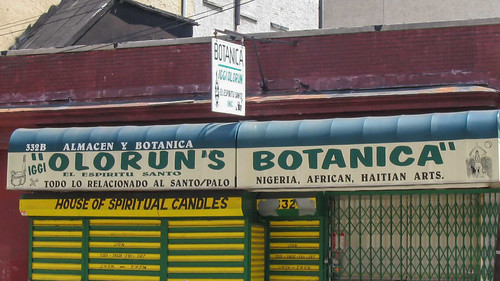
Sometime ago, 2004 in fact, I was walking around in downtown Jersey City and passed this little shop in a street off Newark Avenue. There were two windows. One had what appeared to be African artifacts, statues and masks as I recall. And the other had what appeared to be brightly colored plaster statues of Catholic Saints, reds and blues and greens, yellows, gold, dazzling. As you can see at the lower left, the store is only open four days a week in the afternoon and early evening, and not even that, I suspect, for I never managed to go by there with a camera when it was open. That photo’s all I’ve got.

“I know what this is,” said I to myself, “I know what this is”. It goes by various names depending on where it’s practiced: Santeria, Voudou, Palo, Abakuá, Candomblé, and Voodoo are some of the others. It’s a religion based on West African beliefs and practices and clothed in imagery taken from Roman Catholicism. Olorun’s Botanica is selling religious goods: incense, candles, herbs, medicinals, statuary, beads, charms, and so forth. And in Jersey City it makes sense, as the population is a quarter Hispanic, the Caribbean and Latin America.

Most of the signage is in Spanish, which I don’t understand, but “Nigeria, African, Haitian Arts” is clear enough. That plus what I saw in the window told me all I needed to know. And then we have, “House of Spiritual Candles”. I like that, the juxtaposition in the phrase, “house” with “spiritual candles,” “spiritual” with “candle”. It’s a house, were people live. But these people aren’t people, they are candles, spiritual candles, candles whose smoke and odor passes between the physical and spiritual realms, linking the two.

With that much, I don’t really need any Spanish to know more or less what’s going on. But still, I did a bit of Google Translate out of curiosity. “Botanica” I know, it’s (now) an English word. It’s a place that sells candles, incense, etc. “Olorun” surprised me, it came back as “god”, God’s Botanica. OK. “Almacen” = “Warehouse”, got it. I’d glossed “El Espiritu Santo” as something like “Spirits of the Saints”. But that’s not it. Google says, “The Holy Spirit”. OK.

What about “TODO LO RELACIONADO AL SANTO/PALO”? What’s that? I haven’t a clue. And notice that slash at the end. What’s that doing?

Here’s what Google said: “Everything Related to the Saint/Stick”. I follow everything but “stick”. What!? So I tried “Santo/Palo” and got “Holy/Stick”. Bingo! Now we’re talkin’. Incense! Still it seemed a bit strange. I tried “Palo” by itself and again got “stick”.

Why don’t I try a regular seach on “palo”. That got me what I was looking for. Well, I really didn’t know that THAT is what I was looking for because I didn’t know what the word mean, but the search coughed up something that satisfied my curiosity and made sense in context.

Bursera graveolens, known in Spanish as palo santo ("holy stick"), is a wild tree native to Mexico and the Yucatán Peninsula to Peru and Venezuela that inhabits the South American Gran Chaco region (northern Argentina, Paraguay, Bolivia and the Brazilian Mato Grosso). It is also found in Costa Rica, El Salvador, Guatemala, Honduras, Colombia, Ecuador, Peru[2] and on the Galápagos Islands. The tree belongs to the same family (Burseraceae) as frankincense and myrrh. It is widely used in folk medicine for stomach ache, as sudorific, and as liniment for rheumatism. Aged heartwood is rich in terpenes such as limonene and α-terpineol.
It’s a medicinal. So “Santo/Palo” is something like a holy medicine, sacred medicine, medicine that soothes body and soul.

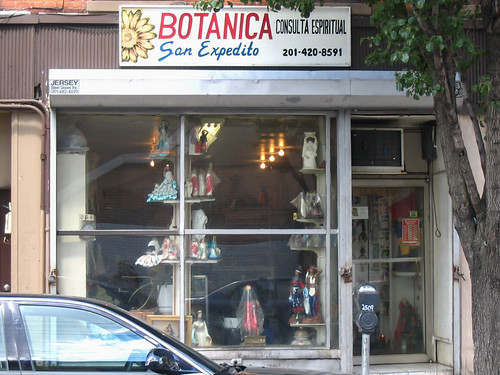
And Olorun’s Botanica is not the only botanica in town. A couple blocks away you can get readings and advice, “Consulta Espiritual” – assuming it’s still there. As I said, these photos are from 2004.

*IMG_0493

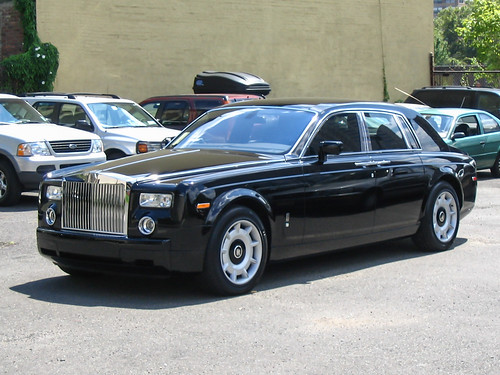
And then a couple of blocks from those shops, somewhere in between or above or below, I don’t know, but somewhere within the same general area of town, somewhere I spotted this:

*IMG_0484

There's no winged-lady hood ornament, but if you look closely at the hubcaps you'll see a telltale “R”. Like I said, diversity in Jersey City.

Moving right along:

*IMG_0419

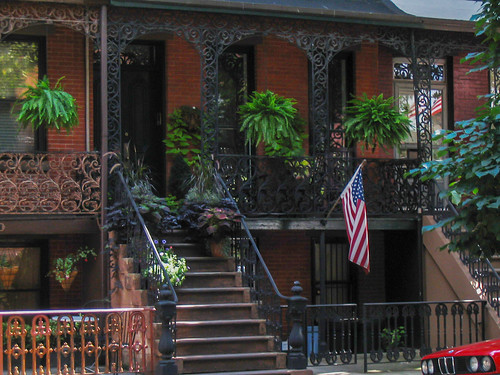
I know what you’re thinking, but no, that’s not the French Quarter in New Orleans. It’s in Hamilton Park, a few blocks from where I used to live.