Sunday, November 13, 2016

Being White in America Has Changed and Trump Has Changed It

Nell Irvin Painter in the NYTimes, "What Whiteness Means in the Trump Era". Whiteness is now (just) another racial category rather than being the default. By selling himself to whites Trump has made himself the public vehicle of that change. And, as Painter points out below, that is a demotion. That's not what Trump intended, but it's what he's done or, if you wall, what the social situation has done with/through him.
I don’t mean that Americans suddenly started counting people as “white.” This has been going on since the first federal census of 1790, which enumerated three categories of white people (“Free white Males of sixteen years and upwards, including heads of families,” “Free white Males under sixteen years” and “Free white Females”). That census also tabulated two other categories: “All other free persons” and “Slaves.” Period. Black was not marked. Since 1790, population statistics have faithfully recognized a category of “white” people, sometimes more than one, especially native- and nonnative born. So I don’t mean that Americans suddenly discovered the category of white in 2016.

I’m saying that what it means to see yourself as white has fundamentally changed, from unmarked default to racially marked [...] In our racially oriented American society, this change marks a demotion for white people. From assumed domination, they now take their place among the multiracial American millions. [...] In the Trump administration, white men will be in charge (virtually his entire transition team, and practically every name offered for a potential cabinet post, is a white man). You could say that’s nothing new, that white men have been in charge forever. This is true, but now with a gigantic difference. This time the white men in charge will not simply happen to be white; they will be governing as white, as taking America back, back to before multiculturalism.
Who gets to define whiteness?
How will white people who didn’t support Mr. Trump in 2016 construe their identity as white people when Trumpists, including white nationalists, Nazis, Klansmen and Mr. Bannon, have posted the markers?

Here’s a further question about white American identity in the wake of “Make America Great Again.” Mr. Trump did not win a majority of popular votes. Even if he had, the population he will have to govern far exceeds his supporters. Given this minority basis of support, what might a Trump administration portend?
His core and beyond:
As president, Mr. Trump’s going to have to move beyond his white and heavily male electorate and face up to conflicts of interest even within his core. A Trump supporter in Atlanta warned the president-elect: Break your promises at your peril.

I will not be surprised if the need to govern all of us alienates his base. And I will not be surprised if being president of a huge, multiracial, multiethnic democracy turns many of his supporters against him as a traitor to their values — perhaps, even, as a traitor to their race.
Now I understand Trump's nutjob birtherism about Obama. In a world of default whiteness the representative leader, of course, had to be white. Obama destroyed the default and Trump is the one who bore witness to that destruction.

Saturday, November 12, 2016

Lincoln Park Fountain, at Night, Jersey City

20161110-_IGP8240

Handing out blame for the 2016 presidential election

Alex Pareene is ranting. Here's a couple paragraphs:
Blame nearly every single person with any power in the Democratic Party, who were gifted a large and growing national majority and managed to piss it away into complete, across-the-board failure at every level of government. Blame them for doing nothing at all to support and fortify organized labor in any period in which they’ve held power since the 1970s. Blame a party that keeps foisting people like Rahm Emanuel, Terry McAulliffe, Patrick Murphy onto increasingly unhappy electorates. Blame a party that can’t recruit electable congressional candidates; that allowed the Texas Democratic Party to dissolve into complete irrelevance even as that state grows more diverse; that pulled out of the Florida Senate race so that Chuck Schumer could buy a couple of ads in the most expensive media market in the country; that lost the Rust Belt in a generation; that chased well-off, well-educated whites as working-class whites were radicalized by psychotic nationalists; that, despite lip service, has done barely anything to make it easier for black people to vote, or to re-enfranchise victims of our fundamentally racist criminal justice system; that allowed ACORN to be dismantled and then watched in horror as urban black votes failed to materialize in Michigan and Pennsylvania; that still can’t grapple with its own responsibility for a foreseeable backlash against the financialized, globalized economy, a backlash that has now been permanently tinged with revanchist racism because only one side provided a coherent narrative for how things went to shit, or was even willing to admit that things went to shit in the first place.

Blame the party, and blame the Clintons, and blame nearly everyone in the upper echelon of Hillary Clinton’s campaign, for clearing the field for her coronation, dismissing every indicator of her unshakable and widespread unpopularity; for pushing the most emblematic representative of the establishment imaginable in an anti-establishment era; for relying on out-of-touch advisers with no meaningful understanding of the lives of most people in her electoral coalition; for failing to sufficiently defend the black vote in states where it was actively and vehemently suppressed; for running a purely defensive campaign, best embodied by her choice of a slice of white bread with a clean record as her running mate; and for not understanding that she was uniquely vulnerable to an opposition campaign based on the clearly true premise that the system is rigged in favor of the powerful and connected.

The President-Elect: Homebody in Chief


I want to be alone.

Mr. Trump, who was shocked when he won the election, might spend most of the week in Washington, much like members of Congress, and return to Trump Tower or his golf course in Bedminster, N.J., or his Mar-a-Lago estate in Palm Beach on weekends. [...] Mr. Trump’s affection for his penthouse apartment runs deep, as his biographer, Michael D’Antonio, learned when Mr. Trump invited him inside the three-story unit in 2014 for an extended interview.

Mr. Trump reveled in recalling the challenges required to design and build the apartment, decorated in 24-karat gold and marble in the Louis XIV style, saying he simply wanted to see if such an ambitious undertaking could be accomplished. He described it less as a home than a tribute to his own self-image.

“I really wanted to see if it could be done,” Mr. Trump said at the time, as he showed Mr. D’Antonio around the apartment. “This is a very complex unit. Building this unit, if you look at the columns and the carvings, this building, this unit was harder than building the building itself.”
The roar of the crowds:
His aides say he has also expressed interest in continuing to hold the large rallies that were a staple of his candidacy. He likes the instant gratification and adulation that the cheering crowds provide, and his aides are discussing how they might accommodate his demand.

“I think Trump has discovered that these rallies are tremendous opportunities for him to get his message out,” said Christopher Ruddy, chief executive of Newsmax Media, a conservative website. “It’s actually sort of old-fashioned, that you want to actually meet people and press the flesh with him.”

Bird and Buildings

20160904-_IGP7335

Friday, November 11, 2016

Was the election decided by noise?

The day before the election Scott Alexander made a post suggesting that the election may well be (may well have been, in retrospect) won by noise. He opens by pointing out that "Hillary seems to lead Trump by 3%" in the popular vote. Then:
Lots of things can happen tomorrow. Maybe it rains in Philadelphia, that city’s racially diverse and left-leaning voters stay home, and Pennsylvania goes for Trump, winning him the election. Maybe there’s a really good get-out-the-vote campaign among Hispanics, and Florida ends up being Trump 48 Hillary 52 instead of the projected Trump 52 Hillary 48. Maybe the Department of Agriculture announces that Hillary is under investigation for bringing exotic weevil species into the US, and the population turns against her en masse.

And someone is going to confuse this kind of stuff with deep insight into the state of the country.
But all that's just noise, in a technical sense of the word. Since Alexander wrote that before the actual vote, he's dealing with polling results. And that kind of difference between the two is within polling error. We're in "butterfly over China" territory. Why? Because, as far as we can tell, actual sentiment – and "sentiment" IS the word, as that's how these things are decided – is pretty evenly divided.

And so:
Instead, I suggest people precommit to their views on politics and society now. We live in a country and a world where Hillary can be at about 47% and Trump at about 45%. This is pretty much all you need to know. It suggests that a lot of people are willing to support a nationalist candidate, and a lot of other people really hate that candidate. It suggests that political fundamentals are totally compatible with a situation where either Trump or Hillary could win based on noise in the electoral process.

(unless the polls are totally wrong and one candidate somehow wins in a 20 percentage point landslide or something)
There was no landslide. As far as we can tell at this point, the popular vote was very close.

Friday Fotos: A Bit of Ontology

20150723-_IGP5027

20141123-_IGP0297

IMGP6324

IMGP4059

IMGP0747rd

We think with gestures and things

In Dark Matter of the Mind Dan Everett devotes a chapter to gesture and its relation to speech. Writing in The Conversation, Gaëlle Vallée-Tourangeau and Frédéric Vallée-Tourangeau argue that gestures are important in thinking:
...that people’s thoughts, choices and insights can be transformed by physical interaction with things. In other words, thinking with your brain alone – like a computer does – is not equivalent to thinking with your brain, your eyes, and your hands – as humans frequently do.

The mind in the world

In the course of problem solving, we naturally tend to recruit artefacts and manipulate them to augment and transform our ability to think and to explain ourselves. Consider a game of Scrabble: players naturally touch, move and re-arrange the tiles they receive. If thinking were simply done “in the head”, what’s the purpose of these moves?

In fact, these moves are integral to the process of generating words. As players reconfigure the physical properties of their environment, they are not simply making it easier for them to think; they are thinking. Moves can be deliberate or serendipitous. This suggests that thinking is fundamentally relational: it unfolds along a series of physical changes in the environment that at times affects, and at times is affected by, a series of biological changes in the brain.
And so it goes with creativity and insight:
While posing a problem presented using a classic pencil and paper format never led to a breakthrough, those who could use physical artefacts to build a model of the problem were much more likely to reach some insight, no matter the difference between the partipants’ cognitive abilities.

We also applied this approach to the study of complex statistical reasoning. Previous research had found that, depending on the ease of mentally representing the statistical information presented, between 11% and 40% of people succeeded in solving these reasoning problems using just pen and paper.

We presented the same information on a pack of cards which reasoners were free to spread out and rearrange in any way they like. Not all participants fully engaged with the cards – perhaps unwilling to be judged as poor thinkers for doing so. Yet the success rate for those who made the most of this opportunity to use the material world to boost their thinking leapt to a 75% success rate.
I would add, anecdotally, that I find that pacing helps me to think. And, as I've argued, drawing diagrams as well.

Arnold Kling on Trump

I also think that those progressives who are predicting that the election will have dire consequences for women, gays, and people of color are making a tactical error. They are setting a very low bar for Mr. Trump and the Republicans. When four years from now we still have civil rights laws in place, mostly-legal abortion, and widely-legal gay marriage, these putative victim communities will be wondering what all the fuss was about.

Going forward, the Republicans desperately need to catch on with one or more of the demographic groups that currently is in the bag for the Democrats. Read David French’s piece again. My takeaway is that if the Republicans stand still, then all the Democrats have to do to win the Presidency is find a candidate who does not turn off the weakly-attached voters.
Nor is Trump an ideologue:
As for ideology, Mr. Trump is not a man of strong principles. He will not treat his victory as a conservative mandate, nor should he.

On health care policy, pundits are talking as if a Senate filibuster is inevitable if the Republicans try to repeal Obamacare. I would bet against this. For one thing, I don’t think Democratic pollsters are going to be advising their clients to fall on their swords to keep Obamacare. For another thing, I would not put it past Mr. Trump to work with Democrats on a new law. You may have forgotten that before Mr. Obama, whose idea of talking with the other side was to say “I won,” we had Presidents who were able to negotiate bipartisan bills. Do not be shocked if Mr. Trump does this. That would, however, result in health care policy that is at best a mixed bag for those of us with a preference for market-oriented solutions.
BTW, I'm NOT one of those with a preference for a "market-oriented solution."

And we're going to get infrastructure projects, in part because regulatory issues are going to be disappeared.

Trump's Dilemma

Over on Facebook my old buddy from The Valve, Adam Roberts, has been reflecting on Trump's victory. Note that Adam is British, so his observations come from the periphery of the maelstrom. Here's where he ends up (after expressing despair):
In order to get elected Trump had to promise some catastrophic things and some impossible things. He is a serial con-artist, and his usual modus operandi is to work his con, bank the money and move on. He has now, for reasons of ego and narcissism, put himself in a position where he has nowhere to hide. It's all scrutiny, day in day out, through all four of the next four years, by the whole world. And the key thing is: he has literally no idea how to do the job which his ego had pushed him into taking. He has no experience and no aptitude and no idea how hard the role is he's blagged for himself. It'll be a slow start, but as his term goes on he'll do nothing to help his core support, because there's nothing he can do -- he can't remake the USA as a manufacturing economy, he can't reopen coal mines. Instead he'll cut taxes, starve the federal budget, pour money into pointless projects like 'The Wall', start trade wars with the rest of the world. He will perpetrate gaff after gaff. He'll delegate almost everything and then discover, to his chagrin, that he, not his subordinates, gets the blame when things don't work out the way his magical thinking promised. When things do go wrong he will bluster and lie and so on, but things in the US will get worse and get most worse for the core Trump demographic. He's doomed. His chapter in US History as the worst ever US President is in the bag. One could almost feel sorry for the guy.
You can read Adam's whole post below, along with comments.

Thursday, November 10, 2016

The NOTHING Photograph

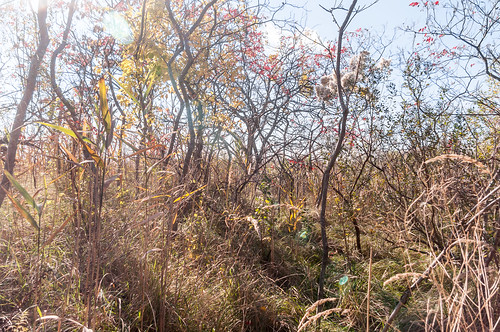
It’s not an aesthetic judgment. I like these ‘nothing’ photographs. It’s a [somewhat tongue-in-cheek] term of art, nothing. Here’s and example:

20161105-_IGP7892

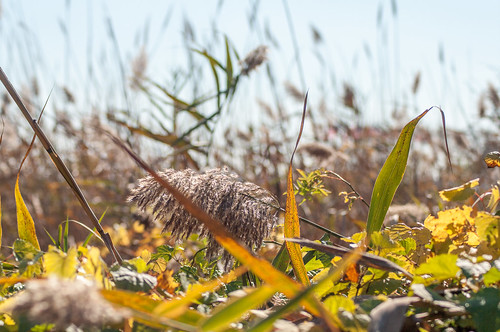
What’s the focal point, what’s the subject? That’s right, nothing. Obviously there’s something in the picture, weeds, bushes, trees, the sky. And light, of course, look at the translucent leaves of grass there at the left. Notice the shadows cast by invisible trees behind and to the right.

But there’s no main object or set of objects. Just a bunch of stuff from left to right, top to bottom. Textures. And space.

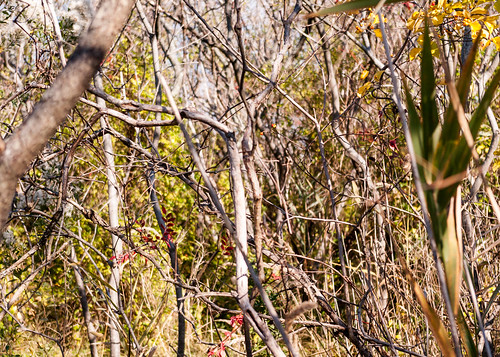
Here’s another example:

20161105-_IGP7886

We’ve got the same compositional features as the previous image, but a different scale, and the sky is all but gone. We’re now closer to things: notice the branch at the upper left, the leaves at the right. And, yes, there’s a branch in the center, but it’s hardly the subject. But I am careful about composition. Nothing must be well composed.

A somewhat different example:

20161105-_IGP7866

There’s a clear division between foreground (weeds, bushes, small trees) and background (blue sky with clouds). Composition two, the apex of a virtual triangle is at the top, just left of center, with a large out-of-focus tassel below the top edge and just right of center. I was probably kneeling down and shooting up.

This:

20161105-_IGP7847

You do the commentary.

[I just noticed, however, that the sun is directly behind the cloud in the middle. If you look closely you’ll see a small disk in the middle of that cloud, just above a tree branch and just above the center of the photo. If you look really closely you’ll see that it’s obscuring a twig. You might want to click over to Flickr so you can enlarge the image.]

Now for something different:

20161105-_IGP8029

We’re working at still a different scale. The field of view is maybe 18 inches wide at the focal plane. There’s a tassel in the center, fronted by crisscrossing leaves of grass – some in- some out-of-focus. And the background’s all blurred, giving us a distinct division between foreground and background. Notice the play of light, very important. Photography is light.

But no real subject.

A last one:

20161105-_IGP8022

Very different, almost solid red. Red articulated by leaves, and depth of focus? Notice the lone branch to the right.

NOTHING

Muslims for Trump – And then there's Bernie, w/ a note from Nate Silver [flip the switch]

Tyler Cowen, Marginal Revolution, I noticed something funny over red lentils:
Earlier this week I was sitting in one of my favorite local Bangladeshi restaurants, enjoying the red lentils. For whatever reason, when the talk switched to politics, the Bangladeshis on the adjacent table switched to English. Five of them were debating heatedly, and with considerable sophistication, whether Donald Trump or Hillary Clinton was the better candidate. From their dress, language, and accents, there was strong evidence they all were Muslim and recent arrivals to this country. I didn’t come away with the feeling that a majority of them would vote for Trump, but not one of them seemed completely sold on Hillary Clinton as the superior choice. At that moment I wondered what was going on.
From Omar Kamel, in Aeon, "I’m Arab and Many of Us Are Glad That Trump Won" –
There’s a bit of fatality involved here to be sure, and a deep level of cynicism. Many of us feel that if America could not choose the best option, then it deserved the worst. Also, there’s a harsh desire for rough truth, rather than hypocritical garnish. In a sense, most Americans are Trump, but many of them like to think of themselves as closer in character to who Clinton (falsely) claims to be; liberal, democratic, leftist, humane, charitable, kind. There are some who faced the facts honestly, and admitted that, for all intents and purposes, Clinton was a criminal and a manipulator, who plays ball with the worst human rights offenders on the planet (Saudi Arabia and Israel, for example) and relies on their financial and political support, that she, when promising to continue Obama’s legacy, is in fact, promising to kill another 4,000 innocent Pakistanis by drone strikes in an illegal attempt to murder untried ‘terrorists’. That this is a woman for whom Madeline Albright is a role model, and Kissinger is an icon, a woman who started out Republican before swapping sides and acting as though she were a Democrat, most likely because she realized that, as a woman, she could go farther as a Democrat. This is a liar who claims to have been dodging sniper fire in a foreign land when she was being greeted with flowers. [...] We do not think Trump is any better, but we think a Trump victory would force the USA to admit to what it has become, and would allow other countries around the world to react appropriately now that the cover has been blown.
BURLINGTON, Vt., Nov. 9 – U.S. Sen. Bernie Sanders (I-Vt.) issued the following statement Wednesday after Donald Trump was elected president of the United States:

“Donald Trump tapped into the anger of a declining middle class that is sick and tired of establishment economics, establishment politics and the establishment media. People are tired of working longer hours for lower wages, of seeing decent paying jobs go to China and other low-wage countries, of billionaires not paying any federal income taxes and of not being able to afford a college education for their kids - all while the very rich become much richer.

“To the degree that Mr. Trump is serious about pursuing policies that improve the lives of working families in this country, I and other progressives are prepared to work with him. To the degree that he pursues racist, sexist, xenophobic and anti-environment policies, we will vigorously oppose him.”
Nate Silver has an interesting article,What A Difference 2 Percentage Points Makes. He notes, after all, that the two parties spun very different narratives, but each claiming to have the voice of the people while their opponent was flat-out mistaken. And does in the context of arguing that interpreting the polls is a tricky business.
But to a first approximation, people are probably giving the polls a little bit too much blame. National polls will eventually miss the popular vote by about 2 percentage points, which is right in line with the historical average (and, actually, a bit better than national polls did in 2012). State polls had considerably more problems, underestimating Clinton’s complete collapse of support among white voters without college degrees but also underestimating her support in states that have large Hispanic populations, such as New Mexico.

Given how challenging it is to conduct polls nowadays, however, people shouldn’t have been expecting pinpoint accuracy. The question is how robust Clinton’s lead was to even a small polling error. Our finding, consistently, was that it was not very robust because of the challenges Clinton faced in the Electoral College, especially in the Midwest, and therefore our model gave a much better chance to Trump than other forecasts did.
He concludes with this observation:
But that’s not very important. What’s important is that Trump was elected president. Just remember that the same country that elected Donald J. Trump is the one that elected Barack Hussein Obama four years ago. In a winner-take-all system, 2 percentage points can make all the difference in the world.
Yes, the same population, but a very different configuration.

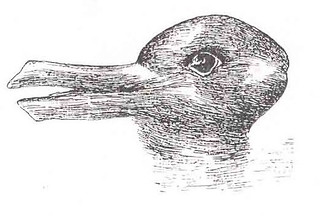
duck-rabbit

I'm one of those who thinks the SYSTEM needs shaking up. I liked Bernie for the win. Given the choice I had, however, I voted 'safely', shall we say. Still, I wonder if there isn't lemonade to be made of this garish orange-haired lemon. After all, the belief that the system needs shaking up generally implies that the believer gets to do the shaking up on their own terms. Perhaps that's an illusion, that there's no such thing as the 'ideal' shake-up. The people who did vote for Trump, after all, don't know what he's going to do. Trump himself doesn't know. Yes, the Supreme Court will go strongly conservative. Maybe he'll actually deep six the Department of Education. These are not good things. But he's said he wants to unite the country. Just what does that mean, concretely? He doesn't know, we don't know. Would Hillary have been a better uniter? We don't know.

Trump wants to be admired. OK. He's President. But when all the votes are tallied, he likely won't get the popular vote. That is, in popular terms, he's still a LOSER. Publically, of course, he'll stake the win. Privately, maybe the loser thing will bug him at 3AM. What'll he do to become a winner? Here's what Tyler Cowen thinks:
If there is any common theme to my predictions, it stems from Trump’s history in franchising his name and putting relatively little capital into many of his business deals. I think his natural instinct will be to look for some quick symbolic victories to satisfy supporters, and then pursue mass popularity with a lot of government benefits, debt and free-lunch thinking. I don’t think the Trump presidency will be recognizable as traditionally conservative or right-wing.
Potayto, potahto. 
Uniter, divider. 
Game on.

Premonitions of 2016


Wednesday, November 9, 2016

Evolution of Language – Will we crack it in 30 years?

When I was young, they was relatively little work on the evolution of human language. Back in the 19th century the Société Linguistique de Paris banned the topic and that ban seemed in effect. By the 1990s, however, things had changed. The evolution of language was now not only a respectable topic for research, but a popular one.

These days any number of people would like to be recognized as the one who discovered how language came about. But discovering the origin of language is rather different from, for example, discovering the tomb of an Egyptian pharaoh. Tombs are physical things with definite locations. To a first approximation, you either know it exists and where, or you don’t. If you start digging in a deserted area and find a tomb, then you discovered it. Simple enough.

But language, how does one discover its origins? The big problem, of course, is that we have no direct observations. If we had a time machine then we could gather such observations. We’d know when and where language originated, and perhaps even how.

Of would we? There is the problem of definition. These communication phenomena we’ve observed, language or not? But that’s likely a matter of mere semantics. It doesn’t really matter just which of them we’re going to certify as ‘real’ language. What needs to be explained, explained, is the entire evolutionary run from a point where there is no language to one where, yes, that’s definitely language. And, while having direct observations of that run would certainly help, it won’t tell us everything. It will tell us about the relationship between spoken language and associated behavior and that will be useful. But it won’t tell us what’s happening in the brain.

Still, I’m beginning to think that we may arrive at a consensus account within 20 or 30 years. I’ve given considerably thought to a related question, the origins of music, which I discussed in Beethoven’s Anvil a decade and a half ago. I extended those ideas at bit and had some remarks on language in Synch, Song, and Society, an essay-review of Steven Mithen’s The Singing Neanderthals. I have no intention of summarizing those arguments here, but I need to mention that I joined the ancient and venerable parade of those who believe that music, or something like it, not only preceded the emergence of language, but is a necessary precursor.

All of this is a prelude to Dan Everett’s new book, Dark Matter of the Mind: The Culturally Articulated Unconscious, which I’m currently reading. As the title indicates, it’s not about the origins of language, but the subject does come up, particularly in his discussion of work on the relationship between gesture and language. I find that discussion very encouraging. That, along with what I already know, is what has me thinking that we may arrive at a consensus account in 20 or 30 years.

If so, the account will stretch over many specific disciplines scattered across linguistics, psychology, anthropology, neuroscience, biology, and who knows what else. The trick is to pull all that together. That’s something our academic institutions are not suited for. If anything, they work against it.

We’ll see.

Post-Election Blues, First Riffs

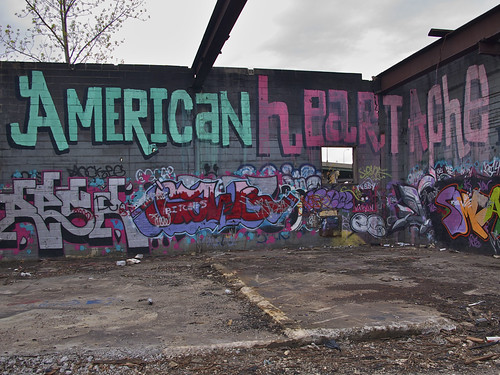
In the 19th century the Morris Canal moved coal from Pennsylvania’s Lehigh Valley to northern New Jersey and terminated in the Hudson River in Jersey City, just across from Lower Manhattan. It carried iron ore westward from the Hudson to Pennsylvania. Not so long ago there was a small industrial building near the mouth of the canal. It was abandoned and falling apart, but had attracted the work of a roving crew of graffiti writers in and around North Jersey and NYC. In May of 2014 I snapped this photo there:

IMGP6464

Consider it a metaphor for the current state of America, this November 9, 2018, the day after Donald Trump defeated Hillary Clinton for the Presidency. Those who won, those who lost, all of us, heartache – in some measure.

* * * * *

I've just received a call from Secretary Clinton. She congratulated us. It's about us. On our victory, and I congratulated her and her family on a very, very hard-fought campaign.

I mean, she fought very hard. Hillary has worked very long and very hard over a long period of time, and we owe her a major debt of gratitude for her service to our country.

I mean that very sincerely. Now it is time for America to bind the wounds of division, have to get together. To all Republicans and Democrats and independents across this nation, I say it is time for us to come together as one united people.

* * * * *


* * * * *

Trump narcissism, boasting, outrage, whining, lying, insulting, shouting, bullying charm is catnip for the media. But incredibly, they don’t understand the business they’re in. They think they’re dissecting his actions and informing us. But they, especially the obsessed CNN, are really providing a conduit for his hindbrain to talk to our hindbrains. During our waking moments, we try to ignore and suppress what our hind brain is singing to us, but it’s always there, whistling its seductive 500 million-year-old tune: “Feed me!” The media are feeding us a part of our brain we don’t get to taste otherwise.

That’s why everyone who tries to analyze or predict Trump’s path to the Presidency with their forebrain has been and will be wrong. Remember when everyone thought he was a joke? Remember when Trump trailed by 10% in all the polls to … everyone? This level of amnesia and denial would be astounding unless we understand it as a kind of brain defect, an aphasia, that is usually an evolutionary advantage but every once in a while blinds us to dangerous realities. We’re trying to peer into the jungle with eyes trained to see only urban architecture and orderly streets and mostly well-behaved humans. Worse, the jungle we’re trying to see is inside us, and we spend most of our time trying to deny that we’ve crawled out of it. Furthermore, the essence of reason and civilization is to declare that the jungle exists only in others, not in ourselves. Yeah, we got that lizard under control, man. It’s those Others you gotta watch out for. This is the flip side of the tune Trump is singing, and all you liberals out there should begin with a little introspection of your own hatreds before condemning the other half of the electorate.

* * * * *


* * * * *

Ross Douthat, NYTimes, The Trump Era Dawns:
I fear the risks of a Trump presidency as I have feared nothing in our politics before. But he will be the president, thanks to a crude genius that identified all the weak spots in our parties and our political system and that spoke to a host of voters for whom that system promised at best a sustainable stagnation under the tutelage of a distant and self-satisfied elite.
Paul Krugman, NYTimes, The Economic Fallout:
The disaster for America and the world has so many aspects that the economic ramifications are way down my list of things to fear.

Still, I guess people want an answer: If the question is when markets will recover, a first-pass answer is never.

Under any circumstances, putting an irresponsible, ignorant man who takes his advice from all the wrong people in charge of the nation with the world’s most important economy would be very bad news. What makes it especially bad right now, however, is the fundamentally fragile state much of the world is still in, eight years after the great financial crisis.
Thomas Friedman, NYTimes, Homeless in America:
As much as I knew that it was a possibility, the stark fact that a majority of Americans wanted radical, disruptive change so badly and simply did not care who the change agent was, what sort of role model he could be for our children, whether he really had any ability to execute on his plan — or even really had a plan to execute on — is profoundly disturbing.

Before I lay out all my fears, is there any silver lining to be found in this vote? I’ve been searching for hours, and the only one I can find is this: I don’t think Trump was truly committed to a single word or policy he offered during the campaign, except one phrase: “I want to win.”

* * * * *