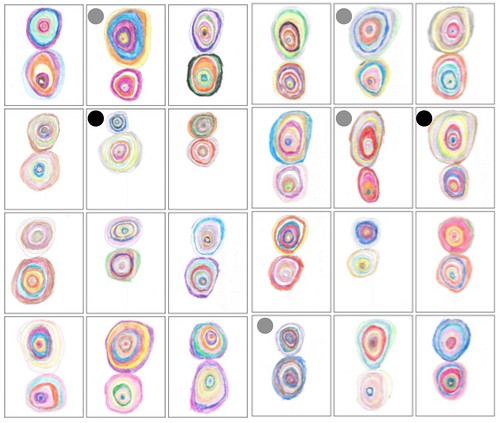
When I started investigating Jamie Bérubé’s art I had no particular expectations, just a reasonable belief that it would be worthwhile. Now that I’ve examined each of his genres it is time to review the investigation. I want to begin with a quick overview of his aesthetic evolution, and then take up some details.
Jamie’s Evolution (so far)
We can divide Jamie’s work into roughly three phases: 1) Preliminary, 2) Compositions, and 3) Biomorphs. By Preliminary I mean Jamie’s early work, which we examined in
On Discovering Jamie’s Principle. Jamie did this between 11 and 14 years old. In this phase the sheet of paper was simply where he made marks of various kinds. Jamie doesn’t have any conception of a sheet of paper as the locus of a particular ‘work’, if you will. Nor did he have any sense of overall composition; he simply placed objects wherever there was room, and, with the exception of some sheets of dots, different kinds of objects could exist on the same sheet.
In the second phase, which we examined in Investigations 1, 3, and 4, Jamie conceives of an individual sheet of paper as the locus for a coherent set of objects. First we examined his
dots images, then
towers of color, and finally (in a single post)
pairs of concentric bands and rows of letterforms paired with a set of concentric bancs. In both the dots and towers schemes Jamie approached the problem of composition with a scheme he could execute with his attention focused on the local area where he is drawing. In the concentric schemes local attention is not sufficient. Jamie has to attend to all four edges when making his initial marks, some of which will not be near one or more edges.
Note that I haven’t observed Jamie drawing. My observations follow from the inherent logic of the drawing situation and take into consideration variations in the images themselves.
For a dots sheet Jamie can start at a top corner and then either move down the sheet, following the adjacent edge or move across the sheet following the top edge. Each successive dot goes next to the previous one; dots are of the same size and same distance apart. When he has finished one row Jamie can begin the next one, right next to the one he has just completed. Jamie continues drawing row after row until either the sheet if filled or until he otherwise stops (perhaps because he is interrupted).
This is Jamie’s simplest kind of drawing. The tower procedure is more complex. I note that we saw examples of dots sheets in his Preliminary phase and towers sheets as well, though the towers were horizontal rather than vertical.
While visually similar, a large number of more or less equally spaced color patches, the towers of color are more complex. For each tower Jamie 1) uses a pen to draw a tall slender rectangle, then 2) he crosses the rectangle with a large number of lines from one side of the rectangle to the other. The cross lines almost always extend beyond the original rectangle. Finally, 3) Jamie uses crayons to fill each cell with color, not bothering to stay strictly within the lines. Starting at either the left of the right edge, Jamie moves across the sheet until it is filled (or he is interrupted).
The two kinds of concentrics sheets are similar in that, in order to draw a set of concentric bands centered on the midline Jamie must attend to the left and right edges. Not having observed him draw I don’t know whether he draws the innermost circle first or the outmost; the latter makes more sense, though, as it make it easier to position the two sets of bands with respect to one another (in one case) or one sect with respect to the letterforms above and the edges left, right, and below. This is a more complex composition problem than Jamie faces with either the dots or the towers. Here Jamie has to conceive of the entire composition before he makes his first marks in a way that isn’t necessary for the dots and the towers. In those cases he has a local procedure which, if followed, will produce a good result. Jamie’s attention has to be more global for the concentrics.
On the whole was Jamie drawing dots sheets and towers sheets before the two types of concentrics sheets? In a sense the answer is yes, because we see such sheets in his early work. We see letterforms and concentric bands in the early work, but they are on sheets with various other graphic objects. We don’t see those compositional forms covering early-phase sheets. If we examined the distribution of sheet-types over the course of months and years, what would we see? What I’m wondering, of course, is whether or not the concentrics began to proliferate only has Jamie had gained confidence from drawing dots and towers.
Michael notes, moreover, “He stopped making these towers a few years ago, but recently resumed them, much to our delight.” What’s up with that?
Finally, I have placed the biomorphs in a third phase (though I assume that he’s been doing other kinds of sheets even as he does these). For one thing, as I have noted before, Michael tells me these are his most recent type, “dating over the last couple of years.” Moreover, as I have argued in
my post about them, these are more sophisticated than Jamie’s earlier schemes.
Biomorphic Complexity
For one thing, the individual graphic elements are fairly complex. They are irregularly shaped; no two are alike (no, I’ve not checked, but this does seem to be the principle); and each of them has an interior line from one side to another. These objects are individualized in the way that letterforms are (notice that Jamie doesn’t repeat letterforms in the concentrics&letterform sheets). Each is its own little world.